


Looking to buy? See our books on amazon.com Get Reading Now! Age of Aces Presents - free pulp PDFs

“Wolves of the Sky” by Frederick Blakeslee

Link - Posted by David on October 30, 2014 @ 12:00 pm in

We’re back with another of Frederick Blakeslee’s “The Story Behind The Cover”—this week the spotlight’s on the July 1933 cover of Dare-Devil Aces. Blakeslee presents the story of an attack on a flight of German planes that was the result of a toothache! Without further ado, Blakeslee’s “The Yellow Hornet”…
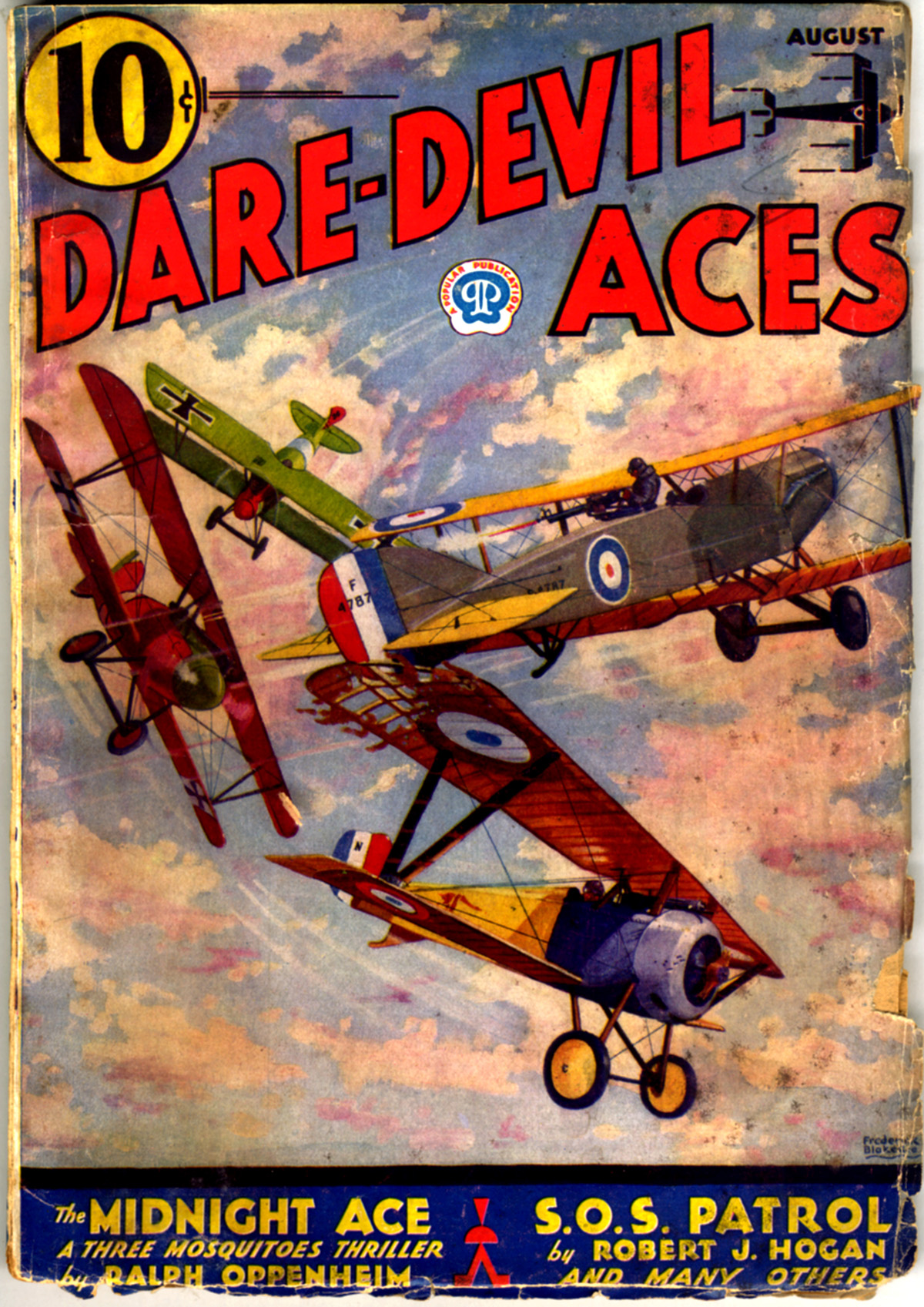
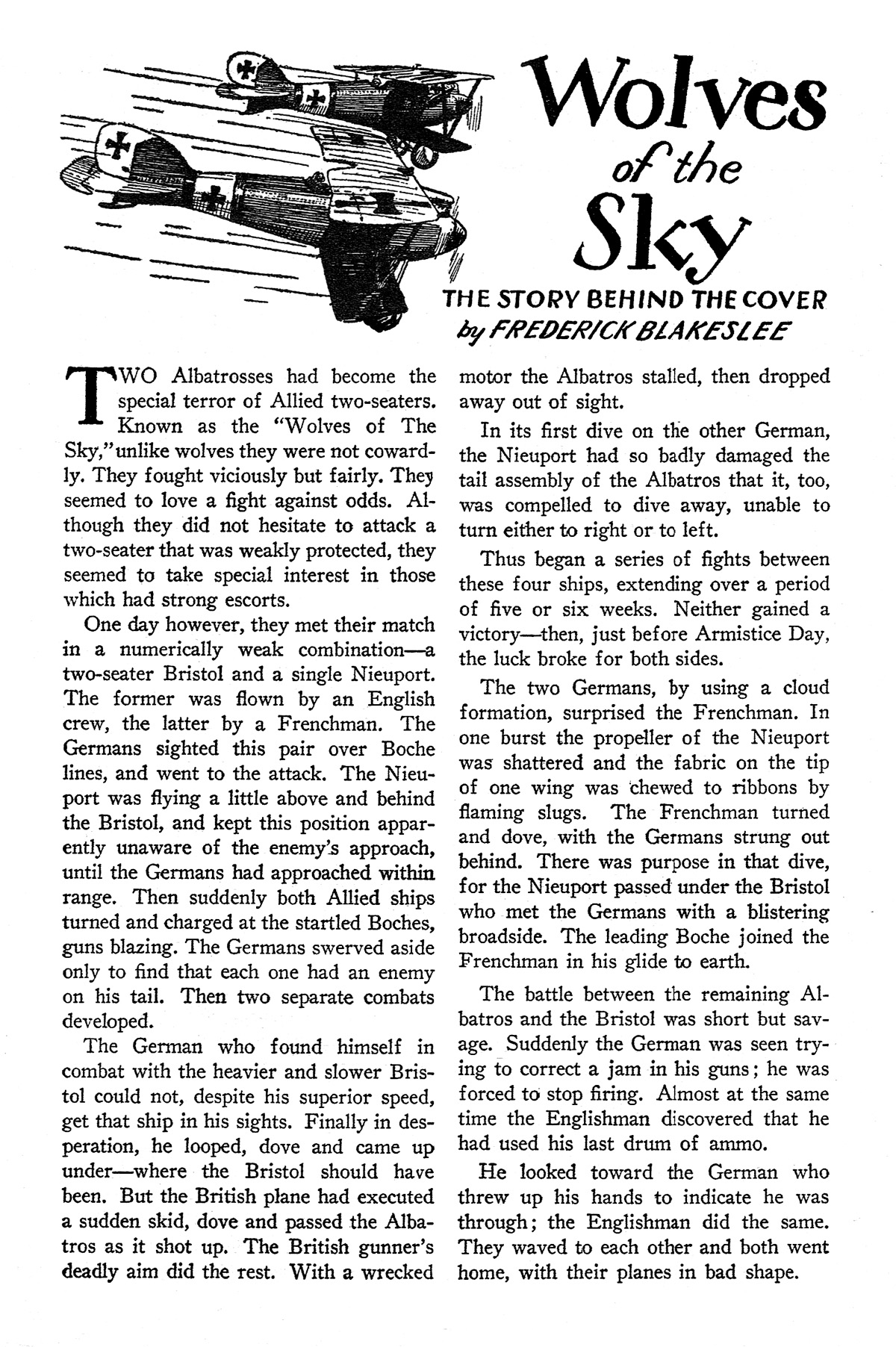
th_DDA_3308TWO ALBATROSSES had become the special terror of Allied two-seaters. Known as the “Wolves of The Sky,” unlike wolves they were not cowardly. They fought viciously but fairly. They seemed to love a fight against odds. Although they did not hesitate to attack a two-seater that was weakly protected, they seemed to take special interest in those which had strong escorts.

One day however, they met their match in a numerically weak combination—a two-seater Bristol and a single Nieuport. The former was flown by an English crew, the latter by a Frenchman. The Germans sighted this pair over Boche lines, and went to the attack. The Nieuport was flying a little above and behind the Bristol, and kept this position apparently unaware of the enemy’s approach, until the Germans had approached within range. Then suddenly both Allied ships turned and charged at the startled Boches, guns blazing. The Germans swerved aside only to find that each one had an enemy on his tail. Then two separate combats developed.

The German who found himself in combat with the heavier and slower Bristol could not, despite his superior speed, get that ship in his sights. Finally in desperation, he looped, dove and came up under—where the Bristol should have been. But the British plane had executed a sudden skid, dove and passed the Alba-tros as it shot up. The British gunner’s deadly aim did the rest. With a wrecked motor the Albatros stalled, then dropped away out of sight.

In its first dive on the other German, the Nieuport had so badly damaged the tail assembly of the Albatros that it, too, was compelled to dive away, unable to turn either to right or to left.

Thus began a series of fights between these four ships, extending over a period of five or six weeks. Neither gained a victory—then, just before Armistice Day. the luck broke for both sides.

The two Germans, by using a cloud formation, surprised the Frenchman. In one burst the propeller of the Nieuport was shattered and the fabric on the tip of one wing was chewed to ribbons by flaming slugs. The Frenchman turned and dove, with the Germans strung out behind. There was purpose in that dive, for the Nieuport passed under the Bristol who met the Germans with a blistering broadside. The leading Boche joined the Frenchman in his glide to earth.

The battle between the remaining Albatros and the Bristol was short but savage. Suddenly the German was seen trying to correct a jam in his guns; he was forced to stop firing. Almost at the same time the Englishman discovered that he had used his last drum of ammo.

He looked toward the German who threw up his hands to indicate he was through; the Englishman did the same. They waved to each other and both went home, with their planes in bad shape.
The Story Behind The Cover
“Wolves of the Sky: The Story Behind The Cover” by Frederick M. Blakeslee (August 1933)

Check back again. We will be presenting more of Blakeslee’s Stories behind his cover illustrations.
“The Yellow Hornet” by Frederick Blakeslee

Link - Posted by David on October 23, 2014 @ 12:00 pm in

We’re back with another of Frederick Blakeslee’s “The Story Behind The Cover”—this week the spotlight’s on the July 1933 cover of Dare-Devil Aces. Blakeslee presents the story of an attack on a flight of German planes that was the result of a toothache! Without further ado, Blakeslee’s “The Yellow Hornet”…

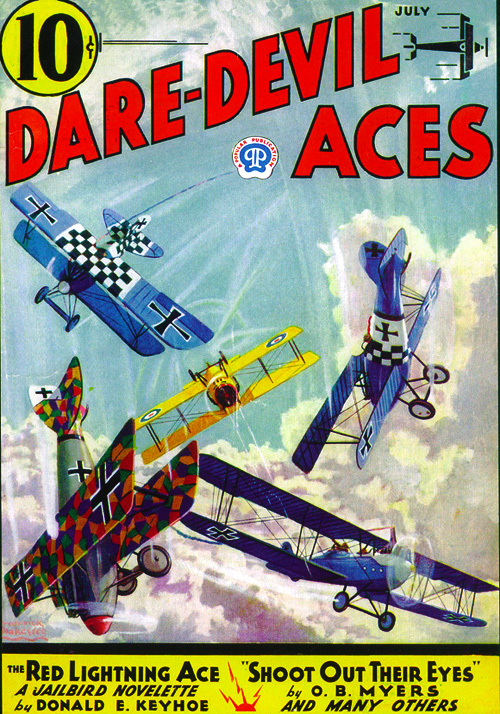
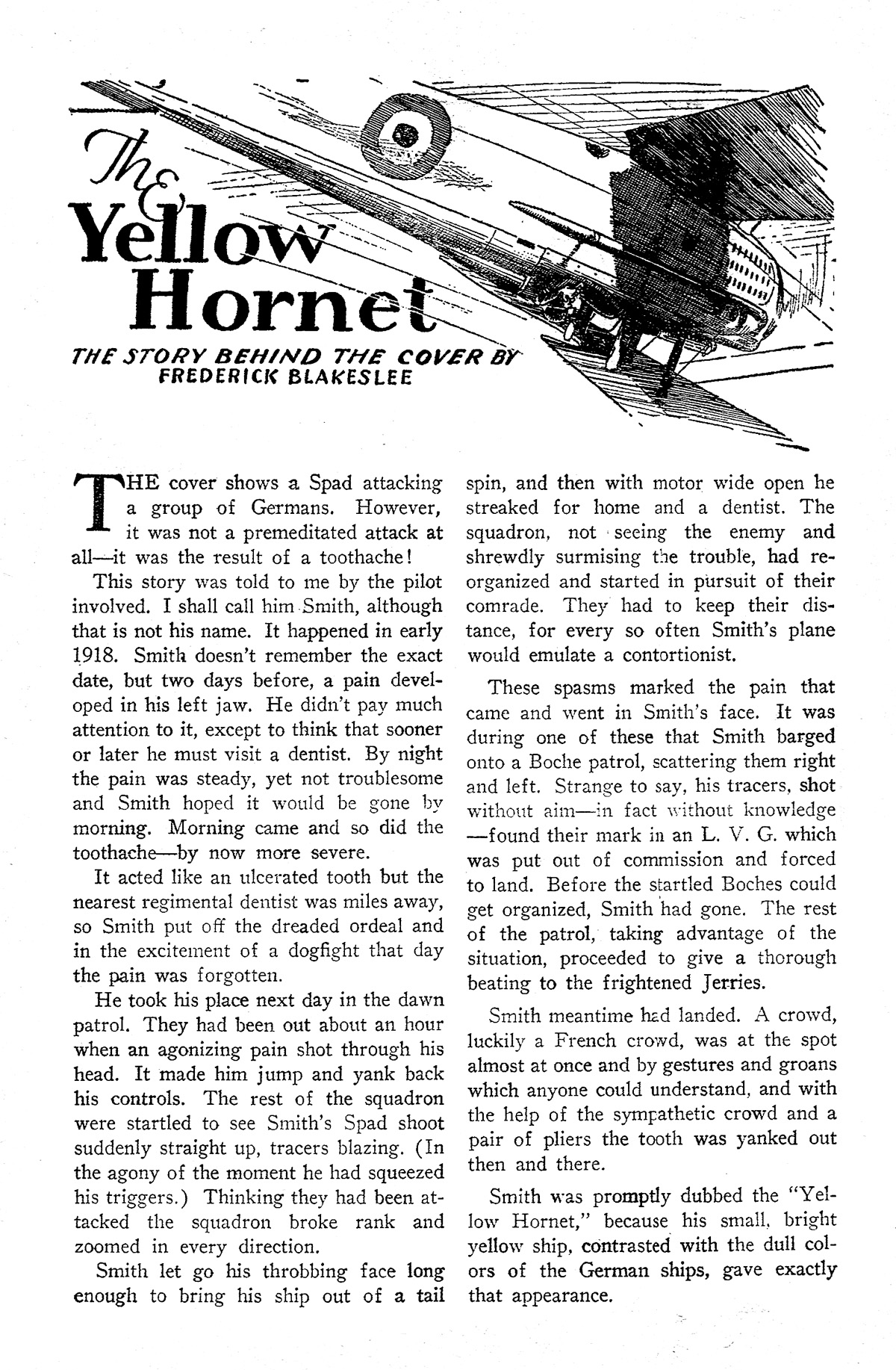
th_DDA_3307THE COVER shows a Spad attacking a group of Germans. However, it was not a premeditated attack at all—it was the result of a toothache!

This story was told to me by the pilot involved. I shall call him Smith, although that is not his name. It happened in early 1918. Smith doesn’t remember the exact date, but two days before, a pain developed in his left jaw. He didn’t pay much attention to it, except to think that sooner or later he must visit a dentist. By night the pain was steady, yet not troublesome and Smith hoped it would be gone by morning. Morning came and so did the toothache—by now more severe.

It acted like an ulcerated tooth but the nearest regimental dentist was miles away, so Smith put off the dreaded ordeal and in the excitement of a dogfight that day the pain was forgotten.

He took his place next day in the dawn patrol. They had been out about an hour when an agonizing pain shot through his head. It made him jump and yank back his controls. The rest of the squadron were startled to see Smith’s Spad shoot suddenly straight up, tracers blazing. (In the agony of the moment he had squeezed his triggers.) Thinking they had been attacked the squadron broke rank and zoomed in every direction.

Smith let go his throbbing face long enough to bring his ship out of a tail spin, and then with motor wide open he streaked for home and a dentist. The squadron, not seeing the enemy and shrewdly surmising the trouble, had reorganized and started in pursuit of their comrade. They had to keep their distance, for every so often Smith’s plane would emulate a contortionist.

These spasms marked the pain that came and went in Smith’s face. It was during one of these that Smith barged onto a Boche patrol, scattering them right and left. Strange to say, his tracers, shot without aim—in fact without knowledge —found their mark in an L.V.G. which was put out of commission and forced to land. Before the startled Boches could get organized, Smith had gone. The rest of the patrol, taking advantage of the situation, proceeded to give a thorough beating to the frightened Jerries.

Smith meantime had landed. A crowd, luckily a French crowd, was at the spot almost at once and by gestures and groans which anyone could understand, and with the help of the sympathetic crowd and a pair of pliers the tooth was yanked out then and there.

Smith was promptly dubbed the “Yellow Hornet,” because his small, bright yellow ship, contrasted with the dull colors of the German ships, gave exactly that appearance.

The Story Behind The Cover
“The Yellow Hornet: The Story Behind The Cover” by Frederick M. Blakeslee (July 1933)

Check back again. We will be presenting more of Blakeslee’s Stories behind his cover illustrations.
“The Vanished Ace” by Frederick Blakeslee

Link - Posted by David on October 16, 2014 @ 12:00 pm in

Frederick Blakeslee painted the covers for Dare-Devil Aces‘ entire fourteen year run. Every one of those covers told a story, and Blakeslee had a page with which to do so. We present Blakeslee’s cover for the June 1933 issue of Dare-Devil Aces—his tribute to the great French Ace, Georges Guynemer—”The Vanished Ace!”

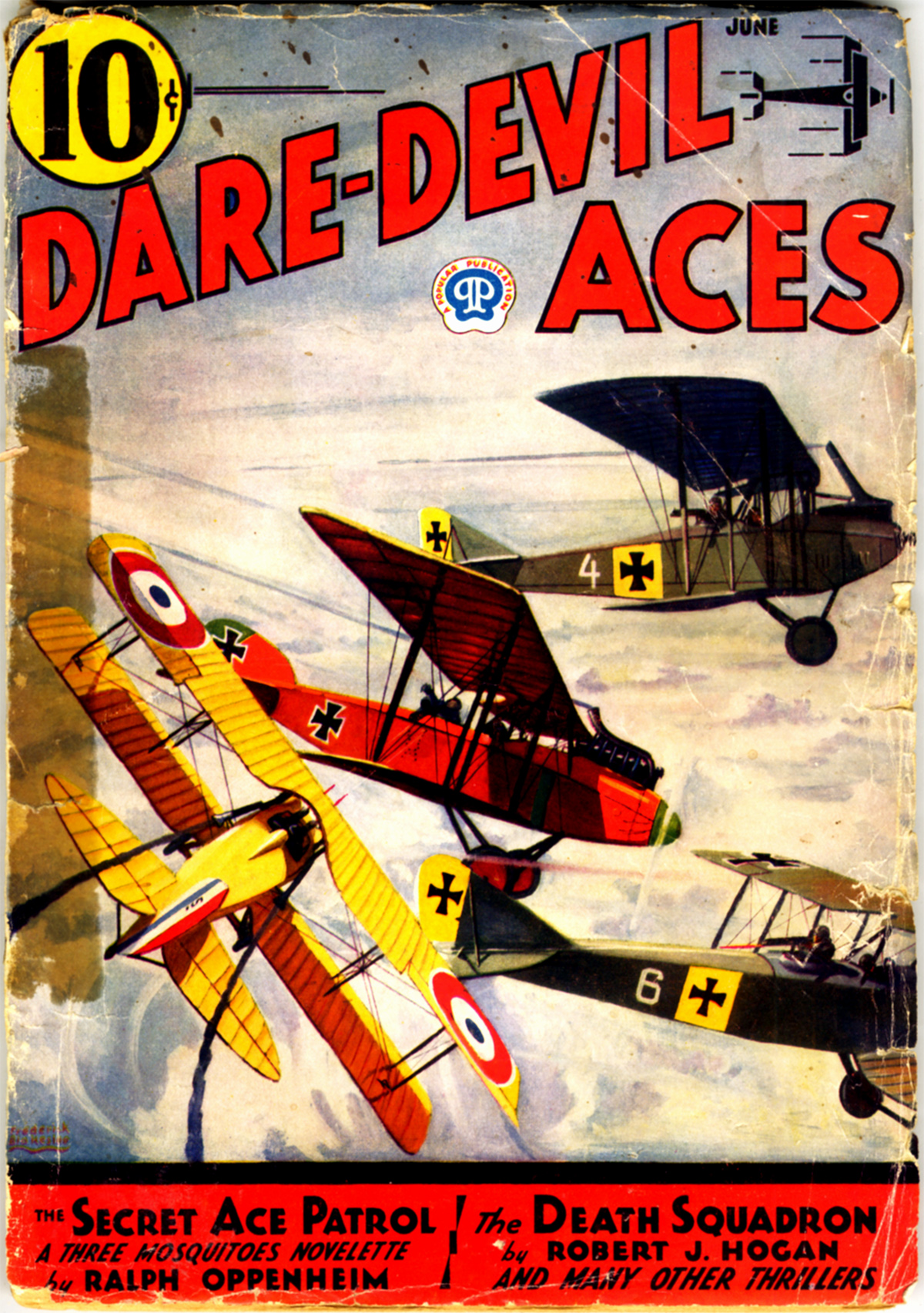
th_DDA_3306THE COVER this month is dedicated to the French hero, Georges Guynemer. It shows him gaining his fifty-first victory, when on August 17, 1917, he shot down a two-seater Albatros. He was to bag two more victories before the end. Then on Sept. 11, 1917, he flew away on patrol—and never came back. He disappeared completely, neither his body nor his ship ever being found. Guynemer’s disappearance is one of the unsolved mysteries of the War.

On that fatal day of September he left his drome with Second Lieutenant Verduraz. They sighted a two-seater over Poelcapelle and Guynemer went to the attack while Verduraz sought to draw off the impending attack of eight German scouts. In this Verduraz succeeded, and he flew back to the spot where the combat had taken place. Guynemer was not in sight. After waiting some time, he flew close to the ground, looking for wreckage. Seeing none and thinking that Guynemer had returned to the airdrome, he flew back, but Guynemer was not there and never was again.

The news was kept quiet in the hope that he had landed and was in hiding. There were grounds for this belief. Germany, always prompt to proclaim a victory, was silent. Ten days later, immediately after a notice of Guynemer’s death had been published in an English paper, Germany published a letter from a pilot named Wissemann, to the effect that he had shot down Guynemer on Sept. 10. This date only added to the mystery for it was a proven fact that Guynemer was alive on Sept. 10. France then demanded details and Germany replied that Guynemer was shot down on the 10th of September and buried in Poelcapelle cemetery with military honors. Another report with a different version had it that two soldiers were present and saw Guynemer’s body with a broken leg and a bullet through the head.

On October 4th, the British took Poelcapelle, but found not a trace of Guynemer’s grave or his ship. France, impatient at so many conflicting reports, again demanded the true facts. This time Germany replied that Guynemer had been killed on the 11th. (This date had already been widely published.) Germany said that due to heavy shelling of the spot the body and machine could not be reached and the shelling had eventually obliterated the wreckage. This version was finally accepted.

If it were true that Wissemann shot Guynemer down, he did not long survive his victory. He had written to his parents thus, “Have no more fears about me, I have brought down Guynemer and I can never again meet so dangerous an adversary.” Yet on Sept. 30th he fell before the guns of Lieutenant Rene Fonck.

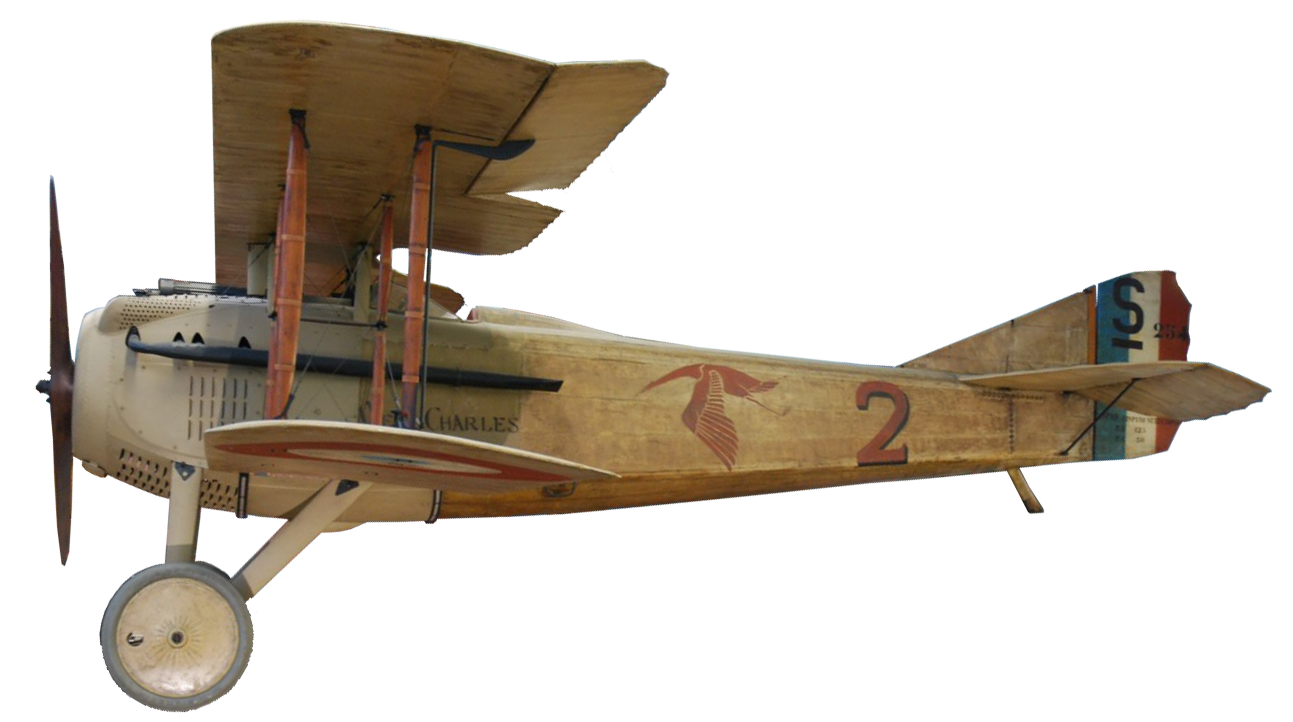
The day Guynemer flew away on his last flight his favorite ship was being repaired, and so it has been preserved. He called his little Spad “Vieux Charles” (old Charlie) and today it is on the balcony within the court of the Hotel des Invalides in Paris. His name is engraved on the roll of honor in the Pantheon, where are the names of the greatest heroes of France.

The Story Behind The Cover
“The Vanished Ace: The Story Behind The Cover” by Frederick M. Blakeslee (June 1933)

According to his english wikipedia page, the red cross provided the following confirmation of his death:

Information received by the Red Cross says Guynemer was shot through the head north of Poelcapelle, on the Ypres front. His body was identified by a photograph on his pilot’s license found in his pocket. The burial took place at Brussels in the presence of a guard of honor, composed of the 5th Prussian Division. Such is the story told by a Belgian, who has just escaped from the Germans. The burial was about to take place at Poelcapelle, when the bombardment preceding the British attack at Ypres started. The burying party hastily withdrew, taking the body with them. The German General chanced to be an aviation enthusiast with a great admiration for Captain Guynemer’s achievements. At his direction the body was taken to Brussels in a special funeral car. Thither the captain was carried by non-commissioned officers and was covered with floral tributes from German aviators. The Prussian Guards stood at salute upon its arrival and during the burial, which was given all possible military honors. The French Government has been invited to place in the Pantheon, where many great Frenchmen are buried, an inscription to perpetuate the memory of Captain Guynemer as ′a symbol of the aspirations and enthusiasm of the Army.′ A resolution to this effect has been introduced in the Chamber of Deputies by Deputy Lasies.

Check back again. We will be presenting more of Blakeslee’s Stories behind his cover illustrations.
“Duel of the Bombers” by Frederick Blakeslee

Link - Posted by David on October 9, 2014 @ 12:00 pm in

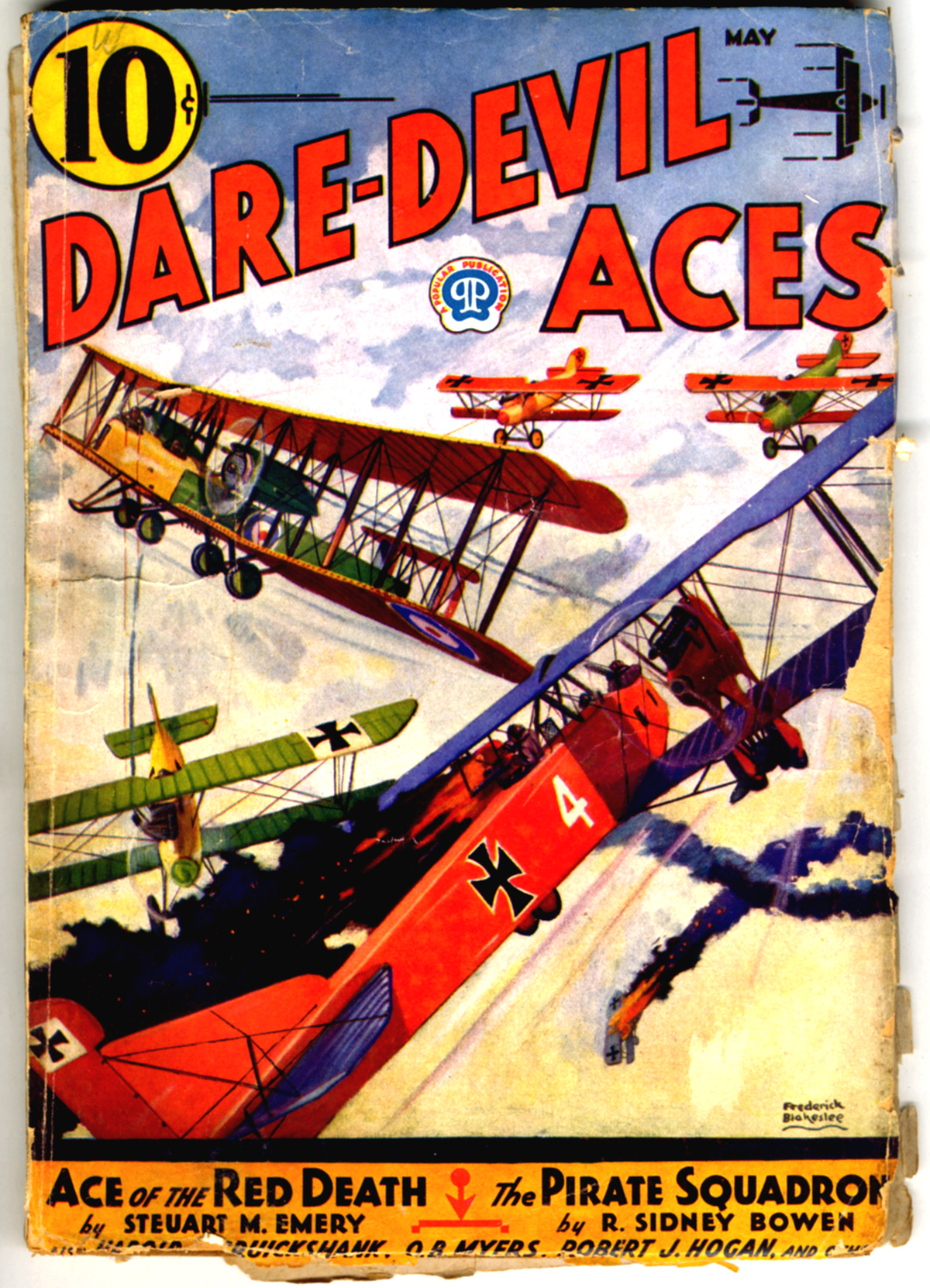
Frederick Blakeslee painted the covers for Dare-Devil Aces‘ entire fourteen year run. Every one of those covers told a story, and Blakeslee had a page with which to do so. This week’s Dare-Devil Aces cover picks up the story where last month’s “The Flaming Coffin” left off. Here is Blakeslee’s cover for the May 1933 issue—”Duel of the Bombers!”

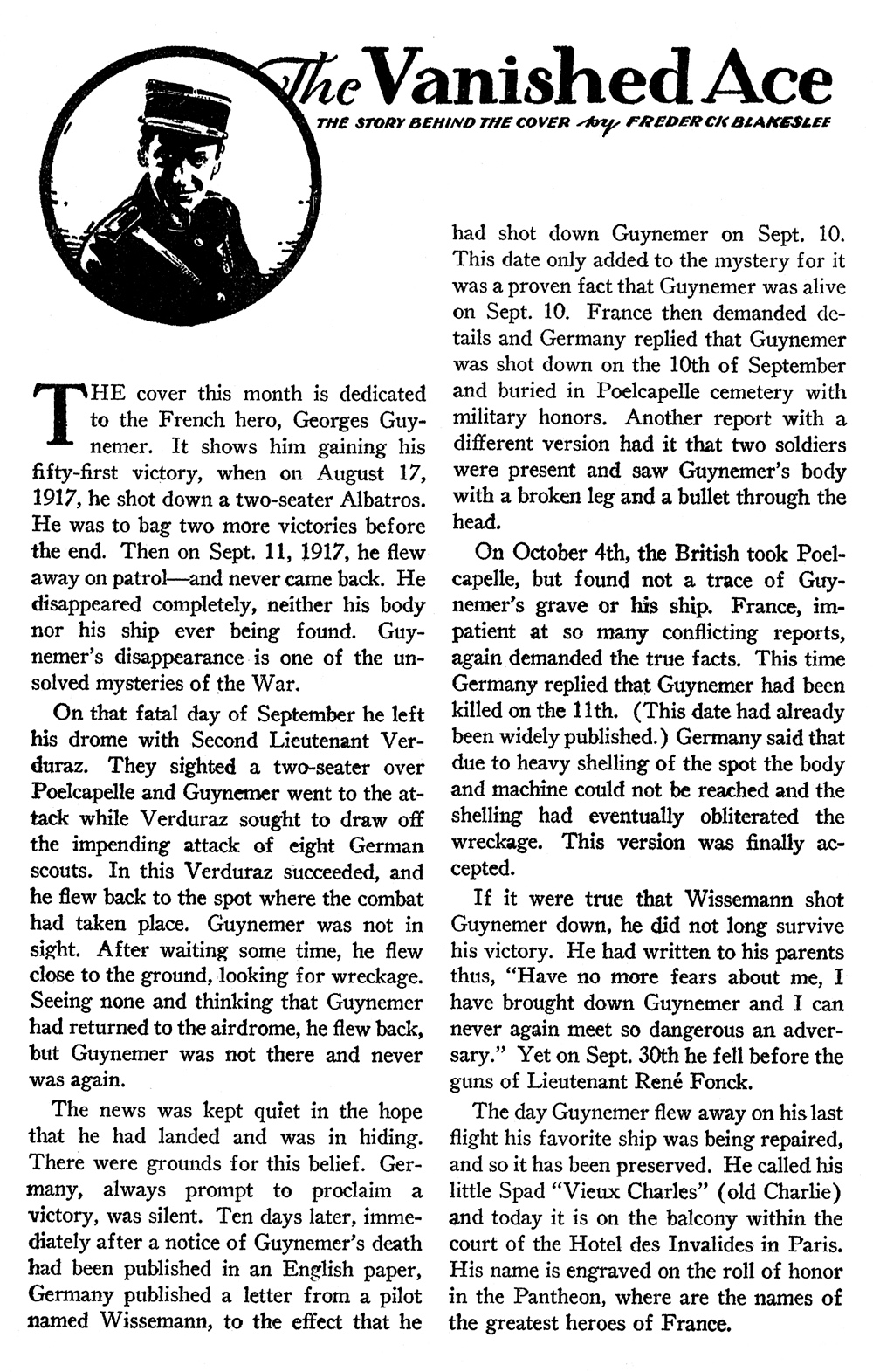
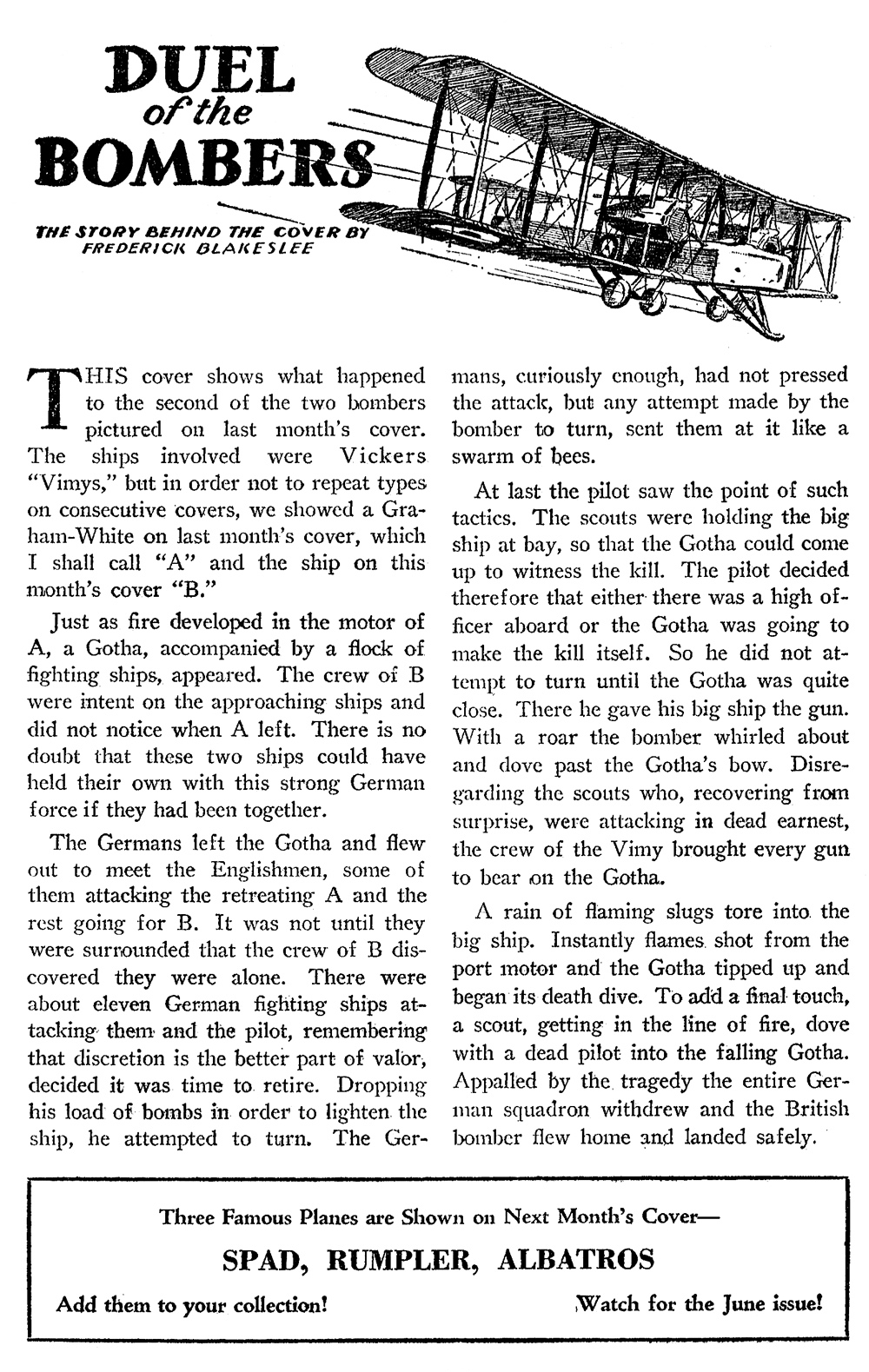
th_DDA_3305THIS COVER shows what happened to the second of the two bombers pictured on last month’s cover. The ships involved were Vickers “Vimys,” but in order not to repeat types on consecutive covers, we showed a Graham-White on last month’s cover, which I shall call “A” and the ship on this month’s cover “B.”

Just as fire developed in the motor of A, a Gotha, accompanied by a flock of fighting ships, appeared. The crew of B were intent on the approaching ships and did not notice when A left. There is no doubt that these two ships could have held their own with this strong German force if they had been together.

The Germans left the Gotha and flew out to meet the Englishmen, some of them attacking the retreating A and the rest going for B. It was not until they were surrounded that the crew of B discovered they were alone. There were about eleven German fighting ships attacking them and the pilot, remembering that discretion is the better part of valor, decided it was time to retire. Dropping his load of bombs in order to lighten the ship, he attempted to turn. The Germans, curiously enough, had not pressed the attack, but any attempt made by the bomber to turn, sent them at it like a swarm of bees.

At last the pilot saw the point of such tactics. The scouts were holding the big ship at bay, so that the Gotha could come up to witness the kill. The pilot decided therefore that either there was a high officer aboard or the Gotha was going to make the kill itself. So he did not attempt to turn until the Gotha was quite close. There he gave his big ship the gun. With a roar the bomber whirled about and dove past the Gotha’s bow. Disregarding the scouts who, recovering from surprise, were attacking in dead earnest, the crew of the Vimy brought every gun to bear on the Gotha.

A rain of flaming slugs tore into the big ship. Instantly flames shot from the port motor and the Gotha tipped up and began its death dive. To add a final touch, a scout, getting in the line of fire, dove with a dead pilot into the falling Gotha. Appalled by the tragedy the entire German squadron withdrew and the British bomber flew home and landed safely.

The Story Behind The Cover
“Duel of the Bombers: The Story Behind The Cover” by Frederick M. Blakeslee (May 1933)

Check back again. We will be presenting more of Blakeslee’s Stories behind his cover illustrations.
“The Flaming Coffin” by Frederick Blakeslee

Link - Posted by David on October 2, 2014 @ 12:00 pm in

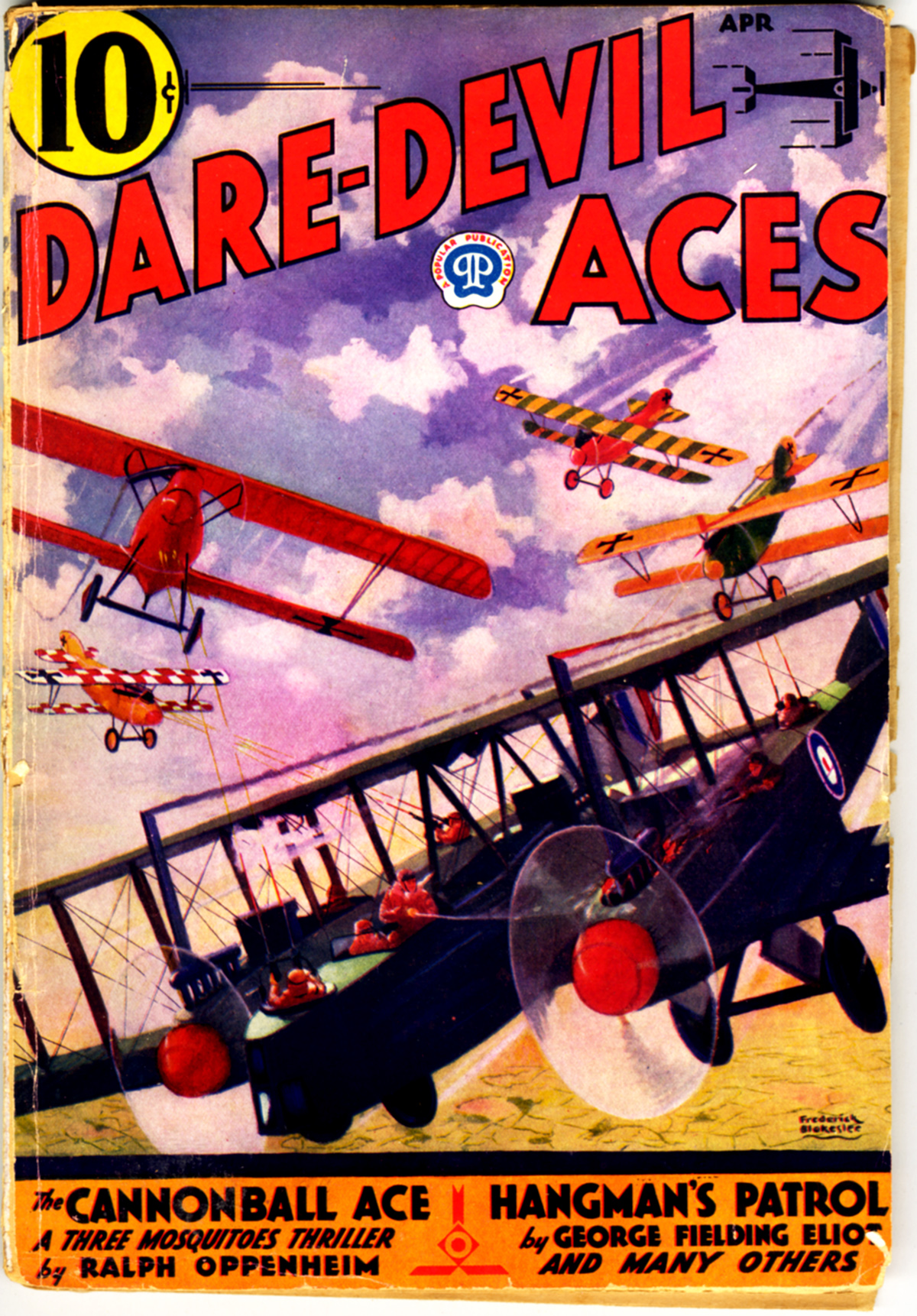
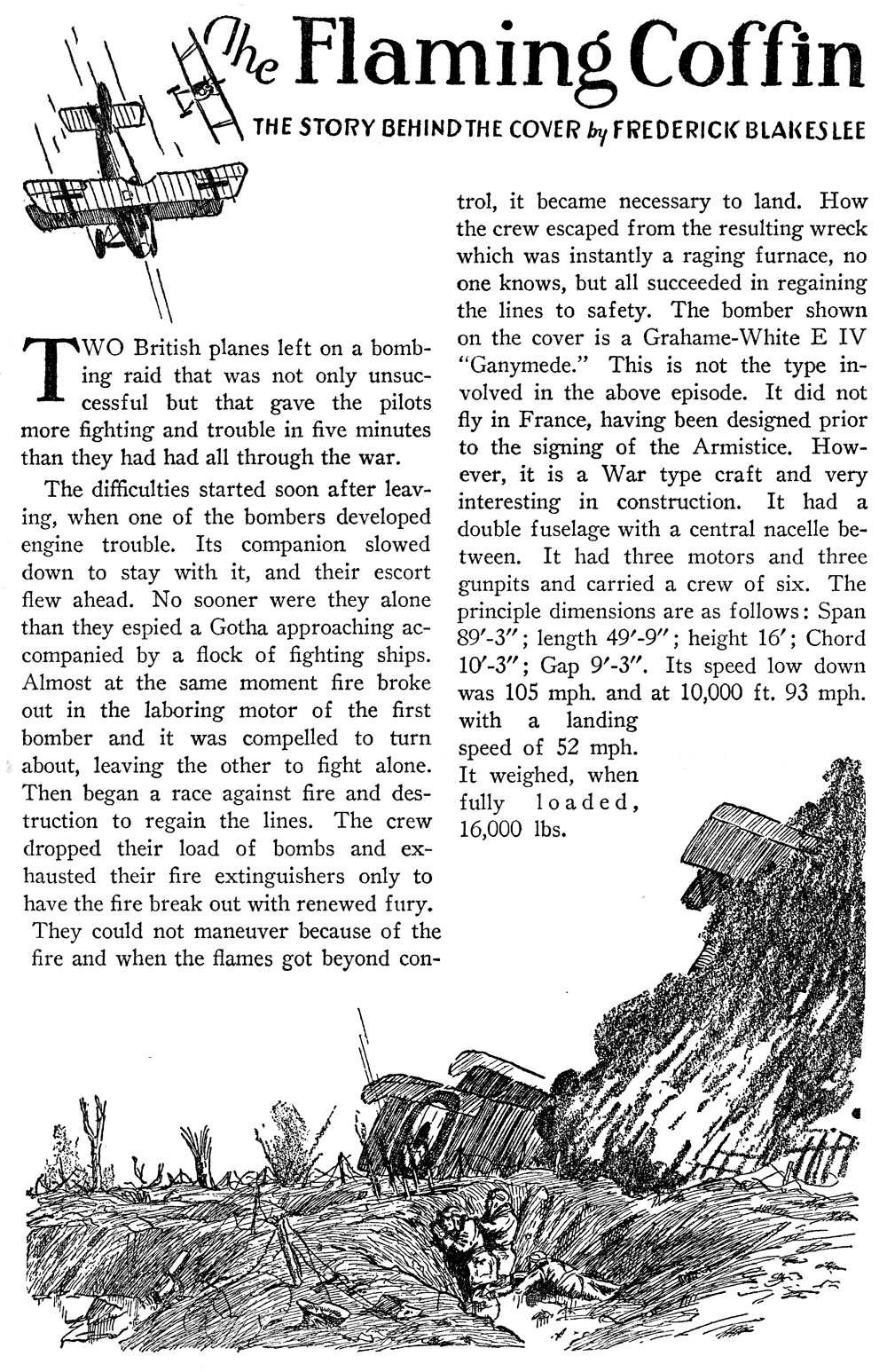
Frederick Blakeslee painted the covers for Dare-Devil Aces‘ entire fourteen year run. Every one of those covers told a story, and Blakeslee had a page with which to do so. Although this time we get a story that’s not quite the story of the cover, but still a good story. This week it’s Blakeslee’s cover for the April 1933 issue of Dare-Devil Aces—”The Flaming Coffin!”

th_DDA_3304TWO British planes left on a bombing raid that was not only unsuccessful but that gave the pilots more fighting and trouble in five minutes than they had had all through the war.

The difficulties started soon after leaving, when one of the bombers developed engine trouble. Its companion slowed down to stay with it, and their escort flew ahead. No sooner were they alone than they espied a Gotha approaching accompanied by a flock of fighting ships. Almost at the same moment fire broke out in the laboring motor of the first bomber and it was compelled to turn about, leaving the other to fight alone. Then began a race against fire and destruction to regain the lines. The crew dropped their load of bombs and exhausted their fire extinguishers only to have the fire break out with renewed fury.

They could not maneuver because of the fire and when the flames got beyond control, it became necessary to land. How the crew escaped from the resulting wreck which was instantly a raging furnace, no one knows, but all succeeded in regaining the lines to safety. The bomber shown on the cover is a Grahame-White E IV “Ganymede.” This is not the type involved in the above episode. It did not fly in France, having been designed prior to the signing of the Armistice. However, it is a War type craft and very interesting in construction. It had a double fuselage with a central nacelle between. It had three motors and three gunpits and carried a crew of six. The principle dimensions are as follows: Span 89′-3″; length 49′-9″; height 16′; Chord 10′-3″; Gap 9′-3″. Its speed low down was 105 mph. and at 10,000 ft. 93 mph. with a landing speed of 52 mph. It weighed, when fully loaded, 16,000 lbs.

The Story Behind The Cover
“The Flaming Coffin: The Story Behind The Cover” by Frederick M. Blakeslee (April 1933)

Check back again next Thursday for the continuation of this story on May’s cover!

“Death Wings!” by Frederick Blakeslee

Link - Posted by David on September 25, 2014 @ 12:00 pm in

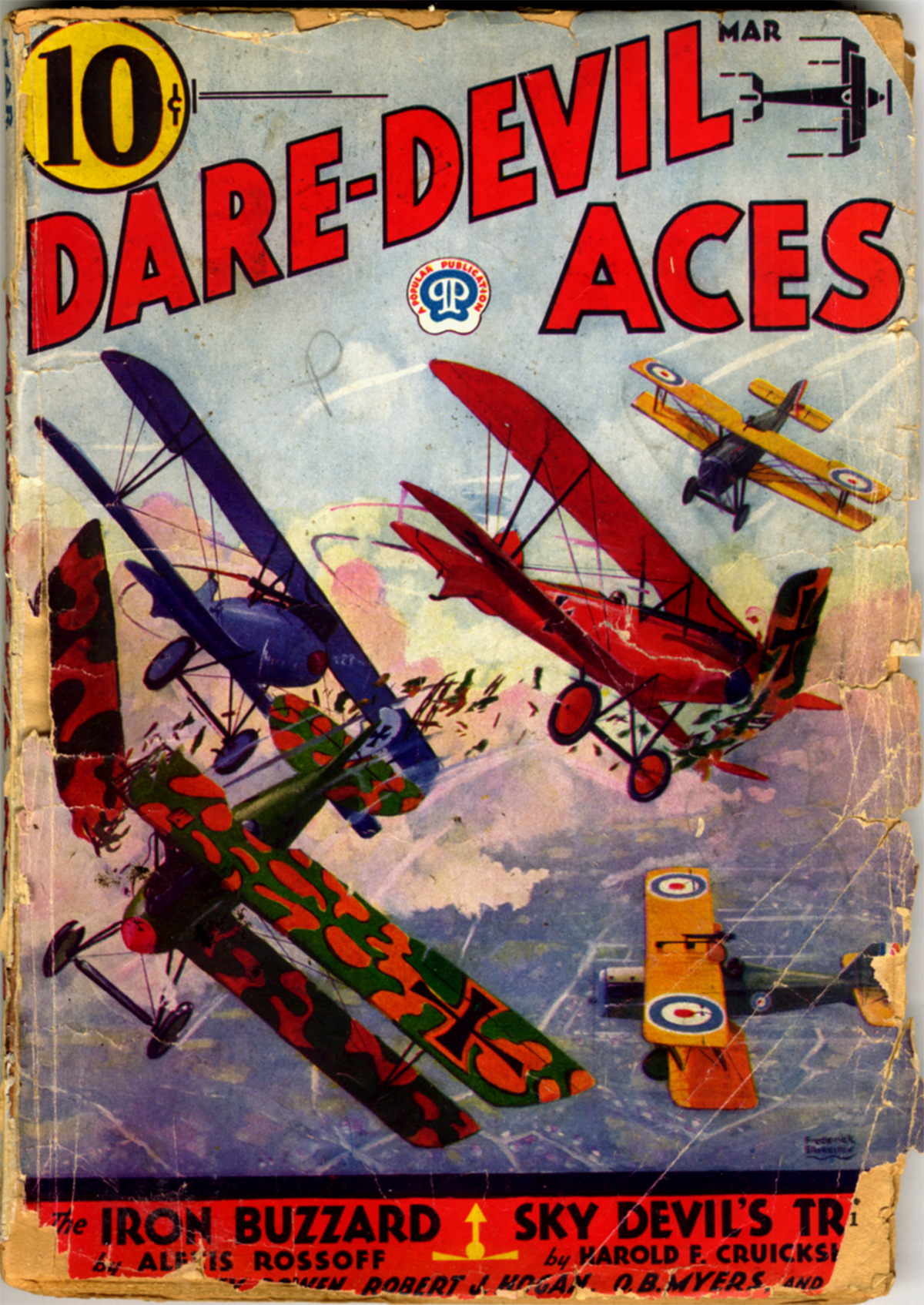
Frederick Blakeslee painted the covers for Dare-Devil Aces‘ entire fourteen year run. Every one of those covers told a story, and Blakeslee had a page with which to do so. We present Blakeslee’s cover for the March 1933 issue of Dare-Devil Aces—”Death Wings!”

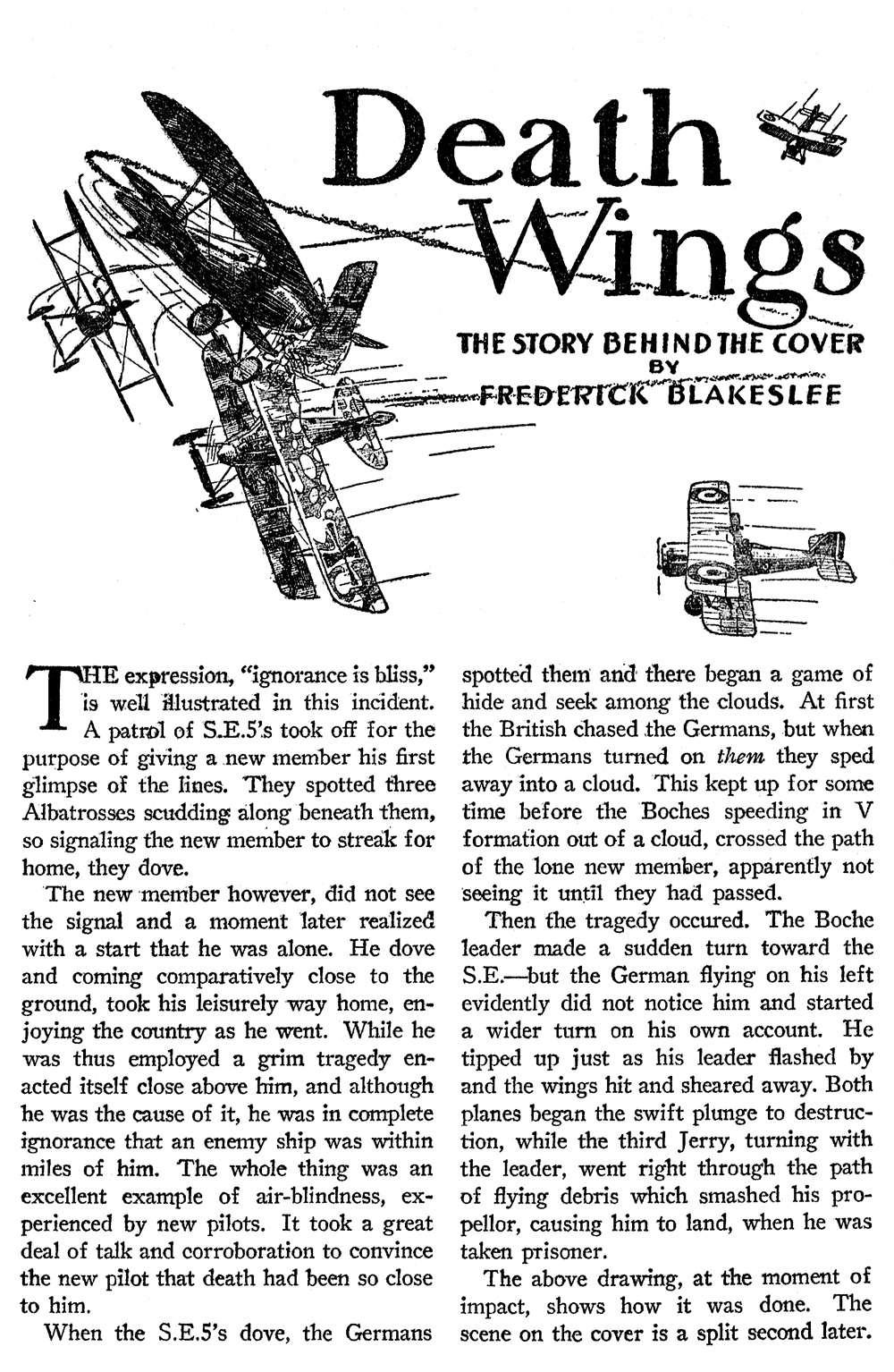
th_DDA_3303THE EXPRESSION, “ignorance is bliss,” is well illustrated in this incident. A patrol of S.E.5’s took off for the purpose of giving a new member his first glimpse of the lines. They spotted three Albatrosses scudding along beneath them, so signaling the new member to streak for home, they dove.

The new member however, did not see the signal and a moment later realized with a start that he was alone. He dove and coming comparatively close to the ground, took his leisurely way home, enjoying the country as he went. While he was thus employed a grim tragedy enacted itself close above him, and although he was the cause of it, he was in complete ignorance that an enemy ship was within miles of him. The whole thing was an excellent example of air-blindness, experienced by new pilots. It took a great deal of talk and corroboration to convince the new pilot that death had been so close to him.

When the S.E.5’s dove, the Germans spotted them and there began a game of hide and seek among the clouds. At first the British chased the Germans, but when the Germans turned on them they sped away into a cloud. This kept up for some time before the Bodies speeding in V formation out of a cloud, crossed the path of the lone new member, apparently not seeing it until they had passed.

Then the tragedy occured. The Boche leader made a sudden turn toward the S.E.—but the German flying on his left evidently did not notice him and started a wider turn on his own account. He tipped up just as his leader flashed by and the wings hit and sheared away. Both planes began the swift plunge to destruction, while the third Jerry, turning with the leader, went right through the path of flying debris which smashed his propellor, causing him to land, when he was taken prisoner.

The above drawing, at the moment of impact, shows how it was done. The scene on the cover is a split second later.

The Story Behind The Cover
“Death Wings: The Story Behind The Cover” by Frederick M. Blakeslee (March 1933)

Check back again. We will be presenting more of Blakeslee’s Stories behind his cover illustrations.
Decoy Smashers

Link - Posted by David on September 18, 2014 @ 12:00 pm in

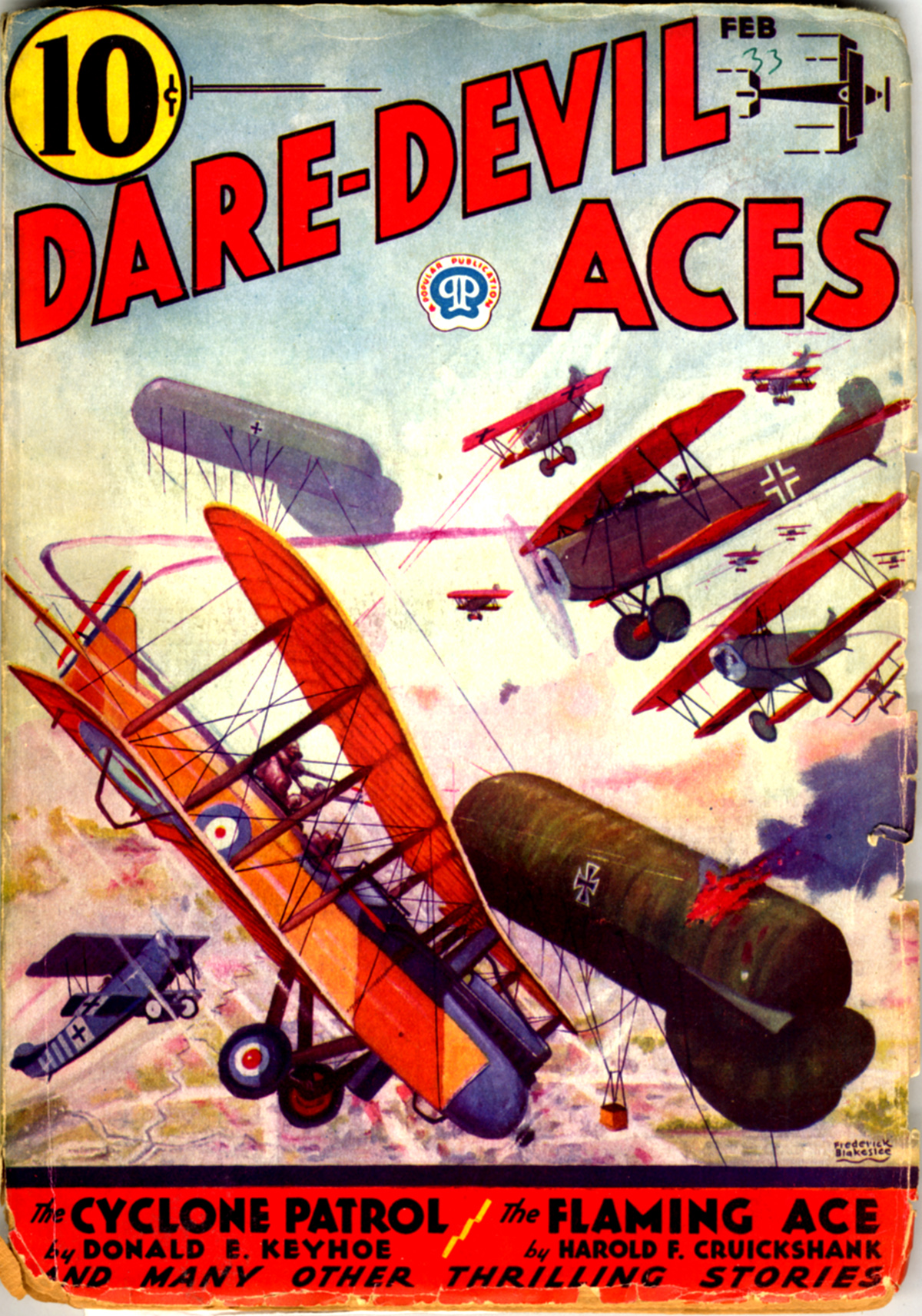
Frederick Blakeslee painted the covers for Dare-Devil Aces‘ entire fourteen year run. Every one of those covers told a story, and Blakeslee had a page with which to do so. We present Blakeslee’s cover for the February 1933 issue of Dare-Devil Aces—”Decoy Smashers”…

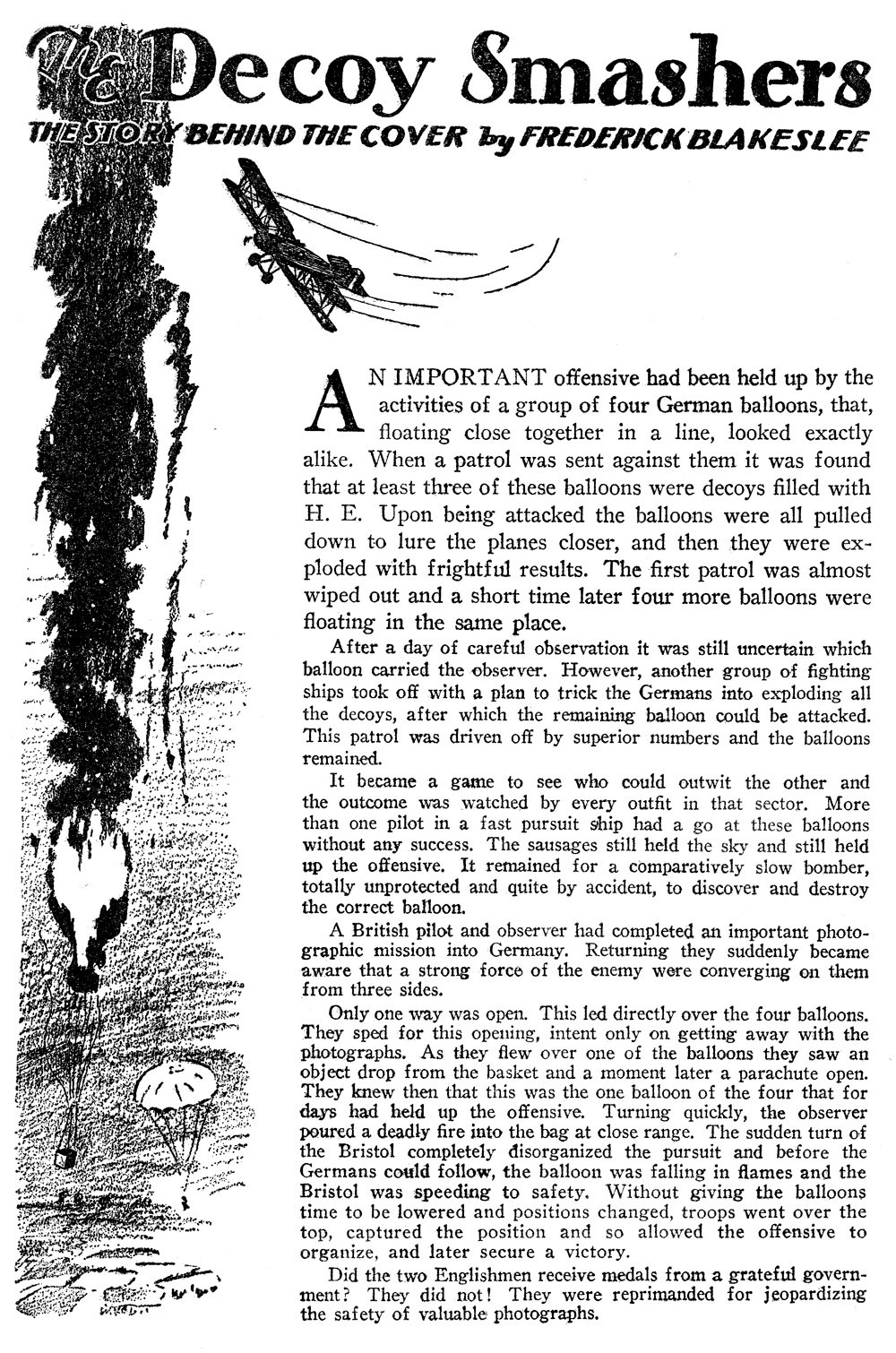
th_DDA_3302AN IMPORTANT offensive had been held up by the activities of a group of four German balloons, that, floating close together in a line, looked exactly alike. When a patrol was sent against them it was found that at least three of these balloons were decoys filled with H.E. Upon being attacked the balloons were all pulled down to lure the planes closer, and then they were exploded with frightful results. The first patrol was almost wiped out and a short time later four more balloons were floating in the same place.

After a day of careful observation it was still uncertain which balloon carried the observer. However, another group of fighting ships took off with a plan to trick the Germans into exploding all the decoys, after which the remaining balloon could be attacked. This patrol was driven off by superior numbers and the balloons remained.

It became a game to see who could outwit the other and the outcome was watched by every outfit in that sector. More than one pilot in a fast pursuit ship had a go at these balloons without any success. The sausages still held the sky and still held up the offensive. It remained for a comparatively slow bomber, totally unprotected and quite by accident, to discover and destroy the correct balloon.

A British pilot and observer had completed an important photographic mission into Germany. Returning they suddenly became aware that a strong force of the enemy were converging on them from three sides.

Only one way was open. This led directly over the four balloons. They sped for this opening, intent only on getting away with the photographs. As they flew over one of the balloons they saw an object drop from the basket and a moment later a parachute open. They knew then that this was the one balloon of the four that for days had held up the offensive. Turning quickly, the observer poured a deadly fire into the bag at close range. The sudden turn of the Bristol completely disorganized the pursuit and before the Germans could follow, the balloon was falling in flames and the Bristol was speeding to safety. Without giving the balloons time to be lowered and positions changed, troops went over the top, captured the position and so allowed the offensive to organize, and later secure a victory.

Did the two Englishmen receive medals from a grateful government? They did not! They were reprimanded for jeopardizing the safety of valuable photographs.

The Story Behind The Cover
“Decoy Smashers: The Story Behind The Cover” by Frederick Blakeslee (February 1933)

Check back again. We will be presenting more of Blakeslee’s Stories behind his cover illustrations.
Blakeslee’s “Death Bomber”

Link - Posted by David on September 11, 2014 @ 12:00 pm in

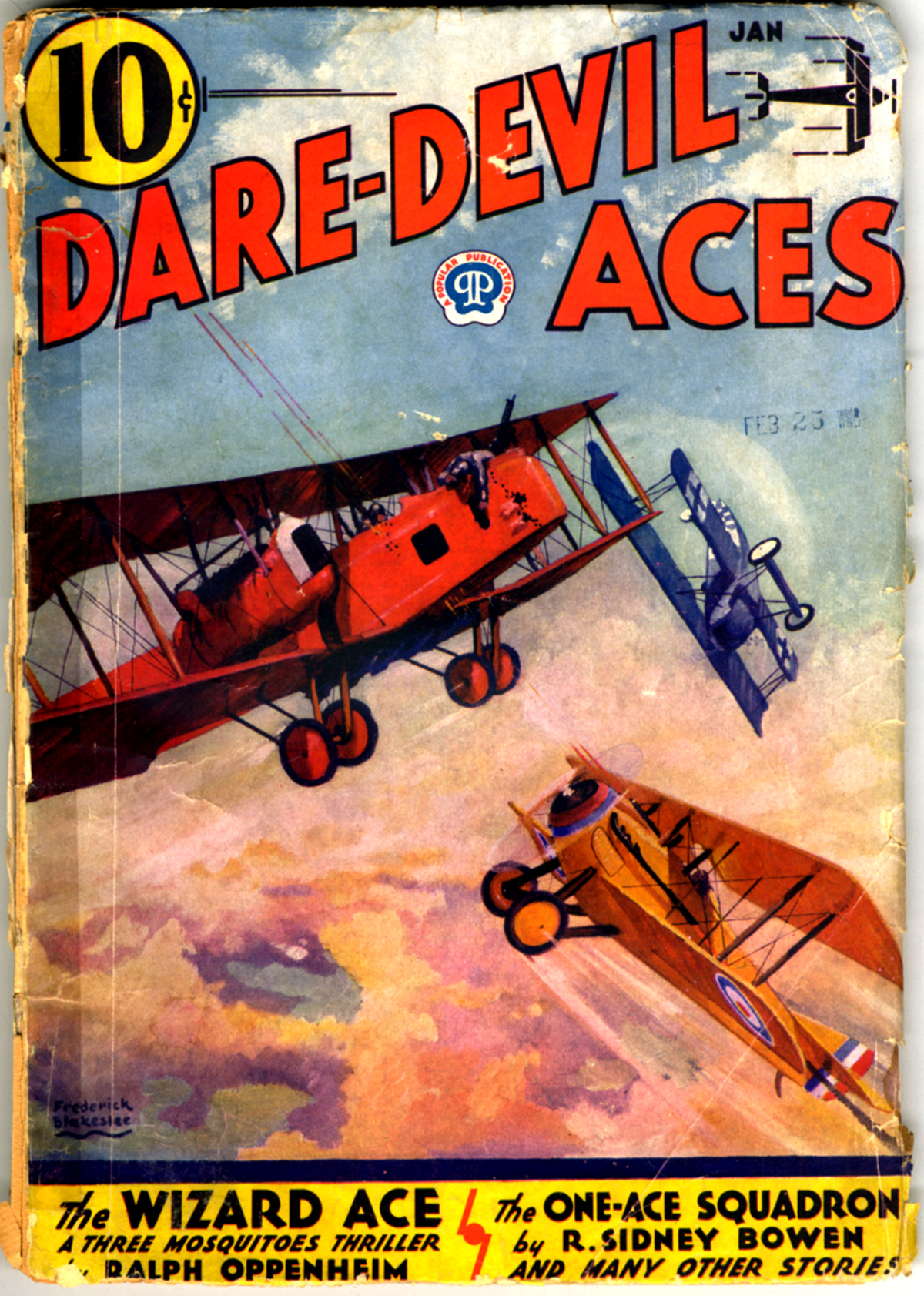
Frederick Blakeslee painted the covers for Dare-Devil Aces‘ entire fourteen year run. Every one of those covers told a story, and Blakeslee had a page with which to do so. We present Blakeslee’s cover for the January 1933 issue of Dare-Devil Aces and the story of R.F.C. pilot Lt. J.R. Gilbert as he happened upon the “Death Bomber”…

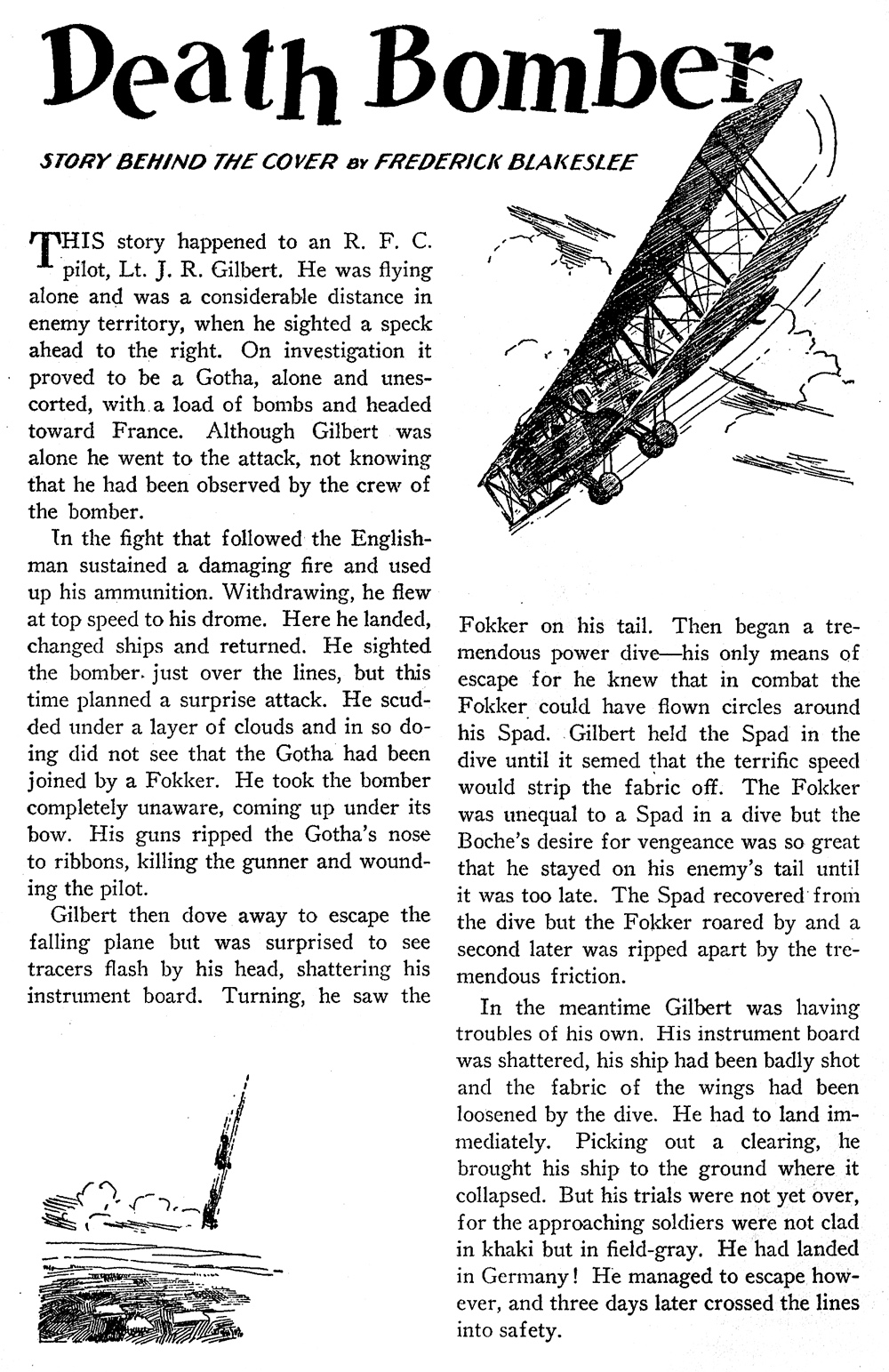
th_DDA_3301THIS story happened to an R.F.C. pilot, Lt. J.R. Gilbert. He was flying alone and was a considerable distance in enemy territory, when he sighted a speck ahead to the right. On investigation it proved to be a Gotha, alone and unescorted, with a load of bombs and headed toward France. Although Gilbert was alone he went to the attack, not knowing that he had been observed by the crew of the bomber.

In the fight that followed the Englishman sustained a damaging fire and used up his ammunition. Withdrawing, he flew at top speed to his drome. Here he landed, changed ships and returned. He sighted the bomber, just over the lines, but this time planned a surprise attack. He scudded under a layer of clouds and in so doing did not see that the Gotha had been joined by a Fokker. He took the bomber completely unaware, coming up under its bow. His guns ripped the Gotha’s nose to ribbons, killing the gunner and wounding the pilot.

Gilbert then dove away to escape the falling plane but was surprised to see tracers flash by his head, shattering his instrument board. Turning, he saw the Fokker on his tail. Then began a tremendous power dive—his only means of escape for he knew that in combat the Fokker could have flown circles around his Spad. Gilbert held the Spad in the dive until it semed that the terrific speed would strip the fabric off. The Fokker was unequal to a Spad in a dive but the Boche’s desire for vengeance was so great that he stayed on his enemy’s tail until it was too late. The Spad recovered from the dive but the Fokker roared by and a second later was ripped apart by the tremendous friction.

In the meantime Gilbert was having troubles of his own. His instrument board was shattered, his ship had been badly shot and the fabric of the wings had been loosened by the dive. He had to land immediately. Picking out a clearing, he brought his ship to the ground where it collapsed. But his trials were not yet over, for the approaching soldiers were not clad in khaki but in field-gray. He had landed in Germany! He managed to escape however, and three days later crossed the lines into safety.

The Story Behind The Cover
“Death Bomber: The Story Behind The Cover” by Frederick Blakeslee (January 1933)

Check back again. We will be presenting more of Blakeslee’s Stories behind his cover illustrations.
Airman’s Code

Link - Posted by David on September 4, 2014 @ 12:00 pm in

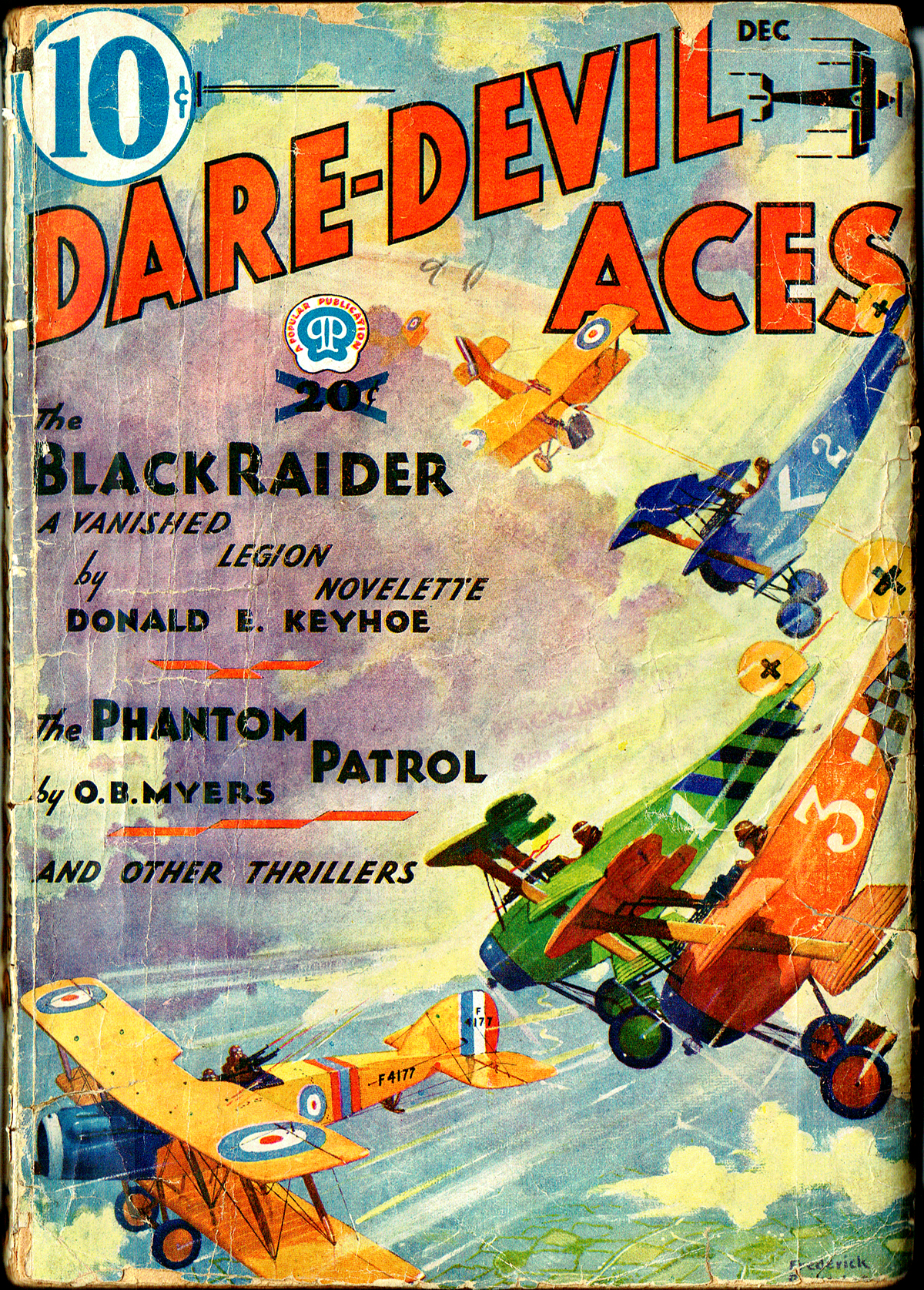
Frederick Blakeslee painted the covers for Dare-Devil Aces‘ entire fourteen year run. Every one of those covers told a story, and Blakeslee had a page with which to do so. We present Blakeslee’s cover for the December 1932 issue of Dare-Devil Aces—”Airman’s Code”…

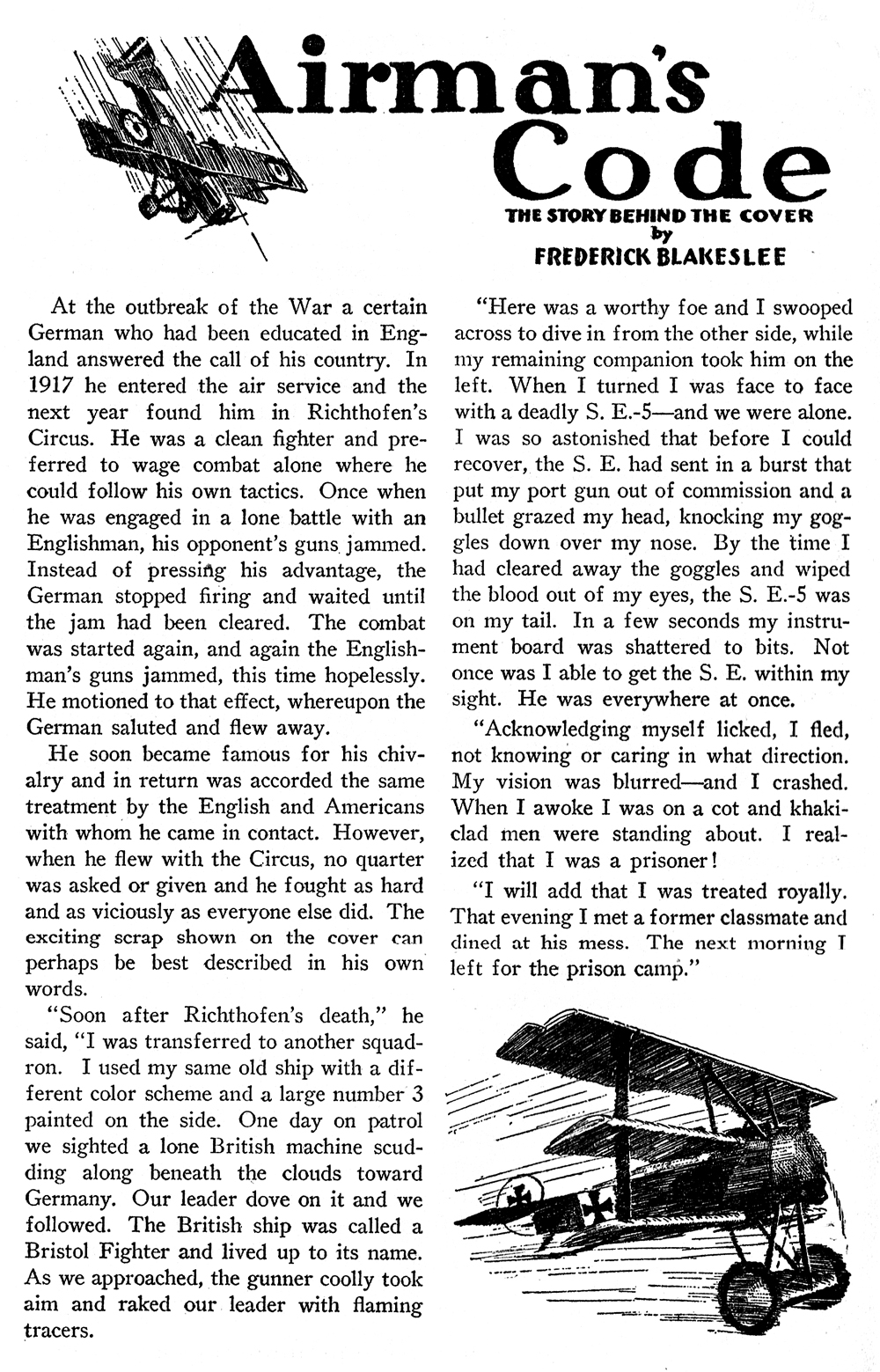
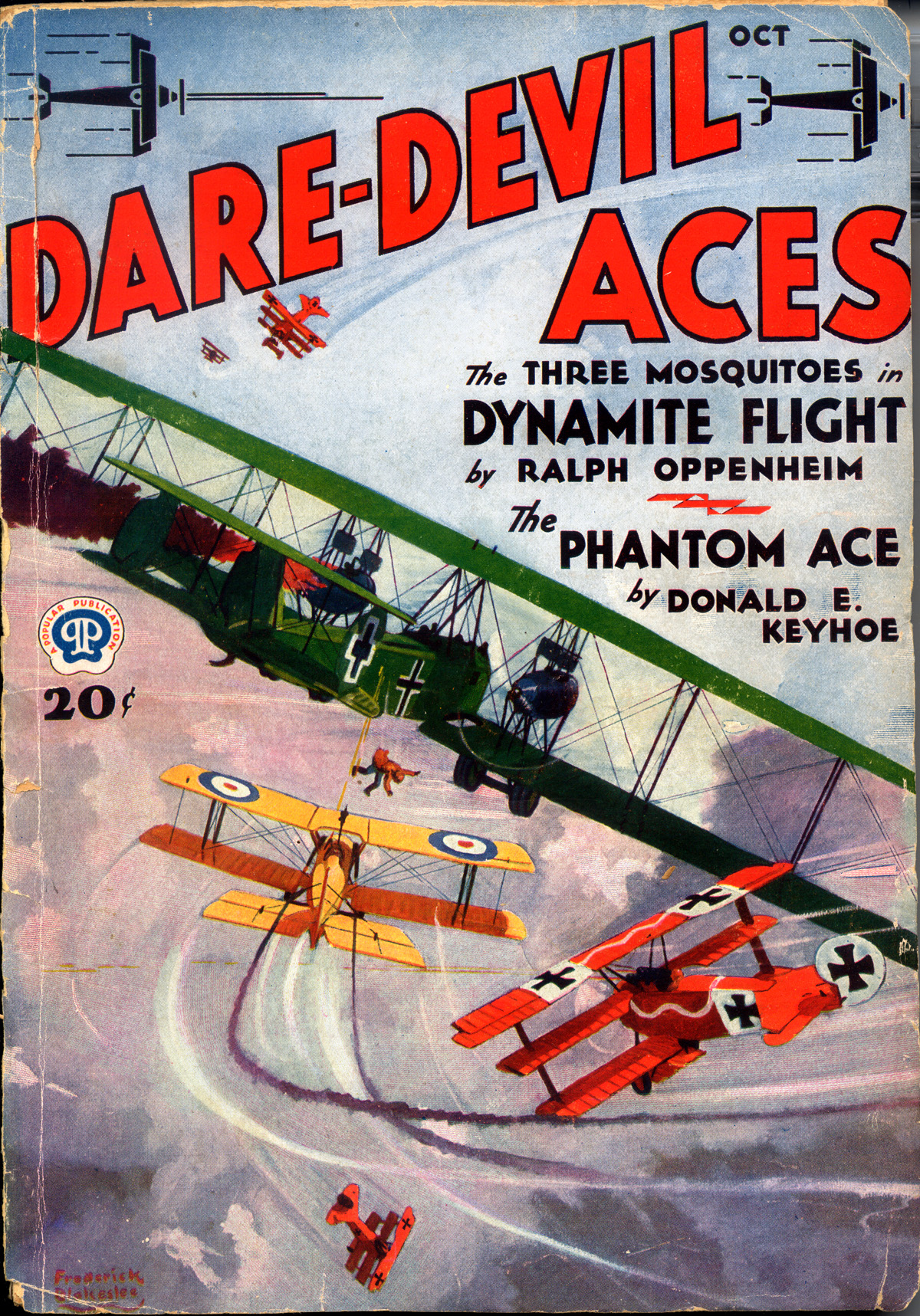
th_DDA_3212AT THE outbreak of the War a certain German who had been educated in England answered the call of his country. In 1917 he entered the air service and the next year found him in Richthofen’s Circus. He was a clean fighter and preferred to wage combat alone where he could follow his own tactics. Once when he was engaged in a lone battle with an Englishman, his opponent’s guns jammed. Instead of pressing his advantage, the German stopped firing and waited until the jam had been cleared. The combat was started again, and again the Englishman’s guns jammed, this time hopelessly. He motioned to that effect, whereupon the German saluted and flew away.

He soon became famous for his chivalry and in return was accorded the same treatment by the English and Americans with whom he came in contact. However, when he flew with the Circus, no quarter was asked or given and he fought as hard and as viciously as everyone else did. The exciting scrap shown on the cover can perhaps be best described in his own words.

“Soon after Richthofen’s death,” he said, “I was transferred to another squadron. I used my same old ship with a different color scheme and a large number 3 painted on the side. One day on patrol we sighted a lone British machine scudding along beneath the clouds toward Germany. Our leader dove on it and we followed. The British ship was called a Bristol Fighter and lived up to its name. As we approached, the gunner coolly took aim and raked our leader with flaming tracers.

“Here was a worthy foe and I swooped across to dive in from the other side, while my remaining companion took him on the left. When I turned I was face to face with a deadly S.E.-5—and we were alone. I was so astonished that before I could recover, the S.E. had sent in a burst that put my port gun out of commission and a bullet grazed my head, knocking my goggles down over my nose. By the time I had cleared away the goggles and wiped the blood out of my eyes, the S.E.-S was on my tail. In a few seconds my instrument board was shattered to bits. Not once was I able to get the S.E. within my sight. He was everywhere at once.

“Acknowledging myself licked, I fled, not knowing or caring in what direction. My vision was blurred—and I crashed. When I awoke I was on a cot and khaki-clad men were standing about. I realized that I was a prisoner!

“I will add that I was treated royally. That evening I met a former classmate and dined at his mess. The next morning I left for the prison camp.”

The Story Behind The Cover
“Airman’s Code: The Story Behind The Cover” by Frederick Blakeslee (December 1932)

Check back again. We will be presenting more of Blakeslee’s Stories behind his cover illustrations.
Frederick Blakeslee’s “The Giant Bomber”

Link - Posted by David on August 28, 2014 @ 12:00 pm in

Back with another of Frederick Blakeslee’s “The Story Behind The Cover.” Each issue of Popular Publication’s Dare-Devil Aces had a fantastic scene of air combat gracing its cover. Frederick Blakeslee painted all 135 covers—and each had a story behind it. This is the story behind the cover of the October 1932 issue—”The Giant Bomber”…

th_DDA_3210BRITISH Intelligence reported a contemplated raid on London by a large force of bombers. A certain squadron near Dunkirk was asked to intercept these ships and to destroy as many as possible. Consequently the air was filled with British craft patroling the coast. As the weather became unsafe for flying, most of the patrols returned to their bases, but several, which had become separated, did not return for some time. Let us follow one of these, an S.E.-5 flown by Lt. Allen Archer.

Archer was returning to his drome when suddenly a huge bomber hove into sight, escorted by three Fokker triplanes flying high above and ahead. Archer was sure that this was the vanguard of the raid and looked anxiously about for help. Not an Allied plane was in sight however, so it was up to him to do something by himself. To attack this huge monster with his comparatively tiny S.E.-5 seemed futile. However, he realized the number of women and children who might not see tomorrow should this ship arrive over London; so despite the heavy odds he decided to attack. He had no sooner made his decision than he found himself in a savage combat with two of the Fokkers. He shot one of them down and, with the other on his tail, headed for the lumbering giant.

As he drew near he let go a burst, but as far as he could see it did no damage. Yet to his utter surprise the bomber gave a lurch, a man fell or jumped overboard and the engines on the left burst into flames. The bomber tipped up and dove into the clouds. Archer was so occupied with the two remaining Fokkers that he was unable to follow the bomber down. After a short combat he drove them off and returned to his field. The bomber landed in Germany, so what happened was never known by the Allies.

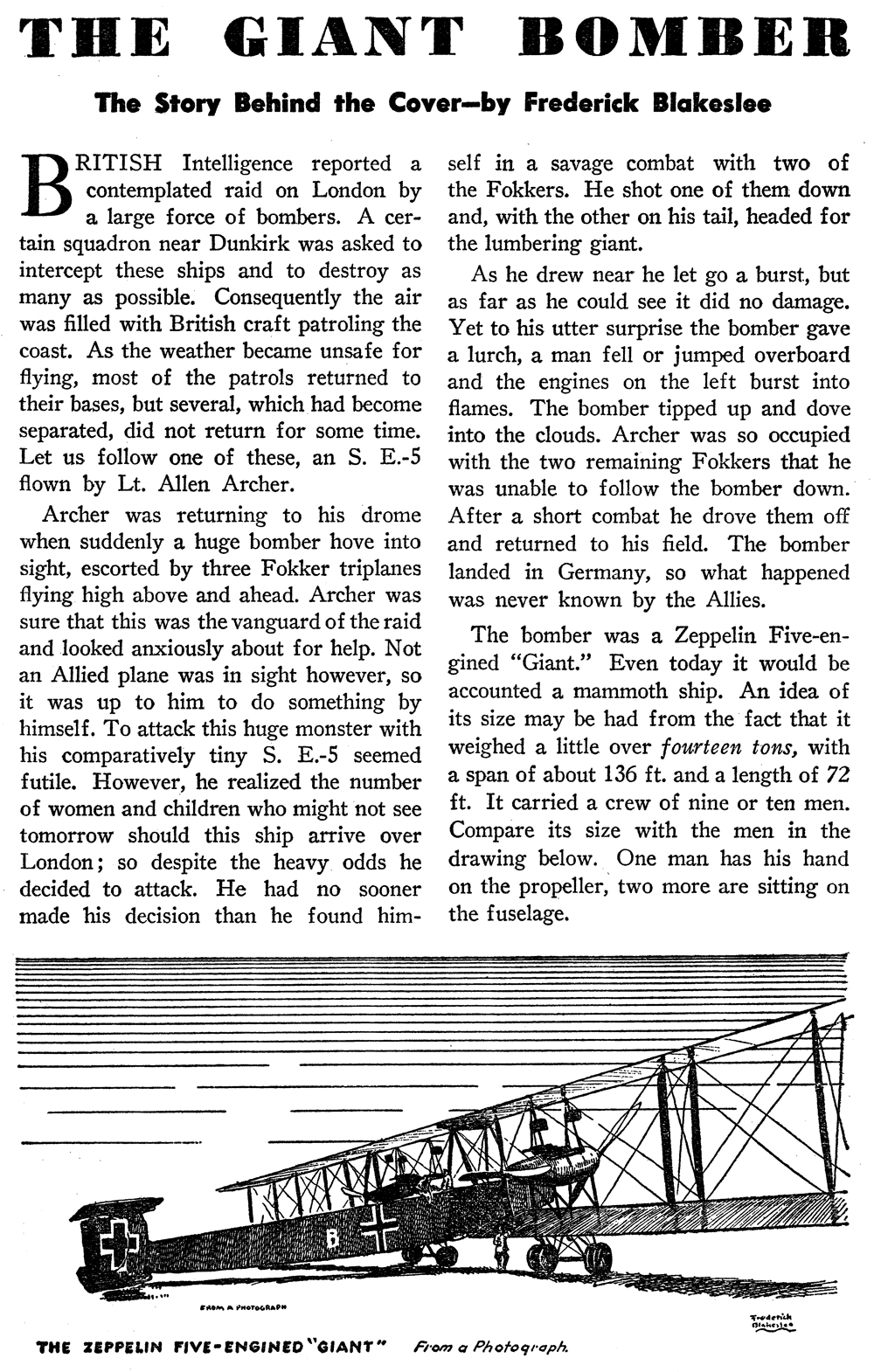
The bomber was a Zeppelin Five-engined “Giant.” Even today it would be accounted a mammoth ship. An idea of its size may be had from the fact that it weighed a little over fourteen tons, with a span of about 136 ft. and a length of 72 ft. It carried a crew of nine or ten men. Compare its size with the men in the drawing below. One man has his hand on the propeller, two more are sitting on the fuselage.

The Story Behind The Cover
“The Giant Bomber: The Story Behind The Cover” by Frederick Blakeslee (October 1932)

Check back again. We will be presenting more of Blakeslee’s Stories behind his cover illustrations.
Frederick Blakeslee’s “Bombing of Zeebrugge”

Link - Posted by David on August 21, 2014 @ 12:00 pm in

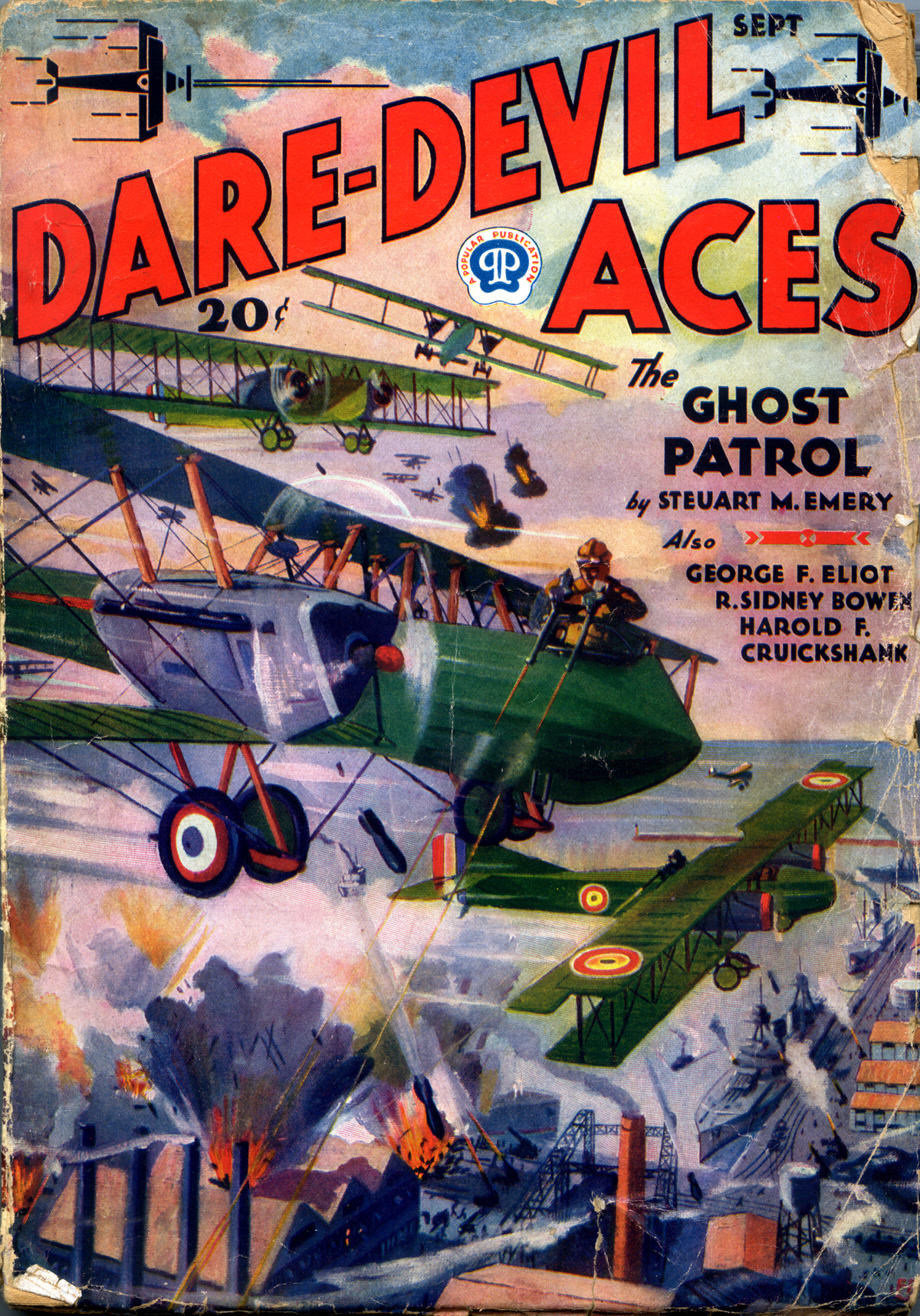
Back with another of Frederick Blakeslee’s “The Story Behind The Cover.” This time we’re featuring Blakeslee’s cover for the September 1932 issue of Dare-Devil Aces. It’s a great battle scene depicting a squdron of French Caudron bombers going about thier business. Here’s Frederick Blakeslee himself to tell you about the “Bombing of Zeebrugge,” The Story Behind the Cover…

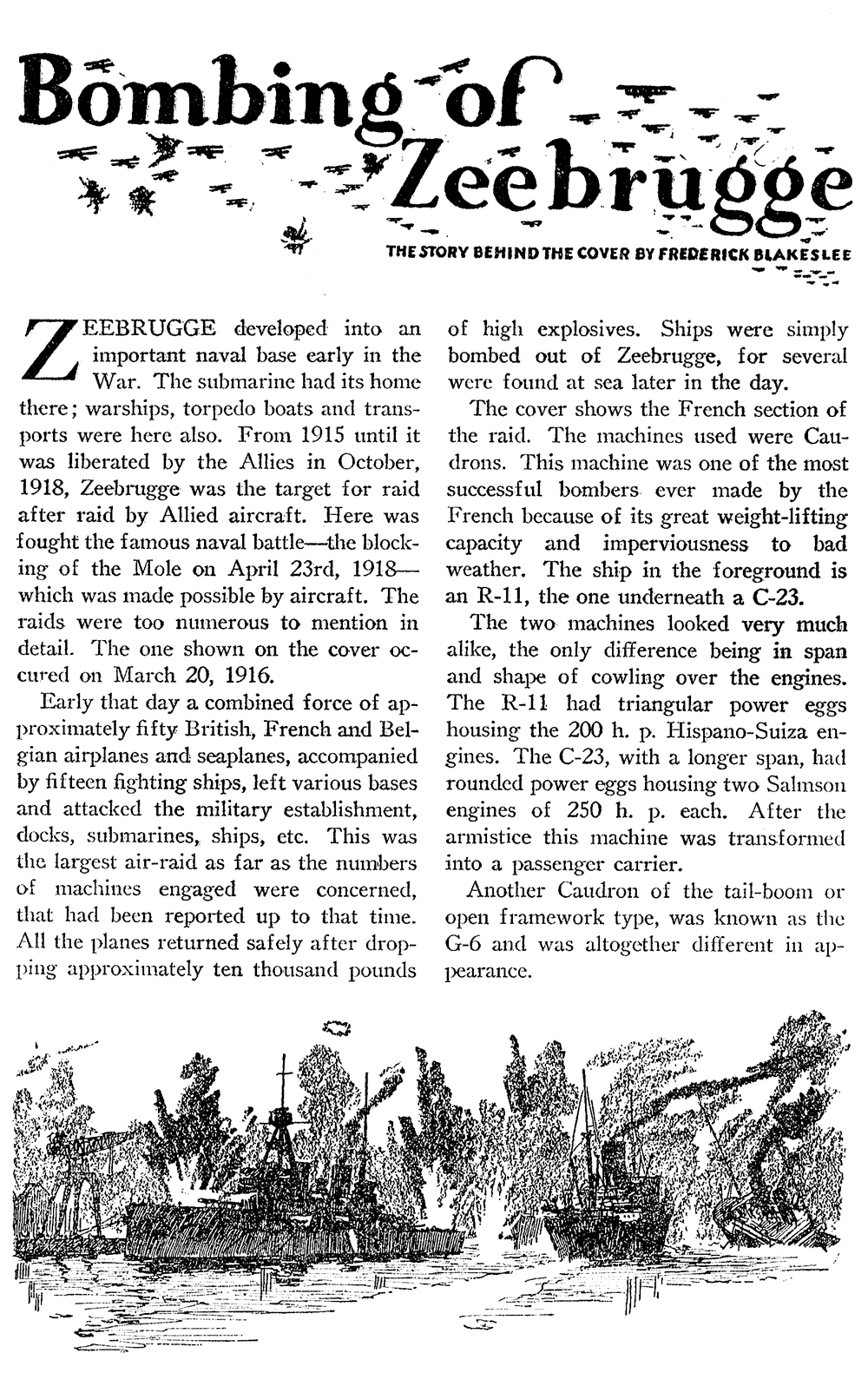
th_DDA_3209ZEEBRUGGE developed into an important naval base early in the War. The submarine had its home there; warships, torpedo boats and transports were here also. From 1915 until it was liberated by the Allies in October, 1918, Zeebrugge was the target for raid after raid by Allied aircraft. Here was fought the famous naval battle—the blocking of the Mole on April 23rd, 1918—which was made possible by aircraft. The raids were too numerous to mention in detail. The one shown on the cover occured on March 20, 1916.

Early that day a combined force of approximately fifty British, French and Belgian airplanes and seaplanes, accompanied by fifteen fighting ships, left various bases and attacked the military establishment, docks, submarines, ships, etc. This was the largest air-raid as far as the numbers of machines engaged were concerned, that had been reported up to that time. All the planes returned safely after dropping approximately ten thousand pounds of high explosives. Ships were simply bombed out of Zeebrugge, for several were found at sea later in the day.

The cover shows the French section of the raid. The machines used were Caudrons. This machine was one of the most successful bombers ever made by the French because of its great weight-lifting capacity and imperviousness to bad weather. The ship in the foreground is an R-ll, the one underneath a C-23.

The two machines looked very much alike, the only difference being in span and shape of cowling over the engines. The R-ll had triangular power eggs housing the 200 h.p. Hispano-Suiza engines. The C-23, with a longer span, had rounded power eggs housing two Salmson engines of 250 h.p. each. After the armistice this machine was transformed into a passenger carrier.

Another Caudron of the tail-boom or open framework type, was known as the G-6 and was altogether different in appearance.

The Story Behind The Cover
“Bombing of Zeebrugge: The Story Behind The Cover” by Frederick Blakeslee (September 1932)

Check back again. We will be presenting more of Blakeslee’s Stories behind his cover illustrations.
The Bridge Bombers

Link - Posted by David on August 18, 2013 @ 3:02 pm in

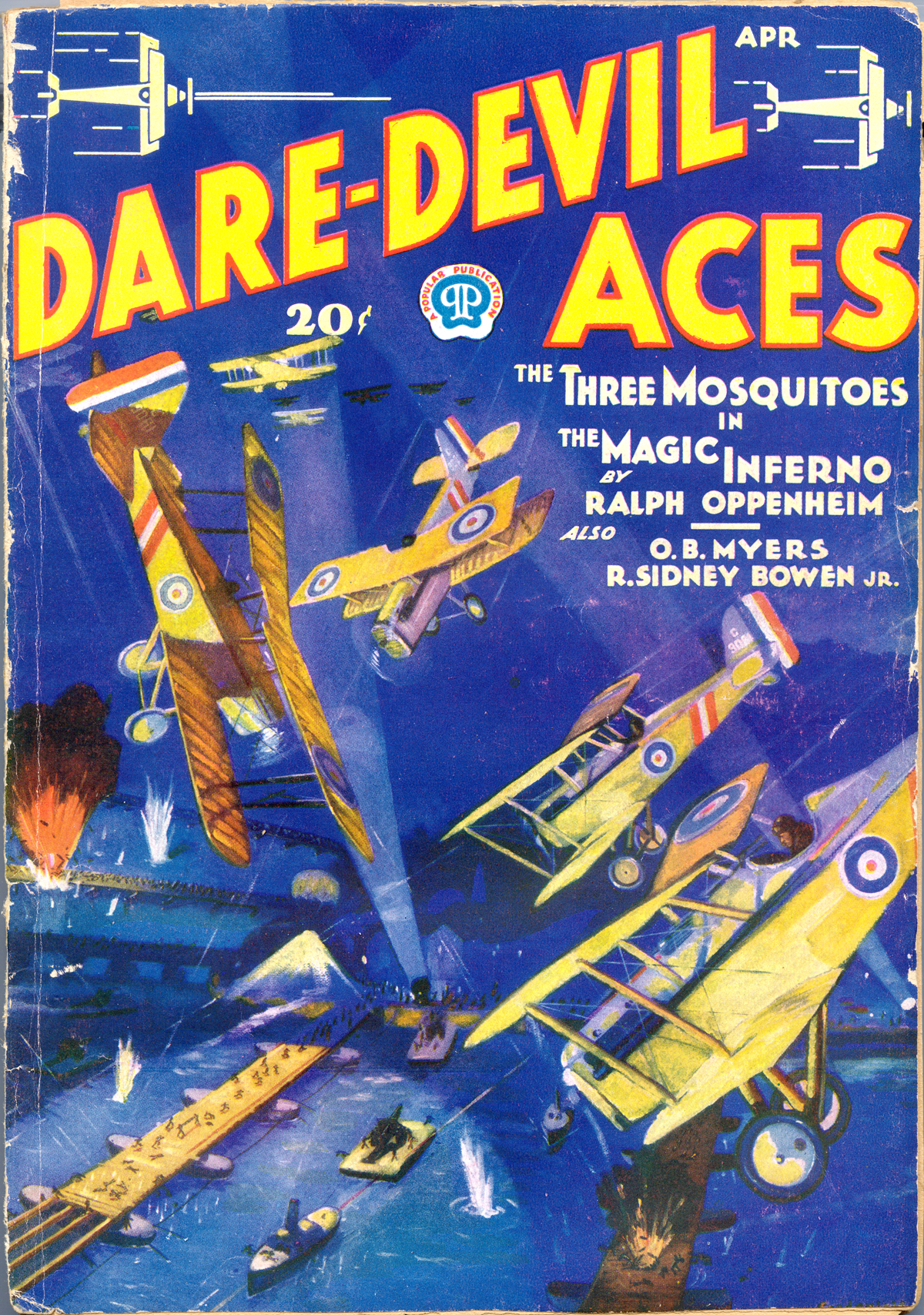
Back with another of Frederick Blakeslee’s “The Story Behind The Cover.” This time we’re featuring Blakeslee’s cover for the April 1932 issue of Dare-Devil Aces. Another of his nighttime covers that are so striking and only seem to appear in the first year of Dare-Devil Aces’ 15 year run. So, without further ado, “The Bridge Bombers” The Story Behind the Cover by Federick Blakeslee…

th_DDA_3204THERE is a river in northern France which a certain German army corps will never forget. Every bridge had been blown up and the French had made a strong resistance from the south bank for two days. German intelligence discovered a weak spot in the defense, however, and here they determined to cross at night.

Soon after dark Boche engineers began their work. Huge guns came out of concealment and were hurried to the riverside. The bridges, which were being built six at once, seemed to fairly leap across and as quickly as they were completed the troops started to march over them. It was then that things began to happen. The Germans became conscious of a pulsation which quickly became a rumble, then a roar, as two squadrons of fighting Scouts swept down upon them, spraying the bridges with lead and dropping small bombs. The Jerries broke and ran in both directions.

Then came the bombers, dropping high explosives, blowing men and bridges to kingdom come. In the meantime a hot ground fire started to drive back those Germans who had succeeded in reaching the south bank. As soon as the low-flying planes had gone, French artillery opened on the enemy who remained on the north bank. The damage by infantry, artillery and planes was terrific and all but annihilated a complete army corps.

The Germans eventually crossed the river, but at a tremendous price. Later they were to return to that river, as eager to get to the north bank as they had been to get to the south.

The Story Behind The Cover
“The Bridge Bombers: The Story Behind The Cover” by Frederick Blakeslee (April 1932)

Check back again. We will be presenting more of Blakeslee’s Stories behind his cover illustrations.
Blakeslee’s Bombing London

Link - Posted by David on August 9, 2013 @ 12:32 pm in

Frederick Blakeslee painted the covers for Dare-Devil Aces‘ entire fourteen year run. Every one of those covers told a story, and Blakeslee had a page with which to do so. We present Blakeslee’s cover for the November 1932 issue of Dare-Devil Aces—”Bombing London.”

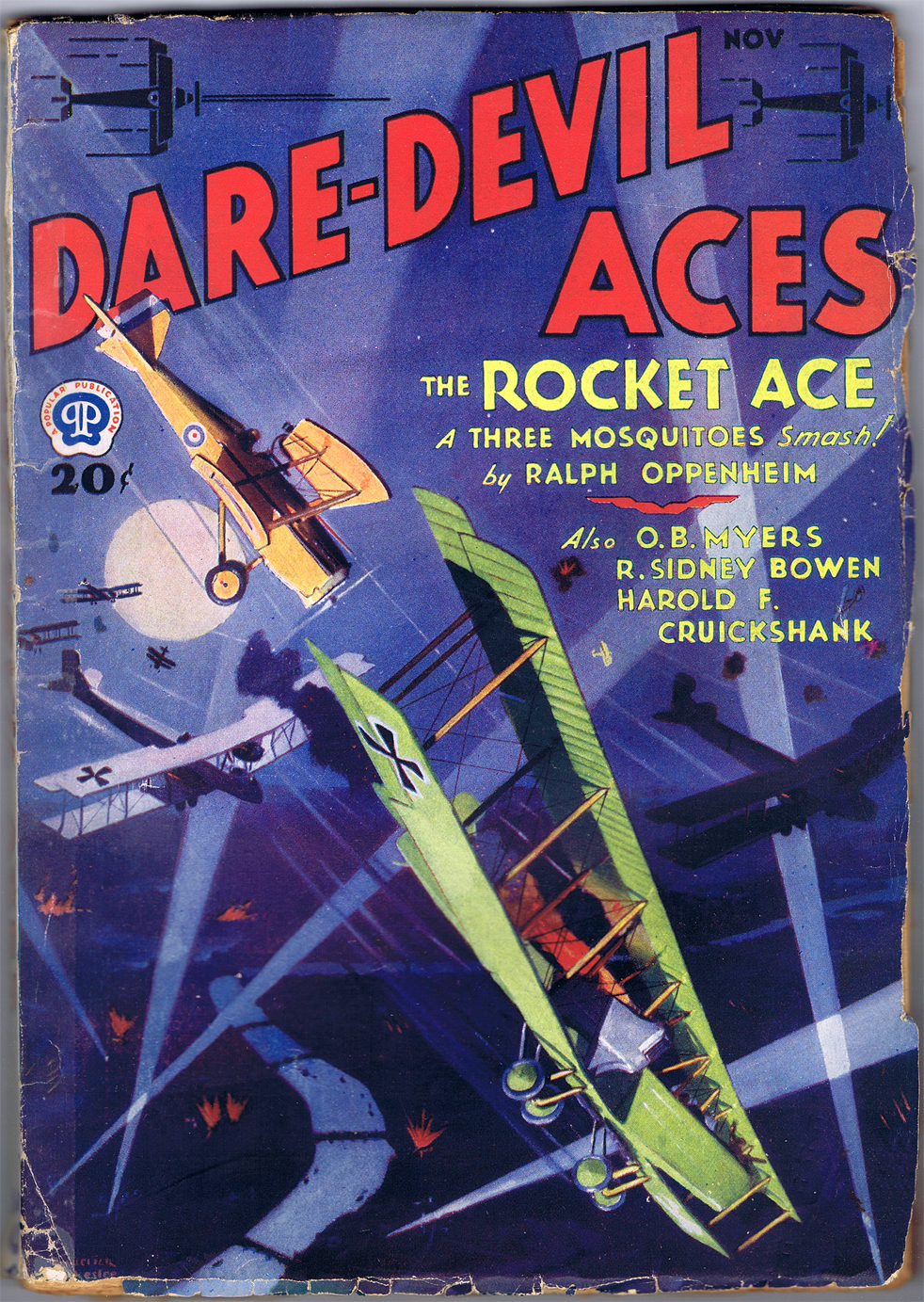
th_DDA_3211THE COVER shows a night raid on London by a squadron of Gothas—one of the most cruel and useless gestures of the War. The Germans seem to have had the idea that these raids would break the morale of the English people. In that respect they utterly failed, for they made England fighting mad and stimulated recruiting as nothing else could have done. The average Englishman took the raids philosophically. Instead of flocking to the cellars a great many went to the roofs to watch the sport. The following anecdote shows their reaction. In a hotel where the people were on the verge of panic during a raid, one of the guests heard the banging of anti-aircraft guns, put down his paper and said in a loud voice, “Come in!” Everyone laughed and the tension was broken.

However, raids were not jokes. They were horrible, serving no useful military purpose and killing hundreds of non-combattants. Most of the raids were at night, although a few were carried out in broad daylight. One such raid killed 104 people and injured 423 in the congested area around the Liverpool St. Station.

The Germans sometimes paid for these “murder raids.” During one of them, perhaps the greatest that took place over London, forty Gotha machines were used. Six were brought down in combat by anti-aircraft and one as the result of engine trouble.

Because of the many failures of Zeppelins to return from raids on London, the Gotha was designed to take its place. It had a wing span of 77 ft. and was powered by two 260 h.p. Mercedes engines, which gave the ship a speed of 73 m.p.h.

The Story Behind The Cover
“Bombing London: The Story Behind The Cover” by Frederick M. Blakeslee (November 1932)

We published a small collection of 10 of Blakeslee’s “Story Behind The Cover” features in The Three Mosqitoes: The Thunderbolt Ace which can be ordered from Amazon. We will be presenting more of Blakeslee’s Stories behind his cover illustrations so check back again…

New Strange Desktops

Link - Posted by David on August 21, 2011 @ 2:38 pm in

We can’t stop harping on about the excellent art work that doesn’t get enough credit in our books. Frederick Blakeslee and John Flemming Gould were masters at rendering airplanes in flight while our own Chris Kalb’s inventive designs are simply the coolest out there.

In our books the spine breaks up the tableaus—and in the interior art galleries we present the art as it was originally published. We spend some time mending the images back together to create a complete image—with a majority of our work ending up in the gutter of the book anyway. Some of these images are just so good we felt the needed to turn them into desktops for you to enjoy on your computer everyday. And we’re getting the ball rolling with three of Chris’ splash page treatments from our latest book, Captain Philip Strange: Strange War. You can choose from the plane vs. pterodactyl of Scourge of the Skies; the bullseye cocarde of Cocardes of Courage; or the green flaming bombs, in black and white here, of The Unholy Horror!

strange_wp_spot

They are available in our Age of Aces Desktops Gallery in a variety of aspect ratios—pick the one that best suits your computer.

We plan to add to the gallery with images from previous books as well as those to come!

More Great Blakeslee Covers!

Link - Posted by David on March 2, 2011 @ 8:06 pm in

For anyone who’s seen a number of G-8 and his Battle Aces covers, then you know Frederick Blakeslee was not as adept at rendering the human form as he was machinery. Trained as a draftsman and with his work at the Curtiss-Sperry Company, Blakeslee excelled in the minutia of areoplane design. And no where was this more evident than in the beautiful and dynamic covers he painted for Popular Publication’s air war anthology series: Battle Aces, Battle Birds and Dare-Devil Aces. The covers were never reflective of the stories within, but Blakeslee usually supplied a brief write-up of the events behind his monthly cover spectacular!

This time we have his twelve covers for the year of 1938 joining those already posted from 1932 through 1937 in our Dare-Devil Aces Cover Gallery! The July and November covers include a bonus of planes battling over a train yard–Blakeslee loved to paint trains as well, providing many covers for Popular’s Railroad Magazine.

« Previous PageNext Page »