


Looking to buy? See our books on amazon.com Get Reading Now! Age of Aces Presents - free pulp PDFs

“The Fokker D-7″ by Frederick Blakeslee

Link - Posted by David on February 16, 2015 @ 6:00 am in

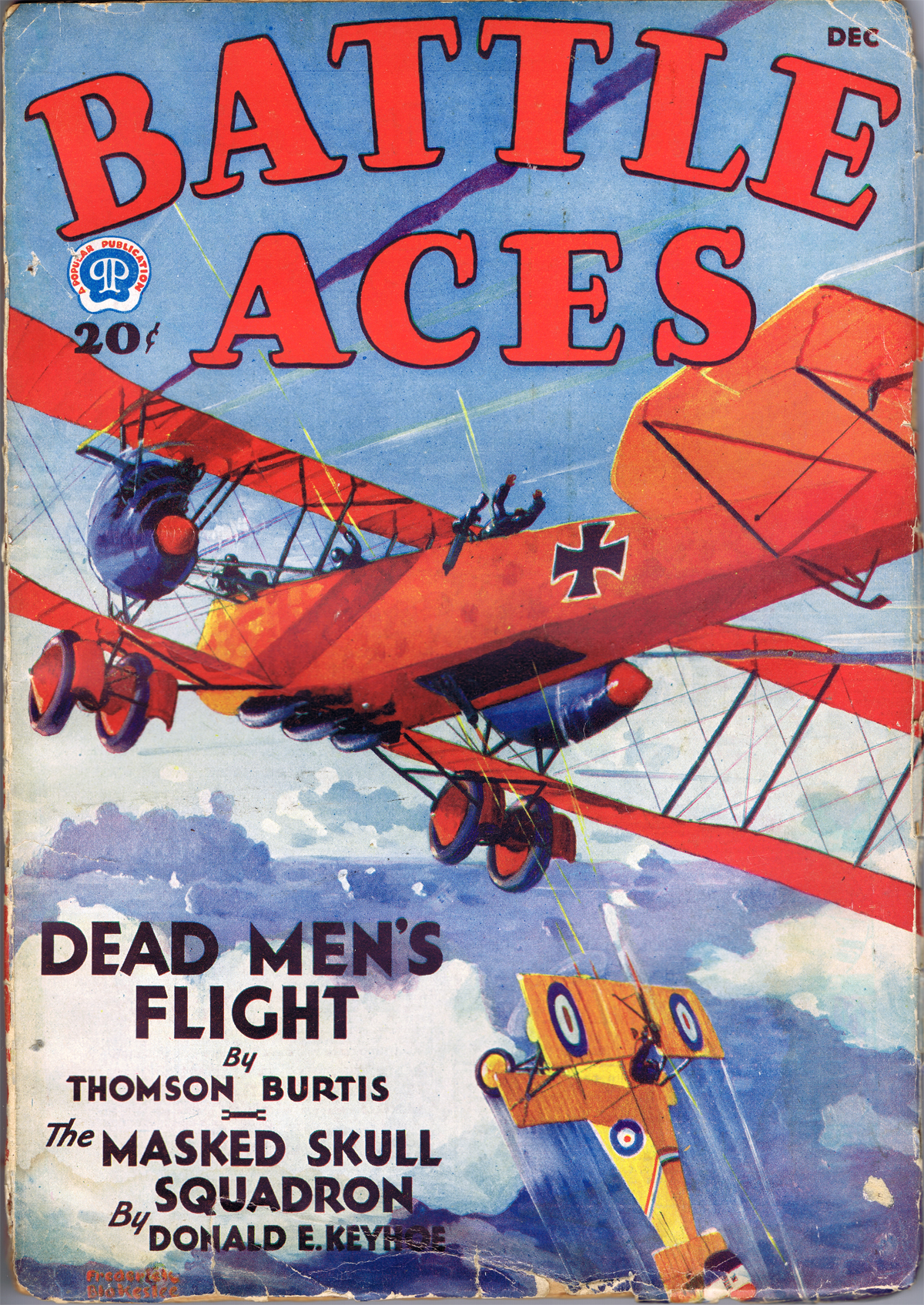
Editor’s Note: This month’s cover is the ninth of the actual war-combat pictures which Mr. Blakeslee, well-known artist and authority on aircraft, is painting exclusively for BATTLE ACES. The series was started to give our readers authentic pictures of war planes in color. It also enables you to follow famous airmen on many of their amazing adventures and fell the same thrills of battle they felt. Be sure to save these covers if you want your collection of this fine series to be complete.
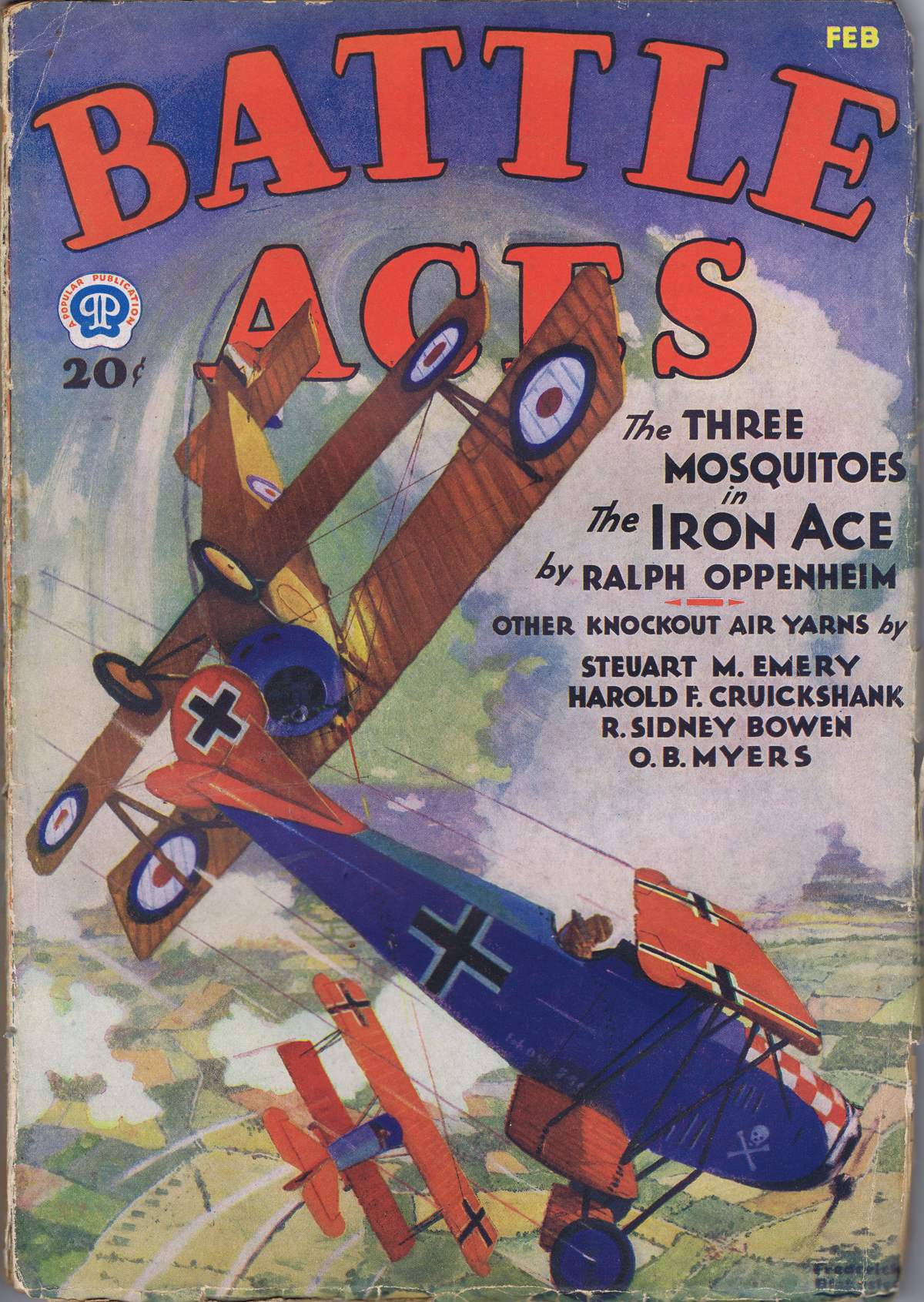
th_BA_3202THE HERO of the exploit featured this month is Lieutenant-colonel William Avery Bishop, the ace of aces. In his many combats, numbering over two hundred, he made an official score of seventy-two enemy planes, destroyed. Seventy-five percent of these combats were undertaken alone and the majority were against great odds. In a single day, his last in France, he brought up his score from sixty-seven to seventy-two, by destroying, unaided, five enemy ships in less than two hours.

Here is the story of the action which is illustrated on the cover. It will give an insight into the daring of this fighter. The combat took place on August 11, 1917. Colonel Bishop went out that day to work independently, as was his custom. Finding the air clear of patrols, he flew to an enemy airdrome only to find it deserted. He then flew on, going at least twelve miles beyond the lines into German territory, until he discovered another airdrome. Here there was great activity. Seven planes, some with their engines running, were lined up in front of the hangars, preparing to ascend. This was just what he had hoped to find.

With throttle wide open, Bishop dove to within fifty feet of the ground, sending a stream of lead into the group of men and planes. He noticed one casualty as the pilots and mechanics scattered in all directions. The Boches manned the ground guns and raked the sky, while the pilots worked frantically to take off. They knew whom they were up against. There was no mistaking “Blue Nose,” which was the name of Bishop’s machine. Furthermore, who but Bishop would come so far into their territory, and have the audacity to attack an airdrome all by himself?

Here, right in their midst, was the man most feared and most “wanted” by the Germans. It meant promotion and an Iron Cross for the pilot who downed him. However he was not easily downed.

At last one Jerry left the ground. Bishop was on his tail like a hawk and before the Jerry could gain maneuvering altitude, Bishop gave him fifteen rounds of hot fire, crashing him to the ground. During this brief action another plane took off but Bishop was too quick for him. He swung around and in a flash was on his tail. Thirty rounds sent this Boche crashing into a tree. In the meantime two more enemy ships had taken off and had gained enough altitude for a serious scrap. These Bishop engaged at once. He attacked the first ship, his guns ripping out one of those short bursts at close range, which were his specialty. The enemy ship went spinning to earth, crashing three hundred yards from the airdrome. He then emptied a full drum into the second hostile machine, doing more moral than material damage, for this plane took to its heels.

Then Captain Bishop flew back to his airdrome, pursued for over a mile by four enemy scouts, who were too discouraged to do any harm. When Bishop left the Front he had won the M.C., the D.F.C., the D.S.O. and bar, the Legion of Honor, the Croix de Guerre, and Briton’s highest award, the V.C. For the action here illustrated he was awarded the D.S.O.
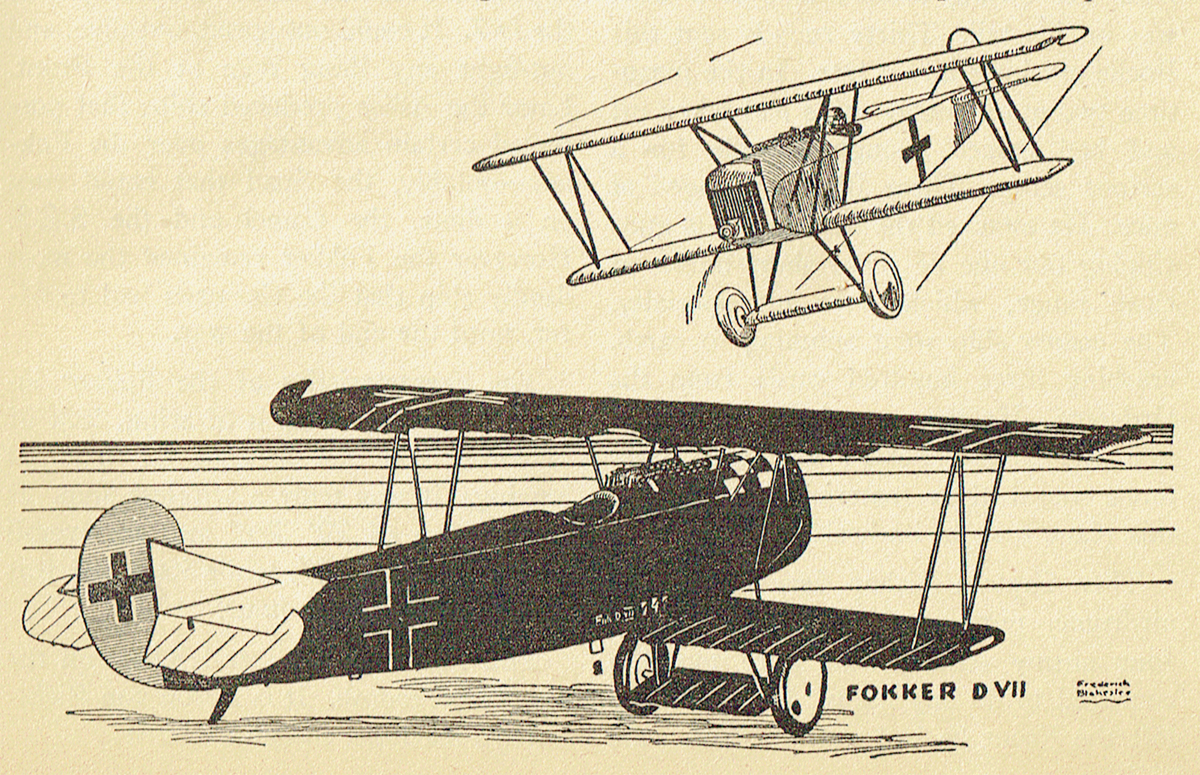
You will recognize the enemy machine as a Fokker D-7, “The Wolf of the Air.” In the hands of a good pilot it was a terror to the Allied forces. It was designed by Anthony Fokker who was not a German, but a subject of Holland. He is now a citizen of the United States.

This remarkable ship might have been on the Allied side, if it had not been for the short-sightedness of official England; for Fokker offered his services to England and was rejected. He then went to Germany where his value was recognized and where he was immediately employed. England, realizing her mistake, offered Fokker two million pounds to leave Germany. Since Fokker was virtually a prisoner there—but that is another story.

At any rate Fokker built the Germans a ship which filled the Allied pilots with wonder and consternation when it first appeared over the lines. This ship was the D-7. It could out-speed, out-dive, and out-fight any thing then at the Front. Later the Allies produced ships that possessed certain advantages over the Fokker—notably, the Spad that could turn on a dime, the Camel and the S.E.5. However the Fokker remained the most deadly ship that the Germans had to offer, until the end of the war.

The characteristics of the Fokker include an extreme depth of wing, lack of dihedral, and the absence of external bracing. It was truly a wireless ship. It had a span of 29′ 3½” and an overall length of 22′ 11½”, while its speed was about 116 miles per hour.

The Fokker D-7
“The Fokker D-7″ by Frederick M. Blakeslee (February 1932)

You will see a Fokker triplane on the cover next month. It is Baron von Richthofen’s machine, so don’t miss it!
“The Camel and Lt. White” by Frederick Blakeslee

Link - Posted by David on February 9, 2015 @ 6:00 am in

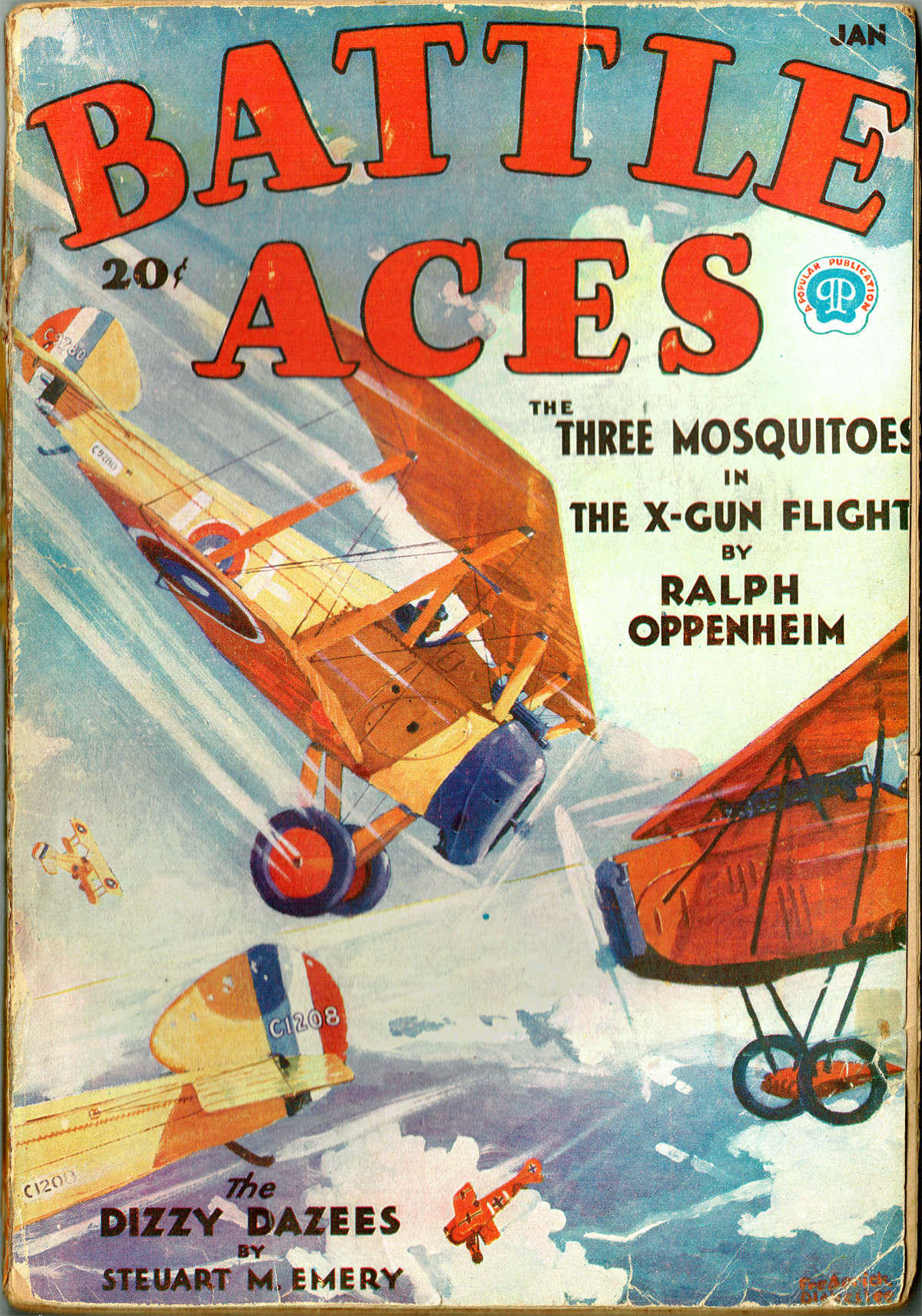
Editor’s Note: This month’s cover is the eighth of the actual war-combat, pictures which Mr Blakeslee well-known artist and authority on aircraft, is painting exclusively for BATTLE ACES. The series was started to give our readers authentic pictures of war planes in color. It also enables you to follow famous airmen on many of their amazing adventures and feel the same thrill of battle they felt. Be sure to save these covers if you want your collection of this fine series to be complete.

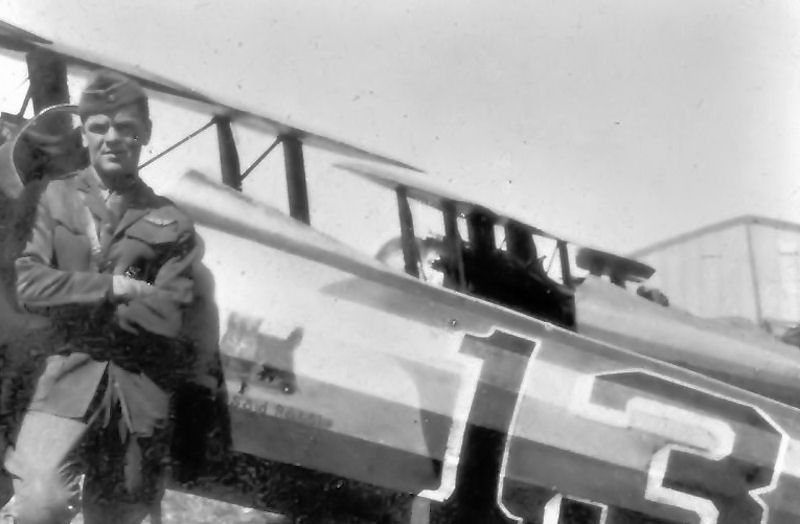
Lt. Wilbert Wallace White
Lt. Wilbert Wallace White, 147th Aero Squadron. He was a Flight Commander for the Squadron and gained 8 victories during his service.

th_BA_3201ON SEPTEMBER 14, 1918, three reconnaissance machines took the air on a mission of observation. They had for protection Second-lieutenant Wilbert W. White. While Lt. White was cruising about above the ships he was attacked by three Halberstadt fighters. He succeeded in fighting them off and leading them away from the observation ships, which were permitted to carry on their work unmolested. On his way home he sighted an enemy balloon near Chambley. He dove through a cloud to the attack, and before the ground crew knew what had happened, the drachen had come down about their ears in flames. The Yank was instantly attacked by two Fokker Scouts.

Although he was alone, with intrepid courage he attacked the first plane head-on, shooting until it went into a vertical dive out of control. Pulling sharply about, he fired a long burst at the second Fokker as it went over him. The Boche didn’t stop to argue, but streaked for the Vaterland as fast as his prop would drive him. For this thrilling exploit Lieutenant White was awarded the D.S.C.

The very next month he paid the supreme price in a way that was heroic in the extreme. He sacrificed his life that a buddy might live.

It was on October 10th that Lieutenant White, while in command of a patrol of four planes, met a flight of five Fokkers. In his patrol was a new member who was taking his first trip over the lines. One of the Boche pilots, perhaps sensing that he was a novice, or just by chances of combat, attacked him and obtained an advantageous position on his tail. The new pilot dodged and turned but was unable to shake off the Fokker, who followed his every move and was rapidly gaining on him. Lieutenant White saw that his friend was in dire trouble. Turning, he sped into position to attack the Boche. The Jerry was intent on his intended victim and was sending short bursts at close range whenever he could get him in line with his gun-sights. The situation looked black for the new pilot, but still blacker when Lieutenant White’s guns jammed hopelessly. Sooner or later a burst from the Fokker would hit a vital spot.

There was only one thing Lieutenant White could do to save his buddy, but it meant a horrible death. Without an instant’s hesitation he swung around and streaked full speed, head-on, into the startled and horrified enemy. The impact was terrific, the results devastating. For this act of extraordinary heroism the oak leaf cluster was awarded. The scene on the cover is just before the impact.

Lieutenant White belonged to the 147th squadron which used Spads. Since there was a picture of a 147th squadron Spad on last month’s cover, I have painted Lieutenant White’s machine as a Sophwith Camel to prevent repetition in plane types.

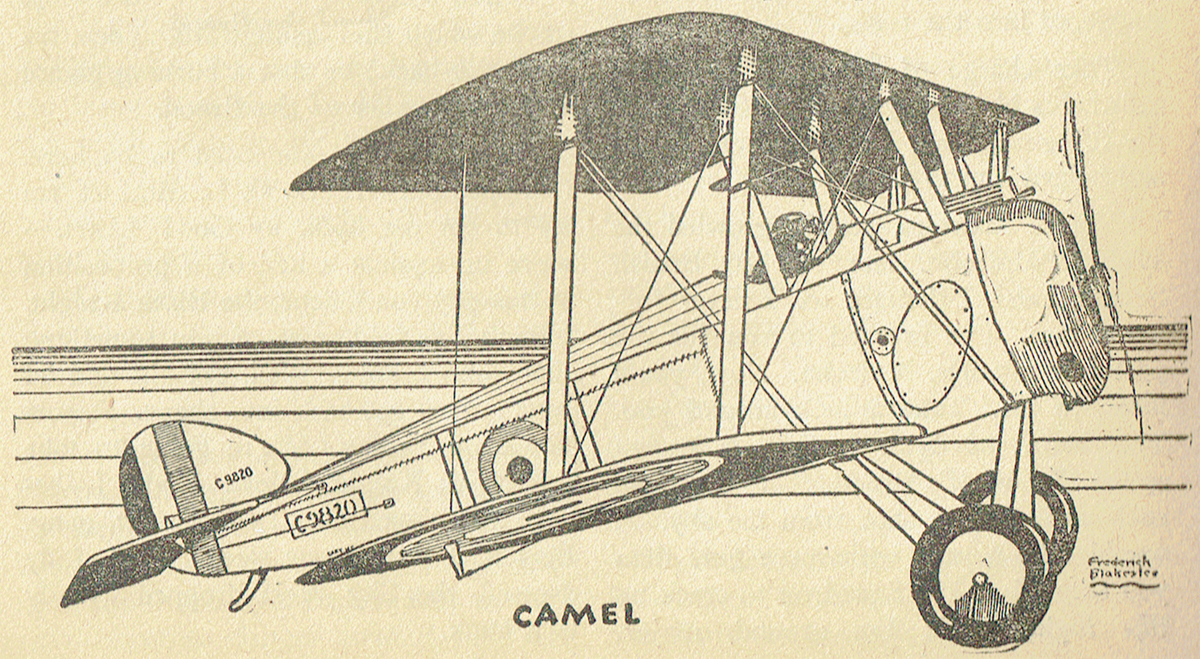
Much can be said for and against the Camel. It was an enlarged and modified “Pup” and was designed specially for high performances and extreme maneuverability. To obtain these ends some of the qualities of the Pup were necessarily sacrificed, and the machine had a reputation for being uncomfortable to fly. In fact I know of no pilot who went into a Camel squadron voluntarily.

Due to the torque of the motor it was extremely difficult to make a right-hand turn. This one fault caused a great many deaths to the men in training.

The Camel was also prone to catch fire in landing. The reason for this was because the engine, a 9-cylinder Gnome Monosoupape rotary, had no carbureter and therefore no throttle. It was necessary to slow down by means of a selector on the ignition system which cut out various cylinders. For example, the engine could run on 9-7-5-3 or one cylinder.

The mixture in the cylinders not used was sent through the exhaust manifold unburnt and might be ignited by the exhaust from an active cylinder. The ship landed with a long flame streaming from the exhaust which very often ignited the fabric.

On the other hand, it was the best ship for maneuvering ever brought out by the Allies, and was a great success in combat.

The Camel could climb to 5,000 feet in 5 minutes and to 10,000 feet in 12 minutes, at which height its speed was 113 m.p.h. It had a span of 28 feet; an overall length of 18 feet, 9 inches; a maximum gap of 5 feet and a minimum gap of 4 feet, F/io inches. A distinctive feature of this machine is the great dihedral of the bottom plane, combined with a flat top plane.

The ship received its name partly because of the appearance of a hump when seen from the side, and partly because the elevators were so sensitive that unless the pilot had a great deal of experience he flew in humps.

The Camel and Lt. White
“The Camel and Lt. White” by Frederick M. Blakeslee (January 1931)

“Friedrichshafen Bomber” by Frederick Blakeslee

Link - Posted by David on February 2, 2015 @ 6:00 am in

Editor’s Note: Every month the cover of BATTLE ACES depicts a scene from a real combat actually fought in the War and a real event in the life of a, great ace. The series is being painted exclusively for this magazine by Frederick M. Blakeslee, well-known artist and authority on aircraft and was started especially for all of you readers who wrote us requesting photographs of war planes. In this way you not only get pictures of the ships—authentic to the last detail—but you see them in color. Also you can follow famous airmen on many of their most amazing adventures and feel the same thrills of battle they felt. Be sure to save these covers if you want your collection of this fine series to be complete.

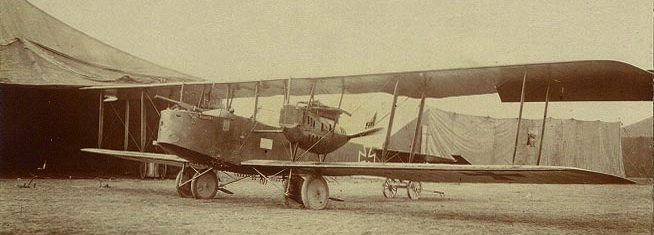
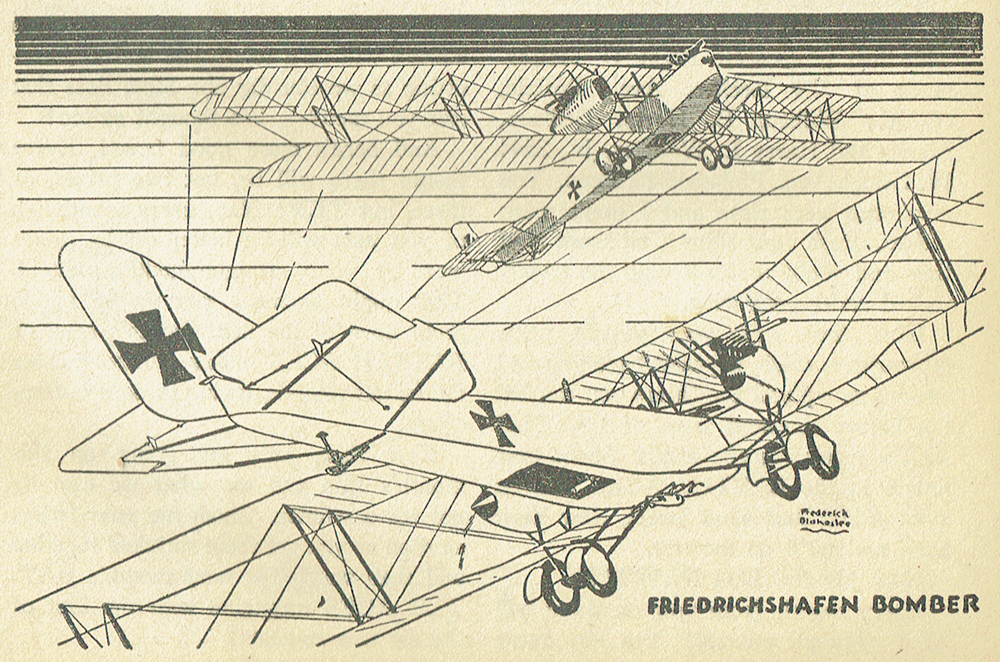
Friedrichshafen G.III Bomber
The Friedrichshafen G.III Bomber

th_BA_3112THE cover this month shows how a Friedrichshafen bomber was brought down by a Frenchman near Verdun. It was a big brute such as this that spelled the doom of Lufbury, America’s most spectacular ace.

The huge ship appeared back of the American sector near Loul. Four fighting ships took the air to give it combat, but returned after expending their ammunition, reporting that it seemed impossible to damage it. The big bomber loafed along as unconcernedly as if it were an elephant with a swarm of mosquitoes at its heels. Then Lufbury obtained permission to try his hand. He took off and mounted above the dragon of the air, then swept down upon it. His machine gun is believed to have become jammed, for when nearly upon the German he swerved off. Almost at once he came back again, flashing by the Boche with his guns blazing. But still the German lumbered on unhurt. Again Lufbury returned to the attack. Suddenly the watchers below saw a line of fire burst from his machine, and the ship began to plunge earthward.

We all know the manner of Lufbury’s death. He had a horror of being burned, and always said that in the event of his machine catching fire he would jump. He was true to his word, for that is exactly what he did, from a height of about two thousand feet. However, this is a digression; let us return to the Friedrichshafen.

These machines were in the air what the battleship is in the sea, and about as dangerous to tackle. There was no blind spot except on the under part of the fuselage toward the bow, and it was extremely hard to maneuver for this position, due to the fact that in the bottom of the floor, just aft of the bomb racks, was a trap door from which a machine gun commanded a view downward and backward.

The weak point in all big planes had been the inability of the gunners to protect the ship from an attack underneath. The secret of the invulnerability of the Friedrichshafen was that, due to this trap door, the gunner could now protect the blind spot, making the accepted mode of an attack on a bomber not only very dangerous but almost useless. The guns aboard these planes commanded a field of fire that almost completely surrounded the ship.

The big red devil pictured on this month’s cover, however, was unlucky. It was returning from a bombing mission at early dawn. A French flyer on morning patrol spotted it and speeding along in the gloom that hung close to the earth, slowly mounted until directly behind the tail. Then with throttle wide open he dove, gaining tremendous speed. He zoomed up and in a flash was directly underneath, his guns blazing forth a deadly hail of lead. Then he stalled, fell away, and dived out of range.

What circumstances accounted for the fact that he was allowed to approach within range, is not known. It is presumed that the crew, for some reason, had lapsed their vigil and were feeling safe either because of the early hour of the morning, or because they thought themselves over Germany. At any rate, that one burst was enough. The big crate came down back of the lines near Verdun, very slightly damaged, and was hailed with much joy by the powers that he.

It would serve no purpose to give an exhaustive technical description of the Friedrichshafen. A few facts will suffice. Big ships as they were, they were considerably smaller than the Gotha, being 36 feet in length with a wing span of 66 feet. They were powered by two 225 h.p. Benz motors, one each side of the center and inclosed in ovoid bonnets. The ship weighed when loaded 6,960 lbs. Beside machine guns they each carried twelve high explosive bombs and seven incendiary bombs.

The cover and the drawing below will give you a very accurate idea of how the plane looked.

Friedrichshafen Bomber
“Friedrichshafen Bomber” by Frederick M. Blakeslee (December 1931)

Next month’s cover will feature a CAMEL in deadly combat with a FOKKER. If you have been wanting an authentic picture in colors of a Camel machine, you will find it on the cover of the January issue. Not only that, but there is a real, gripping story behind the fight in which the ship is portrayed—the story of a valiant flyer who was willing to crash nose on into an enemy plane, willing to meet a flaming death, in order that he might save the life of his buddy. This will be the 8th in the series of actual war combat covers which Mr. Blakeslee is painting for you. If you do not have all of these pictures and would like them so that your series will be complete, send twenty cents for each magazine to Battle Aces, 205 E. 42nd St., New York City, and specify which issue or issues you desire. The planes illustrated so far have been: S.E.5; B.E. Fighter; R.E.8; Pfaltz Scout; Spad.

“The S.E.5 and Lt. Lindsay” by Frederick Blakeslee

Link - Posted by David on January 19, 2015 @ 12:00 pm in

Editor’s Note: Every month the cover of BATTLE ACES depicts a scene from a real combat actually fought in the War and a real event in the life of a great ace. The series is being painted exclusively for this magazine by Frederick M. Blakeslee, well-known artist and authority on aircraft and was started especially for all of you readers who wrote us requesting photographs of war planes. In this way you not only get pictures of the ships—authentic to the last detail—but you see them in color. Also you can follow famous airmen on many of their most amazing adventures and feel the same thrills of battle they felt. Be sure to save these covers if you want your collection of this fine series to be complete.

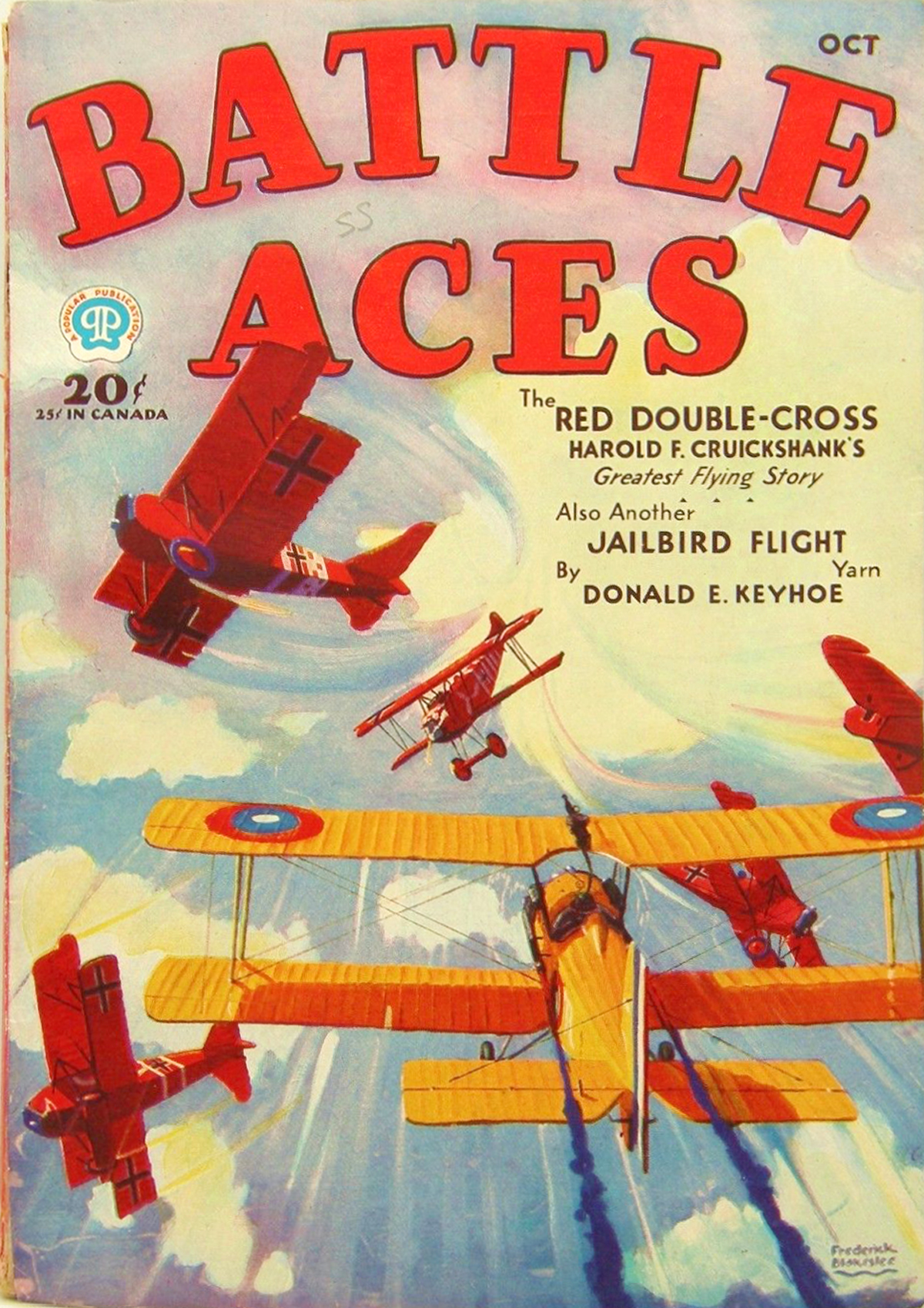
th_BA_3110THE COVER this month might be called “Turn, Turn Who’s Going to Turn.” Of course you know the answer, but just a second before the scene depicted occurred it was a toss-up whether the leading Boche would turn or whether the American ship would be flattened on its nose. However, the Jerry did the turning and all the others did likewise. This tactic of rushing head-on at each other was used by both sides. There were pilots who said that no German could stand up under the terrific strain of an impending collision. Of course this is not true. There must have been Boches who refused to turn, but since no one survived to tell of it, we only hear of the ones who did.

Such a battle of nerves happened to First Lieutenant Robert O. Lindsay of the 139th aero squadron near Bantheville on October 27th, 1918. While on a patrol in company with two others, he met three Jerries with the usual exchange of compliments. The combat took place at three thousand meters and after a sharp combat Lieutenant Lindsay shot down one. While he was maneuvering for position on the tail of another Jerry, he noticed a flock of eight Fokkers coming at him. Without a moment’s hesitation, he turned, and sped straight at the startled Boches.

The German leader held to his course until he saw that Lindsay was not going to turn and then he veered aside at the last moment. The others got out of the way as best they could. In a flash Lindsay was through the formation. Then he whirled around and dove on the last Fokker which, after the first burst, rolled on its back and started the long but swift plunge into eternity. Lindsay then streaked for home as the others in his patrol had done long before. The Jerries got themselves organized and searched an empty sky for the nervy Yank.

On the cover you see Lindsay halfway through the formation and seeing this you are inclined to say that the chances of a collision were remote. But there is an element you might not have taken into consideration—speed. We’ll say Lieutenant Lindsay was traveling over 125 m.p.h. and the Boches at the same speed. That would mean the Jerries were approaching Lindsay at well over 250 m.p.h. At that rate, it doesn’t take long for an object to pass a given point; and so, although the farthest planes from Lindsay seem a long way off, he actually grazed them in passing, for it took only the wink of an eye to close the distance between them.

For this exploit Lieutenant Lindsay won the Distinguished Service Order.

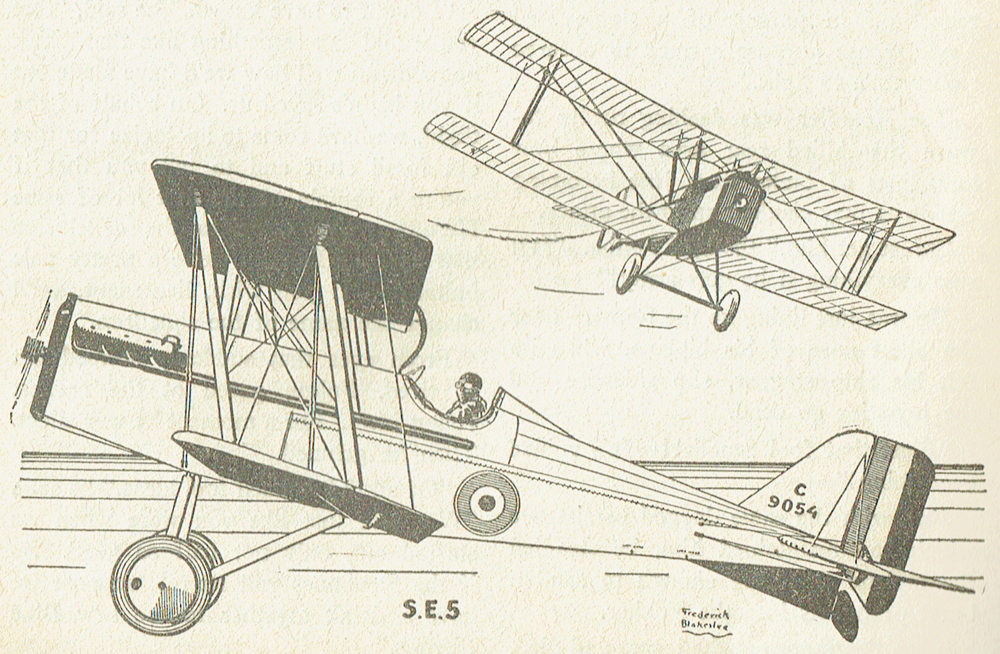
No doubt you will recognize the plane in the foreground as an S.E.5. This was not the type of plane flown by the 139th squadron at that time. In our series, we don’t always show the machines that we actually used in the incidents pictured, because frequently they were the same type, and one of our aims is to give you pictures of every one of the machines. We have used the S.E.5. before in a cover, but have not shown a drawing of it, therefore we include the drawing this month. The Fokker D.7 will be a feature on the December issue.

The S.E.5 and Lt. Lindsay
“The S.E.5 and Lt. Lindsay” by Frederick M. Blakeslee (October 1931)

“The Pfaltz Scouts and Lieutenant Alexander” by Frederick Blakeslee

Link - Posted by David on January 12, 2015 @ 12:00 pm in

Editor’s Note: Every month the cover of BATTLE ACES depicts a scene from a real combat actually fought in the War and a real event in the life of a great ace. The series is being painted exclusively for this magazine by Frederick M. Blakeslee, well known artist and authority on aircraft and was started especially for all of you readers who wrote in asking for photographs of war planes. In this way not only do you get pictures of the ships—authentic to the last detail—but you see them in color. Also you can follow famous airmen on many of their most amazing adventures and feel the same thrills of battle they felt. Be sure to save these covers if you want your collection of this fine series to be complete.

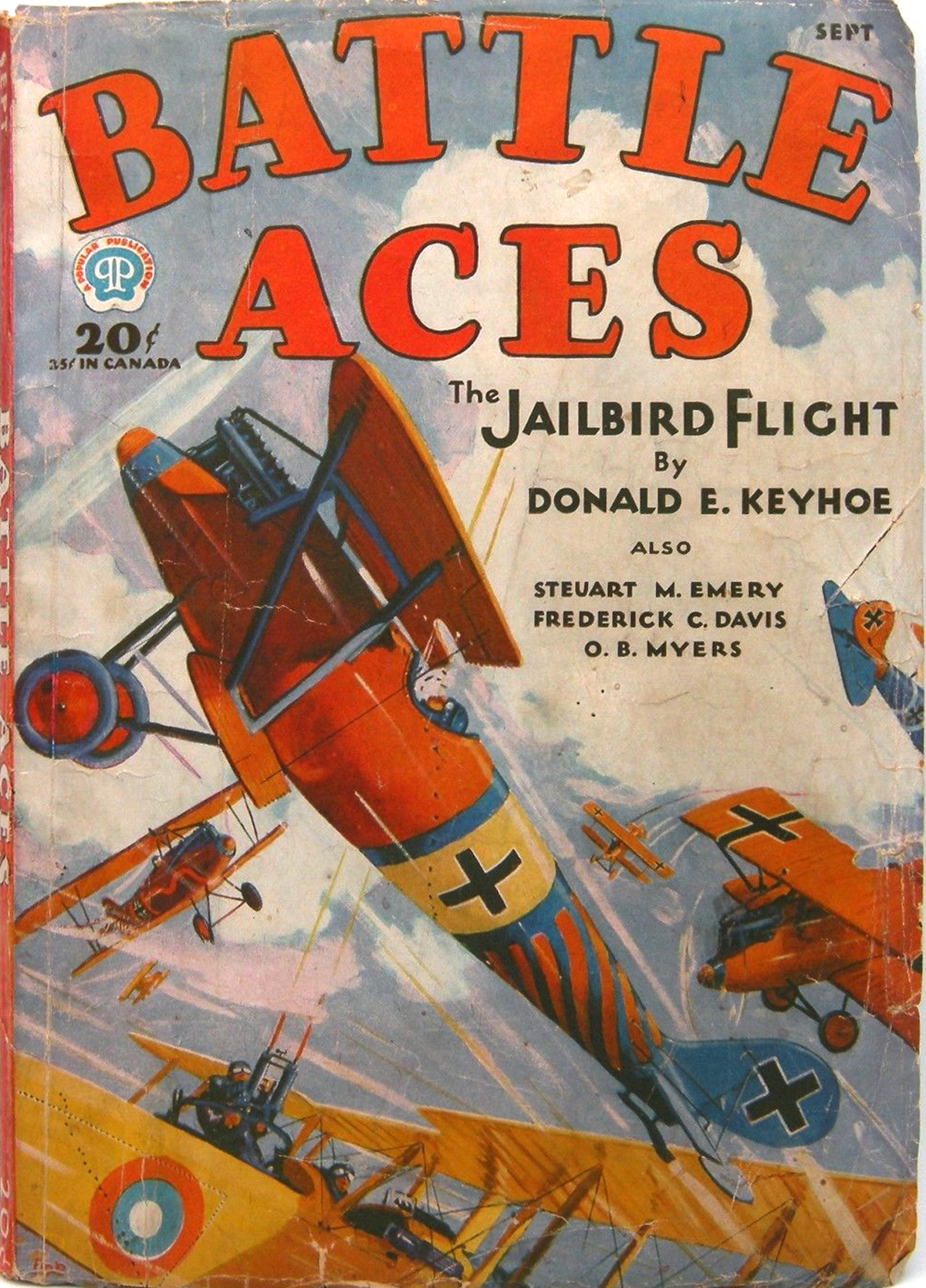
th_BA_3109THE BEST way to tell the story of this month’s cover is in the words of the citation. The pilot was First Lieutenant Stirling C. Alexander of the 99th air squadron and the incident pictured happened in the region of Landres-et-St. Georges, on October 6th, 1918. Here it is.

“He, with Lieutenant Atwater, observer, while on a photographic mission, was forced back by seven enemy pursuit planes. A few minutes later he returned over the lines and while deep in enemy territory was cut off by twelve enemy planes (Pfaltz scouts). He maneuvered his plane to give battle and so effectively managed the machine that he, with his observer, was able to destroy one and force the others to withdraw. With his observer severely wounded, he managed to bring his plane safely back to his own aerodrome with his mission completed.”

Read over the last four words of the citation, and remember—he had twelve Boches to fight! Not three or four, which would have been plenty, but twelve swift pursuit ships that could fly circles around the, comparatively speaking, lumbering reconnaissance ship. With those odds against him he completed his mission. A real pilot!

It is hard to say who had the most important job, the combat pilot, or the reconnaissance pilot, but without any question the reconnaissance pilot had the hardest job. Where the combat pilot could pull out of a fight if anything went wrong, and, due to the speed of his ship, have a fair chance of getting away, the reconnaissance pilot in his slower ship had to rely on his observer’s aim. For him it was a case of fighting it out as best he could. If his observer was shot, or his guns jammed—well, it was just too bad.

The reconnaissance pilot’s work consisted of observing troop movements, often deep in enemy territory; photographing, sometimes at low altitudes; special missions or spy planting (a job no one wanted); artillery direction and, when necessity arose, of fighting his way home.

To fly on such a mission against such overwhelming odds was no mean feat.

The combat pilots of both sides were always on the lookout for the two-place ships, as they were considered cold meat for two or more fighting planes. There is only one case on record where a reconnaissance ship was unmolested. Even archie ignored this particular plane. Combat pilots would sight it from a distance and dive in to attack, but upon recognizing it, would veer off with a smile and look for victims elsewhere.

The ship was a German and was called “The Flying Pig.” It used to come out over the lines every afternoon in the same place, fly up and down and then go home. It never did any harm as far as could be observed and from the lumbering and clumsy way it was flown it derived its name. It was believed to be piloted by an old woman. When a combat ship approached too near, its attempts to escape were pathetic. It was a point of honor among Allied pilots never to harm it. One day, however, a new pilot spied it and dove to the attack. He had heard of this particular ship, and on coming close recognized it and zoomed away. No combat ship had ever come as close as this and the poor “Pig” nearly turned itself inside out getting to safety. Since it never appeared again, it was assumed that the pilot died of fright.

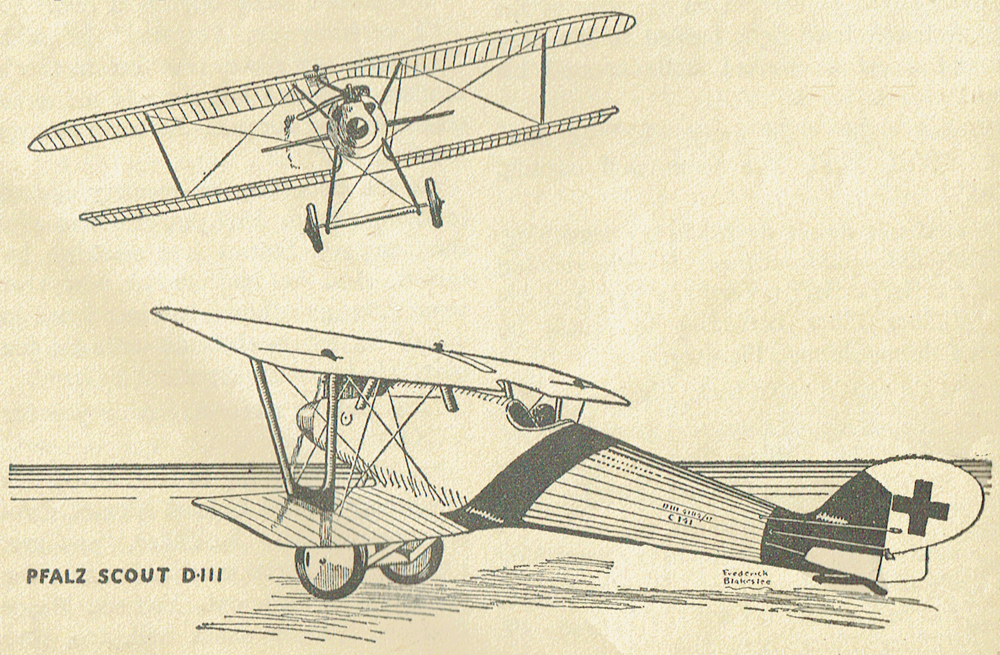
Now let us consider the Boche ship pictured on the cover. It is a Pfaltz scout DIII. Lieutenant Bert Hall of the French army had several battles with Pfaltz scouts and has this to say about them. “The new German Pfaltz single-place ships are damned good. They are as fast as hell and maneuver beautifully.”

The first ship of this type landed in the British lines near Bonnieul, on February 26th, 1918. It is first cousin to the Albatros and is like that ship in many ways. To quote from the report of the first machine captured—”It is light in construction and clean-cut in design, and from the great amount of care that has been taken to keep the fuselage of very good streamline shape, and so free from irregularities, it appears to be the result of a serious attempt to produce a scout machine with good performance. It is powered with a 160 h.p. Mercédés engine. Two Spandau guns fire through the propeller. Its speed at ten thousand feet is 102½ m.p.h. and at fifteen thousand feet, 91½ m.p.h. The estimated absolute ceiling is seventeen thousand feet.

“The machine is stable laterally and un-stable directionally and longitudinally. It tends to turn to the left in flight, is not tiring to fly and is normally easy to land.”

The Germans succeeded in producing a beautiful ship at all events, and one that did a great deal of damage. The faults of the DIII were corrected in a new modle, but it never appeared at the Front as the war ended before it could be brought up. Those who saw it after the Armistice said it was beter looking that the DIII, and if looks meant anything, a ship not to pick a fight wit.

The Pfaltz Scouts and Lieutenant Alexander
“The Pfaltz Scouts and Lieutenant Alexander” by Frederick M. Blakeslee (September 1931)

The original painting for this month’s cover was up for auction in 2012 by Heritage Auctions. They listed it as “The Jailbird Flight, Battle Aces pulp cover, September 1931.” Oil on canvas, it measures 30¼” by 21¼” and was initialed—fmb—by Blakeslee in the lower left. It’s condition reported as: “In-painting from previous frame abrasions visble along the right extreme edge; very light surface grime in the white painted areas; stretcher creases on the upper and right edges faintly visible; area of craquelure in the upper right corner; otherwise in very good condition. Framed to an overall size of 36¾ x 28 inches.” They estimated it would sell for between $3,000 and $5,000, but in the end sold for $2,250.

“The R.E.8’s and Lieutenant Potter” by Frederick Blakeslee

Link - Posted by David on January 5, 2015 @ 12:00 pm in

Editor’s Note: Every month the cover of BATTLE ACES depicts a scene from a real combat actually fought in the War and a real event in the life of a great ace. The series is being painted exclusively for this magazine by Frederick M. Blakeslee, well-known artist and authority on aircraft and was started especially for all of you readers who wrote us requesting photographs of war planes. In this way you not only get pictures of the ships—authentic to the last detail—but you see them in color. Also you can follow famous airmen on many of their most amazing adventures and feel the same thrills of battle they felt. Be sure to save these covers if you want your collection of this fine series to be complete.

th_BA_3108THE COVER this month tells one of the best stories of the War, and that’s saying a lot, because it’s hard to find one that isn’t good. It shows First Lieutenant William C. Potter winning his Distinguished Service Cross—a decoration well earned, as you shall see.

A formation of eight reconnaissance machines, when on a daylight bombing mission in the vicinity of Dun-sur-Meuse, on September 26th, 1918, was attacked by a force of enemy planes three times its number. Now twenty-four Jerries in one formation is a whale of a formation, believe me. Go out some nice clear morning, point your finger at twenty-four places in the sky, and you’ll get some idea of the amount of ammunition floating about that September day.

All hell broke loose when the two formations met. Potter, with his observer, was in the thick of it, and the Jerries had good cause to remember him that day. The fight had been on only a few moments when Potter noticed that his leader’s plane was pulling away from the battle toward Germany, and that the pilot was making desperate efforts to control the machine. The observer’s guns were inactive. Here was a bit of cold meat for the Boche flyers. They weren’t long in realizing it. A half dozen or more left the dogfight and tore in to finish the Yank off, but they hadn’t reckoned with Potter. He also left the fight, and, “under conditions demanding greatest courage and determination flew in close so as to protect him from the rear.”

He beat off the immediate attack on his leader, but by this time they were both well over Germany. The Allied ships had disappeared, and the disabled plane showed no indication of turning. Potter of course knew that something was desperately wrong. The observer was invisible—gone overboard perhaps—but why didn’t the pilot turn? Was he lost? Couldn’t he turn? That was it! The meaning of the pilot’s frantic signaling at last became clear. He couldn’t turn! For some reason the controls were jammed.
Well, he couldn’t leave a helpless comrade to the mercy of the Fokkers, so with renewed energy he fought on, determined to protect his leader to the last drop of blood or gas. By now they were deep in enemy territory and getting deeper every second. Chances of regaining their own airdrome were fast decreasing. The fight raged furiously, the only advantage on the side of the Americans being the Jerries’ inability to separate them, and the great number of German ships which had to watch each other to avoid collision.

Conditions were getting desperate, when suddenly, to Potter’s relief, the leader made a turn about, headed at last for home. Lieutenant Potter turned with him. Regaining his position he started to fight his way toward Allied territory, now miles ahead.

They had a long distance to go, gas was getting low and the ships were badly shot. But the planes continued to fly, and as long as the ammunition held out, the Yanks knew they now had a chance.

The frustrated Boche buzzed after them like a swarm of angry bees. Soon the two speeding planes were back over the lines where the Jerries decided to depart, helped in their decision by the presence of a few Allied wasps. The two tired pilots landed their riddled machines on their own airdrome on the last drop of gas.

It was found that the leader had been unable to turn because his observer had been killed early in the fight, and in falling had jammed the controls. It was only due to the skilled protection afforded by Lieutenant Potter that he had been given an opportunity to clear the jam.

The two ships pictured are not the machines that figured in this experience; we show these because they are more famous than the ones actually used. They are R.E.8’s, also known as the Harry Tate, a British experimental machine, hence the letters R.E.

First produced in 1912, the R.E. had a Beardmore 120 h.p. engine. It gave some good climbs, but being somewhat troublesome to land, was not built in quantities and was more or less obsolete during 1918. Later developments of the type produced in 1914-15-16, showed greater speed and were used in active service for certain specific purposes. The R.E.8, being the eighth in the series, was used during the later period of the war. It resembled somewhat the B.E.’s, known as “Quirks”—two guns fired through the propeller, that was very often four-bladed, and one gun on a swivel in the observer’s cockpit. It had an R.A.F. 4A, 150 h.p. engine; its weight was 2,680 lbs.; speed at 5,000 feet, 103 m.p.h., and at 10,000 feet, 96 m.p.h. It could climb to 5,000 ft. in 11 minutes, 25 seconds, and to 10,000 ft. in 29 minutes, 5 seconds. It’s absolute ceiling was 17,000 ft. Besides reconnaissance work, it could give a very good account of itself in a fight.

The R.E.8's and Lieutenant Potter
“The R.E.8’s and Lieutenant Potter” by Frederick M. Blakeslee (August 1931)

Next week the cover of BATTLE ACES will show a Pfaltz, attacking a D.H.9 which First Lieutenant S.C. Alexander of the 99th Aero Squadron is piloting. The OCTOBER number will show First Lieutenant R.O. Linsay in an S.E.5 fighting a flock of Fokkers. Others in the series will be announced later. The present cover is the third in the series. Last month we featured the B.E. Fighter, and the cover of the June issue showed a flight of S.E.’s attacking a Boche balloon.

“Green Horn Wings” by Frederick Blakeslee

Link - Posted by David on December 25, 2014 @ 12:00 pm in

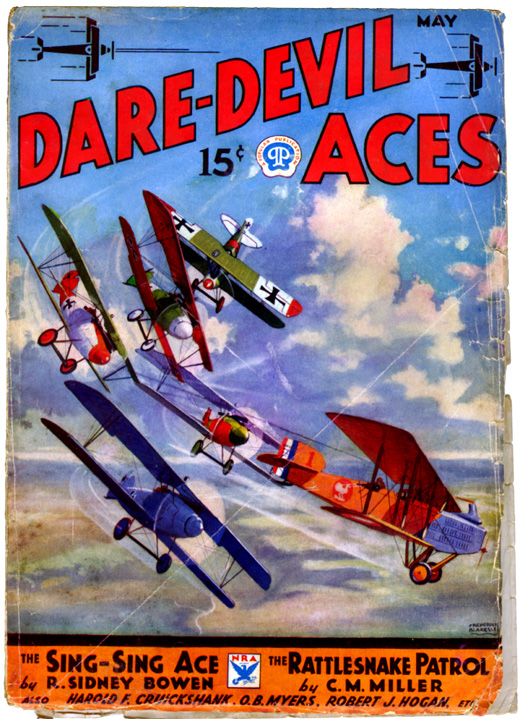
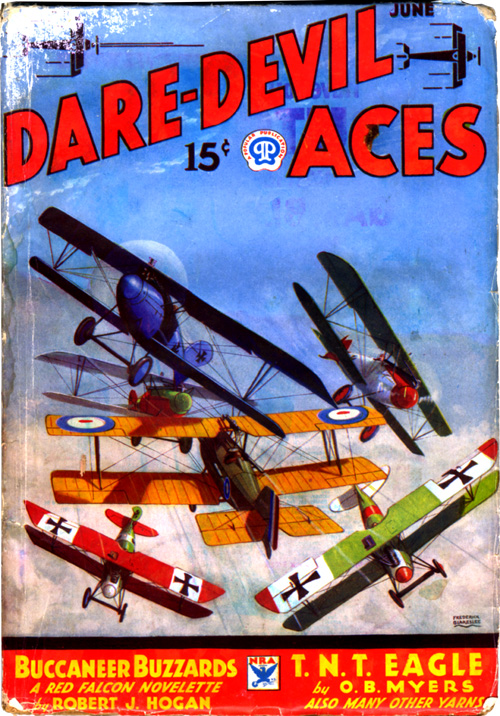
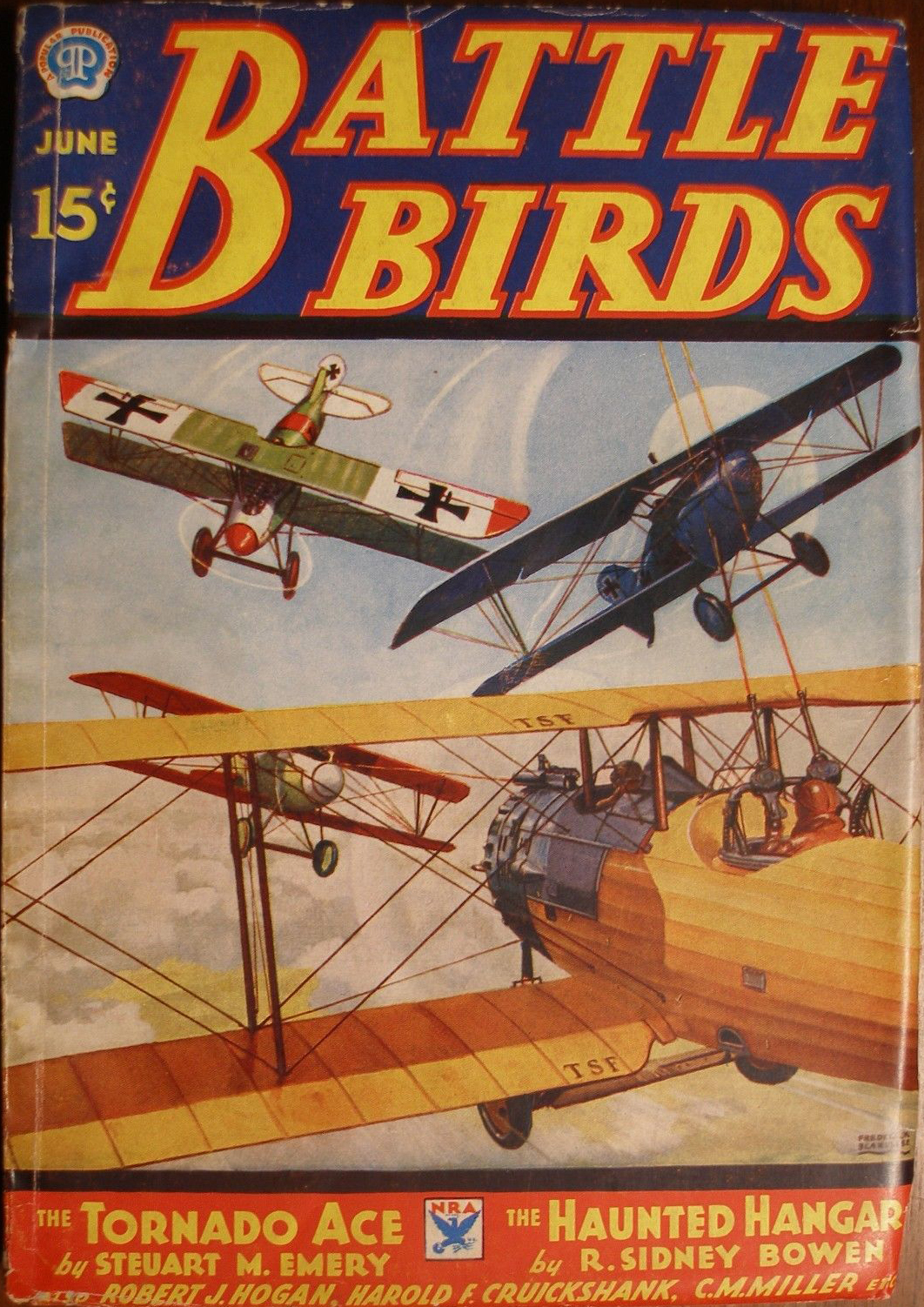
Frederick Blakeslee painted the covers for Dare-Devil Aces‘ entire fourteen year run. He also painted all 17 covers of the first run of Battle Birds. When you’re doing all the covers, it’s easy to have a continuing story. As a special treat this week we have a three part story told over two months and two different magazines. We start with the May 1934 cover of Dare-Devil Aces and continue the story on the following month’s cover and on over to the same month’s issue of Battle Birds!

th_DDA_3405THE COVER this month illustrates one of three exciting encounters described by a German flyer in answer to the question, “What do you consider your most exciting flight?” The author’s name is withheld by request. The other two encounters will be shown on the covers of BATTLE BIRDS and DARE-DEVIL ACES for June. The following has been translated by Mr. J.J. Hermann.

“My most exciting flight? That is very easy to answer—my first front-line patrol.

“Just a word about my plane before I go on. All the ships in our staffel were painted in combinations of red, white and green, except the commander’s, which was all blue. My Albatros had red-tipped upper wings, black crosses on a white field, and the rest of the wing, fuselage and lower wing, was green. A red band encircled the fuselage, on which were black crosses. The fin and rudder were green and the elevator white. It was a beauty and I was immensely proud of it.

“Our commander, like Richthofen, was very severe with anyone who returned to the field with bullet holes in the tail of his machine. Every pilot in the staffel would rather be shot down then come home with holes in his tail.

“I received my instructions, which were to stick in formation and to follow the commander no matter what happened, unless we ran into an enemy formation. In that case, the leader was to rock his ship if he went to the attack, and I was to fly for home at once. They considered me too ‘air-blind’ to be of any use in combat. Of course, I couldn’t understand why any one should be ‘air-blind’, for certainly it would be easy enough to see an enemy plane. But I soon learned.

“I was flying close on the left of the leader, and was so engrossed with watching him that the whole enemy air force could have surrounded us without my knowing it. It was all I could do to keep my place in formation. I would throttle down when I seemed too close and then I’d get too far away and have to speed up only to get too close again. It was probably nervousness, for I had had no trouble in this respect in practice flights.

“I had been making heavy weather of it for perhaps twenty minutes when the leader suddenly dove. Ha, thought I, he is testing me. Down I went only to find that I was last in the formation. The three other planes were bunched directly in front of me. Turning to the left, I frantically tried to regain my position—and lost sight of the staffel at once. There I was as far as I could see, completely alone. The only thing was to go home, but that wasn’t so easy for I was absolutely lost. I was flying around in circles trying to locate the flight when to my surprise I found that I was again following my leader.

“It wasn’t until several hours later that I learned what had happened. When my leader dove it was to attack a lone Bre-guet. My awkward attempts to follow him disrupted the formation and spoiled his surprise move. He received a blast of fire from the French gunner, one bullet passing through his cheek and knocking out a few teeth. Then he saw me floundering around where I wasn’t supposed to be at all; breaking off the flight he picked me up and started for home.

“He looked at me to see if I saw him. I waved—I was determined not to lose him this time—and he began to climb, passing through clouds that covered what had been a cloudless sky. A minute later, he seemed to vanish again. Again I was alone and lost. . . .”

th_DDA_3406“I THOUGHT I knew what had happened. My leader had executed these sudden maneuvers to test me—and I had failed. I determined to be on the alert next time.

“When I saw him go into another dive, therefore, I followed—and a split second later found myself alone again! Finally, after a frantic search, I spotted his Alba-tros high above me. Wondering how he got so high while I was flying so low, I climbed up and took my old position in the formation. This time my leader did not look at me, and a few minutes later we landed at our drome.

“To my surprise no other ships were on the tarmac. We were the first to return. With a sigh of relief at being safely home, but dreading the lecture on formation flying which I knew I deserved, I jumped out of my Albatros. It was then I realized that several men were lifting my leader out of his cockpit. Rushing over I was amazed to see that his face was covered with blood!

“The whole flight had been one surprise after another; but two more were still to come. One occurred a few minutes later when I discovered that the tail of my ship was full of bullet holes! How had they gotten there? While I was trying to figure that puzzle out, one of my missing patrol mates landed and handed me the second surprise by explaining what had happened during the short time I was in the air.

“After describing our encounter with the Breguet (pictured on last month’s cover) he went on. It seemed that my leader, seeing me floundering around instead of flying home and realizing I was a cold meat shot, broke off the flight, picked me up and started for home.

“A minute later an S.E. 5 hurtled straight through our formation. This was when I lost sight of my leader for the second time. The S.E.5 shot through like a mad comet, neither turning right or left, but blazing away with its guns. It is this amazing act of daring that Mr. Blakeslee has painted for the present issue of DARE-DEVIL ACES.

“One of our patrol was shot down th_BB_3406in control and another started in pursuit. The three of us that remained were almost home when we ran into a formation of Salmsons (see June BATTLE BIRDS cover). The leader of this flight shot down another one of our planes—also in control, luckily. The pilot returned two days later. The man shot down by the S.E.5 had to land in enemy territory and was taken prisoner.

“Did I escape a lecture for getting my tail shot full of holes? By the time my leader was out of the hospital I had brought down my third enemy ship—but I got the lecture just the same!”

The Story Behind The Cover
“Green Horn Wings: The Story Behind The Cover” by Frederick M. Blakeslee (May 1934)

The Story Behind The Cover
“S.E.5 Hell: The Story Behind The Cover” by Frederick M. Blakeslee (June 1934)

Check back again. We will be presenting more of Blakeslee’s Stories behind his cover illustrations. This feature will move to Mondays starting in the new year when we will be featuring some of Mr. Blakeslee’s covers for Battle Aces!

“Hell Divers” by Frederick Blakeslee

Link - Posted by David on December 18, 2014 @ 12:00 pm in

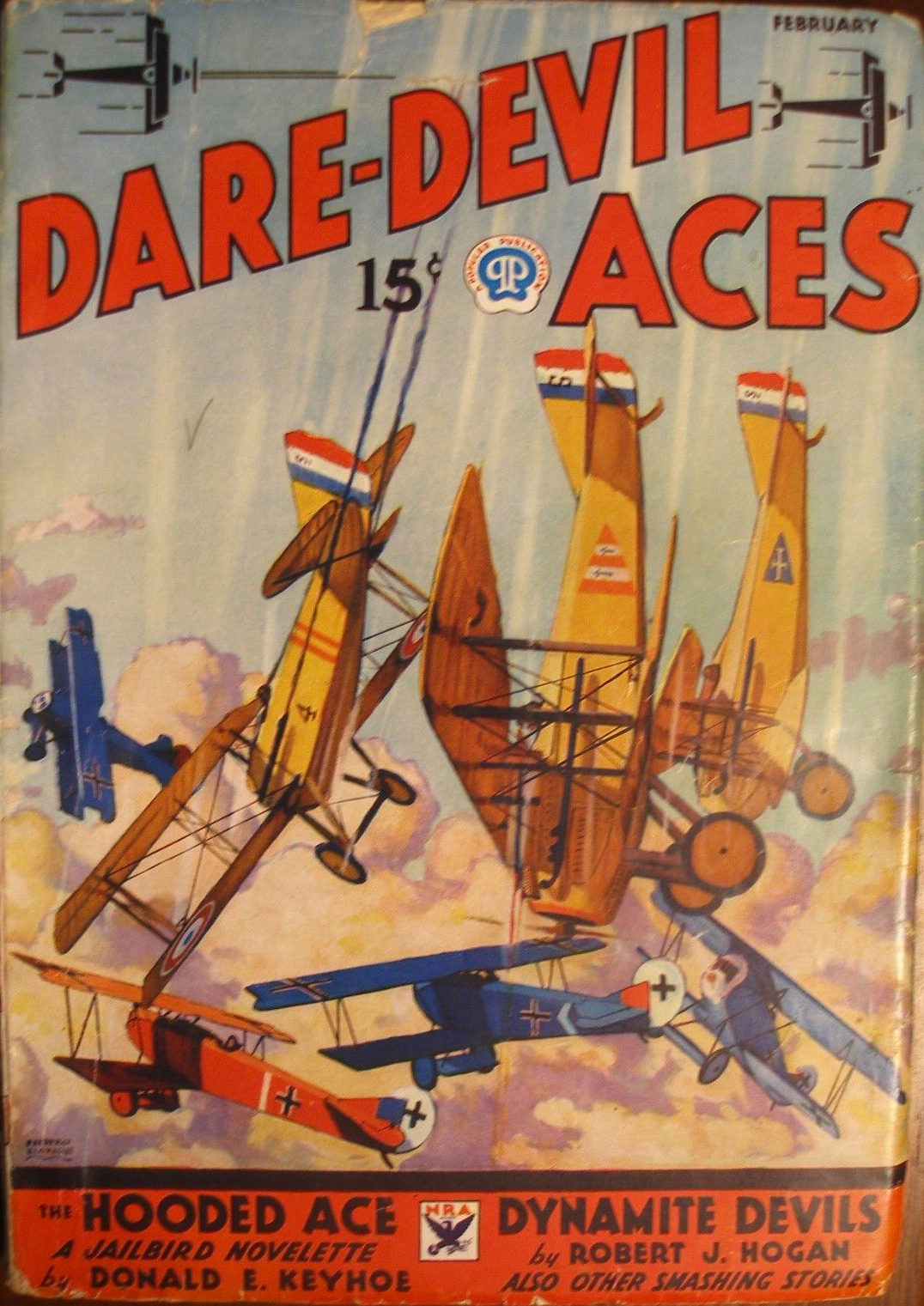
Frederick Blakeslee painted all the covers for the entire run of Dare-Devil Aces. And each of those covers had a story behind it. This time the story is self evident Blakeslee tells us, but then turns around to tell us the story behind his cover for the prvious December’s issue of Battle Birds and ties our old pal, French Ace Georges Guynemer. All this in February’s cover form 1934—”Hell Divers!”

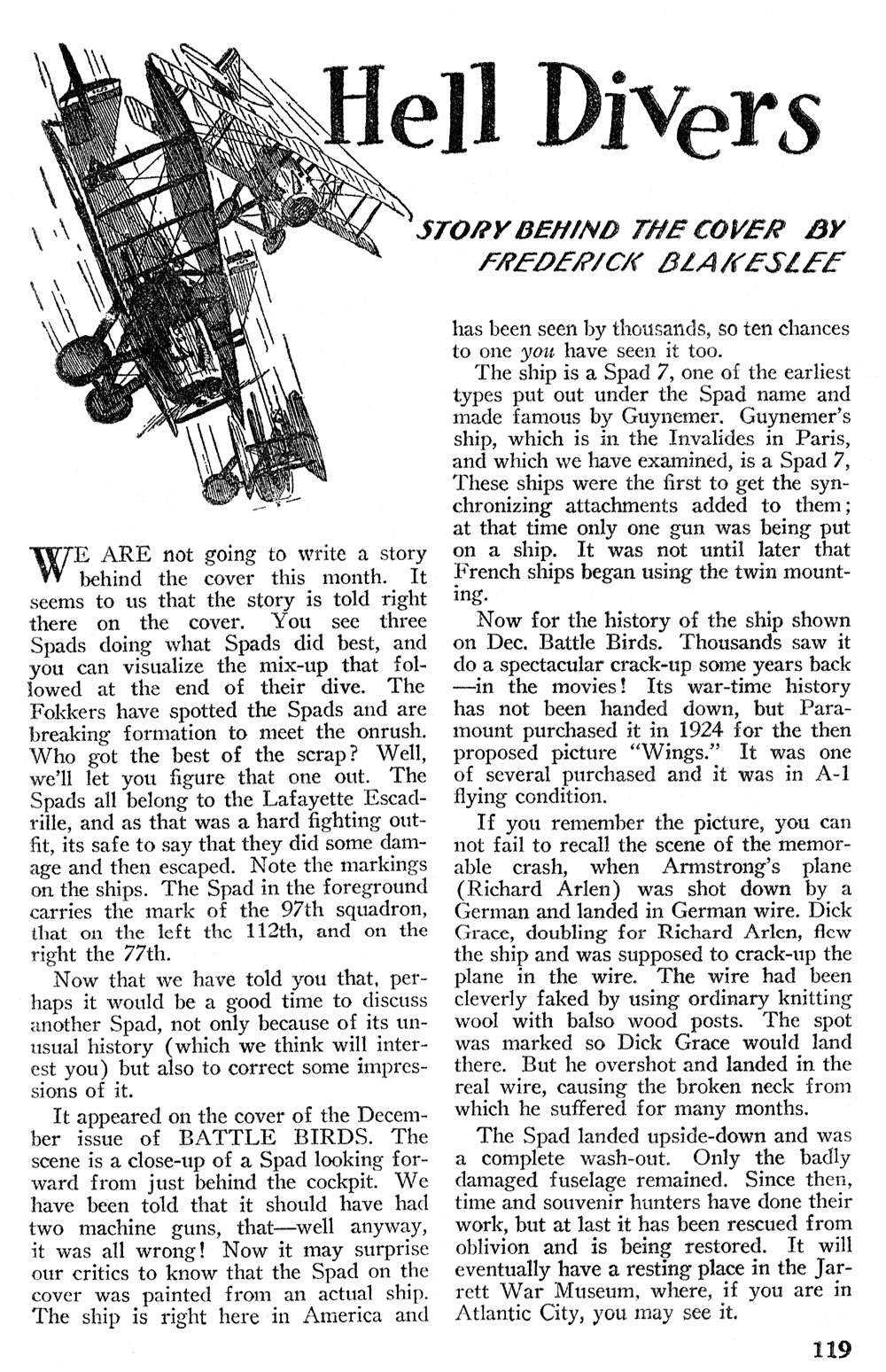
th_DDA_3402WE ARE not going to write a story behind the cover this month. It seems to us that the story is told right there on the cover. You see three Spads doing what Spads did best, and you can visualize the mix-up that followed at the end of their dive. The Fokkers have spotted the Spads and are breaking formation to meet the onrush. Who got the best of the scrap? Well, we’ll let you figure that one out. The Spads all belong to the Lafayette Escadrille, and as that was a hard fighting outfit, its safe to say that they did some damage and then escaped. Note the markings on the ships. The Spad in the foreground carries the mark of the 97th squadron, that on the left the 112th, and on the right the 77th.

Now that we have told you that, perhaps it would be a good time to discuss another Spad, not only because of its unusual history (which we think will interest you) but also to correct some impressions of it.

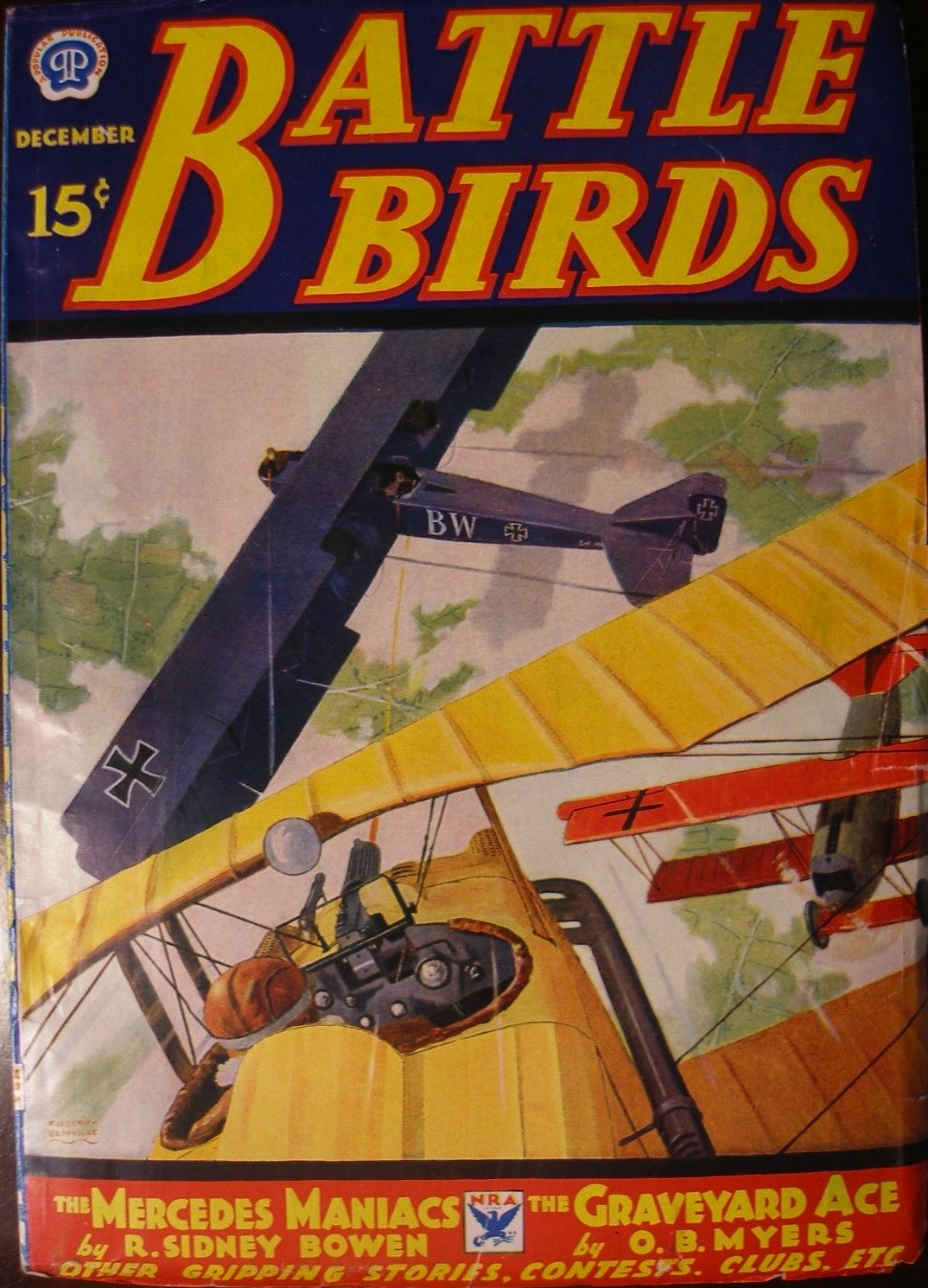
th_BB_3312It appeared on the cover of the December issue of BATTLE BIRDS. The scene is a close-up of a Spad looking forward from just behind the cockpit. We have been told that it should have had two machine guns, that—well anyway, it was all wrong! Now it may surprise our critics to know that the Spad on the cover was painted from an actual ship. The ship is right here in America and has been seen by thousands, so ten chances to one you have seen it too.

The ship is a Spad 7, one of the earliest types put out under the Spad name and made famous by Guynemer. Guynemer’s ship, which is in the Invalides in Paris, and which we have examined, is a Spad 7, These ships were the first to get the synchronizing attachments added to them; at that time only one gun was being put on a ship. It was not until later that French ships began using the twin mounting.

Now for the history of the ship shown on Dec. Battle Birds. Thousands saw it do a spectacular crack-up some years back—in the movies! Its war-time history has not been handed down, but Paramount purchased it in 1924 for the then proposed picture “Wings.” It was one of several purchased and it was in A-l flying condition.

If you remember the picture, you can not fail to recall the scene of the memorable crash, when Armstrong’s plane (Richard Arlen) was shot down by a German and landed in German wire. Dick Grace, doubling for Richard Arlcn, flew the ship and was supposed to crack-up the plane in the wire. The wire had been cleverly faked by using ordinary knitting wool with balsa wood posts. The spot was marked so Dick Grace would land there. But he overshot and landed in the real wire, causing the broken neck from which he suffered for many months.

The Spad landed upside-down and was a complete wash-out. Only the badly damaged fuselage remained. Since then, time and souvenir hunters have done their work, but at last it has been rescued from oblivion and is being restored. It will eventually have a resting place in the Jarrett War Museum, where, if you are in Atlantic City, you may see it.

The Story Behind The Cover
“Hell Divers: The Story Behind The Cover” by Frederick M. Blakeslee (February 1934)

Check back again. We will be presenting more of Blakeslee’s Stories behind his cover illustrations.

“The Green Devil” by Frederick Blakeslee

Link - Posted by David on December 11, 2014 @ 12:00 pm in

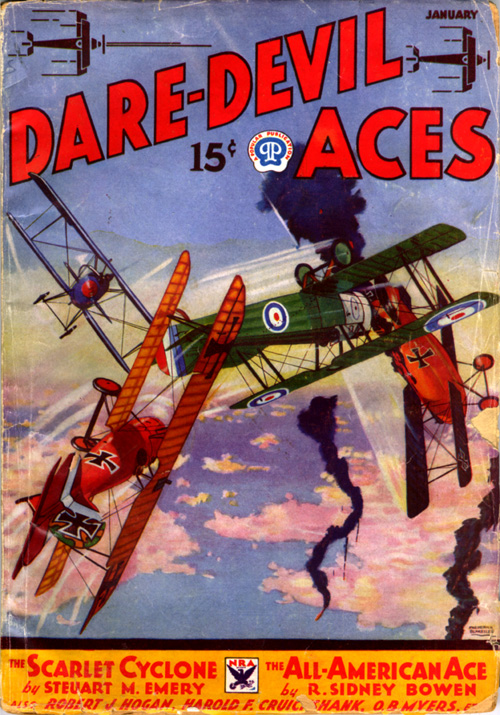
Frederick Blakeslee painted all the covers for the entire run of Dare-Devil Aces. And each of those covers had a story behind it. For the January 1934 issue Blakeslee paints a confrontation between Richthofen’s Circus and a couple of English Camels in “The Green Devil”…

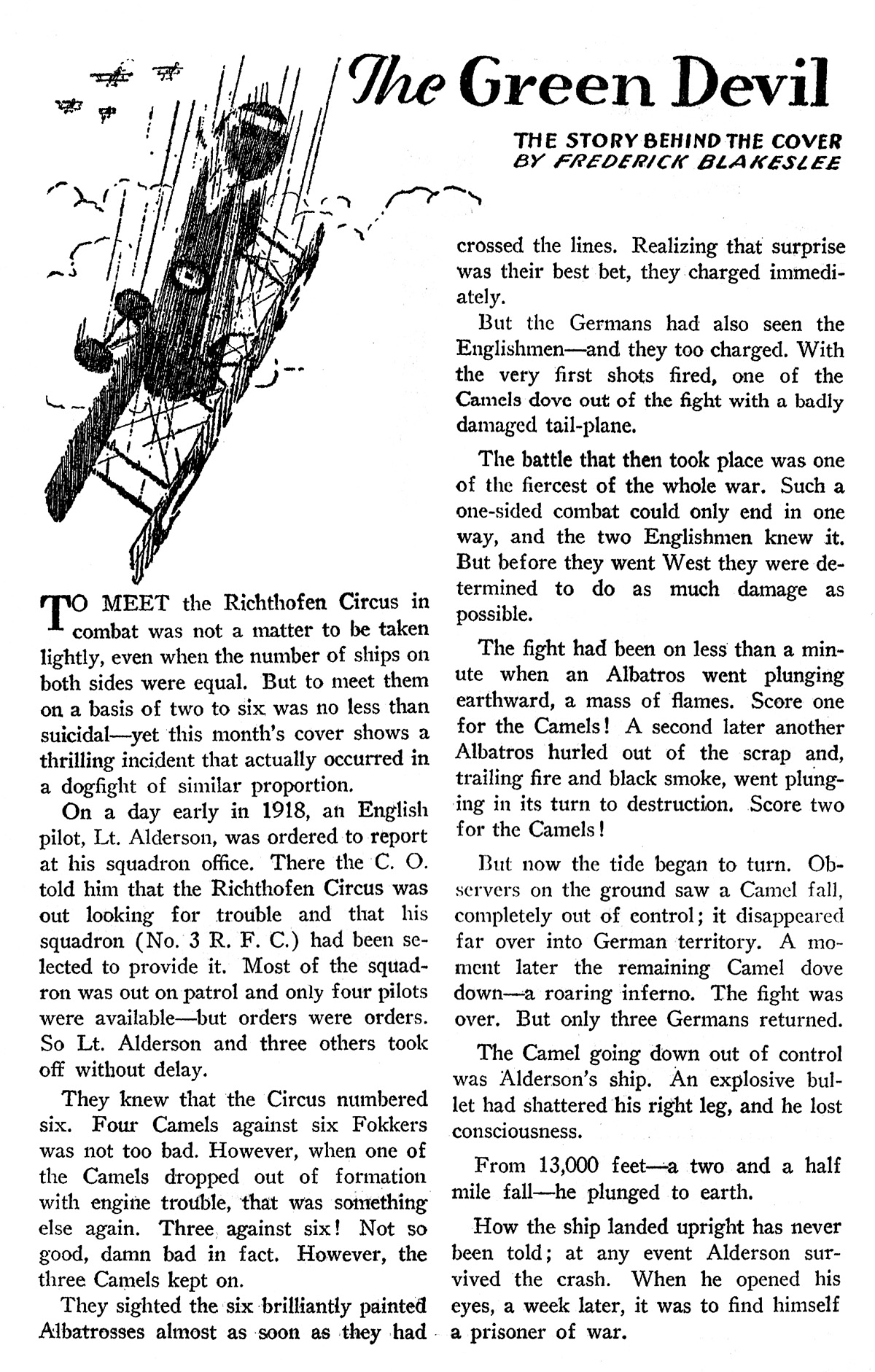
th_DDA_3401TO MEET the Richthofen Circus in combat was not a matter to be taken lightly, even when the number of ships on both sides were equal. But to meet them on a basis of two to six was no less than suicidal—yet this month’s cover shows a thrilling incident that actually occurred in a dogfight of similar proportion.

On a day early in 1918, an English pilot, Lt. Alderson, was ordered to report at his squadron office. There the C.O. told him that the Richthofen Circus was out looking for trouble and that his squadron (No. 3 R.F.C.) had been selected to provide it. Most of the squadron was out on patrol and only four pilots were available—but orders were orders. So Lt. Alderson and three others took off without delay.

They knew that the Circus numbered six. Four Camels against six Fokkers was not too bad. However, when one of the Camels dropped out of formation with engine trouble, that was something-else again. Three against six! Not so good, damn bad in fact. However, the three Camels kept on.

They sighted the six brilliantly painted Albatrosses almost as soon as they had crossed the lines. Realizing that surprise was their best bet, they charged immediately.

But the Germans had also seen the Englishmen—and they too charged. With the very lirst shots fired, one of the Camels dove out of the fight with a badly damaged tail plane.

The battle that then took place was one ol the fiercest of the whole war. Such a one-sided combat could only end in one way, and the two Englishmen knew it. But before they went West they were determined to do as much damage as possible.

The fight had been on less than a minute when an Albatros went plunging earthward, a mass of flames. Score one for the Camels! A second later another Albatros hurled out of the scrap and, trailing fire and black smoke, went plunging in its turn to destruction. Score two Eor the Camels!

But now the tide began to turn. Observers on the ground saw a Camel fall, completely out of control; it disappeared far over into German territory. A moment later the remaining Camel dove down—a roaring inferno. The fight was over. But only three Germans returned.

The Camel going down out of control was Alderson’s ship. An explosive bullet had shattered his right leg, and he lost consciousness.

From 13,000 feet—a two and a half mile fall—he plunged to earth.

How the ship landed upright has never been told; at any event Alderson survived the crash. When he opened his eyes, a week later, it was to find himself a prisoner of war.

The Story Behind The Cover
“The Green Devil: The Story Behind The Cover” by Frederick M. Blakeslee (January 1934)

Check back again. We will be presenting more of Blakeslee’s Stories behind his cover illustrations.

Another Letter from Blakeslee

Link - Posted by David on December 4, 2014 @ 12:00 pm in

Were Frederick Blakeslee still alive, today would be his 116th birthday! In honor of his birthday, today we have another letter from Blakeslee to Jess Yeager. The other day we had a letter Blakeslee sent to Jess in 1935—knee deep in his pulp career. At that time he was doing covers for Dare-Devil Aces and G-8 and his Battle Aces ever month as well as interiors for each issue of Dare-Devil Aces.

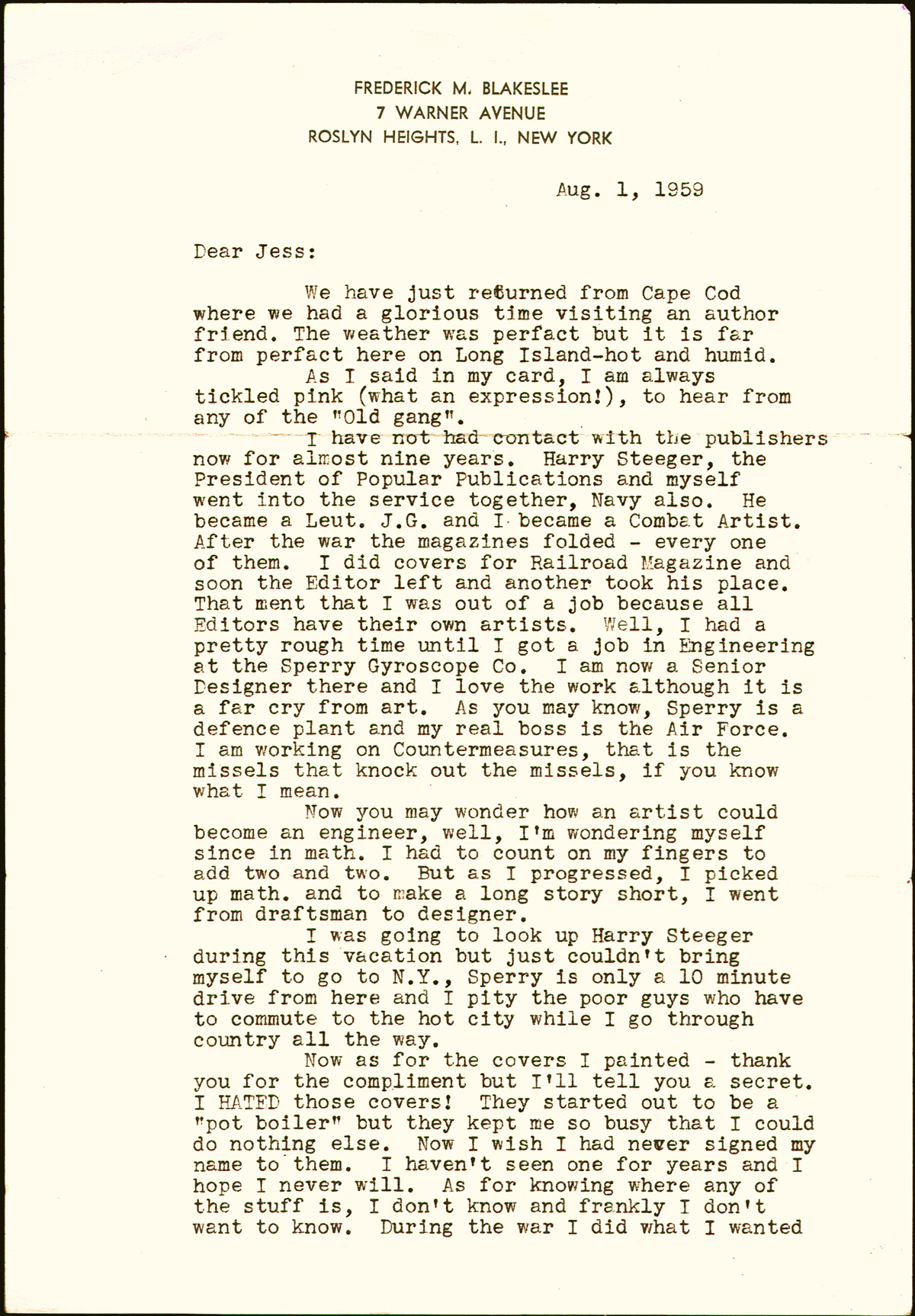
This time we find an older Blakeslee. Now 60, he has left the pulps behind and is Senior Designer at Sperry Gyroscope Co working on Countermeasures—”the missles that knock out the missles” as Blakeslee writes. He updates Jess, a father now, on his life since the demise of the pulps. From August 1st, 1959:

Dear Jess:

    We have just returned from Cape Cod where we had a glorious time visiting an author friend. The weather was perfact but it is far from perfact here on Long Island-hot and humid.

    As I said in my card, I am always tickled pink (what an expression!), to hear from any of the “Old gang”.

    I have not had contact with the publishers now for almost nine years. Harry Steeger, the President of Popular Publications and myself went into the service together, Navy also. He became a Leut. J.G. and I became a Combat Artist. After the war the magazines folded – every one of them. I did covers for Railroad Nagazine and soon the Editor left and another took his place. That ment that I was out of a job because all Editors have their own artists. Well, I had a pretty rough time until I got a job in Engineering at the Sperry Gyroscope Co. I am now a Senior Designer there and I love the work although it is a far cry from art. As you may know, Sperry is a defence plant and my real boss is the Air Force. I am working on Countermeasures, that is the missels that knock out the missels, if you know what I mean.

    Now you may wonder how an artist could become an engineer, well, I’m wondering myself since in math. I had to count on my fingers to add two and two. But as I progressed, I picked up math, and to make a long story short, I went from draftsman to designer.

    I was going to look up Harry Steeger during this vacation but just couldn’t bring myself to go to N.Y., Sperry is only a 10 minute drive from here and I pity the poor guys who have to commute to the hot city while I go through country all the way.

    Now as for the covers I painted – thank you for the compliment but I’ll tell you a secret. I HATED those covers! They started out to be a “pot boiler” but they kept me so busy that I could do nothing else. Now I wish I had never signed my name to them. I haven’t seen one for years and I hope I never will. As for knowing where any of the stuff is, I don’t know and frankly I don’t want to know. During the war I did what I wanted
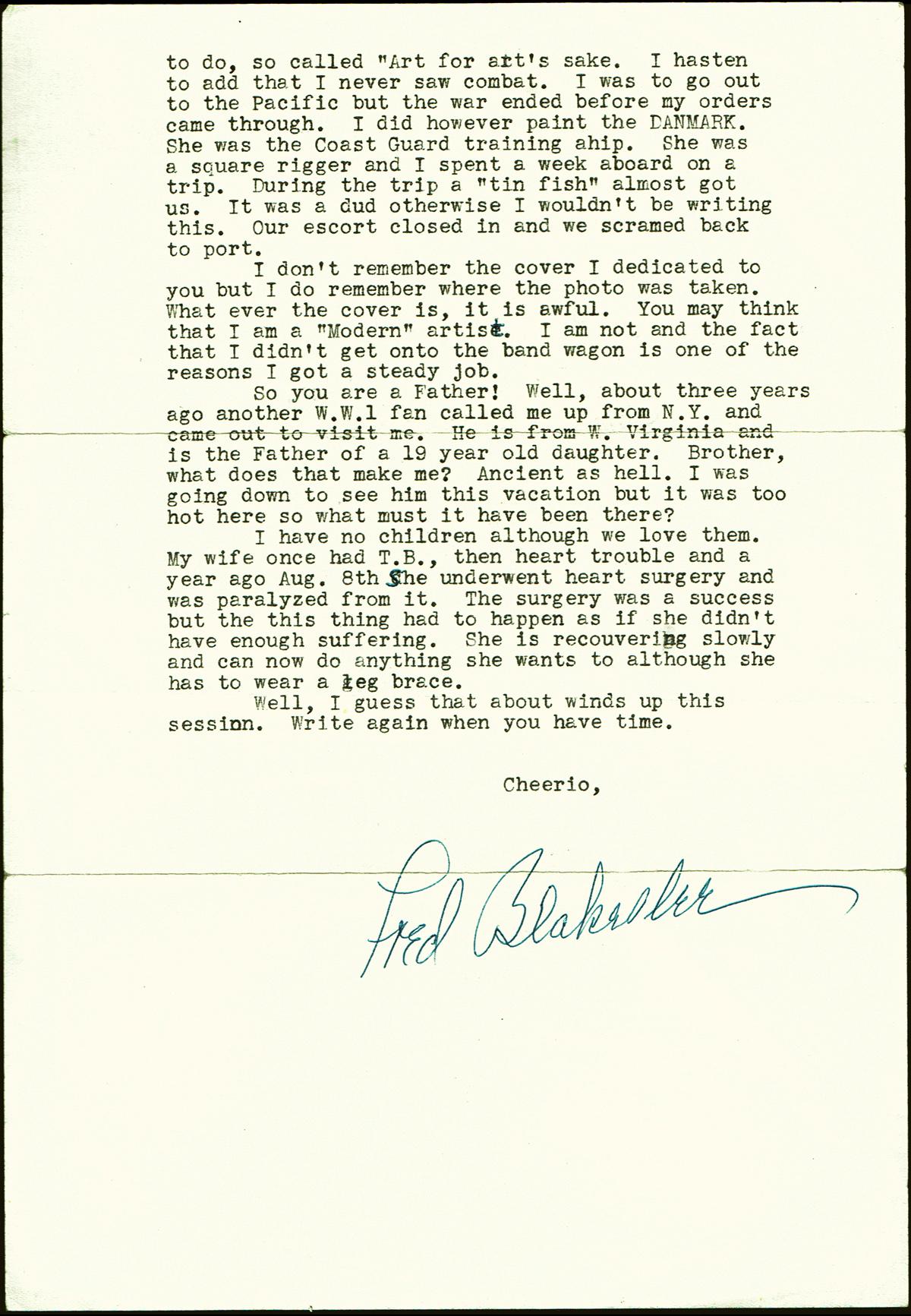
to do, so called “Art for art’s sake. I hasten to add that I never saw combat. I was to go out to the Pacific but the war ended before ny orders came through. I did however paint the DANMARK. She was the Coast Guard training ahip. She was a square rigger and I spent a week aboard on a trip. During the trip a “tin fish” almost got us. It was a dud otherwise I wouldn’t be writing this. Our escort closed in and we scramed back to port.

    I don’t remember the cover I dedicated to you but I do remember where the photo was taken. What ever the cover is, it is awful. You may think that I am a “Modern” artist. I am not and the fact that I didn’t get onto the band wagon is one of the reasons I got a steady job.

    So you are a Father! Well, about three years ago another W.W.I fan called me up from N.Y. and came out to visit me. He is from W. Virginia and is the Father of a 19 year old daughter. Brother, what does that make me? Ancient as hell. I was going down to see him this vacation but it was too hot here so what must it have been there?

    I have no children although we love them. My wife once had T.B., then heart trouble and a year ago Aug. 8th she underwent heart surgery and was paralyzed from it. The surgery was a success but the this thing had to happen as if she didn’t have enough suffering. She is recouveriiag slowly and can now do anything she wants to although she has to wear a leg brace.

    Well, I guess that about winds up this session. Write again when you have time.

                                                Cheerio,
                                                Fred Blakeslee

Happy Birthday Frederick Blakeslee!

A Letter from Blakeslee

Link - Posted by David on December 2, 2014 @ 12:00 pm in

With Frederick Blakeslee’s birthday on Thursday this week, we thought we’d present a little something different that the usual “The Story Behind The Cover.” Today we have a letter from the man himself! Yes, we have a responce to a letter to Mr. Blakeslee from a fan in Pennsylvania who has saved all the Blakeslee covers he can get ahold of—unfortunately he’s having trouble getting back issues of Battle Aces (aren’t we all). However, Blakeslee himself doesn’t seem to hold his old cover work in high reguard.

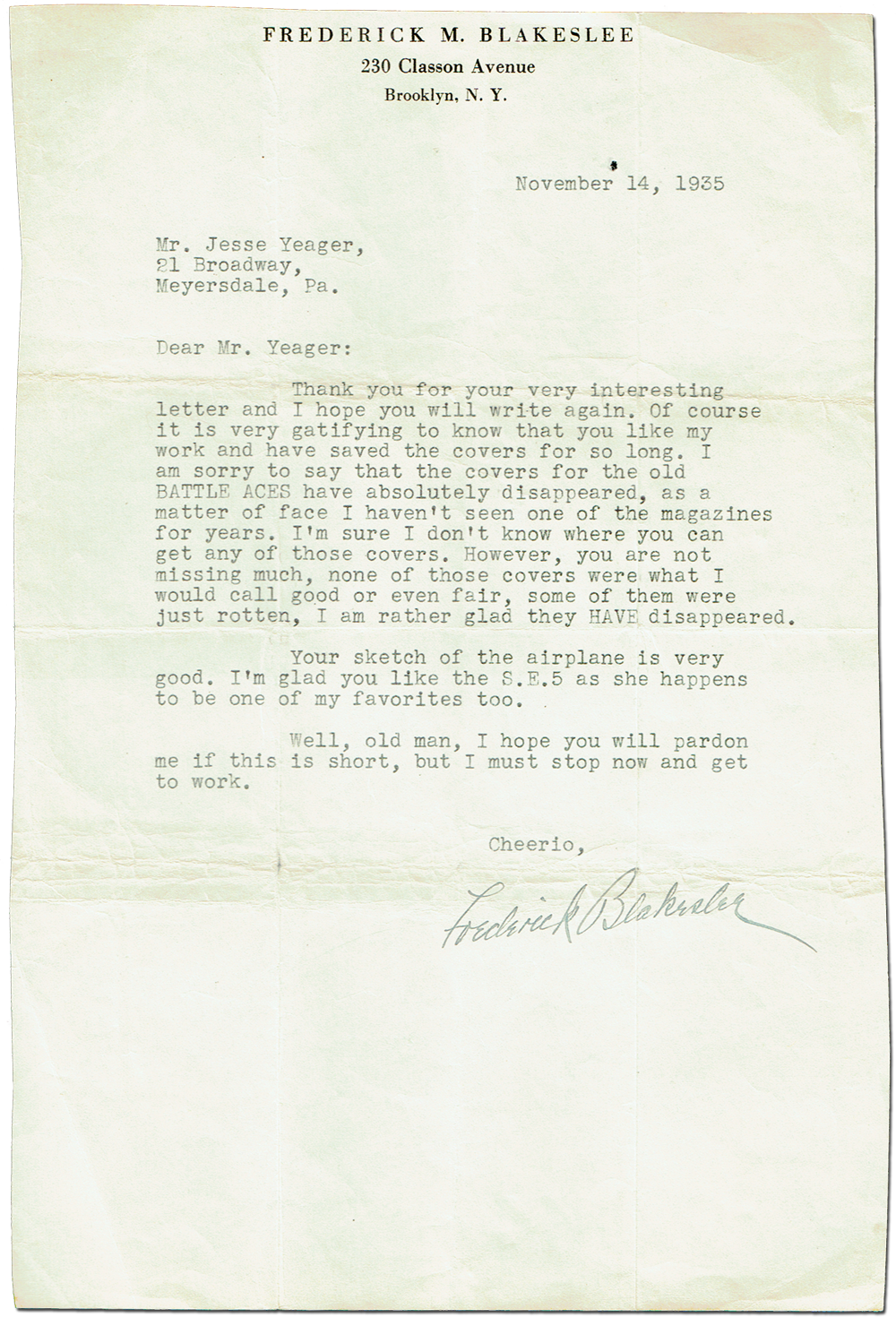
At the time of the letter, Blakeslee was at the top of his form. He was producing cover paintings for Dare-Devil Aces and G-8 and his Battle Aces every month as well as the headers for the stories in each issue of Dare-Devil Aces. From November 14th, 1935:

Dear Mr. Yeager:

    Thank you. for your very interesting letter and I hope you will write again. Of course it is very gatifying to know that you like my work and have saved the covers for so long. I am sorry to say that the covers for the old BATTLE ACES have absolutely disappeared, as a matter of face I haven’t seen one of the magazines for years. I’m sure I don’t know where you can get any of those covers. However, you are not missing much, none of those covers were what I would call good or even fair, some of them were just rotten, I am rather glad they HAVE disappeared,

    Your sketch of the airplane is very good. I’m glad you like the S.E.5 as she happens to be one of my favorites too.

    Well, old man, I hope you will pardon me if this is short, but I must stop now and get to work.

He signed off with “Cheerio,” and signed it “Frederick Blakeslee.”

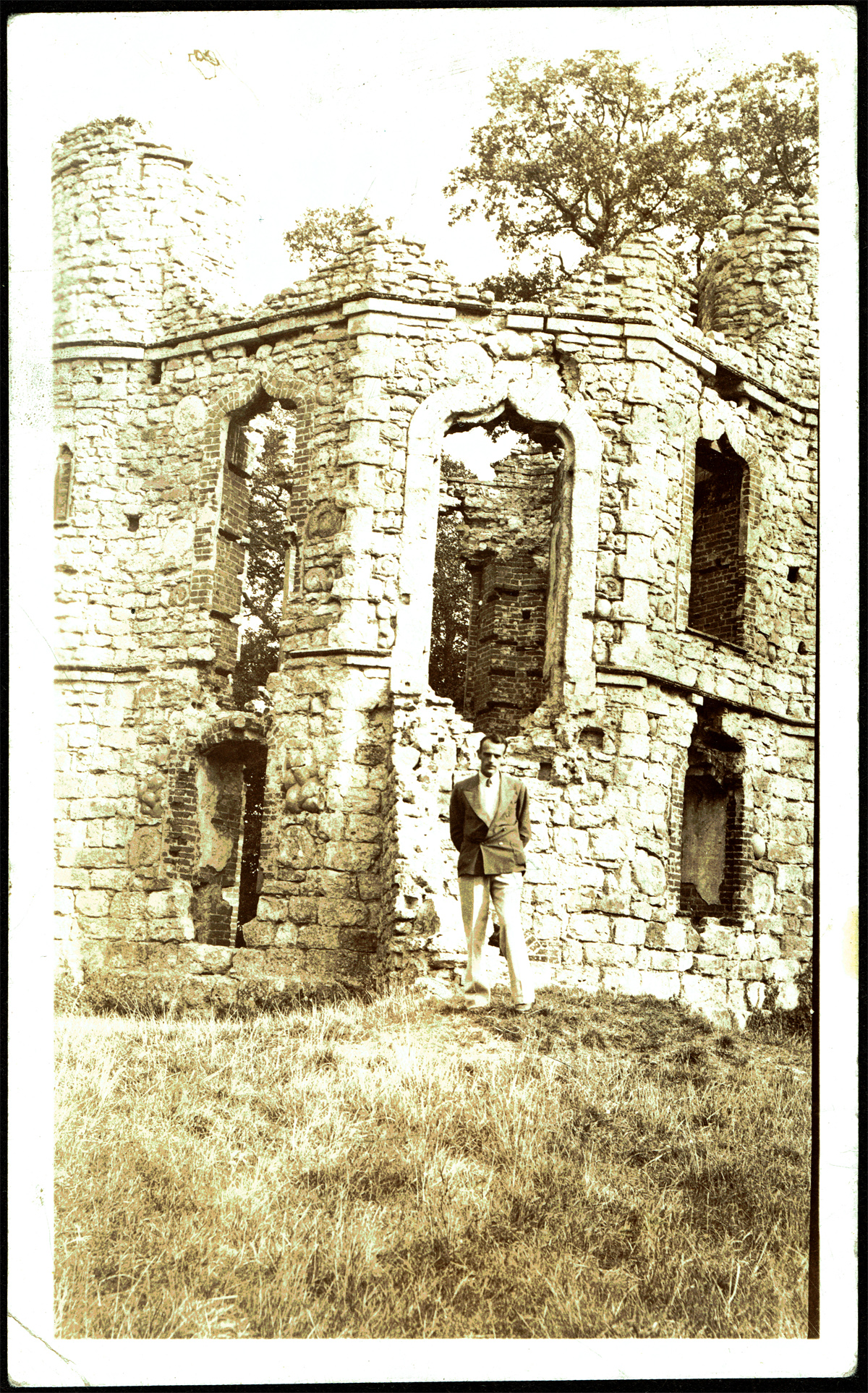
Since the letter’s so short, we have a bonus for you—a vacation snapshot Blakeslee had sent to Jesse at some point in their correspondance. Taken by some castle ruins somewhere between Cambridge & Oxford while on vacation in England in 1936. . .

And be sure to come back on Thursday for another letter to Jesse. This one’s longer and from 1959 after his pulp illustrating career has ended and he’s moved on to other things!

“The Tail Buster” by Frederick Blakeslee

Link - Posted by David on November 27, 2014 @ 12:00 pm in

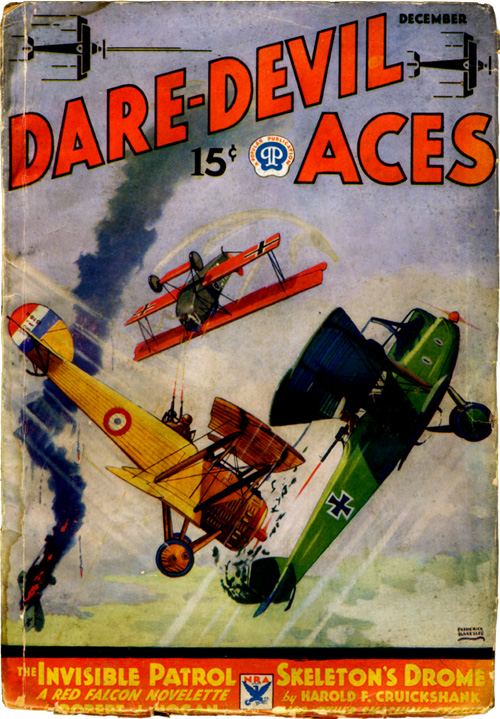
Frederick Blakeslee painted all the covers for the entire run of Dare-Devil Aces. And each of those covers had a story behind it. For the December 1933 issue Blakeslee paints the tail of a premeditated crash between a French Herriot and a German Fokker and L.V.G. in “The Tail Buster”…

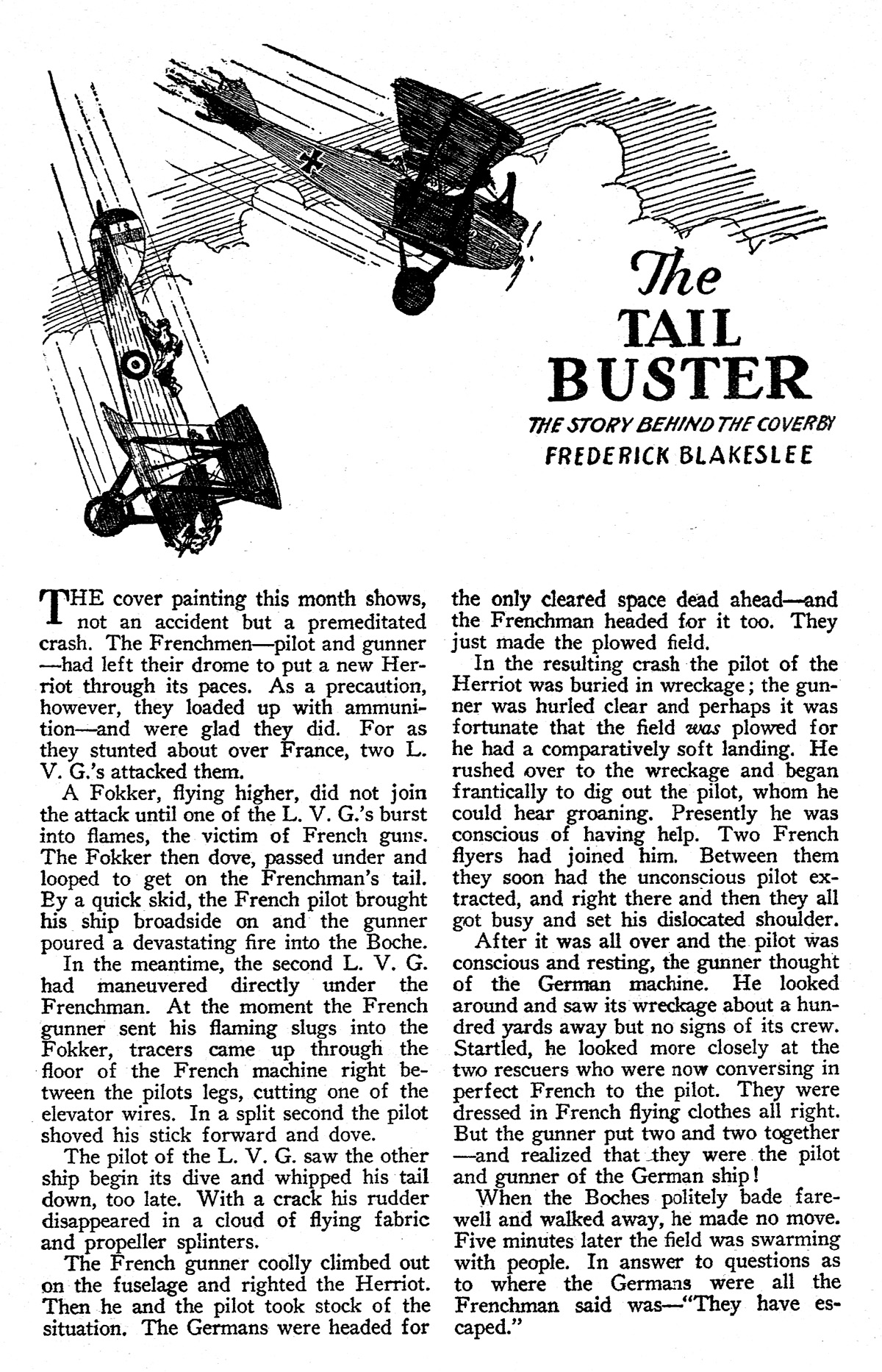
th_DDA_3312THE COVER painting this month shows, not an accident but a premeditated crash. The Frenchmen—pilot and gunner—had left their drome to put a new Herriot through its paces. As a precaution, however, they loaded up with ammunition—and were glad they did. For as they stunted about over France, two L.V.G.’s attacked them.

A Fokker, flying higher, did not join the attack until one of the L.V.G.’s burst into flames, the victim of French guns. The Fokker then dove, passed under and looped to get on the Frenchman’s tail. By a quick skid, the French pilot brought his ship broadside on and the gunner poured a devastating fire into the Boche.

In the meantime, the second L.V.G. had maneuvered directly under the Frenchman. At the moment the French gunner sent his flaming slugs into the Fokker, tracers came up through the floor of the French machine right between the pilots legs, cutting one of the elevator wires. In a split second the pilot shoved his stick forward and dove.

The pilot of the L.V.G. saw the other ship begin its dive and whipped his tail down, too late. With a crack his rudder disappeared in a cloud of flying fabric and propeller splinters.

The French gunner coolly climbed out on the fuselage and righted the Herriot. Then he and the pilot took stock of the situation. The Germans were headed for the only cleared space dead ahead—and the Frenchman headed for it too. They just made the plowed field.

In the resulting crash the pilot of the Herriot was buried in wreckage; the gunner was hurled clear and perhaps it was fortunate that the field was plowed for he had a comparatively soft landing. He rushed over to the wreckage and began frantically to dig out the pilot, whom he could hear groaning. Presently he was conscious of having help. Two French flyers had joined him. Between them they soon had the unconscious pilot extracted, and right there and then they all got busy and set his dislocated shoulder.

After it was all over and the pilot was conscious and resting, the gunner thought of the German machine. He looked around and saw its wreckage about a hundred yards away but no signs of its crew. Startled, he looked more closely at the two rescuers who were now conversing in perfect French to the pilot. They were dressed in French flying clothes all right. But the gunner put two and two together—and realized that they were the pilot and gunner of the German ship!

When the Boches politely bade farewell and walked away, he made no move. Five minutes later the field was swarming with people. In answer to questions as to where the Germans were all the Frenchman said was—”They have escaped.”

The Story Behind The Cover
“The Tail Buster: The Story Behind The Cover” by Frederick M. Blakeslee (December 1933)

Check back again. We will be presenting more of Blakeslee’s Stories behind his cover illustrations.

“The Caterpillar Ace” by Frederick Blakeslee

Link - Posted by David on November 20, 2014 @ 12:00 pm in

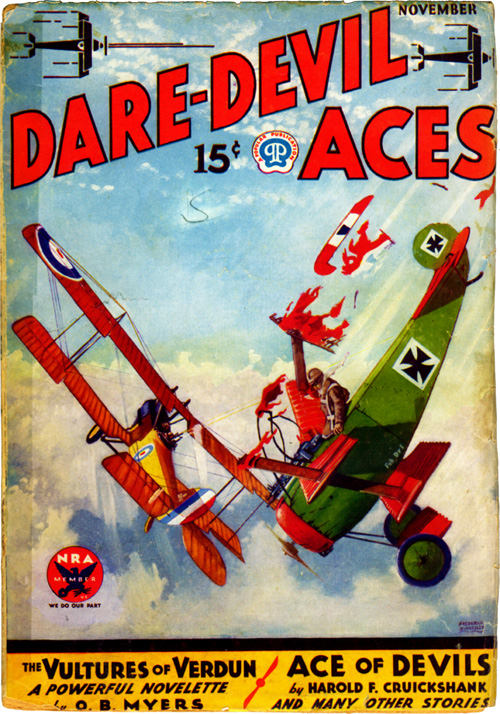
Frederick Blakeslee painted all the covers for the entire run of Dare-Devil Aces. And each of those covers had a story behind it. Blakeslee illustrates an incident in the career of that great German Ace—Ernst Udet! His life was previously featured by Alden McWilliams in his “They Had What it Takes”, but here Blakeslee features the battle that led Udet to use a parachute for the first time, thus becoming “The Caterpillar Ace!”
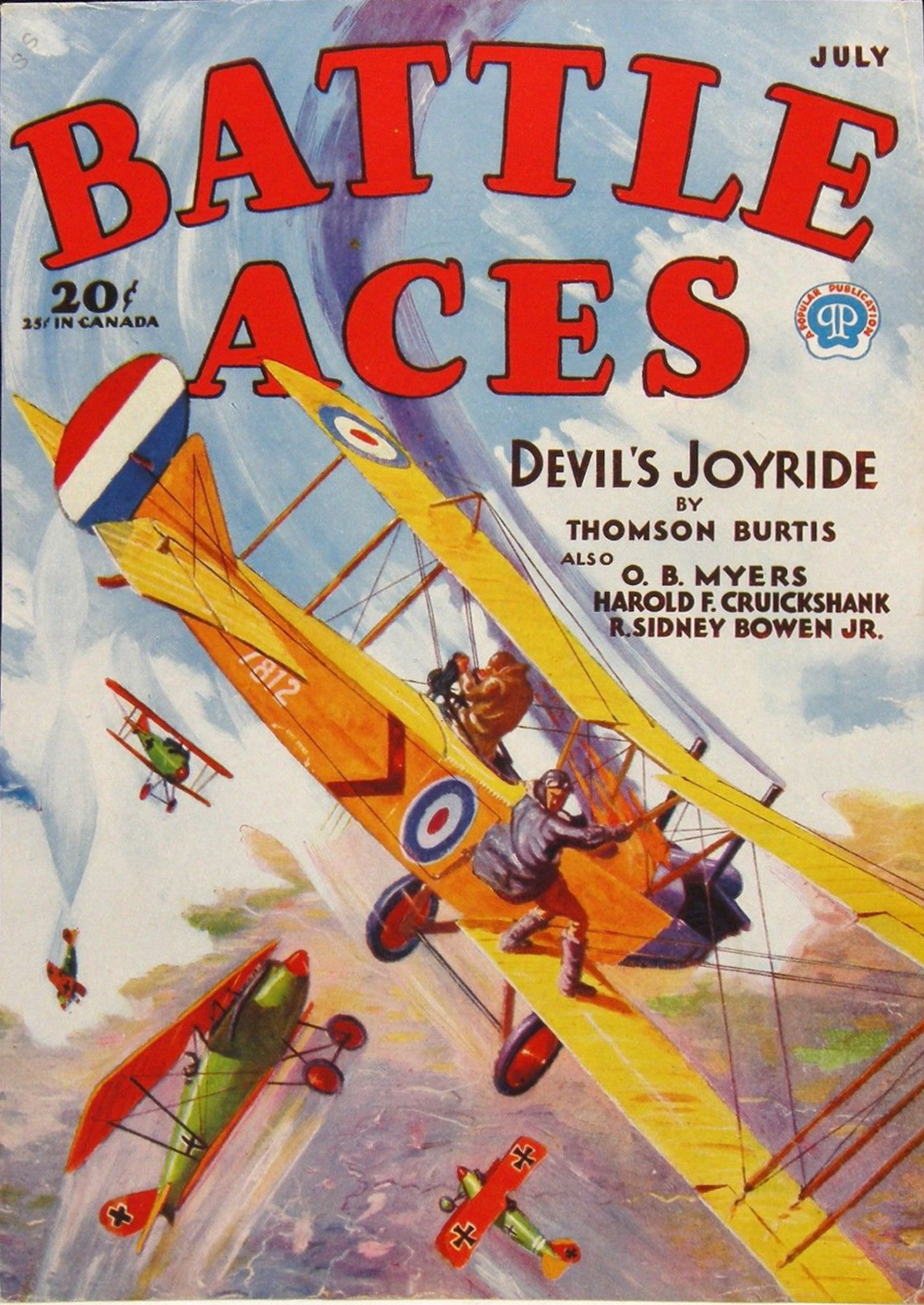
th_DDA_3311THE COVER this month illustrates an incident in the sky adventures of one of Germany’s great war aces—Ernst Udet. There is one slight discrepancy from fact in the painting. The Allied ship on the cover is an R.E.8, whereas Udet was engaged in combat with a Bristol Fighter. When the story was first told me the two planes were described as a Fokker triplane and an R.E.8. Later on—after the canvas was painted and just before this magazine went to press—I discovered the error, but it was too late to remedy it then. Outside of this, however, the picture depicts a great battle climax as it actually occurred in war skies.

You will notice that the German pilot is wearing a parachute. Ernst Udet is the only war-time pilot to escape from a wrecked ship in a parachute—thus having the distinction of being the original member of the Caterpillar Club.

The event was remarkable since, on the day this happened, Udet was wearing a parachute for the first time and against his will. He had been ordered to do so as an experiment. Sighting a Bristol Fighter, he maneuvered onto its tail and when only about a dozen feet away opened fire. His tracers tacked a scam up the Bristol’s back into the gunner’s pit; the gunner slumped over, apparently dead.

Udet’s speed carried him beyond the Bristol. Careful not to give the .pilot chance for a shot at him, he swung around, again on its tail. As he came in close, holding his fire until he should be in perfect position, his eyes widened with horror. For the gunner—supposedly dead—was dragging himself upright, his face a mass of blood; swinging his guns around, he opened fire at point-blank range.

Before the astonished German ace could gather his wits, there was a rendering crash. His upper wing carried away—was shot away, rather—snapping the struts, and pulling the second and third wings with it. A split second later, the wingless fuselage began its plunge to earth.

It was then Udet remembered the unwanted bulk strapped to his back. Well, he might just as well try it. He would die anyway! So he leaped clear. The parachute, to his astonishment, opened and he floated easily to earth, landing in German territory. The pilot of the Bristol had been watching it all. He now came down low over where Udet had landed. The German waved his hand and the Bristol flew away south.

Udet fought under a lucky star. Sometime later, while flying a Fokker D-VII, he was rammed by a fire-eating Camel pilot and he crashed to earth, but was not severely injured.

Ernst Udet is Germany’s leading surviving ace, credited with sixty-two victories. He was respected by friend and foe alike for his sportsmanship in combat. Recently he came to the United States and flew for the movies. He is responsible for the really beautiful air shots in such movies as “The White Hell of Pitz Palu” and “Storm Over Mount Blanc.” Last summer he spent in Greenland working on the movie “S.O.S. Iceberg.” He is one of the most masterly stunt pilots in the world and is one of the few surviving aces who has not lost his cunning.

The Story Behind The Cover
“The Caterpillar Ace: The Story Behind The Cover” by Frederick M. Blakeslee (November 1933)

Check back again. We will be presenting more of Blakeslee’s Stories behind his cover illustrations.

“Terror Bomb—” by Frederick Blakeslee

Link - Posted by David on November 13, 2014 @ 12:00 pm in

This week we feature Dare-Devil Ace’s October 1933 cover, Frederick Blakeslee’s “Terror Bomb!”

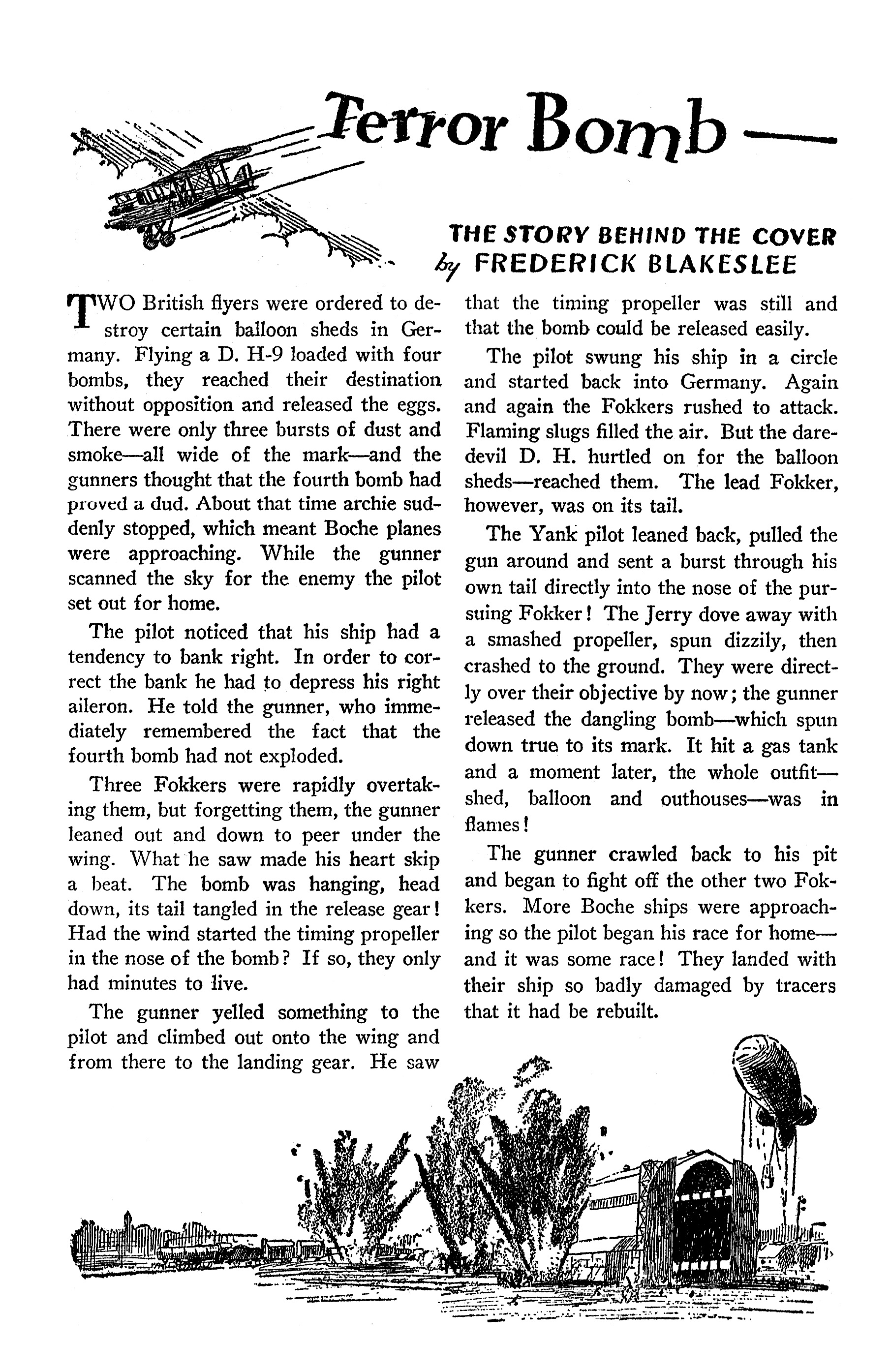
th_DDA_3310TWO BRITISH FLYERS were ordered to destroy certain balloon sheds in Germany. Flying a D.H-9 loaded with four bombs, they reached their destination without opposition and released the eggs. There were only three bursts of dust and smoke—all wide of the mark—and the gunners thought that the fourth bomb had proved a dud. About that time archie suddenly stopped, which meant Boche planes were approaching. While the gunner scanned the sky for the enemy the pilot set out for home.

The pilot noticed that his ship had a tendency to bank right. In order to correct the bank he had to depress his right aileron. He told the gunner, who immediately remembered the fact that the fourth bomb had not exploded.

Three Fokkers were rapidly overtaking them, but forgetting them, the gunner leaned out and down to peer under the wing. What he saw made his heart skip a beat. The bomb was hanging, head down, its tail tangled in the release gear! Had the wind started the timing propeller in the nose of the bomb ? If so, they only had minutes to live.

The gunner yelled something to the pilot and climbed out onto the wing and from there to the landing gear. He saw that the timing propeller was still and that the bomb could be released easily.

The pilot swung his ship in a circle and started back into Germany. Again and again the Fokkers rushed to attack. Flaming slugs filled the air. But the daredevil D.H. hurtled on for the balloon sheds—reached them. The lead Fokker, however, was on its tail.

The Yank pilot leaned back, pulled the gun around and sent a burst through his own tail directly into the nose of the pursuing Fokker! The Jerry dove away with a smashed propeller, spun dizzily, then crashed to the ground. They were directly over their objective by now; the gunner released the dangling bomb—which spun down true to its mark. It hit a gas tank and a moment later, the whole outfit—shed, balloon and outhouses—was in flames!

The gunner crawled back to his pit and began to fight off the other two Fokkers. More Boche ships were approaching so the pilot began his race for home—and it was some race! They landed with their ship so badly damaged by tracers that it had be rebuilt.

The Story Behind The Cover
“Terror Bomb: The Story Behind The Cover” by Frederick M. Blakeslee (October 1933)

Check back again. We will be presenting more of Blakeslee’s Stories behind his cover illustrations.

“Ace of the Storm” by Frederick Blakeslee

Link - Posted by David on November 6, 2014 @ 12:00 pm in

Frederick Blakeslee painted the covers for Dare-Devil Aces‘ entire fourteen year run. Every one of those covers told a story, and Blakeslee had a page with which to do so. This time we present Blakeslee’s cover for the September 1933 issue—”Ace of the Storm”…

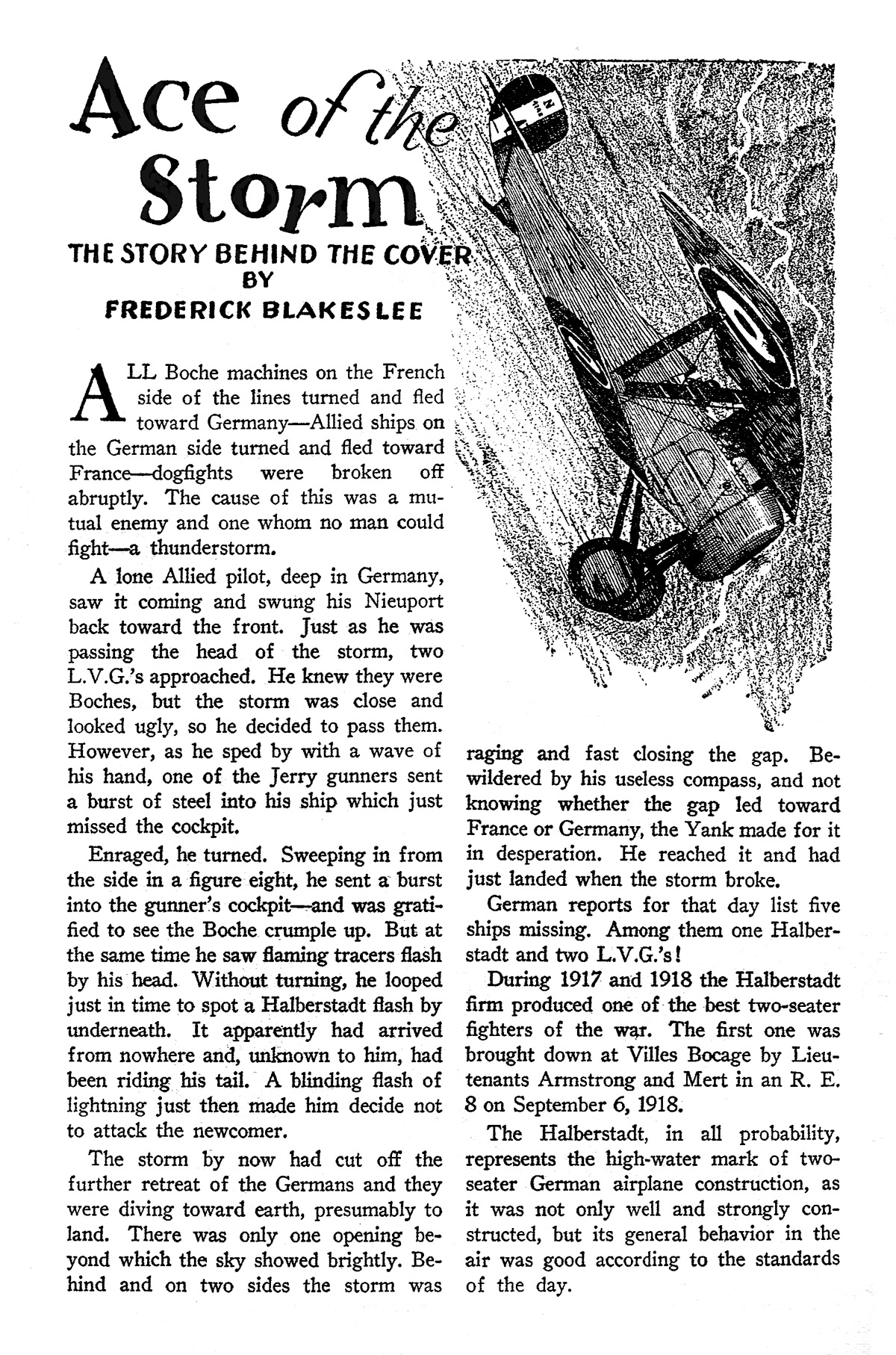
th_DDA_3309ALL BOCHE machines on the French side of the lines turned and fled toward Germany—Allied ships on the German side turned and fled toward France—dogfights were broken off abruptly. The cause of this was a mutual enemy and one whom no man could fight—a thunderstorm.

A lone Allied pilot, deep in Germany, saw it coming and swung his Nieuport back toward the front. Just as he was passing the head of the storm, two L.V.G.’s approached. He knew they were Boches, but the storm was close and looked ugly, so he decided to pass them. However, as he sped by with a wave of his hand, one of the Jerry gunners sent a burst of steel into his ship which just missed the cockpit.

Enraged, he turned. Sweeping in from the side in a figure eight, he sent a burst into the gunner’s cockpit—and was gratified to see the Boche crumple up. But at the same time he saw flaming tracers flash by his head. Without turning, he looped just in time to spot a Halberstadt flash by underneath. It apparently had arrived from nowhere and, unknown to him, had been riding his tail. A blinding flash of lightning just then made him decide not to attack the newcomer.

The storm by now had cut off the further retreat of the Germans and they were diving toward earth, presumably to land. There was only one opening beyond which the sky showed brightly. Behind and on two sides the storm was raging and fast closing the gap. Bewildered by his useless compass, and not knowing whether the gap led toward France or Germany, the Yank made for it in desperation. He reached it and had just landed when the storm broke.
German reports for that day list five ships missing. Among them one Halberstadt and two L.V.G.’s!

During 1917 and 1918 the Halberstadt firm produced one of the best two-seater fighters of the war. The first one was brought down at Villes Bocage by Lieutenants Armstrong and Mert in an R.E.8 on September 6, 1918.

The Halberstadt. in all probability, represents the high-water mark of two-seater German airplane construction, as it was not only well and strongly constructed, but its general behavior in the air was good according to the standards of the day.

The Story Behind The Cover
“Ace of the Storm: The Story Behind The Cover” by Frederick M. Blakeslee (September 1933)

Check back again. We will be presenting more of Blakeslee’s Stories behind his cover illustrations.

« Previous PageNext Page »