


Looking to buy? See our books on amazon.com Get Reading Now! Age of Aces Presents - free pulp PDFs

“The Bourges Bomber” by Frederick Blakeslee

Link - Posted by David on June 22, 2015 @ 6:30 am in

Frederick Blakeslee painted all the covers for the entire run of Dare-Devil Aces. And each of those covers had a story behind it. This time, Blakeslee presents us with more of the approach he used for the covers he painted for Battle Aces—telling us about the ship on cover of the September 1934 cover for Dare-Devil Aces. . . .
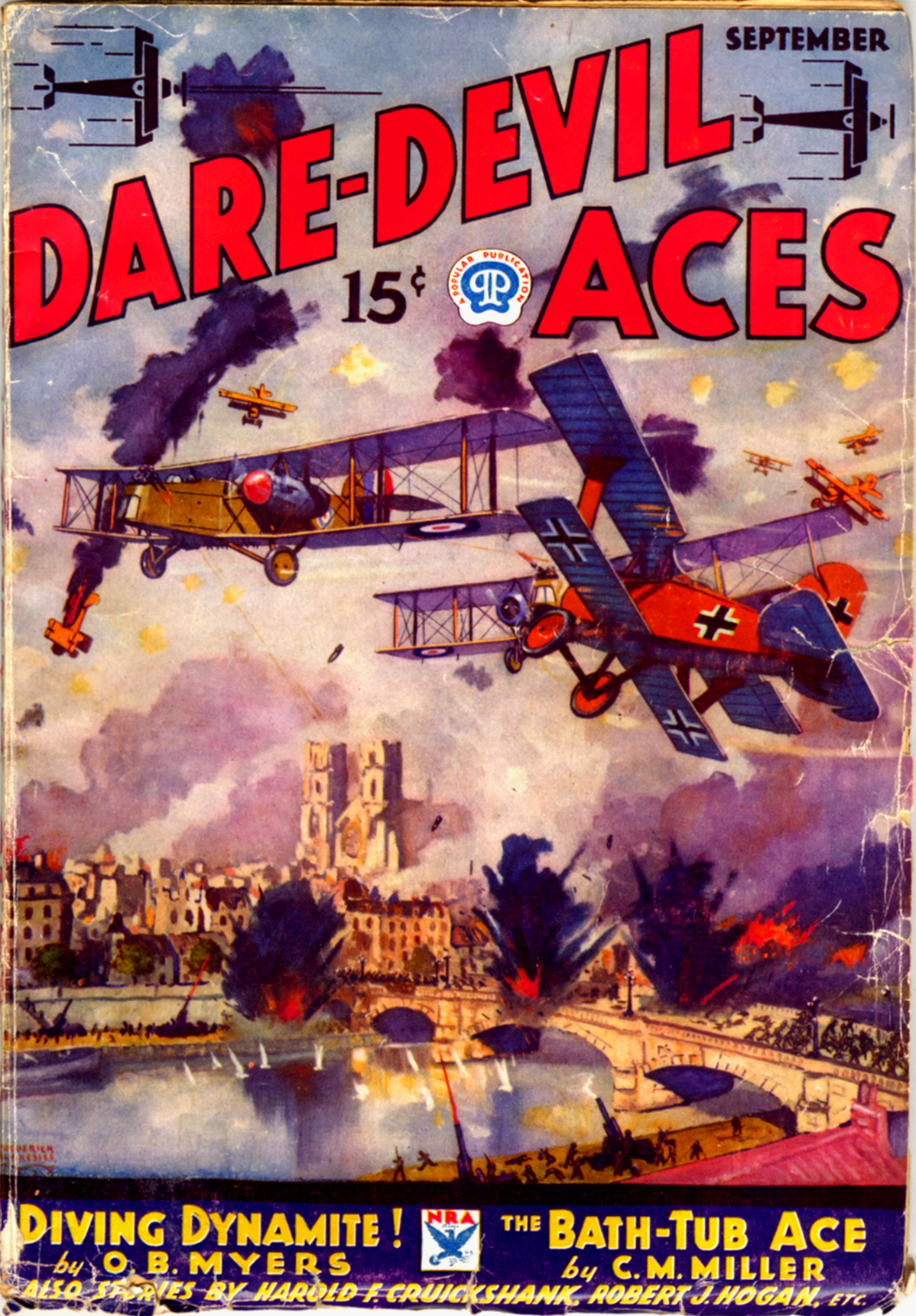
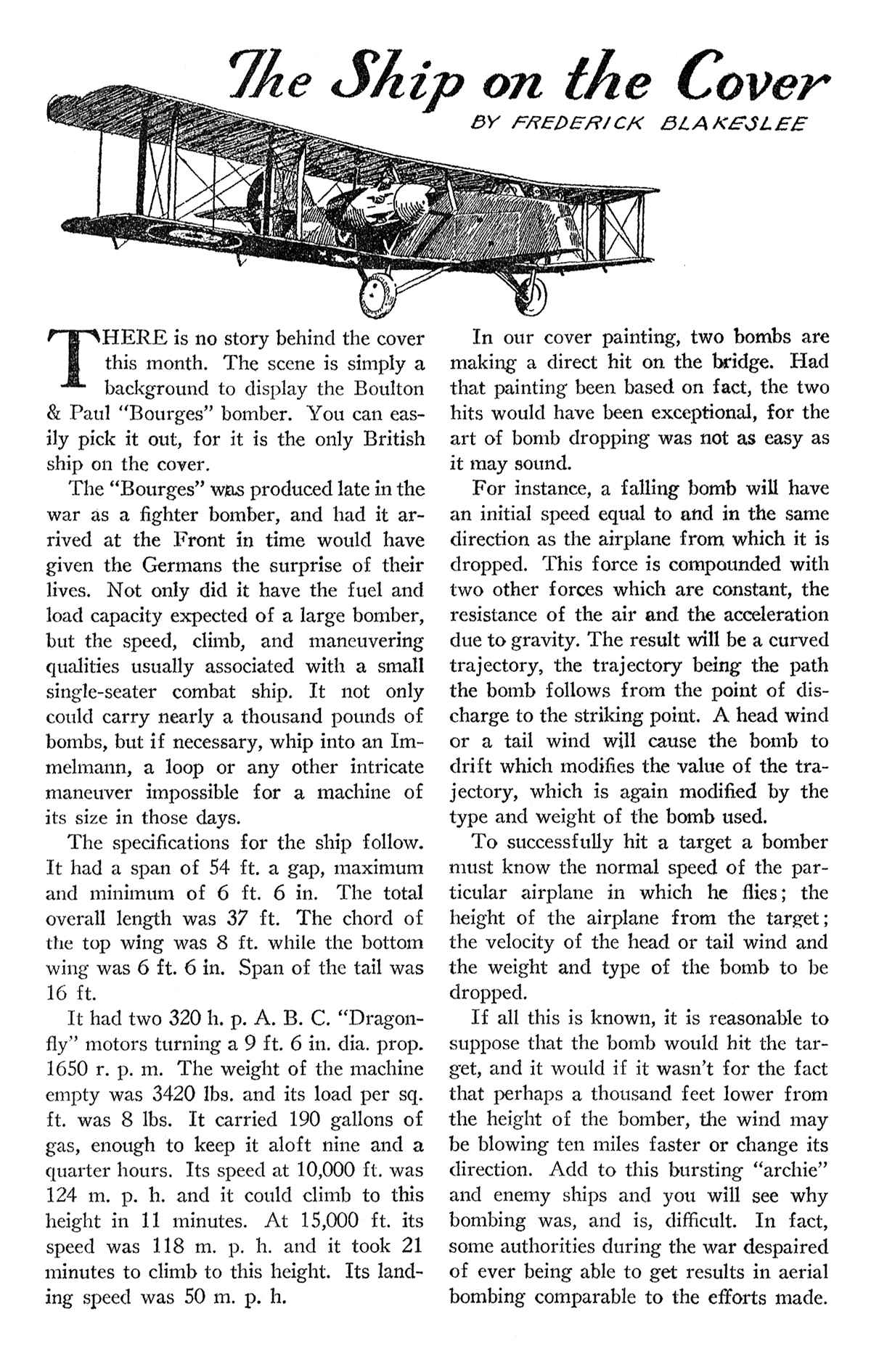
th_DDA_3409THERE is no story behind the cover this month. The scene is simply a background to display the Boulton & Paul “Bourges” bomber. You can easily pick it out, for it is the only British ship on the cover.

The “Bourges” was produced late in the war as a fighter bomber, and had it arrived at the Front in time would have given the Germans the surprise of their lives. Not only did it have the fuel and load capacity expected of a large bomber, but the speed, climb, and maneuvering qualities usually associated with a small single-seater combat ship. It not only could carry nearly a thousand pounds of bombs, but if necessary, whip into an Immelmann, a loop or any other intricate maneuver impossible for a machine of its size in those days.

The specifications for the ship follow. It had a span of 54 ft. a gap, maximum and minimum of 6 ft. 6 in. The total overall length was 37 ft. The chord of the top wing was 8 ft. while the bottom wing was 6 ft. 6 in. Span of the tail was 16 ft.

It had two 320 h.p. A. B. C. “Dragonfly” motors turning a 9 ft. 6 in. dia. prop. 1650 r.p.m. The weight of the machine empty was 3420 lbs. and its load per sq. ft. was 8 lbs. It carried 190 gallons of gas, enough to keep it aloft nine and a quarter hours. Its speed at 10,000 ft. was 124 m.p.h. and it could climb to this height in 11 minutes. At 15,000 ft. its speed was 118 m.p.h. and it took 21 minutes to climb to this height. Its landing speed was 50 m.p.h.

In our cover painting, two bombs are making a direct hit on the bridge. Had that painting been based on fact, the two hits would have been exceptional, for the art of bomb dropping was not as easy as it may sound.

For instance, a falling bomb will have an initial speed equal to and in the same direction as the airplane from which it is dropped. This force is compounded with two other forces which are constant, the resistance of the air and the acceleration due to gravity. The result will be a curved trajectory, the trajectory being the path the bomb follows from the point of discharge to the striking point. A head wind or a tail wind will cause the bomb to drift which modifies the value of the trajectory, which is again modified by the type and weight of the bomb used.

To successfully hit a target a bomber must know the normal speed of the particular airplane in which he flies; the height of the airplane from the target; the velocity of the head or tail wind and the weight and type of the bomb to be dropped.

If all this is known, it is reasonable to suppose that the bomb would hit the target, and it would if it wasn’t for the fact that perhaps a thousand feet lower from the height of the bomber, the wind may be blowing ten miles faster or change its direction. Add to this bursting “archie” and enemy ships and you will see why bombing was, and is, difficult. In fact, some authorities during the war despaired of ever being able to get results in aerial bombing comparable to the efforts made.
The Story Behind The Cover
“The Bourges Bomber: The Ship on the Cover” by Frederick Blakeslee
(September 1934, Dare-Devil Aces)

Next time, Eliot Todd returns with the story of “T.N.T. Wings” on the October 1934 cover. Be sure not to miss it.
“Suicide Buzzards” by Eliot Todd

Link - Posted by David on June 15, 2015 @ 6:00 am in

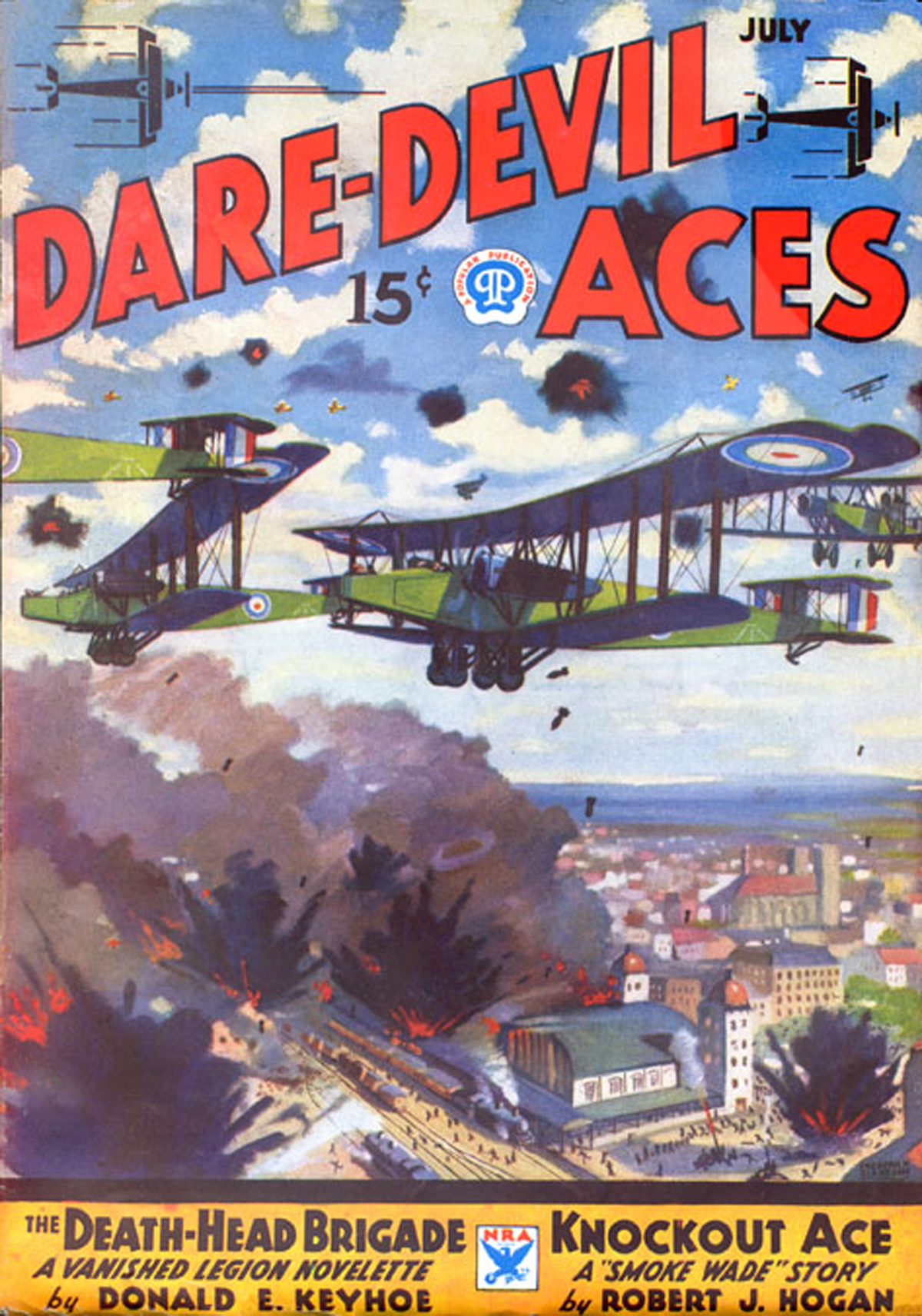
Frederick Blakeslee painted all the covers for the entire run of Dare-Devil Aces. And each of those covers had a story behind it. This time, Eliot Todd recounts the story behind Blakeslee’s July 1934 cover for Dare-Devil Aces. . . .

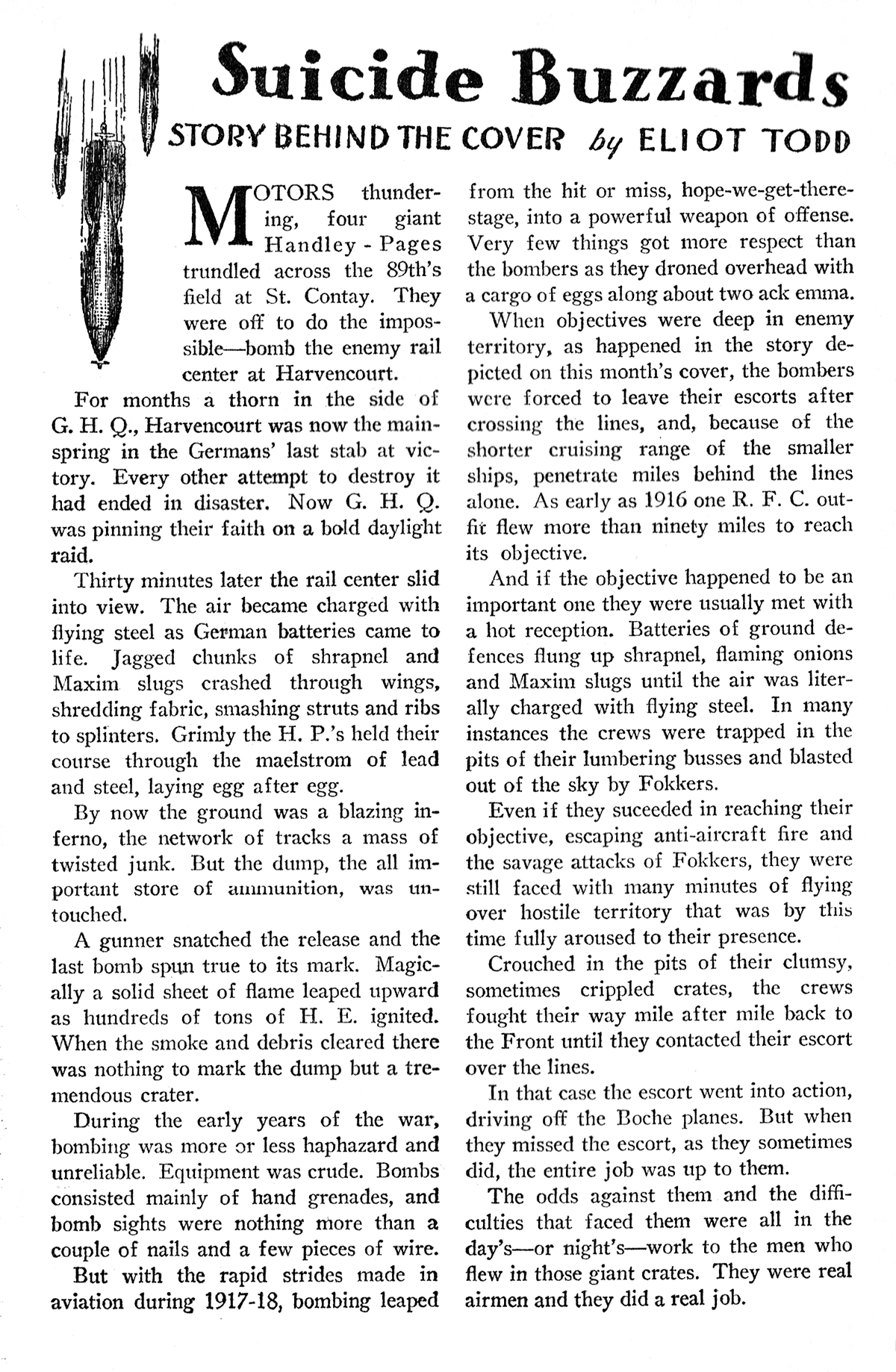
th_DDA_3407MOTORS thundering, four giant Handley-Pages trundled across the 89th’s field at St. Contay. They were off to do the impossible—bomb the enemy rail center at Harvencourt.

For months a thorn in the side of G.H.Q., Harvencourt was now the mainspring in the Germans’ last stab at victory. Every other attempt to destroy it had ended in disaster. Now G.H.Q. was pinning their faith on a bold daylight raid.

Thirty minutes later the rail center slid into view. The air became charged with flying steel as German batteries came to life. Jagged chunks of shrapnel and Maxim slugs crashed through wings, shredding fabric, smashing struts and ribs to splinters. Grimly the H.P.’s held their course through the maelstrom of lead and steel, laying egg after egg.

By now the ground was a blazing inferno, the network of tracks a mass of twisted junk. But the dump, the all important store of ammunition, was untouched.

A gunner snatched the release and the last bomb spun true to its mark. Magically a solid sheet of flame leaped upward as hundreds of tons of H.E. ignited. When the smoke and debris cleared there was nothing to mark the dump but a tremendous crater.

During the early years of the war, bombing was more or less haphazard and unreliable. Equipment was crude. Bombs consisted mainly of hand grenades, and bomb sights were nothing more than a couple of nails and a few pieces of wire.

But with the rapid strides made in aviation during 1917-18, bombing leaped from the hit or miss, hope-we-get-there-stage, into a powerful weapon of offense. Very few things got more respect than the bombers as they droned overhead with a cargo of eggs along about two ack emma.

When objectives were deep in enemy territory, as happened in the story depicted on this month’s cover, the bombers were forced to leave their escorts after crossing the lines, and, because of the shorter cruising range of the smaller ships, penetrate miles behind the lines alone. As early as 1916 one R.F.C. outfit flew more than ninety miles to reach its objective.

And if the objective happened to be an important one they were usually met with a hot reception. Batteries of ground defences flung up shrapnel, flaming onions and Maxim slugs until the air was literally charged with flying steel. In many instances the crews were trapped in the pits of their lumbering busses and blasted out of the sky by Fokkers.

Even if they sucecded in reaching their objective, escaping anti-aircraft fire and the savage attacks of Fokkers, they were still faced with many minutes of flying over hostile territory that was by tins time fully aroused to their presence.

Crouched in the pits of their clumsy, sometimes crippled crates, the crews fought their way mile after mile back to the Front until they contacted their escort over the lines.

In that case the escort went into action, driving off the Boche planes. But when they missed the escort, as they sometimes did, the entire job was up to them.

The odds against them and the difficulties that faced them were all in the day’s—or night’s—work to the men who flew in those giant crates. They were real airmen and they did a real job.

The Story Behind The Cover
“Suicide Buzzards: The Story Behind The Cover” by Eliot Todd (July 1934)

Check back again. We will be presenting more Stories behind the Covers.

“The Yellow Comet” by Eliot Todd

Link - Posted by David on June 8, 2015 @ 6:00 am in

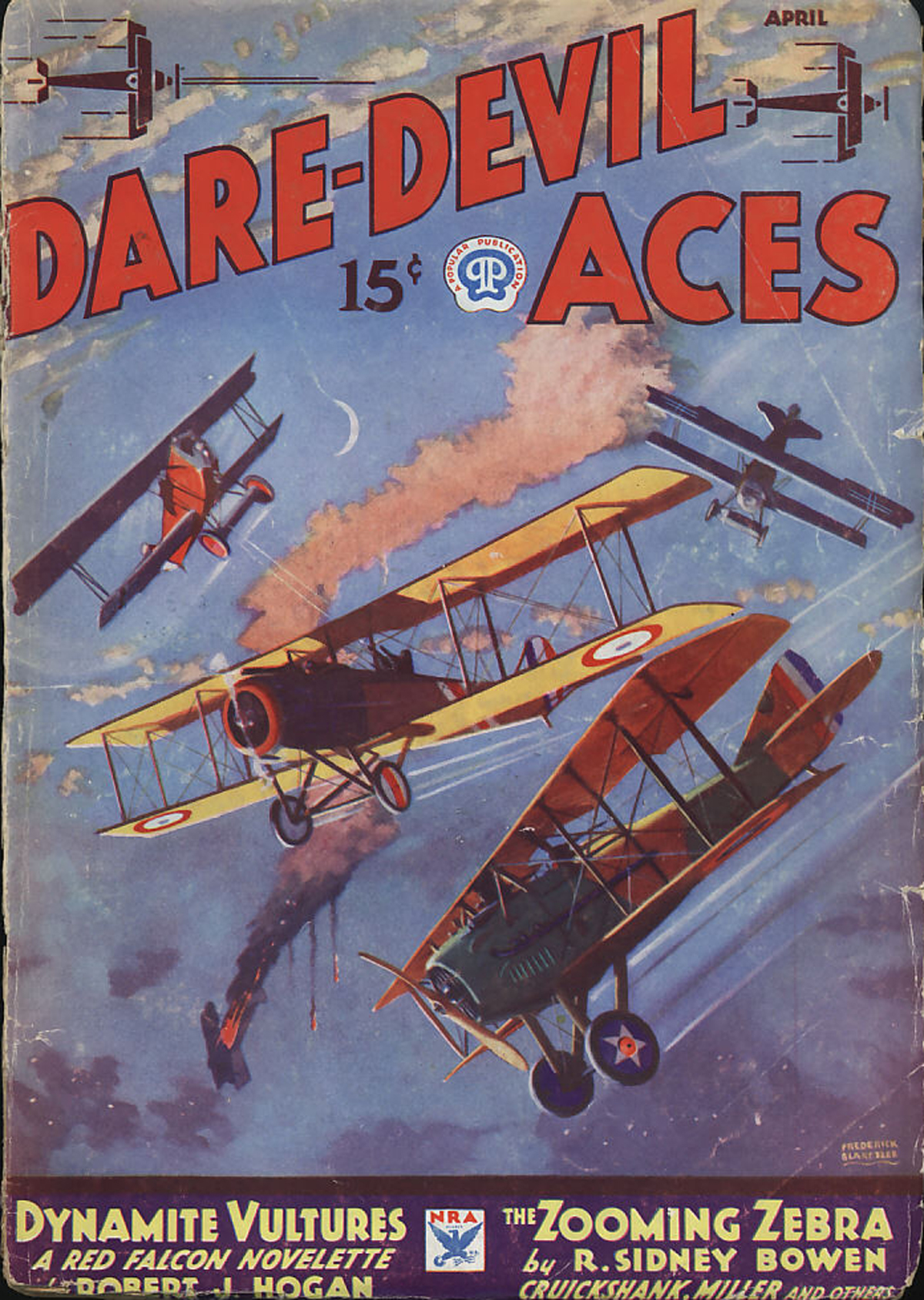
Frederick Blakeslee painted all the covers for the entire run of Dare-Devil Aces. And each of those covers had a story behind it. This time, Eliot Todd recounts the story behind Blakeslee’s April 1934 cover for Dare-Devil Aces. . . .

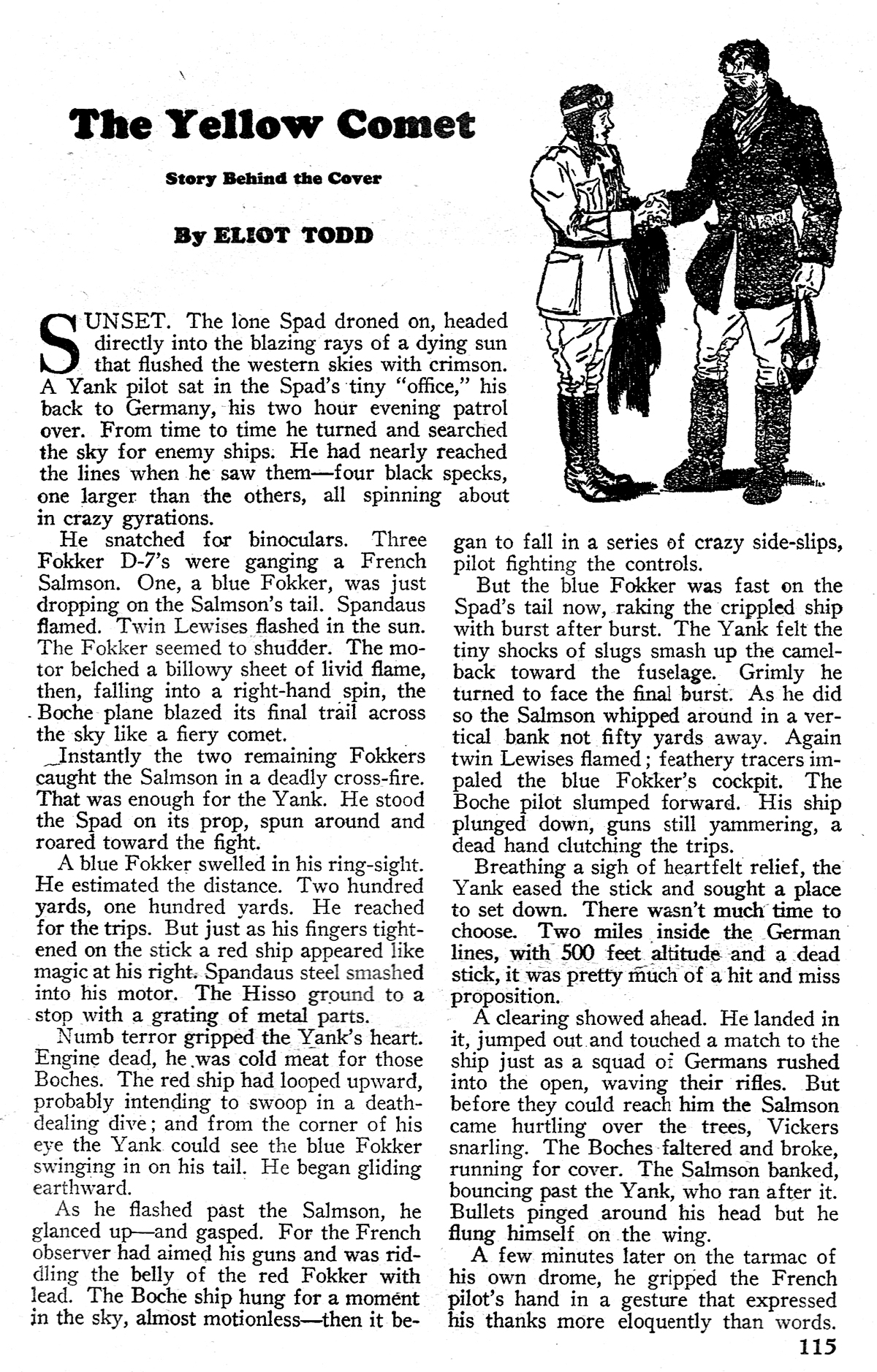
th_DDA_3404SUNSET. The lone Spad droned on, headed directly into the blazing rays of a dying sun that flushed the western skies with crimson. A Yank pilot sat in the Spad’s tiny “office,” his back to Germany, his two hour evening patrol over. From time to time he turned and searched the sky for enemy ships. He had nearly reached the lines when he saw them—four black specks, one larger than the others, all spinning about in crazy gyrations.

He snatched for binoculars. Three Fokker D-7’s were ganging a French Salmson. One, a blue Fokker, was just dropping on the Salmson’s tail. Spandaus flamed. Twin Lewises flashed in the sun. The Fokker seemed to shudder. The motor belched a billowy sheet of livid flame, then, falling into a right-hand spin, the Boche plane blazed its final trail across the sky like a fiery comet.

Instantly the two remaining Fokkers caught the Salmson in a deadly cross-fire. That was enough for the Yank. He stood the Spad on its prop, spun around and roared toward the fight.

A blue Fokker swelled in his ring-sight. He estimated the distance. Two hundred yards, one hundred yards. He reached for the trips. But just as his fingers tightened on the stick a red ship appeared like magic at his right. Spandaus steel smashed into his motor. The Hisso ground to a stop with a grating of metal parts.

Numb terror gripped the Yank’s heart. Engine dead, he was cold meat for those Boches. The red ship had looped upward, probably intending to swoop in a death-dealing dive; and from the corner of his eye the Yank could see the blue Fokker swinging in on his tail. He began gliding earthward.

As he flashed past the Salmson, he glanced up—and gasped. For the French observer had aimed his guns and was riddling the belly of the red Fokker with lead. The Boche ship hung for a moment in the sky, almost motionless—then it began to fall in a series of crazy side-slips, pilot fighting the controls.

But the blue Fokker was fast on the Spad’s tail now, raking the crippled ship with burst after burst. The Yank felt the tiny shocks of slugs smash up the camel-back toward the fuselage. Grimly he turned to face the final burst. As he did so the Salmson whipped around in a vertical bank not fifty yards away. Again twin Lewises flamed; feathery tracers impaled the blue Fokker’s cockpit. The Boche pilot slumped forward. His ship plunged down, guns still yammering, a dead hand clutching the trips.

Breathing a sigh of heartfelt relief, the Yank eased the stick and sought a place to set down. There wasn’t much time to choose. Two miles inside the German lines, with 500 feet altitude and a dead stick, it was pretty much of a hit and miss proposition.

A clearing showed ahead. He landed in it, jumped out and touched a match to the ship just as a squad of Germans rushed into the open, waving their rifles. But before they could reach him the Salmson came hurtling over the trees, Vickers snarling. The Boches faltered and broke, running for cover. The Salmson banked, bouncing past the Yank, who ran after it. Bullets pinged around his head but he flung himself on the wing.

A few minutes later on the tarmac of his own drome, he gripped the French pilot’s hand in a gesture that expressed his thanks more eloquently than words.

The Story Behind The Cover
“The Yellow Comet: The Story Behind The Cover” by Eliot Todd (April 1934)

Check back again. We will be presenting more Stories behind the Covers.

“Hell On Wings” by Frederick Blakeslee

Link - Posted by David on June 1, 2015 @ 6:00 am in

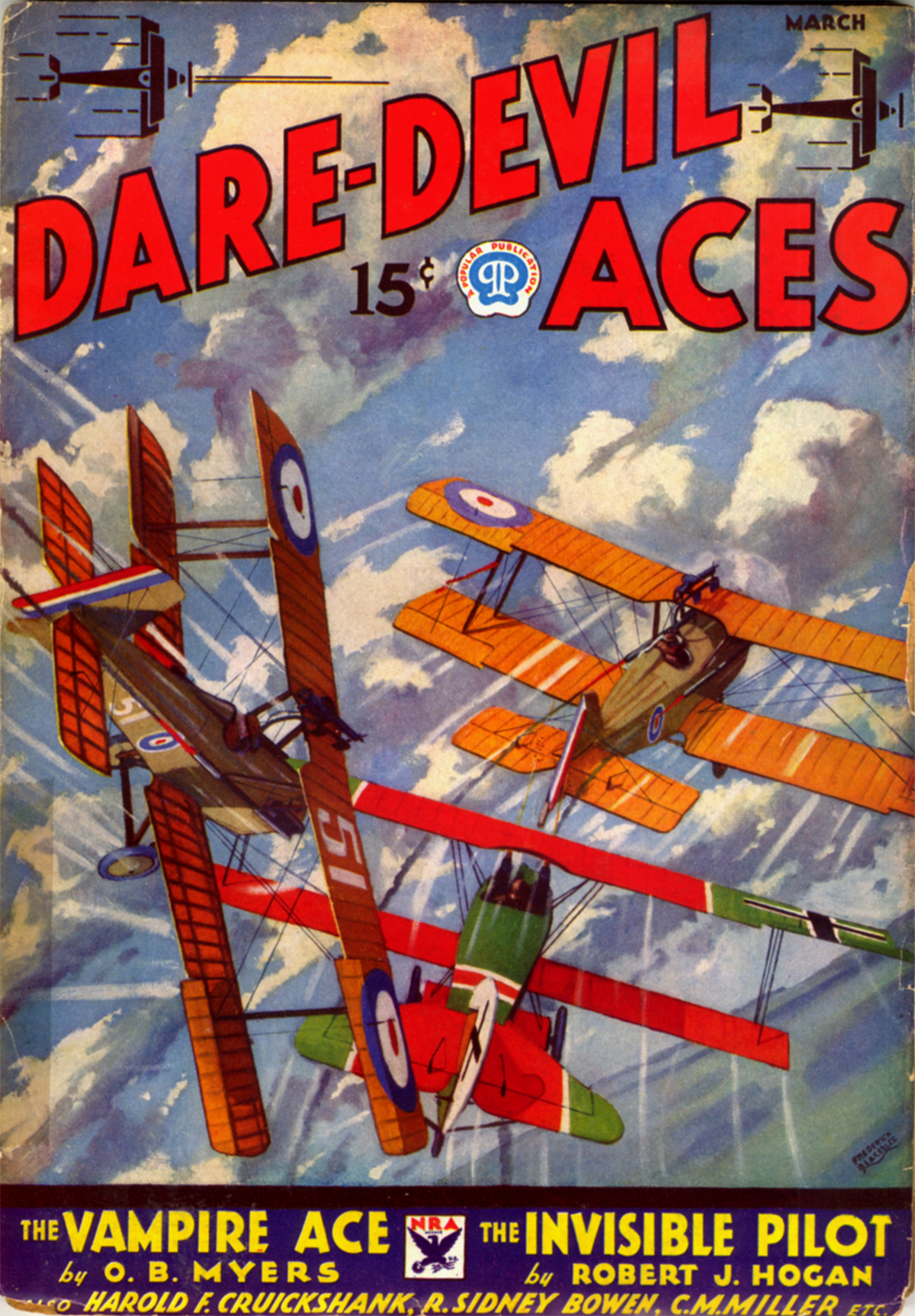
Frederick Blakeslee painted all the covers for the entire run of Dare-Devil Aces. And each of those covers had a story behind it. . . .

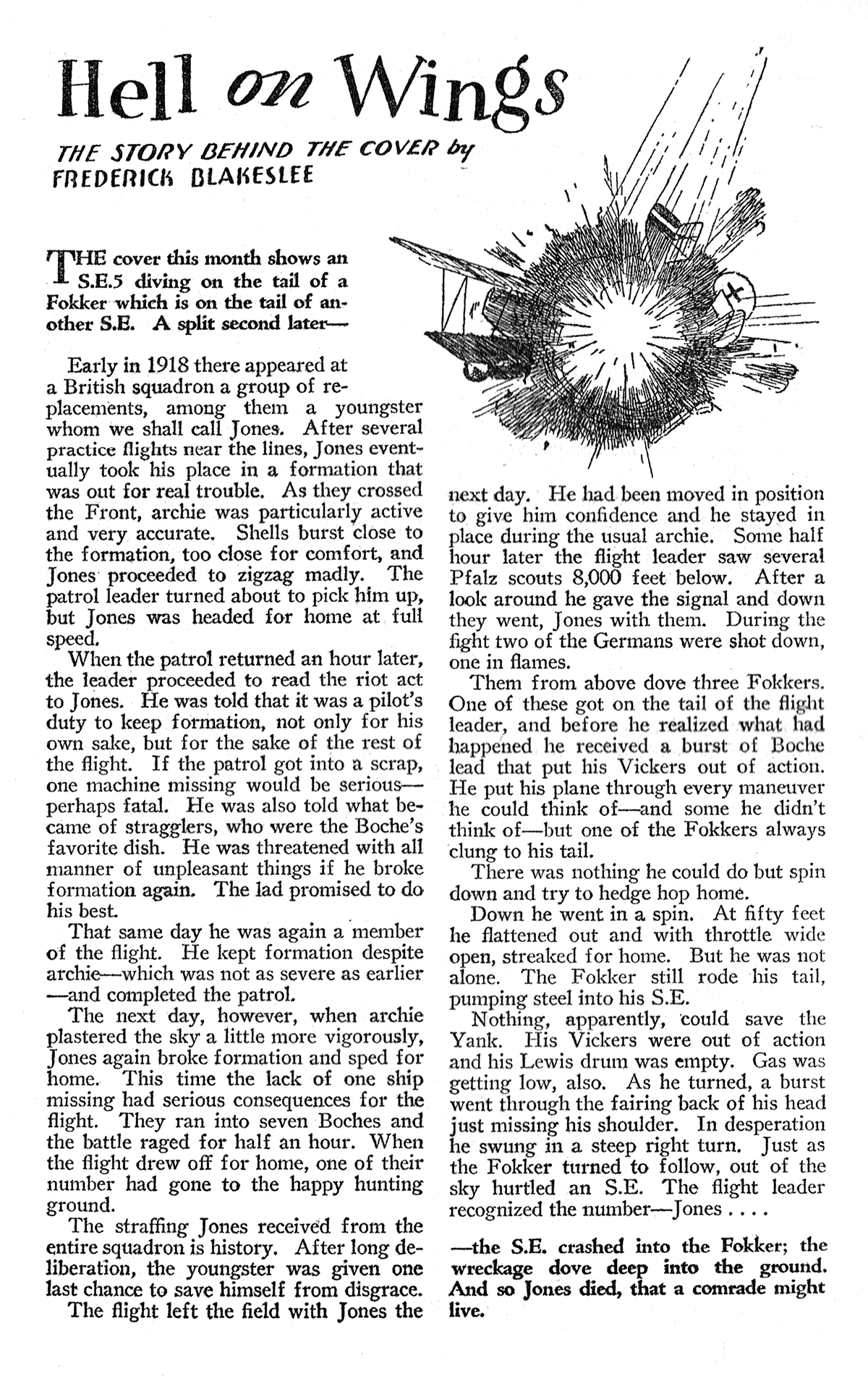
th_DDA_3403THE cover this month shows an S.E.5 diving on the tail of a Fokker which is on the tail of another S.E. A split second later—

Early in 1918 there appeared at a British squadron a group of replacements, among them a youngster whom we shall call Jones. After several practice flights near the lines, Jones eventually took his place in a formation that was out for real trouble. As they crossed the Front, archie was particularly active and very accurate. Shells burst close to the formation, too close for comfort, and Jones proceeded to zigzag madly. The patrol leader turned about to pick him up, but Jones was headed for home at full speed.

When the patrol returned an hour later, the leader proceeded to read the riot act to Jones. He was told that it was a pilot’s duty to keep formation, not only for his own sake, but for the sake of the rest of the flight. If the patrol got into a scrap, one machine missing would be serious— perhaps fatal. He was also told what became of stragglers, who were the Boche’s favorite dish. He was threatened with all manner of unpleasant things if he broke formation again. The lad promised to do his best.

That same day he was again a member of the flight. He kept formation despite archie—which was not as severe as earlier—and completed the patrol.

The next day, however, when archie plastered the sky a little more vigorously, Jones again broke formation and sped for home. This time the lack of one ship missing had serious consequences for the flight. They ran into seven Boches and the battle raged for half an hour. When the flight drew off for home, one of their number had gone to the happy hunting ground.

The straffing Jones received from the entire squadron is history. After long deliberation, the youngster was given one last chance to save himself from disgrace.

The flight left the field with Jones the next day. He had been moved in position to give him confidence and he stayed in place during the usual archie. Some half hour later the flight leader saw several Pfalz scouts 8,000 feet below. After a look around he gave the signal and down they went, Jones with them. During the fight two of the Germans were shot down, one in flames.

Them from above dove three Fokkers. One of these got on the tail of the flight leader, and before he realized what had happened he received a burst of Boche lead that put his Vickers out of action. He put his plane through every maneuver he could think of—and some he didn’t think of—but one of the Fokkers always clung to his tail.

There was nothing he could do but spin down and try to hedge hop home.

Down he went in a spin. At fifty feet he flattened out and with throttle wide open, streaked for home. But he was not alone. The Fokker still rode his tail, pumping steel into his S.E.

Nothing, apparently, could save the Yank. His Vickers were out of action and his Lewis drum was empty. Gas was getting low, also. As he turned, a burst went through the fairing back of his head just missing his shoulder. In desperation he swung in a steep right turn. Just as the Fokker turned to follow, out of the sky hurtled an S.E. The flight leader recognized the number—Jones . . . .

—the S.E. crashed into the Fokker; the wreckage dove deep into the ground. And so Jones died, that a comrade might live.

The Story Behind The Cover
“Hell On Wings: The Story Behind The Cover” by Frederick M. Blakeslee (March 1934)

Check back again. We will be presenting more of Blakeslee’s Stories behind his cover illustrations.

“Bombing of Oberndorf” by Frederick Blakeslee

Link - Posted by David on May 18, 2015 @ 6:00 am in

Frederick Blakeslee painted the covers for Dare-Devil Aces‘ entire fourteen year run. Every one of those covers told a story, and Blakeslee had a page inside the issue with which to do so. We present Blakeslee’s second cover for Dare-Devil Aces—the March 1932 issue—and The Bombing of Oberndorf!”

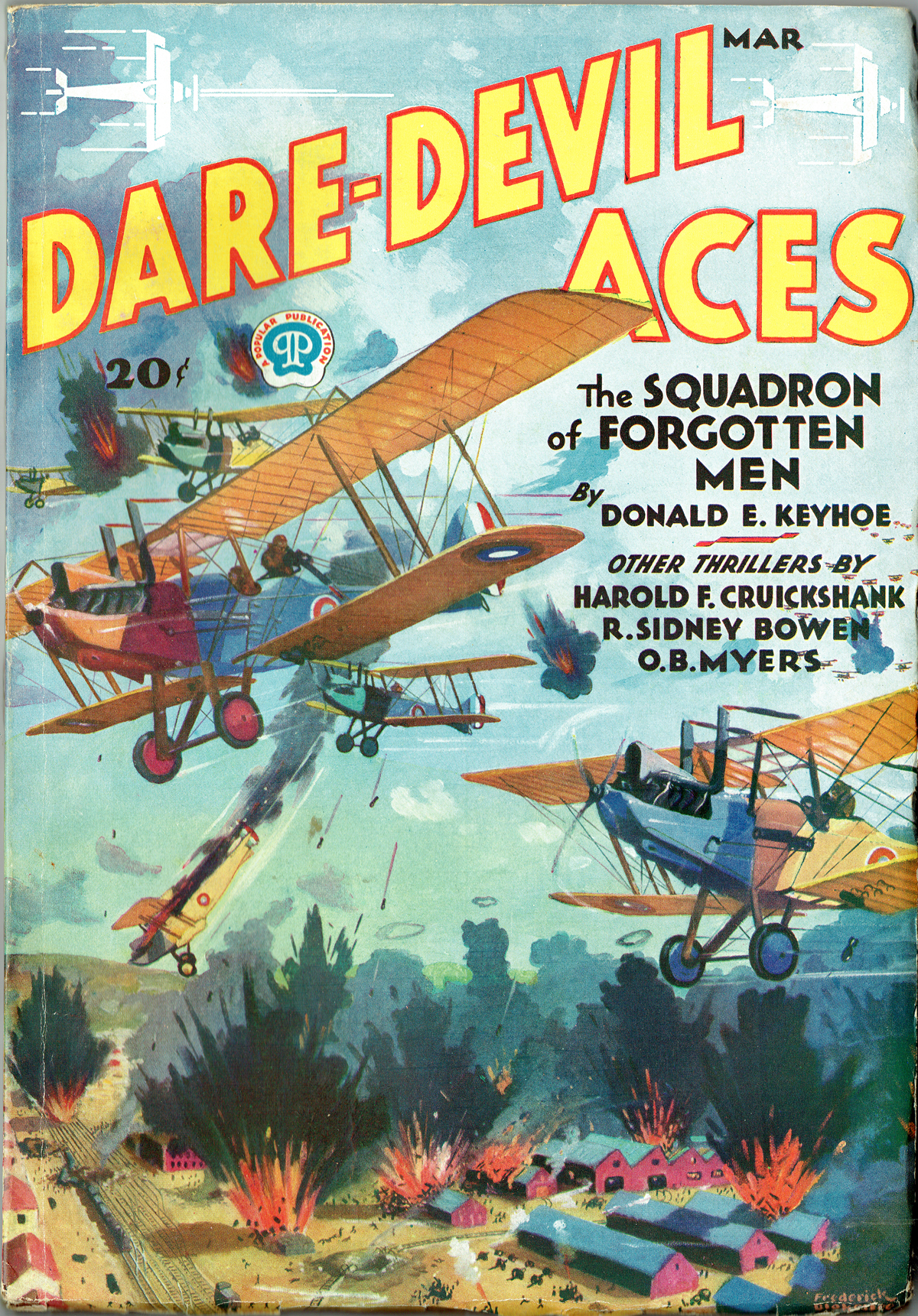
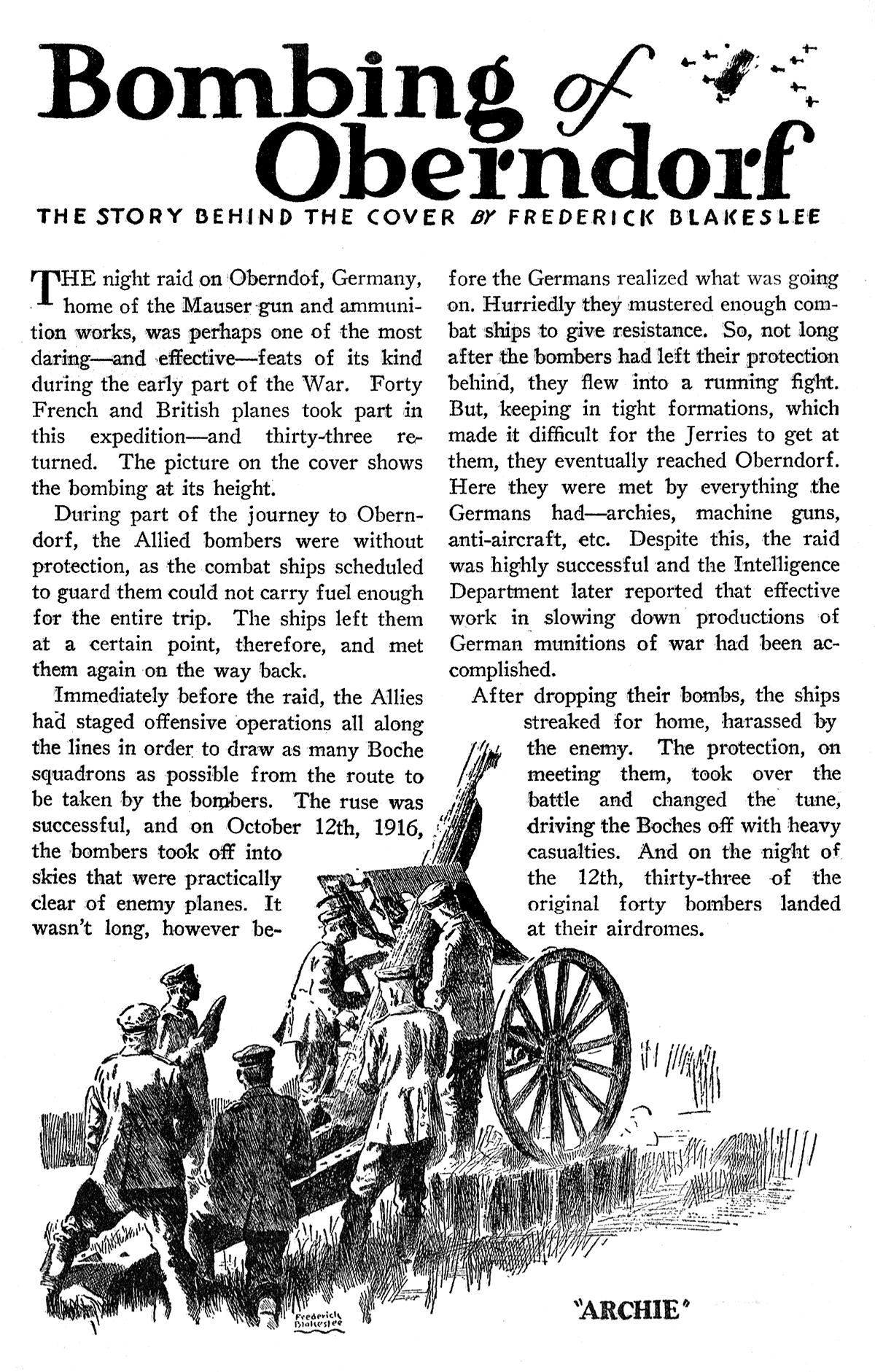
th_DDA_3203THE night raid on Oberndof, Germany, home of the Mauser gun and ammunition works, was perhaps one of the most daring—and effective—feats of its kind during the early part of the War. Forty French and British planes took part in this expedition—and thirty-three returned. The picture on the cover shows the bombing at its height.

During part of the journey to Oberndorf, the Allied bombers were without protection, as the combat ships scheduled to guard them could not carry fuel enough for the entire trip. The ships left them at a certain point, therefore, and met them again on the way back.

Immediately before the raid, the Allies had staged offensive operations all along the lines in order to draw as many Boche squadrons as possible from the route to be taken by the bombers. The ruse was successful, and on October 12th, 1916, the bombers took off into skies that were practically clear of enemy planes. It wasn’t long, however before the Germans realized what was going on. Hurriedly they mustered enough combat ships to give resistance. So, not long after the bombers had left their protection behind, they flew into a running fight. But, keeping in tight formations, which made it difficult for the Jerries to get at them, they eventually reached Oberndorf. Here they were met by everything the Germans had—archies, machine guns, anti-aircraft, etc. Despite this, the raid was highly successful and the Intelligence Department later reported that effective work in slowing down productions of German munitions of war had been accomplished.

After dropping their bombs, the ships streaked for home, harassed by the enemy. The protection, on meeting them, took over the battle and changed the tune, driving the Boches off with heavy casualties. And on the night of the 12th, thirty-three of the original forty bombers landed at their airdromes.

Bombing of Oberndorf
“Bombing of Oberndorf” by Frederick M. Blakeslee (Dare-Devil Aces, March 1932)

“The Vickers “Vimy” Bomber” by Frederick Blakeslee

Link - Posted by David on May 11, 2015 @ 6:00 am in

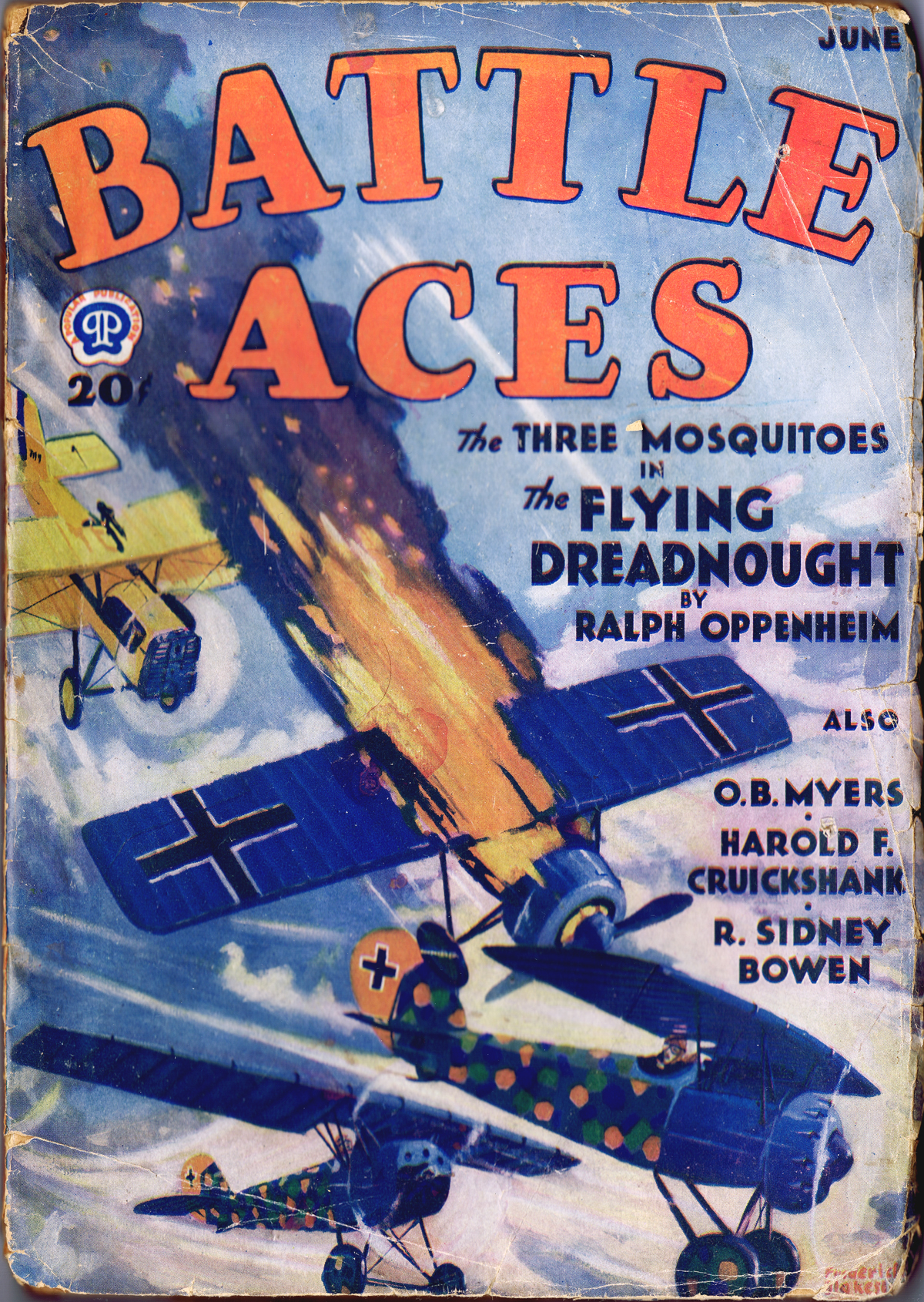
Editor’s Note: This month’s cover is the fifteenth of the actual war-combat pictures which Mr. Blakeslee, well-known artist and authority on aircraft, is painting exclusively for BATTLE ACES. The series was started to give our readers authentic pictures of war planes in color. It also enables you to follow famous airmen on many of their amazing adventures and feel the same thrills of battle they felt. Be sure to save these covers if you want your’ collection of this fine series to be complete.

th_BA_3208THE bombing expedition on which this cover is based is pictured in two parts. The actual raid is shown on the cover of the August issue of DAREDEVIL ACES. This month the adventure of one of the bombers on that mission is pictured.

I shall not repeat the story of the raid here, for that has been told in DAREDEVIL ACES.

Three big British bombers took off late one afternoon to bomb the reported position of a long-range gun implacement. They were flown by British pilots but were to operate in conjunction with an American outfit of fighting ships.

The bombers met the Americans high over Dun and started for the scene of operation. They flew in a tight formation and saw no enemy craft, although they were being followed by several Boches who did not dare attack such a formidable group.

The flight was deep in enemy territory when one of the bombers developed engine trouble in the right-hand motor. It fell behind and unfortunately, at this moment the top patrol was hidden by a cloud so did not observe the accident.

The pilot of the bomber, finding his trouble was getting serious, turned about and started for home, looking for a target for his load of bombs. Through an opening in the ground fog he saw what he took for a supply depot and ordered his men to let go their “eggs.” They were later to be informed that they had fired an ammunition dump.

It was not long before more serious trouble than a “sick” motor arrived. It came with a roar and blazing guns. It was a German Hannoveraner biplane (the bright red ship in the foreground); almost at the same time another ship arrived to add to the difficulties of the bomber. This was a Roland single-seater biplane (the blue and yellow plane diving in from the left).

The bomber, due to its crippled condition, was unable to maneuver and had to fight off the Boches as best it could. The Englishmen were in an uncomfortable position but not hard-pressed until the fight was joined by a Fokker D-VII and a Fokker monoplane. Then things got more serious.

The big ship flew steadily on but was sustaining a deadly fire from every direction. The motor still functioned and seemed to get no worse, but every moment increased the hazard. It was being slowly cut to pieces. Already one rudder was out of commission and a stream of bullets had cut through the center of the fuselage and weakened it. The wings looked like a sieve and many of the wires were cut, also weakening the wings. Tt was remarkable that the ship did not collapse then and there.

They shot down one Boche with their last drum of ammunition. Both gunners and pilot were wounded and they had given themselves up as lost, when help arrived in the form of a patrol of S.E-S’s, who scattered the Germans right and left in short order.

The pilot, faint from a wound in the abdomen, landed his ship on his own airdrome but cracked up in doing so, completing the wreck of an already half ruined ship. All survived, however, and they are living today, proud of their D.S.C. awarded by the American government.

The bombing ship shown on the cover is a very famous one, although most of its fame was gained in peace time persuits. It was designed as a long-distance bomber. It carried two engines in “power eggs” one each side of the fuselage. There were three types of engines used, the Fiat, Hispano-Suiza and Rolls Royce. The bomber here shown is a Vickers Vimy Rolls, which is 1 ft. 6½ in. longer than the other two, otherwise they are the same in appearance. They carried two gunners and a pilot. To prevent the machine from standing on its nose after too fast a landing, a skid was fitted under the nose of the fuselage. Span 67 ft. 2 in., gap 10 ft., overall length 44 ft., speed low down 103 m.p.h., speed at 5,000 ft. 98 m.p.h., landing speed 56 m.p.h.

The Vickers
“The Vickers “Vimy” Bomber” by Frederick M. Blakeslee (August 1932)

Now we come to its peace time fame. It was in a Vickers Vimy Rolls-Royce airplane that Captain J. Alcock and Lt. Whitten Brown, both afterwards knighted, made the first direct flight across the Atlantic from St. Johns, Newfoundland to Clifden, Galway. They traveled 1,880 miles in 15 hours 57 minutes at an average speed of 118 m.p.h., May 18th-19th, 1919.

Captain Ross Smith and three companions, in the same year, and in the same type of ship, flew from England to Australia in 30 days, flying a total of 11,294 miles. They landed at Port Darwin, North Australia and later crossed the continent to Melbourne.

“The Big Gun Bombers” by Frederick Blakeslee

Link - Posted by David on May 4, 2015 @ 6:00 am in

Frederick Blakeslee painted the covers for Dare-Devil Aces‘ entire fourteen year run. Starting with the June 1931 cover of Battle Aces, he started running actual war-combat paintings by Blakeslee on their covers. In a happy cross-over, in August 1932, Mr. Blakeslee had two covers from the same incident. This week we have the Dare-Devil Aces cover which has the main action, while next week we’ll have the Battle Aces cover from that month that covers a side incident concerning a missing bomber. Look for it next week.

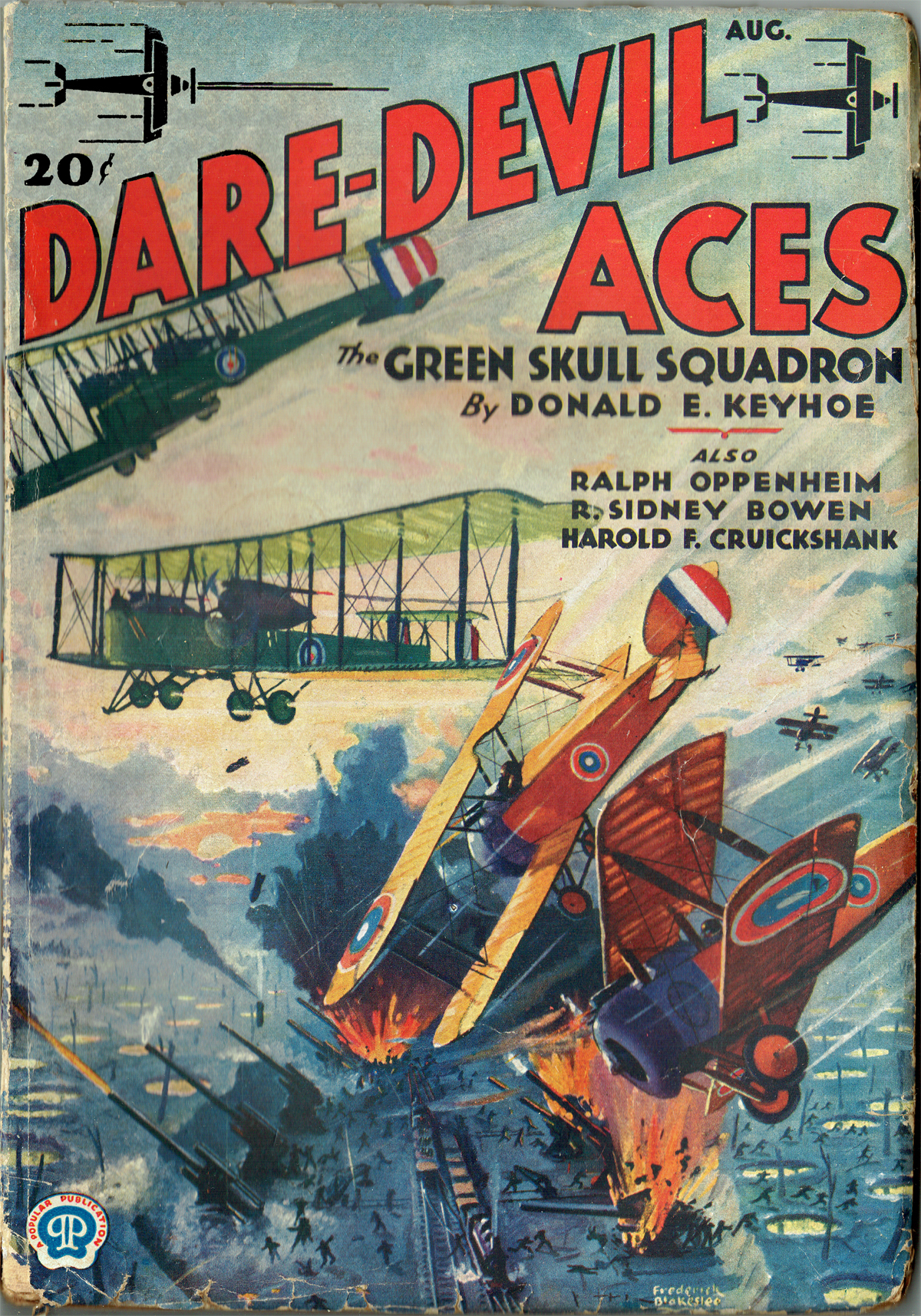
th_DDA_3208AN IMPORTANT concentration point in the American sector had been shelled for days by long-range guns. Yank airplanes had combed enemy territory trying to find their location, but the gunners were canny. They fired in the early morning and at sundown when there was a ground mist. On days when flying was impossible they fired continuously. On good days they were silent.

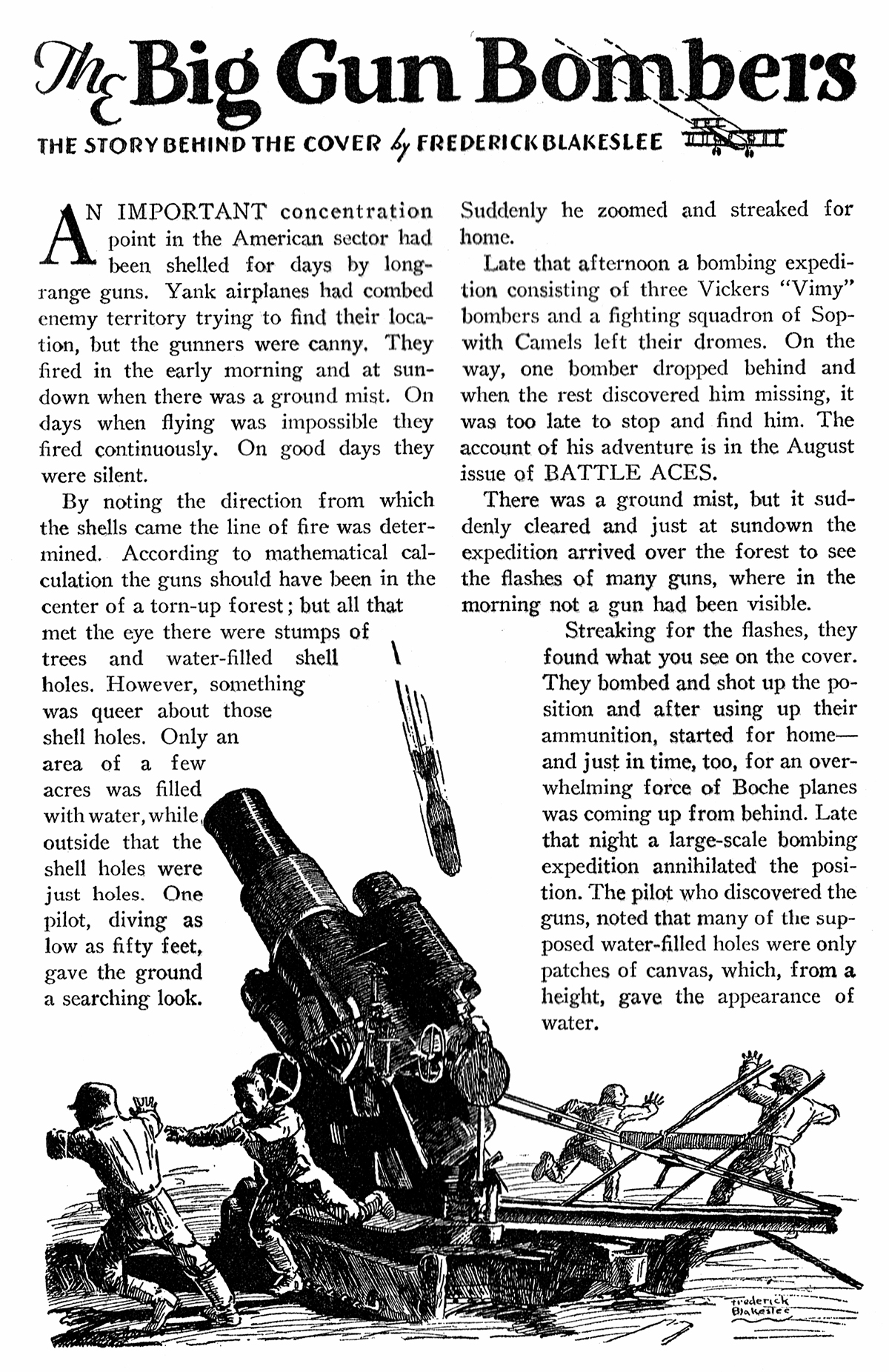
By noting the direction from which the shells came the line of fire was determined. According to mathematical calculation the guns should have been in the center of a torn-up forest; but all that met the eye there were stumps of trees and water-filled shell holes. However, something
was queer about those shell holes. Only an area of a few acres was filled with water, while, outside that the shell holes were just holes. One pilot, diving as low as fifty feet, gave the ground a searching look. Suddenly he zoomed and streaked for home.

Late that afternoon a bombing expedition consisting of three Vickers “Vimy” bombers and a fighting squadron of Sopwith Camels left their dromes. On the way, one bomber dropped behind and when the rest discovered him missing, it was too late to stop and find him. The account of his adventure is in the August issue of BATTLE ACES.

There was a ground mist, but it suddenly cleared and just at sundown the expedition arrived over the forest to see the flashes of many guns, where in the morning not a gun had been visible.

Streaking for the flashes, they found what you see on the cover. They bombed and shot up the position and after using up their ammunition, started for home—and just in time, too, for an overwhelming force of Boche planes was coming up from behind. Late that night a large-scale bombing expedition annihilated the position. The pilot who discovered the guns, noted that many of the supposed water-filled holes were only patches of canvas, which, from a height, gave the appearance of water.

The Big Gun Bombers
“The Big Gun Bombers” by Frederick M. Blakeslee (Dare-Devil Aces, August 1932)

Find out what happened to the lost Vickers “Vimy” Bomber next week!

“The French Breguet” by Frederick Blakeslee

Link - Posted by David on April 27, 2015 @ 6:00 am in

Editor’s Note: This month’s cover is the nineteenth of the actual war-combat pictures which Mr. Blakeslee, well-known artist and authority on aircraft, is painting exclusively for BATTLE ACES. The series was started to give our readers authentic pictures of war planes in color. It also enabled you to follow famous airmen on many of their amazing adventures and feel the same thrills of battle they felt.

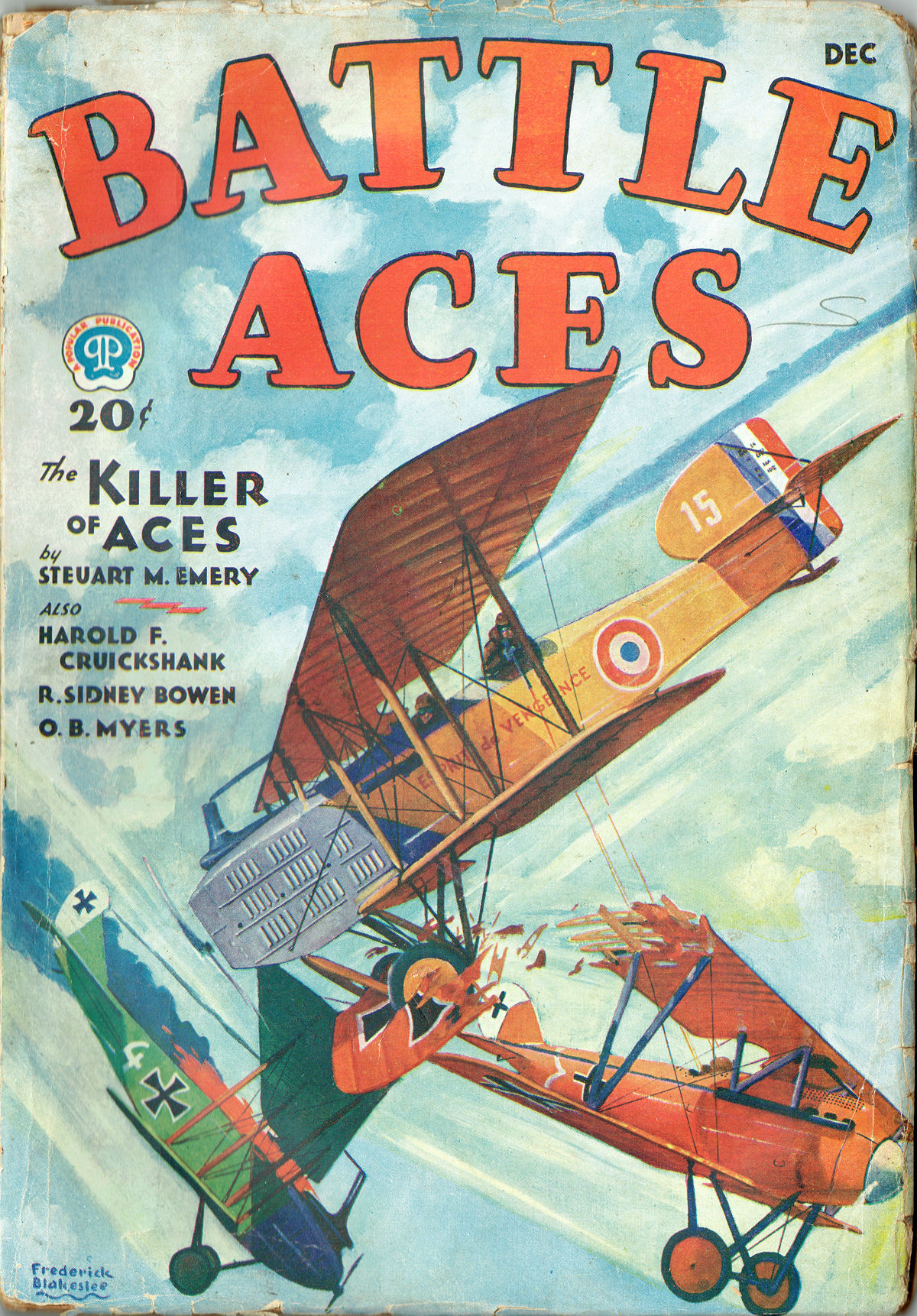
th_BA_3212THE story behind this month’s cover —which shows an exploit of two brothers, Captains Jean and Charles Ranconcour—had its origin five years before the beginning of the War, when the Frenchmen were visiting Berlin. One evening, while they were dining in a crowded restaurant with a friend, a Prussian officer approached their table and without warning flung a glass of wine into Jean’s face. The three leaped to their feet; Charles demanded an explanation in behalf of his brother. The Prussian turned to him, surveyed him from head to foot, then slashed him across the face with a pair of heavy gloves. Jean promptly knocked him down.

By this time, of course, a large crowd had gathered and it was with considerable difficulty that order was restored. First Jean, then Charles, challenged him to a duel and the Prussian accepted, telling them to await his seconds. They waited for two hours, only to learn then that their strange enemy had been seen leaving the city—hurriedly; he had heard, no doubt, that both brothers had a reputation as expert duellists.

From that moment the two brothers swore to obtain satisfaction for this cowardly assault—but their opportunity did not come until nine years later high above the battlefields of France.

The outbreak of the War found Jean and Charles officers in infantry regiments. Late in 1917 they received word that the Prussian officer was in a certain Boche aviation squadron. The brothers immediately transferred to aviation and through influence they were both attached to the same French squadron—Jean as pilot and Charles as his gunner.

They got the reputation of being careful fighters. Although they never avoided a combat, neither did they go out of their way to get into one. But as they did their work and were popular no one accused them of cowardice. The more astute among the squadron guessed the truth. From the name they had christened their Breguet and the fact that Charles scrutinized all enemy planes with binoculars, they guessed the brothers were hunting a particular enemy.

One day early in 1918, the brothers were returning from a mission with two other bombers when they sighted a group of enemy ships escorted by battle planes. Charles examined the flight through his field glasses, as usual; then suddenly he dropped the binoculars, spoke rapidly to his brother. Much to the astonishment of their fellow flyers, Jean’s plane turned and with throttle wide open, hurtled straight for the enemy.

The two other French pilots, realizing something unusual was about to happen, and knowing also that Jean was helplessly out-numbered and had need of every possible gun, turned and followed.

In the scrap that ensued the Frenchmen shot down a two-seater L.V.G. and routed the rest, then looked around for the brothers. They were engaged in a fight to the finish with an L.V.G. that turned, sideslipped and looped but could not shake this French terror on its tall. If Jean and Charles had been careful before, their tactics now were completely changed. They fought like fiends.

In trying to escape, the Boche ship turned and came screaming back just as Jean’s plane dove across it. There was a crash as the landing gear carried away the tip of the L.C.G.’s wing. At the same moment Charles poured a murderous— and fatal—fire into the cockpit.

The L.V.G. dove and crashed. When he had seen it hit the earth, Charles cooly climbed down onto the landing gear and disentangled the wreckage. A few minutes later all three French ships landed near the shattered Boche plane. The body of the German was dragged from the wreckage; Jean and Charles bent over it, looked closely, then straightened and shook hands. The duel to which they had challenged this enemy 9 years ago, had been waged—and won.

The brothers transferred to a combat squadron soon after and both piled up a formidable score before the war ended.

The German ship shown on the cover is an L.V.G. type D single-seater scout.

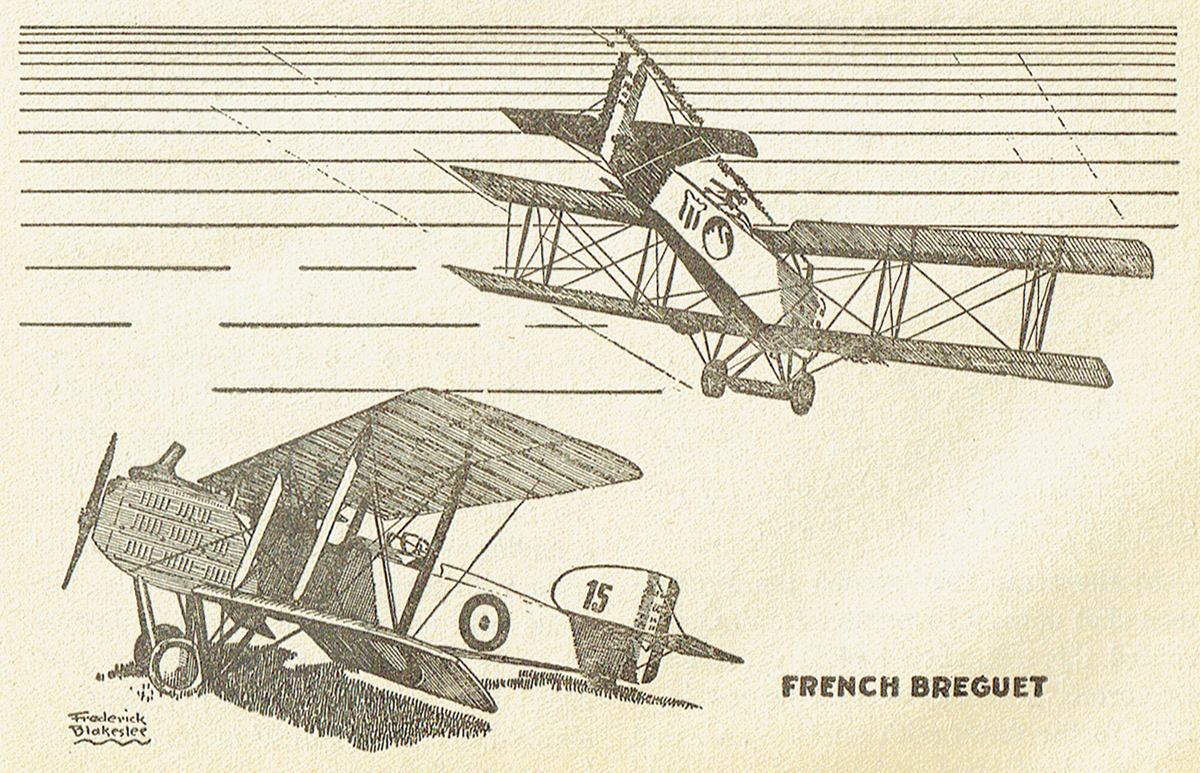
The French ship is a Breguet type 14B-2 with a 300 h.p. Renault engine. It was designed as a day bomber, but carried one gun in front (synchronized) and two guns aft. Only the upper planes were provided with ailerons. The part of the lower plane lying behind the rear spar was hinged along its total length and pulled downward by means of twelve rubber cords fixed on the under side of the ribs. An automatic change of aerofoil corresponding with the load and speed thus results with an easier control of the airplane with and without a load of bombs. Its span was 14.364 meters; length 9 m; speed low down 185 kms per hour. It climbed to 5,000 m. in 47 m. 30 sec. Ceiling was 5,750 m.

The French Breguet
“The French Breguet” by Frederick M. Blakeslee (December 1932)

“The Junkers Biplane” by Frederick Blakeslee

Link - Posted by David on April 20, 2015 @ 6:00 am in

Editor’s Note: This month’s cover is the eighteenth of the actual war-combat pictures which Mr. Blakeslee, well-known artist and authority on aircraft, is painting exclusively for BATTLE ACES. The series was started to give our readers authentic pictures of war planes in color. It also enables you to follow famous airmen on many of their amazing adventures and feel the same thrills of battle they felt.

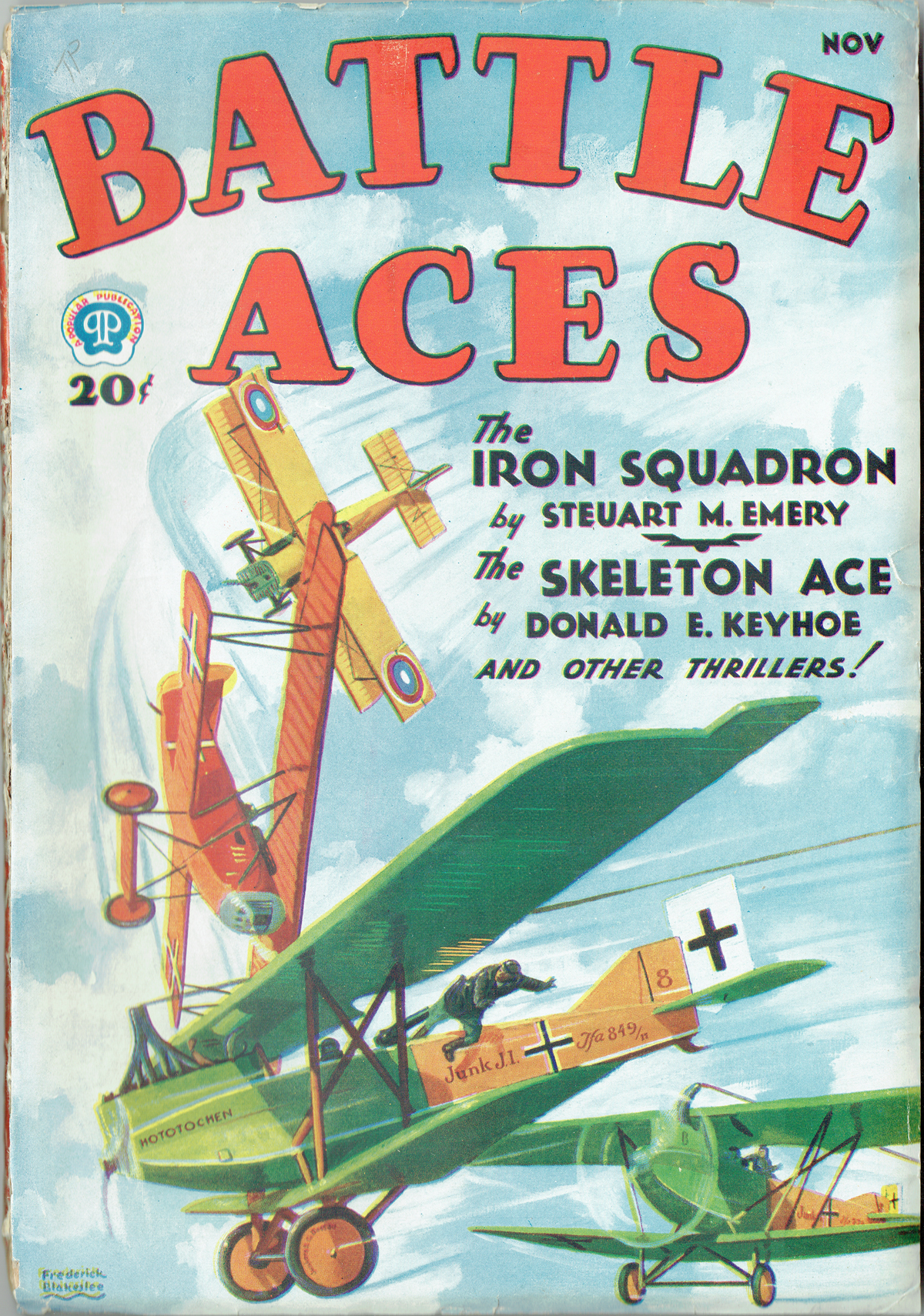
th_BA_3211THIS is the story of a combat in which three German ships were brought down by one American flyer, without a shot being fired by either side. The cover shows how it was done.

A few days before this combat occurred, the American had lost his closest friend. The two men had grown up together in the same town, had enlisted together and had managed to stick together until the day one of them had been killed. His life had come to an end under particularly tragic circumstances, for he had given it for his friend. That friend had sworn vengeance.

On the morning after the funeral, this pilot took the air on an independent patrol, looking for trouble. He encountered no enemy ships and returned. After breakfast he again took off with the same result. That afternoon he resolved to go into Germany and bomb the airdrome of the squadron that had killed his chum.

He arrived over it without opposition except for the inevitable Archie over the lines. There was no ship in sight on the field. He dropped his bombs, doing considerable damage to two hangars and receiving in reply a hot ground fire which did no damage to him whatever. He turned to go back to his airdrome just in time to meet the charge of a Pfalz scout which had approached unobserved. The Boche proved to be as skilled as the American, so that neither gained an advantage over the other in the five or more minutes that the combat lasted. They had both, however, exhausted their ammunition. Finally they waved to one another and departed.

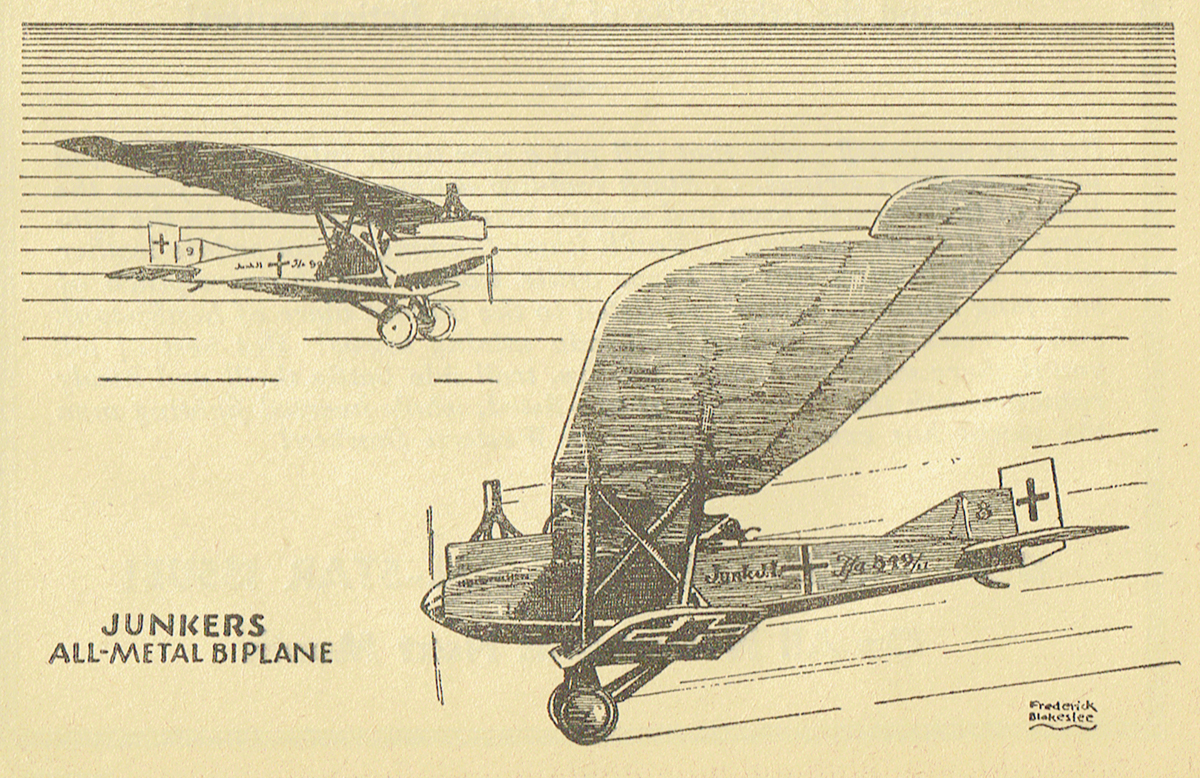
Fortune favored the Yank, for the fight had not attracted any roving Boche. He was no doubt saved by the fact that the squadron of the field over which he had been, was away on some devilment of its own. On his way back, near the lines, he sighted three dots which rapidly approached and soon resolved themselves into two Junkers, escorted by a member of the squadron for which the American had been searching.

This squadron was noted for its savage and ruthless mode of fighting. No quarter was expected of them and no quarter was given. All the Allied outfits in this sector had sworn to exterminate them, but as every man of them was a skillful pilot it proved no easy matter. As a matter of fact the event that finally put an end to this squadron was the death of its leader. True to type, the escort of the Junkers flew ahead to meet the helpless American. On seeing that he had at last met his enemy, the Yank forgot that his ammunition was gone. His only thought was to down this Boche or to die in the attempt.

With rage in his heart he kept on and the two planes came at each other with tremendous speed. As they approached, the American pressed his trigger. Nothing happened, and he remembered with despair his helplessness. It was too late. He could not turn back now.

Strangely, no shots came from the German who dipped just in time to avoid a collision. Then began a series of maneuvers that carried them all over the sky. The American could do nothing but avoid the fire of the German. Both men were evenly matched as to skill and both maneuvered successfully in order to keep out of one another’s range. Had the German known the helpless condition of the American, the fight would have been ended long ago. This, of course, he did not suspect. It was later found that the German’s gun was hopelessly jammed, which explained his failure to fire on the first onslaught.

In the meantime the Junkers had approached and passed. Neither had fired a shot nor made any attempt to join the battle. No explanation has ever been made of their failure to do so. The climax came swiftly. In fact the entire incident happened in less time than it takes to tell it. The two ships, the S.E-5 and the Fokker, got into the maneuver called “chasing tails.” They went round and round, one behind the other, each thinking the other could fire. This tactic of chasing tails by two ships of equal speed and by two pilots of equal skill, could be continued indefinitely unless the circle was broken by another ship. It was effective in preventing one from getting on the other’s tail. Sometimes pilots in this maneuver broke by mutual agreement, by use of signals, each going his own way.

The whirling ships had overtaken the Junkers and had approached dangerously close. In an attempt to break the vicious circle, the Boche dove his ship. As his head was turned, he did not see the leading Junker and crashed at full speed into it. Both fell in a flaming streak, but not before some flying wreckage had shattered the propeller of the following Junker. This ship landed safely in Germany. So three ships were downed without a single shot!

The Junkers Biplane
“The Junkers Biplane” by Frederick M. Blakeslee (November 1932)


“Lt. Carr and the De H-5″ by Frederick Blakeslee

Link - Posted by David on April 13, 2015 @ 6:00 am in

Editor’s Note: This month’s cover is the eleventh of the actual war-combat pictures which Mr. Blakeslee, well-known artist and authority on aircraft, is painting exclusively for BATTLE ACES. The scries was started to give our readers authentic pictures of war planes in color. It also enables you to follow famous airmen on many of their amazing adventures and feel the same thrills of battle they felt.

th_BA_3210IN JUNE, 1918, there arrived at a certain American airdrome in France a group of replacements who had been trained in England. Among them was a lad by the name of Carr. To use a remark of one of his instructors, he was “the world’s worst pilot but a damn fine lad.” He had wrecked more ships than any man in camp. Why he was not thrown out of aviation, or at best sent to an observation group, he did not know. The fact remains that in the final test he passed, and was sent with five others to a fighting squadron. This squadron was proud of its toughness and its record for victories. The squadron leader looked the replacements over critically and approved, for they were just the type he wanted.

Carr was tall, with broad shoulders and an infectious smile—the sort of fellow one likes instantly. He was selected to be the first to go over the lines. Accordingly, next morning he was one of five to line up and take off. However, only four actually did take off. Carr’s ship went wobbling across the field and came up standing in a hedge. The mechanics looked it over for defects and, fortunately for Carr, found one that might have caused the crack-up. Carr, much surprised, thanked his lucky stars for that. Naturally he did not mention that the accident was due to his own stupidity. He was congratulated on his escape and wished better luck.

His next chance arrived and this time he managed to get into the air. His orders were strict; should a fight occur or if he were to loose the others, he was to return immediately. He was back in ten minutes—the time it took him to get lost and return to the airdrome. It did not help his reputation when he crashed in landing.

There followed a painful series of mishaps by which he became known as the “lovable ole dub.” It took them less than a week to discover that Carr would make a far better cab driver than a pilot. On the other hand he was the leader of all their binges. His smile carried him through all his troubles and with the willing help of the rest of the squadron his mistakes were smoothed over. However he was a great responsibility to flight leaders, who dreaded to have him in their patrol. At last, after a bit of particularly stupid flying, the C. O. decided that he would have to return to England. Carr was broken-hearted; he would rather die than be sent back. Rage against his own inability to fly determined him to try one last flight on which he would cither kill or be killed.

Early on the day he was to leave he took out his ship, gave it the gun and swept into the air. Although he did not realize it at the time, he was flying as he should have flown long ago. For the first time, instead of putting his ship into the air by sheer nervous will power, he forgot flying and thought only of fighting.

He had not gone far when he saw a patrol of Jerries beneath him. Without an instant’s hesitation he dove with such fury that he scattered the German ships right and left. Before they had become organized, he had shot down two of them. He dove head-on at another, intending to crash and end his life; but the panic-stricken Boche pulled up and fled with the others who had had enough of this mad American. Carr turned his De H-5 about just in time to see a green Pfalz diving at him. He plunged at him head-on, ripping out a savage burst. The Jerry, badly hit, looped but Carr looped after him.

Just at this point a Fokker Tripe joined the fight. Both planes came out of the loop with Carr on the German’s tail and his tracers crashing into the ship ahead. The Fokker zoomed and his wheel smashed through the left wing of the Pfalz, which went down out of control and crashed behind our lines. In a moment the pilot of the Fokker discovered that he had made a mistake in thinking that he or anyone could withstand such reckless and savage fury. He gave up in panic, raised his hands in token of surrender and followed Carr meekly back.

Carr returned to an overjoyed squadron, as confirmation of his victories had traveled ahead. He did not return to England. Instead he rose to be flight leader, then C.O., and finally became one of America’s aces.

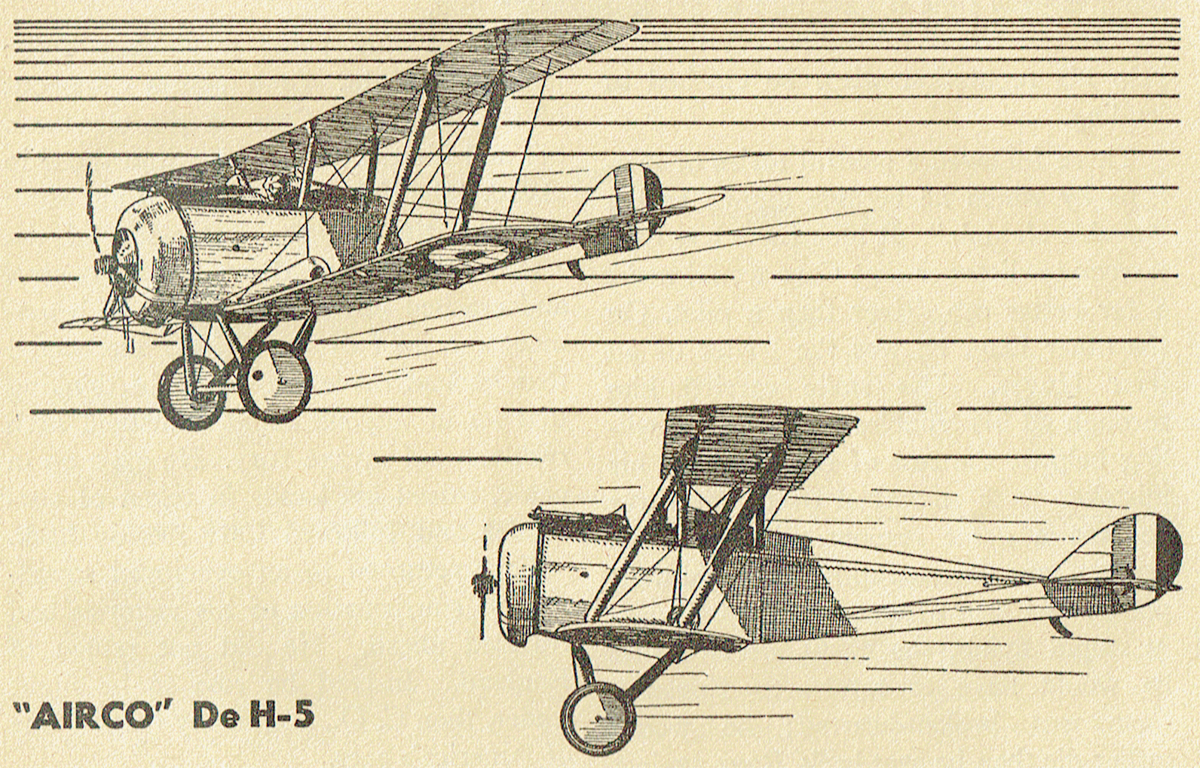
The De H-5 was produced late in 1916 and was extensively used at the front. It was so constructed that the pilot’s view upward and foreward was not entirely blanketed by the top wing. For this reason the top wing was staggered backward and the pilot’s cockpit put beneath the leading edge of that wing. Despite loss of efficiency which resulted from this backward stagger, by careful attention to the reduction of head resistance, a ship was produced with very good all-round performance. Its span was 25′-8″; length 22′; engine 110 h.p., Le Rhone; speed at 10,000 ft. 102 m.p.h.; landing speed 50 m.p.h.; approximate ceiling 15,000 ft.

Lt. Carr and the De H-5
“Lt. Carr and the De H-5″ by Frederick M. Blakeslee (October 1932)

“Lt. Reed and the L.V.G.” by Frederick Blakeslee

Link - Posted by David on April 6, 2015 @ 6:00 am in

Editor’s Note: This month’s cover is the sixteenth of the actual war-combat pictures which Mr. Blakeslee, well-known artist and authority on aircraft, is painting exclusively for BATTLE ACES. The series was started to give our readers authentic pictures of war planes in color. It also enables you to follow famous airmen on many of their amazing adventures and feel the same thrills of battle they felt.

th_BA_3209AN AMERICAN observation group was assigned a very important photographic mission. The objective was far in German territory and heavily guarded both by airplanes and anti-aircraft. Heretofore although several attempts had been made to photograph the position, all had failed. It had been decided, therefore, as a last chance, to send several observation ships, with a huge group of pursuit planes as protection. It was hoped that with this strong-force, one ship at least would be able to go through with the work.

As a matter of fact only one ship, of the twenty-seven that took the air, arrived over the objective.

How six of the observation ships dropped out and how they missed their top protection at the rendezvous, is another story. Suffice it to say that only three of the photographic ships, which were brand-new R.E.8’s, reached the rendezvous; when they did not see the fighting group, they separated and started alone into Germany, for they carried only enough gas to get them there and back and so could not wait. Two of the three were forced to return by strong Boche patrols. One ship was left. Let us follow him into Germany.

The pilot of this ship was not sorry to be alone, for in all the previous attempts there had been eight or nine planes and Lt. Reed felt confident that where many ships had failed, one might do the trick. He flew as high as he could and arrived over his objective unchallenged. On the ground the Germans had observed the lone flyer, but as it was a mere dot in the sky and only one where they had been looking for many, the observers were puzzled. They could not determine whether it was one of their own ships or not. Soon it began to spiral down, but since there was a German airdrome in the neighborhood this was not unusual. It was only when Lt. Reed came within view of the binoculars which were trained on him, that he was recognized as an Allied plane.

Reed came down faster than the gunners could adjust their fuses and in a minute he was at the desired level. He flattened out so that his observer was able to calmly click his camera. While he was thus employed the anti-aircraft suddenly became quiet. No wonder, for eighteen Boche fighting ships were diving on this dauntless American.

He was surrounded in a second by a milling crowd of roaring planes. Almost instantly he was out of action, with his observer seriously wounded and his own legs shot through. The storm of lead stopped as suddenly as it had come. Here was a prize—an R.E.8, a machine the Germans badly wanted intact. The Germans saw that the American was helpless, so they surrounded him in a boxlike formation and headed him toward G.H.Q., or so Lt. Reed supposed.

They had not gone far when two L.V.G.’s took up a position on either side of him, and the rest flew away. Lt. Reed was growing weak from loss of blood. He knew that he could never escape in his condition, for aside from being faint he found that his legs were stiffening so that it was barely possible to steer. He was headed into Germany, so he supposed, and could never be able to turn his ship.

Suddenly the ship on his left dove; at the same moment the L.V.G. on his right burst into flames. Then an S.E.5 with British insignias flashed in front of Lt. Reed, to hurtle down at the other Boche. The next instant Reed found himself flying alone again.

The action had revived him somewhat, but when he tried to turn toward France he found his legs were useless. He could do nothing but fly straight on. He was headed toward the south and had been all along, though he had been unaware of it. Believing that he was going deeper into Germany he flew on until he grew blind from faintness. Then he landed and learned that he was in France. He asked to have his observer and photographs looked after and collapsed.

For their devotion to duty both the observer and the pilot received a high award.

The Luft Verkehrs Gesellschaft, better known as the L.V.G., G.V., was a well-known fighter. It was a two-seater biplane, carrying one Spandau on the right of the motor and firing through the propeller, and one Parabellum gun fired from the observer’s seat. There were several types of L.V.G.’s. One was a C.IV, an improvement over the C.V. Another was a single-seater scout, the D.VI, produced toward the end of the war. It was a queer looking ship. A third was also weird in appearance and called the D.V., a single seater. A big brother to the L.V.G. family was a twin-engined tractor triplane. The cream of the lot however was a little single-seater scout of the D class, one of the speediest looking ships ever made. The span of the L.V.G., C.V. was 44′-8½”; overall length, 42′-2½”, with a speed of 150 km. per hour at 4,000 meters.

Lt. Reed and the L.V.G.
“Lt. Reed and the L.V.G.” by Frederick M. Blakeslee (September 1932)

“A.E.G. Bomber” by Frederick Blakeslee

Link - Posted by David on March 23, 2015 @ 6:00 am in

Editor’s Note: This month’s cover is the fourteenth of the actual war-combat pictures’ which Mr. Blakeslee, well-known artist and authority on aircraft, is painting exclusively for BATTLE ACES. The series was started to give our readers authentic pictures of war planes in color. It also enables you to follow famous airmen on many of their amazing adventures and feel the same thrills of battle they felt. Be sure to save these covers if you want your collection of, this fine series to be complete.

th_BA_3207BECAUSE of a promise not to reveal his identity, the hero of this combat will be called Jim. He was a British war pilot and has a great fund of experiences, some of which he has been good enough to relate for use in this magazine.

This month’s cover story is a most unusual one. Of the seven men involved in the fight only one survived and he, as a result of the battle, spent long months in the hospitals in both France and England. As for the three planes, all were totally wrecked; in fact only portions of the German ships were ever found.

The combat took place toward the end of the war, not long after the exploit of Jim’s which was related in last month’s issue of Battle Aces. On this occasion Jim started out with his patrol early one morning and flew toward the German lines. As the planes advanced the weather suddenly changed. The earth disappeared and the sun burned red through the haze which rapidly gathered. Flying conditions fast became impossible in the face of the gathering storm, so Jim, who was leading the patrol, gave the signal to turn about for home.

The weather changed from bad to worse and soon Jim discovered that he was flying alone. He knew that his patrol had been forced to separate and to fly each man for himself. He decided to head due south in the hope of flying out of the storm, for he could not find his own field and it was suicide to land where he was. Suddenly the form of an immense bomber loomed up ahead, rushing directly at him out of the haze.

It was not until nearly a year later that Jim was able to recall what happened from that moment on.

Let me tell you the story from the ground.

At about 11:30 A.M. two dark objects whirled out of the haze. One landed in a street and proved to be the body of a man, his clothes in shreds and too mutilated for identification. The other object hit the roof of a building in Châlons-sur-Marne, and was followed by splinters of wood, metal and scraps of red fabric. When dug out of the basement this proved to be the wreck of a Mercedes engine.

A few moments later the tip of an airplane wing fell in the outskirts of the same town, preceded by several explosions. It was also reported that at about the same time two Mercedes engines, with separate bits of metal and parts of the wings of an airplane, fell near the road between Châlon and Chepy. Then reports came in of a rain of wreckage falling all over the district. To cap the climax, another Mercedes engine, with more wreckage, fell at Marson, three and a half miles from Chepy. What could be the cause of this deluge of Mercedes engines? All came down at approximately the same time at widely separated points. The bodies of five more men and wreckage were found near Châlon and Chepy.

To add to the interest of the day, at Sommesons, nearly twenty miles from Châlons, an S.E.-5 suddenly shot out of the haze, barely missed a farm house, and spread itself out over the adjacent landscape. The pilot was sent to a hospital unconscious, where he stayed in that condition for several clays. As he was the only one who seemed at all connected with the affair, the matter remained a mystery until a year later when his memory had fully returned. The following is what happened.

As the bomber loomed up ahead, Jim recognized it as a German A.E.G. Contrary to general practice, it was not camouflaged but was painted a bright red. Jim pulled up to pass over. As he zoomed up he saw another bomber almost directly overhead. The nose of his ship pointed directly at it and with an instinctive movement, he pulled his trigger. Almost instantly there was a terrific explosion. The wreckage of the bomber was thrown in all directions. Jim was so close that parts of the Boche ship shattered his propeller and damaged his right wing. The bomber dropped, shearing off the left wing of the A.E.G. underneath close to the fuselage. Jim does not yet know how he escaped the tangle of flying wreckage and ships. The next moment they had vanished and Jim began a long glide earthward; because of the thick haze, his ship crashed, as has been related. (For purposes of design the scene on the cover has been painted in bright sunlight, but in reality the haze was extremely dense.)

The A.E.G. bomber was powered by two 260 h.p. Mercedes engines and carried two guns. At 5,000 feet its speed was 90 m.p.h. and its landing speed about 75 m.p.h. It had one fault. Its elevators did not function well when landing. It was also found advisable not to fly the machine without a passenger in the front seat.

A.E.G. Bomber
“A.E.G. Bomber” by Frederick M. Blakeslee (July 1932)

“Kondor E 111a” by Frederick Blakeslee

Link - Posted by David on March 16, 2015 @ 6:00 am in

Editor’s Note: This month’s cover is the thirteenth of the actual war-combat pictures which Mr. Blakeslee, well-known artist and authority on aircraft, is painting exclusively for BATTLE ACES. The series was started to give our readers authentic pictures of war planes in color. It also enables you to follow famous airmen on many of their amazing adventures and feel the same thrills of battle they felt. Be sure to save these covers if you want your collection of this fine series to be complete.

th_BA_3206JIM, like most of the men who fought in the World War, refused to talk on the subject. He was an English ace and I knew he had done some worthwhile things. Finally, just to get rid of me, he agreed to tell me his story on the condition that, should I repeat it, his name would be withheld. Luck was with me after he once started and by questioning and egging him on I persuaded him to tell me of several other of his exploits. You’ll hear of them in later issues. This month the cover is based on one of his stories which he told very modestly, so I shall retell it in my own way.

A British hospital had been bombed by three German flyers. They had wrecked one wing of it, killing several of the wounded. As soon as the news reached the nearest airdrome, planes took off in pursuit of the marauders, but they had disappeared and as night was setting in the ships had to return.

The three Boche flyers had flown monoplanes with green camouflaged bodies, brick-red rudders and blue wings, so they were marked men. The Allies determined to avenge the outrage and early next morning the patrol took the air together with all ships in that sector. They ranged the sky all without coming in contact with the enemy. On the way home they flew under the clouds, shooting up everything in sight on the ground. When they returned to the drome, Jim’s patrol learned that in their absence the three Jerries had again bombed the hospital, fortunately without any fatal results. The three had lurked in the clouds until the patrols had gone and then proceeded to drop their eggs.

Orders were issued to get these Jerries at all costs. This time the British forces were to fly singly or in pairs, in order to cover more territory. With rage in their hearts the British pilots took the air.

Jim was flying alone and very high when he saw three specks skudding along close to a layer of clouds; they were coming from the direction of Germany. Sure these were the wanted planes, he tilted his machine down to investigate and noticed that one ship was flying high above the other two, probably as a lookout. On coming closer he recognized the plane as one of the bombers of the day before. He pulled his throttle wide open and dove for him.

Too late the Boche heard the scream of the plane behind him. He turned with a startled look as Jim let go a savage burst straight into him at point-blank range. The Boche was probably killed instantly, for he fell forward, his monoplane tipped up and Jim’s smoking bullets smashed through the entire length of the body. The other two ships streaked down one behind the other. All at once Jim realized that he was in a trail of heat and smoke. In his blind fury he had kept a fast hold on his trigger and was pouring a steady stream of lead into the ship ahead.

The smoke brought him to himself and he pulled to one side just in time to see the enemy ship burst into roaring flames. In its dive the burning plane had headed straight for the other two and an instant later had plunged into the leading Boche. There was a blinding flash, followed by a cloud of smoke, suspended for an instant, and when Jim gathered his wits, he and the third Boche were flying alone.

Instantly he brought his nose in line with him and pulled the trigger, but nothing happened. He had used up his ammunition in that wild dive. He thought of his center section gun, but before he could maneuver into position, the German had gone into a dive. Jim determined to get him or die in the attempt. He set off in pursuit, but when the Jerry whirled into the clouds. Jim thought he had seen the last of this particular enemy. He cut in after him, however, and as he came out, saw the Boche still diving towards the earth. A moment later, the Jerry plane flattened out and crashed into a field. The pilot extracted himself from the wreck, ran a few steps and dropped.

Jim landed near him and found that the German was not badly hurt but that his mind had been temporarily deranged. He was removed to a hospital and several weeks later, when his mind and nerves were rested and back to normal, he explained the reason for the bombing of the hospital. The Germans had been informed that the hospital was an ammunition factory in disguise, for the demolition of which they would be highly rewarded.

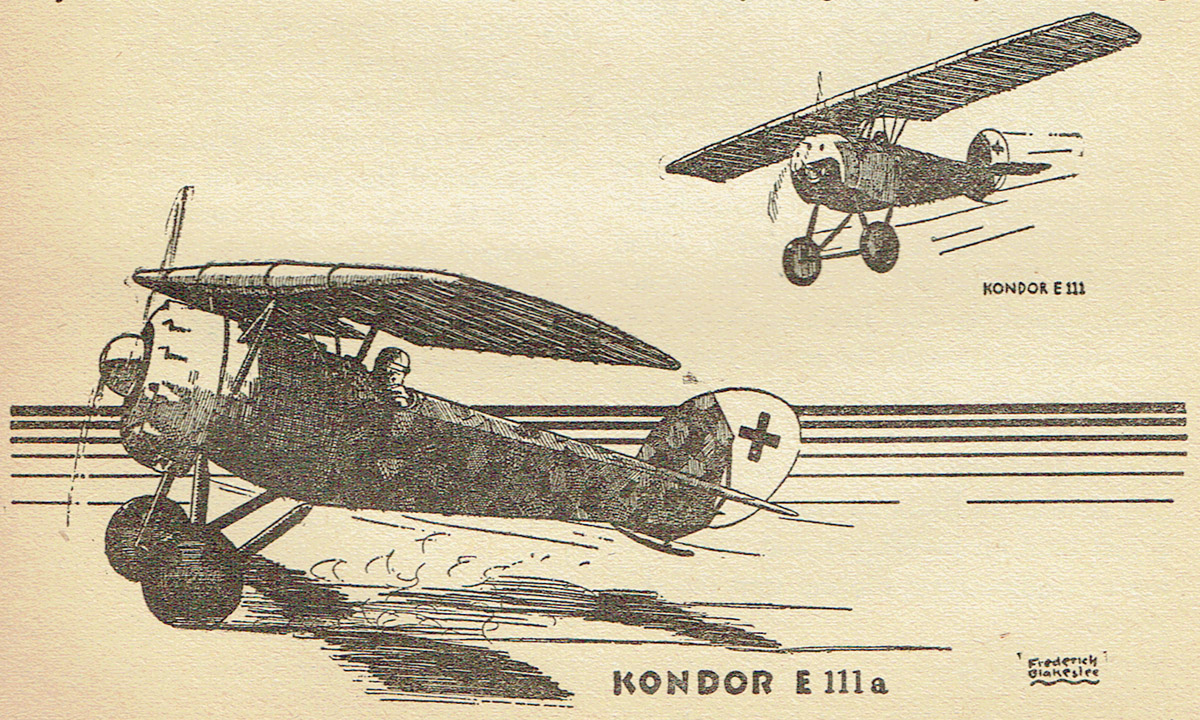
Jim did not recognize the type of the German ship, but was sure it was neither a Fokker nor a Junker. From his meager description it sounds like a Kondor E 111a or E 111. At any rate I have shown these two ships on the cover. There is no information available on this machine except that it had a 200 h.p. Goebel rotary motor.

Kondor E111a
“Kondor E 111a” by Frederick M. Blakeslee (June 1932)

“The Westland Wagtail” by Frederick Blakeslee

Link - Posted by David on March 9, 2015 @ 6:00 am in

Editor’s Note: This month’s cover is the twelfth of the actual war-combat pictures which Mr. Blakeslee, well-known artist and authority on aircraft, is painting exclusively for BATTLE ACES. The series was started to give our readers authentic pictures of war plwves in color. It also enables you to follow famous airmen on many of their amazing adventures and feel the same thrills of battle they felt. Be sure to save these covers if you want your collection of this fine series to be complete.

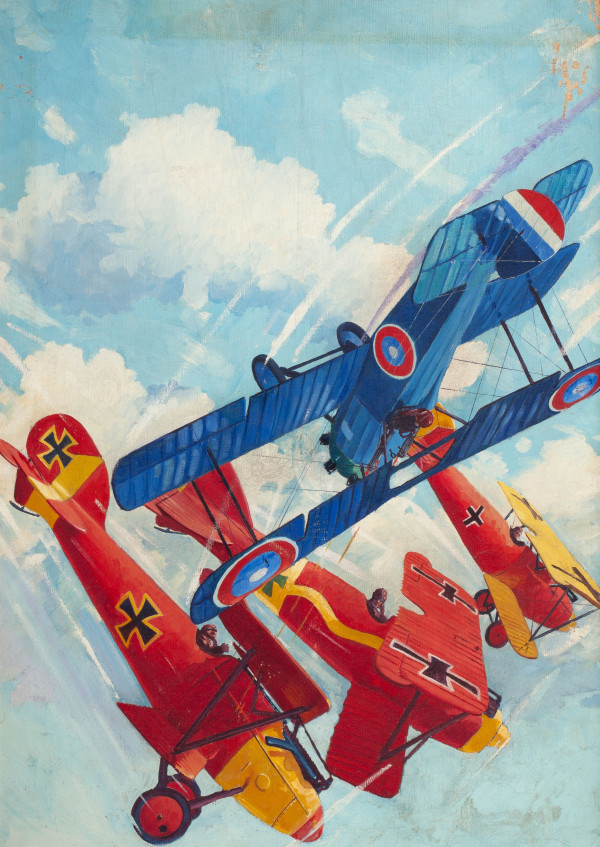
th_BA_3205THE PAINTING on the cover this month lacks two things—movement and noise. The only way to show movement is by the speed lines which stream out behind the planes. As for the noise, you will just have to imagine it. The three diving Germans with motors wide open are sending forth a deafening roar which gives the effect of a musical note when heard at a distance. The American ship, upside down as it zooms over, is emitting a high-pitched, reverberating and ear-splitting shriek. It drowns the bark of two Vicker machine guns which are pouring a stream of hot lead into the nearest Boche. Now that you have stuffed cotton in your ears we’ll go on with the story.

The action took place near Chateau-Thierry on July 2, 1918. The pilot of the American ship was First Lieutenant Alfred A. Grant of the 27th aero squadron. He was out on a patrol with several other officers when he encountered an enemy formation of nine planes. During the combat which followed, Lt. Grant became separated from the others and was immediately set upon by three of the Jerries.

He led these three Boches all over the sky, his comrades having vanished. Whenever opportunity presented itself he would turn and pour hot fire into a German ship. By skilful maneuvering he managed to keep out of serious trouble.

He kept the three Germans on the qui-vive however, and they found it impossible to corner him. Suddenly Lt. Grant broke off the fight and started on a bee-line for home. This was what the Germans wanted and hoped for. They gathered together in a group and dove after him.

On the other hand this was what Lt. Grant had hoped they would do. He allowed them to approach to within range and then zooming up and over he let go a withering blast of machine-gun fire straight into the Jerry ships as they streaked by under him.
One Boche continued his dive into eternity and the others turned and fled for home. For this action Lt. Grant was awarded the Distinguished Service Cross.

At first glance you may th_BA_3109think the German ships are Pfalz scouts of the type shown on the cover last September. If you have that cover compare the two and you will see how and where they differ. The machines illustrated on this cover are Albatros D.V.’s.

The Albatros biplanes were largely used in the War, at first as rather slow two-seater fighting machines, and as reconnaissance types. At the end of 1916 there came a very small Albatros single-seater with a Benz or Mercedes engine of some 175 h.p. This little ship did much damage to the Allies’ airplanes, until it was met and defeated by still faster British and French machines.

The speed of this ship was between 120 and 130 m.p.h. at its best height. This was the type known as the DIII. The DV was essentially the same as the DIII with no outward difference in appearance. There was, however, an improvement in speed and maneuverability. The DIII and DV were speedy looking ships and beautifully stream-lined. They have two Spandau machine guns firing through the propellers.

There was also an Albatros DXI, quite radical in design. The body instead of being rounded was box-shaped and for no apparent reason the rudder and fin were advanced. Between the wings it had a single instead of the V strut. As the bottom wing was much shorter than the upper, this strut inclined outward, and did away with all wiring. There was also a two-seater Albatros and a two-engined bomber.

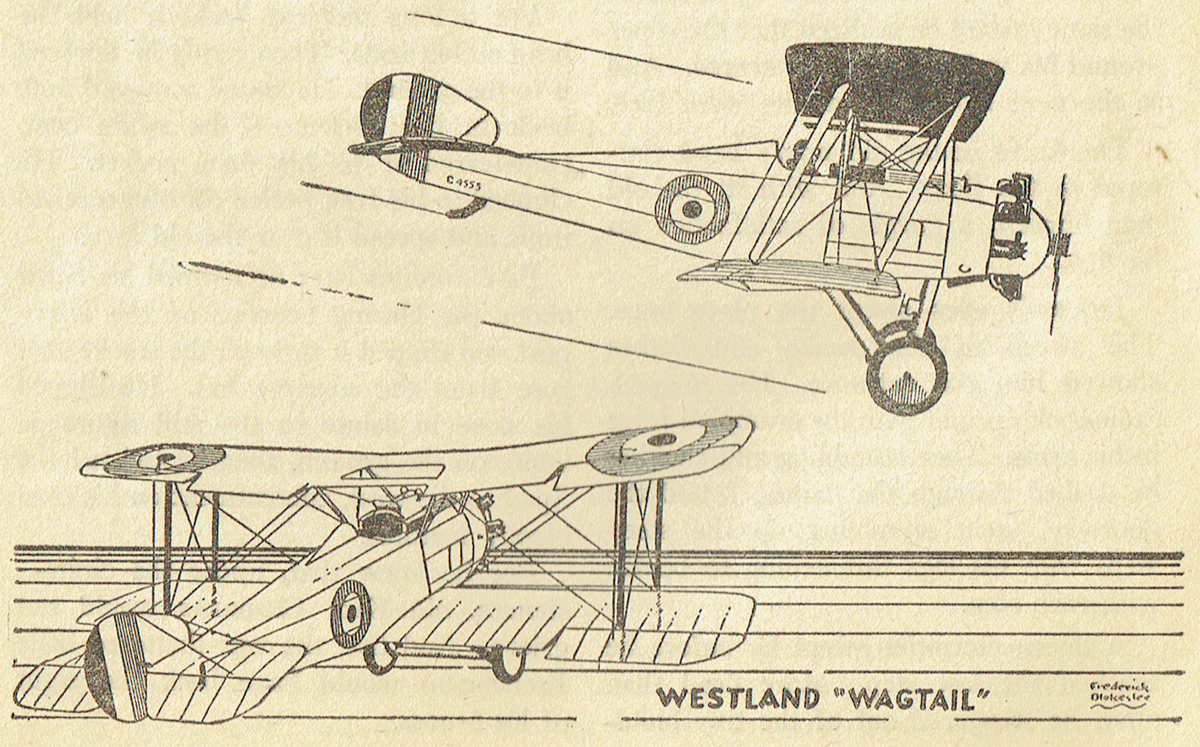
But this month we concern ourselves with the blue ship flown by the American which is a new and seldom heard of type, the Westland “Wagtail.”

It was designed in answer to a general demand for a fast, quick-climbing single-seater fighter, and its purpose was for high altitude fighting. It met the demand, for it could climb to its service ceiling of 17,000 ft. in 17 minutes—a thousand feet a minute, which was fast climbing in those days and hardly surpassed even today.

The pilot’s view upward and downward, was very good, as more than half the center section was left open. The engine cowling differs from the accepted type of the day and has more or less of a modern appearance. It had a span of 23′ 2″ and an overall length of 18′ 11″.

The Westland Wagtail
“The Westland Wagtail” by Frederick M. Blakeslee (May 1932)


“Richthofen’s Last Flight” by Frederick Blakeslee

Link - Posted by David on February 23, 2015 @ 6:00 am in

Editor’s Note: This month’s cover is the tenth of the actual war-combat pictures which Mr. Blakeslee, well-known artist and authority on aircraft, is painting exclusively for BATTLE ACES. The series was started In give our readers authentic pictures of war planes in color. It also enables you to follow famous airmen on many of their amazing adventures and feel the same thrills of battle they felt. Be sure to save these covers if you want your collection of this fine series to be complete.

th_BA_3203THE COVER painting this month depicts the essential elements that combined to cause the death of Baron von Richthofen. All of the planes involved are shown.

Baron von Richthofen was the greatest ace Germany ever produced. He was a cool daring fighter who fought to kill or be killed, and the more skillful his adversaries were the better he liked them. To match wits with a clever opponent brought him the utmost pleasure. He fought like a demon, quickly and surely, taking advantage of every fortune of combat. His
deadly aim accounted for the crashing of eighty Allied planes.

An analysis of his combats show that of his eighty victories, forty-six of the vanquished were two seaters and thirty-four were single-seater scouts. He killed eighty-eight men in these combats, seventeen of whom were unidentified. His record of eighty may be disputed, however, for there are no British casualty records to account for three of the ships which were reported by von Richthofen. If we give him the benefit of the doubt—and there is no evidence that he did not bring down these three—eighty is an imposing” record. He was the terror of the Front and in his all-red ship he blazed his way through the sky from September 17, 1916, until the day of his death, April 21, 1918.

Von Richthofen’s circus became a byword at the Front. The ships composing this staffel resembled a sinister rainbow. They were painted in every color imaginable, no two ships being alike and every one having a different combination. Only one of his circus had a single color scheme. This ship—a Fokker triplane—painted a brilliant red except for the black maltese cross on its white background.

It fell to the lot of Captain Roy Brown to put an end to “The Red Knight of Germany. This he accomplished on April 21, 1918, in the vicinity of Hamel. Four triplanes led by von Richthofen had dived on some old R.E.’s which were engaged on a photographic mission. Captain Roy Brown, with his flight of seven Camels, was two miles above. His attention was directed to the plight of the R.E.’s by the English anti-aircraft calling for help. Down he came in a two-mile dive with his flight screaming in his wake.

The triplanes had been joined by additional Fokkers and Albatrosses, so that they numbered about twenty-two. With guns blazing, the eight Camels plunged into the fight. It developed into one of the most desperate dogfights of the War.

The R.E.’s relieved of their pursuers, streaked for home and escaped.

In Captain Brown’s flight was Lieut. W.R. May, a newcomer and out for the first time. Nevertheless he joined the melee. After downing a Boche he remembered his orders to stay out of a combat, so with great difficulty he disengaged himself and started for home. Death, however, in the form of an all-red triplane, rode on his tail. Do what he could, side, slip, loop and turn, May could not shake the cool and determined fighter who pursued him. His ship was being-shot to pieces and he was painfully wounded. But fortunately death showed no partiality and also road on the tail of the red triplane. Brown had seen the unequal combat and diving in from the right his tracers tucked a seam up the body of the Fokker until they reached the cockpit. The triplane faultered, then glided to the earth, making a nearly perfect landing. It settled between the lines. The pilot did not move. An Australian crawled over the top, attached a rope to the undcr-carriage and drew it to the shelter of a rise in the ground. The pilot was taken out. Baron von Richthofen was dead.

The triplane was another creation of Anthony Fokker, It was speedy and a machine to be avoided in a scrap. Some authorities contend that it had one fatal fault—its tendency to tear itself apart in the air. For this reason the Germans finally abandoned it.

The Fokker triplane had a 110 h.p. engine and its speed was approximately 125 m.p.h. It was 19 feet, 1 inch in length over all and had a top wing span of 25 feet including the balancing fins on the aileron. The span of the center wing was 21 feet and that of the bottom wing was 19 feet. It carried two fixed machine guns on the cowl, syncronized through the propeller.

Richthofen's Last Flight
“Richthofen’s Last Flight” by Frederick M. Blakeslee (March 1932)

« Previous PageNext Page »