


Looking to buy? See our books on amazon.com Get Reading Now! Age of Aces Presents - free pulp PDFs

“The Mail Must Go Through!” By Arch Whitehouse

Link - Posted by David on December 9, 2014 @ 12:00 pm in

Here it is—the first of a thrilling series of True Air Adventures—amazing yarns based on the real adventures of airmen all over the world today! This month, read the true story of what happened to a pilot who stuck to the motto of the Air Mail—”The Mail Must Go Through!”

The Mail Must Go Through

By Arch Whitehouse (Sky Birds, March 1933)

OVER the facade of the New York Post Office building runs a word motto reading to the effect that, in spite of wind and weather, the postal department must remain true to its trust and carry out the business of the Postal Department. But the Air Mail pilot has chopped it all down to a few words: “The Mail Must Go Through!”

It is upon this motto that an almost unbelievable esprit de corps has been founded by the men who carry Uncle Sam’s mail over the skyways.
Things have changed a lot in the past few years, as far as flying the mail goes. The ships are better and faster. The motors are more reliable.

The routes are carefully marked with flashing beacons every ten miles. The airports are no longer cleared cow pastures with a shed at one end. Radio has come to guide the knights of the muzzle-mike. An efficient meteorological system has been worked out, and pilots are warned every few minutes what weather they can expect ten miles ahead.

Above all, every pilot is provided with the airman’s life-preserver—the parachute. If things go wrong, all he has to do is to cut the switch and step off. A billowing canopy of silk blossoms out above him, and he descends slowly to the ground.

But there are airmen in the Air Mail who balk at stepping off and letting the mail go down to a splintering crash—perhaps to a flaming finish. There may be valuable papers in those bags. There may be some widow’s pension stowed away. A love-letter, perhaps, reconciling two youngsters who have been parted by a petty quarrel. There may be the evidence that will save an innocent man from the chair. Or, perhaps, just a letter to some old lady who waits patiently for a happy word from her boy, who has gone away to try his fortunes in some other part of the country. One never knows what’s in the mail bag.

John Wolf, an Air Mail pilot, took off from Cleveland one night for Newark, 390 miles away. In the back pit of his Douglas mail ship lay 900 pounds of Uncle Sam’s choicest postal cargo. Pilot Wolf had often wondered what was in this mail. He’d pondered over it many times as he pounded his way across “the hump” of the Allegheny Mountains.

The airmen have named the hump the Mail Pilots’ Graveyard, for the whole trail is scored and marked with the numberless crashes that have occurred there. Pilot Wolf often wondered whether it was worth it. Then he’d stare at the insignia on the side of his ship—”U. S. Mail”—make an imaginary salute, and climb into the cockpit.

But on this night in question—about a year ago, to be exact—Pilot Wolf would have had all the excuse in the world for saying, “Bad weather upstairs. No use risking a crash tonight.” For there was a welter of fog and rain sweeping across the Cleveland field when he went out to the throbbing Douglas. He had been inside the operations office to look at the weather report coming through from Newark—and it was none too encouraging.

But Wolf took off. The mail had to go through!

Fifteen minutes after he took off, his radio set went dead. This would have been sufficient for most people, but Wolf kept on. There might be a break near Newark. After all, there were 900 pounds of mail in the back pit. He climbed to 12,000 feet to make sure that he’d clear the hump, but ice began to form on his wings, changing the camber and choking the controls. He had to go down lower and risk a crash in the Mail Pilots’ Graveyard.

For four hours he flew, averaging about 115 miles per hour, but no sign of Newark could he find. He was above a fog blanket that shrouded everything. On eastward he continued to push—hoping for a break. His ship bounced and pounded against the icy winds. New and amazing things happened to his instruments, and at times he found himself flying on his back. He kept fighting the Douglas, got back on the course and peered down again. No sight of Newark—or of anything else.

“Look here, John,” Pilot Wolf must have argued with himself. “You only have so much gas in this boiler. How about going down and taking a chance? Or how about slipping off and taking to the silk? Why risk your neck for 900 pounds of mail that is probably only bills, advertisements or dunning letters?”

But he glared at himself in the reflections cast by the dials of the in struments and shook his head. He had to go on.

He finally realized that there was none too much fuel left, however, and common sense prevailed.

He went down—down—down until he felt that he must crash into some buildings. Then he steadied himself and released a parachute flare. The big flaming ball of fire seeped away and went down farther and then, Pilot Wolf saw the cruel, reaching whitecaps of the Atlantic Ocean!
“Whew! Where am I?” he growled yanking back on his stick and pulling the Douglas out of the glide.

Turning westward, he tore back toward land, expecting any minute to find himself impaled on the lofty masts of some fog-bound transatlantic liner. He sat tense for nearly half an hour and raced westward peering over the cowling into the blanket of fog.

Then, a light! A dim but heaven sent gleam twinkled ahead. Pilot Wolf shot his Douglas for it with every ounce of power in the big Liberty engine. It was a lighthouse, he could tell by the time of the flashes. He tore up toward it and recognized it as Montauk Light on Long Island. Evidently he had passed over Newark without seeing it.

Now should he bail out? He was over ground, he was certain of that. There was not much gas left, so it would be wise to get out while the getting was good. No, the mail must go through!
He circled the village twice, seeking a place to land. He couldn’t get back to Newark now. He dropped more flares in an effort to find a level space to set the big mail ship down. There was nothing in sight.

Then one of those things happened that people think can happen only in fiction. Some one—a member of the village fire department—was air-minded enough to realize what was the matter. He probably had been a reader of a good aviation magazine—like Sky Birds, for instance. The pounding of the big Liberty up there in the soup and the trickling pathetic flares coming down through the fog told their story.

A fire alarm was sounded, and all the volunteer firemen were sent to the widest fairway of the North Fork Country Club. The air-minded fireman, who goes nameless, superintended the placing of the cars so that their headlights lit up a wide swath of level turf.

Wolf, amazed at the sudden appearance of this uncharted landing field, took a chance. He cut his motor and glided down to a perfect landing—just as the idling Liberty spluttered its last gasp. The tanks were dry.

Wolf slept at the firehouse that night, after seeing the mail safely aboard a train for New York. The next morning he calmly told his story to the air-minded fireman who had unconsciously adopted the Air Mail motto, “The Mail Must Go Through!”
“The Tail Buster” by Frederick Blakeslee

Link - Posted by David on November 27, 2014 @ 12:00 pm in

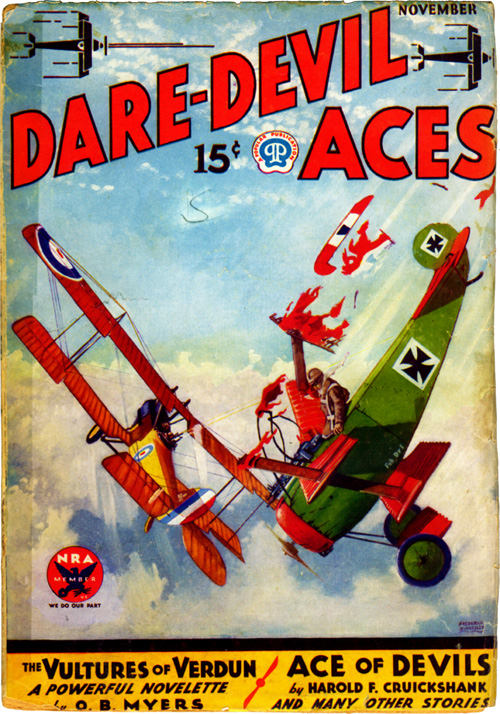
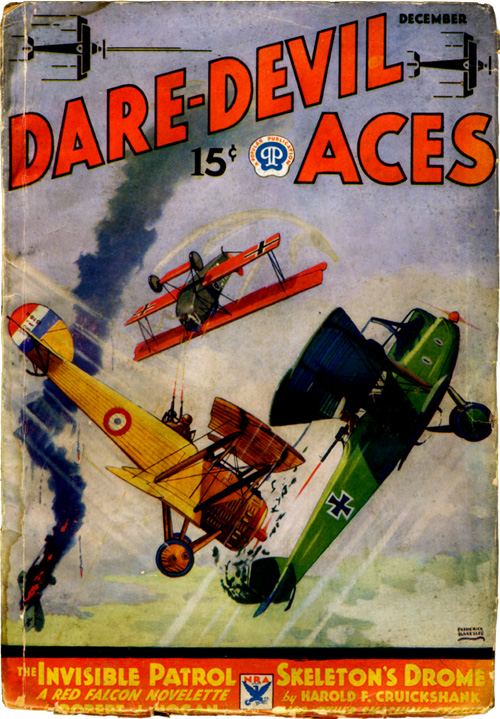
Frederick Blakeslee painted all the covers for the entire run of Dare-Devil Aces. And each of those covers had a story behind it. For the December 1933 issue Blakeslee paints the tail of a premeditated crash between a French Herriot and a German Fokker and L.V.G. in “The Tail Buster”…

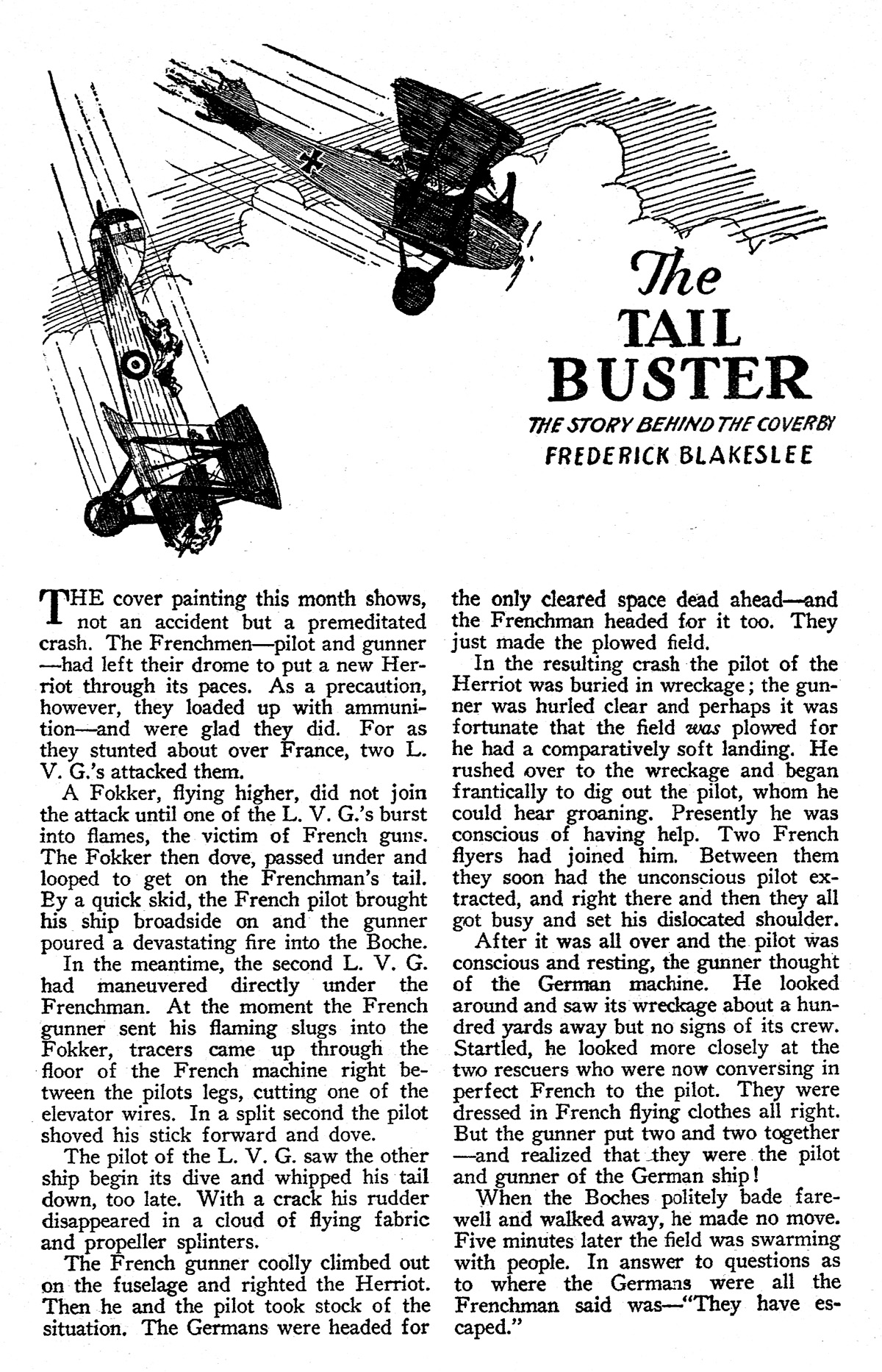
th_DDA_3312THE COVER painting this month shows, not an accident but a premeditated crash. The Frenchmen—pilot and gunner—had left their drome to put a new Herriot through its paces. As a precaution, however, they loaded up with ammunition—and were glad they did. For as they stunted about over France, two L.V.G.’s attacked them.

A Fokker, flying higher, did not join the attack until one of the L.V.G.’s burst into flames, the victim of French guns. The Fokker then dove, passed under and looped to get on the Frenchman’s tail. By a quick skid, the French pilot brought his ship broadside on and the gunner poured a devastating fire into the Boche.

In the meantime, the second L.V.G. had maneuvered directly under the Frenchman. At the moment the French gunner sent his flaming slugs into the Fokker, tracers came up through the floor of the French machine right between the pilots legs, cutting one of the elevator wires. In a split second the pilot shoved his stick forward and dove.

The pilot of the L.V.G. saw the other ship begin its dive and whipped his tail down, too late. With a crack his rudder disappeared in a cloud of flying fabric and propeller splinters.

The French gunner coolly climbed out on the fuselage and righted the Herriot. Then he and the pilot took stock of the situation. The Germans were headed for the only cleared space dead ahead—and the Frenchman headed for it too. They just made the plowed field.

In the resulting crash the pilot of the Herriot was buried in wreckage; the gunner was hurled clear and perhaps it was fortunate that the field was plowed for he had a comparatively soft landing. He rushed over to the wreckage and began frantically to dig out the pilot, whom he could hear groaning. Presently he was conscious of having help. Two French flyers had joined him. Between them they soon had the unconscious pilot extracted, and right there and then they all got busy and set his dislocated shoulder.

After it was all over and the pilot was conscious and resting, the gunner thought of the German machine. He looked around and saw its wreckage about a hundred yards away but no signs of its crew. Startled, he looked more closely at the two rescuers who were now conversing in perfect French to the pilot. They were dressed in French flying clothes all right. But the gunner put two and two together—and realized that they were the pilot and gunner of the German ship!

When the Boches politely bade farewell and walked away, he made no move. Five minutes later the field was swarming with people. In answer to questions as to where the Germans were all the Frenchman said was—”They have escaped.”

The Story Behind The Cover
“The Tail Buster: The Story Behind The Cover” by Frederick M. Blakeslee (December 1933)

Check back again. We will be presenting more of Blakeslee’s Stories behind his cover illustrations.

“The Caterpillar Ace” by Frederick Blakeslee

Link - Posted by David on November 20, 2014 @ 12:00 pm in

Frederick Blakeslee painted all the covers for the entire run of Dare-Devil Aces. And each of those covers had a story behind it. Blakeslee illustrates an incident in the career of that great German Ace—Ernst Udet! His life was previously featured by Alden McWilliams in his “They Had What it Takes”, but here Blakeslee features the battle that led Udet to use a parachute for the first time, thus becoming “The Caterpillar Ace!”

th_DDA_3311THE COVER this month illustrates an incident in the sky adventures of one of Germany’s great war aces—Ernst Udet. There is one slight discrepancy from fact in the painting. The Allied ship on the cover is an R.E.8, whereas Udet was engaged in combat with a Bristol Fighter. When the story was first told me the two planes were described as a Fokker triplane and an R.E.8. Later on—after the canvas was painted and just before this magazine went to press—I discovered the error, but it was too late to remedy it then. Outside of this, however, the picture depicts a great battle climax as it actually occurred in war skies.

You will notice that the German pilot is wearing a parachute. Ernst Udet is the only war-time pilot to escape from a wrecked ship in a parachute—thus having the distinction of being the original member of the Caterpillar Club.

The event was remarkable since, on the day this happened, Udet was wearing a parachute for the first time and against his will. He had been ordered to do so as an experiment. Sighting a Bristol Fighter, he maneuvered onto its tail and when only about a dozen feet away opened fire. His tracers tacked a scam up the Bristol’s back into the gunner’s pit; the gunner slumped over, apparently dead.

Udet’s speed carried him beyond the Bristol. Careful not to give the .pilot chance for a shot at him, he swung around, again on its tail. As he came in close, holding his fire until he should be in perfect position, his eyes widened with horror. For the gunner—supposedly dead—was dragging himself upright, his face a mass of blood; swinging his guns around, he opened fire at point-blank range.

Before the astonished German ace could gather his wits, there was a rendering crash. His upper wing carried away—was shot away, rather—snapping the struts, and pulling the second and third wings with it. A split second later, the wingless fuselage began its plunge to earth.

It was then Udet remembered the unwanted bulk strapped to his back. Well, he might just as well try it. He would die anyway! So he leaped clear. The parachute, to his astonishment, opened and he floated easily to earth, landing in German territory. The pilot of the Bristol had been watching it all. He now came down low over where Udet had landed. The German waved his hand and the Bristol flew away south.

Udet fought under a lucky star. Sometime later, while flying a Fokker D-VII, he was rammed by a fire-eating Camel pilot and he crashed to earth, but was not severely injured.

Ernst Udet is Germany’s leading surviving ace, credited with sixty-two victories. He was respected by friend and foe alike for his sportsmanship in combat. Recently he came to the United States and flew for the movies. He is responsible for the really beautiful air shots in such movies as “The White Hell of Pitz Palu” and “Storm Over Mount Blanc.” Last summer he spent in Greenland working on the movie “S.O.S. Iceberg.” He is one of the most masterly stunt pilots in the world and is one of the few surviving aces who has not lost his cunning.

The Story Behind The Cover
“The Caterpillar Ace: The Story Behind The Cover” by Frederick M. Blakeslee (November 1933)

Check back again. We will be presenting more of Blakeslee’s Stories behind his cover illustrations.

“The Broken Parole” by William E. Barrett

Link - Posted by David on November 18, 2014 @ 12:00 pm in

William E. Barrett is an excellent author. Known for such classics as The Left Hand of God, Lillies of the Field, and our own The Iron Ace! In honor of William E. Barrett’s birthday this past weekend, we have for you a tale of broken wings from the January 1933 issue of Sky Birds. The brothers Cord, one stripped of his honor while the other was honor bound not to fly!

Flying high in a blood-red sky, von Sternberg had taken toll of the lives of many men. Over the brothers Cord he had thrown an even grimmer shadow, for he had robbed one of his honor, the other of the right to fly. But wings can be built that are too strong to be broken.

“Terror Bomb—” by Frederick Blakeslee

Link - Posted by David on November 13, 2014 @ 12:00 pm in

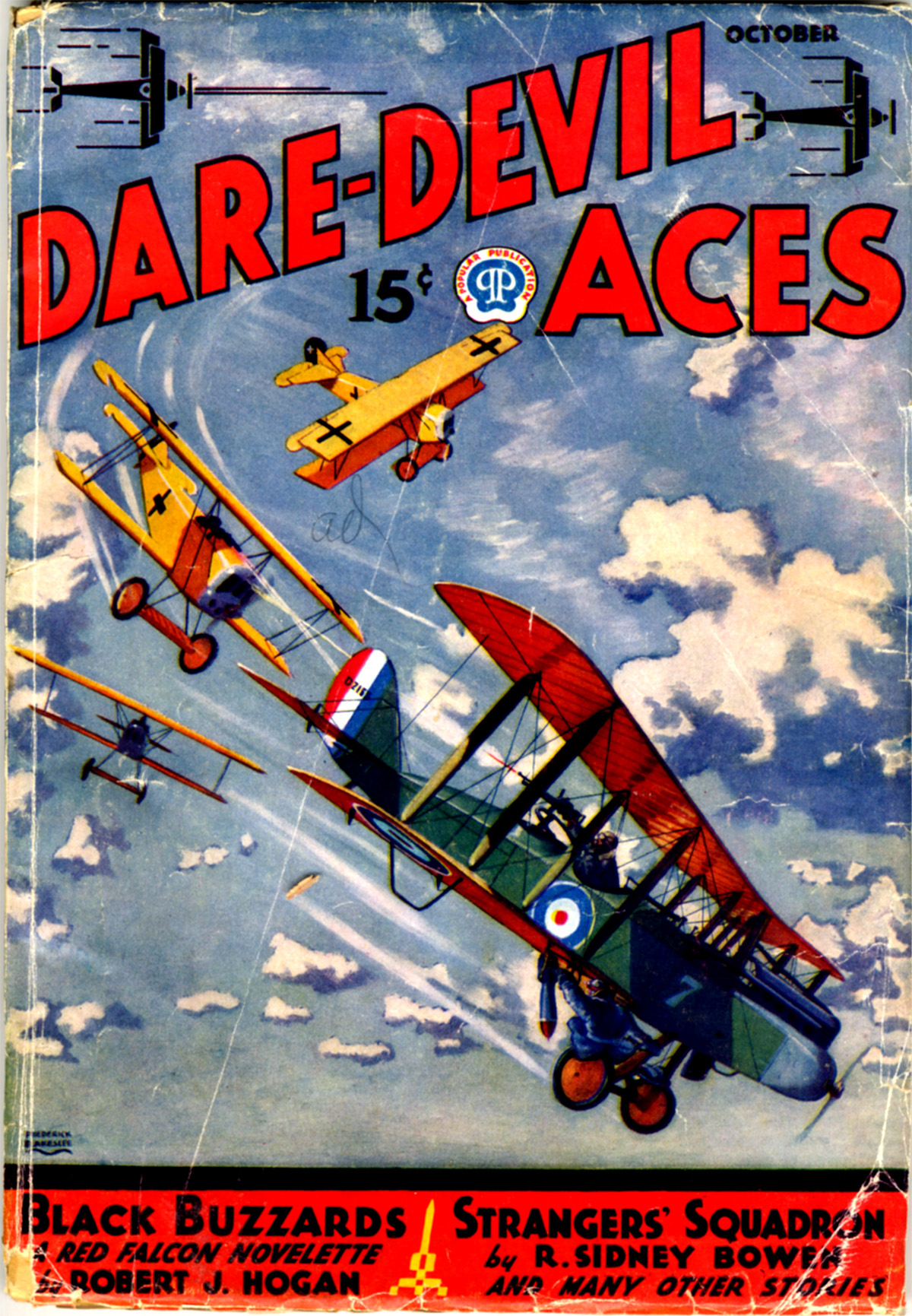
This week we feature Dare-Devil Ace’s October 1933 cover, Frederick Blakeslee’s “Terror Bomb!”

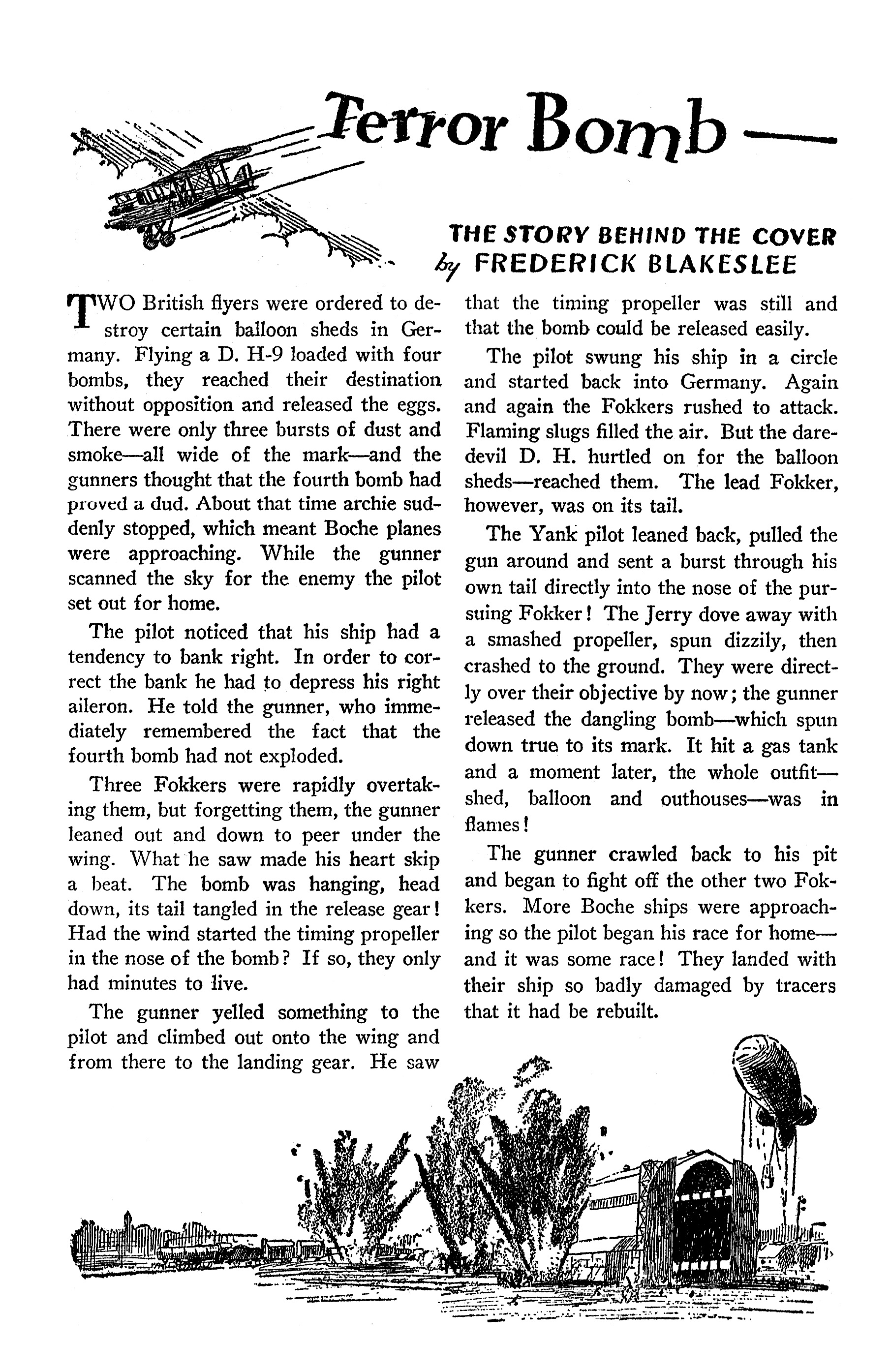
th_DDA_3310TWO BRITISH FLYERS were ordered to destroy certain balloon sheds in Germany. Flying a D.H-9 loaded with four bombs, they reached their destination without opposition and released the eggs. There were only three bursts of dust and smoke—all wide of the mark—and the gunners thought that the fourth bomb had proved a dud. About that time archie suddenly stopped, which meant Boche planes were approaching. While the gunner scanned the sky for the enemy the pilot set out for home.

The pilot noticed that his ship had a tendency to bank right. In order to correct the bank he had to depress his right aileron. He told the gunner, who immediately remembered the fact that the fourth bomb had not exploded.

Three Fokkers were rapidly overtaking them, but forgetting them, the gunner leaned out and down to peer under the wing. What he saw made his heart skip a beat. The bomb was hanging, head down, its tail tangled in the release gear! Had the wind started the timing propeller in the nose of the bomb ? If so, they only had minutes to live.

The gunner yelled something to the pilot and climbed out onto the wing and from there to the landing gear. He saw that the timing propeller was still and that the bomb could be released easily.

The pilot swung his ship in a circle and started back into Germany. Again and again the Fokkers rushed to attack. Flaming slugs filled the air. But the daredevil D.H. hurtled on for the balloon sheds—reached them. The lead Fokker, however, was on its tail.

The Yank pilot leaned back, pulled the gun around and sent a burst through his own tail directly into the nose of the pursuing Fokker! The Jerry dove away with a smashed propeller, spun dizzily, then crashed to the ground. They were directly over their objective by now; the gunner released the dangling bomb—which spun down true to its mark. It hit a gas tank and a moment later, the whole outfit—shed, balloon and outhouses—was in flames!

The gunner crawled back to his pit and began to fight off the other two Fokkers. More Boche ships were approaching so the pilot began his race for home—and it was some race! They landed with their ship so badly damaged by tracers that it had be rebuilt.

The Story Behind The Cover
“Terror Bomb: The Story Behind The Cover” by Frederick M. Blakeslee (October 1933)

Check back again. We will be presenting more of Blakeslee’s Stories behind his cover illustrations.

“Ace of the Storm” by Frederick Blakeslee

Link - Posted by David on November 6, 2014 @ 12:00 pm in

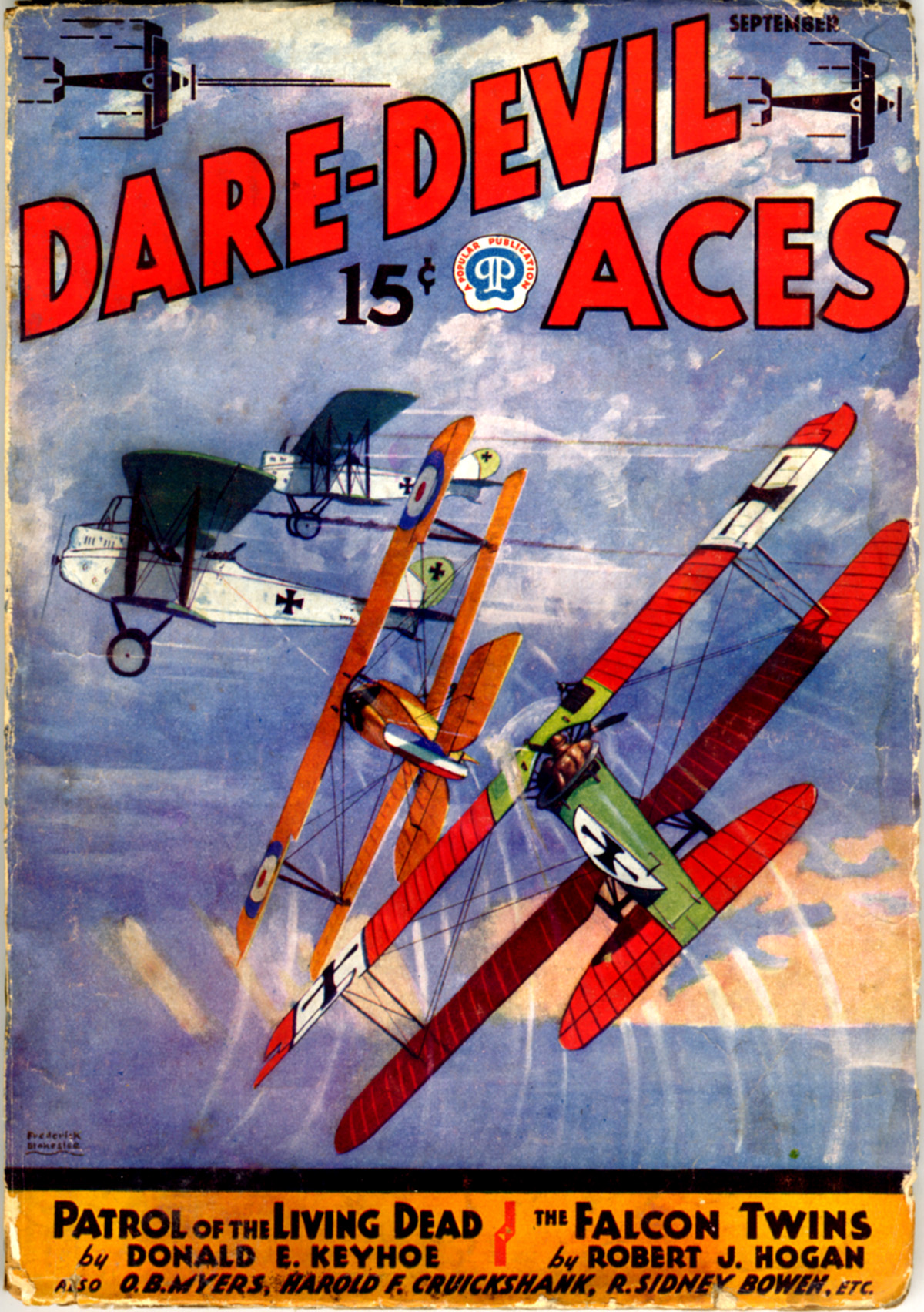
Frederick Blakeslee painted the covers for Dare-Devil Aces‘ entire fourteen year run. Every one of those covers told a story, and Blakeslee had a page with which to do so. This time we present Blakeslee’s cover for the September 1933 issue—”Ace of the Storm”…

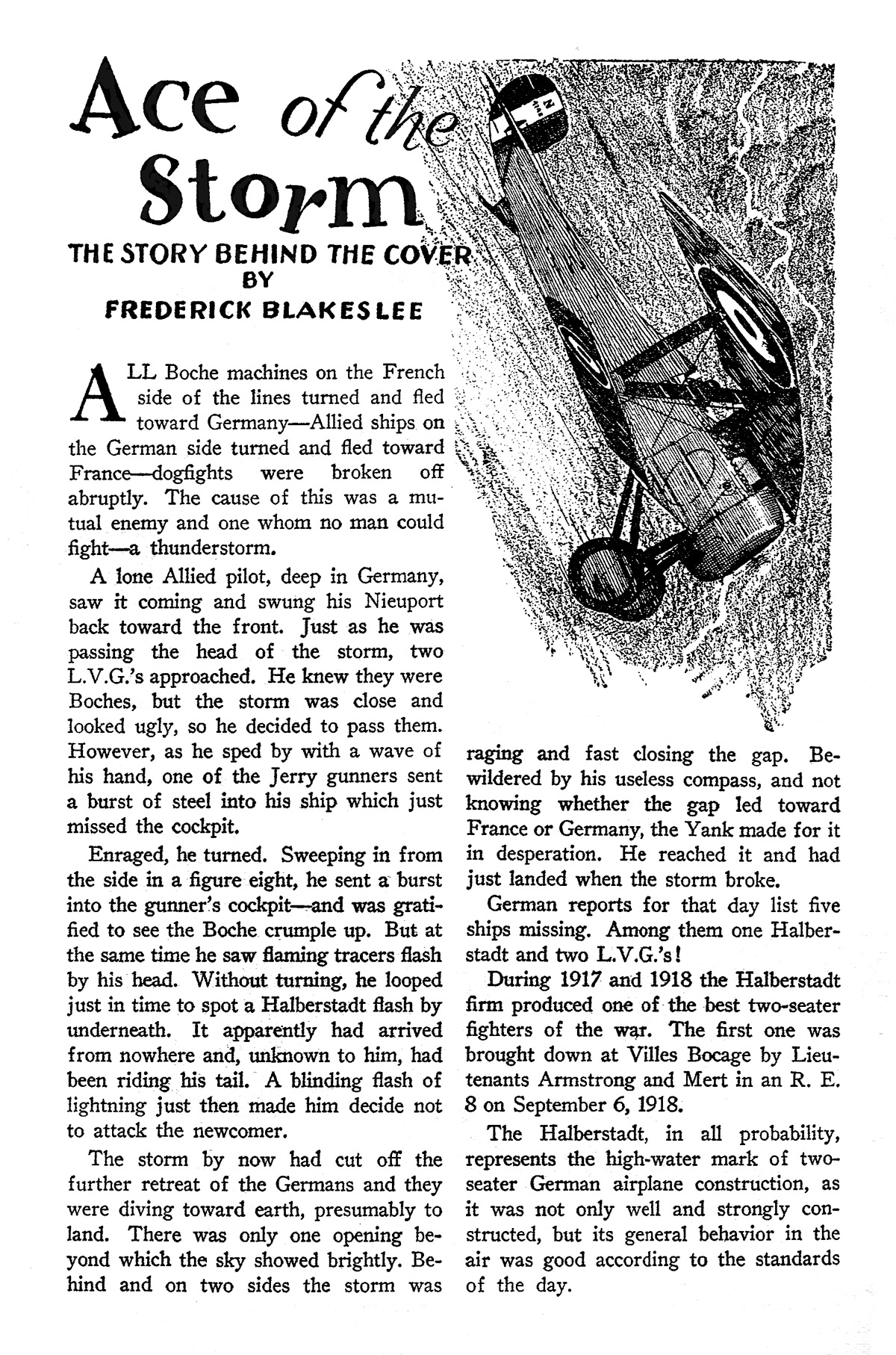
th_DDA_3309ALL BOCHE machines on the French side of the lines turned and fled toward Germany—Allied ships on the German side turned and fled toward France—dogfights were broken off abruptly. The cause of this was a mutual enemy and one whom no man could fight—a thunderstorm.

A lone Allied pilot, deep in Germany, saw it coming and swung his Nieuport back toward the front. Just as he was passing the head of the storm, two L.V.G.’s approached. He knew they were Boches, but the storm was close and looked ugly, so he decided to pass them. However, as he sped by with a wave of his hand, one of the Jerry gunners sent a burst of steel into his ship which just missed the cockpit.

Enraged, he turned. Sweeping in from the side in a figure eight, he sent a burst into the gunner’s cockpit—and was gratified to see the Boche crumple up. But at the same time he saw flaming tracers flash by his head. Without turning, he looped just in time to spot a Halberstadt flash by underneath. It apparently had arrived from nowhere and, unknown to him, had been riding his tail. A blinding flash of lightning just then made him decide not to attack the newcomer.

The storm by now had cut off the further retreat of the Germans and they were diving toward earth, presumably to land. There was only one opening beyond which the sky showed brightly. Behind and on two sides the storm was raging and fast closing the gap. Bewildered by his useless compass, and not knowing whether the gap led toward France or Germany, the Yank made for it in desperation. He reached it and had just landed when the storm broke.
German reports for that day list five ships missing. Among them one Halberstadt and two L.V.G.’s!

During 1917 and 1918 the Halberstadt firm produced one of the best two-seater fighters of the war. The first one was brought down at Villes Bocage by Lieutenants Armstrong and Mert in an R.E.8 on September 6, 1918.

The Halberstadt. in all probability, represents the high-water mark of two-seater German airplane construction, as it was not only well and strongly constructed, but its general behavior in the air was good according to the standards of the day.

The Story Behind The Cover
“Ace of the Storm: The Story Behind The Cover” by Frederick M. Blakeslee (September 1933)

Check back again. We will be presenting more of Blakeslee’s Stories behind his cover illustrations.

“Wolves of the Sky” by Frederick Blakeslee

Link - Posted by David on October 30, 2014 @ 12:00 pm in

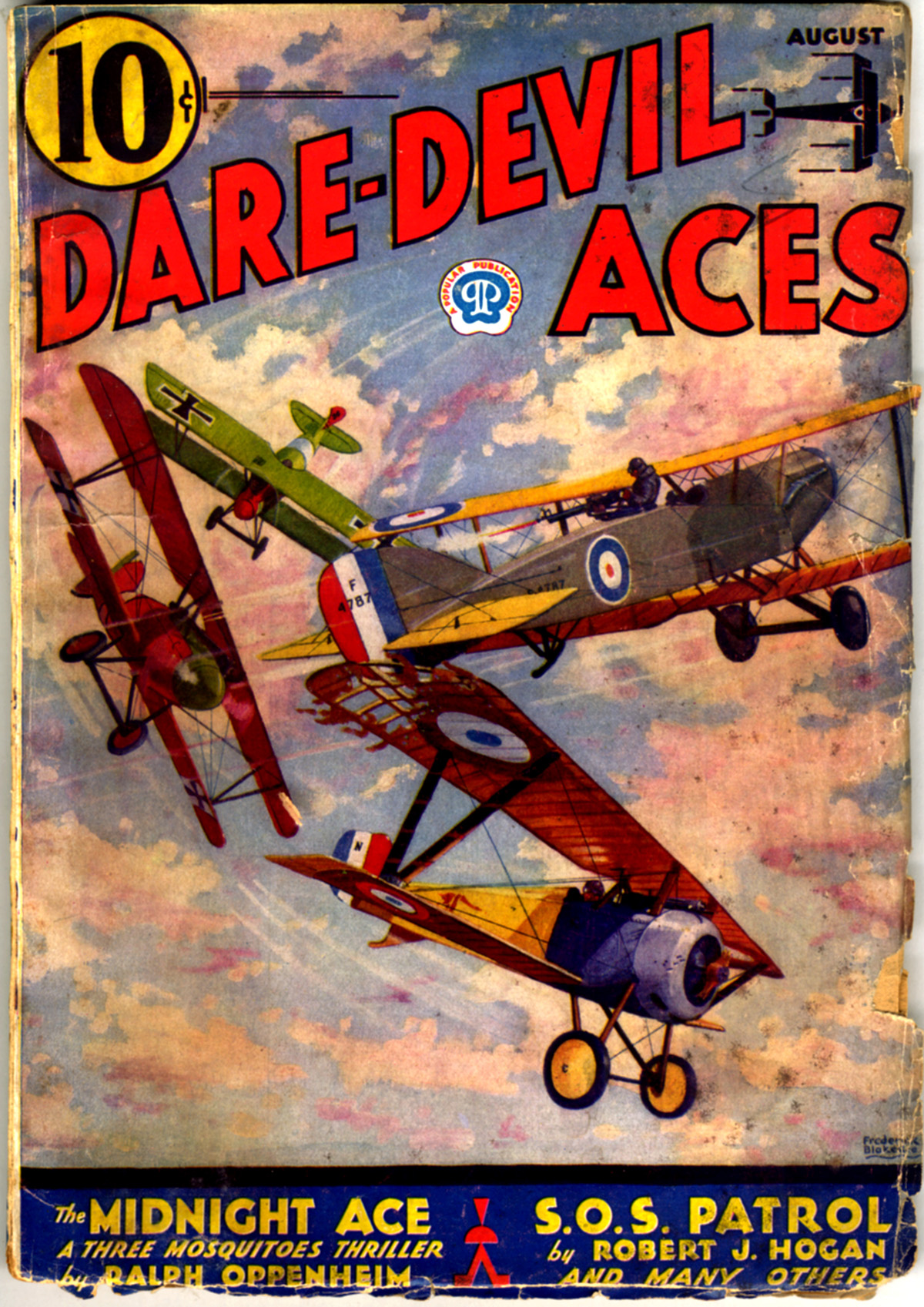
We’re back with another of Frederick Blakeslee’s “The Story Behind The Cover”—this week the spotlight’s on the July 1933 cover of Dare-Devil Aces. Blakeslee presents the story of an attack on a flight of German planes that was the result of a toothache! Without further ado, Blakeslee’s “The Yellow Hornet”…

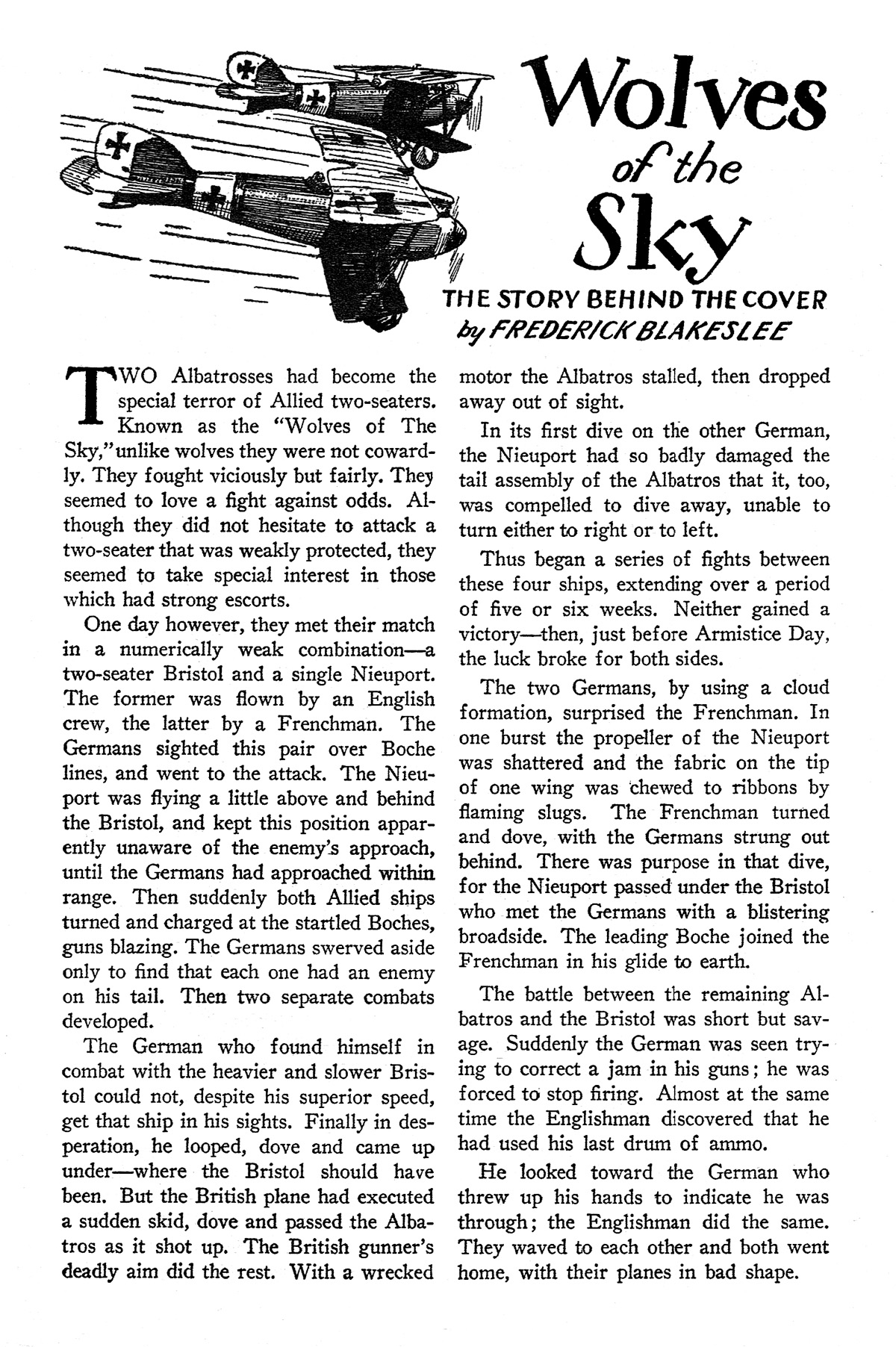
th_DDA_3308TWO ALBATROSSES had become the special terror of Allied two-seaters. Known as the “Wolves of The Sky,” unlike wolves they were not cowardly. They fought viciously but fairly. They seemed to love a fight against odds. Although they did not hesitate to attack a two-seater that was weakly protected, they seemed to take special interest in those which had strong escorts.

One day however, they met their match in a numerically weak combination—a two-seater Bristol and a single Nieuport. The former was flown by an English crew, the latter by a Frenchman. The Germans sighted this pair over Boche lines, and went to the attack. The Nieuport was flying a little above and behind the Bristol, and kept this position apparently unaware of the enemy’s approach, until the Germans had approached within range. Then suddenly both Allied ships turned and charged at the startled Boches, guns blazing. The Germans swerved aside only to find that each one had an enemy on his tail. Then two separate combats developed.

The German who found himself in combat with the heavier and slower Bristol could not, despite his superior speed, get that ship in his sights. Finally in desperation, he looped, dove and came up under—where the Bristol should have been. But the British plane had executed a sudden skid, dove and passed the Alba-tros as it shot up. The British gunner’s deadly aim did the rest. With a wrecked motor the Albatros stalled, then dropped away out of sight.

In its first dive on the other German, the Nieuport had so badly damaged the tail assembly of the Albatros that it, too, was compelled to dive away, unable to turn either to right or to left.

Thus began a series of fights between these four ships, extending over a period of five or six weeks. Neither gained a victory—then, just before Armistice Day. the luck broke for both sides.

The two Germans, by using a cloud formation, surprised the Frenchman. In one burst the propeller of the Nieuport was shattered and the fabric on the tip of one wing was chewed to ribbons by flaming slugs. The Frenchman turned and dove, with the Germans strung out behind. There was purpose in that dive, for the Nieuport passed under the Bristol who met the Germans with a blistering broadside. The leading Boche joined the Frenchman in his glide to earth.

The battle between the remaining Albatros and the Bristol was short but savage. Suddenly the German was seen trying to correct a jam in his guns; he was forced to stop firing. Almost at the same time the Englishman discovered that he had used his last drum of ammo.

He looked toward the German who threw up his hands to indicate he was through; the Englishman did the same. They waved to each other and both went home, with their planes in bad shape.

The Story Behind The Cover
“Wolves of the Sky: The Story Behind The Cover” by Frederick M. Blakeslee (August 1933)

Check back again. We will be presenting more of Blakeslee’s Stories behind his cover illustrations.

“The Yellow Hornet” by Frederick Blakeslee

Link - Posted by David on October 23, 2014 @ 12:00 pm in

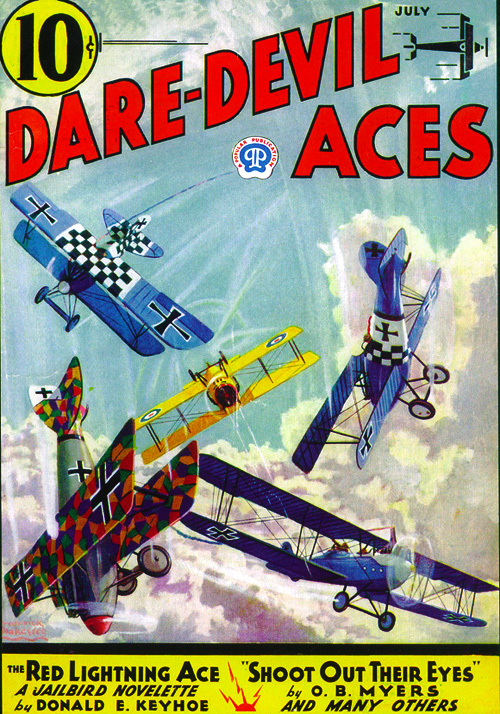
We’re back with another of Frederick Blakeslee’s “The Story Behind The Cover”—this week the spotlight’s on the July 1933 cover of Dare-Devil Aces. Blakeslee presents the story of an attack on a flight of German planes that was the result of a toothache! Without further ado, Blakeslee’s “The Yellow Hornet”…

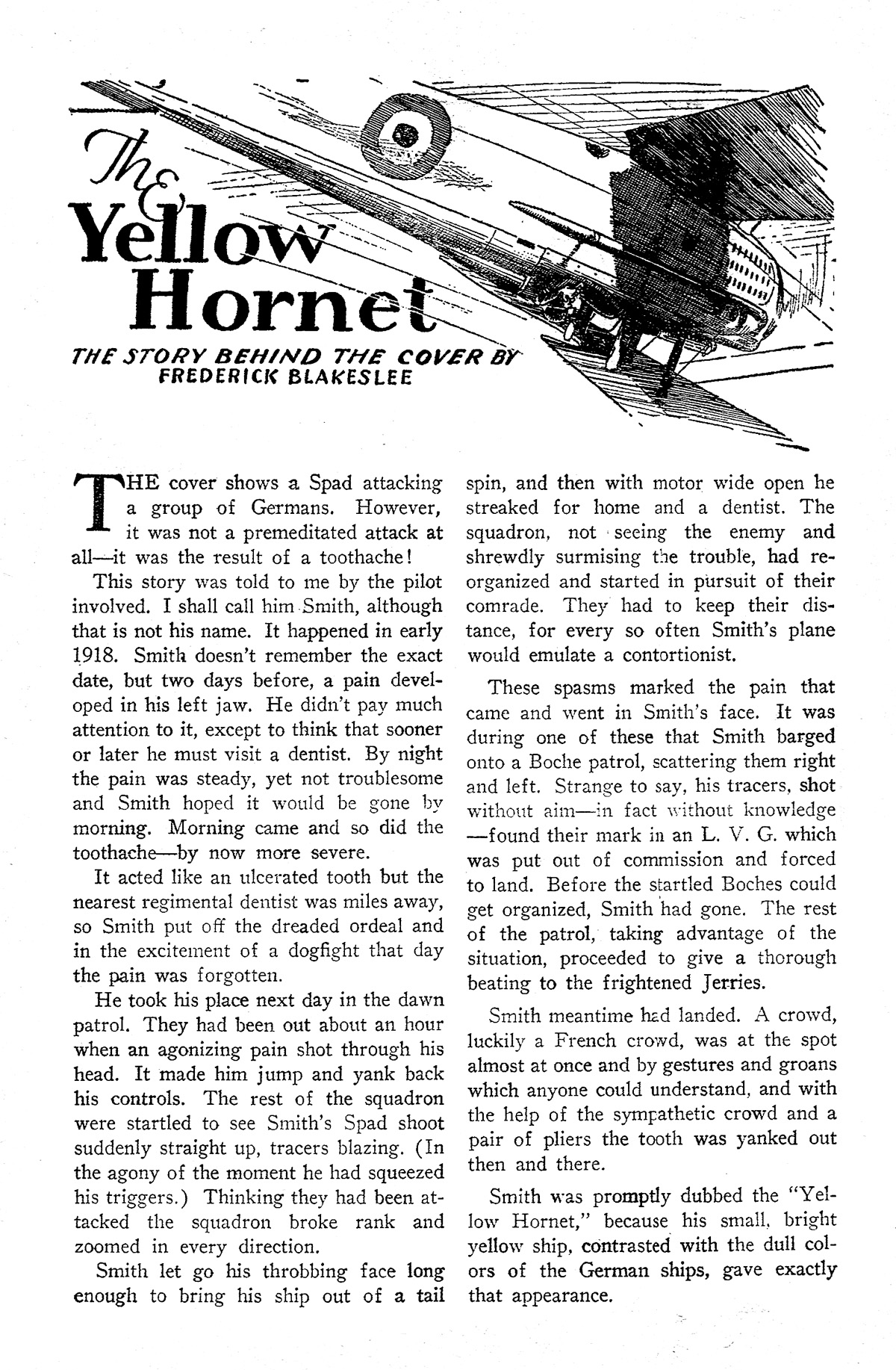
th_DDA_3307THE COVER shows a Spad attacking a group of Germans. However, it was not a premeditated attack at all—it was the result of a toothache!

This story was told to me by the pilot involved. I shall call him Smith, although that is not his name. It happened in early 1918. Smith doesn’t remember the exact date, but two days before, a pain developed in his left jaw. He didn’t pay much attention to it, except to think that sooner or later he must visit a dentist. By night the pain was steady, yet not troublesome and Smith hoped it would be gone by morning. Morning came and so did the toothache—by now more severe.

It acted like an ulcerated tooth but the nearest regimental dentist was miles away, so Smith put off the dreaded ordeal and in the excitement of a dogfight that day the pain was forgotten.

He took his place next day in the dawn patrol. They had been out about an hour when an agonizing pain shot through his head. It made him jump and yank back his controls. The rest of the squadron were startled to see Smith’s Spad shoot suddenly straight up, tracers blazing. (In the agony of the moment he had squeezed his triggers.) Thinking they had been attacked the squadron broke rank and zoomed in every direction.

Smith let go his throbbing face long enough to bring his ship out of a tail spin, and then with motor wide open he streaked for home and a dentist. The squadron, not seeing the enemy and shrewdly surmising the trouble, had reorganized and started in pursuit of their comrade. They had to keep their distance, for every so often Smith’s plane would emulate a contortionist.

These spasms marked the pain that came and went in Smith’s face. It was during one of these that Smith barged onto a Boche patrol, scattering them right and left. Strange to say, his tracers, shot without aim—in fact without knowledge —found their mark in an L.V.G. which was put out of commission and forced to land. Before the startled Boches could get organized, Smith had gone. The rest of the patrol, taking advantage of the situation, proceeded to give a thorough beating to the frightened Jerries.

Smith meantime had landed. A crowd, luckily a French crowd, was at the spot almost at once and by gestures and groans which anyone could understand, and with the help of the sympathetic crowd and a pair of pliers the tooth was yanked out then and there.

Smith was promptly dubbed the “Yellow Hornet,” because his small, bright yellow ship, contrasted with the dull colors of the German ships, gave exactly that appearance.

The Story Behind The Cover
“The Yellow Hornet: The Story Behind The Cover” by Frederick M. Blakeslee (July 1933)

Check back again. We will be presenting more of Blakeslee’s Stories behind his cover illustrations.

“The Vanished Ace” by Frederick Blakeslee

Link - Posted by David on October 16, 2014 @ 12:00 pm in

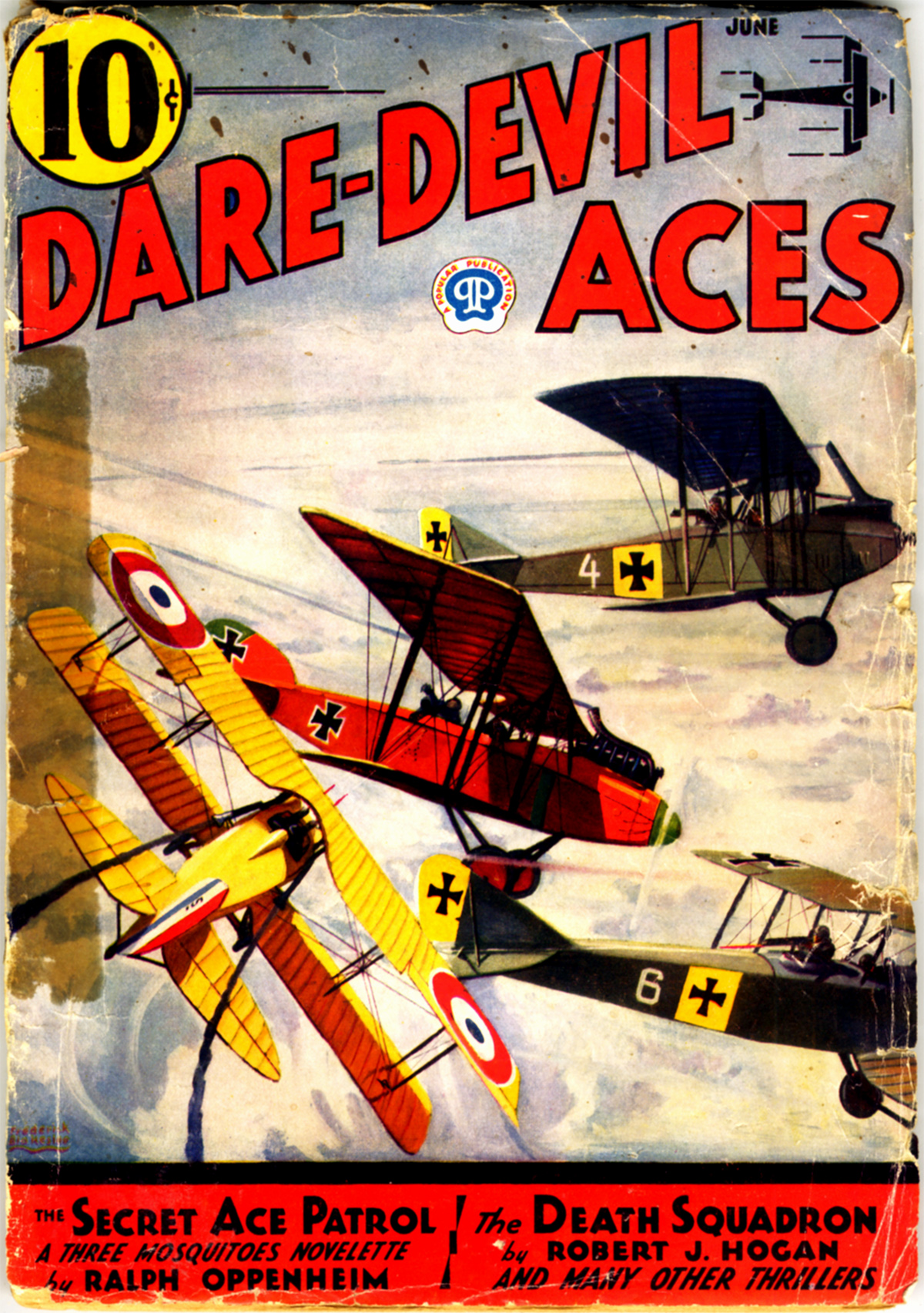
Frederick Blakeslee painted the covers for Dare-Devil Aces‘ entire fourteen year run. Every one of those covers told a story, and Blakeslee had a page with which to do so. We present Blakeslee’s cover for the June 1933 issue of Dare-Devil Aces—his tribute to the great French Ace, Georges Guynemer—”The Vanished Ace!”

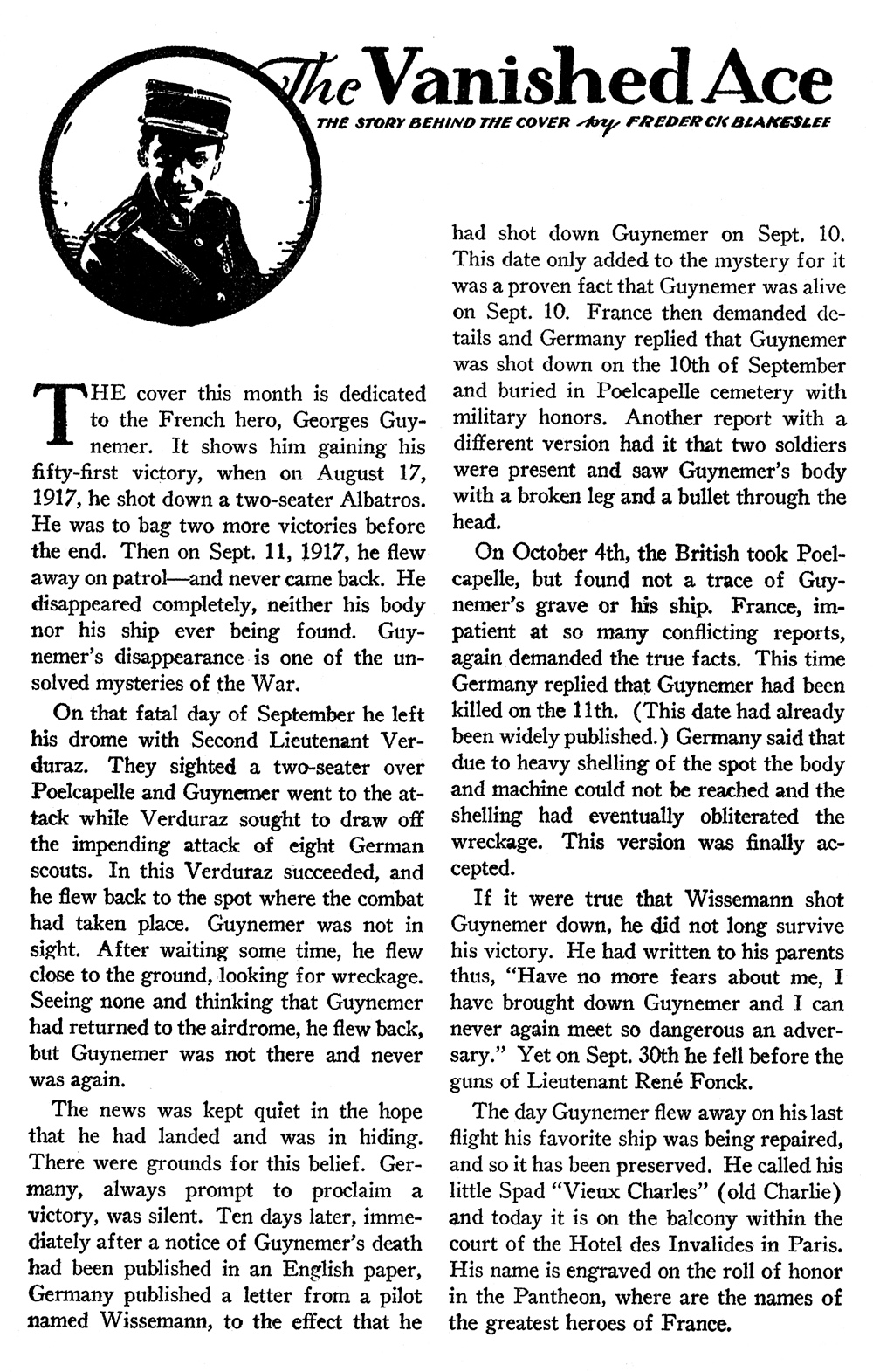
th_DDA_3306THE COVER this month is dedicated to the French hero, Georges Guynemer. It shows him gaining his fifty-first victory, when on August 17, 1917, he shot down a two-seater Albatros. He was to bag two more victories before the end. Then on Sept. 11, 1917, he flew away on patrol—and never came back. He disappeared completely, neither his body nor his ship ever being found. Guynemer’s disappearance is one of the unsolved mysteries of the War.

On that fatal day of September he left his drome with Second Lieutenant Verduraz. They sighted a two-seater over Poelcapelle and Guynemer went to the attack while Verduraz sought to draw off the impending attack of eight German scouts. In this Verduraz succeeded, and he flew back to the spot where the combat had taken place. Guynemer was not in sight. After waiting some time, he flew close to the ground, looking for wreckage. Seeing none and thinking that Guynemer had returned to the airdrome, he flew back, but Guynemer was not there and never was again.

The news was kept quiet in the hope that he had landed and was in hiding. There were grounds for this belief. Germany, always prompt to proclaim a victory, was silent. Ten days later, immediately after a notice of Guynemer’s death had been published in an English paper, Germany published a letter from a pilot named Wissemann, to the effect that he had shot down Guynemer on Sept. 10. This date only added to the mystery for it was a proven fact that Guynemer was alive on Sept. 10. France then demanded details and Germany replied that Guynemer was shot down on the 10th of September and buried in Poelcapelle cemetery with military honors. Another report with a different version had it that two soldiers were present and saw Guynemer’s body with a broken leg and a bullet through the head.

On October 4th, the British took Poelcapelle, but found not a trace of Guynemer’s grave or his ship. France, impatient at so many conflicting reports, again demanded the true facts. This time Germany replied that Guynemer had been killed on the 11th. (This date had already been widely published.) Germany said that due to heavy shelling of the spot the body and machine could not be reached and the shelling had eventually obliterated the wreckage. This version was finally accepted.

If it were true that Wissemann shot Guynemer down, he did not long survive his victory. He had written to his parents thus, “Have no more fears about me, I have brought down Guynemer and I can never again meet so dangerous an adversary.” Yet on Sept. 30th he fell before the guns of Lieutenant Rene Fonck.

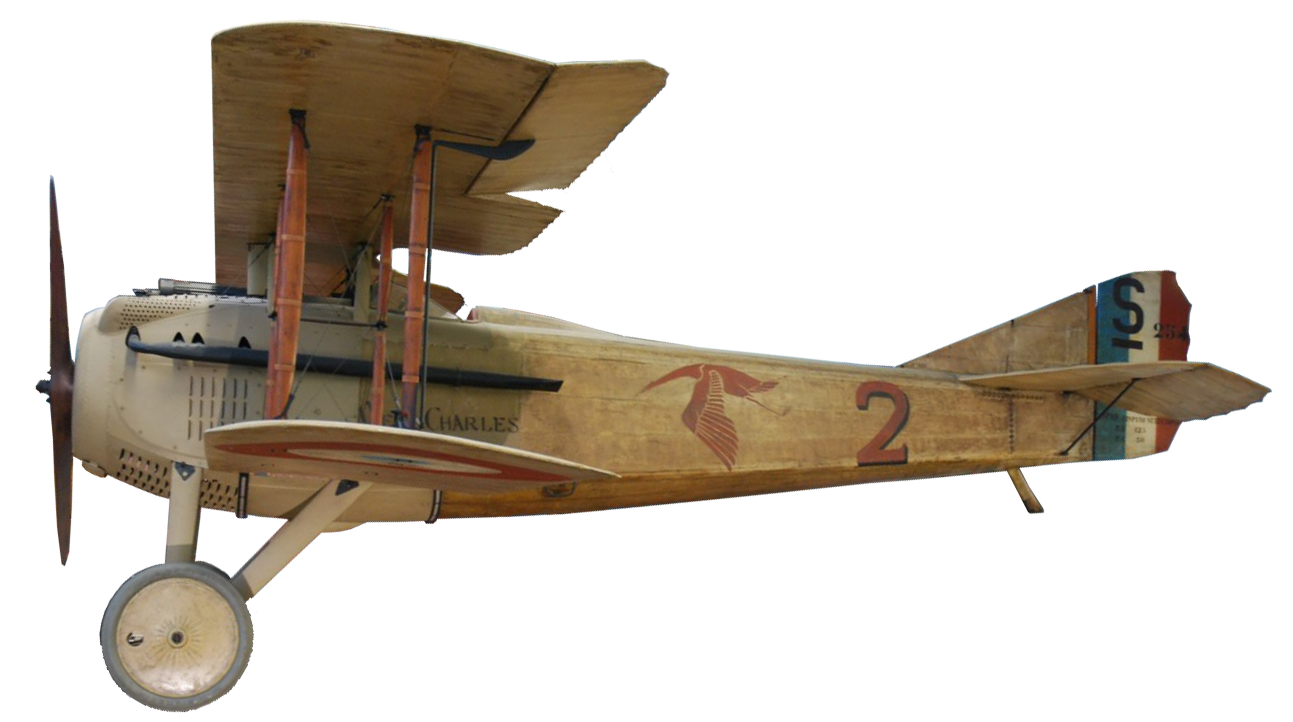
The day Guynemer flew away on his last flight his favorite ship was being repaired, and so it has been preserved. He called his little Spad “Vieux Charles” (old Charlie) and today it is on the balcony within the court of the Hotel des Invalides in Paris. His name is engraved on the roll of honor in the Pantheon, where are the names of the greatest heroes of France.

The Story Behind The Cover
“The Vanished Ace: The Story Behind The Cover” by Frederick M. Blakeslee (June 1933)

According to his english wikipedia page, the red cross provided the following confirmation of his death:

Information received by the Red Cross says Guynemer was shot through the head north of Poelcapelle, on the Ypres front. His body was identified by a photograph on his pilot’s license found in his pocket. The burial took place at Brussels in the presence of a guard of honor, composed of the 5th Prussian Division. Such is the story told by a Belgian, who has just escaped from the Germans. The burial was about to take place at Poelcapelle, when the bombardment preceding the British attack at Ypres started. The burying party hastily withdrew, taking the body with them. The German General chanced to be an aviation enthusiast with a great admiration for Captain Guynemer’s achievements. At his direction the body was taken to Brussels in a special funeral car. Thither the captain was carried by non-commissioned officers and was covered with floral tributes from German aviators. The Prussian Guards stood at salute upon its arrival and during the burial, which was given all possible military honors. The French Government has been invited to place in the Pantheon, where many great Frenchmen are buried, an inscription to perpetuate the memory of Captain Guynemer as ′a symbol of the aspirations and enthusiasm of the Army.′ A resolution to this effect has been introduced in the Chamber of Deputies by Deputy Lasies.

Check back again. We will be presenting more of Blakeslee’s Stories behind his cover illustrations.

“Duel of the Bombers” by Frederick Blakeslee

Link - Posted by David on October 9, 2014 @ 12:00 pm in

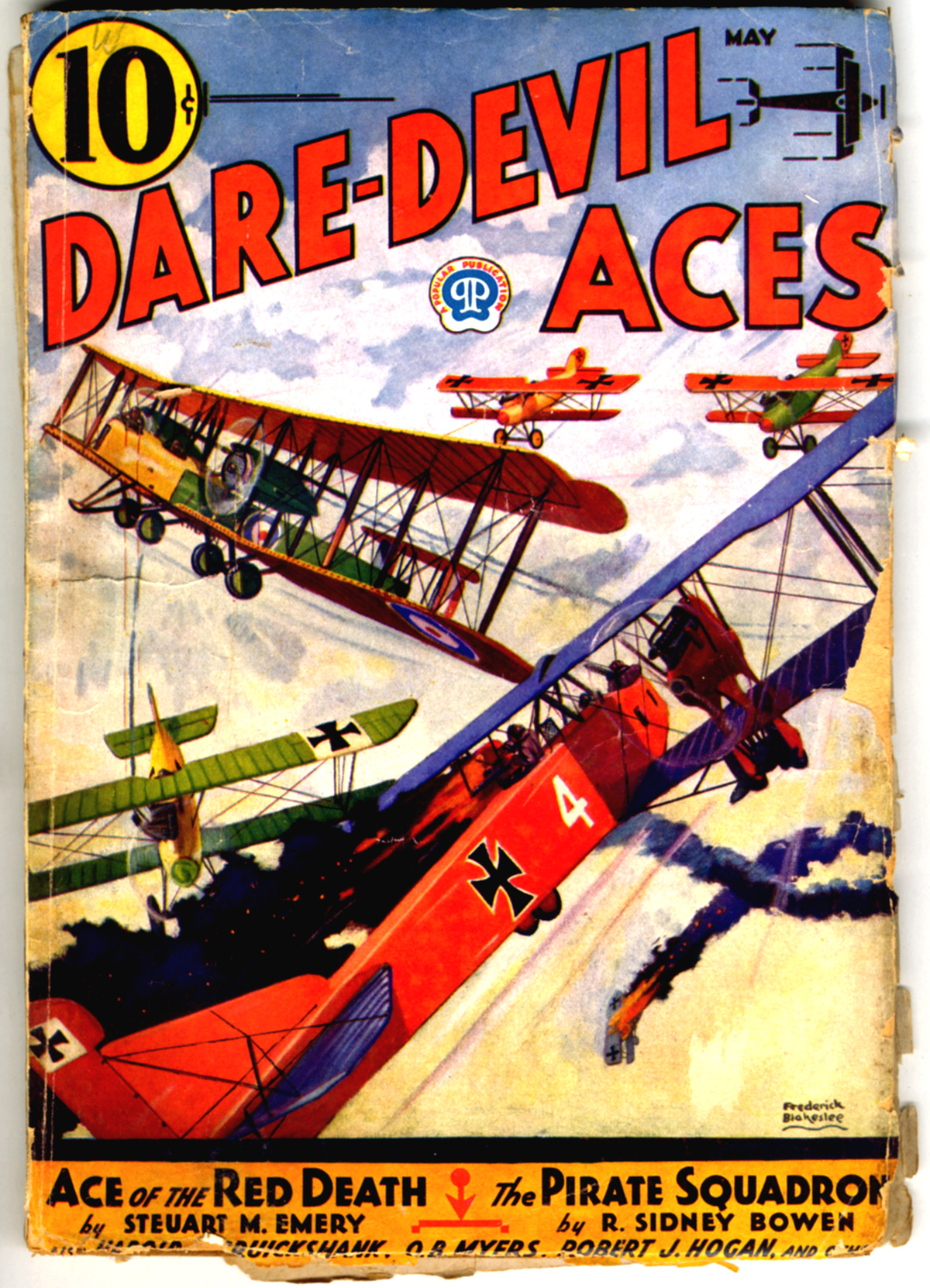
Frederick Blakeslee painted the covers for Dare-Devil Aces‘ entire fourteen year run. Every one of those covers told a story, and Blakeslee had a page with which to do so. This week’s Dare-Devil Aces cover picks up the story where last month’s “The Flaming Coffin” left off. Here is Blakeslee’s cover for the May 1933 issue—”Duel of the Bombers!”

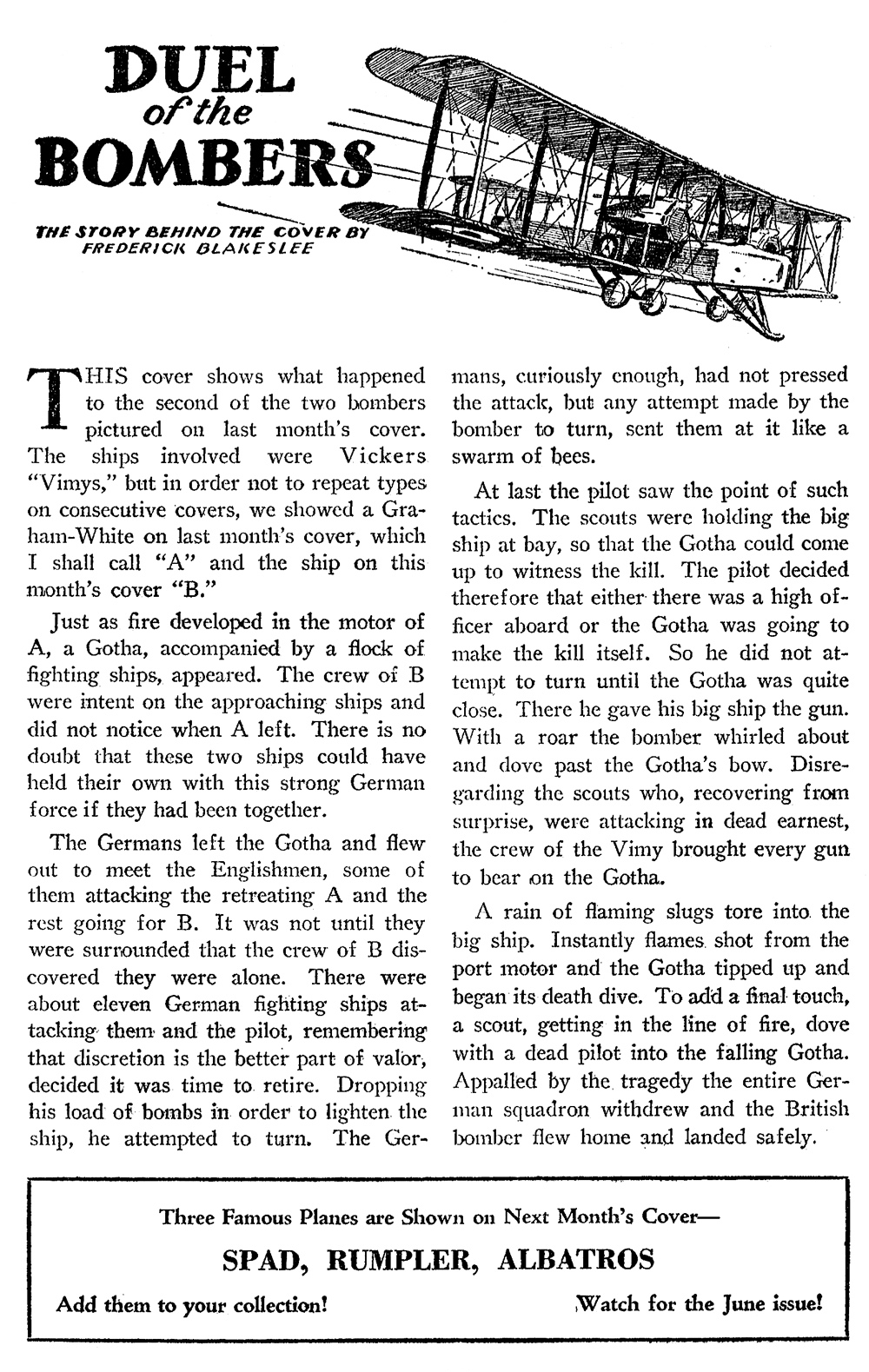
th_DDA_3305THIS COVER shows what happened to the second of the two bombers pictured on last month’s cover. The ships involved were Vickers “Vimys,” but in order not to repeat types on consecutive covers, we showed a Graham-White on last month’s cover, which I shall call “A” and the ship on this month’s cover “B.”

Just as fire developed in the motor of A, a Gotha, accompanied by a flock of fighting ships, appeared. The crew of B were intent on the approaching ships and did not notice when A left. There is no doubt that these two ships could have held their own with this strong German force if they had been together.

The Germans left the Gotha and flew out to meet the Englishmen, some of them attacking the retreating A and the rest going for B. It was not until they were surrounded that the crew of B discovered they were alone. There were about eleven German fighting ships attacking them and the pilot, remembering that discretion is the better part of valor, decided it was time to retire. Dropping his load of bombs in order to lighten the ship, he attempted to turn. The Germans, curiously enough, had not pressed the attack, but any attempt made by the bomber to turn, sent them at it like a swarm of bees.

At last the pilot saw the point of such tactics. The scouts were holding the big ship at bay, so that the Gotha could come up to witness the kill. The pilot decided therefore that either there was a high officer aboard or the Gotha was going to make the kill itself. So he did not attempt to turn until the Gotha was quite close. There he gave his big ship the gun. With a roar the bomber whirled about and dove past the Gotha’s bow. Disregarding the scouts who, recovering from surprise, were attacking in dead earnest, the crew of the Vimy brought every gun to bear on the Gotha.

A rain of flaming slugs tore into the big ship. Instantly flames shot from the port motor and the Gotha tipped up and began its death dive. To add a final touch, a scout, getting in the line of fire, dove with a dead pilot into the falling Gotha. Appalled by the tragedy the entire German squadron withdrew and the British bomber flew home and landed safely.

The Story Behind The Cover
“Duel of the Bombers: The Story Behind The Cover” by Frederick M. Blakeslee (May 1933)

Check back again. We will be presenting more of Blakeslee’s Stories behind his cover illustrations.

“The Flaming Coffin” by Frederick Blakeslee

Link - Posted by David on October 2, 2014 @ 12:00 pm in

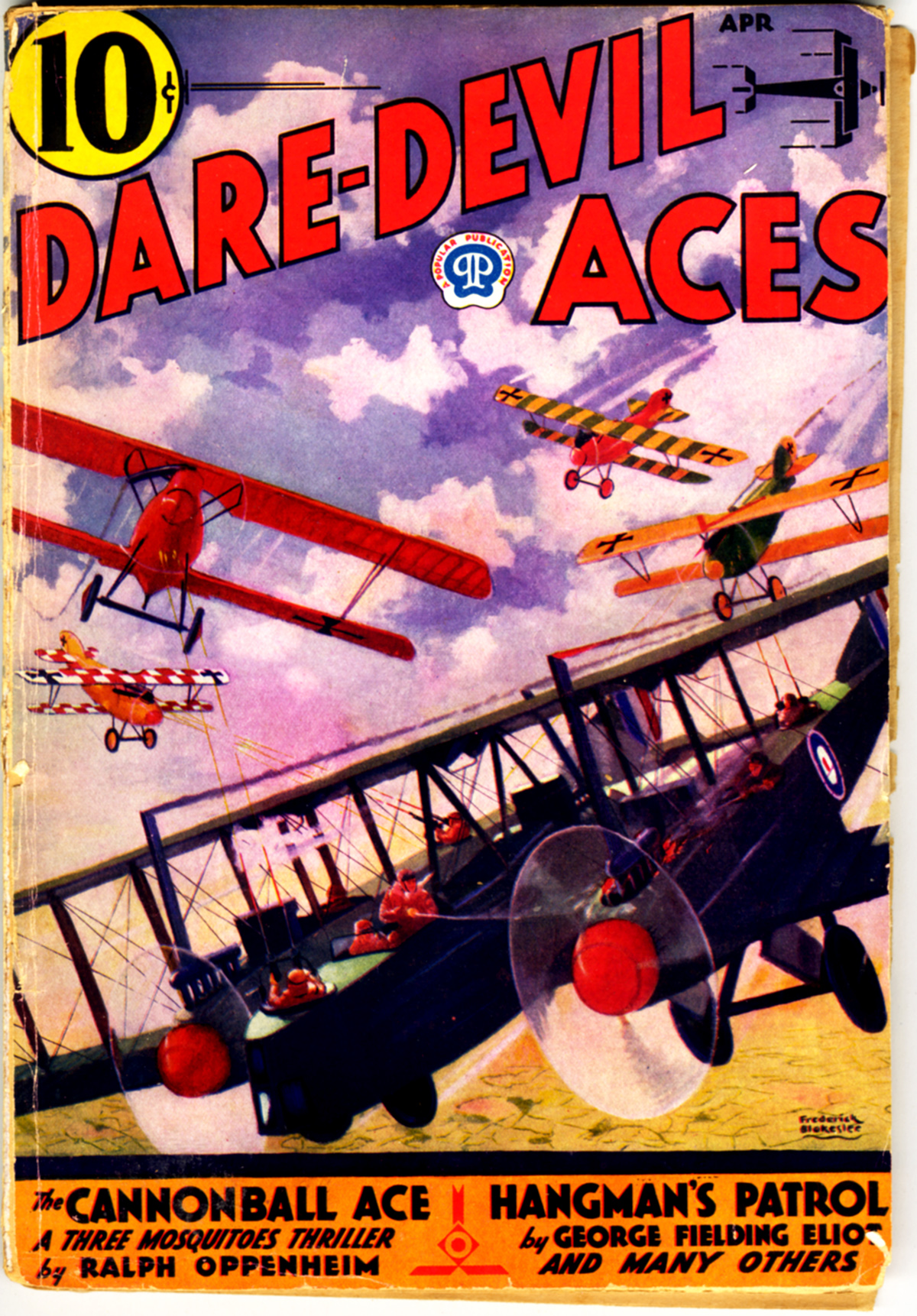
Frederick Blakeslee painted the covers for Dare-Devil Aces‘ entire fourteen year run. Every one of those covers told a story, and Blakeslee had a page with which to do so. Although this time we get a story that’s not quite the story of the cover, but still a good story. This week it’s Blakeslee’s cover for the April 1933 issue of Dare-Devil Aces—”The Flaming Coffin!”

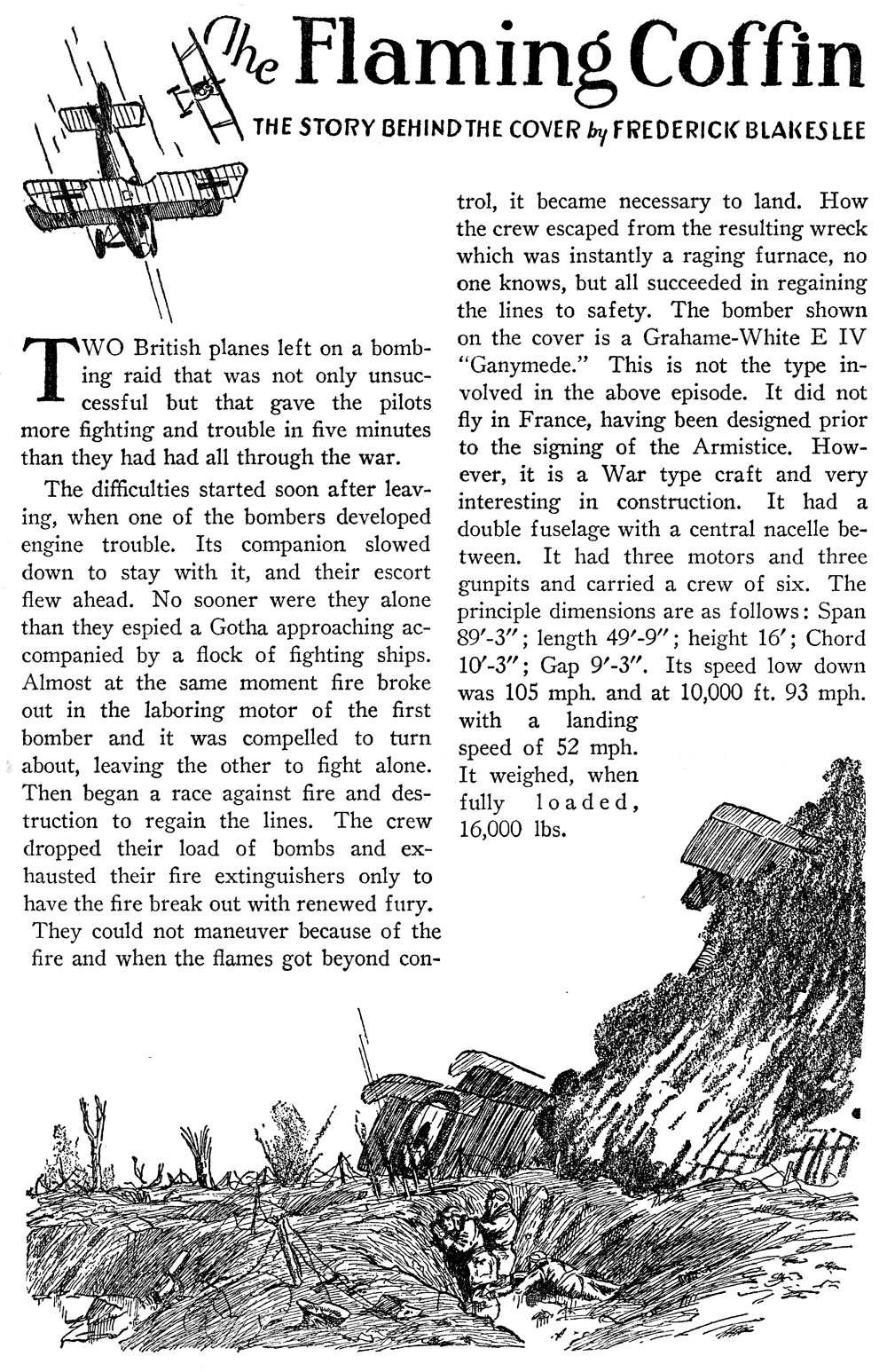
th_DDA_3304TWO British planes left on a bombing raid that was not only unsuccessful but that gave the pilots more fighting and trouble in five minutes than they had had all through the war.

The difficulties started soon after leaving, when one of the bombers developed engine trouble. Its companion slowed down to stay with it, and their escort flew ahead. No sooner were they alone than they espied a Gotha approaching accompanied by a flock of fighting ships. Almost at the same moment fire broke out in the laboring motor of the first bomber and it was compelled to turn about, leaving the other to fight alone. Then began a race against fire and destruction to regain the lines. The crew dropped their load of bombs and exhausted their fire extinguishers only to have the fire break out with renewed fury.

They could not maneuver because of the fire and when the flames got beyond control, it became necessary to land. How the crew escaped from the resulting wreck which was instantly a raging furnace, no one knows, but all succeeded in regaining the lines to safety. The bomber shown on the cover is a Grahame-White E IV “Ganymede.” This is not the type involved in the above episode. It did not fly in France, having been designed prior to the signing of the Armistice. However, it is a War type craft and very interesting in construction. It had a double fuselage with a central nacelle between. It had three motors and three gunpits and carried a crew of six. The principle dimensions are as follows: Span 89′-3″; length 49′-9″; height 16′; Chord 10′-3″; Gap 9′-3″. Its speed low down was 105 mph. and at 10,000 ft. 93 mph. with a landing speed of 52 mph. It weighed, when fully loaded, 16,000 lbs.

The Story Behind The Cover
“The Flaming Coffin: The Story Behind The Cover” by Frederick M. Blakeslee (April 1933)

Check back again next Thursday for the continuation of this story on May’s cover!

“Death Wings!” by Frederick Blakeslee

Link - Posted by David on September 25, 2014 @ 12:00 pm in

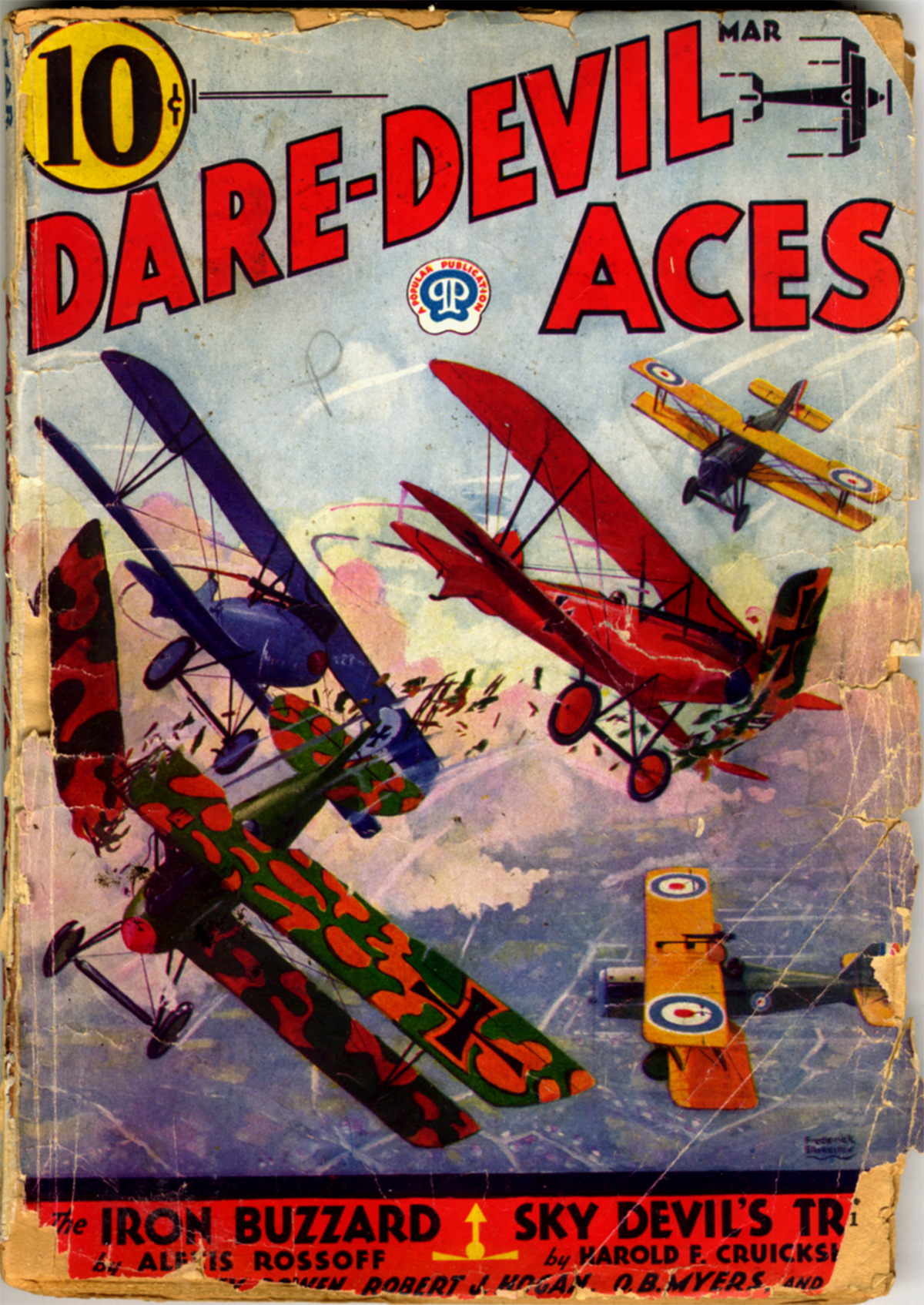
Frederick Blakeslee painted the covers for Dare-Devil Aces‘ entire fourteen year run. Every one of those covers told a story, and Blakeslee had a page with which to do so. We present Blakeslee’s cover for the March 1933 issue of Dare-Devil Aces—”Death Wings!”

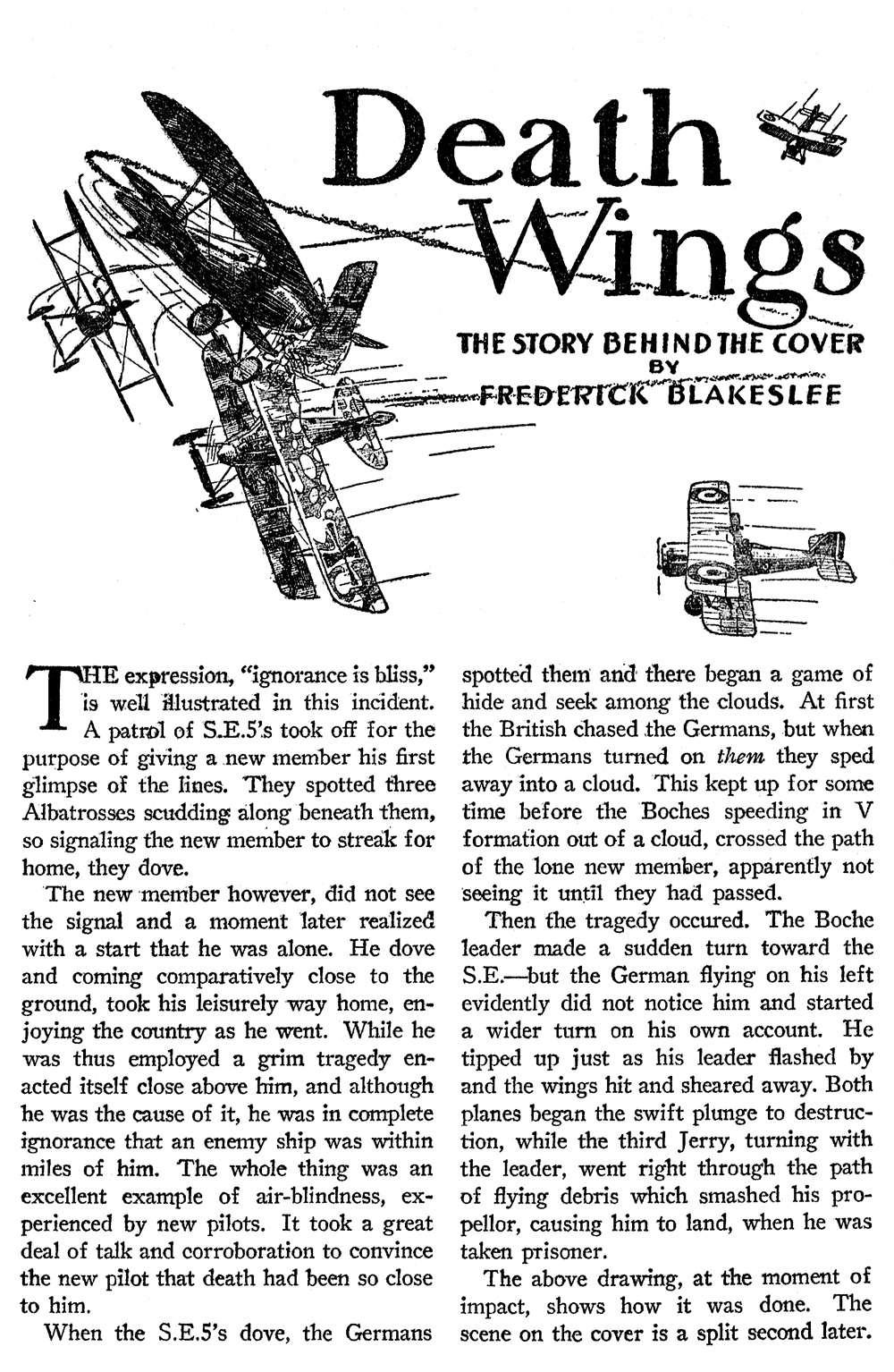
th_DDA_3303THE EXPRESSION, “ignorance is bliss,” is well illustrated in this incident. A patrol of S.E.5’s took off for the purpose of giving a new member his first glimpse of the lines. They spotted three Albatrosses scudding along beneath them, so signaling the new member to streak for home, they dove.

The new member however, did not see the signal and a moment later realized with a start that he was alone. He dove and coming comparatively close to the ground, took his leisurely way home, enjoying the country as he went. While he was thus employed a grim tragedy enacted itself close above him, and although he was the cause of it, he was in complete ignorance that an enemy ship was within miles of him. The whole thing was an excellent example of air-blindness, experienced by new pilots. It took a great deal of talk and corroboration to convince the new pilot that death had been so close to him.

When the S.E.5’s dove, the Germans spotted them and there began a game of hide and seek among the clouds. At first the British chased the Germans, but when the Germans turned on them they sped away into a cloud. This kept up for some time before the Bodies speeding in V formation out of a cloud, crossed the path of the lone new member, apparently not seeing it until they had passed.

Then the tragedy occured. The Boche leader made a sudden turn toward the S.E.—but the German flying on his left evidently did not notice him and started a wider turn on his own account. He tipped up just as his leader flashed by and the wings hit and sheared away. Both planes began the swift plunge to destruction, while the third Jerry, turning with the leader, went right through the path of flying debris which smashed his propellor, causing him to land, when he was taken prisoner.

The above drawing, at the moment of impact, shows how it was done. The scene on the cover is a split second later.

The Story Behind The Cover
“Death Wings: The Story Behind The Cover” by Frederick M. Blakeslee (March 1933)

Check back again. We will be presenting more of Blakeslee’s Stories behind his cover illustrations.

Decoy Smashers

Link - Posted by David on September 18, 2014 @ 12:00 pm in

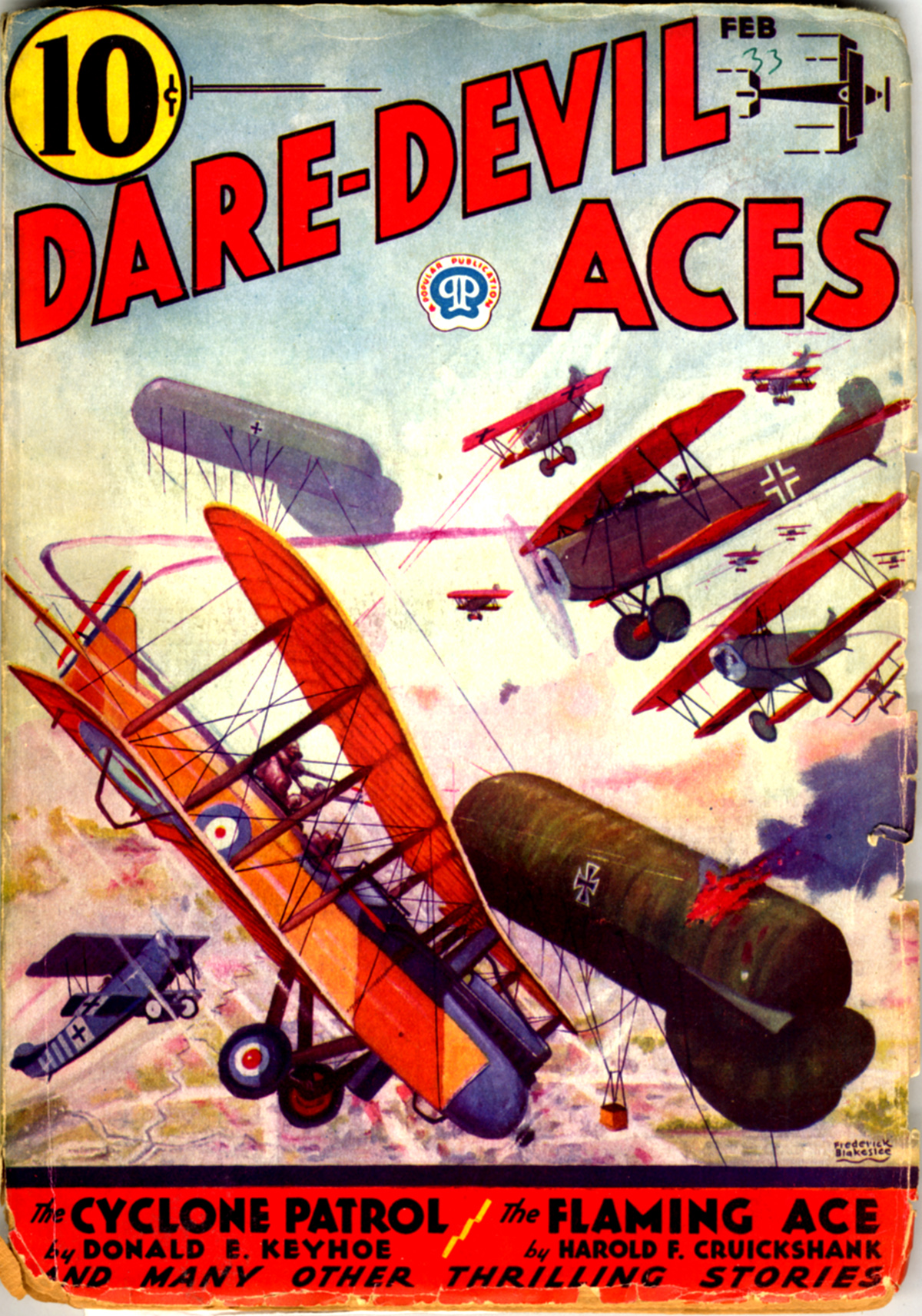
Frederick Blakeslee painted the covers for Dare-Devil Aces‘ entire fourteen year run. Every one of those covers told a story, and Blakeslee had a page with which to do so. We present Blakeslee’s cover for the February 1933 issue of Dare-Devil Aces—”Decoy Smashers”…

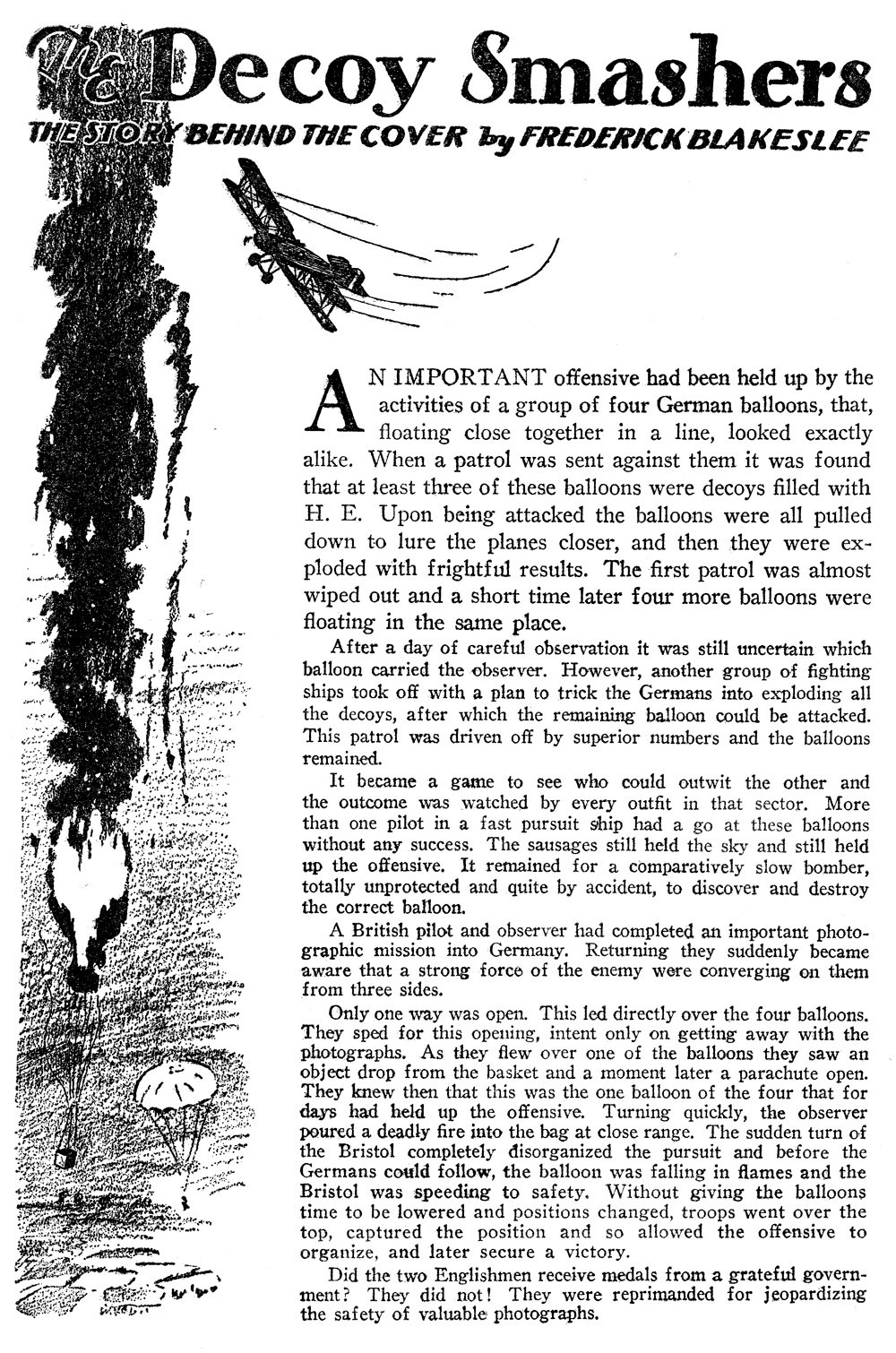
th_DDA_3302AN IMPORTANT offensive had been held up by the activities of a group of four German balloons, that, floating close together in a line, looked exactly alike. When a patrol was sent against them it was found that at least three of these balloons were decoys filled with H.E. Upon being attacked the balloons were all pulled down to lure the planes closer, and then they were exploded with frightful results. The first patrol was almost wiped out and a short time later four more balloons were floating in the same place.

After a day of careful observation it was still uncertain which balloon carried the observer. However, another group of fighting ships took off with a plan to trick the Germans into exploding all the decoys, after which the remaining balloon could be attacked. This patrol was driven off by superior numbers and the balloons remained.

It became a game to see who could outwit the other and the outcome was watched by every outfit in that sector. More than one pilot in a fast pursuit ship had a go at these balloons without any success. The sausages still held the sky and still held up the offensive. It remained for a comparatively slow bomber, totally unprotected and quite by accident, to discover and destroy the correct balloon.

A British pilot and observer had completed an important photographic mission into Germany. Returning they suddenly became aware that a strong force of the enemy were converging on them from three sides.

Only one way was open. This led directly over the four balloons. They sped for this opening, intent only on getting away with the photographs. As they flew over one of the balloons they saw an object drop from the basket and a moment later a parachute open. They knew then that this was the one balloon of the four that for days had held up the offensive. Turning quickly, the observer poured a deadly fire into the bag at close range. The sudden turn of the Bristol completely disorganized the pursuit and before the Germans could follow, the balloon was falling in flames and the Bristol was speeding to safety. Without giving the balloons time to be lowered and positions changed, troops went over the top, captured the position and so allowed the offensive to organize, and later secure a victory.

Did the two Englishmen receive medals from a grateful government? They did not! They were reprimanded for jeopardizing the safety of valuable photographs.

The Story Behind The Cover
“Decoy Smashers: The Story Behind The Cover” by Frederick Blakeslee (February 1933)

Check back again. We will be presenting more of Blakeslee’s Stories behind his cover illustrations.

Blakeslee’s “Death Bomber”

Link - Posted by David on September 11, 2014 @ 12:00 pm in

Frederick Blakeslee painted the covers for Dare-Devil Aces‘ entire fourteen year run. Every one of those covers told a story, and Blakeslee had a page with which to do so. We present Blakeslee’s cover for the January 1933 issue of Dare-Devil Aces and the story of R.F.C. pilot Lt. J.R. Gilbert as he happened upon the “Death Bomber”…

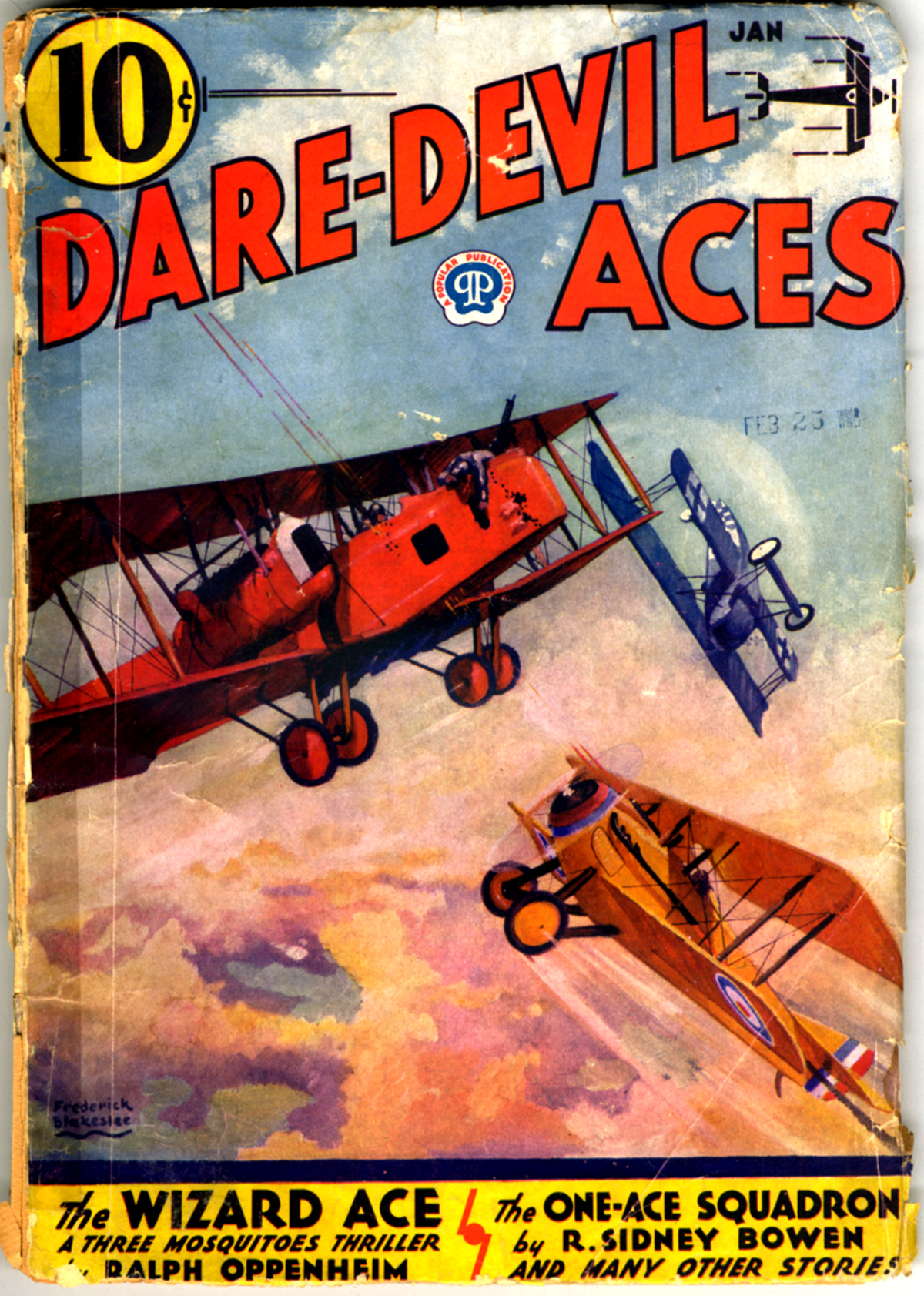
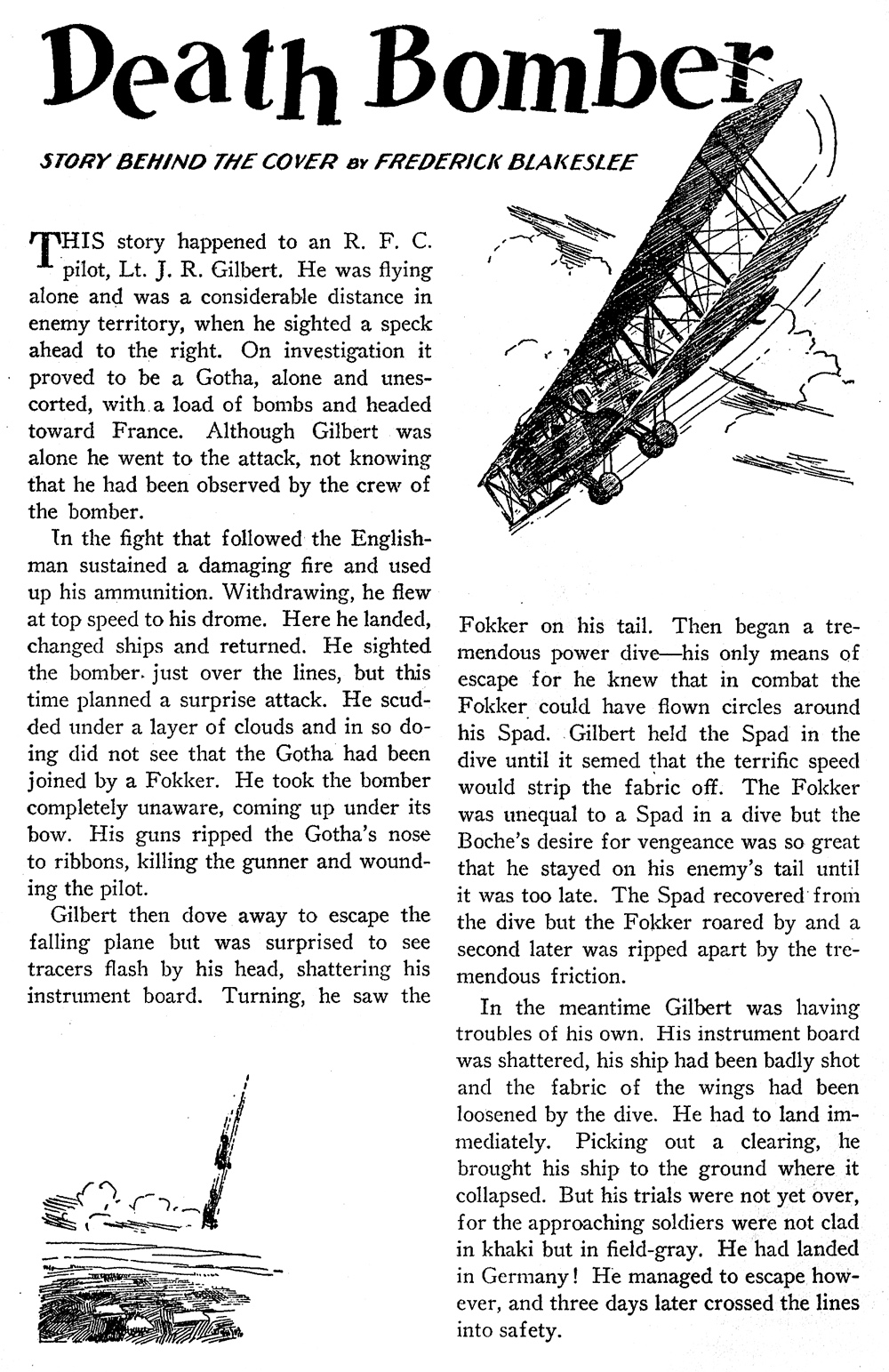
th_DDA_3301THIS story happened to an R.F.C. pilot, Lt. J.R. Gilbert. He was flying alone and was a considerable distance in enemy territory, when he sighted a speck ahead to the right. On investigation it proved to be a Gotha, alone and unescorted, with a load of bombs and headed toward France. Although Gilbert was alone he went to the attack, not knowing that he had been observed by the crew of the bomber.

In the fight that followed the Englishman sustained a damaging fire and used up his ammunition. Withdrawing, he flew at top speed to his drome. Here he landed, changed ships and returned. He sighted the bomber, just over the lines, but this time planned a surprise attack. He scudded under a layer of clouds and in so doing did not see that the Gotha had been joined by a Fokker. He took the bomber completely unaware, coming up under its bow. His guns ripped the Gotha’s nose to ribbons, killing the gunner and wounding the pilot.

Gilbert then dove away to escape the falling plane but was surprised to see tracers flash by his head, shattering his instrument board. Turning, he saw the Fokker on his tail. Then began a tremendous power dive—his only means of escape for he knew that in combat the Fokker could have flown circles around his Spad. Gilbert held the Spad in the dive until it semed that the terrific speed would strip the fabric off. The Fokker was unequal to a Spad in a dive but the Boche’s desire for vengeance was so great that he stayed on his enemy’s tail until it was too late. The Spad recovered from the dive but the Fokker roared by and a second later was ripped apart by the tremendous friction.

In the meantime Gilbert was having troubles of his own. His instrument board was shattered, his ship had been badly shot and the fabric of the wings had been loosened by the dive. He had to land immediately. Picking out a clearing, he brought his ship to the ground where it collapsed. But his trials were not yet over, for the approaching soldiers were not clad in khaki but in field-gray. He had landed in Germany! He managed to escape however, and three days later crossed the lines into safety.

The Story Behind The Cover
“Death Bomber: The Story Behind The Cover” by Frederick Blakeslee (January 1933)

Check back again. We will be presenting more of Blakeslee’s Stories behind his cover illustrations.

“T.N.T. Transport” by Arch Whitehouse

Link - Posted by Bill on July 8, 2010 @ 7:12 pm in

Secret Service agent and flying reporter Buzz Benson approached Sunkist Airport in his slick speedy Corsair for the worst assignment he ever had. Ten days before, three gigantic Boeing transports had vanished from the sky—never to appear again. Was it another Jap plot or something more mysterious?

« Previous PageNext Page »