


Looking to buy? See our books on amazon.com Get Reading Now! Age of Aces Presents - free pulp PDFs

“The Flaming Coffin” by Frederick Blakeslee

Link - Posted by David on October 2, 2014 @ 12:00 pm in

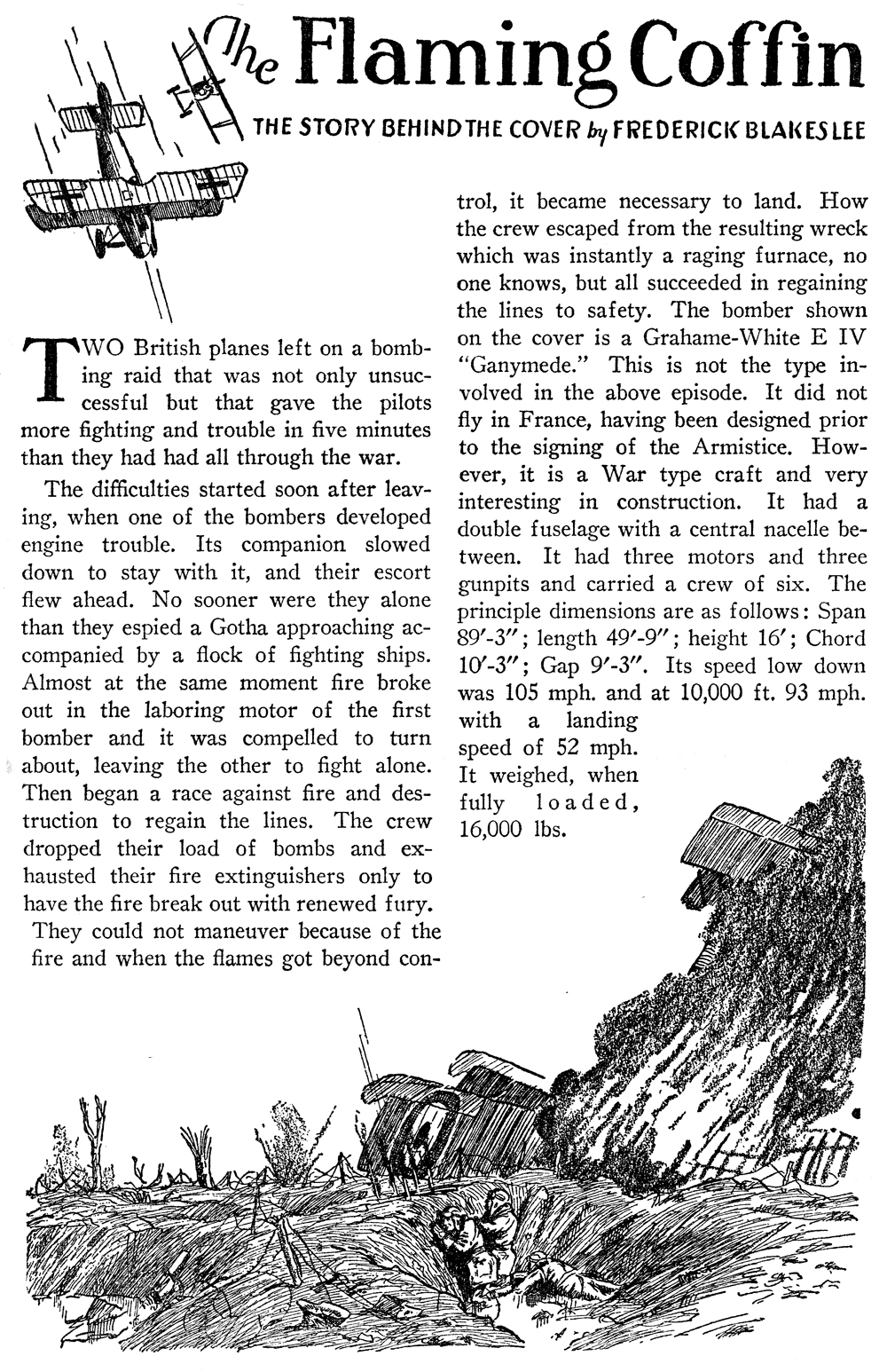
Frederick Blakeslee painted the covers for Dare-Devil Aces‘ entire fourteen year run. Every one of those covers told a story, and Blakeslee had a page with which to do so. Although this time we get a story that’s not quite the story of the cover, but still a good story. This week it’s Blakeslee’s cover for the April 1933 issue of Dare-Devil Aces—”The Flaming Coffin!”
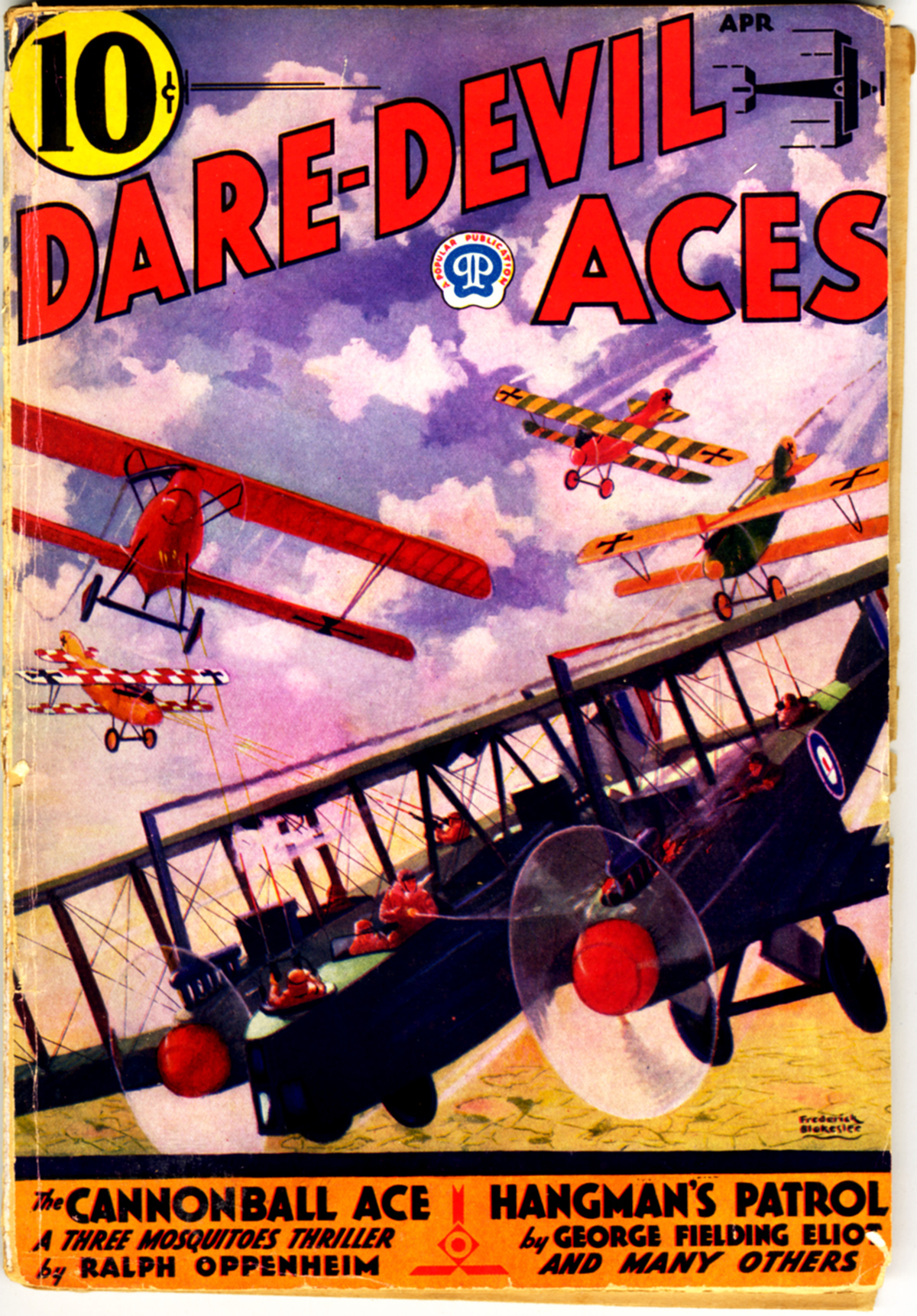
th_DDA_3304TWO British planes left on a bombing raid that was not only unsuccessful but that gave the pilots more fighting and trouble in five minutes than they had had all through the war.

The difficulties started soon after leaving, when one of the bombers developed engine trouble. Its companion slowed down to stay with it, and their escort flew ahead. No sooner were they alone than they espied a Gotha approaching accompanied by a flock of fighting ships. Almost at the same moment fire broke out in the laboring motor of the first bomber and it was compelled to turn about, leaving the other to fight alone. Then began a race against fire and destruction to regain the lines. The crew dropped their load of bombs and exhausted their fire extinguishers only to have the fire break out with renewed fury.

They could not maneuver because of the fire and when the flames got beyond control, it became necessary to land. How the crew escaped from the resulting wreck which was instantly a raging furnace, no one knows, but all succeeded in regaining the lines to safety. The bomber shown on the cover is a Grahame-White E IV “Ganymede.” This is not the type involved in the above episode. It did not fly in France, having been designed prior to the signing of the Armistice. However, it is a War type craft and very interesting in construction. It had a double fuselage with a central nacelle between. It had three motors and three gunpits and carried a crew of six. The principle dimensions are as follows: Span 89′-3″; length 49′-9″; height 16′; Chord 10′-3″; Gap 9′-3″. Its speed low down was 105 mph. and at 10,000 ft. 93 mph. with a landing speed of 52 mph. It weighed, when fully loaded, 16,000 lbs.
The Story Behind The Cover
“The Flaming Coffin: The Story Behind The Cover” by Frederick M. Blakeslee (April 1933)

Check back again next Thursday for the continuation of this story on May’s cover!
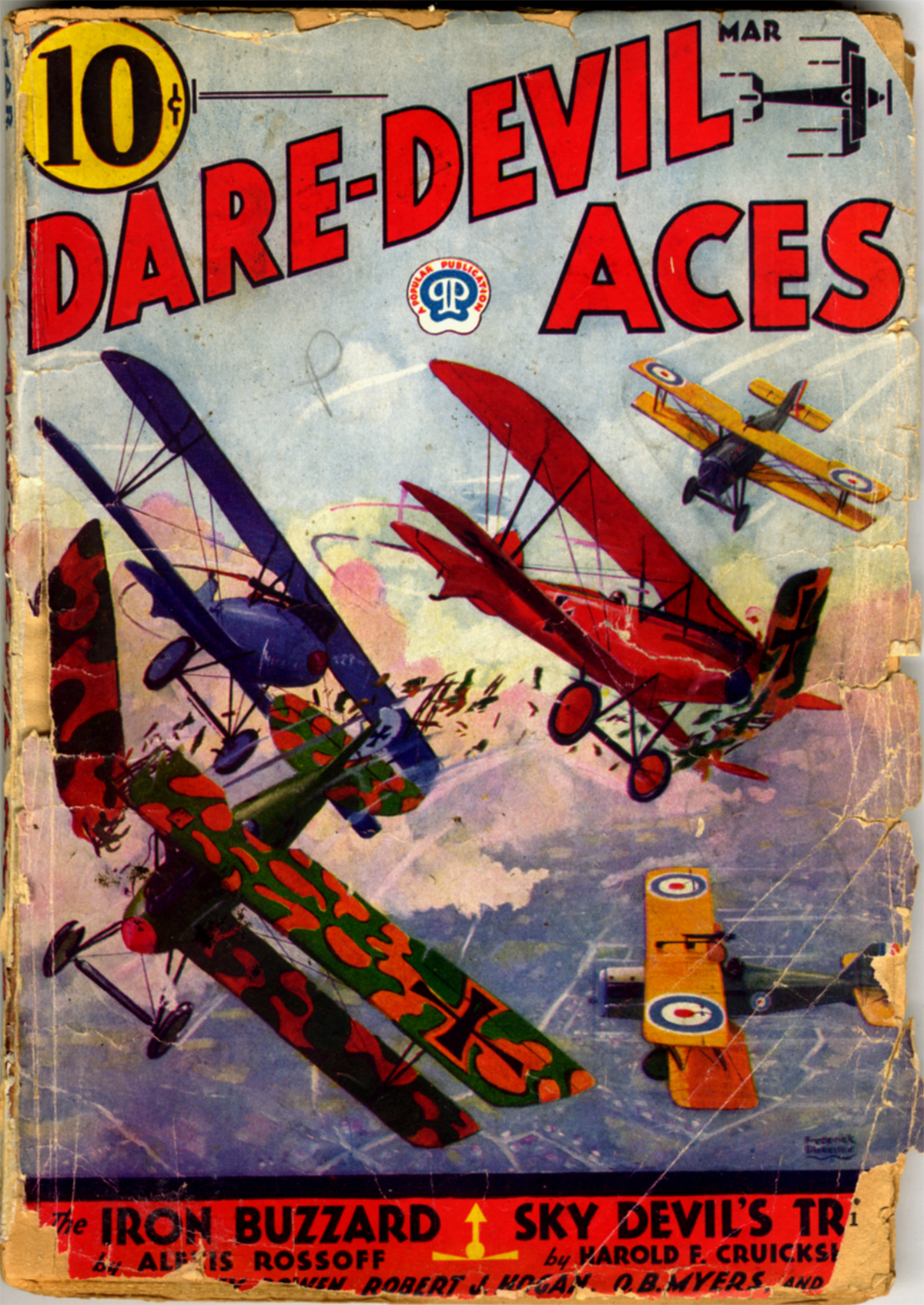
“Death Wings!” by Frederick Blakeslee

Link - Posted by David on September 25, 2014 @ 12:00 pm in

Frederick Blakeslee painted the covers for Dare-Devil Aces‘ entire fourteen year run. Every one of those covers told a story, and Blakeslee had a page with which to do so. We present Blakeslee’s cover for the March 1933 issue of Dare-Devil Aces—”Death Wings!”

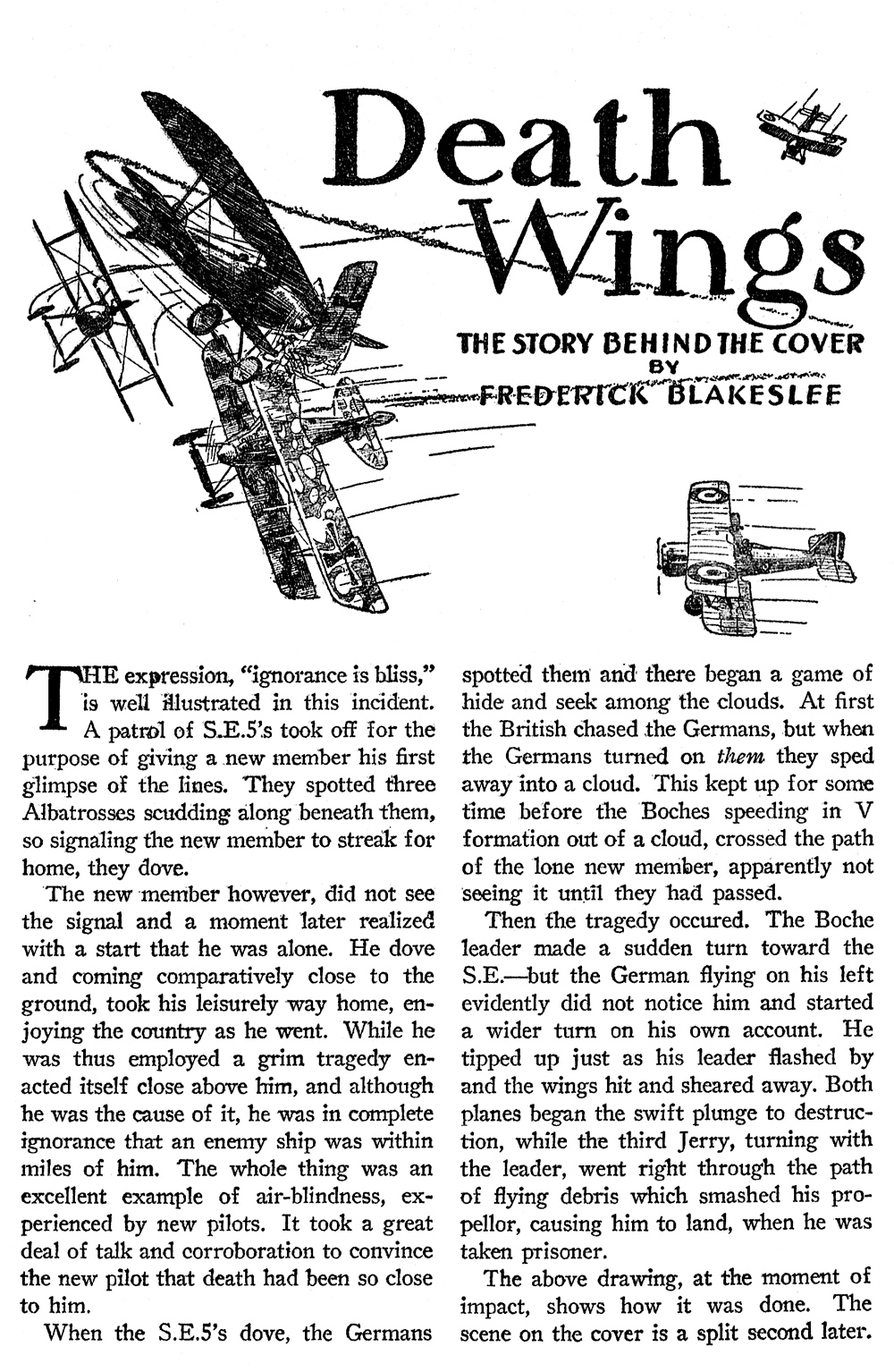
th_DDA_3303THE EXPRESSION, “ignorance is bliss,” is well illustrated in this incident. A patrol of S.E.5’s took off for the purpose of giving a new member his first glimpse of the lines. They spotted three Albatrosses scudding along beneath them, so signaling the new member to streak for home, they dove.

The new member however, did not see the signal and a moment later realized with a start that he was alone. He dove and coming comparatively close to the ground, took his leisurely way home, enjoying the country as he went. While he was thus employed a grim tragedy enacted itself close above him, and although he was the cause of it, he was in complete ignorance that an enemy ship was within miles of him. The whole thing was an excellent example of air-blindness, experienced by new pilots. It took a great deal of talk and corroboration to convince the new pilot that death had been so close to him.

When the S.E.5’s dove, the Germans spotted them and there began a game of hide and seek among the clouds. At first the British chased the Germans, but when the Germans turned on them they sped away into a cloud. This kept up for some time before the Bodies speeding in V formation out of a cloud, crossed the path of the lone new member, apparently not seeing it until they had passed.

Then the tragedy occured. The Boche leader made a sudden turn toward the S.E.—but the German flying on his left evidently did not notice him and started a wider turn on his own account. He tipped up just as his leader flashed by and the wings hit and sheared away. Both planes began the swift plunge to destruction, while the third Jerry, turning with the leader, went right through the path of flying debris which smashed his propellor, causing him to land, when he was taken prisoner.

The above drawing, at the moment of impact, shows how it was done. The scene on the cover is a split second later.

The Story Behind The Cover
“Death Wings: The Story Behind The Cover” by Frederick M. Blakeslee (March 1933)

Check back again. We will be presenting more of Blakeslee’s Stories behind his cover illustrations.

Decoy Smashers

Link - Posted by David on September 18, 2014 @ 12:00 pm in

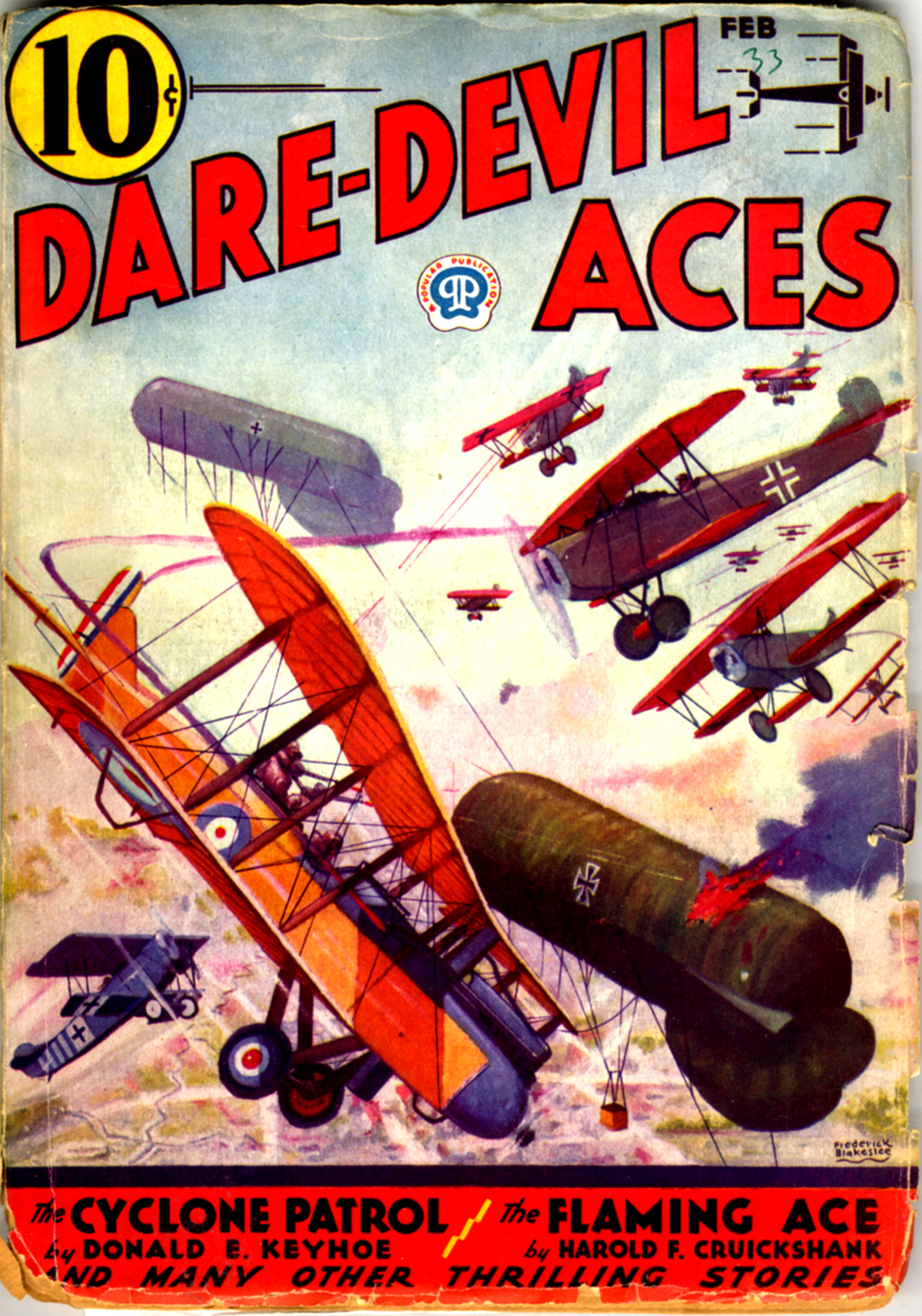
Frederick Blakeslee painted the covers for Dare-Devil Aces‘ entire fourteen year run. Every one of those covers told a story, and Blakeslee had a page with which to do so. We present Blakeslee’s cover for the February 1933 issue of Dare-Devil Aces—”Decoy Smashers”…

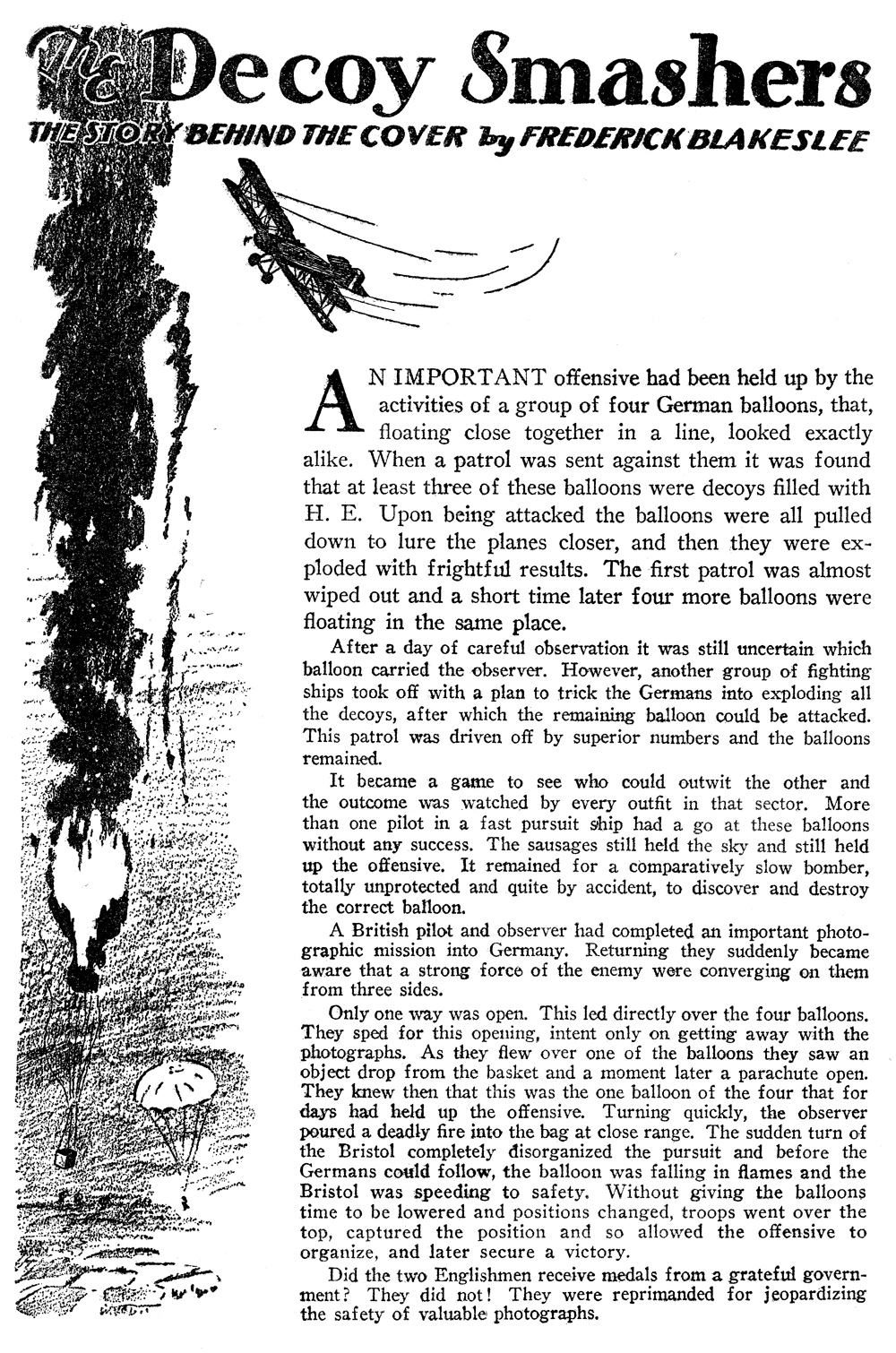
th_DDA_3302AN IMPORTANT offensive had been held up by the activities of a group of four German balloons, that, floating close together in a line, looked exactly alike. When a patrol was sent against them it was found that at least three of these balloons were decoys filled with H.E. Upon being attacked the balloons were all pulled down to lure the planes closer, and then they were exploded with frightful results. The first patrol was almost wiped out and a short time later four more balloons were floating in the same place.

After a day of careful observation it was still uncertain which balloon carried the observer. However, another group of fighting ships took off with a plan to trick the Germans into exploding all the decoys, after which the remaining balloon could be attacked. This patrol was driven off by superior numbers and the balloons remained.

It became a game to see who could outwit the other and the outcome was watched by every outfit in that sector. More than one pilot in a fast pursuit ship had a go at these balloons without any success. The sausages still held the sky and still held up the offensive. It remained for a comparatively slow bomber, totally unprotected and quite by accident, to discover and destroy the correct balloon.

A British pilot and observer had completed an important photographic mission into Germany. Returning they suddenly became aware that a strong force of the enemy were converging on them from three sides.

Only one way was open. This led directly over the four balloons. They sped for this opening, intent only on getting away with the photographs. As they flew over one of the balloons they saw an object drop from the basket and a moment later a parachute open. They knew then that this was the one balloon of the four that for days had held up the offensive. Turning quickly, the observer poured a deadly fire into the bag at close range. The sudden turn of the Bristol completely disorganized the pursuit and before the Germans could follow, the balloon was falling in flames and the Bristol was speeding to safety. Without giving the balloons time to be lowered and positions changed, troops went over the top, captured the position and so allowed the offensive to organize, and later secure a victory.

Did the two Englishmen receive medals from a grateful government? They did not! They were reprimanded for jeopardizing the safety of valuable photographs.

The Story Behind The Cover
“Decoy Smashers: The Story Behind The Cover” by Frederick Blakeslee (February 1933)

Check back again. We will be presenting more of Blakeslee’s Stories behind his cover illustrations.

Blakeslee’s “Death Bomber”

Link - Posted by David on September 11, 2014 @ 12:00 pm in

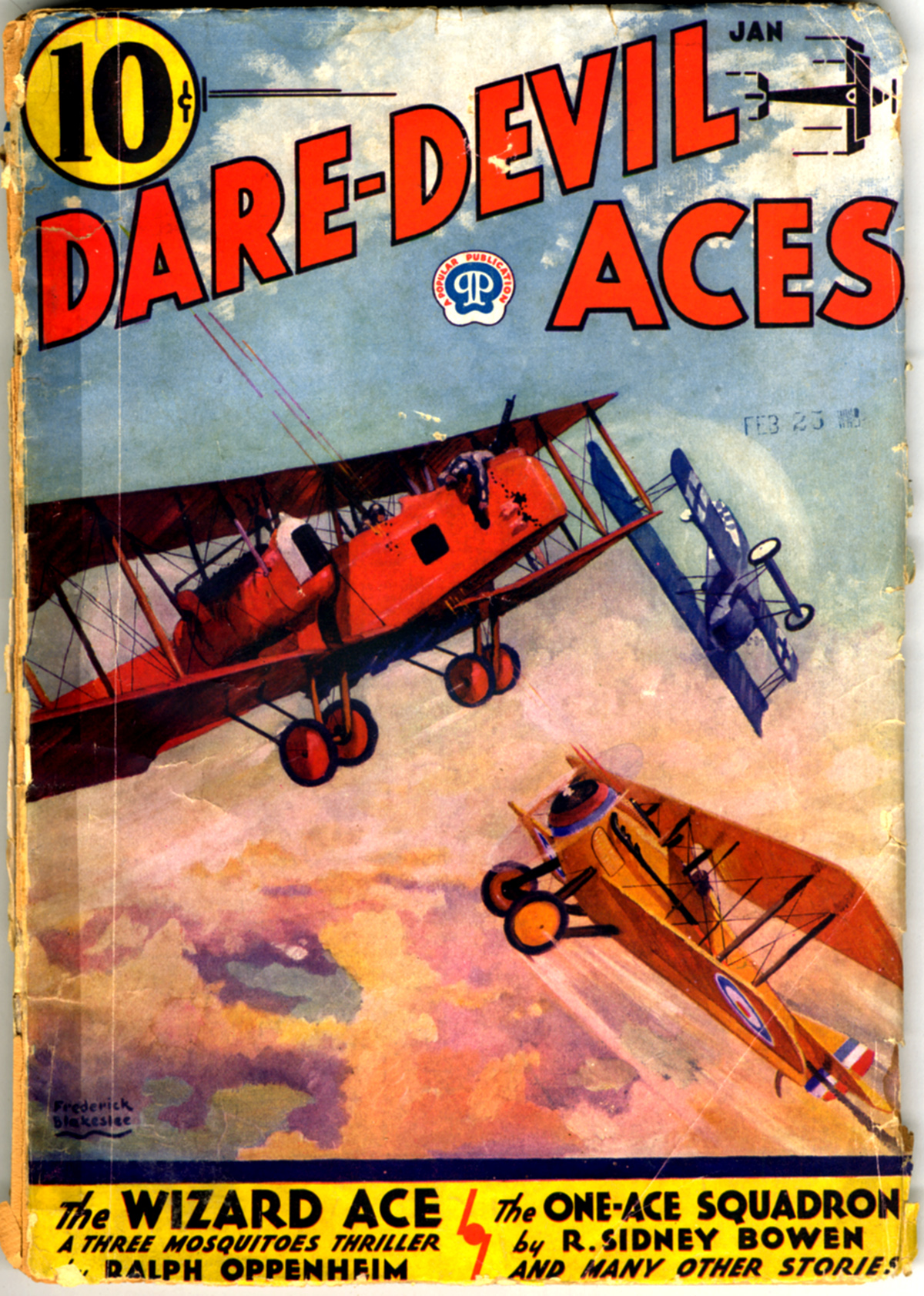
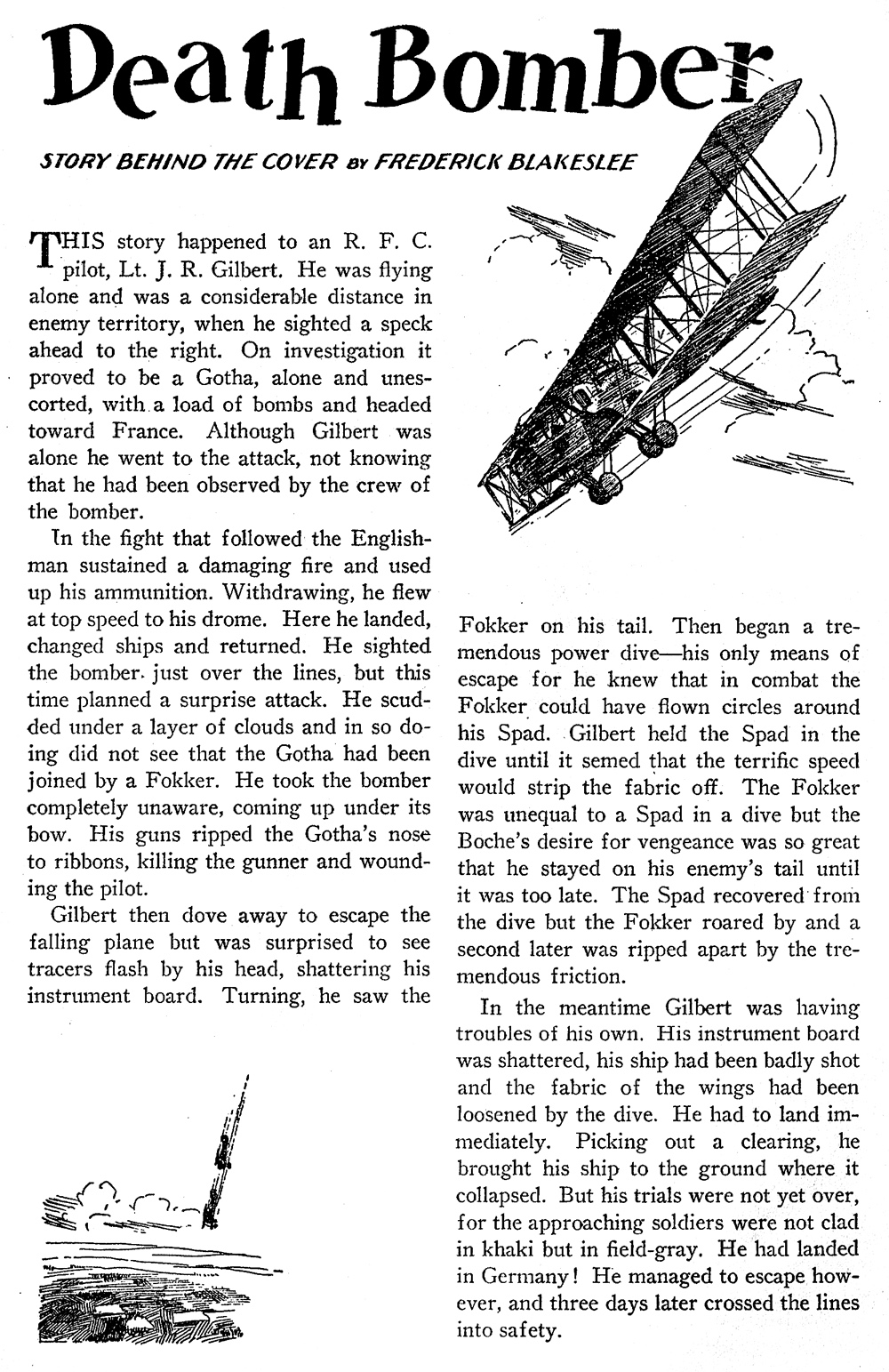
Frederick Blakeslee painted the covers for Dare-Devil Aces‘ entire fourteen year run. Every one of those covers told a story, and Blakeslee had a page with which to do so. We present Blakeslee’s cover for the January 1933 issue of Dare-Devil Aces and the story of R.F.C. pilot Lt. J.R. Gilbert as he happened upon the “Death Bomber”…

th_DDA_3301THIS story happened to an R.F.C. pilot, Lt. J.R. Gilbert. He was flying alone and was a considerable distance in enemy territory, when he sighted a speck ahead to the right. On investigation it proved to be a Gotha, alone and unescorted, with a load of bombs and headed toward France. Although Gilbert was alone he went to the attack, not knowing that he had been observed by the crew of the bomber.

In the fight that followed the Englishman sustained a damaging fire and used up his ammunition. Withdrawing, he flew at top speed to his drome. Here he landed, changed ships and returned. He sighted the bomber, just over the lines, but this time planned a surprise attack. He scudded under a layer of clouds and in so doing did not see that the Gotha had been joined by a Fokker. He took the bomber completely unaware, coming up under its bow. His guns ripped the Gotha’s nose to ribbons, killing the gunner and wounding the pilot.

Gilbert then dove away to escape the falling plane but was surprised to see tracers flash by his head, shattering his instrument board. Turning, he saw the Fokker on his tail. Then began a tremendous power dive—his only means of escape for he knew that in combat the Fokker could have flown circles around his Spad. Gilbert held the Spad in the dive until it semed that the terrific speed would strip the fabric off. The Fokker was unequal to a Spad in a dive but the Boche’s desire for vengeance was so great that he stayed on his enemy’s tail until it was too late. The Spad recovered from the dive but the Fokker roared by and a second later was ripped apart by the tremendous friction.

In the meantime Gilbert was having troubles of his own. His instrument board was shattered, his ship had been badly shot and the fabric of the wings had been loosened by the dive. He had to land immediately. Picking out a clearing, he brought his ship to the ground where it collapsed. But his trials were not yet over, for the approaching soldiers were not clad in khaki but in field-gray. He had landed in Germany! He managed to escape however, and three days later crossed the lines into safety.

The Story Behind The Cover
“Death Bomber: The Story Behind The Cover” by Frederick Blakeslee (January 1933)

Check back again. We will be presenting more of Blakeslee’s Stories behind his cover illustrations.

“T.N.T. Transport” by Arch Whitehouse

Link - Posted by Bill on July 8, 2010 @ 7:12 pm in

Secret Service agent and flying reporter Buzz Benson approached Sunkist Airport in his slick speedy Corsair for the worst assignment he ever had. Ten days before, three gigantic Boeing transports had vanished from the sky—never to appear again. Was it another Jap plot or something more mysterious?

“The Spy in the Ointment” by Robert J. Hogan

Link - Posted by Bill on March 16, 2010 @ 9:53 pm in

When they asked for volunteers to fly that spy mission, Abe answered because he couldn’t sit down. It took another spy to convince him that medals were not always granted for bravery.

“One Blue Flare” by O. B. Myers

Link - Posted by Bill on March 4, 2010 @ 11:02 am in

When the Blue Flare tore through the skies, no pilot ever failed to answer that signal for help. But sometimes someone answers it who shouldn’t. Then a baited trap is the only answer.

“The Frying Suit” by Joe Archibald

Link - Posted by Bill on February 24, 2010 @ 10:14 pm in

Phineas Pinkham had given Major Rufus Garrity two cigars in a week—and they’d both been good! What was behind this sudden bout of good behavior? Something was very wrong at the drome of the Ninth Pursuit.

“Bomb Voyage” by Joe Archibald

Link - Posted by Bill on December 29, 2009 @ 11:17 pm in

That idea Phineas had for trapping half the German Air Force was good. G.H.Q. liked it. Even Major Rufus Garrity took to it. Oh, yes, there was a catch. Half the German Air Force had to fall for it, too.

“Without Benefit of Bullets” by Major George Fielding Eliot

Link - Posted by Bill on August 1, 2008 @ 2:43 pm in

Pat Magee didn’t believe in ghosts, but how else could he explain the German two seater that landed on the Allied tarmac with empty cockpits. His curiosity had gotten him in trouble before, and now it was about to again.

“Fat Cance” by Major George Fielding Eliot

Link - Posted by Bill on June 10, 2008 @ 1:44 pm in

Everyone likes a fat guy, unless they have to fly with him. “Tubby” Gorkin could barely fit into the rear observer’s cockpit and no pilot wanted him as their observer. Now, with a new hard edged C.O. coming on, it looked like the end of Tubby’s dream of becoming a pilot.

« Previous Page