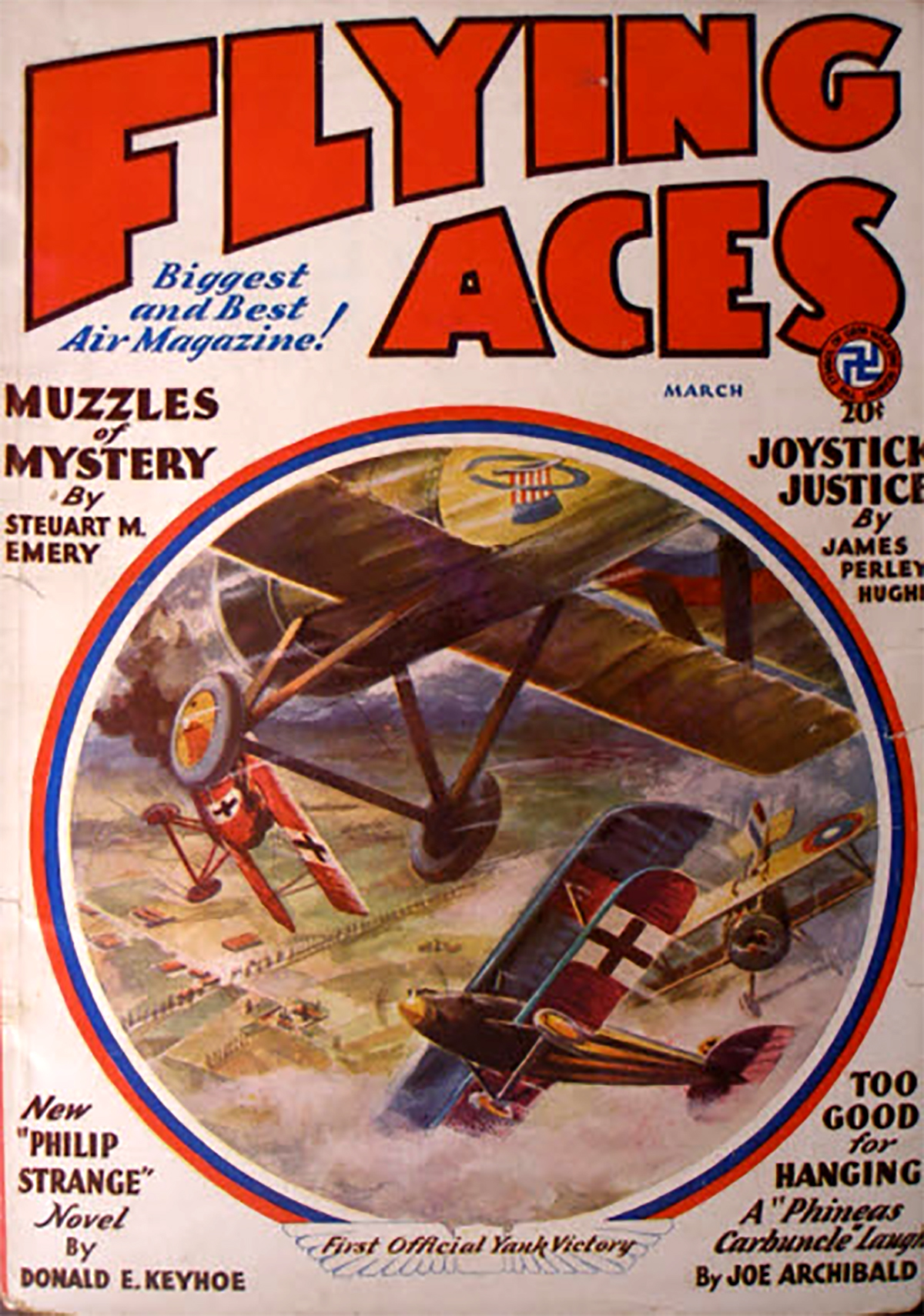



Looking to buy? See our books on amazon.com Get Reading Now! Age of Aces Presents - free pulp PDFs

How the War Crates Flew: Airplane Cooperation with the Artilary

Link - Posted by David on February 9, 2021 @ 6:00 am in

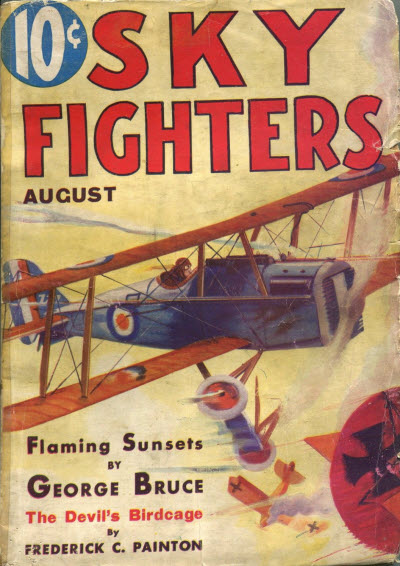
FROM the pages of the August 1932 number of Sky Fighters:

Editor’s Note: We feel that this magazine has been exceedingly fortunate in securing R. Sidney Bowen to conduct a technical department each month. It is Mr. Bowen’s idea to tell us the underlying principles and facts concerning expressions and ideas of air-war terminology. Each month he will enlarge upon some particular statement in the stories of this magazine. Mr. Bowen is qualified for this work, not only because he was a war pilot of the Royal Air Force, but also because he has been the editor of one of the foremost technical journals of aviation.

Airplane Cooperation With the Artillery

by Robert Sidney Bowen (Sky Fighters,August 1932)

COLONEL BOWERS leveled calm gray eyes at the pilots of the 42nd Pursuit Squadron.

“Gentlemen,” he said, “The Seventh Field Battery will start its shoot of the German rail-head, back of Issy, tomorrow morning at nine sharp. The Fiftieth Observation Squadron will conduct the shoot, and it will be your job to see that they are protected from German patrols. I know I can depend upon you to do a damn fine job.”

OF COURSE you can, Colonel. The 42nd boys will go over and knock the pin feathers off any Huns who get nasty. But there happens to be a couple of fledglings around here who are piping up with questions about what those observation ships have got to do. Now, you and I both know that during the late war the observation ship boys missed a lot of praise and credit that they rightly deserved. So I think it would be a good idea if we gathered ’round and chinned about observation ships and shoots for awhile.

Okay, then let’s gather.

Naturally the main idea of observation ships was to observe. And of course, what they observed was anything going on below on the ground. So in order that these question-asking fledglings won’t interrupt us, we will start with the ground and work our way up.

The map of France was divided into a number of sheets that were key-numbered so that you could easily find the adjacent sheets if you wanted to. Each sheet was 36,000 yards by 22.000 yards. And each of those sheets was divided into twenty-four lettered squares, lettered from A to X. (Fig 1)

You’ll note that there are four rows of six squares. And of course you want to understand that the top represents the northerly direction, the bottom the southerly, and the two sides east and west respectively. Well, so much for that. Now, the squares in the top and bottom rows were 6,000 by 5,000 yards. And the squares in the two middle rows were 6,000 by 6.000 yards.

Alright, now the top and bottom rows were again divided into thirty squares numbered from one to thirty. And the squares in the two middle rows were divided into thirty-six squares, numbered from one to thirty-six. To show just what we mean let us take Square A and Square K of Fig. 1, and what do we have? Well, take a look at Fig. 2. Get the idea?

Okay. Now as Square A is 6,000 by 5,000 yards and divided up into thirty numbered squares, it makes each of those squares 1,000 yards square. And as Square K is 6,000 by 6.000 yards and divided up into thirty-six numbered squares, it makes each of those squares 1,000 yards square also.

Now to check back for a moment, we started with a map sheet representing one section of land 36,000 by 22.000. We divided it up so that we got twenty-four sections of land, twelve of them 6,000 yards by 5.000 yards, and twelve of them 6,000 by 6,000 yards. And then we took those twenty-four squares and divided each of them into squares 1,000 yards by 1,000 yards. So you see we are now able to pick out any area of 1.000 yards by 1,000 yards on a section of land that was 36,000 by 22,000 yards when we started.

But we want to get it down smaller than that, so we take each one of these 1000 yards by 1000 yards squares and divide them again into four squares each and letter them A, B, C and D. And of course you can figure that each of these new squares is 500 yards by 500 yards. And just so’s you won’t forget look at Fig. 3.

However, 500 yards by 500 yards is still a pretty big area, so we will get it down smaller yet by starting with the lower left hand corner of each of the lettered squares and marking off ten equal points to the right and ten equal points straight up. Now, if we continued out those lines we would have 100 more squares with each square being 50 yards by 50 yards. Or if necessary we could divide each lettered square of Fig. 3 into 1,000 squares, each of which be five yards by five yards. But 100 squares, 50 yards by 50 yards each is small enough.

NOW all of these squares I’ve been talking about are all printed on the map sheet and lettered and numbered accordingly. That is, all except the last four lettered squares (A, B, C, D). They aren’t marked off in 100 squares usually. They are just left blank and you imagine where the ten equal spaced lines are going to the right, and going from the bottom up, beginning at the left side. Of course, though, if that particular observer was fussy he’d mark in the lines. Fig. 4.

I knew it. … I knew it! That fledgling sitting over there has just got to ask questions, hasn’t he!

He pipes up with: “What’s all these squares got to do with an artillery shoot?”

Alright, I’m getting to that right now. The Colonel has told the boys that the Seventh Artillery is going to let drive on the rail-head back of Issy. Well, does the artillery know the exact location of that rail-head? Perhaps they’ve never shot at it before.

Sure they know it . . . because the observation planes have already spotted it for them.

But to make everything clear for this question-asking fledgling we’ve got here, let’s say that instead of a rail-head it’s an ammunition dump that sprang up over-night, and that the observer notes it for the first time while out on patrol. Call it anything you want . . . but at least something that’s important and must be fired upon right away.

The leader of the observation flight sees it, and immediately starts to locate it on his map so that he can wireless the news (with the small sending sets carried) back to the gunners. Naturally he knows it’s on the map sheet he has, because he took off with the correct key numbered map sheet for the area he was going to patrol.

So by comparing the map with things on the ground (rivers, woods, towns, etc.) he finds that the ammo dump is in Square K. He looks closer and notes that it is in Square 15 of Square K. He keeps on looking and notes that it is in Square D of Square 15. And by figuring still closer he notes that the ammo dump is right where line 7, running from left to right in Square D, crosses perpendicular line 5. In other words he has pin-pointed the ammo dump, or whatever the target is, in an area of 50 yards by 50 yards.

Then he calls the battery on the wireless key by sending down a prearranged code number and the battery number. He does that three times at intervals of one minute each. Then he sends the pin-point map reading of where the target is. You’ve guessed it! Sure, he sends down the map sheet key-number, and then sends K—15—D—7—5. The gunners receive that and know just where to find the target on their map. And when they find that, they can set their guns for the range required.

So, that’s how an observation plane spots a target and sends its exact location back to the “blind” gunners.

Now, let’s say that the guns are ready to fire. The observation pilot has sent down the code-call three times, and he also sends down the pin-point location three times. And then he sends down the order to fire.

INCIDENTALLY, whenever the observer sends wireless messages to the battery he does so when he is flying from the target toward the battery.

Okay, the Fire! is sent down, and the plane banks around and flies back toward the target. At the end of three minutes the battery fires a shell over. The observer notes where it falls in relation to the target and then when the plane banks around and flies toward the battery again he sends down the correction.

Now for the corrections the observer sends down.

The target being fired upon is the center of a clock, with 12 o’clock being due north and the remaining hours accordingly. Around the target are imaginary circles at radial distances of 10, 25, 50, 100, 200, 300, 400 yards, etc. And these circles are lettered from the center Y, Z, A, B, C, D, E, F, etc.

So let us say that the first shell lands 200 yards north of the target. The correction would then be, C at 12 o’clock. And if the second shell lands 50 yards to the east of the target, the correction sent down would be, A at 3 o’clock. Of course I’ve been speaking of corrections. The observer simply tells the gunners where each shell lands so that they can make the correction on their gun sights. Of course there is no correction when a hit is made and the observer signals down that a hit has been made. And when the target is destroyed the signal to Cease Fire is sent down.

And now a little story before I put on my hat and call it a day with you fledglings.

It has to do with sending back new pin-point locations. There was in France, what was known as the S.O.S. call from plane to gunners. It was never supposed to be sent down unless the target was of great importance. A couple of thousand marching troops, or three or four field batteries on the road, or fifty or more motor lorries. In other words . . . mighty worthwhile shooting up. The reason being that when the S. O. S. signal came down, every gun within range of the target fired three shots. And during the latter part of the war, that usually meant 10,000 guns!

Well, it seems that an Allied pilot was one day straffing a German staff car, and he couldn’t seem to do much about it. So he ups and gets sore and sends down the S. O. S. Now, there’s no need of my describing what happened to that staff car and all the Hun brass-hats sitting in it. But, as for the pilot . . . he was yanked off the Front and grounded for the rest of the war. Now, take that funny look off your faces, because I’m telling you right from the shoulder, that poor peelot was not yours truly!

“First Official Yank Victory” by Paul Bissell

Link - Posted by David on January 31, 2021 @ 6:00 am in

THIS week we present another of Paul Bissell’s covers for Flying Aces! Bissell is mainly known for doing the covers of Flying Aces from 1931 through 1934 when C.B. Mayshark took over duties. For the March 1932 cover Bissell put us right in the action of the

First Official Yank Victory

th_FA_3203LIEUTENANTS Alan Winslow and Douglas Campbell of the 95th Squadron, U.S. Air Service, were on alerte duty, Toul Airdrome, April 14, 1918. American squadrons at the Front were new, and no German had yet been marked up to the credit of the Yanks. These two aces-to-be thought it pretty tough to be kicking their heels on the home airdrome while “Rick” and others were patrolling the lines with a chance of a scrap at any moment, and a chance to bring credit to the 95th for the first Boche.

Suddenly the phone rang. “Yes, Squadron 95 . . . . What? . . . . Deux Boches?
. . . . Oui! Quel direction?
. . . . Pont-a-Mousson! . . . . Bien. Merci.”

In an instant motors already warmed up were roaring, chucks pulled out, and Winslow and Campbell had taken off in a steep climbing spiral, heading back in the direction of two tiny specks now appearing just under the low-hanging clouds. Hugging the ceiling, the two Americans swung to the east, hoping to gain unobserved a position on the tail of their enemy. A cloud, hanging low out of the otherwise fairly level ceiling, helped them in this for a moment. Coming out of this, however, they found themselves flying in the opposite direction, parallel to and about a quarter of a mile to the east of the two Germans, who immediately turned to attack. One was an Albatros D-5, and the other a Pfalz D-3.

The desperate tail chasing game began. Twisting and turning, the battle drifted slowly back until it was actually over the Americans’ own airdrome. Here the clouds drove them down scarcely five hundred feet from the ground. Burst after burst from both sides had as yet done no serious harm to any of the combatants.

Campbell, scrapping it out with the Pfalz, had drifted slightly to the west. Winslow, diving at the Albatros from the side, banked up steeply, kicked his plane over, slipped off on a wing, nosing down until he was under the German plane, then quick back, hard on his stick, and he saw the belly of the red machine come slowly into line with his sights. His chance at last!

Tight he squeezed his trigger, and a wild joy swept over him as he felt the answering throb of his gun. At the last instant he banked over to avoid collision—and just in time, for the red ship, spurting smoke, slipped unevenly off, wing down and tail up. The German pilot strove to gain control, partially righting the wounded ship just before it piled up almost at the door of Winslow’s own hangar.

Just a moment later Campbell brought his man down in a nearby field to the west. It was America’s first air victory. Two to the credit of the Hat-in-the-Ring Squadron, and the Germans knew that the Eagles were in the air!

The Ships on The Cover
“First Official Yank Victory”
Flying Aces, March 1932 by Paul J. Bissell

“Squadron of the Snows” by Allan R. Bosworth

Link - Posted by David on January 22, 2021 @ 6:00 am in

THIS week we have a story from the pen of the Navy’s own Allan R. Bosworth. This time Bosworth gives us a tale of war in the Alps! Bart Mason, American pilot of Native-American desert is attached to the British squadron posted at the Italian army post west of Treviso. The sector has been terrorized by Paul Katz and his Squadron of the Snows. The problem is, Katz’ Staffel flies all-white planes which seem invisible against the snowy backdrop of the Alps—that is until Bart dons some warpaint!

Somewhere in the ice-covered heights of the Alps that deadly Snow Squadron had its lair— and none could challenge their invisible menace, until a yelling, fighting Indian had a yen to paint the town red.

From the pages of the April 1932 issue of War Birds, it “Squadron of the Snows!”

“War’s Youngest Ace Downs Voss” by Paul Bissell

Link - Posted by David on January 18, 2021 @ 6:00 am in

THIS week we present another of Paul Bissell’s covers for Flying Aces! Bissell is mainly known for doing the covers of Flying Aces from 1931 through 1934 when C.B. Mayshark took over duties. For the October 1932 cover Bissell put us right in the action as Rhys-Davids downs Werner Voss!

War’s Youngest Ace Downs Voss

th_FA_3210YOUTH, winged youth. Youth, flying to meet death.

In all the strange chapters that came from the war there is nothing more incredible than the youthfulness of its air heroes.

23 years old—a major. Officially credited with seventy-five victories in individual combat.

22 years old—a captain. Internationally known for aggressive bravery, the idol of his nation, and a price on his head, dead or alive.

21 years old—a lieutenant. With more than twoscore victories to his credit. Decorated by nations and feted by kings.

And so it went, on down—20 years—19 years—18 years—and there it stops—officially! But listen:

“And you,” said the recruiting sergeant to a glad-faced youngster who stood, bright-eyed, in front of him. “What do you wish?”

“I’ve come to enlist, sir,” replied the boy.

“Enlist, is it? And do you think it’s a kindergarten in France we be asending the lads to?”

“No, sir. I mean to fight,” was the quiet answer.

For an instant the sergeant studied the serious eyes before him. “And your age, my boy?”

“Fift—I mean eighteen, sir.”

“Eighteen, eh,” growled the sergeant, shaking his head as he reached for an enlistment blank. “Do you know what you’re doing, sonny?”

“Righto, sir.”

“Righto, it is then. And eighteen years ye be, though if you’re eighteen, Mister Methusaleh is my name. What’s your name, youngster?”

“Rhys-Davids, sir,” he replied, and a school lad had started on the road to glory, death and fame.

It was early autumn of seventeen, and the 56th Squadron, R.F.C., was in the thick of it. This famous squadron almost daily battled Richthofen and the best of his “gentlemen.” Fought them through the entire war to a credit of 411 planes downed—but not without themselves adding many famous names to the already long list of those who died for England. Included in this list was the name of their famous commander, McCudden, with fifty-eight victories to his personal credit.

Here, with this outfit, was the lad who had come to France “meaning to fight.” And fight he had. Never was there a pilot more willing or eager for a scrap. He would attack recklessly, even though outnumbered, and in a dogfight he became a madman—a madman dealing death to the enemy. And then he would return to his drome to become all boy again. A happy boy, with pets—birds that sang to him—pups that “Waited each day for his return—and tame rabbits that nipped off the shoots in the little garden behind his shack and nibbled greens, from his hand.

Already more than a score of German. had fallen before his fire. Schaffer, of “Richthofen’s Own,” had fought his last fight against this youngster. But it was on September 23, 1917, that he gained his most famous victory.

THE squadron was on patrol, protecting some bombers, when off to one side were seen two German planes. It did not seem likely that they would attack, as the English squadron numbered more than a dozen of Bristols, Camels and S.E.Ss. That is, it did not seem likely until, by the black-and-white-checkered fuselage it was seen that one of the Germans was Lieutenant Werner Voss.

This was one adversary that the Allies held in the greatest respect. Already both his plane and name were known all up and down the Front. He was always looking for combats, and fought generally over Allied territory, which could not be said of Richthofen. And with forty-eight victories over the Allies, Voss, himself of most humble origin, was a serious rival of the noble-born baron.

Indeed, records seem to show that Voss, feeling himself in every way the equal of his rival as an ace, had refused to be the tail protector to Richthofen and, on at least one occasion, when the victories of Voss had reached a number almost equal to those of the Rittmeister himself, the High Command had seen fit to transfer the mere “Lieutenant” to a less active sector, where opportunities for combat were fewer.

With such an opponent as this, the Britishers knew that attack might be expected, and when, a moment later, a patrol of Albatrosses appeared, no one was surprised to see the checkered triplane dive in headlong. Voss’ companion, flying to one side and slightly behind, was almost immediately shot down. And when the Albatrosses refused to accept battle, Voss was left to his fate.

It was an unequal fight, though after the German had winged his way through the first terrific rain of fire from all the other ships, it was Rhys-Davids who engaged him in a duel. Around and around they tore, with Voss, hemmed in on all sides, hoping only to sell his life as dearly as possible. The Fokker tripe, with its German pilot, had met its equal in the little S.E.5 flown by the English boy!

The British plane turned and twisted, meeting maneuver with maneuver, until at last the looked-for opening came and the checkered fuselage for a moment was full in the sights. Just for an instant—but an instant that was filled with spitting lead, an instant that began that mad, twisting dive that ended near Poelcapelle for the triplane with the black crosses on its wings, and ended in eternity for the brave German ace.

Rhys-Davids followed him down to the ground. It was the game—there must be no slip. Then, with motor full on, himself untouched, he raced back to his pets.

The lad—his comrades thought he must be now almost seventeen years old—had thirty-two unofficial victories to his credit, and those gods that be must have laughed as they wrote his name on a shell. No German airman carried it. But an Archie battery, a month later, shot it from the ground. Ten thousand feet up it found him.

Back in his shack the birds still sang in their cages and the rabbits still nibbled in the garden. But the puppies waited the return of their boy master in vain, for the war’s youngest ace had gone West.

The Ships on The Cover
“War’s Youngest Ace Downs Voss”
Flying Aces, October 1932 by Paul J. Bissell

“Akbar the Black” by O.B. Myers

Link - Posted by David on January 8, 2021 @ 6:00 am in

THIS week, he have a story from the pen of a prolific pulp author O.B. Myers! Myers was a pilot himself, flying with the 147th Aero Squadron and carrying two credited victories and awarded the Distinguished Service Cross. He wrote hundreds of stories for the pulps—primarily in the detective and air war pulps. We’ve collected a few of his best he had in Dare-Devil Aces as The Black Sheep of Belogue: The Best of O.B. Myers.
Memo, to all intelligence operatives, and to all Air Squadron Commanders:

    Wanted, for desertion, as a renegade and spy, the following: Full name, Akbar Swaalii Ajjaszid, known as Akbar or Akbar the Black (le Noir). Half-breed African, mixed negroid and Arab parentage; skin dark brown in color. Born in French Somaliland, about 1890; left Jibuti to come to Paris in 1915 as the body-servant of a major of Spaliis. Left his master after arrival, to join a gang of apaches. Involved in stabbing affray in Cafe Fouleau in August, 1915. Enlisted, French Foreign Legion, September of same year. Assigned by request to flying service; trained Pau, Avord; sent to Front in January, 1916, with 5th Escadrille de Chasse (Pursuit). In three months of action gained two accredited victories. Disappeared April 19th; believed to have deserted to the enemy, and to be at the present lime actively engaged in their flying forces. Report of his capture, or evidence of his death, will please be sent to this office at once.

They called him Akbar the Black. His cannibal ship spewed hate through black skies—but even outlaw wings must crack when the ghost of the past calls “Time!”

“Major Vaughn Wins the D.S.C.” by Paul Bissell

Link - Posted by David on January 4, 2021 @ 6:00 am in

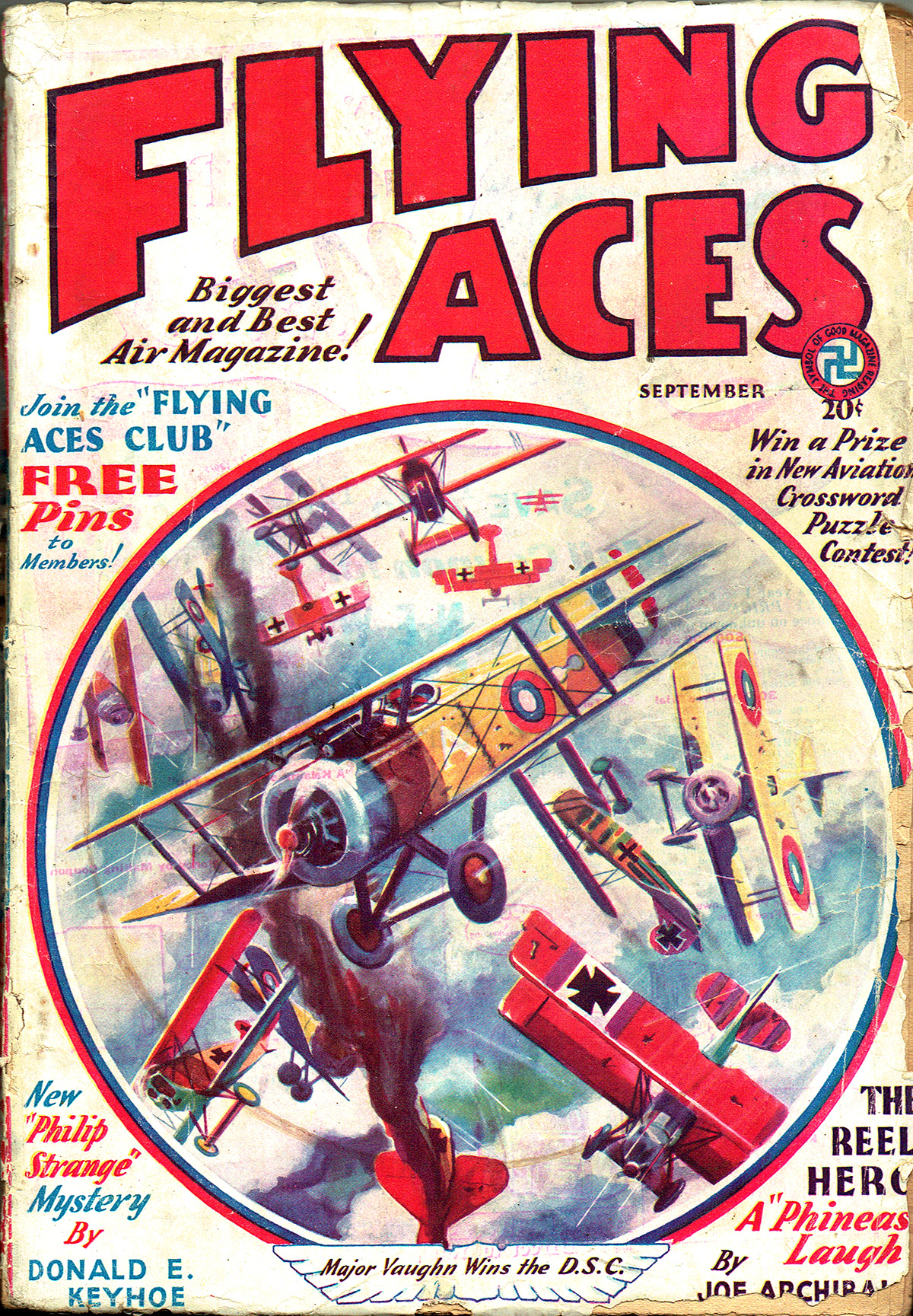
THIS week we present another of Paul Bissell’s covers for Flying Aces! Bissell is mainly known for doing the covers of Flying Aces from 1931 through 1934 when C.B. Mayshark took over duties. For the September 1932 cover Bissell put us right in the action that lead to Major George Vaughn winning a D.S.C.!

Vaughn Wins the D.S.C.

th_FA_3209“FOR extraordinary heroism in action near Cambrai, France. On September 22, 1918, Lieutenant Vaughn, while leading an offensive patrol, sighted 18 enemy Fokkers about to attack a group of five Allied planes which were flying at a low level. Although outnumbered nearly five to one, he attacked the enemy group and personally shot down two of the enemy planes, the remaining three pilots of his flight shooting down two more. His daring and courage enabled the group of Allied planes to escape ….”

So reads the American army citation on which the D.S.C. was awarded to Lieutenant George A. Vaughn. But between the lines is even more of a story—the story of a youth who left school to serve his country, first with the British and then under his own colors, with the 17th Aero Squadron—the story of a lad who came victorious through many air battles and who, that morning in September, 1918, seeing some of his comrades trapped by the enemy, went unhesitatingly to their aid. He knew he was outnumbered five to one by the Boche, yet he deliberately accepted the desperate odds. He calmly watched the chill hand of death reach for him; coolly he evaded its annihilating clutch and saw its grim fingers close on two of his enemies.

He fought many times after this, wresting victory after victory from the Boche until the war’s end found him one of America’s leading aces, with the rank of major.

It was 8:45 a.m. on a clear sunny morning. Big cumulus clouds about seven thousand feet up floated slowly across No-Man’s-Land, casting great blue shadows on the shell-pocked surface, and themselves affording excellent hiding places for enemy airplanes.

Vaughn, with three companions, was flying just under the clouds, protecting another flight of five Camels about three thousand feet below and slightly in advance of him. From the east fifteen Fokkers came in at about Vaughn’s level. They turned and flew parallel with him, all the time watching the lower flight. Then suddenly they tipped over on their noses and went down in a body on the planes below.

Suspecting a trap, Vaughn immediately searched the skies overhead. Sure enough, there they were—another batch of Germans ready to swoop down like hawks on him and his companions. Instantly he saw the one chance—to lead his flight down into the fight below, and do what damage they could diving in—at the same time giving the five Allied planes a chance to break away-and then try to get out of it before the enemy from above could surround them.

DOWN the four Camels tore, into the twisting dogfight below them—tracer bullets reaching out ahead, searching their red targets. In an instant it was every man for himself. Vaughn saw one of the Camels go down in flames and cursed the damned Boche as his sights picked up a black cross squarely. His fingers squeezed the trips. A wild answering throb as his guns spit flame, and he saw the red machine fall off out of control.

He swung in a tight turn to the left. The whole world now seemed nothing to him but white streaks of smoke cutting the sky in every direction, while red, yellow, green ships— ships with huge black crosses or ships with the tricolored circles of the Allies—seemed to come suddenly from nowhere.

The upper flight was now on him. He could see their tracers swish by him as they came down.

The red belly of a Fokker stood squarely in front of him. A quick burst, and he saw the red tail kick up as the Boche started on his last dive. Number Two—but a burst of bullets came through the cockpit just over his knees. Too close! They had him hemmed in, so he took his only chance, and threw himself into a spin.

Down he went, his tail whipping around and around. In this way he afforded no easy target. But the Germans followed him down, firing burst after burst into him, diving past, zooming back and diving again, their guns blazing. That spin seemed endless.

Luckily, most of the Germans had given him up as finished, and turned back. One last persistent Boche fired a long burst, and then he, too. turned, leaving Vaughn, as he supposed, to crash. Just in time the little Camel answered the controls.

THEN came the greatest blow of the battle. He was out of gas. There was no answering roar from the motor, and with a sinking heart and a vision of German prison camps, he sought a place to set her down. Lower he came. Now scarcely fifty feet was between him and the torn earth, the idling prop was slowing perceptibly, when suddenly it came to him—-the emergency tank! Quickly he switched it on. There was a sputter; then with a full-throated roar the engine took hold and the little machine climbed rapidly up again.

But the battle was over, and now not a plane was to be seen. So, turning toward his airdrome, some twenty minutes away, Vaughn for the first time had an opportunity to think about himself. It was then he was conscious of a burning sensation across his back. His flying suit was soaking wet just below his right shoulder. Wounded, he thought, and to use his own words, “Fine! Now I’ll get a month in the hospital. Or perhaps they’ll send me to Blighty.”

He could feel no pain, so decided it was slight, and landed with a broad smile, feeling he had rather put it over on the boys. Then came the second blow of the day, as the mechanics pointed to where the corner of his gas tank had been shot away. His clothes were soaked, not with blood, but with gasoline. No wound! No Blighty! Well, what the hell! It had been a good scrap, anyway. Six Fokkers had been accounted for, and only two Camels lost.

All Vaughn got then was a new ship. But later, with bands playing and flags flying and a lot of soldiers standing round to see how it was done, they pinned a bit of ribbon on him. Not much for a man who had played with death daily, but just the Army’s way of saying, “This guy’s damn good!”

The Ships on The Cover
“Major Vaughn Wins the D.S.C”
Flying Aces, September 1932 by Paul J. Bissell

“Famous Firsts” January 1932 by William E. Barrett

Link - Posted by David on November 11, 2020 @ 6:00 am in

THIS November we’re celebrating William E. Barrett’s Birthday. Before he became renown for such classics as The Left Hand of God and Lilies of The Field, Barrett honed his craft across the pages of the pulp magazines—and nowhere more so than in War Birds and it’s companion magazine War Aces where he contributed smashing novels and novelettes, True tales of the Aces of the Great War, encyclopedic articles on the great war planes as well as other factual features. Here at Age of Aces Books he’s best known for his nine Iron Ace stories which ran in Sky Birds in the mid ’30s!

Among those factual features was “Famous Firsts” which ran frequently in the pages of War Aces. “Famous Firsts” was an illustrated feature much along the lines of Barrett’s “Is That a Fact?” that was running in War Birds, only here the facts were all statements of firsts. And like “Is That a Fact?” in War Birds, this feature was also taken over by noted cartoonist Victor “Vic Vac” Vaccarezza in 1932.

The January 1932 installment, from the pages of War Birds, features Bert Hall, the first successful attempt to land an agent behind the lines, and the first biplane equipped with a Lewis gun!

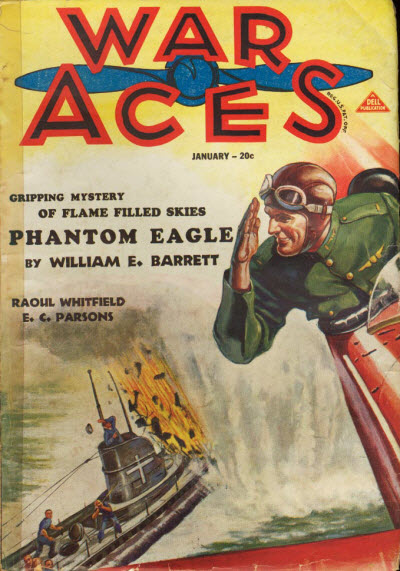
“Phantom Eagle” by William E. Barrett

Link - Posted by David on November 6, 2020 @ 6:00 am in

THIS November we’re celebrating William E. Barrett’s Birthday with one of his pulp stories each Friday.

Before he became renown for such classics as The Left Hand of God and Lilies of The Field, Barrett honed his craft across the pages of the pulp magazines—and nowhere more so than in War Birds and it’s companion magazine War Aces where he contributed smashing novels and novelettes, True tales of the Aces of the Great War, encyclopedic articles on the great war planes as well as other factual features. Here at Age of Aces Books he’s best known for his nine Iron Ace stories which ran in Sky Birds in the mid ’30s!

From the Tarmac letters column in the January 1932 War Aces—”Unless we misjudge the reading taste of our readers we feel that “Phantom Eagle,” by W. E. Barrett is about the ideal story. It has that balance of action, mystery and fantasy that gives you a new set of thrills. Obviously, it was too bizarre to be entirely fiction, so we asked the author about it. As is the case with most of Barrett’s fiction, it is based on some true incident. Here is his letter:
    You’ve guessed it. There was a great deal of truth behind that yarn. We were up at Ayr, Scotland, getting the finishing touches on acrobatics. In my flight there was a young English lad of the aristocratic type so commonly turned out by Oxford. He was about the best on the field when he felt like it or thought he had an appreciative gallery watching him. He didn’t have a great deal of stomach, though.

    He wiped his landing gear off one day making a stall landing and it was a week before he got over the resultant ground loops. Most of the chaps passed him by—the white feather was a bit obvious. We were all in a little pub one night imbibing a bit when our hero got into a brawl with a sour old Scotsman. He was getting the worst of it and was looking for a way to quit when the son of the heather knocked him cold.

    A big, burly, slow-moving chap got up out of the corner and came over. He faced the Scotsman and methodically assumed a fighting pose.

    “What a Lauterman starts, a Lauterman finishes.” Those were the only words he uttered, but he gave the Scotsman an unmerciful beating. By inquiring around a bit I found the history of those brothers who were so utterly dissimilar. I learned the history of that German father and English mother—the proud loyalty to anything that a Lauterman did held by that elder brother.

    We went out to France and young Lauterman went with us. He didn’t hold up on the line in combat work and was transferred to a bombing outfit. He turned up missing in action one day and we never heard from him after that.

    The rest of the story is pure fiction. I simply pictured what would happen if those two brothers met on the lines. In the last analysis I believe the elder Lauterman would have acted just as I have him do in the story.

— W.E. Barrett.

Hell’s hinges sealed the lips of that Unteroffizier in the pilotless Spad. None could tell how that phantom transfer had been made in shell-torn skies, or the meaning of that dying speech, “What a Lauterman starts, a Lauterman finishes”

From the January 1932 War Aces, it’s a story you won’t soon forget—William E. Barrett’s “Phantom Eagle!”

“Baracca Leads Raid on Austrians” by Paul Bissell

Link - Posted by David on October 26, 2020 @ 6:00 am in

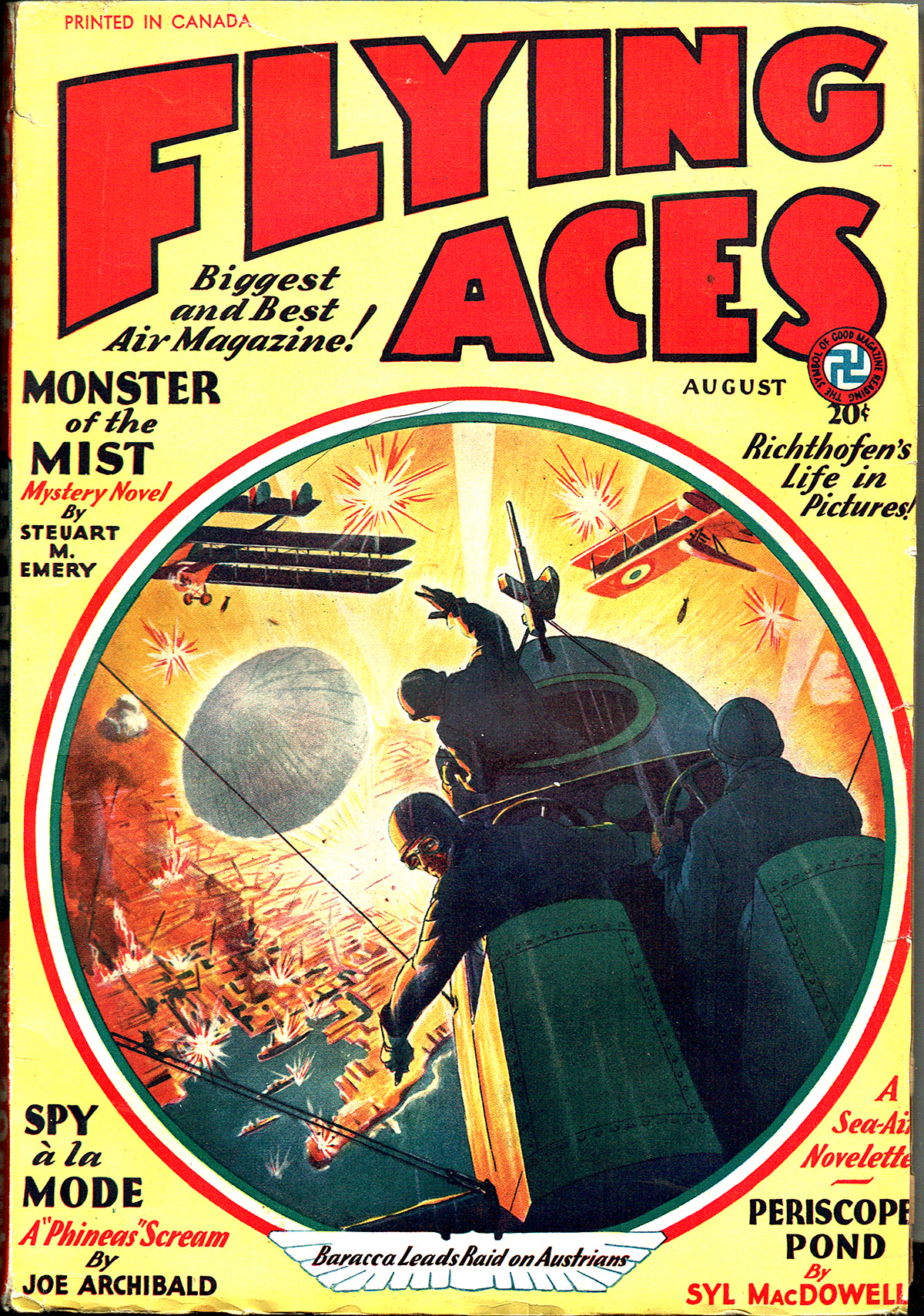
THIS week we present another of Paul Bissell’s covers for Flying Aces! Bissell is mainly known for doing the covers of Flying Aces from 1931 through 1934 when C.B. Mayshark took over duties. For the August 1932 cover Bissell put us right in the cockpit with Baracca as his squadron bombs the Austrian Naval at Pola!

Baracca Leads Raid on Austrians

th_FA_3208“ALL ships are on the line, sir. Bombs are in racks, and they are ready to take off.” The general’s aide saluted smartly, and the general turned ^o a major at his side, who wore his boots like a cavalryman, but whose silver wings showed him to be an aviator.

“You know your orders, major. You will lead the squadron and be guided across by the boats. The planes will follow you at four-minute intervals. When you have found your objective, you will drop your bombs. Captain Barrechi will release his parachute light on the target you designate. After dropping their explosives, all ships will return directly to this airdrome. That is all.”

And instead of the usual salute he held out his hand, which was eagerly grasped by the major.

The field was an Italian airdrome on the west coast of the Adriatic. The major, unlike most aviators of the war, was not a young man. He had entered the Italian army almost fifteen years before, serving in the cavalry, and rising to the rank of captain. In the first days after Italy had cast her fate with that of the Allies and it became necessary to build up an Italian air force, he had, in spite of his “advanced age,” obtained a transfer to this branch of the service, and had quickly become an ace.

Now he was Major Baracca, the Italian ace of aces. All up and down. the entire front he was known not only as a great pilot, but as one of the great air fighters of the world. With a more matured mind than the younger men, he, though ever searching and participating in personal battles with the enemy, was constantly planning and scheming larger offensive movements—movements using whole groups and squadrons, and inflicting severe damage along the Austrian front. More than seventy successful bombing raids were under his personal leadership. More than a thousand times he crossed the enemy line, seeking battle. In thirty-six of these individual combats he had come away victorious, before finally, on June 21, 1918, fighting against tremendous odds, the bullet bearing his name found its mark, and he fell from the skies, a flaming sacrifice to war.

Tonight, in the late summer of 1917, he was leading one of the largest and most daring of his raids. Over to the east the Austrians, in their naval base at Pola, felt themselves safe from attack in the knowledge that the broad Adriatic lay between them and their Italian foes.

At nine-thirty sharp, the first huge ship took the air. One thousand pounds of high explosives were fastened beneath its wings. Below, stretched out across the Adriatic, was a fleet of power boats, speeding across the dark waters, a hooded light shining from each stern to guide the big planes to their destination. Four minutes later, with huge engines roaring, the second plane took off, and so on at four-minute intervals until the entire force was in the air. Twenty planes were in the first squadron, and twenty-six in the second. Long before the last ship had left the field, the first ship had already dropped its missiles and was on its way back home.

The night was deathly still. Not even a light breeze fanned the smooth surface of the sea below. From three thousand feet up Major Baracca could see the tiny light guiding him—a light which he soon overtook, only to pick up another immediately a few miles farther along and speeding in the same direction. And so he passed from one to another of these moving beacons, until he made out the lights of a city on the dim horizon.

Now the tiny light he had been following flashed brightly twice, then swung out in a wide circle and vanished. It was the signal. In front and below him lay the naval base and arsenal of Pola. The moment had arrived. Carefully he made his calculations and peered searchingly into the darkness below. His must be a direct hit. The naval base itself must be spotted, so that Captain Barrechi might drop his parachute flare directly over their objective.

He signaled to his pilot, who nosed the big plane over into an easy glide, motors throttled down and wires singing. He had made almost a complete circle over the town when his eyes picked up the marks he was looking for. A quick order to the pilot, and the plane flattened out, gliding squarely over the target. The bomber leaned tensely over the side, his arm raised, his eyes carefully lining through the sights on the lights below. A quick signal, a click of levers, a slight waver, and two dark masses detached themselves from below the wings and hurtled downward.

One tense instant, and then, far below, two blinding flashes followed by the sharp, terrific intonation of high explosives. Immediately the night was stabbed by beams of light. Major Baracca gazed, eagerly over the sides to mark his hit. The blinding light of one of the beams caught his ship full in its glare, and shells began to burst around him. But below a sudden burst of flame, as a small store of munitions went off, showed that his bombs had landed in the arsenal area.

THE archies were now bombing him heavily. Machine guns spattered, and flaming onions swept through the night. His motors roared as the pilot gave her the gun, and with a wild feeling of exultation Baracca signaled to swing in a wide circle so as to give Barrechi a chance to drop his light, and give himself the benefit of this light, in dropping his other bombs.

As Barrechi glided down and dropped his flare, there was a sharp explosion, followed by a bright downward rush as of a falling meteor. Then a sharp snap as the parachute opened, and the light floated easily in space, swaying gently and lighting up the scene below. With no breeze, the light hung in the air as if anchored.

This came as a complete surprise to the Austrians, and for some minutes there was panic. Men could be seen dashing madly around; the guns actually ceased firing, and even the searchlights snapped off as if trying to hide from the merciless glare above.

Quickly Baracca saw his advantage, and undisturbed by fire from below, he calmly glided his plane lower and directly over a spot marked with a red X on the map held on his knees. Leisurely and with deadly certainty the bomber sighted; his arm flashed downward, and the levers clicked. Tensely they waited, leaning over the side to watch the two bombs drop straight down, their white fins clearly seen in the brilliant light.

For a split second they seemed to disappear as they landed. Then there was a terrific upheaval. A whole section of the surface below seemed to lift itself up in an attempt to reach the plane above—then, giving up its vain effort, to split into a thousand weird shapes and tongues of flame. Explosion after explosion followed, as one building set off another. Again Baracca’s lever worked, and the giant plane dealt another hand of death from the sky.

Now Barrechi was also releasing his bombs. And plane number three was just entering the circle of light. The archies had commenced their fire again, but their aim was wild, for terror had struck the hearts of the Austrians.

For five hours this bombardment continued. One after another the big Capronis, heedless of the shell-fire from below, coolly dropped their eggs. Forty-six ships came over, carrying death and destruction to the Austrians, and forty-six ships returned safely to Italy, with their bomb-racks empty.

The Ships on The Cover
“Baracca Leads Raid on Austrians”
Flying Aces, August 1932 by Paul J. Bissell

“Nungesser to the Rescue!” by Paul Bissell

Link - Posted by David on October 12, 2020 @ 6:00 am in

THIS week we present another of Paul Bissell’s covers for Flying Aces! Bissell is mainly known for doing the covers of Flying Aces from 1931 through 1934 when C.B. Mayshark took over duties. For the July 1932 cover Bissell put us right in the action as Lieutenant Charles Nungesser surprises a flight of German Hell hawks!

Nungesser to the Rescue!

th_FA_3207IT WAS a hazy morning in December of ’16. The sun struggled to break through the heavy fog which had for days now hung close to the sodden landscape. Here and there were patches of snow, but in general the land was all half-frozen mud. The armies of the Allies and the Germans had dug themselves in for the winter, satisfied, except for an occasional almost individual effort, merely to hold what they had, fortify themselves against attack, and await spring for offensive movements.

On a French airdrome just a few kilometers back of the lines several ships were being groomed to take off. Motors were warmed up and impatient pilots looked constantly up at the sky, waiting for the fog to clear away. Finally a small Nieuport took off, circling the field and climbing away rapidly, soon to be lost in the mist. On the wings was the tri-color cocarde of the French. On the fuselage was painted a curious insignia. On a black heart was imposed a white skull and crossbones, above which was a coffin with a lighted candle at either end, and to one side was featured in large figures the number 13.

This was the plane of Lieutenant Charles Nungesser, a pilot who, even at this early date in the war, was already an ace, and whose daring and aggressiveness were to lead him into numberless air battles, gain for him the credit of forty-five victories against his adversaries, and leave him, at the end of the war, with more wounds than any living aviator. He fought always for the glory of France, with a recklessness and abandon that did not take into consideration any thought of personal safety. To him days that he could not fly were days wasted. He chafed with impatience when bad weather or wounds kept him from the skies and his eager search for the enemy.

For days now Nungesser had been held down to earth by the bad weather and restlessly he had waited for the sun to break through, until, when telephonic advices from up and down the line told him that the weather was clearing, he took off into the mist rather than wait longer for it to lift.

He was not a thousand feet up when he went into a cloud bank, and, nosing the little machine up slightly, he headed in the general direction of Metz, flying solely by his compass and instinct. All around was gray mist. There was no top, no bottom, just one moist, gray evenness all around. Only the “feel” of his seat told him whether he was climbing, level, or banked over.

Steadily he gained altitude, his windshield running little streams of water, his whole plane glistening wet from the gray mist. Ten, fifteen minutes he climbed; his altimeter now showed twelve thousand feet when suddenly he burst from the grayness into the blazing sunlight. Above him, now, was only the limitless blue, below the great billowy clouds formed an irregular floor, dazzling white in the sunshine, with brilliant blup shadows.

IT WAS some seconds before he could adjust his eyes to the sudden brilliance. Then, off to the left, he made out four planes, mere specks against the horizon. Placing the sun behind him, and still climbing, slowly he gained on them, and before long made them out to be four German Halberstadt scouts. He was now fifty miles north of his airdrome, and the cloud formations were beginning to break up. Great holes in them showed, far below, the woods of Valluber, splotched with sunlight and shadow.

Just east of Lechelle he saw the four scouts suddenly turn over on their noses and go diving through one of these openings. His first thought was that they were simply diving to get below the clouds, but a second glance showed him the reason of their plunge. A British Caudron artillery observation plane was flying calmly below, unaware of the death and destruction hurtling toward it.

A push forward on the wheel and the little Nieuport nosed over, motor full on, roaring in pursuit of the diving Germans. The British pilot, now aware of his danger, banked around sharply, avoiding the first German plane, which flashed by and turned in a wide spiral to renew the attack. The second German, diving with guns blazing, was forced to change his course to avoid the deadly fire that the British observer poured out on him.

Nungesser, as yet unobserved, banked over to keep “in the sun” and be ready for the first German as he turned back to dive at the Caudron. Easing back on his wheel to hold his elevation, he got himself directly in position, counting on the fact that because of the sun at his back he would be unseen by the German, now up on his wingtip, twisting as he turned for his second attack. Over again went the Nieuport’s nose, on went the motor full, and carefully Nungesser guided his headlong flight until at last he saw the German’s tail creep between his sights. A little more and the Boche pilot himself was full in line with the Frenchman’s guns. A squeeze of the trigger and a tracer bullet proved the aim was true. Then a full burst. The German, caught unawares, half-turned in his seat as the bullets spat around him. His arm jerked up sharply as he was hit. Helplessly he attempted to evade the diving Frenchman. He veered off to the left, but his move was anticipated by Nungesser, and another burst, this time into his gas tank, finished the show.

A puff of smoke, then a burst of flame, and the doomed Halberstadt plunged downward, twisting and turning, leaving a trail of smoke behind.

A sharp renversement and Nungesser was back to the defense of the slow-moving Caudron. The Germans, however, seeing their leader go down in flames, had had enough, and were already streaking it for home.

The Ships on The Cover
“Nungesser to the Rescue!”
Flying Aces, July 1932 by Paul J. Bissell

IT WAS ten years later, and again the day was gray. Again a ship stood impatiently at a French airdrome. It was a larger ship this time, a ship carrying untold gallons of gasoline to enable it in one flight to span an ocean. A ship all white, but on its fuselage was again painted that strange insignia, a white skull and crossbones on a black heart. It was scarcely daybreak, but a crowd had collected. Word had gone around that Nungesser and Coli were about to start.

For days and weeks they had waited impatiently on the ground for conditions which would give them at least a chance of success. On the other side of the Atlantic, groomed and ready, other planes were waiting to make this same attempt from the west. No time could be lost if Nungesser was to.gain for his beloved country the honor of the first successful flight between France and America. The telegraph clicked, word was flashed that the weather over the Atlantic seemed favorable, or at least as favorable as they might hope for. The chance must be taken.

Quick orders were given. The motor, already warmed, was again tested. Last-minute directions and dispatches were given, and farewells spoken. Two men climbed into the cockpit. All was ready. A face leaned out of the cabin, a hand went up in a waved farewell to the crowd. The chocks were pulled, and the plane started down the runway. A moment later, and the great White Bird, staggering under its weight of gasoline, rose into the air, and Nungesser, one of France’s great air heroes, had started on his last flight.

Twenty hours had passed. Once again a plane struggled in the dense nothingness of the fog. A pilot who had come victorious through many air battles against the Germans was now at death grips with the elements themselves. A missing motor, wings heavily laden with ice, fuel low, and a storm-whipped sea beneath. The last grim secrets of that brave flight have been hidden forever.

On the night of Nungesser’s fateful flight there was on the west shore of the Atlantic a British ex-war pilot who owed his life to the French ace, a pilot who waited anxiously for word of the White Bird’s safe arrival, waited anxiously and waited in vain. And there is a legend that on a high cliff of the bleak Newfoundland coast there is a small stone that looks ever out toward sea. It has no name, and bears but two words, “In Memory.” And carved deep in the solid granite slab is once again that strange insignia—a skull and crossbones on a heart.

“The Singing Major” by Raoul Whitfield

Link - Posted by David on September 11, 2020 @ 9:28 pm in

THIS week we have a story by Raoul Whitfield! Whitfield is primarily known for his hardboiled crime fiction published in the pages of Black Mask, but he was equally adept at lighter fair that might run in the pages of Breezy Stories. We’ve posted a few of his Buck Kent stories from Air Trails. While the Buck Kent stories were contemporary (1930’s), “The Singing Major” from the January 1932 issue of War Aces is set in The Great War and, in fact, based on a real person. At the time of publication, Whitfield told the editors of War Aces that the legends of this major are still talked about among the peasants in one locality. His was a temperament they couldn’t understand, hence many are the wild stories about him.
One in particular they like to tell. A ranking colonel came to the major’s field for one of those everlasting inspections. The major smilingly met him and then, in front of the whole company and while humming Madelon, he knocked the colonel down. He did it to get the court-martial that would relieve him of his command, but the audacity of the act left him scot free. The colonel excused the act on the grounds of ragged nerves from overwork and war strain. His next effort was to knock a buck private kicking, but again it didn’t work. The major went through the war with something eating him inwardly and trying all sorts of things at the most unexpected moments to get himself in clink.

He looked mild, but he was rough, tough and nasty—that Singing Major, Up and down the Front he was famous for anything from arson to mayhem until he answered his third curtain call and found the Reaper himself blocking the wings.

“Little Orphan Danny” by Allan R. Bosworth

Link - Posted by David on @ 6:00 am in

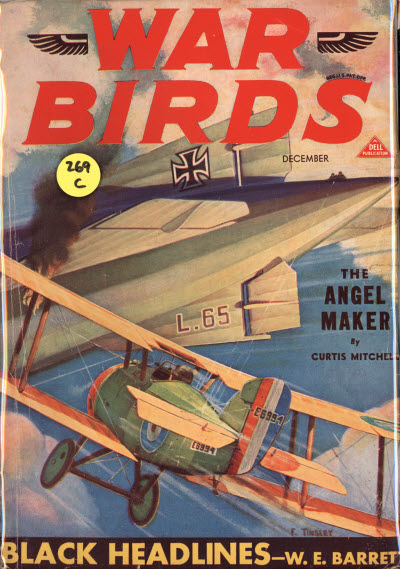
THIS week we have a story from the pen of the Navy’s own Allan R. Bosworth. Being a Navy man, Bosworth’s stories primarily dealt with the Navy. However, this week’s story from the pages of War Birds, Bosworth gives us something different—the Steenth Squadron has a German spy in their midst. Dizzy Donovan exists the help of a local orphan the squadron has taken a shine to to help ferret out the hidden Boche agent. But the pilots are the ones in for a surprise at Little Orphan Danny’s birthday Party! From the pages of the December 1932 it’s “Little Orphan Danny!”

Dizzy Donovan, premier poet of the air, took an orphan to raise. When the pilots of the Steenth tried to celebrate Little Danny’s birthday they learned about the war from him!

“Sea Bats” by Lester Dent

Link - Posted by David on August 21, 2020 @ 6:00 am in

LESTER DENT is best remembered as the man behind Doc Savage. But he wrote all number of other stories before he started chronicling the adventures of everyone’s favorite bronze giant. Here we have an action-packed tale of war time intrigue from the pages of the April 1932 issue of War Birds—”Sea Bats!”

A flying ship without a pilot; a murder without a murderer; a base without a hangar—Squeak knew something was haywire. It took double-crossed wings to throw the shadow of black crosses where they belonged.


And as a bonus, here’s another newspaper article about Lester Dent! This time it’s an article of Lester planning on touring the west retracing the route he had taken as a kid in a covered wagon. From The La Plata Home Press, it’s “Magazine Writer To Tour West!”


Magazine Writer To Tour West

La Plata Home Press, La Plata, MO • 13 AUGUST 1931

Doing Farm Work Here Occupied Part of Vacation

THIRTY years ago, Bern Dent of LaPlata, then a rancher in the West, trailed cattle herds over a route thru the Northwest. The country was then sparsely settled. Today, his son, Lester Dent, New York fiction writer and author of western stories, starts from his LaPlata farm home to cover this same territory and on to the coast, not in a slow-moving van, but in a high-powered motor car.

Crossing the Big Horn mountains, Mr. Dent will also retrace the course of a trip he, as a small boy, made in company with his parents in a covered wagon, before the era of motor cars and good roads. On this trip, there were no bridges and they camped three weeks on the banks of Big Powder river, waiting for that fast-flowing stream to subside until it could be forded.

After helping put up hay, and wielding a hoe on his father’s farm here, Lester Dent went to Carrollton, Mo., Thursday, where he plans to join his wife for a motor trip through the Black Hills, the Yellowstone and Jackson Hole country, Oregon, Utah and Colorado. A sister-in-law, Miss Corrine Gerling, of Carrollton, will accompany them.

Mr. Dent will obtain material to be used in a series of western stories he is writing. He will return to LaPlata in three weeks or a month, and in October will return to New York for the winter.

The story of Lester Dent and his development as a fiction writer is as interesting as any story he has written. On the cover page of such magazines as All-Fiction, Popular, Western Trail, War Brides, War Aces, you will find the name of Lester Dent, and now, after writing all kinds of adventure stories, his name is found in Scotland Yard and other such magazines, as a writer of detective stories.

“How Barker Won the V.C.” by Paul J. Bissell

Link - Posted by David on December 23, 2019 @ 6:00 am in

THIS week we present another of Paul Bissell’s covers for Flying Aces! Bissell is mainly known for doing the covers of Flying Aces from 1931 through 1934 when C.B. Mayshark took over duties. For the February 1932 cover Bissell put us right in the action as Major Barker fights his way through Hell skies to down five German planes in a single day!

How Barker Won the V.C.

th_FA_3202JUST four years before, it had been Barker. W.G. Private 106074, First Canadian Rifles. Today, October 17, 1918, it was Major Barker, D.S.C., M.C., with forty-six Germans to his credit, who was waving good-bye to his squadron mates as in his Snipe machine he took off for England. The day was clear, and those on the ground smiled as they saw the little machine climb higher and higher. Yes, Billy Barker was obeying orders and “proceeding to England,” but via Germany, and one last scrap.

He was four and a half miles up when he met his first enemy, a double-seater machine, with a good pilot and a scrappy observer. Twice Barker attacked before he sent this plane down. Then, when the machine burst into flames, he pulled out of his dive, leveling off just as a burst from above caught him completely unawares.

He slipped away on a wing, but not soon enough to avoid an explosive bullet which completely shattered his left thigh. Turning to the attack, his fast-maneuvering Snipe quickly got him into a position where, with deadly coolness, he finished his second German of the day.

Dizzy from loss of blood, he suddenly found the sky around him literally black with German pjanes. The watching Tommies on the ground estimated that the planes numbered no less than sixty.

Without hesitation Barker dived at the nearest enemy. Number three went down.

Now the Germans were firing at him from every direction. His machine was hit repeatedly and he himself was wounded again, this time in the right thigh. His machine out of control, he fell into a spin, followed down by the whole German circus. After a few thousand feet, however, the rush of air revived Barker, and savagely he returned to the attack.

A quick tight loop—his favorite maneuver—one short burst, and the fourth German went down in flames. But again Barker pays dearly. This time another explosive bullet takes away his entire left elbow joint. Once again he goes into a spin, down he twists, the Boche diving after and riddling his machine. The gas tank is demolished. Fighting desperately to maintain consciousness, he switches his engine to his auxiliary tank, and once again turns on his foes.

But the battle is over. Faint from loss of blood, scarcely conscious, Barker, with one last effort, turns his plane toward the west, and dives headlong toward the shell-pocked earth, piling up in a barbed wire entanglement just inside the British lines.

Downed at last, but still alive and smiling. Sixty to one were the odds. Five German planes was the toll he took.

The best that England could give in medical attention was his. Slowly they nursed him back to health, and Major Barker became Colonel William George Barker, V.C., D.S.O., M.C., with fifty-one official air victories to his credit—and he was less than twenty-four years old!

The Ships on The Cover
“How Barker Won the V.C.”
Flying Aces, February 1932 by Paul J. Bissell

“Is That a Fact?” April 1932 by William E. Barrett

Link - Posted by David on November 25, 2019 @ 6:00 am in

THIS November we’re celebrating William E. Barrett’s Birthday. Before he became renown for such classics as The Left Hand of God and Lilies of The Field, Barrett honed his craft across the pages of the pulp magazines—and nowhere more so than in War Birds and it’s companion magazine War Aces where he contributed smashing novels and novelettes, True tales of the Aces of the Great War, encyclopedic articles on the great war planes as well as other factual features. Here at Age of Aces Books he’s best known for his nine Iron Ace stories which ran in Sky Birds in the mid ’30s!

Among those factual features was “Is That a Fact?” which ran frequently in the pages of War Birds. It was an aviation themed version of a Ripley’s Believe It or Not kind of feature with hard to believe they’re true facts. Although written by Barrett, the feature was illustrated by noted cartoonist Victor “Vic Vac” Vaccarezza.

The April 1932 installment, from the pages of War Birds, features Major Raoul Lufbery, Captain F.R. McCall and the R.F.C.’s 56th Squadron!

« Previous PageNext Page »