Looking to buy? See our books on amazon.com Get Reading Now! Age of Aces Presents - free pulp PDFs

“Smell-Shocked” by Joe Archibald

Link - Posted by Bill on April 20, 2010 @ 10:59 am in

That great German ace, the Mad Butcher from Hamburg, wants some Limburger and can’t find it. Phineas, the mad Pinkham from Boonetown, Iowa, has some Limburger and doesn’t know it. Oh, yes. Fate brings them together. The big cheese!

More Great Blakeslee Covers!

Link - Posted by David on April 18, 2010 @ 1:14 pm in

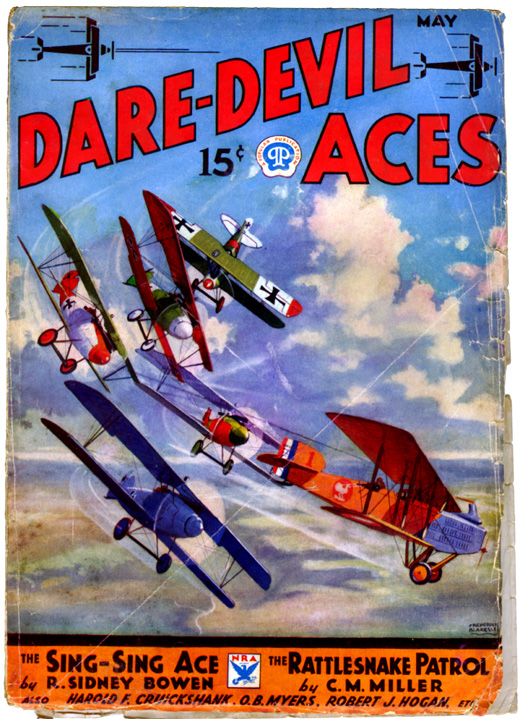
This week we have more great Dare-Devil Aces covers by Frederick Blakeslee. Popular Publications published some dynamite aviation art on the cover of Dare-Devil Aces! Sadly, we don’t use more than a sliver of it for our books. But that’s a design choice — We’re not trying to keep anything from you. And now we’ve added two more years of great Blakeslee covers to our growing gallery––1934 and 1935!

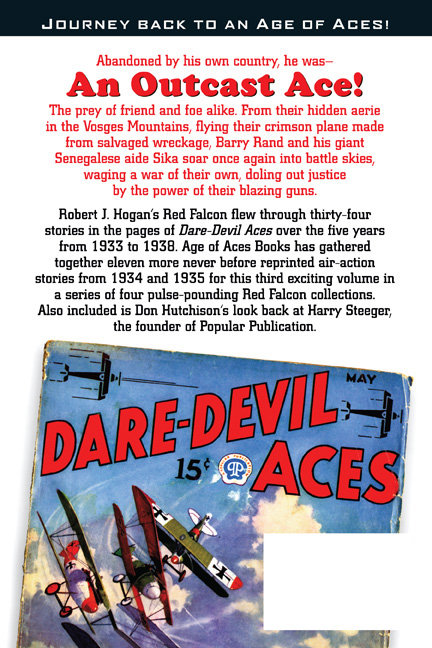
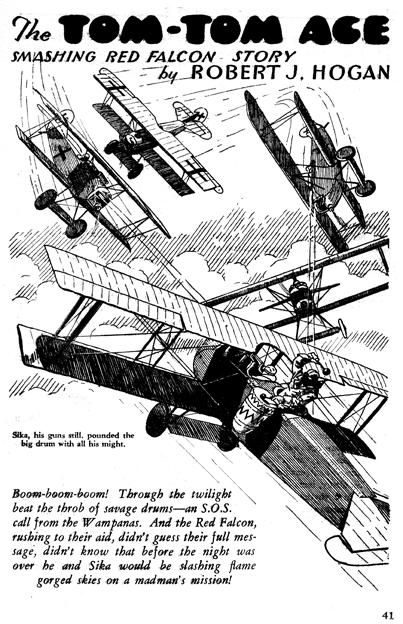
We’ve only featured two covers from this period on our books. The Red Falcon: The Complete Dare-Devil Aces Years Volume III collected his adventures from January 1934 through July 1935 and as such we used the cover from the May 1934 issue on the back cover of that book. The three planes on the May 1934 issue sort of mirror the three planes challenging the Red Falcon and Sika in the Blakeslee illustration for “The Tom-Tom Ace” used on the cover.

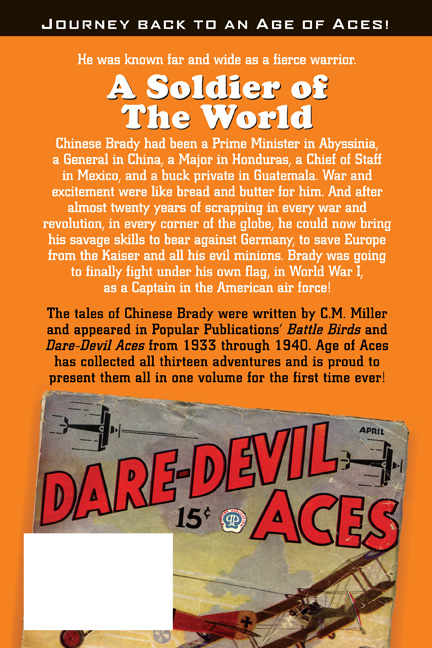
The other cover we’ve used was from 1935. Chinese Brady: The Complete Adventures made use of the April cover. The grey clouds worked well with the orange cover in a way the usual blue sky Blakeslee uses on a majority of the covers didn’t.

You can enjoy these as well as covers from 1932 and 1933 in our Dare-Devil Aces Cover Gallery!

“Raider Wings” by Arch Whitehouse

Link - Posted by Bill on April 1, 2010 @ 9:01 am in

Tug Hardwick’s sleek Northrop was beautiful as it hurtled over the shimmering Sulu Sea—beautiful, that is, until its vitals were poisoned with whistling lead! Anyhow, this hot interview was something the Flying-Reporter  hadn’t expected. Why, before his story was written it was getting punctuated—with bullets! But bullets or no. Tug was bent on tracking down his man. And he knew he was on the right track when a booming laugh brought forth—a little ship that wasn’t there!

Dare-Devil Aces Cover Gallery Update!

Link - Posted by David on March 29, 2010 @ 1:28 pm in

One of the great features of the Popular Publications air war anthology pulps we reprint in our books are the original Frederick Blakeslee covers. We feature Blakeslee’s interior black and white illustrations heavily throughout our books and on the covers. But the actual pulp covers were never representational of any of the stories or characters inside, so we don’t really get to feature them in our books aside from the back cover where sadly they are cropped and covered by the UPC code. But here on our site we can prominently feature Blaleslee’s incredible covers for Dare-Devil Aces in full color!

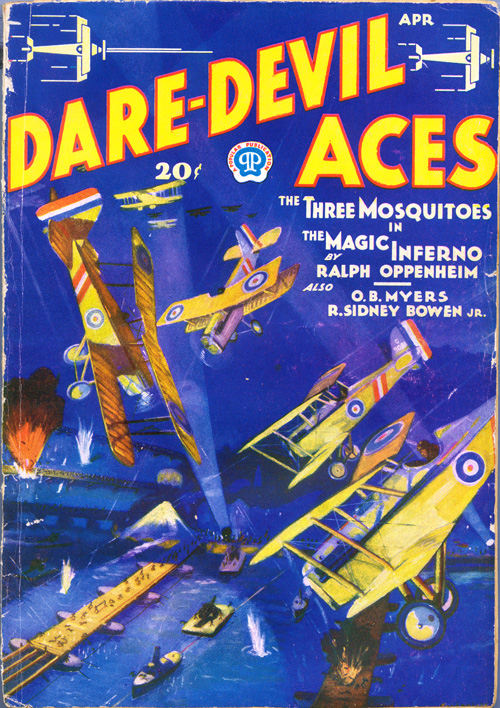
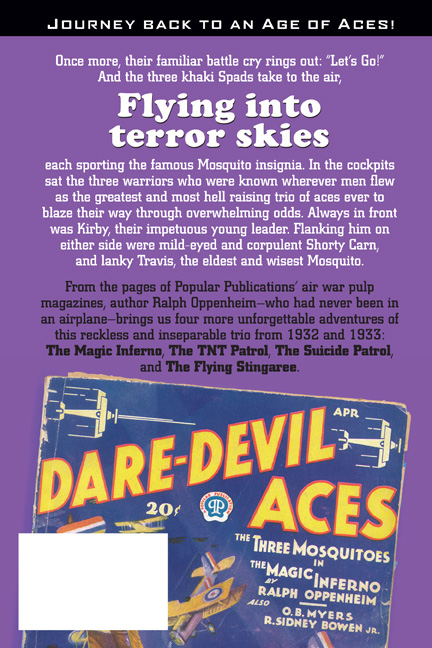
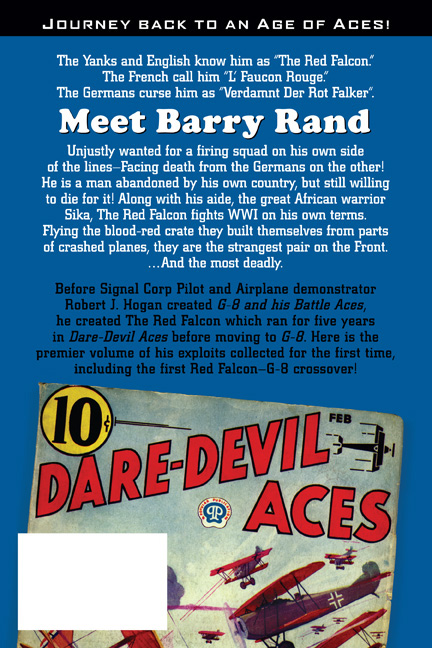
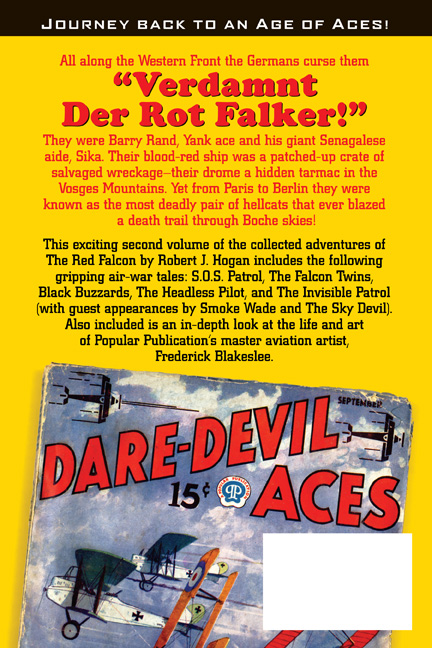
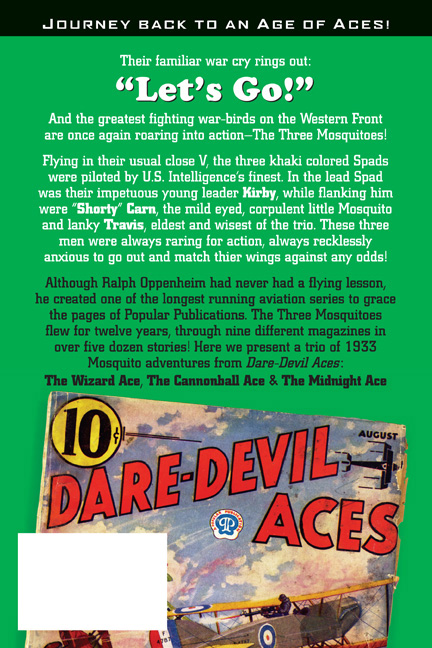
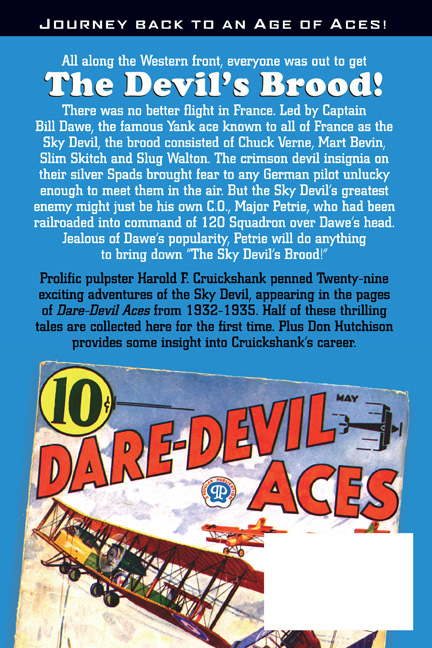
The Dare-Devil Aces Cover Gallery is a work in progress. 3 Mosquitoes 2 back thumbWe’re starting off with a good number of the covers from 1932 through 1933. We are missing a few we plan to fill in in the future. You may recognize the tops of a number of these. The April 1932 cover was used on the back of The Three Mosquitoes: The Magic Inferno. That’s the only cover from 1932 we’ve used so far, but we’ve used a number of the 1933 covers. Featured on the backs of several of our other books are the February cover which was used on the back of The Red Falcon Vol.1 while the September cover was used for Volume 2. Our first collection of The Three Mosquitoes—The Wizard Ace—employed the August cover. The May issue featured on The Sky Devil: Hell’s Skipper!

Check out the Dare-Devil Aces covers here!

“The Suicide Strafe” by Major George Fielding Eliot

Link - Posted by Bill on March 24, 2010 @ 7:45 am in

Those four victories to his credit meant nothing to Bob Sexton—now. At last he had gotten Gerhardt, the invincible German ace—had sent his famous Red-Wing plane crashing down to a fiery doom. Yet that fifth victory—the descendu that made him an ace—was the one he would never be able to claim.

“The Spy in the Ointment” by Robert J. Hogan

Link - Posted by Bill on March 16, 2010 @ 9:53 pm in

When they asked for volunteers to fly that spy mission, Abe answered because he couldn’t sit down. It took another spy to convince him that medals were not always granted for bravery.

“One Blue Flare” by O. B. Myers

Link - Posted by Bill on March 4, 2010 @ 11:02 am in

When the Blue Flare tore through the skies, no pilot ever failed to answer that signal for help. But sometimes someone answers it who shouldn’t. Then a baited trap is the only answer.

“The Frying Suit” by Joe Archibald

Link - Posted by Bill on February 24, 2010 @ 10:14 pm in

Phineas Pinkham had given Major Rufus Garrity two cigars in a week—and they’d both been good! What was behind this sudden bout of good behavior? Something was very wrong at the drome of the Ninth Pursuit.

Robert J. Hogan’s Characters On a Historical Timeline

Link - Posted by Bill on February 18, 2010 @ 7:59 pm in

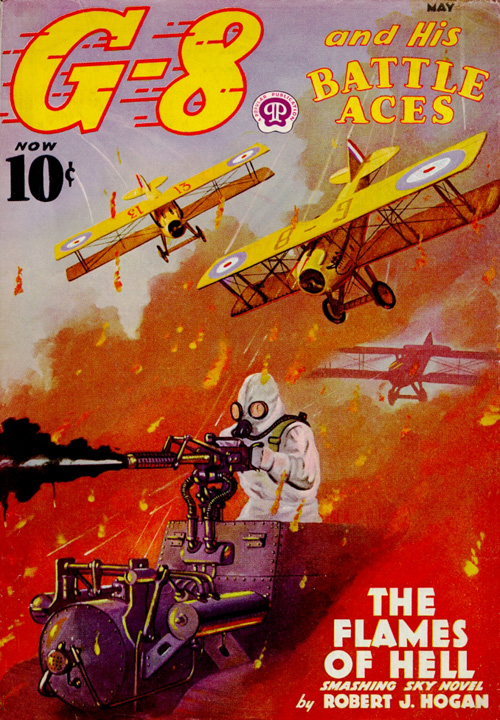
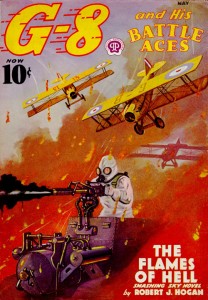
G-8 The Flames of HellRobert J. Hogan was one of the most prolific pulp writers of the 30’s and early 40’s. His best stories were built around World War I aviators. G-8 and his Battle Aces flew and fought for 110 issues in their magazine. Barry Rand as the Red Falcon appeared over 50 times in Dare-Devil Aces and G-8 and His Battle Aces. As fictional characters, they seemed to fight the war forever. But I decided to see how Hogan’s stories stacked up against a historical timeline of the war.

World War I went on for five long years before ending on November 11, 1918. It made a pretty big canvas for pulp writers to paint their word pictures on. But the U.S. didn’t start fighting until June of 1917. Because his characters were American, Hogan had a much smaller window for his stories. Further shrinking of that window is necessary because of references he uses throughout the tales.

One important point in regards to the timing of the G-8 stories is the airplanes being flown. G-8, Bull, and Nippy all fly the SPAD XIII which was built by the French. They were first flown in combat by the French in September 1917, but it wasn’t until March of 1918 that the U.S. Air Service purchased 800 of them for its’ pilots. Because so many Americans had flown for France before the U.S. joined the war, it is possible that some of them would have had SPAD XIII’s before March 1918. The famous flying spy G-8 would almost certainly have had one before the rest of the American pilots. Thus September 1917 is the first possible date for the beginning of the G-8 adventures. There is another important piece of data that points to a later date though.

Hogan often has the Germans flying the incomparable Fokker D VII. It was widely considered the best fighter plane of it’s time. Unfortunately for Hogan, the D VII didn’t enter combat until April 1918. I would consider this as the most probable beginning of the recorded G-8 stories. Historically, we have to squeeze all 110 of them into the period between April and November of 1918. Thus G-8 was facing off about every other day against the worst the Germans could throw at him.
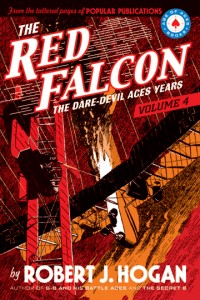
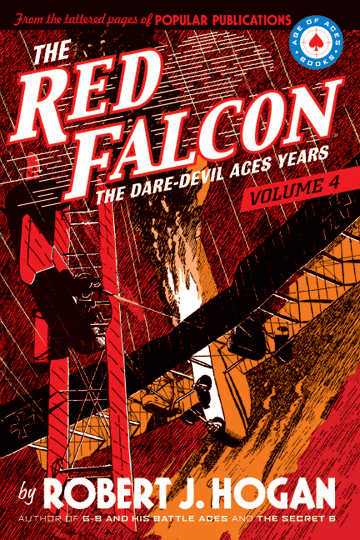
The Red Falcon 4The Red Falcon’s place on the timeline is governed by many of these same factors. He built his famous red fighter using parts from planes that had crashed near his Vosges Mountain hideaway. The fuselage was from a Fokker D VII, the wings were from a SPAD XIII. This would indicate a date no earlier than April 1918. However, Barry Rand also equipped his plane with a Liberty engine.

The American built Liberty made its’ combat debut powering the British DH4 in May 1918, but Hogan states that the Red Falcon’s engine came from a DH9. This plane was not equipped with Liberty engines until August. Furthermore, only one DH9 made it to the front in time for combat duty. Assuming this single plane was shot down over the Vosges, the Red Falcon could not have gotten his engine before August 1918. His 53 recorded adventures took place between August and November of 1918.

Having a historical start for the Red Falcon also provides a bookmark for the G-8 stories. The March 1937 issue of G-8 and His Battle Aces features a brief appearance by Barry Rand. This means that August 1918 is the earliest possible date for this story titled Fangs of the Sky Leopards. It was the 42nd issue which means that the last 68 of G-8’s adventures had to have occurred in the 4 months between August and November 1918, while the first 41 took place in the 4 months from April to July 1918.

I’m sure the pressures of monthly deadlines far outweighed Hogan’s need for historical accuracy. His great knowledge of the machines flown in WWI is one of the factors that made his fiction so appealing, but it would have been interesting to read these stories with a more careful historical placement of the characters.


“The Flying Fortress” by Arch Whitehouse

Link - Posted by Bill on @ 2:48 pm in

A Yank pilot said too much at a Paris estaminet, a British airman said too little on the way to the Front. And a battle that began at twelve thousand feet hurtled to a hangar door. Will this be the end of The Casket Crew?

“Transpacific Plunder” by Frederick C. Painton

Link - Posted by Bill on February 10, 2010 @ 10:14 pm in

Tony Blaine knew it was a bad idea to be in that Manilla bar in the first place—after all his first take-off as chief pilot of the Pacific Cruiser was less than four hours away. And when that girl approached him, deep down in his gut, he knew trouble was also going to be aboard this flight

“Medals for Josephine” by Oscar J. Friend

Link - Posted by Bill on February 3, 2010 @ 9:12 pm in

To the brass hats Josephine was just a bomber in an American squadron cooperating with the R.A.F. in the Burma campaign. But to her crew she was a gallant old girl of the air who had been through many hazardous flying hours with her four boyfriends.

“Hell’s Hangar” by Donald E. Keyhoe

Link - Posted by Bill on January 20, 2010 @ 9:26 pm in

Save for some strange, organ-like trills that had sounded from his radio,  Dick Knight’s flight had been uneventful. But Knight did not know that those weird tones he had heard were the ominous notes of an overture to a drama of death. Nor did he know that just five minutes before, a gaunt Prussian, with feverish eyes on a black clock, had whispered: “Five more minutes! Only five more minutes to wait after all these years!”

“The New Zeppelin” by C.B. Mayshark

Link - Posted by Bill on January 13, 2010 @ 9:45 pm in

On May 6, 1937, the airship Hindenburg caught fire and was destroyed while attempting to dock with its mooring mast at the Lakehurst Naval Air Station. But one year earlier the Hindenburg was preparing to make its first voyage to North America, and “Flying Aces” was heralding its arrival with an article and cover painting in the June 1936 issue by C. B. Mayshark (which would have been on the stands in May).

“The Flying Saucers Are Real” by Donald E. Keyhoe

Link - Posted by Bill on January 7, 2010 @ 7:41 pm in

One of our favorite writers here at Age of Aces is Donald E. Keyhoe, but he is as well known for his UFO research as he is for the air war stories he wrote for the pulps. Here is one of his earliest books on the subject, published in 1950.

Keyhoe is a graduate of the U.S. Naval Academy at Annapolis. He flew in active service with the Marine Corps, managed the tour of the historic plane in which Bennett and Byrd made their North Pole flight, was aide to Charles Lindbergh after the famous Paris flight, and was chief of information for the Aeronautics Branch, Department of Commerce.

wallace_smallThe Harry Ransom Center at The University of Texas at Austin has a collection of The Mike Wallace Interview shows on line including the one he conducted with Major Donald E. Keyhoe in 1958.

The Mike Wallace Interview:
Maj. Donald E. Keyhoe

(March 8, 1958)

« Previous PageNext Page »