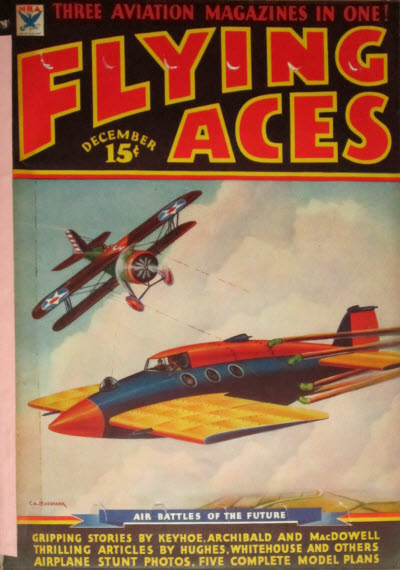
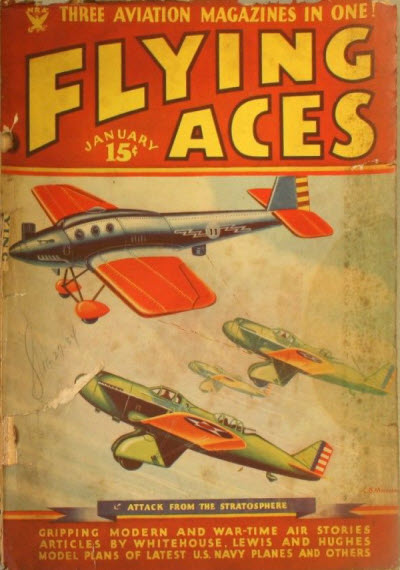
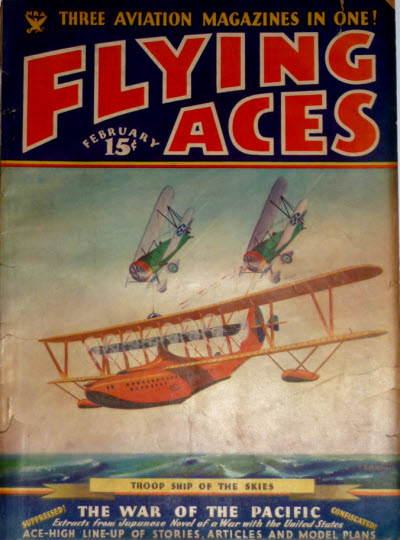
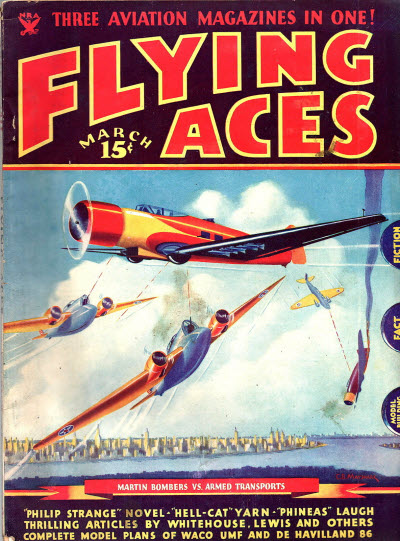
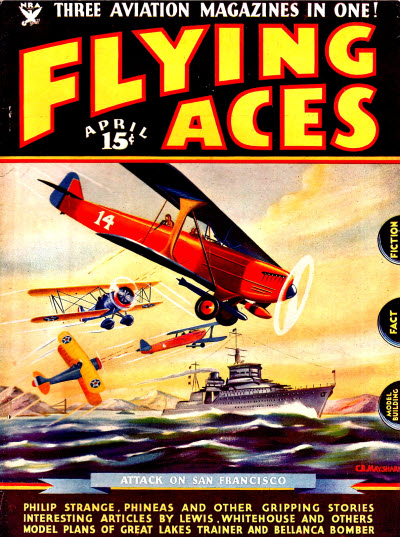
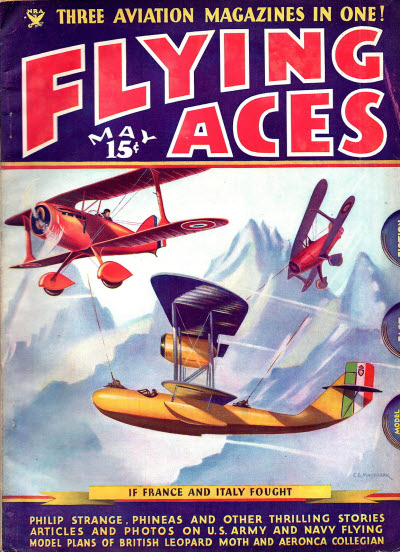
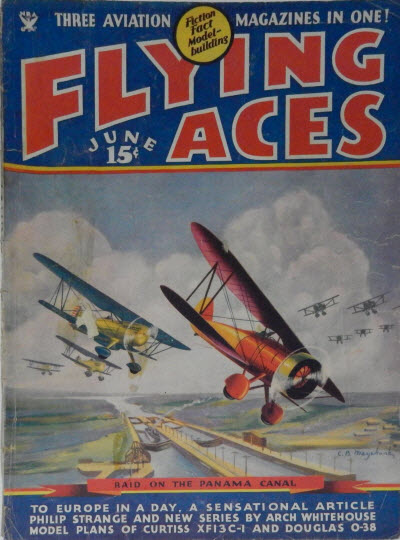
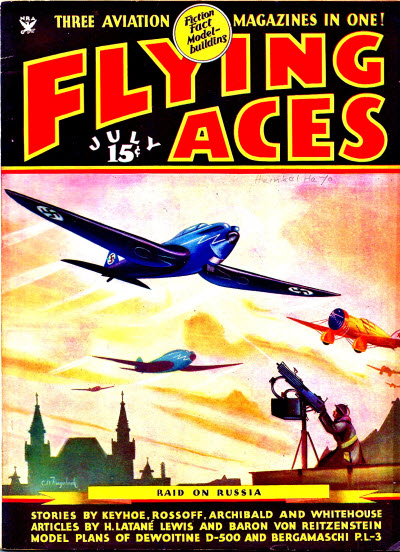
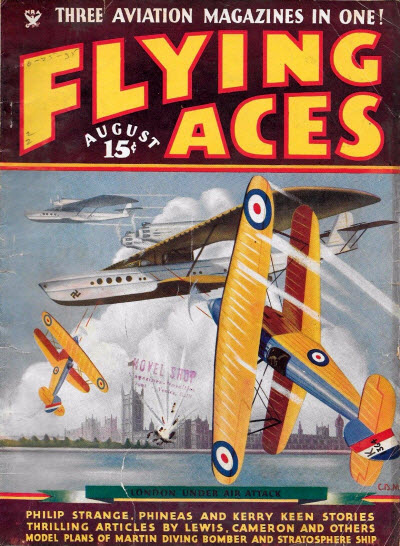
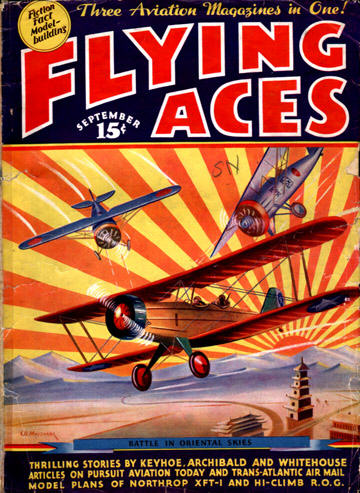
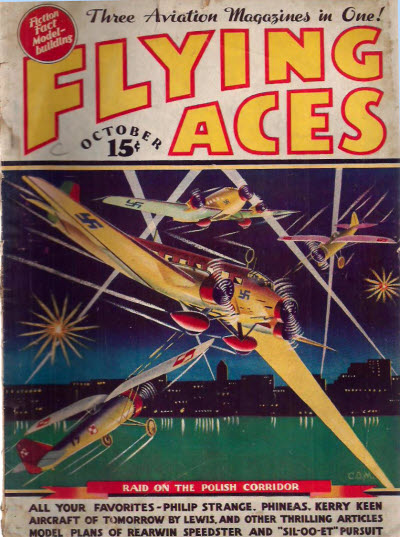
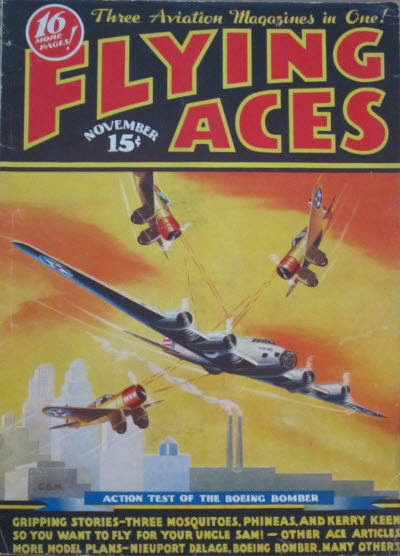
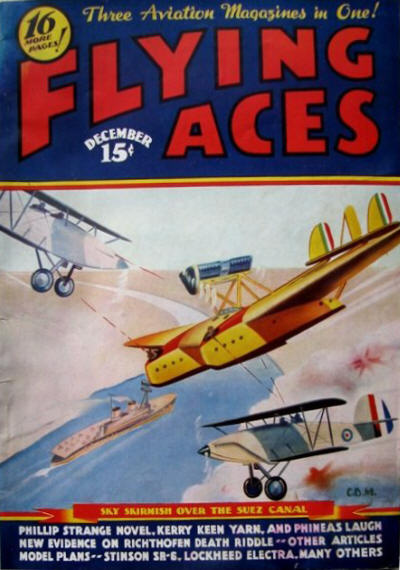
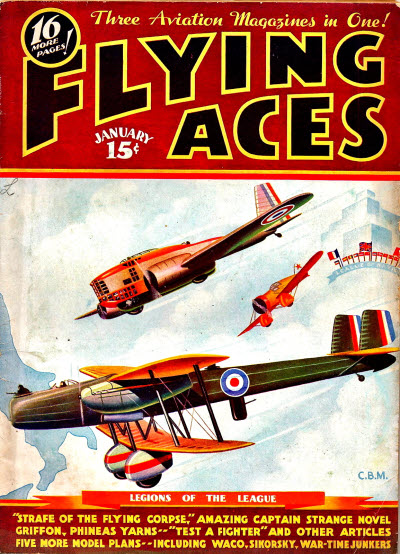
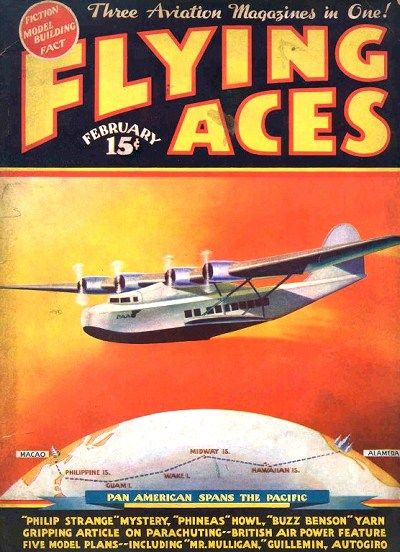
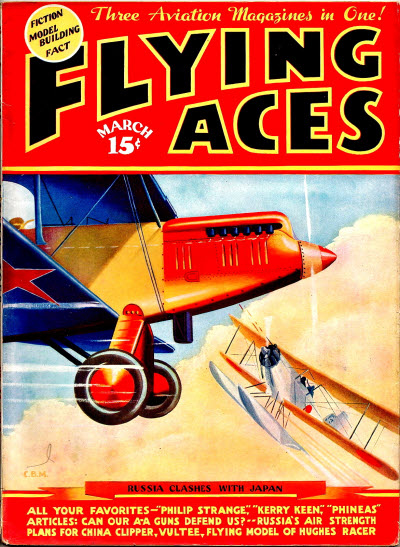
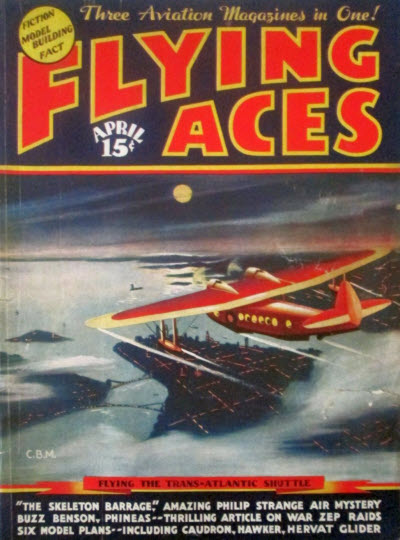
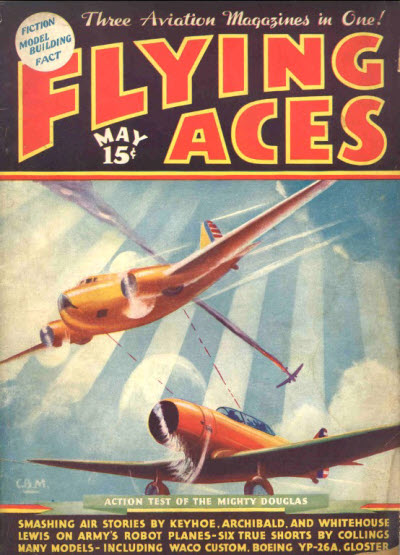
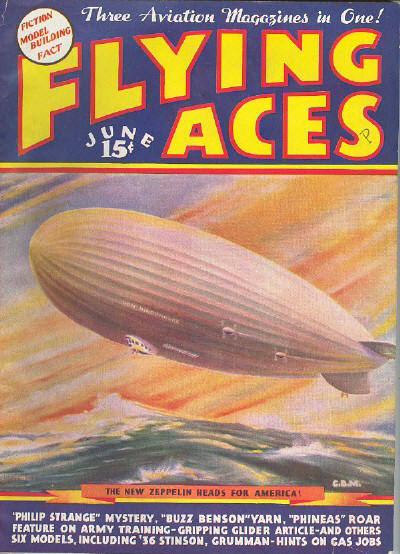
THIS May we’re celebrating the genius that is C.B. Mayshark! On Mondays we’ll be exploring his combat maneuver covers he did for Sky Birds in 1934; Wednesdays bring his “How The Aces Went West” feature from 1935 issues of Sky Birds; and Fridays bring his covers from Flying Aces (1934-1936) and a story attributed to him from Dare-Devil Aces!
We featured his first Sky Birds cover yesterday to get the month rolling a day early. Today we have a bio of the man from Age of Aces’ resident art historian, David Saunders. Saunders’ Field Guide to Wild American Pulp Artists is an excellent site profiling any pulp artist and illustrator you can think of. Here is his entry for C.B. Mayshark:

CASIMIR B. MAYSHARK
(1912-1978)
CASIMIR BENTON “DUKE” MAYSHARK was born Casimir Mieczyslaus Mayshark, Jr., on January 3, 1912 in Sacramento, California. His father, Casimir Mieczyslaus Mayshark, was born in 1881 in Poland and came to the U.S. in 1893 and settled in San Francisco, California.
The family name Mayshark is an English transliteration of the Polish name in the Cyrillic alphabet, so U.S. immigration officials had to assign approximate phonetic equivalents. Other members of the same family who came to the U.S. were assigned various names of similar sounds, such as “Maycherczyk,” “Marzajek,” “Majchrzak,” and “Mazureck.”
The father was a commercial artist in the advertising industry of San Francisco. It was the father’s second marriage, the first one having ended unhappily, after he deserted his wife and two sons in Missouri.
The mother, Oreon Gracie Page, was born in 1875 in Mississippi, so she was six years older than her husband. She was also and artist. She designed and decorated Art Nouveau china. It was also her second marriage, the first one having ended after one year, when her husband, Percy Frank Wilson (1878-1906), the city editor of the Memphis News Scimitar, died of typhoid fever on January 15, 1906. After his death she lived with her parents in El Paso, Texas, where she operated a private art school.
In 1908 she advertised her classes in the local newspaper. By 1910 she had moved to Los Angeles, California, where she met and married Casimir Mieczyslaus Mayshark on May 7, 1910. They had two children, Casimir Mieczyslaus Mayshark, Jr., (b.1912), and his younger brother, James Page Mayshark, born June 5, 1913. The family lived at 278 29th Avenue in San Francisco.
On May 25, 1913 The San Francisco Call reported in the Art Notes column by Porter Garnett, “Casimir M. Mayshark has recently shown a landscape at the Bohemian Club. This is the first easel picture that Mr. Mayshark, who has specialized in scenic decoration in European and Eastern theaters, has exhibited here. It arrests the attention immediately by its personal quality, its quietness and its altogether delightful color.”
In 1913 the San Francisco Sketch Club organized a poster contest to commemorate the city’s patron saint, Saint Francis. On November 1, 1913 The San Francisco Call published the results of the contest. Casimir M. Mayshark was listed as an entrant but failed to win the $500 prize, which went to the NYC artist Adolph Treidler (1886-1981).
In 1914 Casimir M. Mayshark, with his wife and two sons, moved to El Paso, Texas, where they lived with the mother’s family and the father worked as a manager of the Tuttle System outdoor advertising agency.
In 1915 Casimir M. Mayshark, with his wife and two sons, moved to the East Coast to pursue his career as a Commercial artist in New York City. The family lived at 24 Van Dyke Place in Summit, New Jersey. The father commuted by ferry boat to NYC, where he worked as a freelance commercial artist.
On September 12, 1918 during the Great War Casimir M. Mayshark registered with the draft board. He listed his occupation as Poster Designer. He was recorded to be of medium height, slender build, with blue eyes and brown hair. He was thirty-six, married and supporting two young sons, so he was not selected for military service.
In 1919 the father deserted the family and was never heard from again. Casimir, Jr., was age seven and James was age six. After the marriage was legally dissolved, Casimir Mieczyslaus Mayshark, Jr., was renamed Casimir Benton Mayshark.
The mother and two sons moved to Chatham, New Jersey, where they lived at 222 Hillside Avenue. She supported the family as a commercial artist designing decorative wall paper for a manufacturer.
The father had moved to Atlantic City, NJ, where he worked as a sign painter.
On September 15, 1920 Casimir M. Mayshark addressed the 11th Annual Convention of the Outdoor Advertising Association, held in Cleveland, Ohio. His lecture topic was “Color in Outdoor Advertising.”
In 1925 Casimir M. Mayshark married his third wife, Jesse Whitney. She was born in 1889 in New Hampshire. They lived with her brother’s family at 54 Turner Street in Boston, Massachusetts, where he worked as an Interior Decorator. They had two children, Cyrus, born August 3, 1926, who grew up to become an author, and Mary, born May 5, 1928, who grew up to become Mrs. Mary Mayshark Perkins.
In 1929 the father, Casimir M. Mayshark, lived with his third wife and two children at 54 Conant Street in Roxbury, MA, but the following year he again deserted his third wife and two children, after which that marriage was legally dissolved.
In June of 1930 Casimir Benton “Duke” Mayshark graduated from Chatham High School. He had always liked to draw, but by high school he had become interested in a career as a commercial artist.
In 1931 he attended the University of Alabama, where he completed his freshman year. The Great Depression brought hard times to most American families, which made college difficult to afford. By 1932 his younger brother, James Mayshark, had graduated high school with a promising record in football and a dream to play in college, so Casimir Benton “Duke” Mayshark entered the work force instead of returning to Alabama after his freshman year. His brother became a star player with the Mountain Hawks of Lehigh University in Bethlehem, PA.
In 1932 C. B. Mayshark began to work as a commercial artist in NYC publishing and advertising. He attended night school art classes at the Art Students League at 215 West 57th Street, where his best teacher was Morris Kantor (1896-1974).
In 1934 C. B. Mayshark painted covers for the pulp magazines Sky Birds and Flying Aces. He also drew pen-and-ink interior story illustrations for these two titles. In addition, he wrote several descriptive articles about his cover paintings, which were featured inside the magazines. He signed his work for pulp magazines “C. B. Mayshark” and “C.B.M.”
The 1940 NYC Business Directory listed the art studio of C. B. Mayshark at 15 West 51st Street, between Fifth and Sixth Avenues.
In 1941 he was hired as a staff artist at the James M. Mathes Advertising Company in the prestigious Chanin Building, at 122 East 42nd Street, where Street & Smith, Ideal Publishing, and Decker Publications also had offices. While working at the advertising company he met Helen Lucille Dunaway. She was born December 30, 1919 in Yonkers, New York, and was a graduate of Smith College. She worked as a clerical secretary at J. M. Mathes.
By 1941 his estranged father, Casimir M. Mayshark, had moved to San Diego, California, where he worked as a draftsman for the Simpson Construction Company at the San Diego Naval Training Station. He lived in a lodging house at 432 F Street.
In 1943 Casimir Benton Mayshark was drafted. Before entering service he married Helen Lucille Dunaway. They eventually had three children, Joseph (b.1944), Cassandra (b.1946), and Sanford (b.1951). The family lived in Forest Hills, Queens, NY.
During WWII C. B. Mayshark served as a Second Lieutenant in the Army Air Corps, 17th Bomber Wing, Second Air Corps, Radio Division. He was stationed at an air base in Idaho, where he painted a mural in Building 23 of the air base. He was not sent overseas.
His younger brother, James P. Mayshark, served as a Captain in the Army Tank Corps and was wounded in North Africa.
On 1943 nationwide newspapers covered the poignant story of his mother, Mrs. Oreon Page Mayshark, and her remarkable experience as she sat in a Times Square movie theater and watched a wartime newsreel with dramatic battle scenes, and suddenly recognized her son as he was wounded in combat.
After the war, C. B. “Duke” Mayshark started Mayshark & Keyes Advertising Art Company with a partner, Bill Keyes. The company grew successful during the post-war years.
His brother, James P. Mayshark, became a salesman of Pneumatic tools and moved to Buffalo, NY.
In 1950 C. B. Mayshark sold his share in the business to his partner and retired to Santa Fe, New Mexico, where he designed and build the family home.
In 1952 he was appointed Director of the New Mexico State Tourist Bureau, of the State Department of Development, under Governor Ed Mechem.
In 1954 that political appointment ended, after which C. B. Mayshark started Mayshark Lithographing Company, which printed jobs for the public, but also won contracts to print posters for the New Mexico State Tourism Bureau.
In 1962 Casimir B. Mayshark’s mother, Oreon Gracie Page Mayshark, died at the age of eighty-seven in Santa Fe, where she had lived with the family.
In 1962 C. B. Mayshark closed the printing company when he was appointed Administrative Assistant for New Mexico Governor Jack Campbell.
In 1964 C. B. Mayshark became Executive Secretary to the Governor of New Mexico, in charge of Promotion of Business and Tourism with national advertising campaigns, New Mexico Magazine, and the organization of the New Mexico State Exhibition at the 1964 World’s Fair in NYC.
The father, Casimir Mieczyslaus Mayshark, returned to San Fransisco, where he lived at 715 Clementina Street, and continued to work as a Commercial Artist, until he died at the age of eighty-four on November 5, 1965.
In 1966 C. B. Mayshark was the Director of the New Mexico Department of Development.
In 1968 C. B. Mayshark retired from New Mexico State politics and concentrated on making art. His work was exhibited at the University of New Mexico, St. John’s College in Santa Fe, and the University of Hawaii.
C. B. “Duke” Mayshark (age sixty-six) and his wife, Helen Lucille Mayshark (age fifty-eight), were fatally injured in an automobile accident in Albuquerque, NM, on September 28, 1978.
David Saunders included many photos and illustrations in his entry for C.B. Mayshark on his site. Please check them out and come back frequently this month for more from C.B. Mayshark!
© 2015 David Saunders. David Saunders is the son of pulp artist Norman Saunders and an artist himself. The above article is from David’s website A Field Guide to Wild American Pulp Artists and is used with his kind permission.






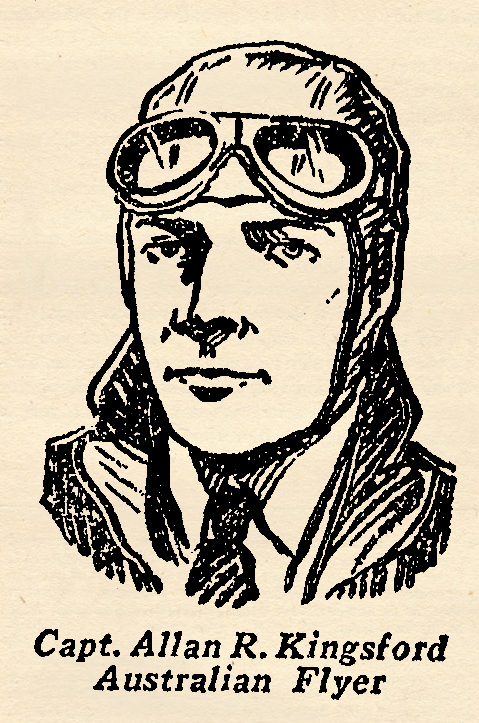 simple private in the Australian Army. The troop ship carrying his contingent was torpedoed by a German submarine and he was cast adrift in a heaving sea at midnight with only a frail spar to buoy him up. He served for over a year as a Lance Corporal of Infantry in Mesopotamia, he determined upon obtaining a transfer to the Hying corps, and after many setbacks he finally was ordered for flight training and sent to England, He became pilot of the Zeppelin night patrol guarding London, later joining that strange organization, the British Independent Air Force, as a bombing pilot attached to 100 Squadron. As a member of that group which served under no army, but roved about from point to point, he took part in 270 night bombing raids and became known as the Ace of night bombers. This account of his most thrilling flight is taken from his private memoirs.
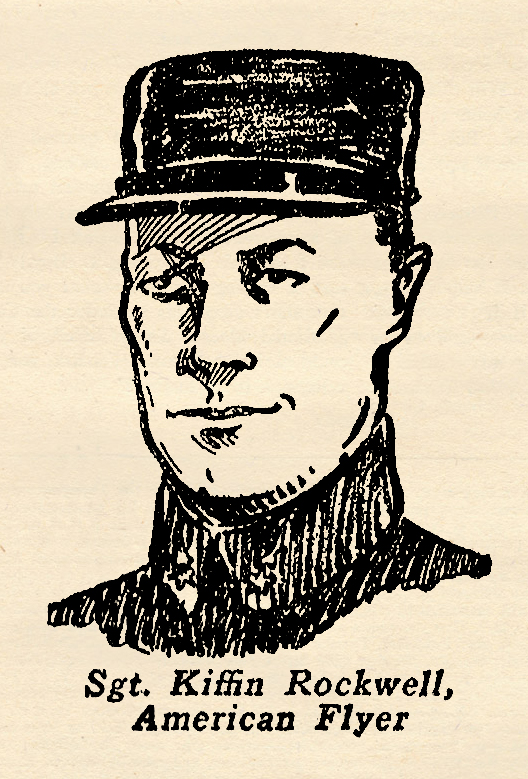 of fortune. Born and raised In Aaheville, N. Carolina, young Rockwell got the wanderlust soon after graduating from the University of Virginia. When the Germans made their surprise move on the forts of Liege, Rockwell was serving in the ranks of the Foreign Legion. For a heroic exploit in hand to hand bayonet fighting, he was awarded the Medaille Militaire. For a whole year he served with the Foreign Legion in the trenches, then transferred to the aviation and went into training at Avord. When Norman Prince formed the first American Flying Squadron in Paris, Rockwell was one of those invited to join. He proved out to be one of the best and most daring pilots of that original band. His career was cut short by his untimely death on September 23rd, 1916.
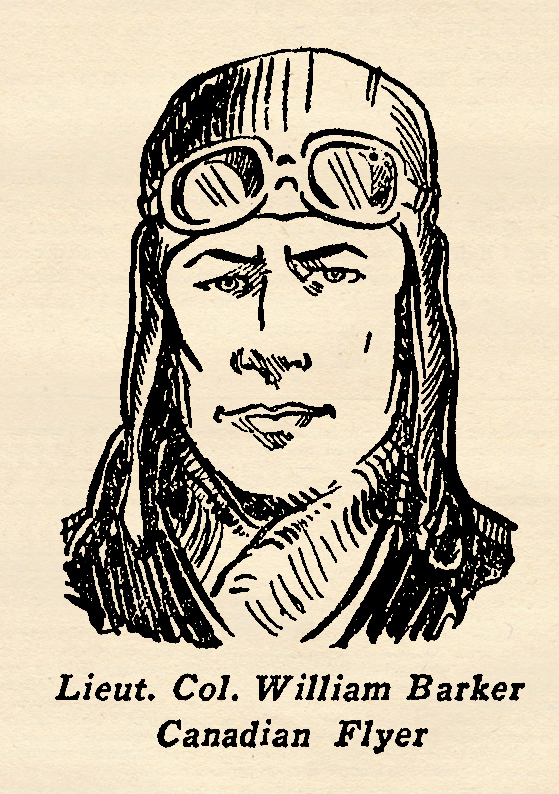 of William Barker’s career on two flying fronts reads more like fiction than fact. Born in the prairie province of Manitoba in 1894, he enlisted as a Private in the Canadian Army at the age of 19. He served in the cavalry before transferring to the flying corps. Barker began as a simple private. But he skyrocketed swiftly through all the grades to that of Lieut. Colonel. His training for a pilot was limited to two flights with an instructor. After that he was turned loose to begin piling up an amazing record. On October 27, 1918, he crowned this amazing record with the most astounding aerial feat of the whole war . . . fighting and escaping from a surrounding net of 6O enemy planes at the dizzy altitude of 20,000 feet.
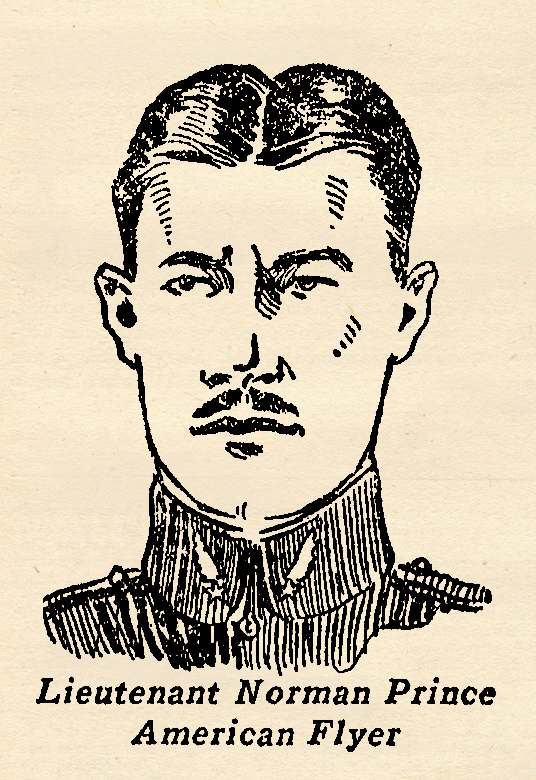 August 31, 1887, scion of one of the blue-blooded families In old Boston, was Norman Pslnce, the founder of the famous LaFayette Escadrille. Educated at Groton and Harvard for a career in business with his wealthy family, he hazarded his promising future and used his wealth and family prestige in overcoming obstacle’s to form a squadron of American aviators for battle at the front. With him in the beginning were Thaw, Chapman, Rockwell, McConnell, Hall and Cowdin. These Americans with Prince made up the roster of the original squadron sent up to the front at Luxeuil in May, 1910.
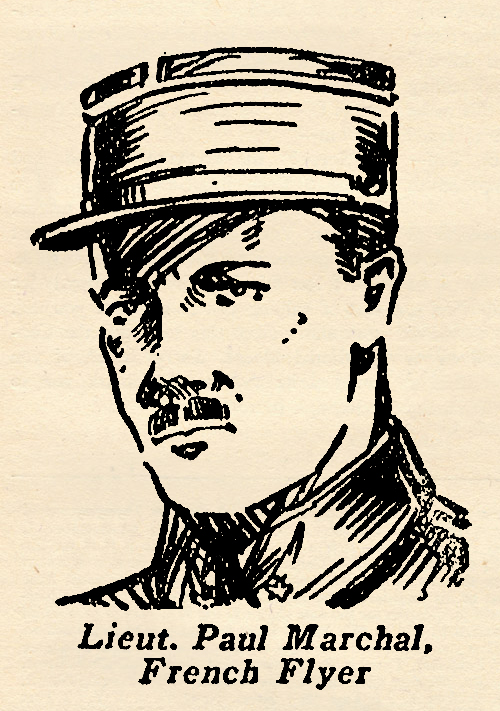 colors on the first day war was declared, and it was he that answered the challenge of that bold German, lieutenant Max Immelmann, when the latter bombed Paris with leaflets calling for surrender. Immelmann had to fly a matter of but a hundred kilometers, or less, to get over the city of Paris. But when Marchal answered his challenge with an identical flight to Berlin, he had to fly 8QO kilometers.
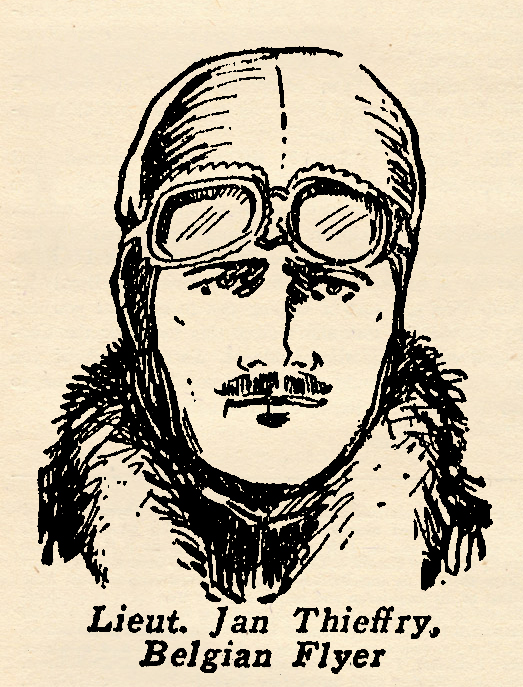 a part in the war of the air as she did in the war on the ground, when her brave soldiers held up the advance of the German hordes at the gates of Liege until the British and French armies could mobilize and get to the front to begin their counter-offensive. Corporal Jan Thieffry was a motorcycle despatch rider at that time. He was taken prisoner by a flying squadron of German Uhlans, but after some months made his escape.
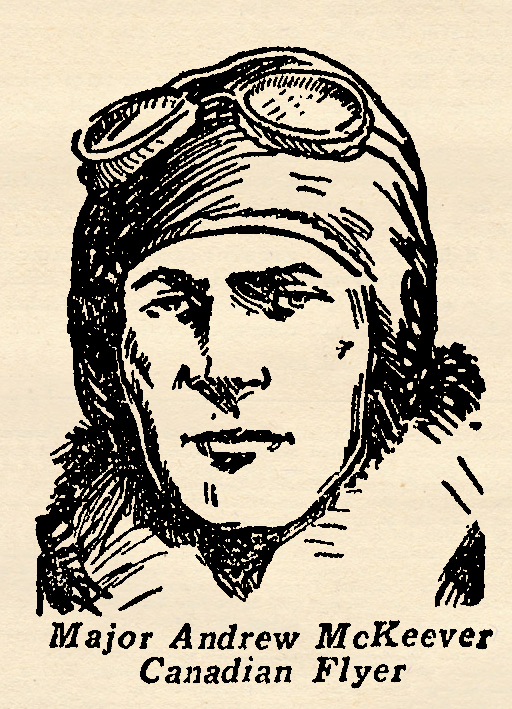 was one of the many daring young sky fighters that came from Canada to add fame and lustre to the deeds and exploits of the Royal Air Force, He put in almost a full year in the infantry before he was transferred for flying training. He joined the R.F.C. in December, 1916, was commissioned a lieutenant and sent over to the 11th Observation Squadron in France on May 16th, 1917.
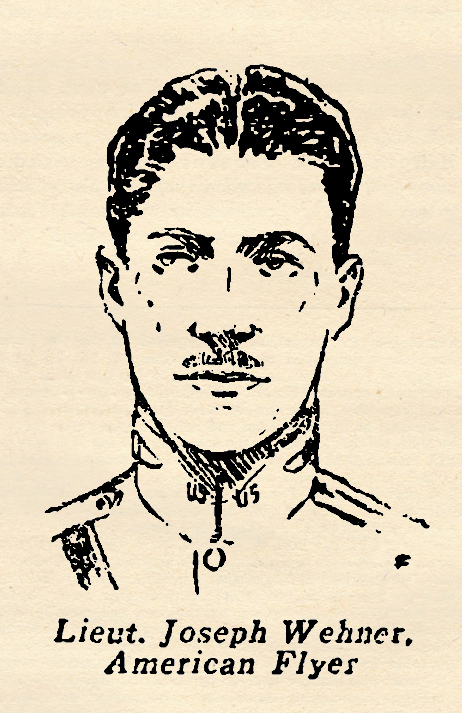 was the most daring sky fighter in the American Air Service. But it is hard to say whether he would have established the record he did without the aid of Joe Wehner, his constant and steadfast companion and buddy in the 27th Squadron. He was Luke’s alter ego.
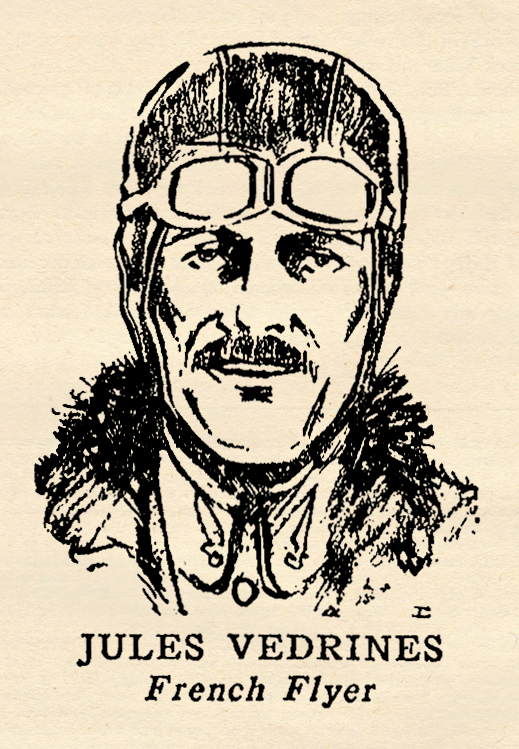 great war broke out Jules Vcdrines was the most famous flyer of France. He had twice won the Gordon Bennett speed trophy, and held both distance and altitude records. It was through his efforts that France wrested supremacy of the air from the United States and Great Britain. Along with Garros, Pegoud, Marechal, Le Blanc, Audemars, and other famous French flyers of his day, he enlisted in the French Flying Corps the day after war was declared.
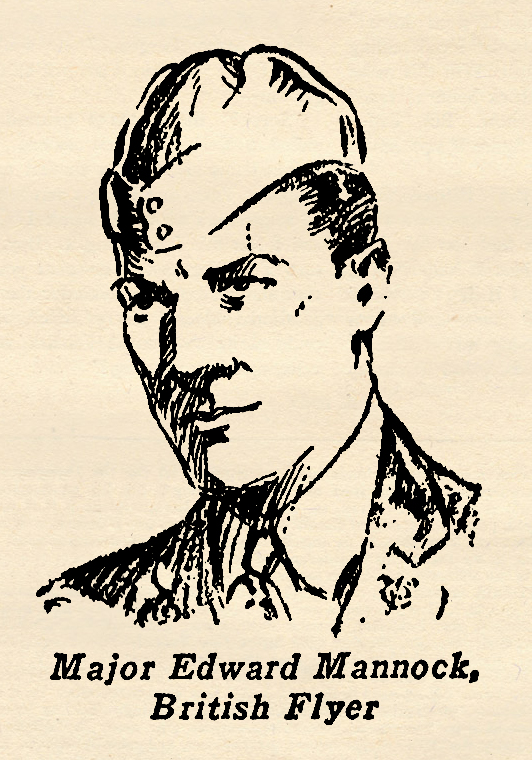 the British postal department, Turkey, when the war broke out. He was immediately made a prisoner by the Turks, and spent almost a year in an enemy camp before he was repatriated to England in 1915. He first served in the Royal Engineers, was commissioned as a lieutenant and transferred to the flying Corps in August, 1916. Major McCudden, the great British Ace, was his first instructor.
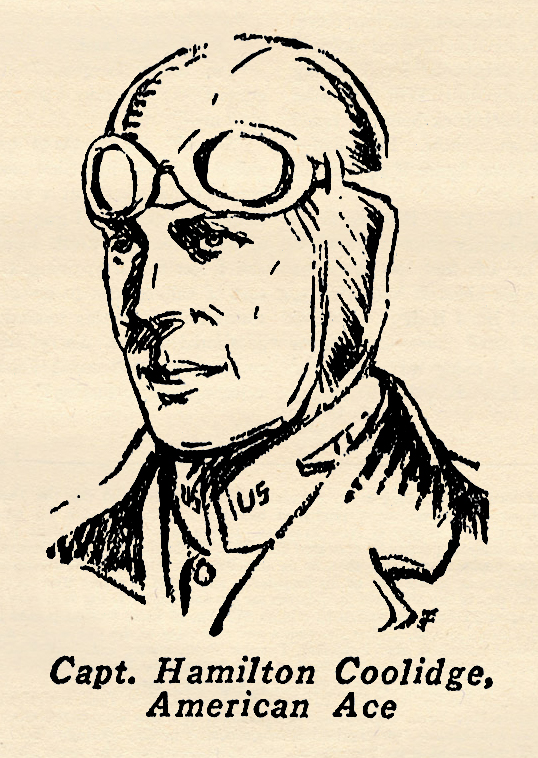 Hamilton Coolidge was well known throughout the land even before the war began. He enlisted in the aviation section of the Signal Corps and got his primary flight training at Mineola along with Quentln Roosevelt, his hoy-hood friend.
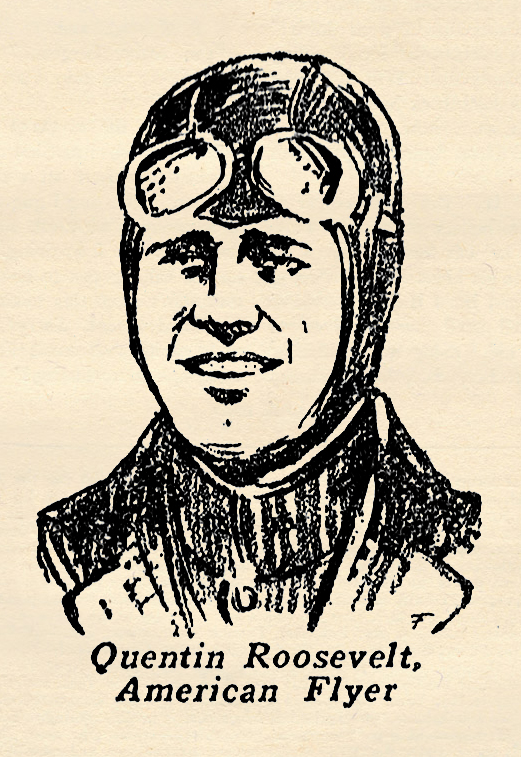 at Oyster Bay, N.Y., the fourth and last son of a famous fighting family, November 19th, 1897, six weeks after his illustrious father, Theodore Roosevelt, had left to fight for the freedom of Cuba. Although handicapped by a permanently injured back, he succeeded by dint of cunning and painful effort in fooling the medical examiners and being accepted for training as an aviator.
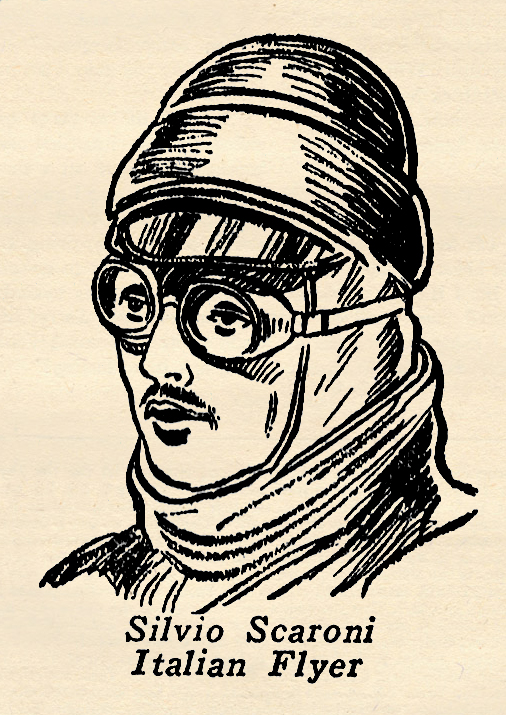 born at Brescia, Italy, and entered the aviation corps at the beginning of the war. As a bomber he was recognized as one of the best in the Italian Flying Corps and he was very adopt in handling big three-engined Capronis. But the big ships were too slow to satisfy Lieutenant Scaroni. He wanted to fly single Heaters and eventually managed to secure his transfer to a combat squadron on the morning of November 14, 1917.