“Shower Kraut” by Joe Archibald
“HAW-W-W-W-W!” 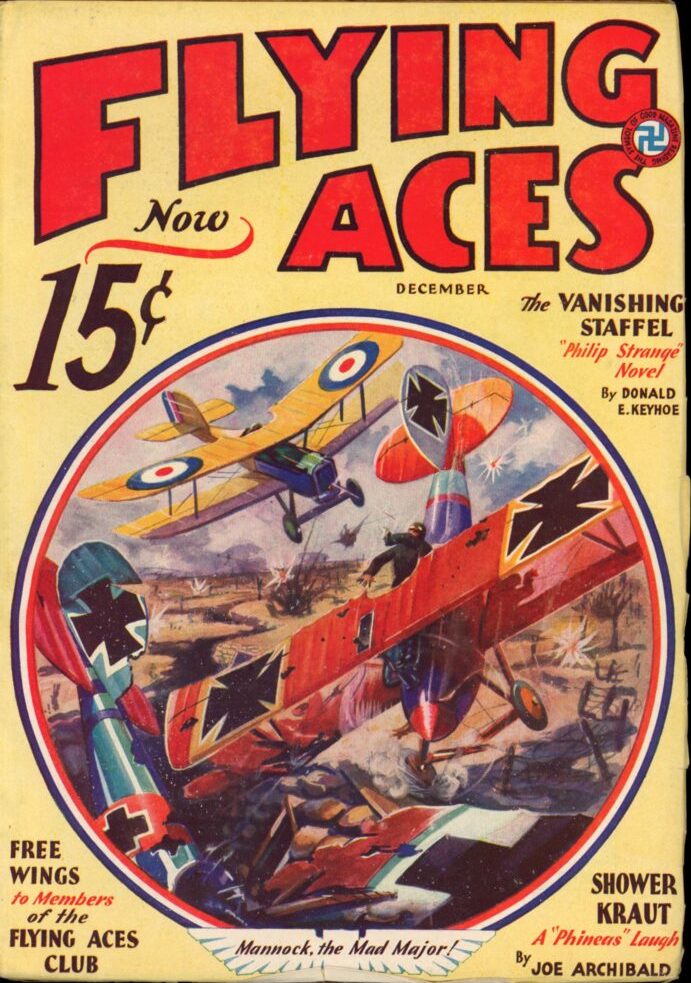 That sound can only mean one thing—that Bachelor of Artifice, Knight of Calamity and an alumnus of Doctor Merlin’s Camelot College for Conjurors is back to vex not only the Germans, but the Americans—the Ninth Pursuit Squadron in particular—as well. Yes it’s the marvel from Boonetown, Iowa himself—Lieutenant Phineas Pinkham!
They’d threatened Phineas Pinkham with Blois before—and he’d lived to laugh at them. But this time the future of the ace of Boonetown, Iowa, was in the hands of a Brigadier who didn’t exactly like being pushed in the face!
“The Death Turn” by E.W. Chess
THIS week we have story of 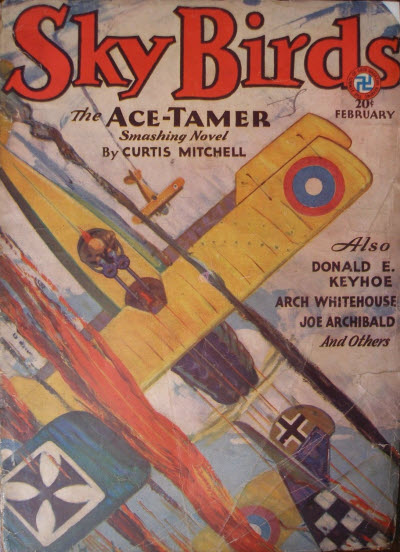 air intrigue by E.W. Chess. Elliot W. Chess was a prominent author in the pulps—his name frequently appearing on the covers to entice readers. His pulp career spanned from 1929 to 1940, but a majority of his output was in the early thirties. Equally adept at both westerns having grown up in El Paso, Texas and air war stories having served in the Royal Flying Corp in the First World War and the 7th Squadron of the Polish Air Force afterward when Russians tried to invade the country.
Fourteen years before, when men fought each other and skies were red with their blood. Allied pilots over a hundred-mile sector of the Front had known von Kruger’s Death Turn—and feared it. Now no one remembered that dread maneuver—until one day a stranger with a deep scar across his face walked up to a little Texas flying field—and gave it a new meaning.
From the pages of he February 1932 number of Sky Birds, it’s “The Death Turn” by E.W. Chess!
“Message in the Ashes” by O.B. Myers
THIS week we have another early story 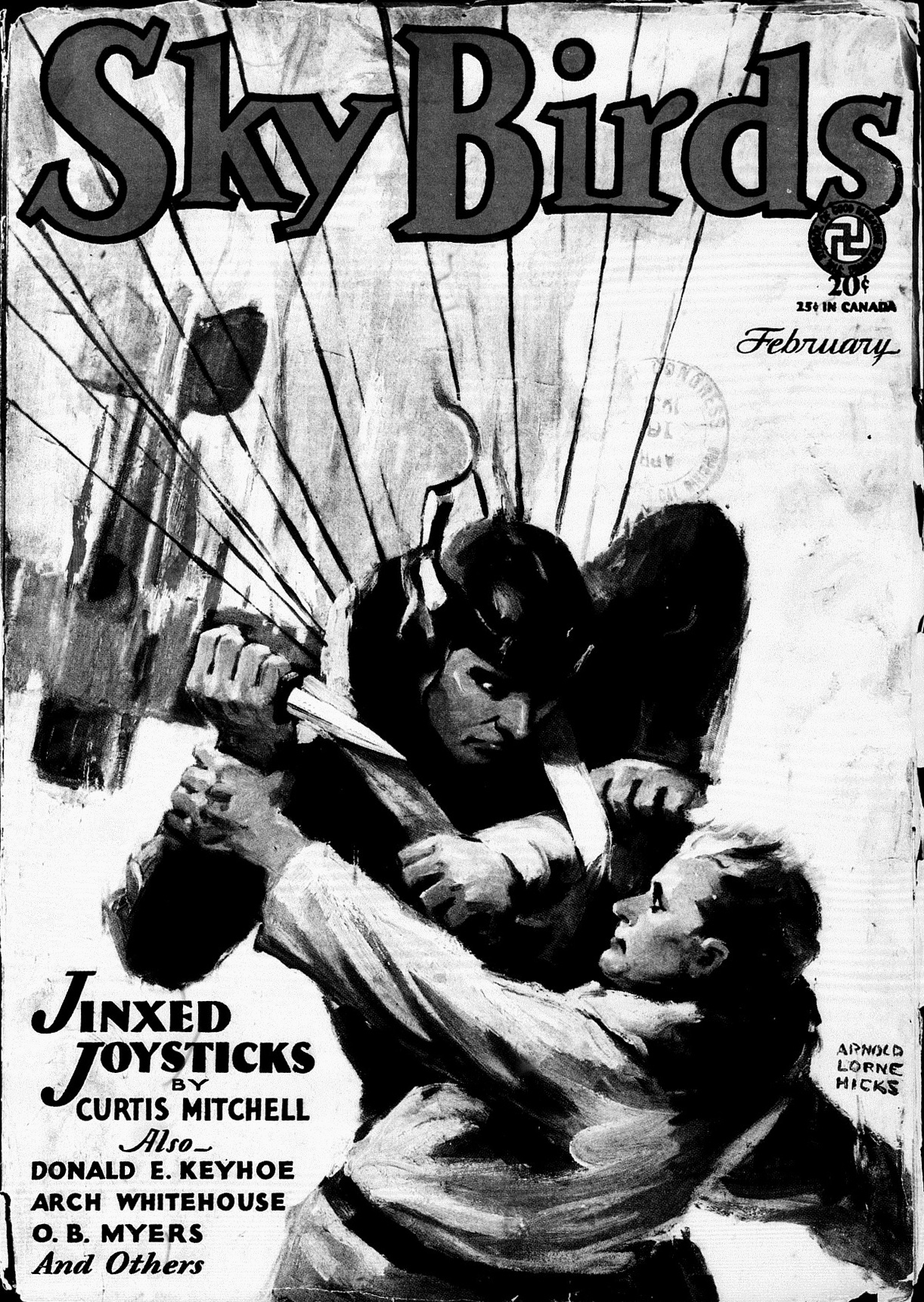 by the prolific O.B. Myers! Myers was a pilot himself, flying with the 147th Aero Squadron and carrying two credited victories and awarded the Distinguished Service Cross.
“Only one explanation I can see, Reed,” said the Skipper. “Burwell must have escaped, stolen a Halberstadt, and flown over. He was trying to land here when his tank was hit from the ground.”
“We—we killed him ourselves!” gasped Rip. Joe was dead. Rip tried to grasp the fact, but could not. He saw before him the laughing blue eyes, the ruddy countenance, the square shoulders of his nearest and dearest friend. He felt again the throb of relief in his throat as he had seen that tiny figure jump from a wreck, far below, and move across the greenness of the meadow. Joe Burwell dead, like this? But no, it could not be. It was too ghastly. His mind refused to believe—and yet, the evidence. . . . Rip needed to find out what events had led from Joe crashing in a field in Germany to flying that Halberstadt to it’s fiery conclusion!
Not one of those American pilots dared approach that seething cauldron of flames—not one could read its strange secret. But when only gray dust remained of what had been a German plane, they saw—and read the—MESSAGE IN THE ASHES!