



“Sky Fighters, February 1936″ by Eugene M. Frandzen
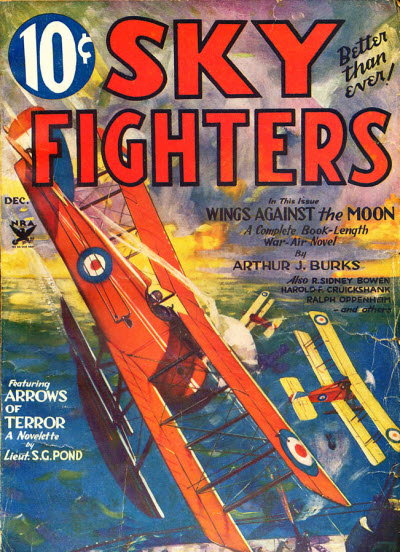
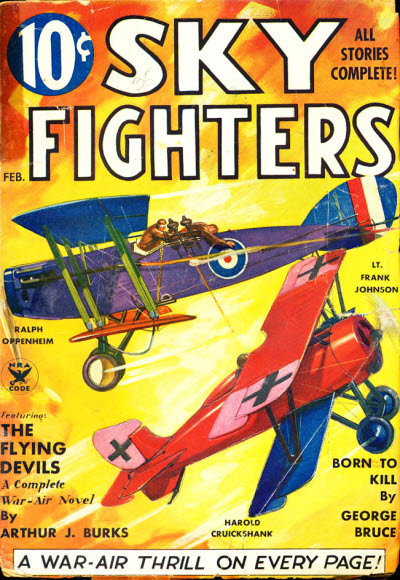
Eugene M. Frandzen painted the covers of Sky Fighters from its first issue in 1932 until he moved on from the pulps in 1939. At this point in the run, the covers were about the planes featured on the cover more than the story depicted. Mr. Frandzen features a battle between a De Haviland Pusher and a German D.F.W. C4 on the February 1936 cover!
The Ships on the Cover
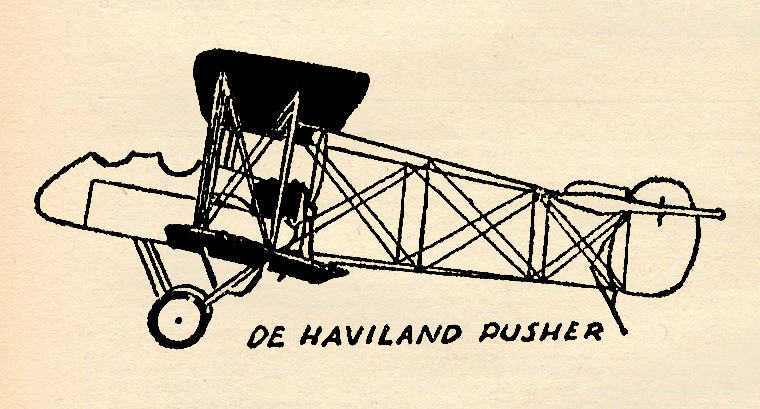
THE De Haviland planes will always 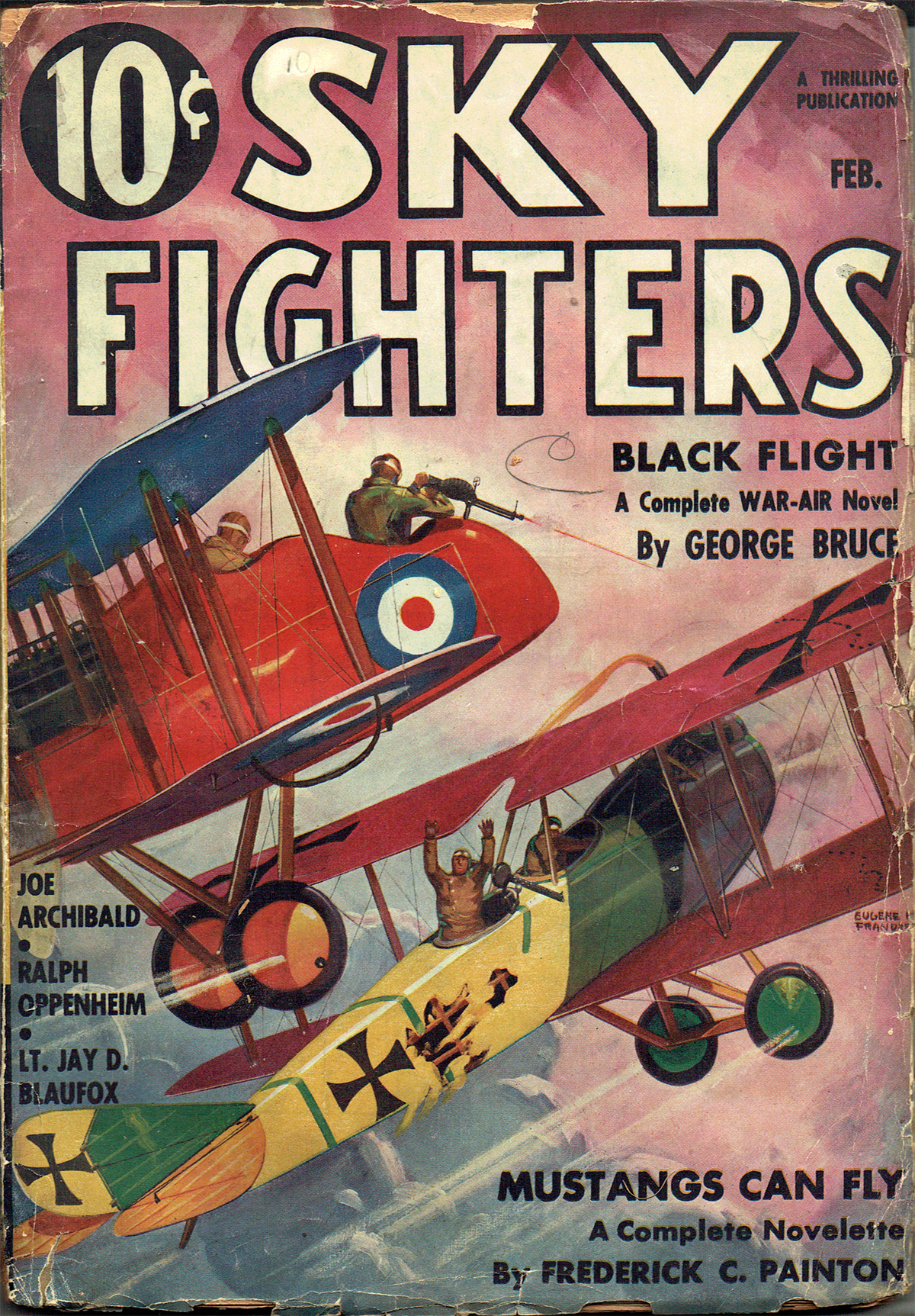 be remembered in the United States by the number of D.H.s this country ordered on such a grand scale when we entered the war. The early D.H.s are not given the credit they deserve because Capt. Geoffrey De Haviland might never have had a chance to build later models if his early one had not been so good. It combatted the Fokker menace back in 1916 when the Germans had things their own way in the air. When these D.H. Pusher biplanes came along the Allied airmen began to take heart. At last they had a machine that could outfly the Fokker which was the scourge of the Front. The D.H. Pusher was similar to the earlier F.E.s but much superior in speed. They had only two bays of struts and were simplified considerably in the tail boom construction.
The British airmen in the bucket seat of the D.H. Pusher on the cover had confidence in their machine when it proudly paraded its course through the skies. They had a speedy ship with a front gun to blaze the Germans from the air when those hitherto superior, overconfident airmen darted across Allied territory for a looksee at all the preparations being made on the ground.
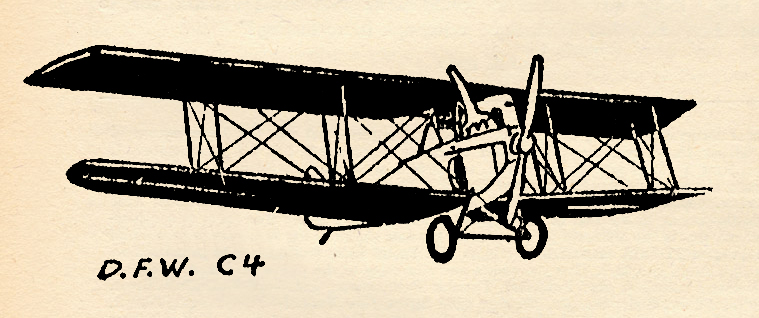
On this occasion they met not one of Mr. Fokker’s products but a German D.F.W. C4 (Deutsche Flugzeug Werke). This two-seater carried a 200 h.p. Benz motor. The C4 had radiators on the sides of the fuselage directly in the slipstream which made it possible to use a small radiator to run a big engine, by which trick the Germans gained efficiency. The wings were not swept back but had dihedral.
Funny-Looking, But—
Funny-looking crates, those old flying bird cages, but some pilots who flew them still brag about them and swear that it was a wonderful sensation to fly a pusher. Of course, there was the uncomfortable feeling of having a heavy engine nestling behind your seat to squash you flatter than a pancake in a crackup.
When the tractors replaced the pushers all but a few aviation experts predicted that pushers would never more waddle through the air. But along toward the end of the war the British Vickers Co. came out with a single-seater Pusher with two front guns. It was powered with a better engine than the old Pushers used and could tick off over 120 miles per hour low down; and low down was the place it did its job, right over the German trenches. It was built for ground strafing and it was a honey to fly. Again the anti-pusher crowd said “It’s a freak, a last try using an obsolete principle. There ain’t no such thing as a good pusher.”
That old Vickers Vampire was just about 
the swan song of the pushers for many 
years. And then, nearly fifteen years after
 the end of the World War the French 
Hanriot Company brought out one of the
speediest, slickest-looking fighters of the
 year, the Hanriot H-110-C1. And believe it
 or not, it was a PUSHER that could slice
 through the air at the very nice speed of
 220 m.p.h.
Lightning-Quick Action
The German D.F.W. on the cover had a pilot who had knocked down several of the earlier slower moving pushers. He saw an easy kill and got careless. One moment the D.H. Pusher was in front of him. The next it had pulled a lightning-like maneuver which no ship other than a tractor had hitherto been capable of Lewis slugs cracked and rattled into the German ship, knocking the front gun’s firing mechanism cock-eyed. Then the stream of lead slid back and ripped a section of canvas from the observer’s pit. That worthy never got in a shot, his hands were too high in the air clawing at the clouds.
The British gunner pointed towards the Allied rear lines. The German pilot nodded his head and slanted his ship down, swearing solemnly that if he ever escaped and got into the air again he’d be mighty careful to keep out of the way of pushers.
Sky Fighters, February 1936 by Eugene M. Frandzen
(The Ships on The Cover Page)
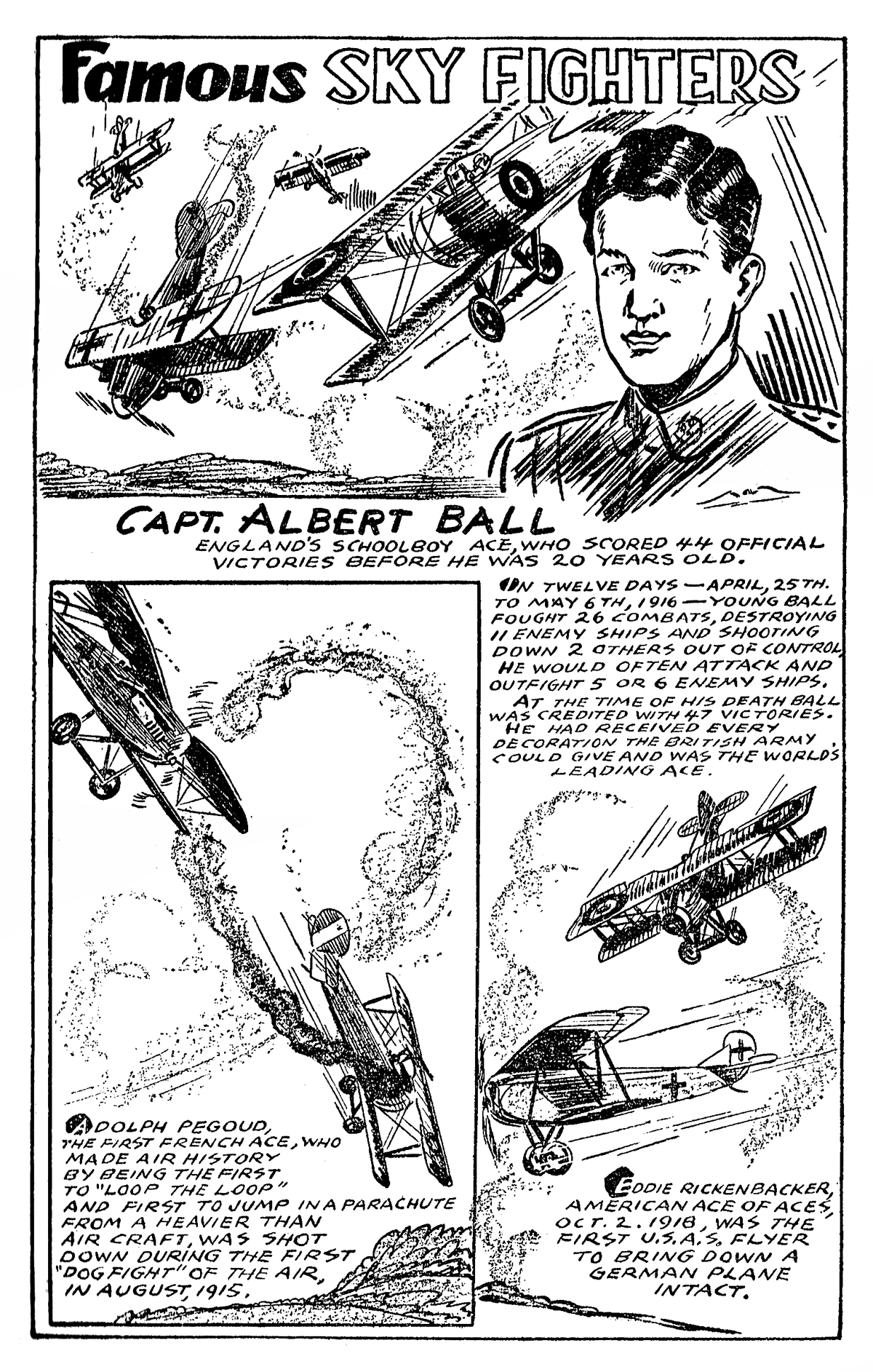
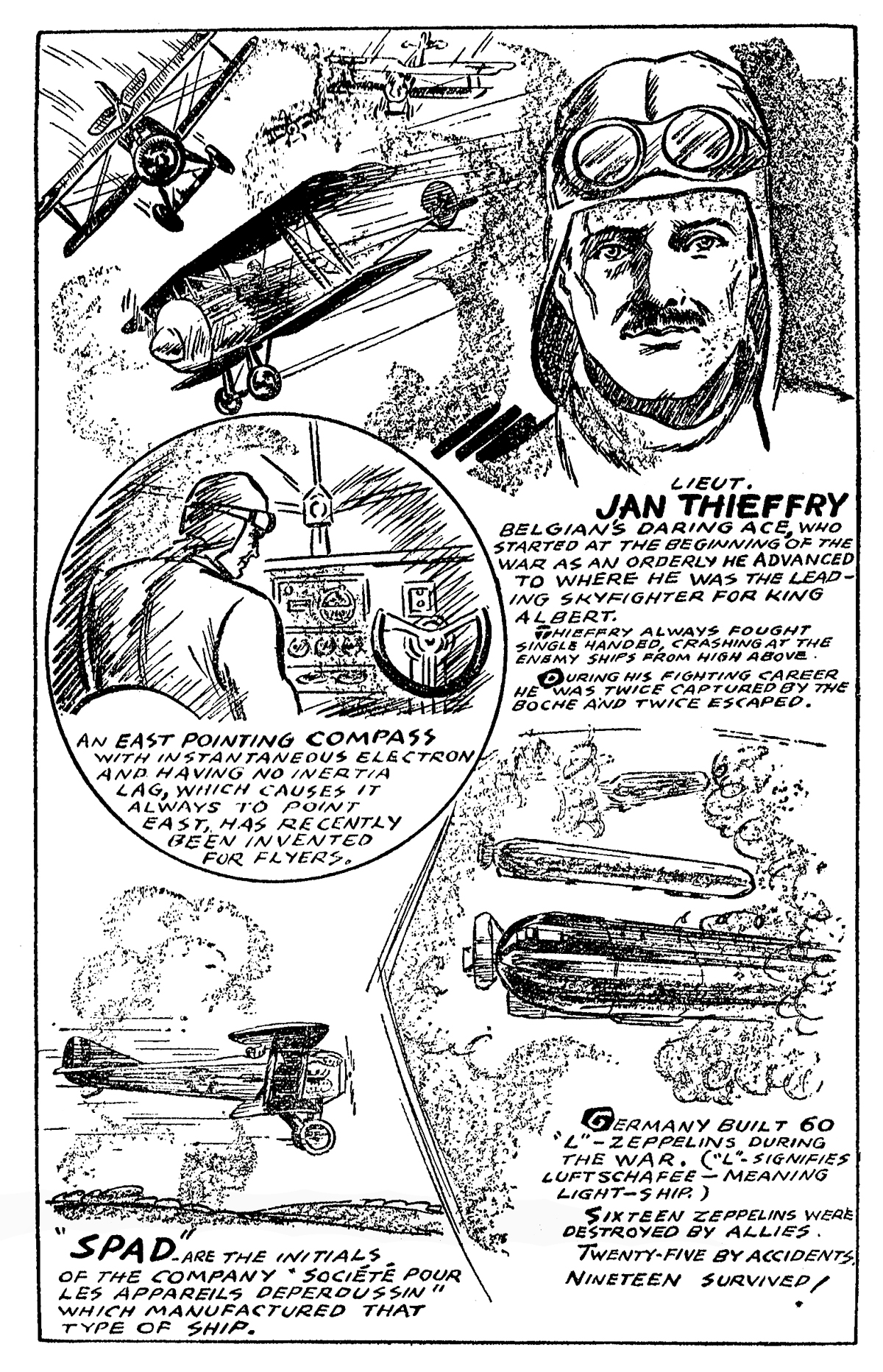
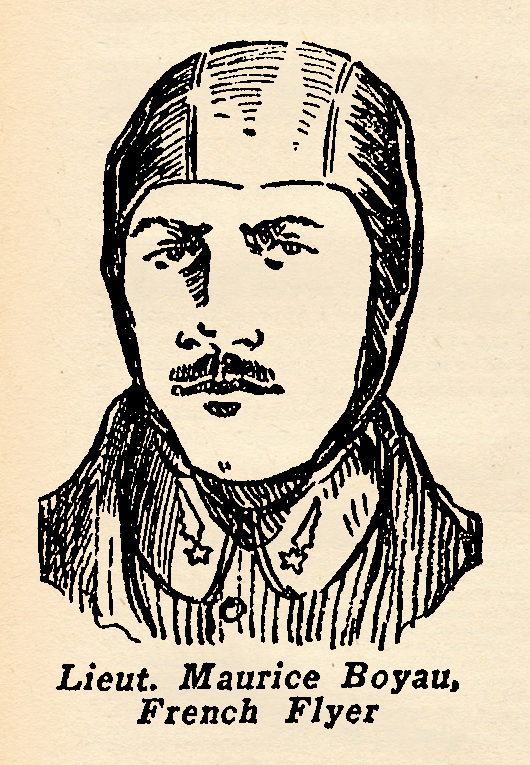 ranking ace. Fonck, Guynemyer, Nungesser and Madon, all ranked above him in actual victories scored. Maurice Boyau combined all the best qualities of these four aces and wan in addition the most ingenious. If death had not cut short his flaming career long before the war ended, it is very possible that he might have attained the honor of being France’s ace of aces, for he had every qualification for that distinction. He was struck down when he had run his 35 victories, but not before he had won every medal within the power of his native country to bestow. These Included the Legion d’Honneur, Medaille Militaire and the Croix da Guerre, with numerous stars and palms. The following story taken from his diary gives a striking and vivid example of his ingenuity. The translator has made no attempt to polish the language of Boyau’s script, feeling that to do so would take away from the charming simplicity of the document.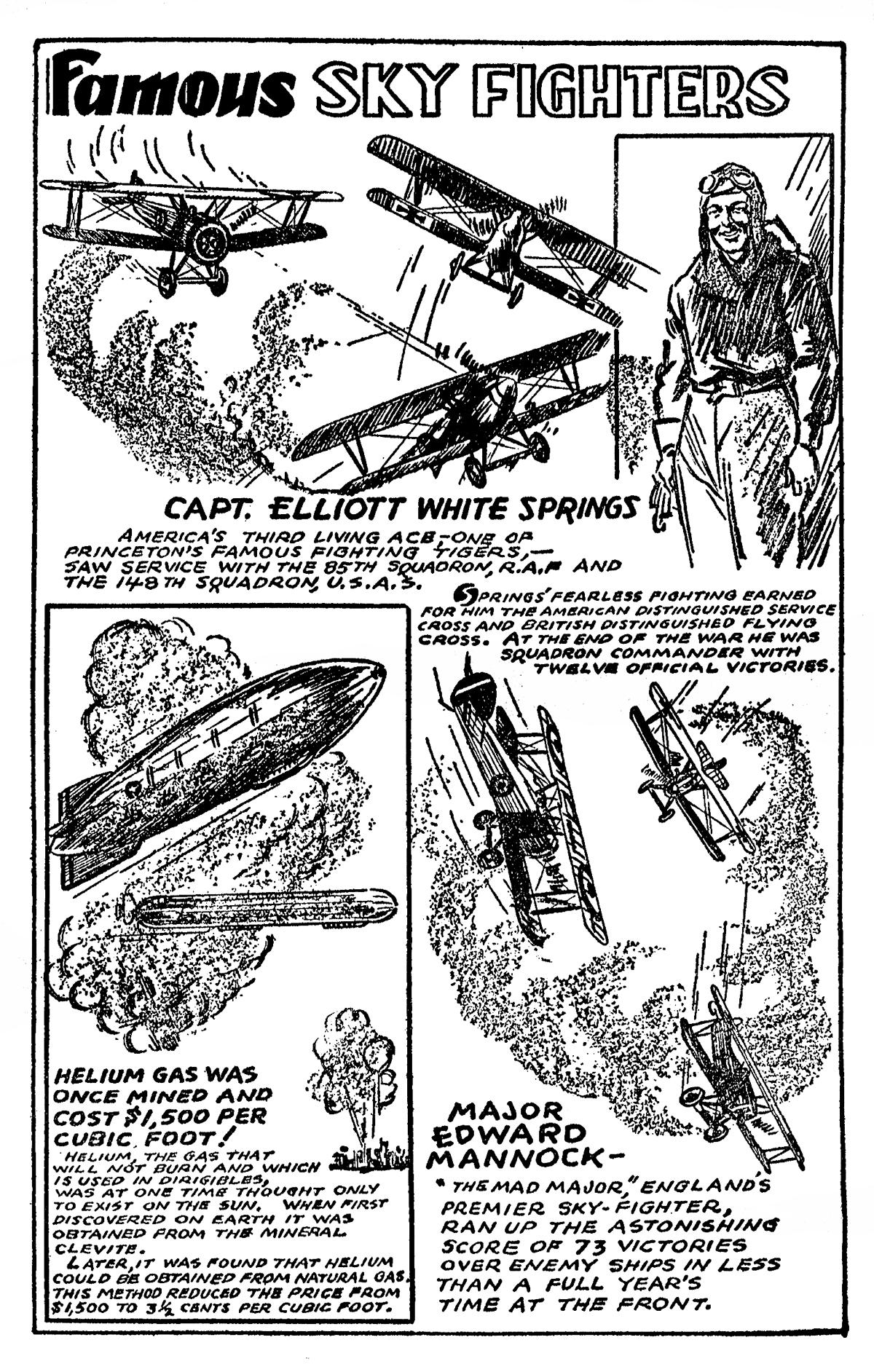


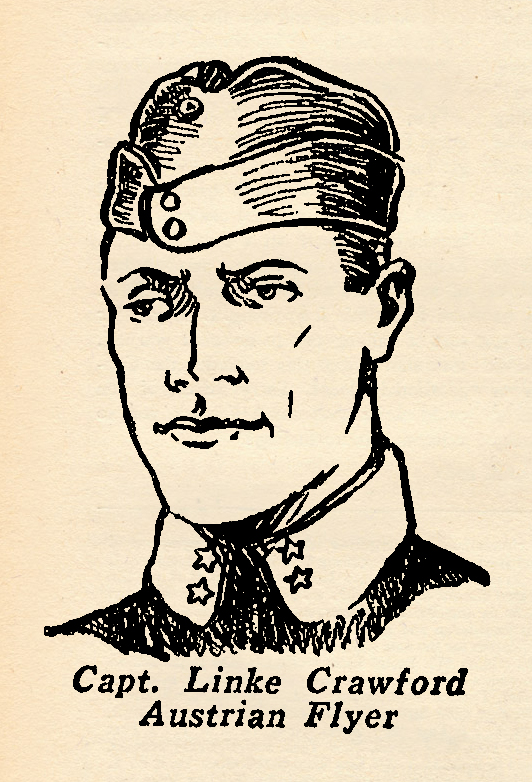 most brilliant and scintillating of all the flying aces. Most everyone knows that Captains Brumoninski and Linke were the ranking Austrian flyers and carried on a duel for top honors all through the war with first one, then the other, on top. But what most informed people do not know, is that Captain Crawford and Captain Linke were one and the same person! Son of an English father and an Austrian mother, Linke Crawford was born and raised in gay Vienna. When he began to win fame as a fighting pilot he had dropped the Crawford part of his name and was known as Captain Linke. although he was listed on the army rolls as Captain Crawford. He fell victim finally under the guns of Colonel Barker, famous Canadian ace. Up to that time, however, he had scored 27 victories and won all the awards possible from his country. The story below is taken from the archives of the Austrian Imperial Air Corps in Vienna.


 great story from the pen of Ralph Oppenheim. Best known in these parts for
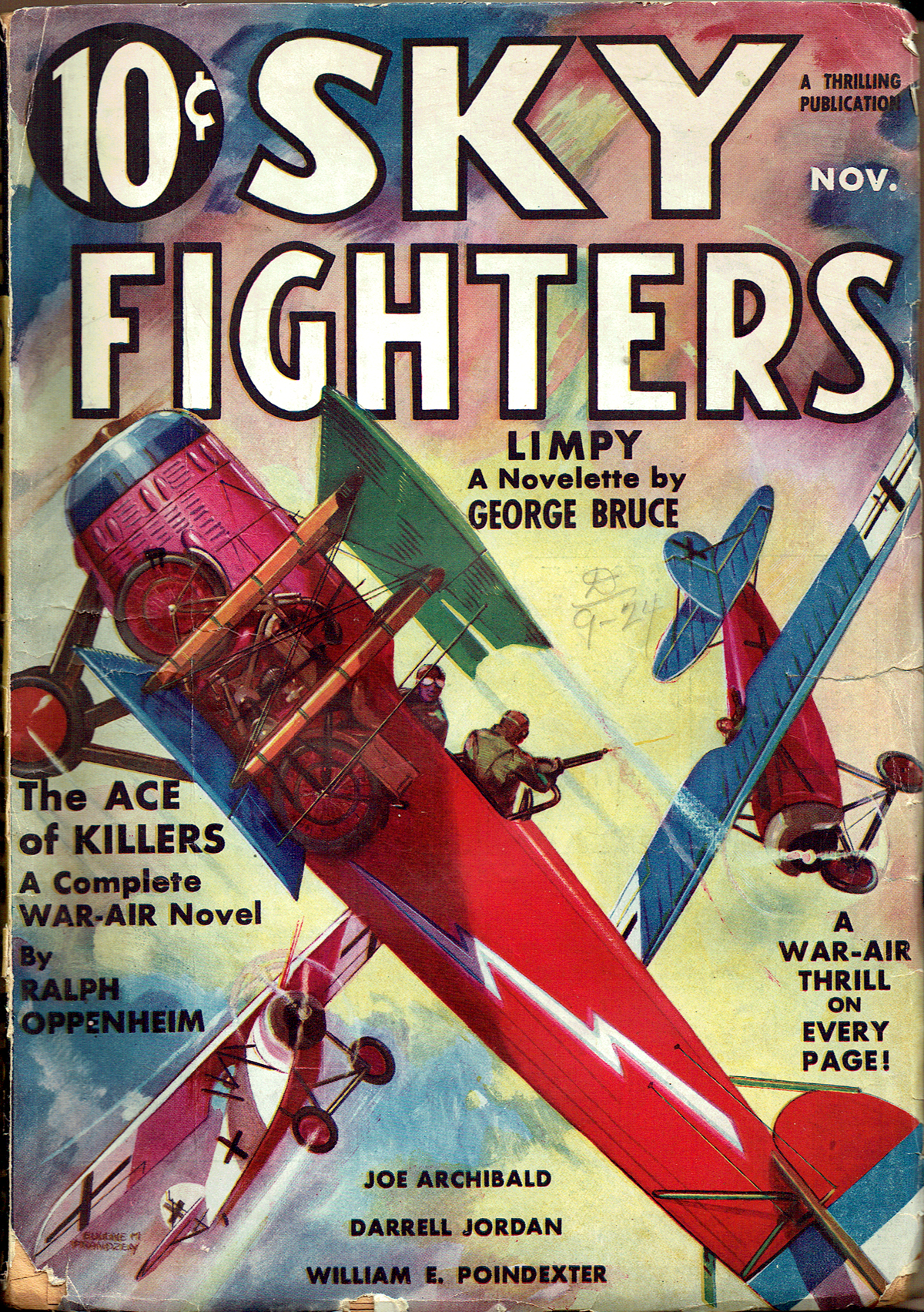
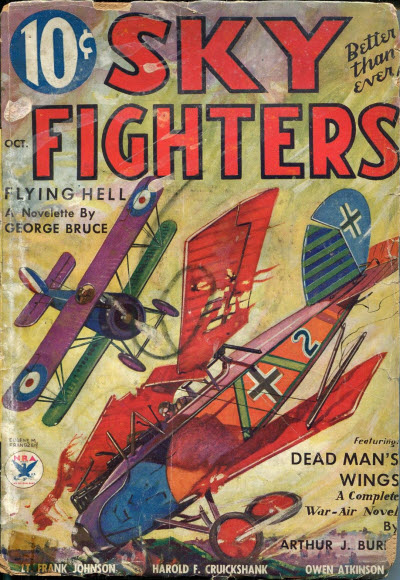 Silent Orth—ironically named for his former penchant to boast, but blessed with the skills to carry out his promises—is faced his a choice. He’s ordered to retrieve a spy with valuable information that could save the lives of thousands from behind the lines, but, at the same time his best mate is to face a German firing squad! Save the Spy or save his friend . . . . or save both? Impossible! But if anyone could do it, Orth could! From the pages of the October 1934 issue of Sky Fighters, Silent Orth flies toward his “Zero Hour!”
 a story by another of our favorite authors—
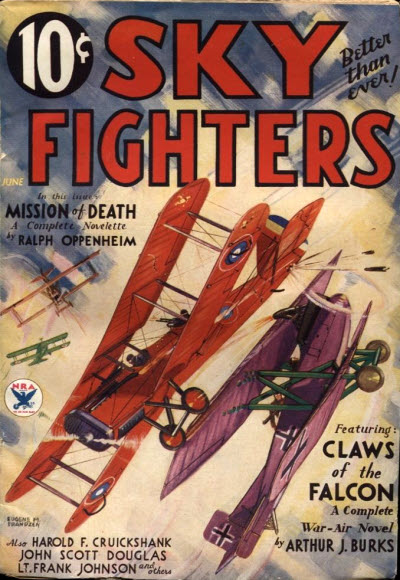
 Mosquito Month we have a non-Mosquitoes story from the pen of Ralph Oppenheim. “Streak” Davis must stop Erich von Hartwig, Germany’s master flying spy—the craftiest and most underhanded Boche in the war! Von Hartwig just murdered three Allied officers at Chaumont in cold blood—then made off with a dispatch cylinder containing most vital information of our troop movement. His orders: “Head him off and burn von Hartwig and his black Albatross in the sky so there’s no chance of those papers falling into German hands!”