Looking to buy? See our books on amazon.com Get Reading Now! Age of Aces Presents - free pulp PDFs

“Blackbird” by Lt. Frank Johnson

Link - Posted by David on January 11, 2019 @ 6:00 am in

ORTH is back! Silent Orth had made an enviable record, in the face of one of the worst beginnings—a beginning which had been so filled with boasting that his wingmates hadn’t been able to stand it. But Orth hadn’t thought of all his talk as boasting, because he had invariably made good on it. However, someone had brought home to him the fact that brave, efficient men were usually modest and really silent, and he had shut his mouth like a trap from that moment on.

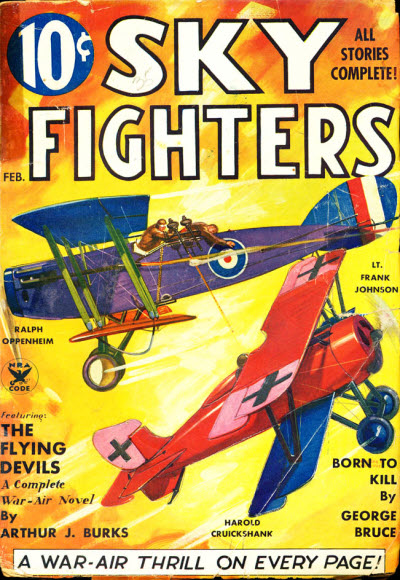
Acclaimed the greatest of Allied fliers on both sides of the lines, Silent Orth had reached the end of his rope. The Germans knew it, all those who could see what was transpiring. And especially did Franz Kohl know it, as he sat on Orth’s tail in a bullet-swift Albatros and hammered relentlessly away at the battered and broken Spad of the American ace. The Americans on the ground who could see knew it and held their breaths, and their hearts were tight with sorrow. The Americans in the air who were held back from helping him by literal walls of wings, knew it. Everybody knew that Orth was doomed—with one solitary exception—Silent Orth! And he would not give up until one, or both of them, were dead! From the pages of the February 1935 Sky Fighters, it’s “Blackbird!”

Orth Was a Fighter that Just Wouldn’t Stay Dead—Not While a Single Hun Still Rode the Sky!

“Famous Sky Fighters, March 1935″ by Terry Gilkison

Link - Posted by David on January 2, 2019 @ 6:00 am in

STARTING in the October 1933 issue of Sky Fighters and running almost 5 years, Terry Gilkison’s “Famous Sky Fighters” was a staple of the magazine. Each month Gilkison would illustrate in a two page spread different Aces that rose to fame during the Great War.

Although Gilkison was probably better known for his syndicated newspaper work, he also provided black and white story interior illustrations for pulp magazines. His work appeared in Clues, Thrilling Adventures, Texas Rangers, Thrilling Mystery, Thrilling Western, and Popular Western. Gilkison provided similar features in a few other Thrilling Publications—there was “Famous Soldiers of Fortune” and later “Adventure Thrills” in Thrilling Adventures, Famous Crimes” in Thrilling Detective, and the fully illustrated air adventure stories of Buck Barton “The Flying Devil” in The Lone Eagle! He signed most of this work with only his initials “T.G.” to maintain a low profile and preserve his reputation as a syndicated newspaper cartoon artist.

The March 1935 installment, from the pages of Sky Fighters, Features Corporal Edmond Genet, Baron von Buttler Brandenfels, Captain Arthur Bristol, and the incomparable Roland Garros!

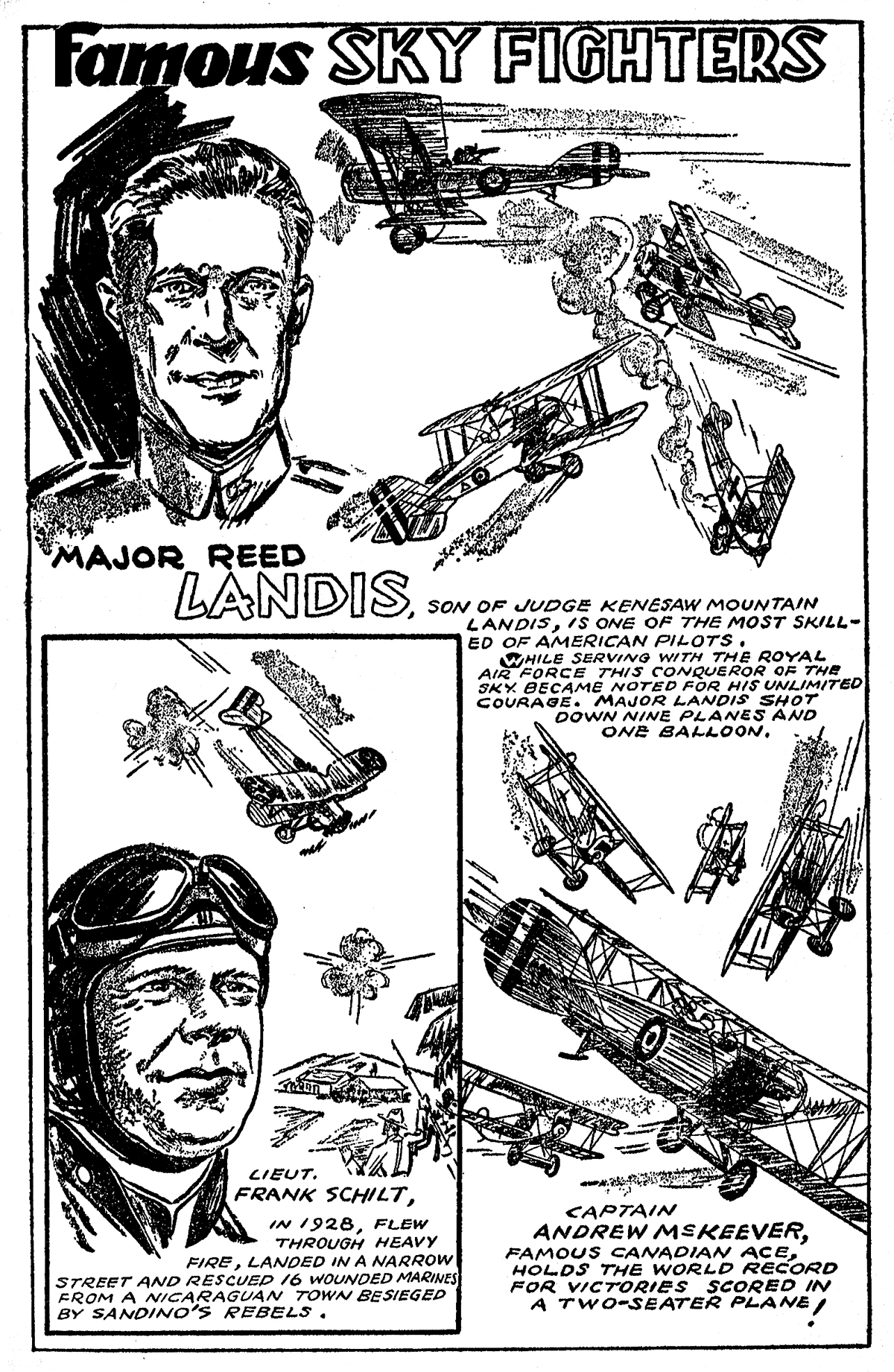
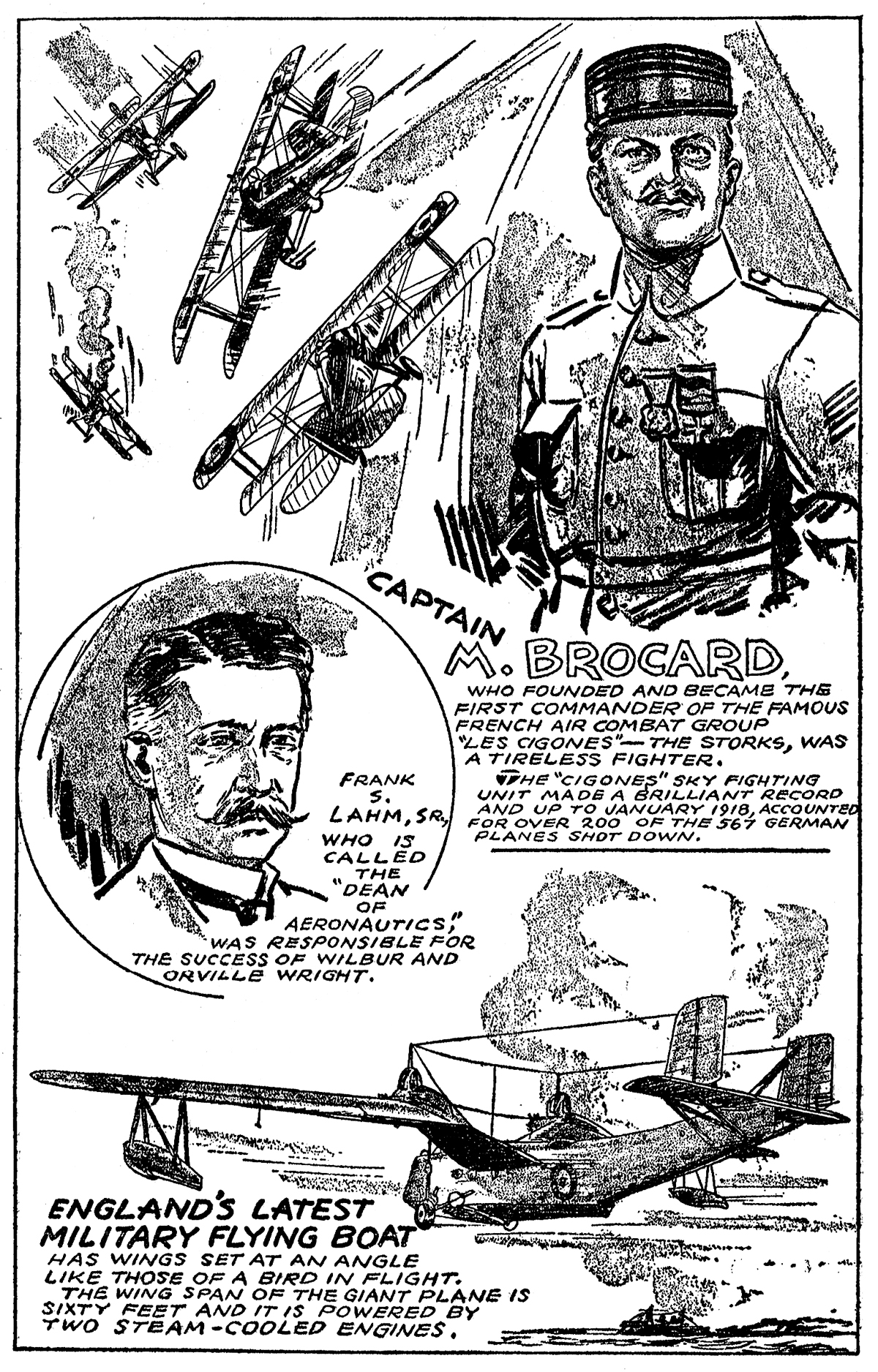
Next time in “Famous Sky Fighters,” Terry Gilkison features Major Reed Landis, Lt. Frank Schilt, Capt Andrew McKeever and Capt. M. Brocard! Don’t miss it!

“Famous Sky Fighters, February 1935″ by Terry Gilkison

Link - Posted by David on December 19, 2018 @ 6:00 am in

STARTING in the October 1933 issue of Sky Fighters and running almost 5 years, Terry Gilkison’s “Famous Sky Fighters” was a staple of the magazine. Each month Gilkison would illustrate in a two page spread different Aces that rose to fame during the Great War.

Although Gilkison was probably better known for his syndicated newspaper work, he also provided black and white story interior illustrations for pulp magazines. His work appeared in Clues, Thrilling Adventures, Texas Rangers, Thrilling Mystery, Thrilling Western, and Popular Western. Gilkison provided similar features in a few other Thrilling Publications—there was “Famous Soldiers of Fortune” and later “Adventure Thrills” in Thrilling Adventures, Famous Crimes” in Thrilling Detective, and the fully illustrated air adventure stories of Buck Barton “The Flying Devil” in The Lone Eagle! He signed most of this work with only his initials “T.G.” to maintain a low profile and preserve his reputation as a syndicated newspaper cartoon artist.

The February 1935 installment, from the pages of Sky Fighters, Features Lieut. David Putnam, Colonel Dean Lamb, Capt. C.F. Chander and the only Ace of the three seaters—Captain Didier Le Cour-Grandmaison!

Next time in “Famous Sky Fighters,” Terry Gilkison features Corporal Edmond Genet, Baron von Buttler Brandenfels, Captain Arthur Bristol, and the incomparable Roland Garros! Don’t miss it!

“Sky Fighters, March 1936″ by Eugene M. Frandzen

Link - Posted by David on December 10, 2018 @ 6:00 am in

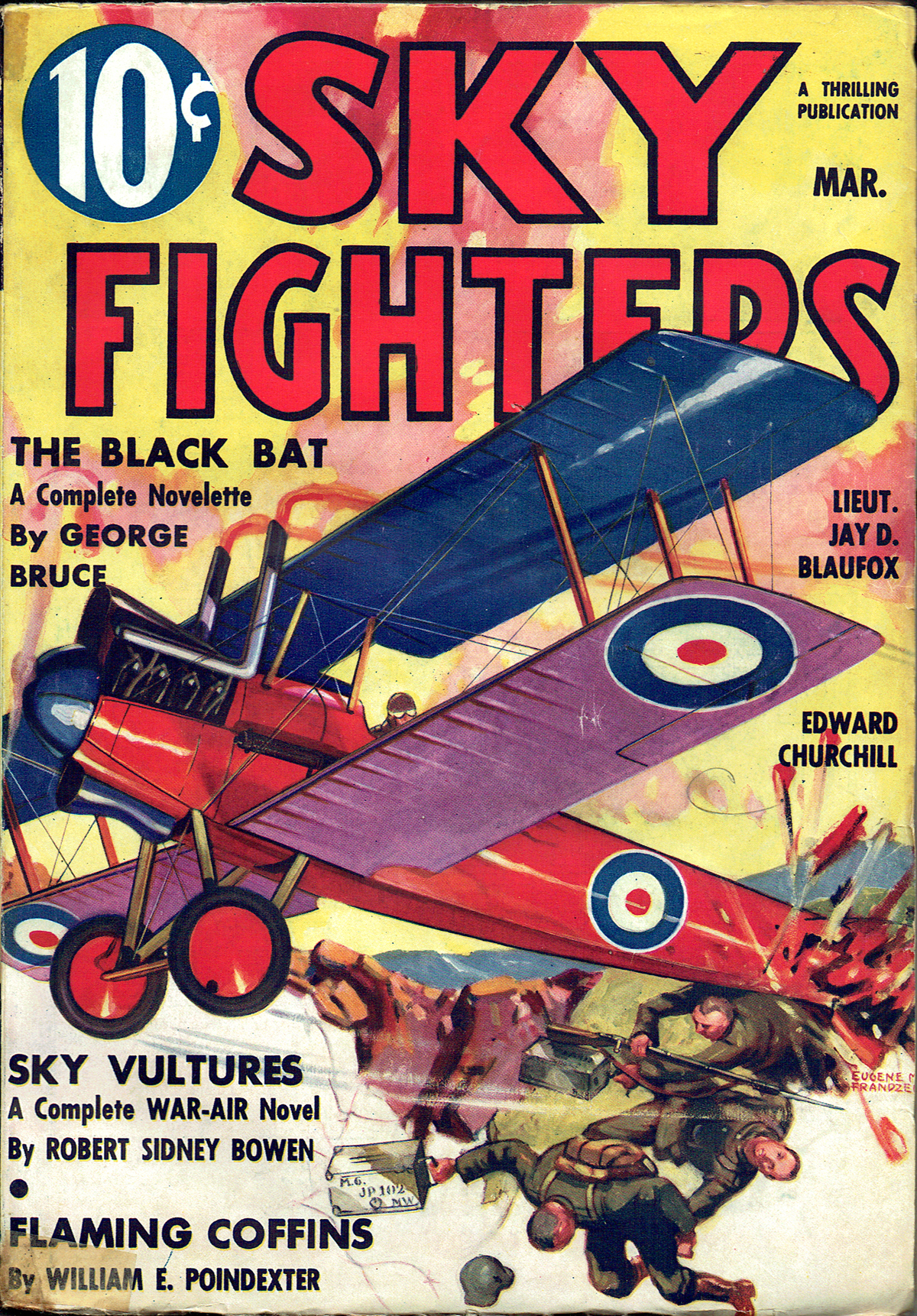
Eugene M. Frandzen painted the covers of Sky Fighters from its first issue in 1932 until he moved on from the pulps in 1939. At this point in the run, the covers were about the planes featured on the cover more than the story depicted. Mr. Frandzen features a battle between a De Haviland Pusher and a German D.F.W. C4 on the March 1936 cover!

The Ships on the Cover

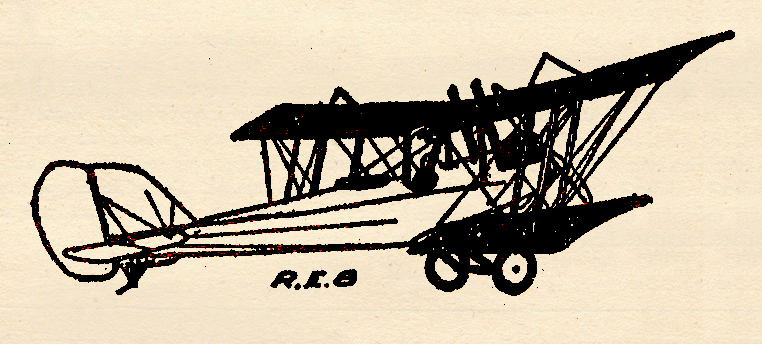
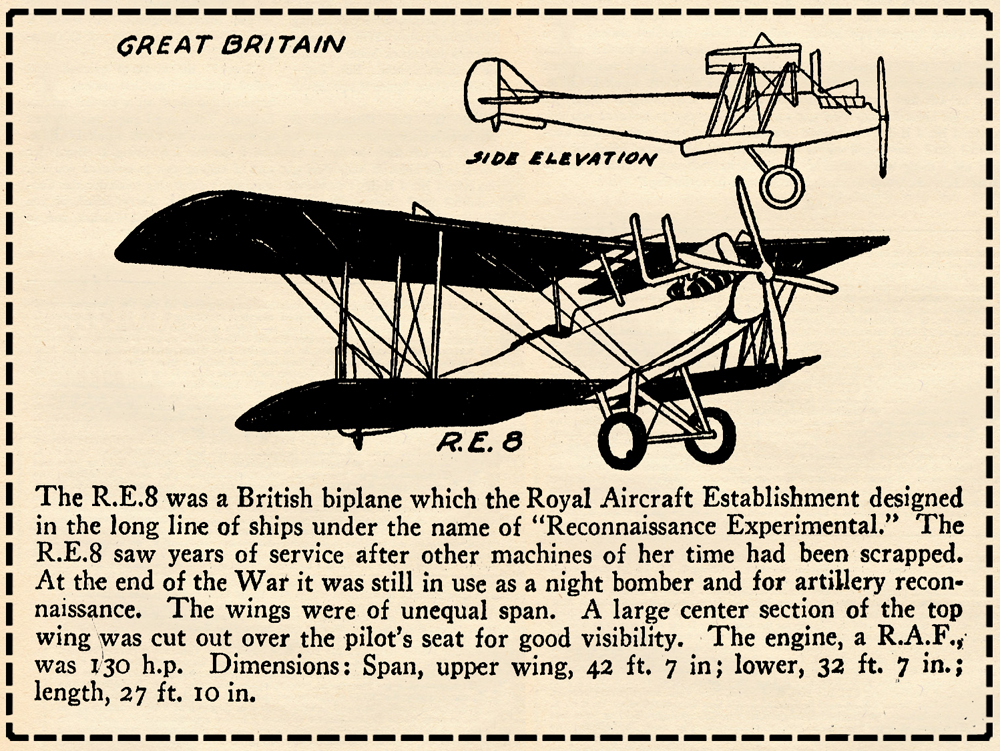
THE R.E.8 had the title th_SF_3603“Reconnaissance Experimental” but there was not so much experimental in her as good old fighting spirit. Since the line of R.E.s preceding the 8 had worked out most of the defects in actual combat flying rather than in the brain of designers, the old girl had been pretty well refined when she made her debut. The British Royal Aircraft Factory was responsible for some lesser lights in their production but the S.E.5 came out on their wartime stage to end the show in a round of applause from the aviators who flew them. But even when the S.E.s were starring at the front the R.E.8s were holding up their end of the show patrolling the sky lanes dropping bombs In the darkness of night to the end of the war.
Backstage at the training schools the R.E. put the young novices through the groundwork, in this case groundwork of the sky of fancy turns, pauses for leveling out between steep dives, pirouettes, all maneuvers to make sky hoofers for the chorus of war.

Never a Has Been

The R.E.8 did her work so well carrying on in any job that she could never have the slurring title of “Has been.” A ship that could look back on the glories of such a career need never slink away when the applause was for newcomers. It had the quiet reserve to serve gracefully, giving of its experience while treasuring in the heart of its big engine the memory of such days as the one when it flew back in 1918, the scene pictured on the cover.
An army is said to march on its belly. That’s a good old bromide and gets past first base, but marching never brought in a home run. The same can be said for a plane with only gas to feed it. It can go places but it can’t do things. The one thing needed above all others to ground or air forces is ammunition.

Silencing a pair of machine-guns in a bombproof hillside dugout commanding a pass was the problem confronting “Crackup” Jones of Texas and points West. Now “Crackup” came by his name because he had smashed more planes in landing and taking off than any other three living flyers in the A.E.F. He’d cracked his way through two schools and left a trail of splinters that ran up the national debt considerably. But that didn’t bother Mr. Jones for he and every one else who had seen him fly knew that once he got into the air no other two-legged mortal could swap lead with him and live to tell the story.

Wotta Man!

One guy swore he’d seen Jones crack a Nieuport full speed into a hangar roof. Thrown clear he sailed through the air a hundred feet and landed gracefully on the top of a grounded captive balloon. When they finally got him down he’d written a thousand-word account of the experience with diagrams for the “Stars and Stripes.” Wotta man!

“Crackup” is in the pilot’s pit of the old R.E.8 he borrowed from the British. He’d dropped all his bombs on the bombproof dugout at the head of a narrow pass just in front of his own lines. He’d sprayed every round from his machine-guns. His gas was nearly exhausted when he spied three Boche lugging up ammunition to the machine-gun nest. If those men got their cargo to the guns safely it meant the Yanks couldn’t push through.

“Crackup” Thinks—and Acts

“Crackup” thought fast. A narrow river was below the cliff. If he could smash his plane into those Germans and his luck held out he’d be catapulted into the water safe on the Allied side. Having thought, “Crackup” acted. Down he swooped, gave the last drop of gas to his coughing engine and smacked his enemies and their dangerous ammunition over the edge of the cliff with his empennage.

His tailless plane leaped through the air like a ski jumper, cleared the river and smashed head on into a jagged mass of rocks. “Crackup’s” luck had deserted him at last. When they pulled him out of the wreckage it was found that the wind had been knocked completely out of him and he had suffered a severe fracture of the left little finger.
The Ships on The Cover
Sky Fighters, March 1936 by Eugene M. Frandzen
(The Ships on The Cover Page)

Full specifications of the R.E.8 were featured in the LIBRARY OF WAR PLANES in this issue.
“Famous Sky Fighters, January 1935″ by Terry Gilkison

Link - Posted by David on December 5, 2018 @ 6:00 am in

STARTING in the October 1933 issue of Sky Fighters and running almost 5 years, Terry Gilkison’s “Famous Sky Fighters” was a staple of the magazine. Each month Gilkison would illustrate in a two page spread different Aces that rose to fame during the Great War.

Although Gilkison was probably better known for his syndicated newspaper work, he also provided black and white story interior illustrations for pulp magazines. His work appeared in Clues, Thrilling Adventures, Texas Rangers, Thrilling Mystery, Thrilling Western, and Popular Western. Gilkison provided similar features in a few other Thrilling Publications—there was “Famous Soldiers of Fortune” and later “Adventure Thrills” in Thrilling Adventures, Famous Crimes” in Thrilling Detective, and the fully illustrated air adventure stories of Buck Barton “The Flying Devil” in The Lone Eagle! He signed most of this work with only his initials “T.G.” to maintain a low profile and preserve his reputation as a syndicated newspaper cartoon artist.

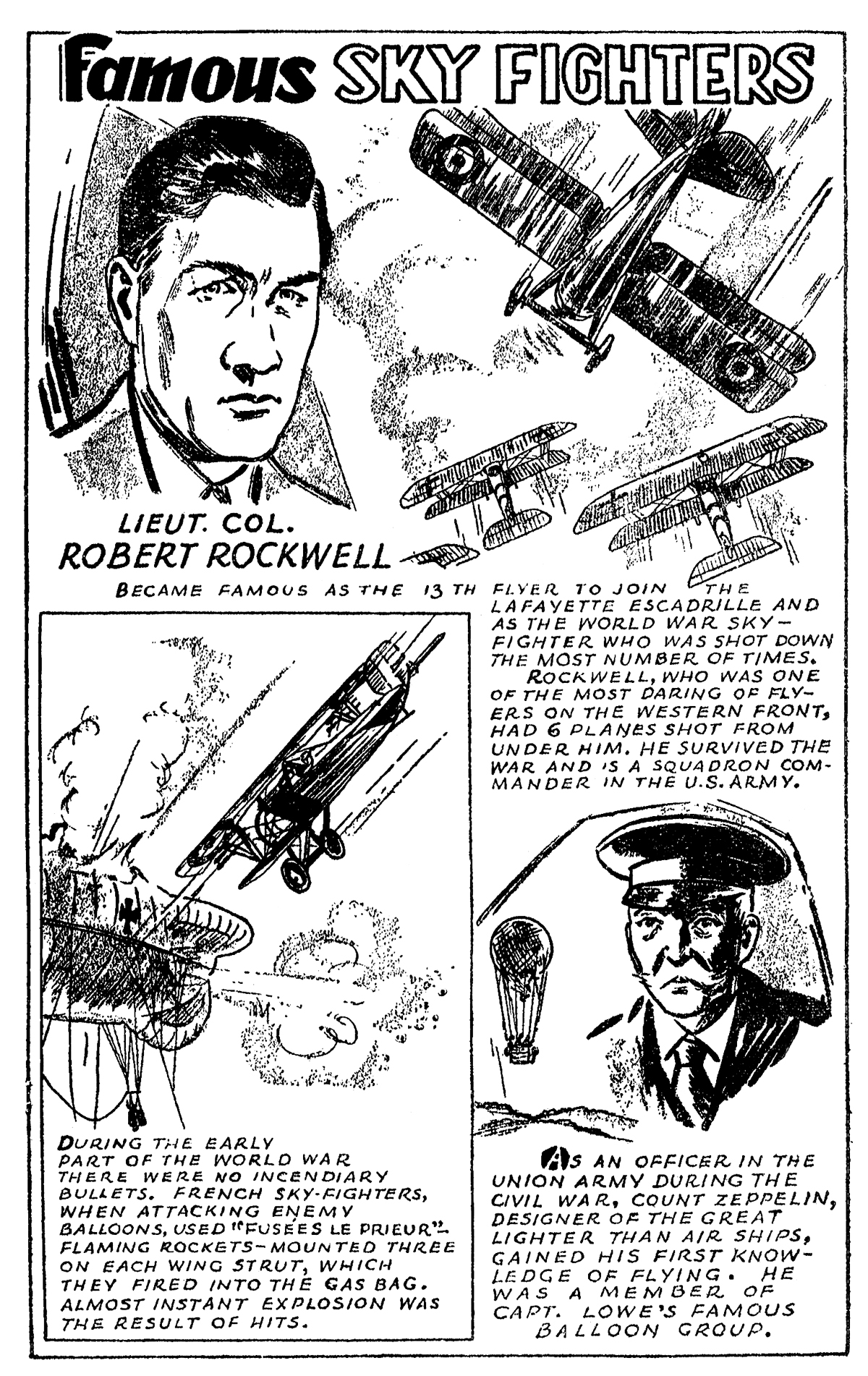
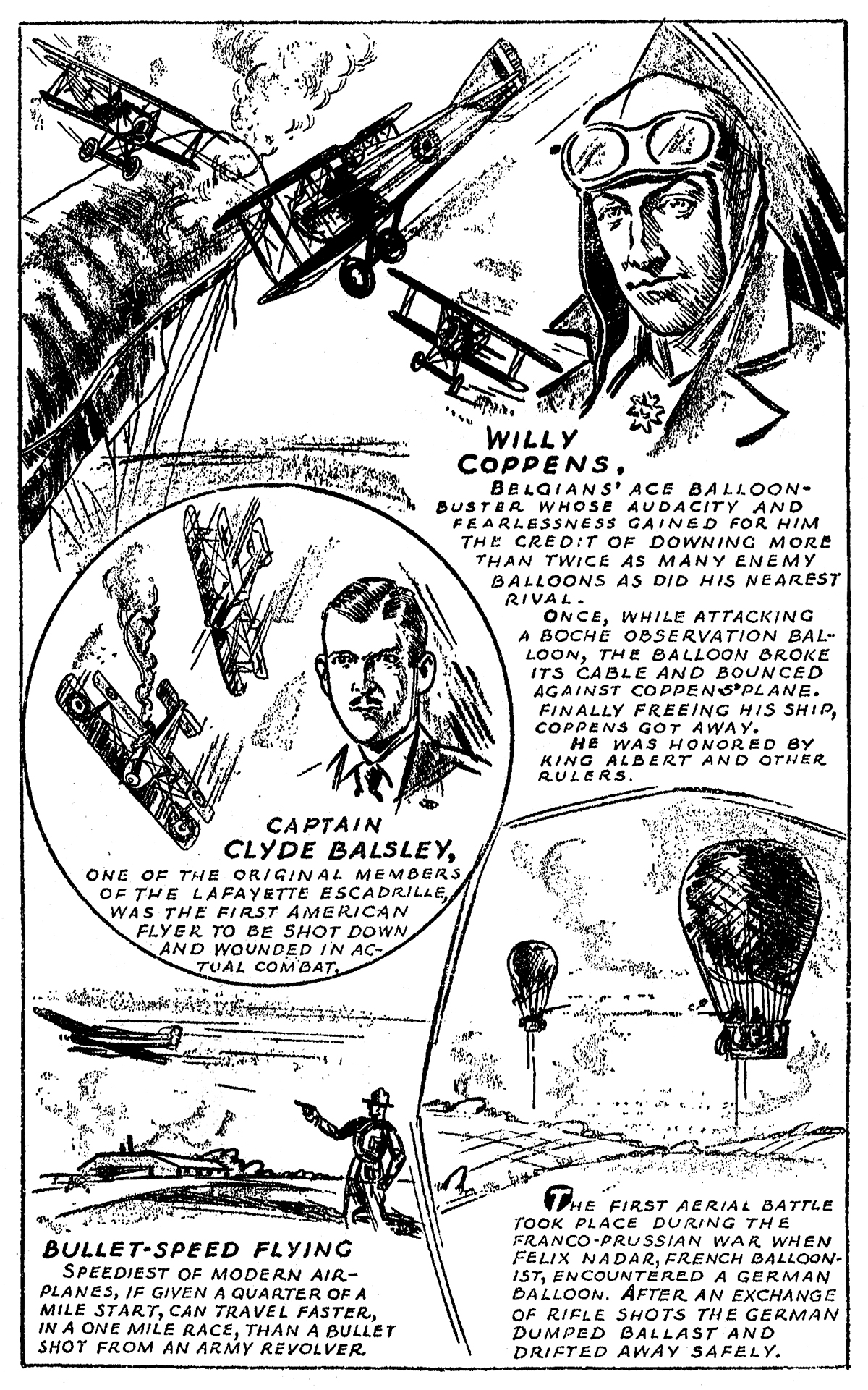
The January 1935 installment, from the pages of Sky Fighters, Features Lieut. Colonel Robert Rockwell, Belgian Ace Willy Coppens and Capt. Clyde Balsley of the Lafayette Escadrille!

Next time in “Famous Sky Fighters,” Terry Gilkison features Lieut. David Putnam, Colonel Dean Lamb, Capt. C.F. Chander and the only Ace of the three seaters—Captain Didier Le Cour-Grandmaison! Don’t miss it!

“Famous Sky Fighters, December 1934″ by Terry Gilkison

Link - Posted by David on October 24, 2018 @ 6:00 am in

STARTING in the October 1933 issue of Sky Fighters and running almost 5 years, Terry Gilkison’s “Famous Sky Fighters” was a staple of the magazine. Each month Gilkison would illustrate in a two page spread different Aces that rose to fame during the Great War.

Although Gilkison was probably better known for his syndicated newspaper work, he also provided black and white story interior illustrations for pulp magazines. His work appeared in Clues, Thrilling Adventures, Texas Rangers, Thrilling Mystery, Thrilling Western, and Popular Western. Gilkison provided similar features in a few other Thrilling Publications—there was “Famous Soldiers of Fortune” and later “Adventure Thrills” in Thrilling Adventures, Famous Crimes” in Thrilling Detective, and the fully illustrated air adventure stories of Buck Barton “The Flying Devil” in The Lone Eagle! He signed most of this work with only his initials “T.G.” to maintain a low profile and preserve his reputation as a syndicated newspaper cartoon artist.

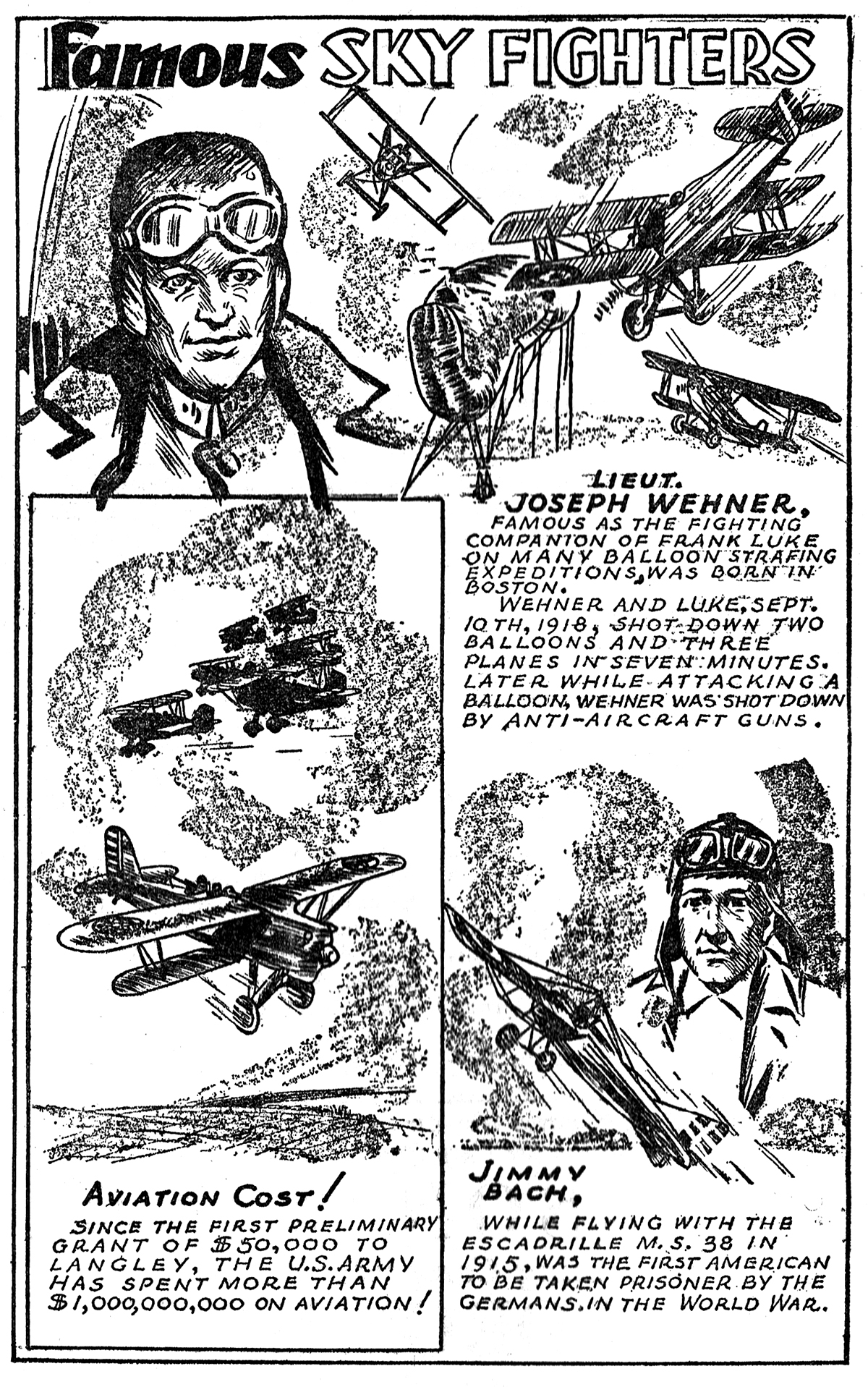
The December 1934 installment, from the pages of Sky Fighters, Features Lieut. Joseph Wehner, Major Gabriel D’Annunzio, and shout outs to Napoleon and Belgium’s Willy Coppens!

Next time in “Famous Sky Fighters,” Terry Gilkison features Lieut. Colonel Robert Rockwell, Belgian Ace Willy Coppens and Capt. Clyde Balsley of the Lafayette Escadrille! Don’t miss it!

“The Devil’s Ace” by Lt. Frank Johnson

Link - Posted by David on October 12, 2018 @ 6:00 am in

ORTH is back! Silent Orth had made an enviable record, in the face of one of the worst beginnings—a beginning which had been so filled with boasting that his wingmates hadn’t been able to stand it. But Orth hadn’t thought of all his talk as boasting, because he had invariably made good on it. However, someone had brought home to him the fact that brave, efficient men were usually modest and really silent, and he had shut his mouth like a trap from that moment on.

Orth asks the C.O. for extra flying time—he figures he only really feels comfortable in the air on the hunt and the more Boche he can take out the sooner the war will be over! Unfortunately, Orth—living up to his name—doesn’t tell anyone why he wants the extra time. Before you know it one event leads to another and Orth is accused of being in league with the Germans! From the pages of the December 1934 Sky Fighters, it’s “The Devil’s Ace!”

Silent Orth, Hellwinder of the Crimson Skies, Gets into a Whale of a Jam—and All Because He Asks for Extra Flying Time Without Giving Reasons!

“Famous Sky Fighters, November 1934″ by Terry Gilkison

Link - Posted by David on October 10, 2018 @ 6:00 am in

STARTING in the October 1933 issue of Sky Fighters and running almost 5 years, Terry Gilkison’s “Famous Sky Fighters” was a staple of the magazine. Each month Gilkison would illustrate in a two page spread different Aces that rose to fame during the Great War.

Although Gilkison was probably better known for his syndicated newspaper work, he also provided black and white story interior illustrations for pulp magazines. His work appeared in Clues, Thrilling Adventures, Texas Rangers, Thrilling Mystery, Thrilling Western, and Popular Western. Gilkison provided similar features in a few other Thrilling Publications—there was “Famous Soldiers of Fortune” and later “Adventure Thrills” in Thrilling Adventures, Famous Crimes” in Thrilling Detective, and the fully illustrated air adventure stories of Buck Barton “The Flying Devil” in The Lone Eagle! He signed most of this work with only his initials “T.G.” to maintain a low profile and preserve his reputation as a syndicated newspaper cartoon artist.

The November 1934 installment, from the pages of Sky Fighters, Features General William Mitchell, Lieut. Colonel Pinsard, Lt. George Madon, and the incomparable Max Immelmann!

Next time in “Famous Sky Fighters,” Terry Gilkison features Lieut. Joseph Wehner, Major Gabriel D’Annunzio, and shout outs to Napoleon and Belgium’s Willy Coppens! Don’t miss it!

“The Hun Hunter” by Arch Whitehouse

Link - Posted by David on October 5, 2018 @ 6:00 am in

THIS week we have a short, but gripping tale from the prolific pen of Arch Whitehouse! Whitehouse gives us Len Stallard, a natural pilot and a keen hunter. He had a one-track mind and, once mounted in an active service squadron, he went to work with inevitable results—Four Huns the first week, a citation and a Croix de Guerre. Unfortunately, as good as he was in the air, he was equally poor on the ground—and found himself unable to mix with the rest of the gang at No.76. He discovers how his fellow pilots feel about him when his plane goes down behind enemy lines! From the August 1936 issue of Sky Fighters, it’s Arch Whitehouse’s “The Hun Hunter!”

Hated alike by friend and foe, Len Stallard lights out for Boche territory to end it all!

“Famous Sky Fighters, October 1934″ by Terry Gilkison

Link - Posted by David on September 26, 2018 @ 6:00 am in

STARTING in the October 1933 issue of Sky Fighters and running almost 5 years, Terry Gilkison’s “Famous Sky Fighters” was a staple of the magazine. Each month Gilkison would illustrate in a two page spread different Aces that rose to fame during the Great War.

Although Gilkison was probably better known for his syndicated newspaper work, he also provided black and white story interior illustrations for pulp magazines. His work appeared in Clues, Thrilling Adventures, Texas Rangers, Thrilling Mystery, Thrilling Western, and Popular Western. Gilkison provided similar features in a few other Thrilling Publications—there was “Famous Soldiers of Fortune” and later “Adventure Thrills” in Thrilling Adventures, Famous Crimes” in Thrilling Detective, and the fully illustrated air adventure stories of Buck Barton “The Flying Devil” in The Lone Eagle! He signed most of this work with only his initials “T.G.” to maintain a low profile and preserve his reputation as a syndicated newspaper cartoon artist.

The October 1934 installment, from the pages of Sky Fighters, Features Capt. Hamilton Coolidge, Lieut. Constant Soulier, and the evil genius who thought up the Zeppelin air raid—Baron von Buttlar Brandenfels!

Next time in “Famous Sky Fighters,” Terry Gilkison features General William Mitchell, Lieut. Colonel Pinsard, Lt. George Madon, and the incomparable Max Immelmann! Don’t miss it!

“Famous Sky Fighters, September 1934″ by Terry Gilkison

Link - Posted by David on September 12, 2018 @ 6:00 am in

STARTING in the October 1933 issue of Sky Fighters and running almost 5 years, Terry Gilkison’s “Famous Sky Fighters” was a staple of the magazine. Each month Gilkison would illustrate in a two page spread different Aces that rose to fame during the Great War.

Although Gilkison was probably better known for his syndicated newspaper work, he also provided black and white story interior illustrations for pulp magazines. His work appeared in Clues, Thrilling Adventures, Texas Rangers, Thrilling Mystery, Thrilling Western, and Popular Western. Gilkison provided similar features in a few other Thrilling Publications—there was “Famous Soldiers of Fortune” and later “Adventure Thrills” in Thrilling Adventures, Famous Crimes” in Thrilling Detective, and the fully illustrated air adventure stories of Buck Barton “The Flying Devil” in The Lone Eagle! He signed most of this work with only his initials “T.G.” to maintain a low profile and preserve his reputation as a syndicated newspaper cartoon artist.

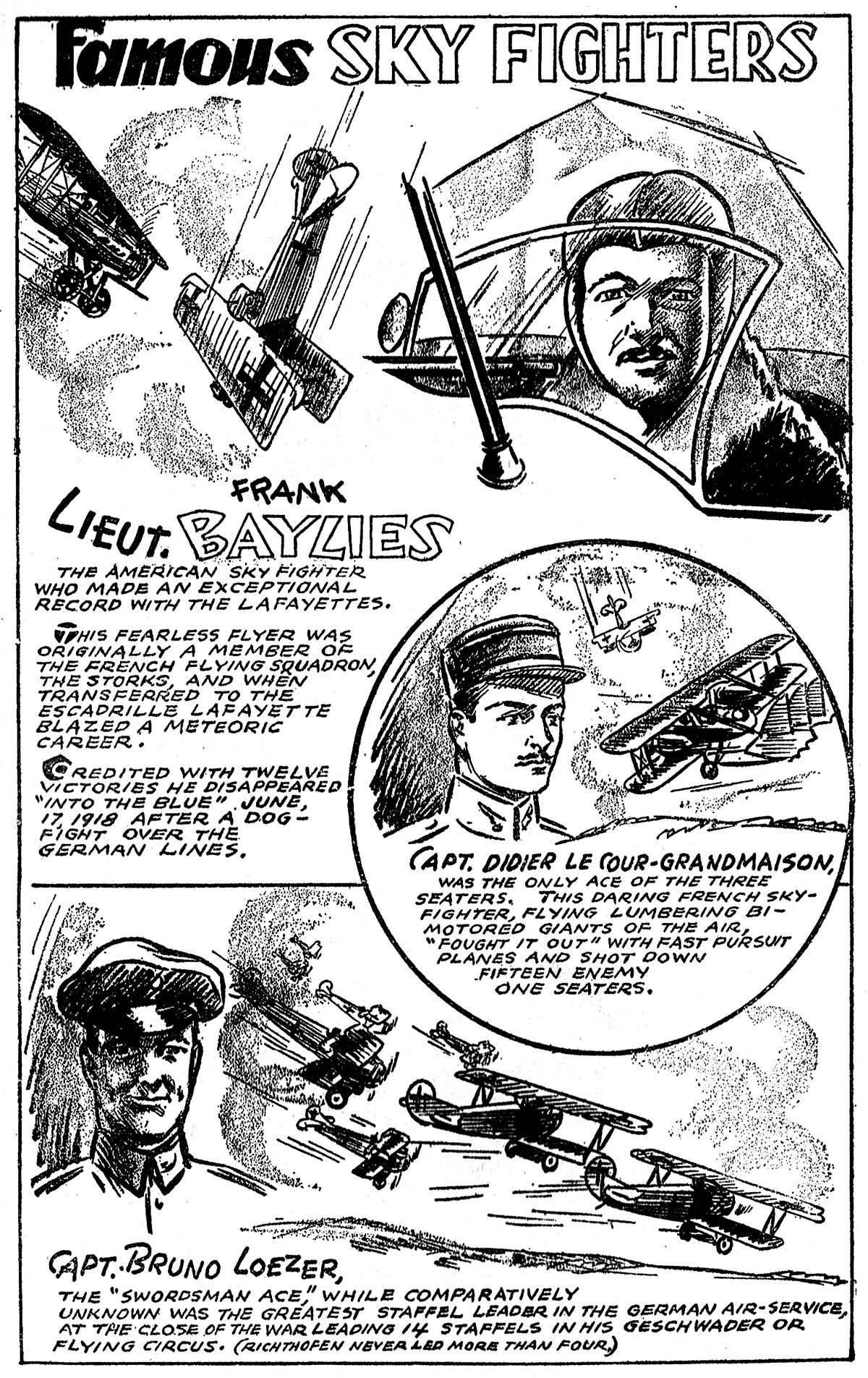
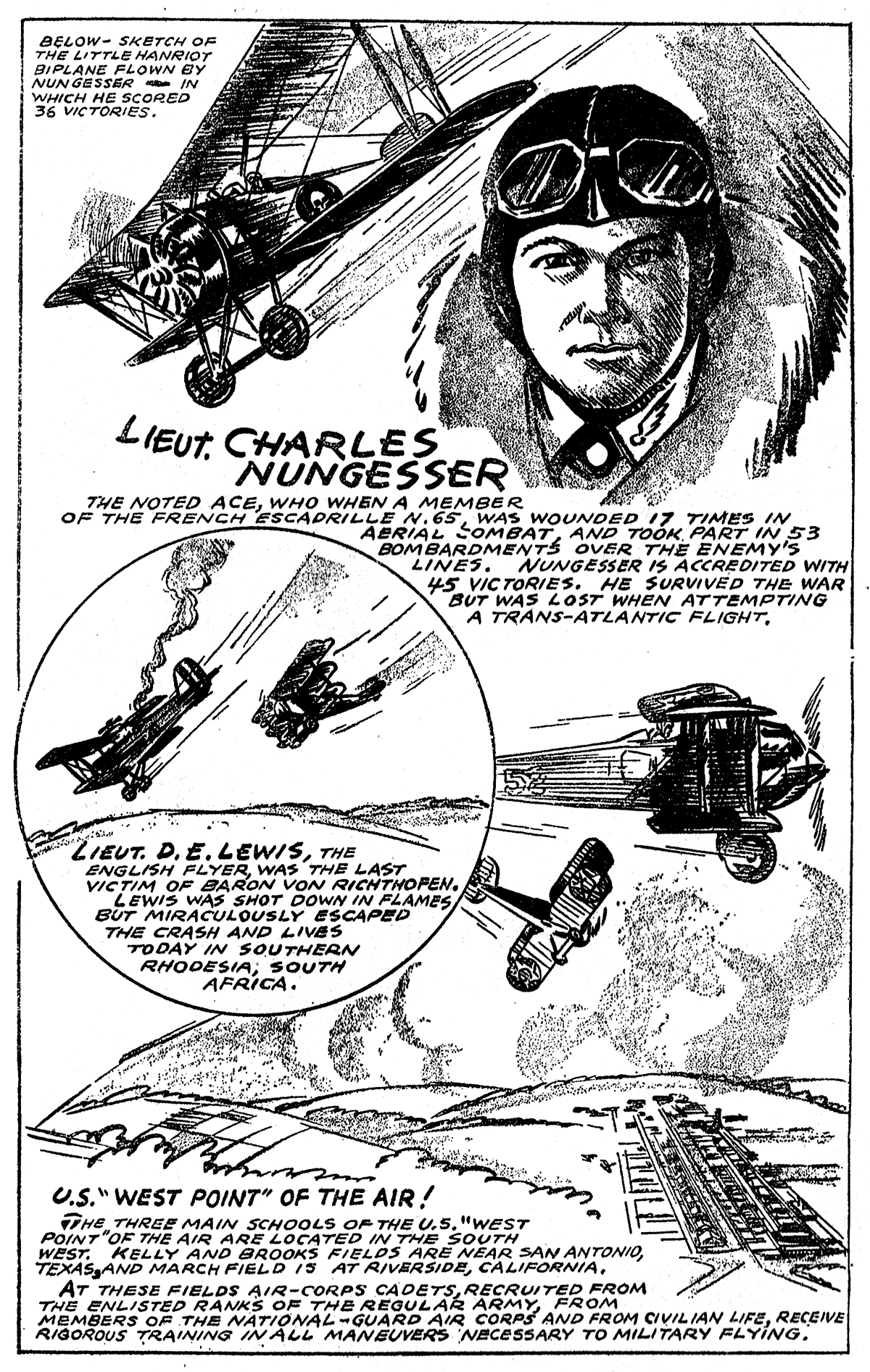
The September 1934 installment, from the pages of Sky Fighters, Features Lt. Frank Baylies, Lieut.Charles Nungesser, and Capt. Bruno Loezer—”The Swordsman Ace”!

Next time in “Famous Sky Fighters,” Terry Gilkison features Capt. Hamilton Coolidge, Lieut. Constant Soulier, and the evil genius who thought up the Zeppelin air raid—Baron von Buttlar Brandenfels! Don’t miss it!

“Famous Sky Fighters, August 1934″ by Terry Gilkison

Link - Posted by David on August 29, 2018 @ 6:00 am in

STARTING in the October 1933 issue of Sky Fighters and running almost 5 years, Terry Gilkison’s “Famous Sky Fighters” was a staple of the magazine. Each month Gilkison would illustrate in a two page spread different Aces that rose to fame during the Great War.

Although Gilkison was probably better known for his syndicated newspaper work, he also provided black and white story interior illustrations for pulp magazines. His work appeared in Clues, Thrilling Adventures, Texas Rangers, Thrilling Mystery, Thrilling Western, and Popular Western. Gilkison provided similar features in a few other Thrilling Publications—there was “Famous Soldiers of Fortune” and later “Adventure Thrills” in Thrilling Adventures, Famous Crimes” in Thrilling Detective, and the fully illustrated air adventure stories of Buck Barton “The Flying Devil” in The Lone Eagle! He signed most of this work with only his initials “T.G.” to maintain a low profile and preserve his reputation as a syndicated newspaper cartoon artist.

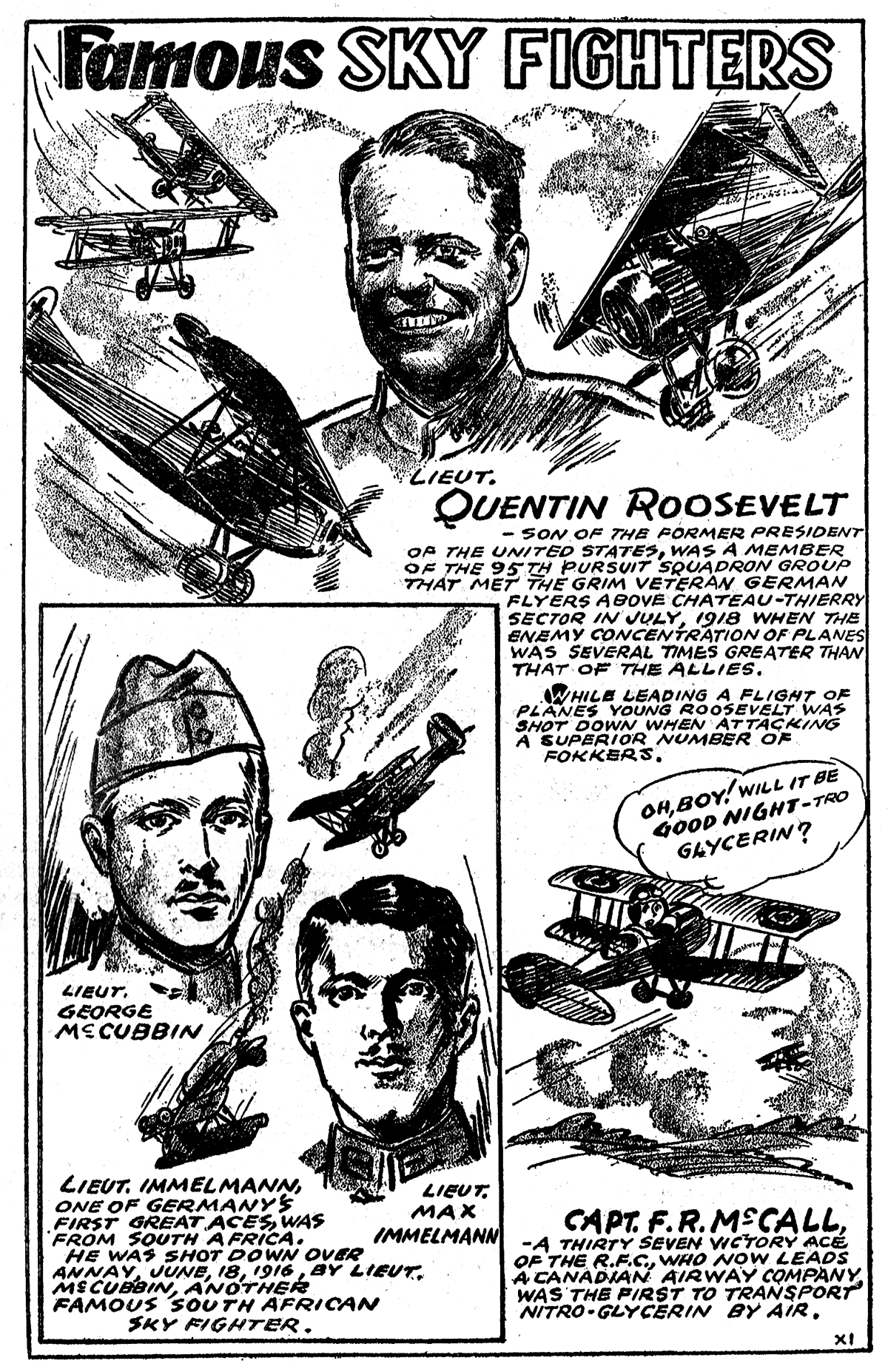
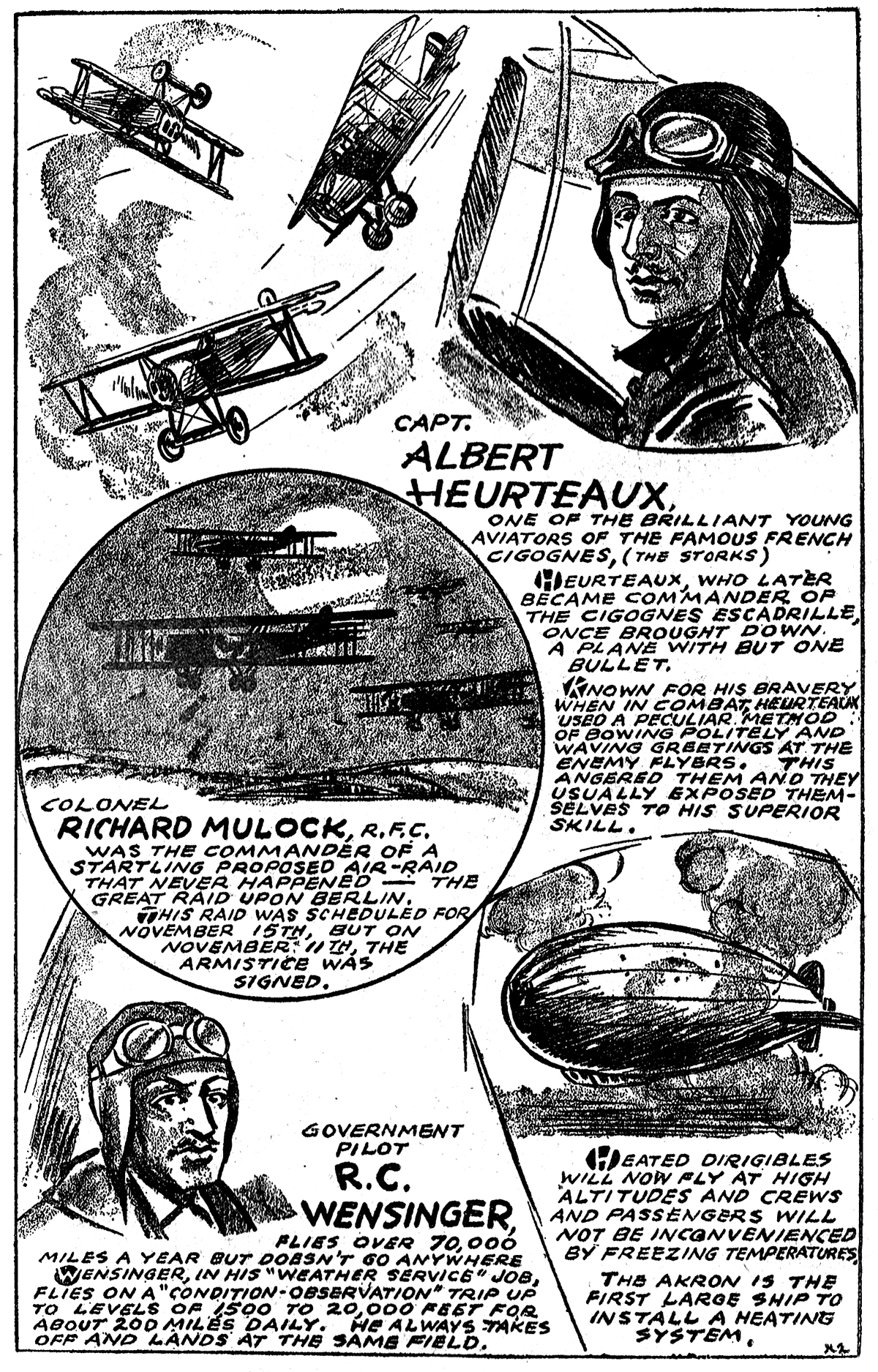
The August 1934 installment, from the pages of Sky Fighters, Features Lt. Quentin Roosevelt and Capt. Albert Heurteaux!

Next time in “Famous Sky Fighters,” Terry Gilkison features Lt. Frank Baylies, Lieut. Charles Nungesser, and Capt. Bruno Loezer—”The Swordsman Ace”! Don’t miss it!

“Famous Sky Fighters, July 1934″ by Terry Gilkison

Link - Posted by David on August 15, 2018 @ 6:00 am in

STARTING in the October 1933 issue of Sky Fighters and running almost 5 years, Terry Gilkison’s “Famous Sky Fighters” was a staple of the magazine. Each month Gilkison would illustrate in a two page spread different Aces that rose to fame during the Great War.

Although Gilkison was probably better known for his syndicated newspaper work, he also provided black and white story interior illustrations for pulp magazines. His work appeared in Clues, Thrilling Adventures, Texas Rangers, Thrilling Mystery, Thrilling Western, and Popular Western. Gilkison provided similar features in a few other Thrilling Publications—there was “Famous Soldiers of Fortune” and later “Adventure Thrills” in Thrilling Adventures, Famous Crimes” in Thrilling Detective, and the fully illustrated air adventure stories of Buck Barton “The Flying Devil” in The Lone Eagle! He signed most of this work with only his initials “T.G.” to maintain a low profile and preserve his reputation as a syndicated newspaper cartoon artist.

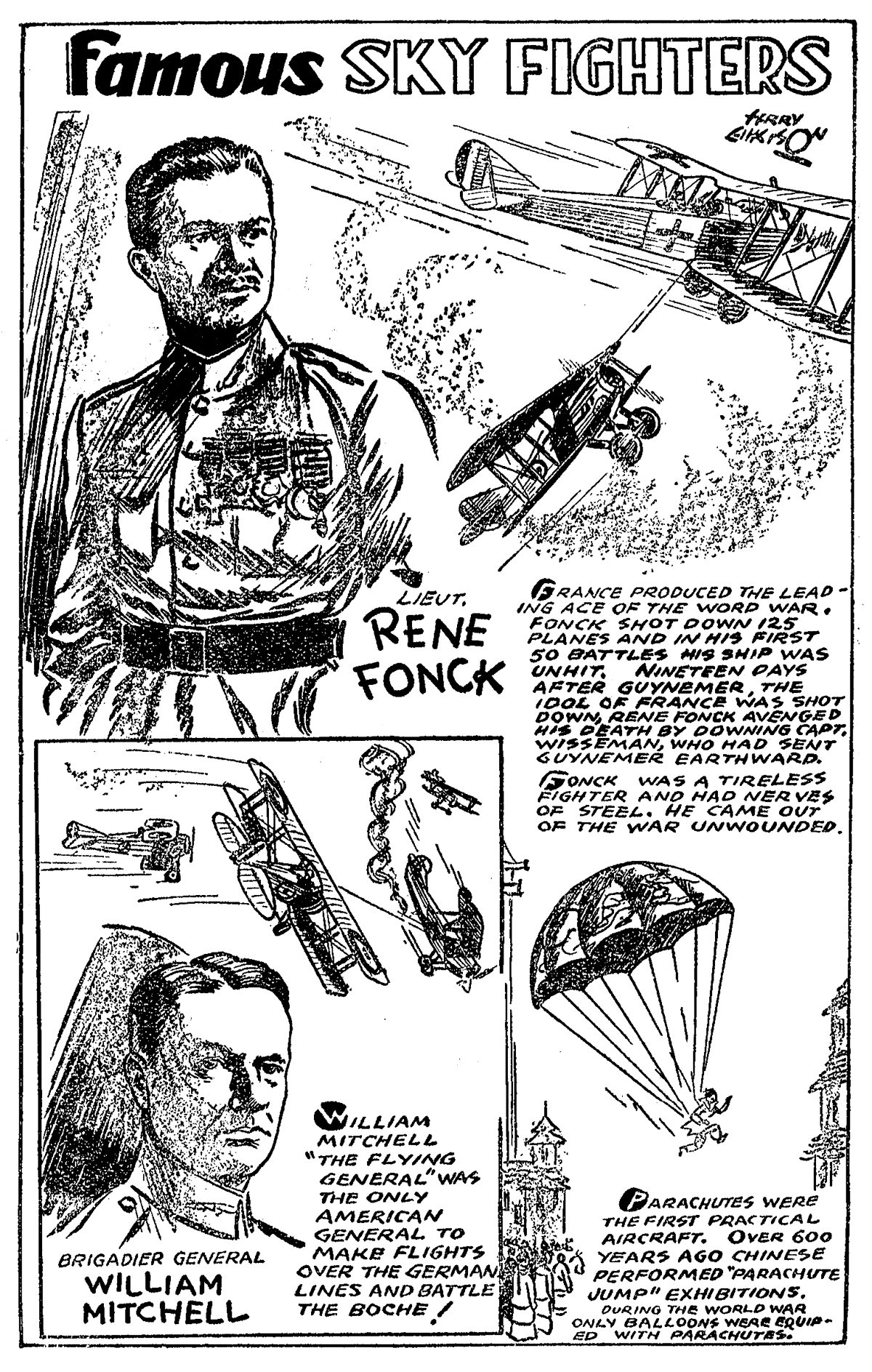
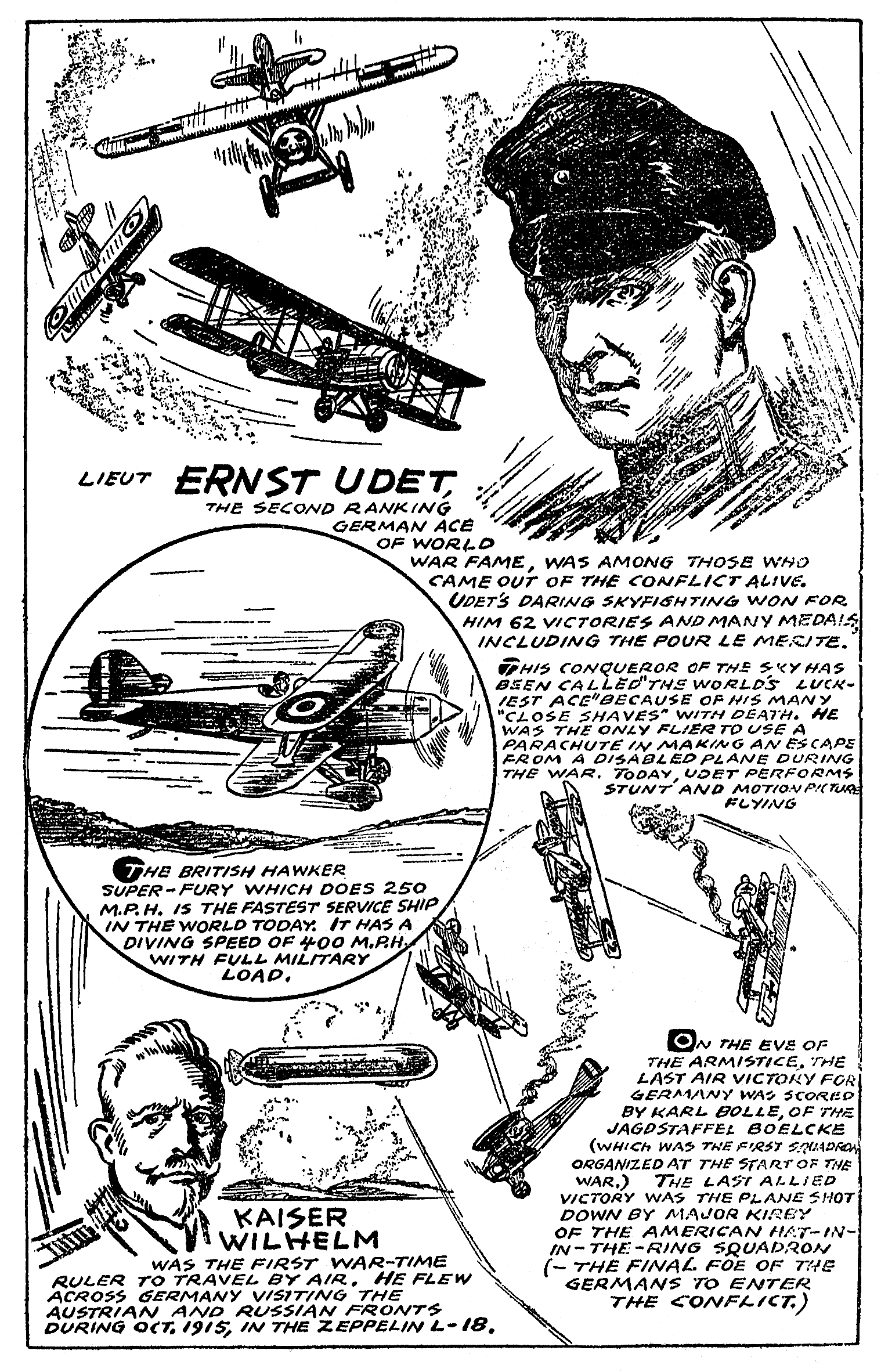
The July 1934 installment, from the pages of Sky Fighters, Features Lt. Rene Fonck, Brigadier General William Mitchell, and Lt. Ernst Udet!

Next time in “Famous Sky Fighters,” Terry Gilkison features Lt. Quentin Roosevelt and Capt. Albert Heurteaux! Don’t miss it!

Is Silent Orth really “Bullet Proof” by Lt. Frank Johnson

Link - Posted by David on August 10, 2018 @ 6:00 am in

ORTH is back! Silent Orth had made an enviable record, in the face of one of the worst beginnings—a beginning which had been so filled with boasting that his wingmates hadn’t been able to stand it. But Orth hadn’t thought of all his talk as boasting, because he had invariably made good on it. However, someone had brought home to him the fact that brave, efficient men were usually modest and really silent, and he had shut his mouth like a trap from that moment on.

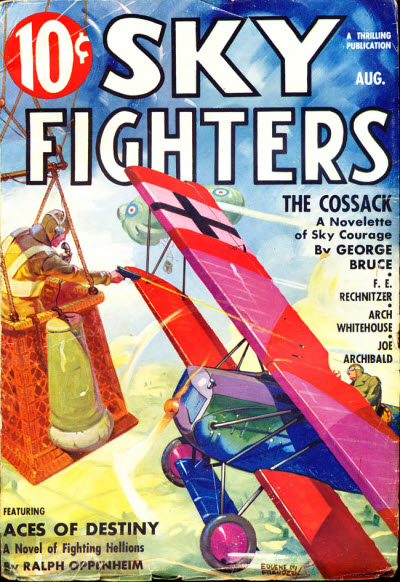
It’s a reputation that has drawn a lot of attention across the lines in Germany. So much so that their leading Ace—Stefan Weldman, the “bullet-proof” Ace—has transferred to the area in hopes of taking Orth out! And if he doesn’t get the job done, his four Staffel mates will finish the job. From the pages of the November 1934 issue of Sky Fighters, Silent Orth takes on Germany’s “Bullet Proof” Ace!

Silent Orth, Crack Flyer, Goes Gunning for Stefan Weldman, Invincible Ace of the Boche, in this Hell-Busting Story!

“Sky Fighters, February 1936″ by Eugene M. Frandzen

Link - Posted by David on August 6, 2018 @ 6:00 am in

Eugene M. Frandzen painted the covers of Sky Fighters from its first issue in 1932 until he moved on from the pulps in 1939. At this point in the run, the covers were about the planes featured on the cover more than the story depicted. Mr. Frandzen features a battle between a De Haviland Pusher and a German D.F.W. C4 on the February 1936 cover!

The Ships on the Cover

THE De Haviland planes will always th_SF_3602 be remembered in the United States by the number of D.H.s this country ordered on such a grand scale when we entered the war. The early D.H.s are not given the credit they deserve because Capt. Geoffrey De Haviland might never have had a chance to build later models if his early one had not been so good. It combatted the Fokker menace back in 1916 when the Germans had things their own way in the air. When these D.H. Pusher biplanes came along the Allied airmen began to take heart. At last they had a machine that could outfly the Fokker which was the scourge of the Front. The D.H. Pusher was similar to the earlier F.E.s but much superior in speed. They had only two bays of struts and were simplified considerably in the tail boom construction.

The British airmen in the bucket seat of the D.H. Pusher on the cover had confidence in their machine when it proudly paraded its course through the skies. They had a speedy ship with a front gun to blaze the Germans from the air when those hitherto superior, overconfident airmen darted across Allied territory for a looksee at all the preparations being made on the ground.

On this occasion they met not one of Mr. Fokker’s products but a German D.F.W. C4 (Deutsche Flugzeug Werke). This two-seater carried a 200 h.p. Benz motor. The C4 had radiators on the sides of the fuselage directly in the slipstream which made it possible to use a small radiator to run a big engine, by which trick the Germans gained efficiency. The wings were not swept back but had dihedral.

Funny-Looking, But—

Funny-looking crates, those old flying bird cages, but some pilots who flew them still brag about them and swear that it was a wonderful sensation to fly a pusher. Of course, there was the uncomfortable feeling of having a heavy engine nestling behind your seat to squash you flatter than a pancake in a crackup.

When the tractors replaced the pushers all but a few aviation experts predicted that pushers would never more waddle through the air. But along toward the end of the war the British Vickers Co. came out with a single-seater Pusher with two front guns. It was powered with a better engine than the old Pushers used and could tick off over 120 miles per hour low down; and low down was the place it did its job, right over the German trenches. It was built for ground strafing and it was a honey to fly. Again the anti-pusher crowd said “It’s a freak, a last try using an obsolete principle. There ain’t no such thing as a good pusher.”

That old Vickers Vampire was just about 
the swan song of the pushers for many 
years. And then, nearly fifteen years after
 the end of the World War the French 
Hanriot Company brought out one of the
speediest, slickest-looking fighters of the
 year, the Hanriot H-110-C1. And believe it
 or not, it was a PUSHER that could slice
 through the air at the very nice speed of
 220 m.p.h.

Lightning-Quick Action

The German D.F.W. on the cover had a pilot who had knocked down several of the earlier slower moving pushers. He saw an easy kill and got careless. One moment the D.H. Pusher was in front of him. The next it had pulled a lightning-like maneuver which no ship other than a tractor had hitherto been capable of Lewis slugs cracked and rattled into the German ship, knocking the front gun’s firing mechanism cock-eyed. Then the stream of lead slid back and ripped a section of canvas from the observer’s pit. That worthy never got in a shot, his hands were too high in the air clawing at the clouds.

The British gunner pointed towards the Allied rear lines. The German pilot nodded his head and slanted his ship down, swearing solemnly that if he ever escaped and got into the air again he’d be mighty careful to keep out of the way of pushers.

The Ships on The Cover
Sky Fighters, February 1936 by Eugene M. Frandzen
(The Ships on The Cover Page)

« Previous PageNext Page »