


Looking to buy? See our books on amazon.com Get Reading Now! Age of Aces Presents - free pulp PDFs

My Most Thrilling Sky Fight: Capitaine Georges Madon

Link - Posted by David on November 16, 2016 @ 6:00 am in

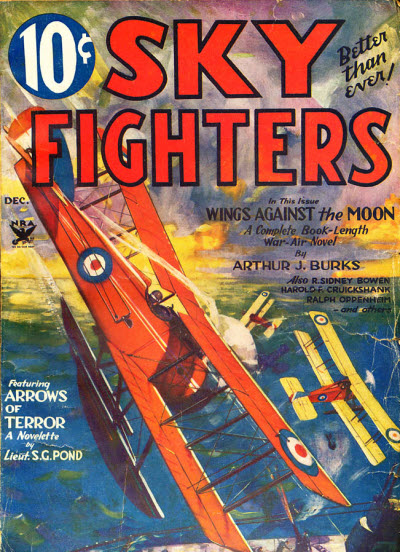
Amidst all the great pulp thrills and features in Sky Fighters, they ran a true story feature collected by Ace Williams wherein famous War Aces would tell actual true accounts of thrilling moments in their fighting lives! This week we have Capitaine Georges Madon, another great French Ace, telling of his most thrilling sky fight!

Capitaine Georges Madon was one of the most famous of the French flying aces. Along with Guynemer, Navarro and Nungesser, he furnished the spectacular flying news that filled the newspapers in the early days of the World War. He was credited with over forty victories and only the great Guynemer topped him in the list of French aces during his time on the battle front.
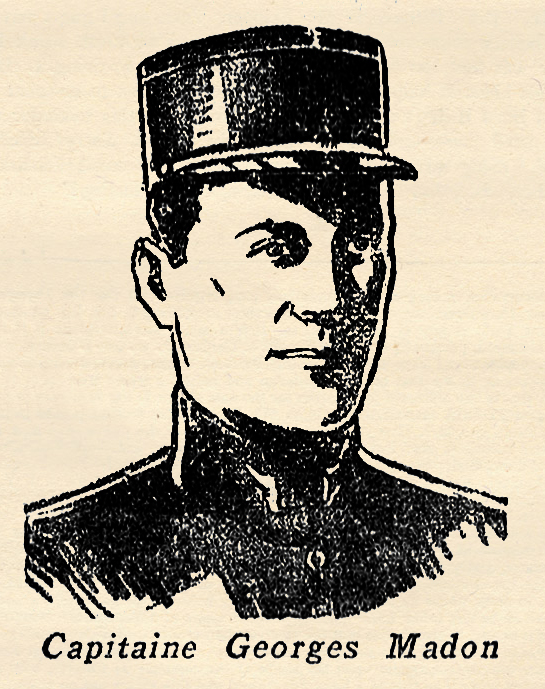
Cool, courageous and audacious, he kited the battle skies, making short shrift of all the enemy flyers who were unfortunate enough to encounter his specially gunned Nieuport fighter. Yet, when asked to describe his most thrilling air battle, he hesitated some moments before giving an account of the air collision described below. Such a collision three miles above the earth was something that was feared by every front line pilot.


AN EIGHTEEN THOUSAND FOOT FALL

by Capitaine Georges Madon • Sky Fighters, November 1933

I was flying high over the front lines. The altimeter showed 6,000 meters to be exact. I looked down over one side of my lower left wing and saw a Boche. I dived down to attack him immediately. He didn’t see me until my tracer began to crackle through his fuselage. Then he maneuvered quickly to avoid my charge. But he must have been a new pilot for he did the wrong thing. He zoomed right up into the path of my Nieuport.

There was a thunderous crash, then all went still as death. My right lower wing was torn off. The enemy plane was completely pulverized. In some manner we fell apart as we started to drop. The minutes that followed gave me some thrills, I tell you. I looked at my sick plane. The propeller was broken. Struts were torn out. Guy wires fluttered back in the growing air stream. The wing that had torn off fluttered down beside me. All was in ruins, I saw that.

But it was the atrocious, horrid thought of the fall, which was bound to end soon with a smash on the ground, that set my nerves tingling and put my mind to work.

The wreck of my plane dropped nose down for several hundred meters. Then it went into a slow spin that lasted for about 4,000 meters.

I moved my control stick, convulsively, frantically, but uselessly. The control wires had sheared away. A sickening sensation gripped me. My mind went aflame with multiple thoughts. In turn, I seemed to review in my memory, scenes of my family, of my duty in the chasse squadrons, of my captivity in Germany, of my escape, and a thousand other things. One’s memory works fast at such moments. But what was co-existent with these scenes and towered above all else was my fear of falling among the Boches.

Suddenly, by some miracle of fate, the spinning ceased. I had done nothing with my controls. Nevertheless, my sick plane slowly but surely righted itself. And miracle of miracles! It headed right toward our own lines.

I ponder with my heart still in my chest. Perhaps I shall escape death? I’ll fracture my legs! I’ll break my back! I shall surely become an invalid—but I shall live!

I shall live! Words of hope, divine words that often were, alas, the last ones faintly uttered by so many of my comrades. A shadow crosses my vision. I look, barely see some poplar trees. I try to steer through them, hit them in order to break the impact of my fall. But the stick dangles loosely in my grip. The rudder bar is pressureless beneath my feet.
I shoot beyond the poplar trees. A darker shadow looms. It is the ground!

There is a terrific crackling. A sinister thud. Flying debris. A rude jolt and jar. It is the end!

But no! From the tangled heap I succeed in extricating myself. And I had only broken my finger!
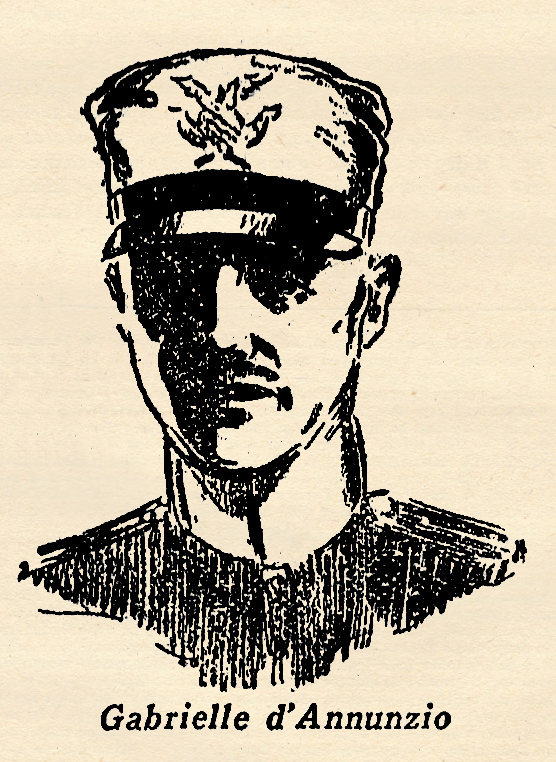
My Most Thrilling Sky Fight: Captain Gabrielle d’Annunzio

Link - Posted by David on November 2, 2016 @ 6:00 am in

Amidst all the great pulp thrills and features in Sky Fighters, they ran a true story feature collected by Ace Williams wherein famous War Aces would tell actual true accounts of thrilling moments in their fighting lives! This time it the Italian Ace, Captain Gabrielle d’Annunzio.

Captain Gabrielle d’Annunzio, famous Italian poet and dramatist and enthusiastic patriot, was one of the most colorful and forceful of Italian flyers in the early days of the World War. He enlisted early in the most spectacular branch of the army, the Italian Air Corps. Soon after completing his training he was assigned to a bombardment squadron which was charged with harassing the then fast-advancing Austro-German armies, which threatened to overwhelm the brave Italian defenders and take the capitol at Home. By exerting superhuman efforts the Italians prevented that.

The following is taken from reports of newspaper correspondents at the scene of battle.


MY FIRST NIGHT FLIGHT

by Captain Gabrielle d’Annunzio • Sky Fighters, October 1933

I was nervous on that night. It was to be my first night bombardment flight. I was detailed to blow up an ammunition dump. It was necessary that this dump be destroyed to halt the advance of the victorious Austro-German armies. I was not sure of myself, but my heart bled for my country. I must succeed, I vowed. It was not fear of death that made me nervous, but fear of not being able to accomplish my mission.

We took off shortly after midnight. The moon was shining brilliantly on the beautiful Italian hill country over which we were flying. Soon we were across the lines, and the Austrian anti-aircraft batteries opened up. I thought I was high enough to be out of range, but a dazzling red mushroom flare that burst above me made me realize I was mistaken.

I tried to climb, then, and nosed up. But my bomber was too heavily loaded and the controls wouldn’t answer. For an instant I was panicky, I swung right and left when the shell began to burst nearer and nearer to me.

After a few minutes of that, I saw that I could dodge the shrapnel. The feeling of panic left me. I grew confident and headed directly for my target, which was easily recognized in the shower of moonlight. I sent the bomber down low, through a hail of shrapnel and machine-gun bullets. But I didn’t worry about them. I was over the dump and knew I could destroy it the moment I dropped my bombs.

I went down lower and lower to make sure I wouldn’t miss. Finally I let go and zoomed up. There was a brilliant flare that filled the whole sky. Then a terrific concussion that shook my bomber like it was fragile cardboard. But I didn’t care. I was happy. I had accomplished my mission. Whether I returned or not was inconsequential.

But I did get back, and safely. I knew then that I could handle a night bomber. I was never nervous about night bombardment any more and I hadn’t failed my country.

“Sky Fighters, January 1934″ by Eugene M. Frandzen

Link - Posted by David on October 31, 2016 @ 6:00 am in

Eugene M. Frandzen painted the covers of Sky Fighters from its first issue in 1932 until he moved on from the pulps in 1939. At this point in the run, the covers were about the planes featured on the cover more than the story depicted. On the January 1934 cover, It’s a battle of the Allied piloted Sopwith Camels against the German Albatross DVs!

The Ships on the Cover

THE SHIPS on this th_SF_3401 month’s cover are the Sopwith Camel and the Albatross D.V. Both were outstanding in their class during the World War.

The Sopwith Camel was a single-seater tractor biplane which had such fine fighting qualities that the pilots of the Royal Air Force gave this ship credit for the successful end of the war in the air. Many of the best known British aces flew Camels at some time in their careers.

A Tricky Little Scout

Collishaw alone brought down over twenty enemy aircraft in this ship out of his sixty confirmed victories. Barker flew a Camel over the Alps at the head of a British squadron which utterly routed the Austrian air forces. Many American squadrons were equipped with Sop Camels. George Vaughn and Elliott White Springs ran up their victories in them. Despite the effectual qualities this little scout possessed, it had plenty of tricks. It was the doom of many novices, but in the hands of an experienced pilot its trickiness could be turned to an advantage.

It had a tendency to rotate the plane instead of the propeller. However, there wasn’t a ship at the front which could out-maneuver it below ten thousand feet. At that height it made 113 m.p.h. It was equipped with a Clerget motor of 130 h.p. The maximum height was 9 feet, length 18 feet 9 inches and the span 28 feet. It could climb to 10,000 feet in twelve minutes.

Two Albatross D-5’s pitted against two Sopwith Camels is a fight in which either side may win. Much depends on the pilot.

An Exciting Fight

In the fight pictured on this month’s cover the Albatross scouts are in a bad way. One is a smoker trying vainly to shed the persistent Camel on his tail. The other has his guns blazing down at an enemy machine-gun nest. The broadside he is receiving from the Camel barging in from his side is dangerously close. Theoretically those two Albatross’ should have the bulge on the slower Camels. But the Boche ships are heavier, harder to jerk around. Those little Camels have been flashing in and out, lashing the Germans with Vickers slugs; completing a dangerous maneuver and being set for another before the foe could get organized.

Family Tree of the Albatross

The Albatross D-5 brought to the front in 1918 had a long line of ancestors. The beginning of its family tree was in the dim past—the days of the “Taube” school of airplane design in 1911. From those Taube-like types of monoplanes through the slow moving biplanes of early war days, mostly two-seaters, to the trim ship on the cover was a big jump. The Albatross scout of 1915 had a speed of 80 m.p.h. with its Mercedes 130 h.p. engine. The Albatross D-5 pushed along at from 135 to 140 m.p.h. without any trouble at all. Its Mercedes motor was stepped up to 220 h.p. by that time.

When any of these husky German ships were attacked the Allied aviators treated them with plenty of respect.

The Ships on The Cover
Sky Fighters, January 1934 by Eugene M. Frandzen
(The Ships on The Cover Page)

Next time, Mr. Frandzen features the Hanriot 3 C.2 and the giant L70 Class Zeppelin!

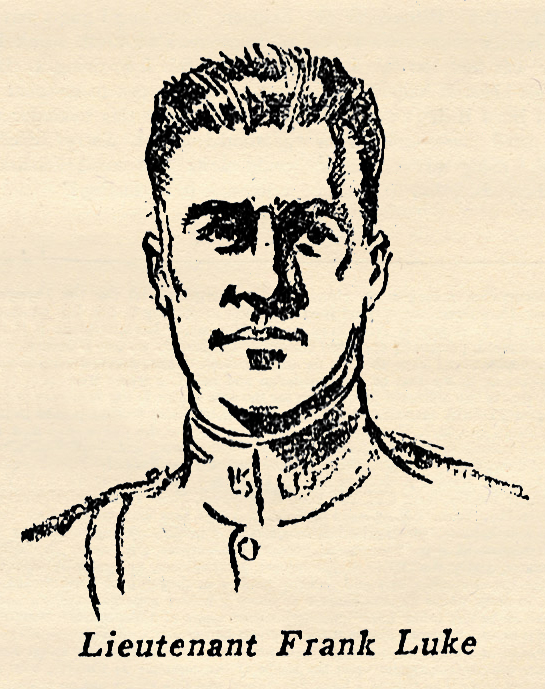
My Most Thrilling Sky Fight: Lieutenant Frank Luke

Link - Posted by David on October 19, 2016 @ 6:00 am in

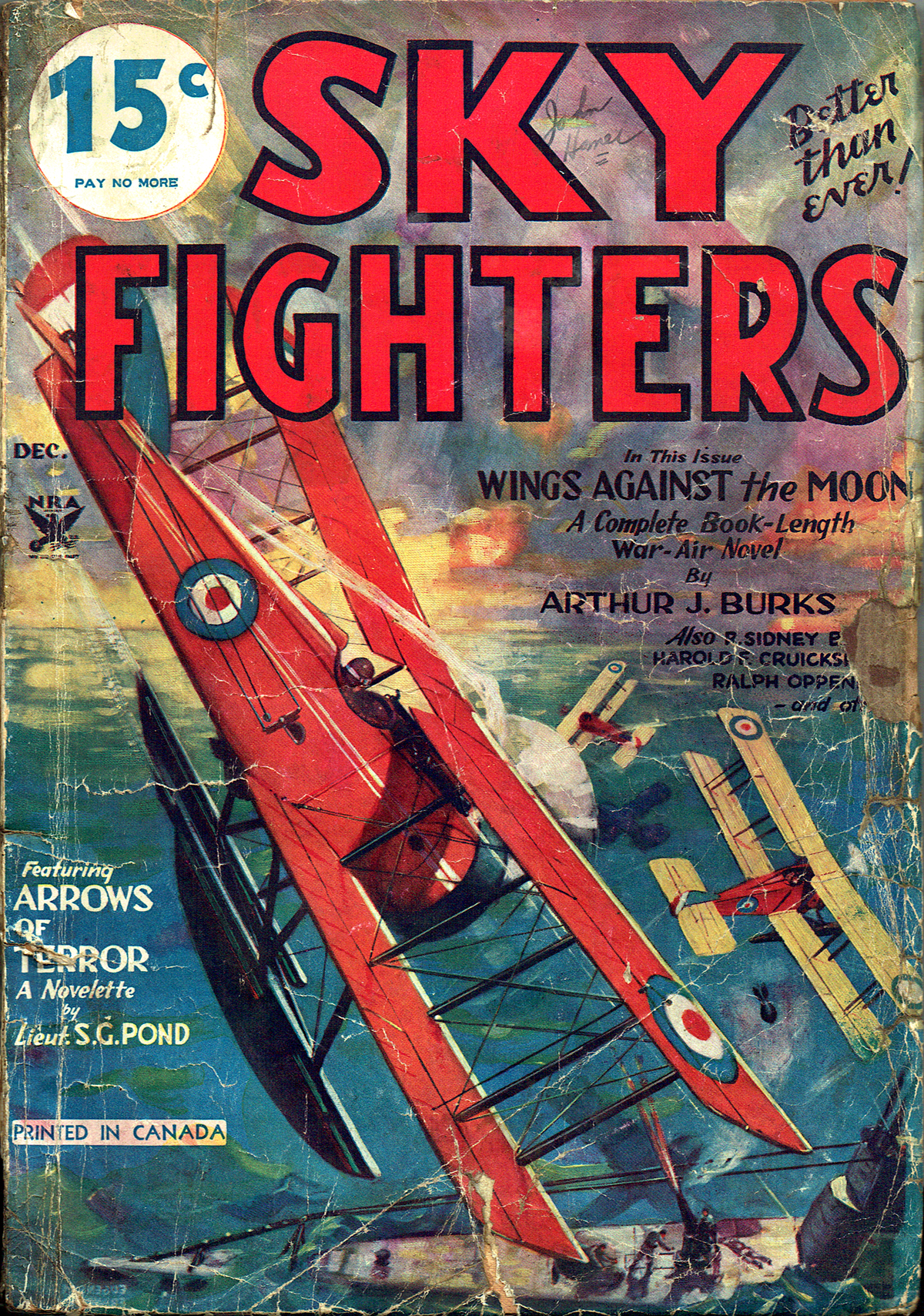
Amidst all the great pulp thrills and features in Sky Fighters, they ran a true story feature collected by Ace Williams wherein famous War Aces would tell actual true accounts of thrilling moments in their fighting lives! The man considered America’s second greatest Ace, Frank Luke tells us about his most thrilling sky fight.

Frank Luke! How much the name means to those few who knew how he fought and died. His front line career was short, hectic and dynamic. He blazed across the war-torn skies of France like a flaming meteor. Very few people ever heard of Luke during his short but Sensational career on the Western Front. His fame and name came after he died. He is recognized now as the most courageous, the most audacious war bird that ever handled a control stick and pressed the Bowden triggers mounted on it. Only Eddie Rickenbacker topped him in the final list of American Aces after the War was ended. Rickenbacker was officially credited with 26 victories. Frank Luke had 21. But the comparison is hardly fair to Luke, for Rickenbacker was on the front for almost six months, while Luke’s front line career lasted only a little over two weeks. Even in that short space of time he had worked up to the top and was the American Ace of Aces when he died. There is no telling what, score he would have run up, if fortune had been more in his favor. The story below he told to Sergeant John Monroe, who was a favorite of his.
 

VENGEANCE FLIGHT

by Lieutenant Frank Luke • Sky Fighters, October 1933

Which was my most satisfactory fight? Well, all of them that ended with the other fellow going down to his death were pretty satisfactory. But there is one that stands out above all my victories so far.

That’s the fight in which I got the Hun who knocked down the Englishmen in the crippled De Haviland. I didn’t like the way that Hun waited for the Limey’s motor to go bad before pouncing on them. They didn’t have a chance. One burst was all the Hun needed. Being on the ground myself at the time, I didn’t think I had time to get in my ship and get up there in time to get in on the fight.

But when I saw the D.H.’s wing fall off and the ship go down in a spin, I felt a peculiar feeling inside me. My Spad was ready on the line. I hopped into it and took off. By the time I had gained altitude the Hun was streaking for home. But I was determined to get him. It was a long rear-end chase and getting dark fast.

No matter, I caught the bird about five kilometers inside his own lines and piqued down on his tail with blood in my eye. I held my fire until I was about a hundred meters behind his streaking Fokker, then I let go with both guns.

But the Hun had been watching me, I guess. He jerked up in a screaming zoom and my shots went low. I got mad, threw my Spad into an abrupt chandelle right on his tail. He Immelmanned away. I followed. We went round and round.

He didn’t shoot at me, but was damn successful in keeping away from my bursts. I was getting madder and madder every second, and threw a lot of slugs, uselessly. After a few moments of that going round and round, I got wise to myself. The Hun was making a monkey of me, just playing me out.

Understand, I was plenty far back in the enemy lines and it was getting dark fast. He knew he would get me if he just strung out the fight a little. Within a few more minutes there was bound to be a whole sky full of his mates come to his assistance. He knew that and was just marking time. I sensed that after a while.

It made me mad again, to think I had been such a fool. But I didn’t go off my nut. I kept my head, and circled round and round with him some more, watching from the corner of my eye for other Huns, and keeping my thumbs off the Bowden trips. I didn’t intend wasting any more slugs until I had a sure shot.

That chance came before I expected it. He showed his tail surfaces just momentarily. I pressed the trips. The tracer bored through the fuselage behind his back. That was all there was to it. The Fokker plunged over in an abrupt dive and went roaring into the earth with the motor full on.

I beat it for our advance landing field then with my motor wide open. And good thing they had thrown some gasoline in the sand barrels and lighted it. With the light from those flares I was able to sit down without cracking up.

I won’t get any credit for that victory, though. There weren’t any observers. But what the h—! I got him after he got the crippled Englishmen. That’s reward enough!

It was my most satisfactory fight.

“Sky Fighters, December 1933″ by Eugene M. Frandzen

Link - Posted by David on October 17, 2016 @ 6:00 am in

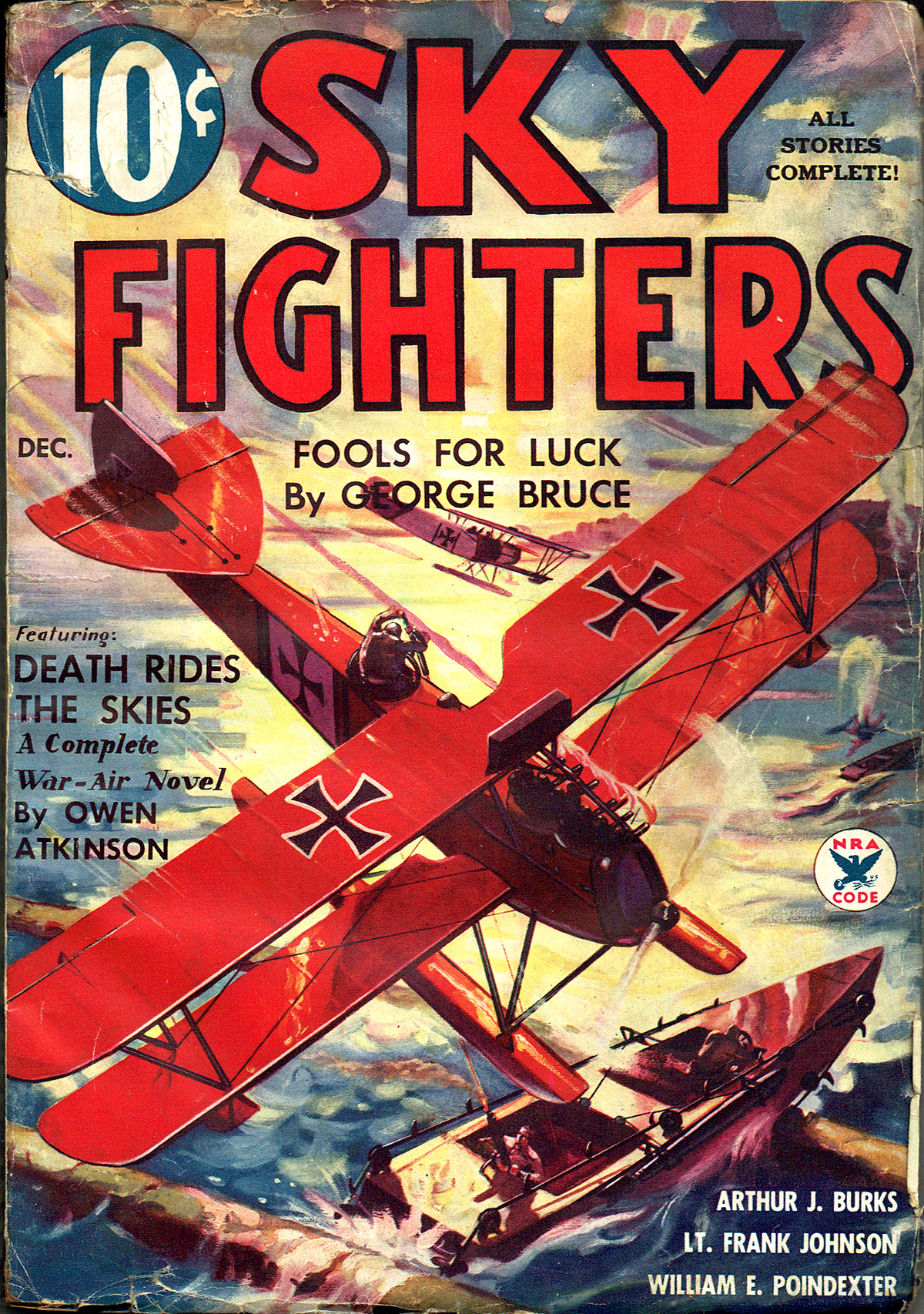
Eugene M. Frandzen painted the covers of Sky Fighters from its first issue in 1932 until he moved on from the pulps in 1939. At this point in the run, the covers were about the planes featured on the cover more than the story depicted. On the December 1933 cover, It’s a Westland N.17 Seaplane hunting for German submarines!

The Ships on the Cover

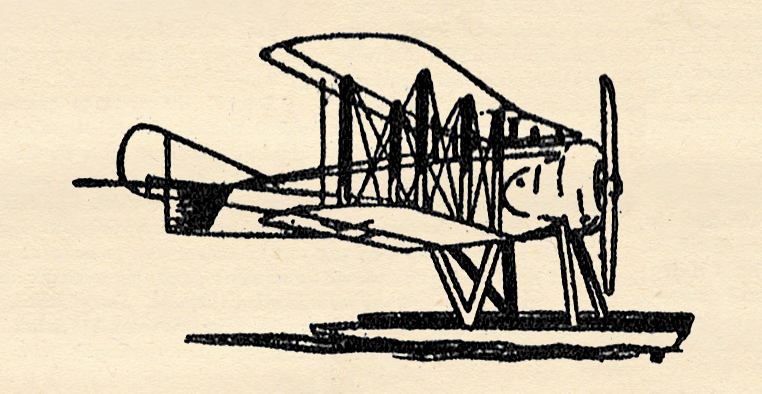
THE planes on this month’s cover th_SF_3312 are all of one type, the Westland N.17 Seaplane. It was a shipboard plane which could be stowed away below decks by folding the wings back along the sides of the fuselage.

The British had plenty of work for these little sea scouts. The North Sea and other near-by waters were the favorite lurking places for German submarines. To spot a sub with only its periscope above the surface or completely submerged could be efficiently accomplished only by a plane above. Then it was the seaplane pilot’s job to go into action with his bombs or to wireless the position of the enemy to the nearest sub-chaser.

The three Westlands pictured on the cover have caught the German submarine above water. Before it could submerge they have attacked it with machine-gun fire and with bombs. The sub’s commander has no choice but to fight back. Up comes his hidden gun which is below the deck plates in its own water-tight compartment when the sub is submerged.

Twenty seconds is all the time needed before the gun goes into action. A shell whistles by the Westland in the foreground. Machine-gun bullets from the Westlands slash through the air. Two German!! are down. Another leaps to the breach of the gun. Another shell screams at the attackers. Just at this moment the plane directly over the sub has released • bomb. The pilot’s aim is perfect. In less than a second it will hit—a twisted mass of steel plates will sink to the bottom.

Possibly in less than an hour a huge transport with thousands of our troops Aboard will steam over this very spot In the distance one of our doughboys may spot the three Westlands flying low over the water. Ten to one he’ll think, “Now, that’s the kind of a soft job to have. Nothing to do but roost up there and put in a couple of hours doing nothing to help us Yanks win the war.”

The Westland N.17 was powered by a Bentley Rotary motor. It could skim above the water at about 108 miles per hour. It’s landing speed was forty-five miles per hour when fitted with trailing edge flaps. This ship was the answer to the British Admiralty’s demand for a stable, fast single-seater scout which could be used from seaplane carriers as a fighter, sub spotter and light bomber. It came up to all specifications and was in service up to the end of the war.

Just before the battle of Jutland it was a seaplane that warned Admiral Jellicoe that German submarines were directly ahead. Possibly a different outcome to the greatest naval engagement of the World War would have been written in our history books if It had not been for the alertness of those sturdy little planes roaring back and forth across the path of British dreadnaughts.

Seaplanes directed the fire of the battleships shelling the entrance to the Dardanelles, making possible direct hits at a range of 12,000 yards.

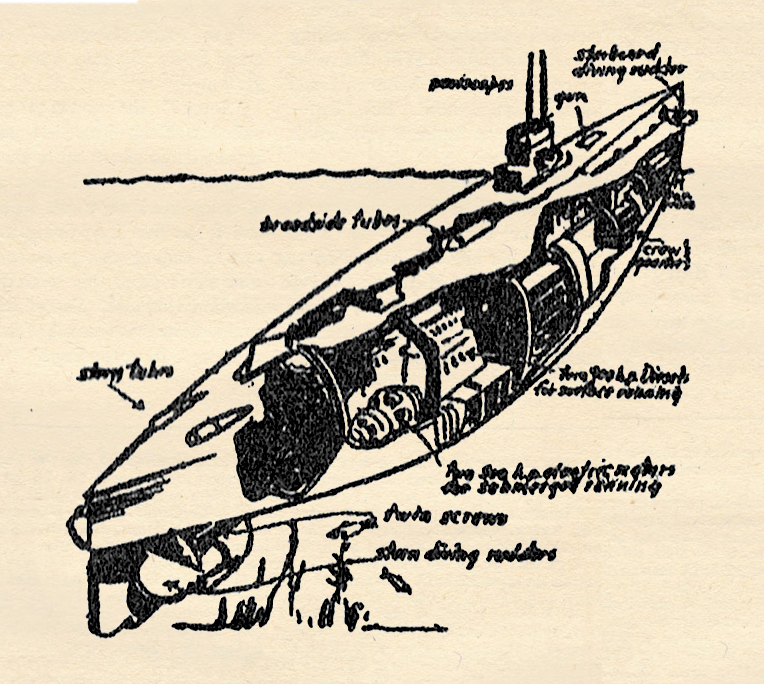
For those who care to shed their parachutes and don a diver’s suit we are including a self-explanatory diagram-drawing of a German sub. These undersea engines of destruction accounted for a loss In merchant tonnage to the Allies amounting to nearly 13,000,000 tons.

The Ships on The Cover
Sky Fighters, December 1933 by Eugene M. Frandzen
(The Ships on The Cover Page)

Next time, Mr. Frandzen features the Sopwith Camel and Albatross D.V.!

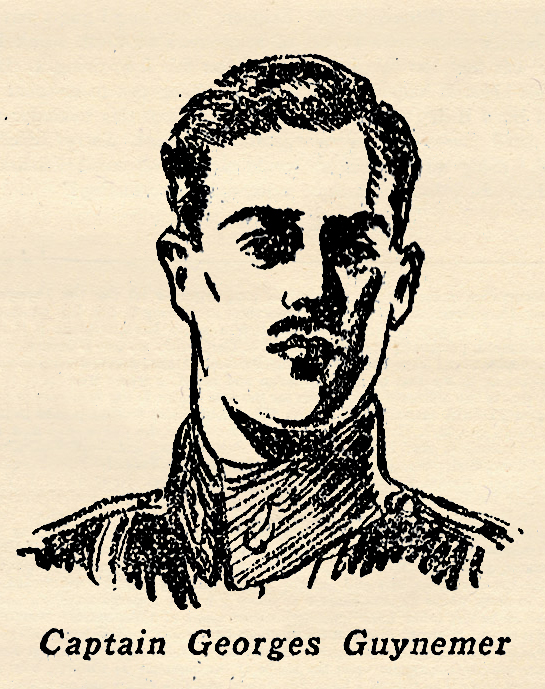
My Most Thrilling Sky Fight: Captain Georges Guynemer

Link - Posted by David on October 5, 2016 @ 6:00 am in

Amidst all the great pulp thrills and features in Sky Fighters, they ran a true story feature collected by Ace Williams wherein famous War Aces would tell actual true accounts of thrilling moments in their fighting lives! This time it’s Georges Guynemer, France’s national treasure!

Captain Guynemer, French flier, was the moat spectacular and colorful of all the flying Aces. Young, tall, slender, but in very poor physical health, he was a veritable demon in the air, He had absolutely no regard for his own personal safety. Time after time be attacked single-handed whole squadrons of enemy planes. On the ground he was shy, reserved, and spoke very few words to anyone. Whenever he came to Paris on his very infrequent leaves from the front to secure medical aid, the whole city was decorated in festive attire in his honor. He was the toast of the boulevards, the darling of the French populace. And the whole world mourned his passing when he died, shot down by a comparatively obscure German pilot, who got in a chance shot from exceedingly long range. The German pilot, Wisseman, never knew until afterward that it was the great Guynemer that he had shot down. When Guynemer passed mysteriously into the blue, he was officially credited with 57 enemy aircraft and universally recognized as the Ace of Aces of all the armies.

When asked by a newspaper correspondent to tell of his most thrilling air battle, he brought out a little black notebook from his tunic pocket and translated from it very matter-of-factly the account that follows below.


FOUR VICTORIES IN A SINGLE DAY

by Captain Georges Guynemer • Sky Fighters, October 1933

My most thrilling air battle! Let me think. Ah, I have it! It was the day I won four victories, a spring day in May, 1917. Two days before my closest rival, Lieutenant Nungesser, had downed three Boches. I was determined to beat his record.

I went out alone on solo patrol early in the morning. While cruising high behind the Boche lines, I see a lone enemy plane and make for it. A good start, I say to myself, I must not fail. I throw my Spad down in a power dive and approach very close. The enemy pilot does not see me. I press my gun trips and get in a burst. It is a good one. A wing shears from the other plane and it crashes in the woods near Corbeny. That was at 8:30 in the morning. I am elated. It was so easy. But I was foolish. I forgot to watch out of the corner of my eye.

A moment later I bank around lazily and run smack into the tracer of another Boche who has piqued down from the clouds to avenge the death of his comrade. The bullets crackle through my wings. I maneuver swiftly and escape the pilot’s hail of fire. But then the gunner in the rear seat has his guns on me. I remain calm, though, I slip off on one wing, go into a dive, then zoom up beneath. On my back I see that I have the other plane lined. I press the trips for a quick burst. It is enough. The two-seater goes down in flames toward Jusancourt.

Captain Auger comes along then, and we fly together towards another two-seater about a kilometer off, behind the enemy trenches. The enemy sees us and flees for home. I speed up and catch him, press my trips again. But sad thing! Nothing happens. My cartridge bandolier is empty. Then I realize my first flight must not have been so easy. I expended more cartridges than I thought. I turn and fly back to my own airdrome.

At 2 o’clock in the afternoon I go out again, hunting around by myself, I encounter soon a D.F.W. Ah, another chance, I say. I leap in with pulses throbbing, The other pilot shoots first, at long range. I dodge his bullets and press in closer. At close range I open up with both guns at a vital spot. I am rewarded for my patience. The D.F.W. bursts into flames. I watch it until it crashes, then go cruising around again.

I meet up with another two-seater between Guignicourt and Condesur-Snippes. If I make a record, I must get him, I think. So I am wary. I do not attack immediately. I pretend I do not see him and circle back behind the enemy lines, getting his machine between me and my own lines. Then I race back to attack from the rear. He wiggles out of my burst, and shoots back at me. We exchange bursts tit for tat. I vow I will press in with guns flaming until he falls. I do not fear he will get me first. I have confidence. My next bursts are effective. The pilot wilts in his seat. His plane goes spinning down.

Voila! I am happy.

It was my best day, four victories.

At 3:40, when my gas is low, I turn about and fly home.

“Sky Fighters, November 1933″ by Eugene M. Frandzen

Link - Posted by David on October 3, 2016 @ 6:00 am in

Eugene M. Frandzen painted the covers of Sky Fighters from its first issue in 1932 until he moved on from the pulps in 1939. At this point in the run, the covers were about the planes featured on the cover more than the story depicted. On the November 1933 cover, It’s the S.E.5 vs the Phalz D-3!

THE ships pictured on this month’s th_SF_3311 cover are the S.E.5 and the Pfalz D-3.

The Pfalz was a single-seater chaser manufactured by the Flugzeugwerke firm founded by two famous pioneers of the German aviation industry, the Everbusch Brothers.

Germany built many types of planes during the World War. The Pfalz was one of her outstanding successes. Its motor was a 160 h.p. Mercedes, capable of swinging the plane through the air at 102½ m.p.h. when at a height of 10,000 feet. Low down its 160 horses could pull it along at a slightly increased speed. It was stable laterally, but unstable directionally and longitudinally. It answered to its controls obediently, but always had a tendency to keep turning to the left in flight.

The pilot from his office gets a good view of all that’s going on in all directions except where the top wing interferes with his vision.

The heavy Mercedes made this ship nose-heavy and many an ambitious German pilot got into plenty of trouble in putting his Pfalz into a dive and keeping it there too long. He had a difficult job in yanking the front end of his sky steed into level flight. He also had to watch his step when landing or he was likely to roll up in a ball.

The single-bay “V” struts were probably adopted from the early Nieuport design. The Germans, instead of connecting the lower part of the “V” placed a short member against the lower wing, hoping to get additional strength and to be able to anchor the bracing wires somewhat apart.

Two ships coming together in the air usually means curtains for both. Boelke, the famous German Ace, was killed when his plane was barely grazed by a ship being flown by one of his pupils. Many other airmen have cracked up in this way.

In the picture on the cover it is a toss up whether the Allied pilot will get his ship down safely. His undercarriage has snapped clear of its moorings. If he can keep control of his ship for a split second, he will be able to clear the tail of the German ship and possibly bring his own plane down for a pancake landing. If he can find two trees with a gap between them of about twenty feet he can sheer off his wings and slow up his smash. In the case of the German in his wing-wrecked Pfalz there is not a doubt of his end. He is through.

The S.E.5 single-seater scout (the S.E. stands for Scouting Experimental) was about the smoothest job in its class }hat the British turned out. It was a product of the Royal Aircraft establishment. It was powered by a Hispano-Suiza 220 h.p. motor. It could do around 120 miles an hour. The downward visibility was improved by cutting away a portion of the lower plane close to the body. A Lewis Vickers gun was parked on the left side of the hood in front of the pilot. A Lewis gun was mounted on a track arrangement above the top wing. The pilot was able to pull the butt end of his gun down till he could shoot at a vertical angle at any ship which got above him. This gave him a decided advantage over the single seaters of the enemy’s ships.

The dihedral of the wings was noticeably greater than any other British ship of its time. Landing, the pilot had to be mighty careful, as did the Pfalz pilot in his ship—both ships were nose-heavy.

Major Jimmie McCudden, the British Ace, who downed fifty-three enemy planes before a Spandau bullet carrying his initials snuffed out his glorious career, swore by the S.E.5s. He claimed, as did other of his brother pilots, that it was the finest ship produced during the war. It could hold its own in any maneuver that a Boche ship might force it into and nine times out of ten come out top dog.

The Ships on The Cover
Sky Fighters, November 1933 by Eugene M. Frandzen
(The Ships on The Cover Page)

Next time, Mr. Frandzen features the Westland N-17 Seaplane and a German submarine!

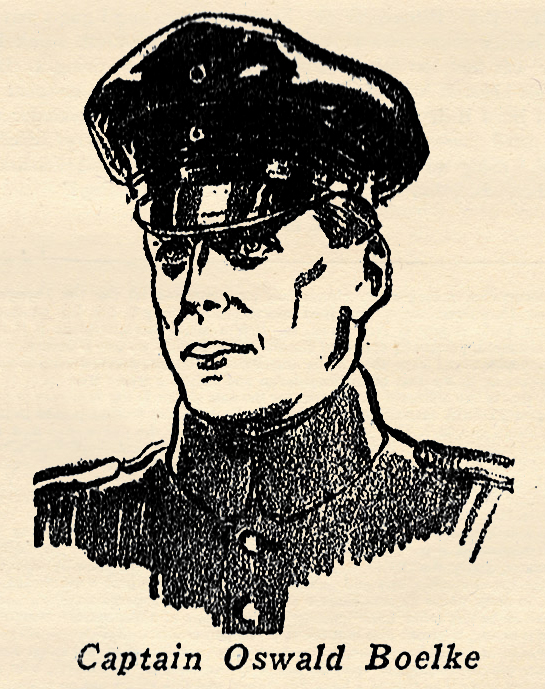
My Most Thrilling Sky Fight: Captain Oswald Boelke

Link - Posted by David on September 21, 2016 @ 6:00 am in

Amidst all the great pulp thrills and features in Sky Fighters, they ran a true story feature collected by Ace Williams wherein famous War Aces would tell actual true accounts of thrilling moments in their fighting lives! This time it’s one of Germany’s greatest air fighters—Captain Oswald Boelke!

All the heroes of the flying forces were not on the Allied side. The enemy also had its heroic figures.

Captain Boelke was among the greatest of the enemy air fighters. He reigned supreme until his death; then Baron von Richtofen came along to carry on where Boelke left off.

The German air fighting tactics varied somewhat from those of the Allies, tending more towards mass attack, emulating in that respect the German system of arms to attack in force with superior number, For that reason accounts of German air fights are not usually as spectacular or glamorous as accounts of Allied fights. Boelke’s account of his fight with a dead pilot, however, borders on the realms of fiction, and could hardly he believed if it did not come from such a practical-minded, stolid figure as was the German flying Captain.


THE PHANTOM PILOT

by Captain Oswald Boelke • Sky Fighters, November 1933

ON THE 27th of September (1916) I attacked with my patrol a flight of six English single-seaters. I knocked down one of them, and immediately picked on another. But as I whirled into the second attack, the first machine, whose pilot I thought I had killed, having seen my tracer stream right into his face, made for me. I tried to escape the charge, but nothing I did seemed to avail. The enemy plane glued right on my tail. I was very much surprised at his tenacity.

After all, I was certain that I had killed the English pilot minutes before, yet here he was, still flying around in a circle stubbornly. The fact was mysterious indeed. I flew over very close to the enemy machine to investigate, and saw that the pilot was prostrate over the gunwales of his cockpit. He certainly seemed dead.

Sure, then, that the plane could do me no harm, I left it and banked off, to tackle another Englishman whom my comrades had rounded up for me. I got him without difficulty, sending him down in a slow spin.

Then the mysterious plane with the dead pilot at the controls veered around and headed toward me.

And what a strange thing! It crept up to within fifty meters of my plane. Next thing I knew, a stream of tracer spewed from its nose. The bullets rattled through my fuselage. I nosed down to escape the slugs. The plane shot overhead, so I banked around and slid down after the spinning Englishman. When the Englishman crashed in a shell crater, the other plane seemed suddenly to straighten out and scoot for its own lines.

I followed and watched, saw it land easily in an open space behind its own lines. When it stopped rolling, soldiers from the trenches came out and pulled the pilot from the pit. They laid him out on the ground and covered him with a blanket, face and all. One of the soldiers crossed himself. I knew then my own conclusions were confirmed. The pilot was really dead. But the way that plane maneuvered with a dead hand on the control stick was positively uncanny.

It had me in a cold sweat. I finally figured out that the plane was rigged so perfectly that it really flew itself.

That it seemed to tail me was pure coincidence. As for the slugs that poured from its nose, they were merely the result of a last convulsive muscular movement of the dying pilot. But I tell you, one experience like that is enough! I would rather fight ten daring, darting Englishmen all at once, than do solitary battle with a ghost plane with dead hands at the controls.

“Sky Fighters, October 1933″ by Eugene M. Frandzen

Link - Posted by David on September 19, 2016 @ 6:00 am in

Eugene M. Frandzen painted the covers of Sky Fighters from its first issue in 1932 until he moved on from the pulps in 1939. At this point in the run, the covers were about the planes featured on the cover more than the story depicted. On the October 1933 cover, It’s a battle of a lone Salmson being harassed by some Fokker D-7s!

The Ships on the Cover

THE SHIPS pictured on this month’s th_SF_3310cover are Fokker D-7s and a lone Salmson.

The Salmson was manufactured by the French firm Societe des Moteurs Salmson. It was one of the most reliable observation ships used during the World War and was flown extensively by the French. The Americans and Italians also used it to good advantage.

Its engine was a Salmson 260 h.p. radial turning over 1500 revolutions per minute. The cylinders arranged radially like the modern Wrights were mounted around a two part crankcase. Nine tubes brought the exhaust to a collector, formed as a ring and arranged in front of the cylinders. This is the outer rim of the nose of the ship.

The cylindrical shape of the nose with its numerous ventilating slits is distinctive. In fact it can be mistaken for no other war-time ship.

The span of the Salmson on the cover is 39 ft. The length 27½ ft. Its top speed was just under 120 m.p.h. It could climb to 10,000 ft. in 18 minutes.

Although this ship was far ahead of its time in streamlining, it had a certain bulky appearance that suggested it might be a stubborn brute when answering to its controls. Just the reverse was true. It could be taken up carrying a pilot and an observer and made to do things and go places.

Therefore the predicament in the picture may not be as serious for the Allied airmen as one would think at the first glance. The pilot has rolled his ship so that his gunner can blast the Fokker zooming up from below at the rate of 800 feet per minute. The pilot’s front gun is lined up on the tail of a second Fokker hammering out a stream of Vicker’s slugs.

Downing these two “N” strutted German planes will cut down the odds tremendously. But as long as even one of these blunt-snouted German pursuit ships remain in the sky the Allied flyers have plenty to worry about.

The Fokker was considered Germany’s best fighting plane produced during the war. It was a radical change from her ships which followed the sweep-back design of the Taube wing construction. There were no graceful sweeping lines on Tony Fokker’s bus; just a business-like ruggedly constructed engine of destruction. It could match any maneuver of an Allied ship except in diving.

In a dive it had a tendency to pull up. Many of its opponents, getting in a tight fix with a D-7 and seeing Spandau slugs lacing fabric to ribbons got away from seemingly certain death by opening wide their throttles and diving toward the earth.

The Fokker was powered by the famous Mercedes 160 h.p. motor, the most efficient of many fine power plants produced by German engineers. This engine had such stamina and dependability that some Allied pilots removed them from captured German planes and placed them in their own ships.

The entire fuselage assembly of the Fokker was constructed of steel, even including members where wood is almost universally used. The wings, reversing the steel construction principally used in the fuselage, were made entirely of wood.

External bracing wires are not used between the wings. Both upper and lower wings are without dihedral.

Salmson and Fokker ships were highlights of ingenious designers’ skill. Radically different in design, but both capable of doing their allotted jobs in a businesslike manner.

The Ships on The Cover
Sky Fighters, October 1933 by Eugene M. Frandzen
(The Ships on The Cover Page)

Next time, Mr. Frandzen features the S.E.5 and Phalz D-3!

“Sky Fighters, December 1934″ by Eugene M. Frandzen

Link - Posted by David on May 30, 2016 @ 6:00 am in

Eugene M. Frandzen painted the covers of Sky Fighters from its first issue in 1932 until he moved on from the pulps in 1939. At this point in the run, the covers were about the planes featured on the cover more than the story depicted. On the December 1934 cover, It’s a battle of the Sea as the Phönix Seaplane is attacked by an Austrian Sea Tank!

The Ships on the Cover

TANKS, bristling with machine-guns th_SF_3412 and one pounders, crawled on to the muck and mud of the British front near Cambrai during 1916. Slowly these squat engines of destruction inched closer to the German hordes. Relentlessly they smashed the Boche lines, literally buried them in their supposedly impregnable trenches.

Tanks from that day on held a major position in the War’s spotlight. Not only on land did the tanks crush the enemy, they did things on the water.

A Slick Stunt!

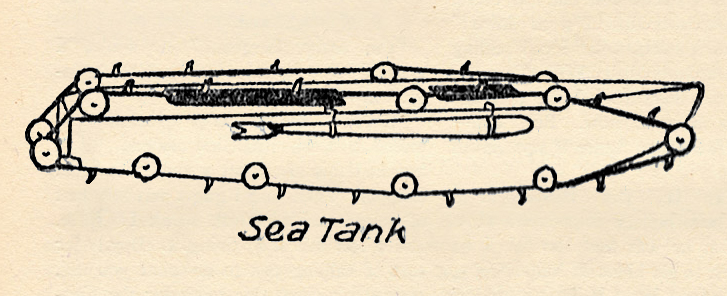
About 400 miles southeast of Cambrai on the Adriatic is the fortified port of Pola. During the war the Austrians were top men of this strategic spot. In 1916 the Italians barged in with a flock of torpedo boats and raised hell with things in general, but it was not until 1918 that they pulled one of the slickest stunts of the whole war. They rigged up a small speed boat with geared cables running along each side just as a tank’s tractor treads are placed. Steel claws on this tractor cable made this boat literally a sea tank. It could do anything on the water that its famous iron brother could do on land.

Across the mouth of the harbor of Pola the Austrians had constructed stout obstructions which would frustrate any more raids from the Italian mosquito fleet. But they had not figured on the gnat fleet. That fleet consisted of two boats shown on the cover. Each boat carried two torpedoes, one swung on either side, two men and a machine-gun.

Bottled up in the harbor was the Austrian fleet. Vigilance had somewhat relaxed, the Austrians felt their position to be impregnable from sea raids.

And then out of the Adriatic two small strange-looking craft pounded across the choppy waves straight up to the harbor barriers. They slowed down, eased their noses against the wall, gears were meshed and the endless chain of iron claws scratched at the wall, dug in, held and the prows of the tiny raiders eased over the top. Slowly the boats were heaved over the first barrier. Down splashed their noses. One eased over the second obstruction and tore through the inner harbor toward the Austrian fleet.

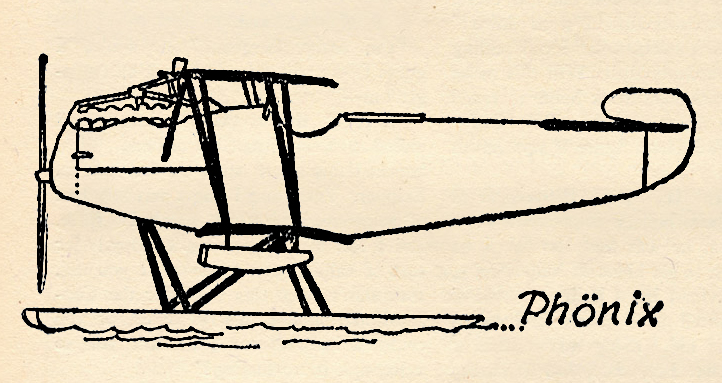
Sirens screamed, land batteries roared. The battleships brought their guns into position and blazed away. Two Phönix seaplanes careened off the water, clawed their way into the air and dove on the brazen raiders. Down swooped one of the planes, front guns lacing the sea tank just pulling itself over the second obstruction. The after machine-gun on the sea tank bucked and jerked as its gunner arced it to meet his diving foe. The observer in the rear of the Phönix pushed his gun over the side, blasted slugs down. One bullet hit a vital part of the sea tank’s mechanism. Its engine sputtered, went half dead. Score one for the Austrians.

Two Famous Firsts

But the second sea tank miraculously raced safely through the gauntlet of falling shells and the fire of the second Phönix. The machine-gun went into action on the second sea tank and the pursuing seaplane’s propeller sprayed into a thousand bits. Score one for the tanks.

On went the tiny boat until at blank broadside range it released its two torpedoes at the 20,000 ton dreadnaught. A terrific concussion shook the harbor. Slowly the majestic fighting ship listed, shuddered, and sank.

One tiny, battered sea tank clawed its way out of the harbor and limped slowly across the choppy surface of the Adriatic toward home. Two famous firsts for the tanks; 1916 at Cambrai—1918 at Pola.

The Ships on The Cover
Sky Fighters, December 1934 by Eugene M. Frandzen
(The Ships on The Cover Page)

Next time, Mr. Frandzen features the Fokker E.1 and the F.E.2!

My Most Thrilling Sky Fight: Captain Albert Ball

Link - Posted by David on May 18, 2016 @ 6:00 am in

Amidst all the great pulp thrills and features in Sky Fighters, they ran a true story feature collected by Ace Williams wherein famous War Aces would tell actual true accounts of thrilling moments in their fighting lives! This time it’s British Captain Albert Ball’s Most Thrilling Sky Fight!

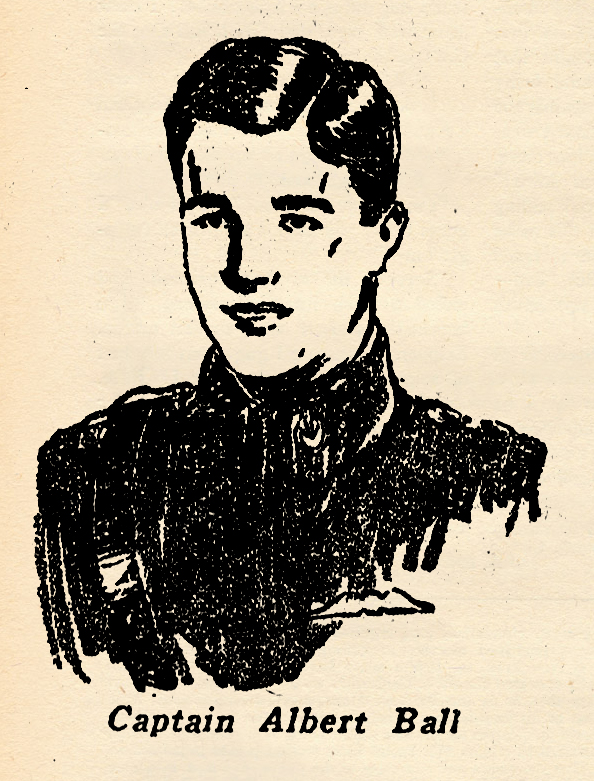
Captain Albert Ball was the first of the Royal Flying Corps pilots to make a distinguished record. Unlike the French, the British made no mention of their air pilot’s victories. One day Ball wrote home that he had just counted his 22nd victory. His mother proudly showed this letter to her friends. Ball was disbelieved.
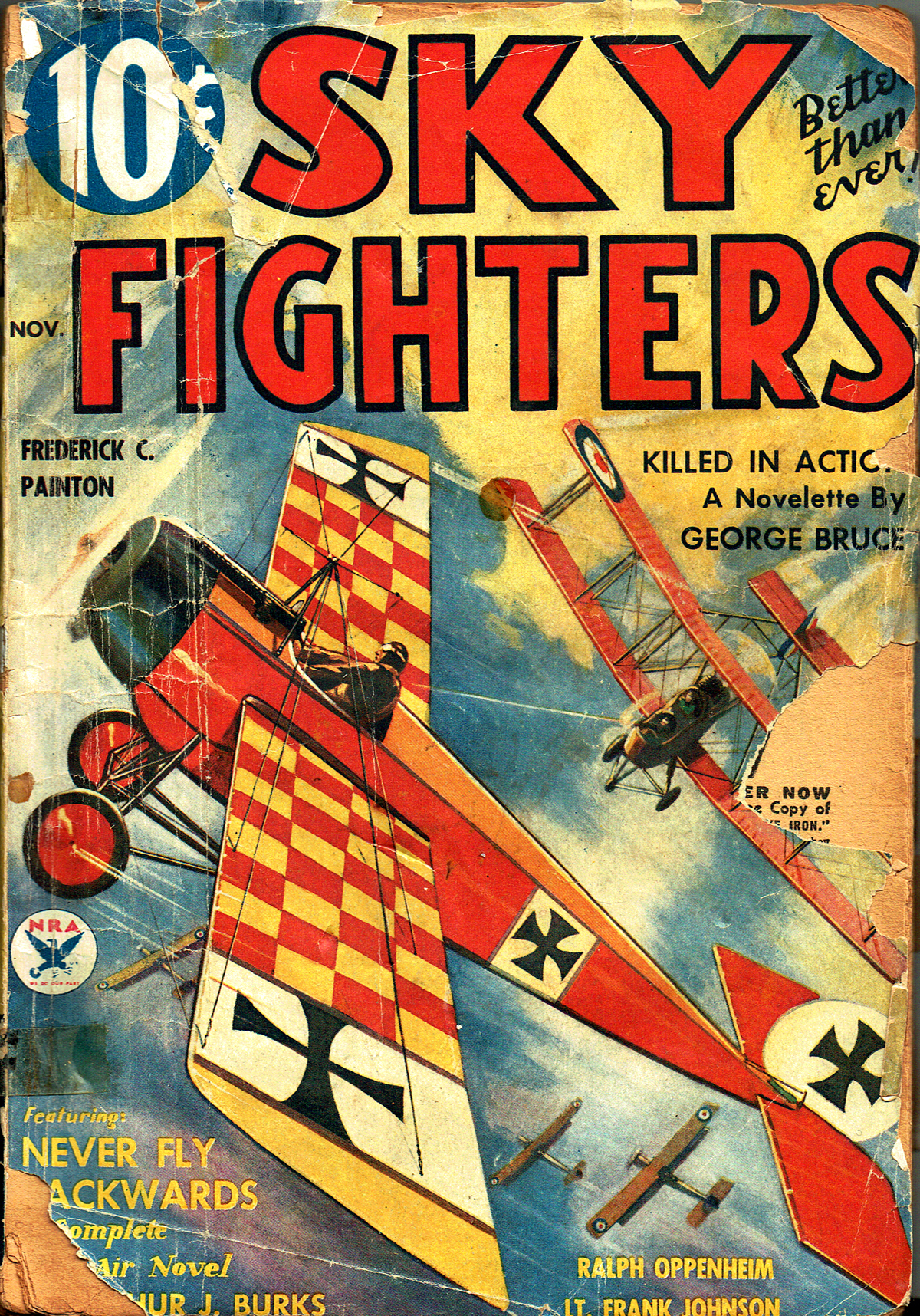
It was beyond belief at that time that any single pilot could have shot down so many enemy planes. Ball was finally vindicated. From that time on the British publicized the exploits of flying aces. Ball shot down 43 enemy planes and one balloon, being at the time of his death the Ace of Aces of all the armies.

He received every decoration the British Army could give him, including the Victoria Cross. He was killed in a new British triplane by the younger von Richthofen the day after America entered the War.

The account below is taken from a letter to his family in Nottingham.


AN ENGLISH ACE’S BEST FIGHT

by Captain Albert Ball • Sky Fighters, December 1933

WHILE cruising high over my own lines I spotted a formation of eight enemy machines about 5 kilometers away. They were well within their own lines, so I circled around slowly, watching, waiting for them to come after me. But they did not.

I decided then to do the attacking myself. The Hun formation let me come on without any apparent effort to scatter. I had my thumbs on the trigger trips, but I was determined not to fire until I got within deadshot range. I knew I had to knock down my first target to shatter their morale. Down, down I went, expecting Hun fire all the time. But oddly none came. They usually fire at very long range. But in another hundred yards I saw why they withheld fire. All at once they opened up simultaneously with a steady stream of slugs.

I was diving so fast and so steep that I couldn’t swerve off from that hail of lead. I had to go through run the gauntlet. I did, diving even steeper, trusting my life to the hands of Fate. The slugs sieved through my ship. I held my breath, shoved on my cockpit, ducked my head, won through without getting nicked in a vital spot.

Before the gunners could swing their muzzles and center me, I pulled up in a climbing zoom, nosing right into the blind belly of the nearest Hun. At fifteen meters I pressed my triggers. The pilot crumpled over. The ship went spinning down. I went over on my back, straightened out, lined another. It burst into flames with my second salvo of fire.

The German formation was completely disorganized now. They turned and fled in all directions. I chased one, centered my fire from directly behind. My bursts were effective. A wing crumpled, collapsed. It went down. I banked, and took after another, caught up with him, gave him the same dose. The ship went spinning down. Four in one fight! It was a record for me.

I banked and chased the other three far into Germany. But had to give up before I caught them. My petrol was running short, and I have an unholy fear of being forced down in enemy territory.

“Sky Fighters, November 1934″ by Eugene M. Frandzen

Link - Posted by David on May 16, 2016 @ 6:00 am in

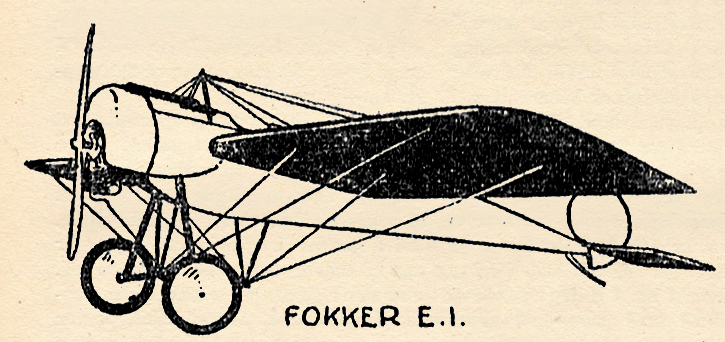
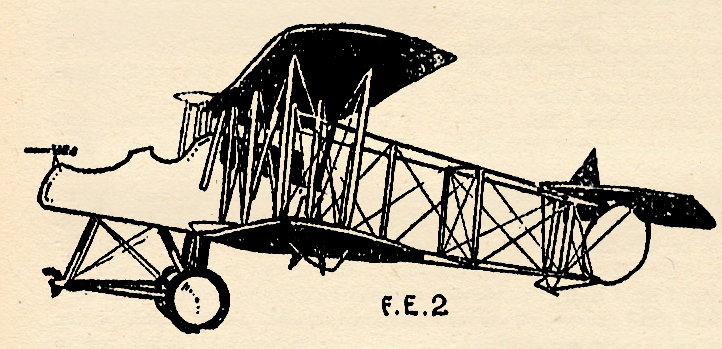
Eugene M. Frandzen painted the covers of Sky Fighters from its first issue in 1932 until he moved on from the pulps in 1939. At this point in the run, the covers were about the planes featured on the cover more than the story depicted. On the November 1934 cover, It’s a battle of the wire jobs as the Fokker Eindecker 1 takes on the Farman Experimental 2!

The Ships on the Cover

THE airmen in the early th_SF_3411 months of the war were gallant knights who took their frail, slow-moving craft into the air for observation purposes only. Occasionally a bomb or two was pitched over the side just to make it interesting for the opposing ground troops. But when fliers from different sides of the line met each other above the war fields they usually nodded, waved their hands, or if they stirred up a little hate they thumbed their noses at each other.

Then one day a German pilot with a perverted sense of humor threw a few bricks down at an Allied aviator, which of course was unsportsmanlike. The next day the Allied flier took a shotgun into the clouds and blammed both barrels at a German plane. The handwaving and friendly nods ceased.

Next to break the peace of the sky lanes was Roland Garros, the French flier, who mounted a Hotchkiss machine-gun on the cowl of his fragile little Morane, put steel triangular plates on his propeller and let the Germans have the works. He did plenty of damage to the Germans until he had to make a forced landing in enemy territory with his precious gun. He was captured before he could destroy his gun and plane. The secret was out.

Fokker’s Synchronized Gun

Anthony Fokker got busy on a synchronized gun. He rigged up a system of mechanical gears connected to his prop shaft and was able to send a steady stream of lead through the propeller arc.

That invention really started the fireworks in the air. Garros’ gun was a makeshift arrangement worked with a hand-trigger not synchronized. The Fokker gun was synchronized and was a weapon of death and destruction.

Boelke and Immelmann were two of the first to flame through the skies with the new gun. Allied plane after plane went crashing to earth. The Germans were mopping up, blasting their opponents from the air.

And then when things looked the darkest, up soared the British pusher type planes. One of these, the F.E.2 (Farman Experimental) barged into the fight with a Lewis gun blazing from its front observer’s pit. And did those old flying bathtubs bust hell out of the Fokker menace? They certainly did!

Take a look at this month’s cover and you will get in on the last stanza of a fight between a Fokker E.1 and the famous old stick and wire job, the F.E.2.

Strange—But True!

Down below three British two-seaters are lumbering along. The Fokker Eindecker has been hidden above the clouds and spots the three foes. He carefully tests his one synchronized gun and tips his square-winged monoplane down. His Oberursel engine bellows as it yanks the plane down in a power dive. The German pilot suddenly glances to his right. Out of a cloud bank breaks an F.E.2. The German yanks his ship out of its dive, kicks it up to come around and down on this newest enemy before polishing off the two-seaters.

But an expert is behind the Lewis gun in the flying bathtub. The German’s body jerks in his pit as the British gunner’s slugs find their mark. A pained expression of surprise marks the German’s face. It is against all reason that such an awkward-looking contraption could fly, let alone down his sleek streamlined Fokker.

It might be against all reason, but facts fill the history books that tell us that it was the good old F.E.2’s that stopped the sky slaughter of the Fokker Eindeckers.

The Ships on The Cover
Sky Fighters, November 1934 by Eugene M. Frandzen
(The Ships on The Cover Page)

Next time, Mr. Frandzen features a sea battle as Phönix seaplane is attacked by a Sea Tank!

My Most Thrilling Sky Fight: Lieutenant Navarre

Link - Posted by David on May 4, 2016 @ 6:00 am in

Amidst all the great pulp thrills and features in Sky Fighters, they ran a true story feature collected by Ace Williams wherein famous War Aces would tell actual true accounts of thrilling moments in their fighting lives! This time it’s French Lieutenant Navarre’s Most Thrilling Sky Fight!

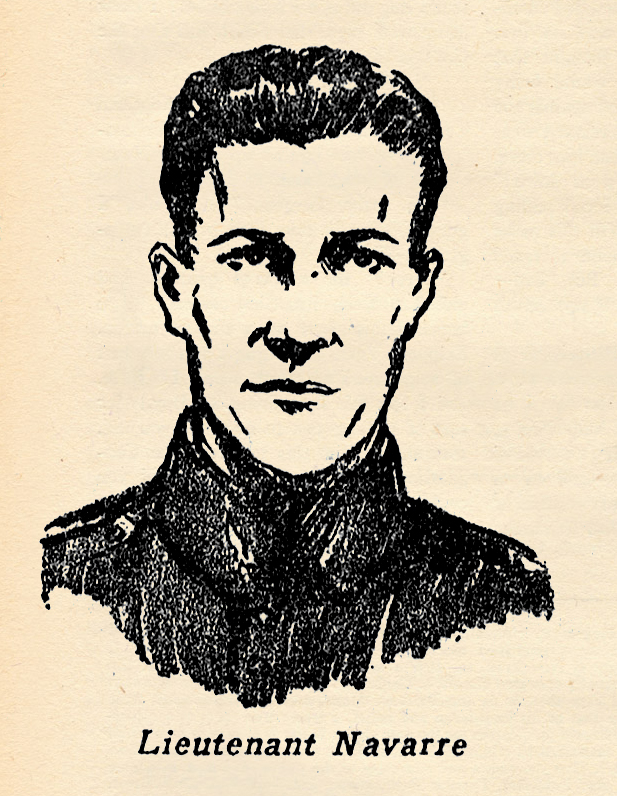
The year before America entered the War, there was one name that was consistently emblazoned in the papers along with Marshal Joffre, Earl Kitchner, and the other high ranking generals. It was the name of Navarre, the “Sentinel of Verdun.” Navarre was the first Ace, the first man to destroy live enemy aircraft in plane to plane combat. At the first battle of Verdun he did yeoman duty. It was his reports brought in after solo patrols far in the rear of the German lines that enabled Marshal Joffre to so dispose his defense troops at Verdun that the attacking armies under the command of the German Crown Prince were never able to take the city.

Alone, of all the French fortifications, it stood impregnable through the entire War. To Navarre, as much as to anybody else, belongs the credit for this victory. It was only during Navarre’s last days on the front that his plane was equipped with a machine-gun.

Despite that fact, he rolled up a record of 12 enemy planes brought down and destroyed before he was wounded and permanently disabled. His account below is from the records of a French journalist.


AN UNUSUAL VICTORY

by Lieutenant Navarre • Sky Fighters, December 1933

THE AIR FIGHT which I believe the most remarkable is one which took place far beyond Verdun. A German photo plane had come down out of the clouds unexpectedly right over the fortress, had circled around undisturbed and taken pictures. I got the call at my airdrome just as I had landed from a flight.

Without taking time to fill with gasoline or load up with more ammunition, I hopped in my ship and took off again. When the enemy ship saw me coming, it banked off and headed for home. I poured on all juice and raced after it.

The distance between us narrowed very slowly. My heart was in my mouth. I was sad. I knew I must get that ship before it landed with its pictures. I goosed my throttle and spark, stuck the nose of my ship down until I was just skimming the ground. Boche rifles shot at me.

Stitches of little round holes appeared like magic in my wings. But I raced on with greater speed because I was close to the ground. The Boche photo ship was still high up, but beginning to circle. I prayed for time to wait! Pushed on my controls, did everything! Just managed to get beneath the Boche as he was coming down for a landing on his own drome. The Boches on the ground saw me. They hustled out other ships. I nosed up to meet the down coming Boche with my hand tense on the trigger of my Lewis gun. At fifty yards I gave a burst. It missed.

The Boche answered with two bursts. I banked and slipped away. The Boche nosed after me, sending out bullets all the while. Two other planes were taxiing across the ground. They would be up soon!

I had to do something swiftly, or not at all. I banked around, headed towards the photo plane, got it sighted and pressed my trigger again. But nothing happened! I had run through the last of my ammunition with the previous burst. I stuck my nose down. The Boche photo plane came after me, right on my tail. I stood up. in my seat, looked at my gun hopelessly. Looked back over my shoulder. The Boche plane was almost on me. The pilot was grinning. His propeller was almost gnawing at my tail surfaces. But there were no shots.

A sudden idea hit me. I reached up, wrenched the empty ammunition drum from my Lewis. Without waiting I hurled it back over my head. The propeller blast carried it straight back. I heard a chattering thud, then a hissing plop. I looked back over my shoulder. The drum had shattered the Boche’s prop. One blade had broken. The engine was wobbling in its frame. I swung out of my dive, banked up. The Boche hurtled past out of control, plunged into the earth, burst into flames.

The other Boche got up, raced me all the way to Verdun. But I beat them back. They didn’t come across after me. They turned back at the lines. That without question is my most remarkable flight.

“Sky Fighters, October 1934″ by Eugene M. Frandzen

Link - Posted by David on May 2, 2016 @ 6:00 am in

Eugene M. Frandzen painted the covers of Sky Fighters from its first issue in 1932 until he moved on from the pulps in 1939. At this point in the run, the covers were about the planes featured on the cover more than the story depicted. On the October 1934 cover, It’s the Halberstadt C.L.2 vs the Avro “Spider”!

The Ships on the Cover

THE Halberstadt C.L.2 was, th_SF_3410 with its sister ship the C.L.4, a bright spot in Germany’s output of two-seater fighters. It was simpler in design than most of the German ships of this type; probably thereby lays the reason for its very good performance. Kicking over 1,385 r.p.m.’s at 10,000 feet, it could travel at around 100 m.p.h. It was not so hot on climbing, but was light on its controls and could be maneuvered with ease.

The other ship on the cover is the Avro “Spider,” a job turned out by the famous A.V. Roe & Co., Ltd. It had “It” when it came to speed, maneuverability, and climb. Its trick triangular system of inter-plane bracing obviated the use of flying or landing wires. And when it came to visibility that “one holer” in the top wing gave the pilot a look-see up and ahead. Even downward vision was good as the chord of the lower wing was very narrow.

Let’s slip back about half an hour before this crackup that’s pictured on the cover.

A Trophy of War

Consider yourself planked on an Allied tarmac. Out in front of number one hangar is a captured German ship; a Halberstadt. A group of British aviators are standing around admiring their trophy. Greaseballs have tuned her up, she is idling beautifully. One of them with three pots of colors is ready to paint the British cocardes on this German ship. There is darn good reason for this art work on captured machines. It’s to save the Allied test pilots who take up the captured ship back of the lines from getting popped down by some other Allied aviator who might think a German was at the stick.

Standing among the British aviators is a young man with a very dejected expression on his square face. His goggles are shoved back. His collar ornaments are German. To the Allied aviators, whose captive he is, he is just a flyer who happened to work for the wrong side. Much wine and spirits have trickled down all throats since the capture of the German. All hands are buddies, friends; in fact old pals. What if Fritz did pop at them from his Halberstadt? It was all in the game.

Just a Joy-Ride

“Let’s have a little ride in your old war chariot, Fritz,” suggested Lieutenant Mills, who had forced the German down.

So Fritz climbed in at the controls after it was certain his front and rear guns were harmless. Lt. Mills tucked a pistol into his pocket and heaved himself up on the side.

Smack!

Fritz fist clipped the Britisher on the button. The Mercedes roared. Dirt blasted into the other’s eyes on the ground.

An Avro roared throatily in the next hangar. Lt. Mills was in it in a jiffy, gunned the Bentley and blasted down the drag and up into the air. It took him twenty minutes to catch Fritz. Then came ten minutes of systematic sniping at engine and wings. Finally the Halberstadt’s engine sputtered, died. Down she came, flopping and shuddering. As her undercarriage hit the ground her wings folded and called it a day. Lt. Mills landed close by, rubbed his aching jaw and walked over to the wreck. Fritz crawled out, felt himself all over and indicated that he was not injured. He then shoved out his jaw and Lt. Mills carefully planked a beautiful right uppercut home. Fritz took it standing up and grinned.

Mills produced a flask—”Cheerio,” he grinned.

“Prosit,” replied Fritz.

The Ships on The Cover
Sky Fighters, October 1934 by Eugene M. Frandzen
(The Ships on The Cover Page)

Next time, Mr. Frandzen features the Fokker E.1 and the F.E.2!

“Night Eagle” by Harold F. Cruickshank

Link - Posted by David on April 22, 2016 @ 6:00 am in

WE’RE back with another exciting air adventure from the pages of the pulp magazines of the 1930’s. This week we have a tale from the pen of that Canadian stalwart—Harold F. Cruickshank. Cruickshank was a prolific writer. He wrote all manner os stories for the pulps—war, aviation, westerns, even animal stories!

Here we have a story from the December 1933 issue of Sky Fighters. In Night Eagle Cruickshank tells a tale of Squadron Twenty tasked with taking out a German ammo dump and meeting with little success.

Johnny Blair was all set to smash the german ammo dump to smithereens—but his bombs proved to he duds!

For more great tales by Harold F. Cruickshank, check out Sky Devil: Hell’s Skipper—All along the Western front, everyone was out to get The Sky Devil’s Brood! There was no better flight in France. Led by Captain Bill Dawe, the famous Yank ace known to all of France as the Sky Devil, the brood consisted of Chuck Verne, Mart Bevin, Slim Skitch and Slug Walton. The crimson devil insignia on their silver Spads brought fear to any German pilot unlucky enough to meet them in the air. But the Sky Devil’s greatest enemy might just be his own C.O., Major Petrie, who had been railroaded into command of 120 Squadron over Dawe’s head. Jealous of Dawe’s popularity, Petrie will do anything to bring down “The Sky Devil’s Brood!”

« Previous PageNext Page »