



My Most Thrilling Sky Fight: Lieut. Silvio Scaroni
Amidst all the great pulp thrills and features in Sky Fighters, they ran a true story feature collected by Ace Williams wherein famous War Aces would tell actual true accounts of thrilling moments in their fighting lives! This time we have Italian Fighter Ace Lieutenant Silvio Scaroni’s most thrilling sky fight!
Lieutenant Silvio Scaroni was 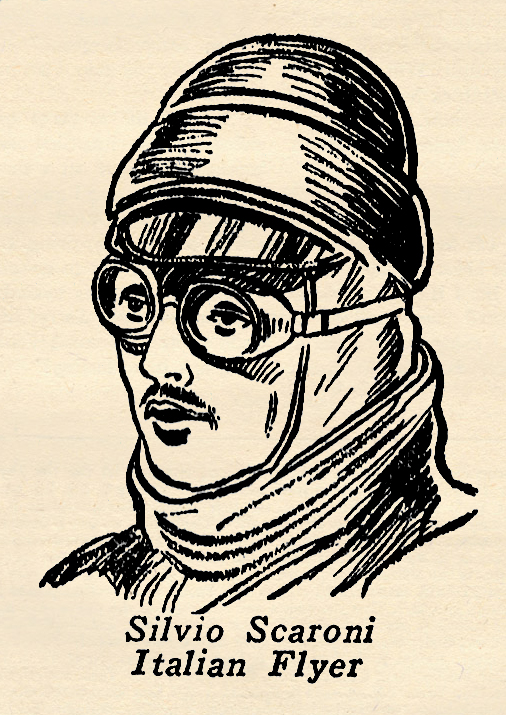 born at Brescia, Italy, and entered the aviation corps at the beginning of the war. As a bomber he was recognized as one of the best in the Italian Flying Corps and he was very adopt in handling big three-engined Capronis. But the big ships were too slow to satisfy Lieutenant Scaroni. He wanted to fly single Heaters and eventually managed to secure his transfer to a combat squadron on the morning of November 14, 1917.
That same day he registered his first victory. Within three months he had accounted for 18 enemy planes. His untimely end came in an accidental crash. He was decorated with all the honors Italy could confer, and in Brescia a magnificent monument has been erected to his memory. His story, below is one of the most remarkable of all war experiences.
THE FLAMING COFFIN
by Lieut. Silvio Scaroni • Sky Fighters, August 1935
I HAVE had many dangerous moments in the air, in observation, bombardment and combat planes. But there is no doubt in my mind as to the most dangerous I ever experienced. It was that night over the Adriatic when I was flying a big three-engined Caproni as part of a bombing formation headed for the Austrian coast. Night flying enemy planes attacked us when we were utterly unprepared.
The brigadier out front had just called for me to come up and take the forward guns as we were approaching the coast line, when I heard a rattle, like rolling thunder, above the roar of the engines. Then there was what seemed like a flash of lightning and I felt myself spinning in the forward nacelle under the impetus of a terrific blow on my shoulder. I picked myself up from the floor of the pit and staggered erect. The big plane was diving straight down, and two lurid streams of fiery tracers splashed on the gangway.
The night attacker was less than fifty meters off our tail. I yelled to the brigadier to pull back on the wheel and yank the ship out of its dive. Then in the phosphorous glare of the tracer I saw that was not possible. The pilot was dead at the wheel, his head almost severed from his body. As I groped toward the control pit, I wondered why Captain Ercle, in the back gunner’s pit, had not come up to take over the controls. The ship was spinning violently and surging downward abruptly now. The Austrian pilot remained fastened to the falling ship like a leech, pumping hundreds of rounds into us. The other planes had disappeared in the blackness.
I managed finally to gain the pit. I stumbled over something and almost fell. When I looked down I saw why Captain Ercle had not been able to take over from the brigadier. It was his dead body I had stumbled over. I yanked the wheel from the dead brigadier’s hand, pushed him from the seat and got his feet off the rudder bar. It was only then I realized that I had only one good hand. My right hung limply at my side.
I gave the wheel a twist and ruddered against pressure, looking overside as I did so. There was a bare, rocky headland beneath, a small black shadow jutting into the sea. The bursts from the attacking plane were still clattering into the Caproni. One engine went dead, then another. I had only one left. Luckily it was the one in the rear, for I would never have been able to maneuver the plane if it had been one of the wing motors. I was weak.
With the rough rock just beneath, I dropped a landing flare. It hit the ground and exploded all at once, blinding me in its dazzling light. The ensuing darkness was blacker than Hades. I could see absolutely nothing, not even the glow lights on my instrument board. But I heard the wheels crunch. I pulled up swiftly, staggered crazily, bumped and rolled still.
Oncoming soldiers shouted at me to throw my hands up. I laughed in their faces and carefully set fire to the big plane. The rifle shots did not get me. Two weeks later I stole across the border and regained our own lines.
 a story from the one and only creator of The Three Mosquitoes—Ralph Oppenheim! Mickey Rand trained pilots to be Aces using his infallible techniques of air combat. That is until it seemed the German Ace Kemmerer had found a way to beat these tricks, downing three of Mickey’s star pupils and he wasn’t about to let his latest protege, Jim Conway be next!
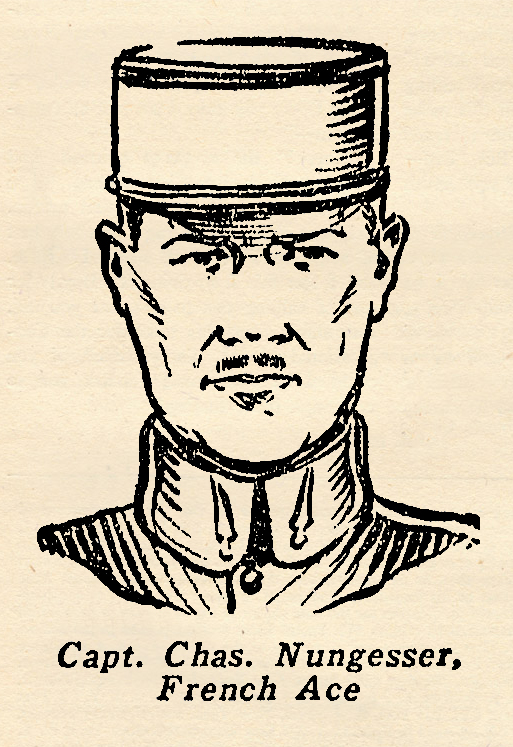 none is more poignantly remembered than Charles Nungesser, who began his flaming war career as a Lieutenant of Hussars and was one of that famous lighting band of cavalrymen that stopped the German Uhlans at the gates of Paris. For his exploits in this heroic stand he was awarded the Medal Militaire, the highest combat award.
 a story from the pen of a prolific pulp author and venerated newspaper man—Frederick C. Painton. In “Heroes Die Hard” Painton crafts a story of an immoral politician trying to use his carefully created war record to sweep him in to office when the war is over. The only problem is a man he wronged in the past who now stands in the way of his future! From the October 1933 issue of Sky Fighters, it’s “Heroes Die Hard!”
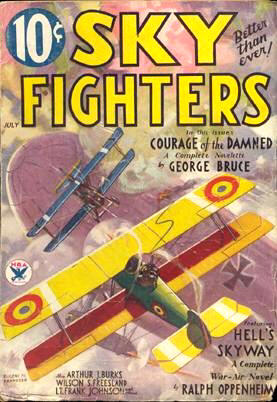 but Silent Orth is back! Silent Orth—ironically named for his penchant to boast, but blessed with the skills to carry out his promises—comes up against a trio of deadly marksmen who manage to take down their victims with but a single bullet! Orth must take down all three before fresh new recruits arrive the next day—The problem is, Orth has vowed to take each of them out with a single shot. From the July 1934 issue of Sky Fighters it’s Silent Orth in “Single Action!”
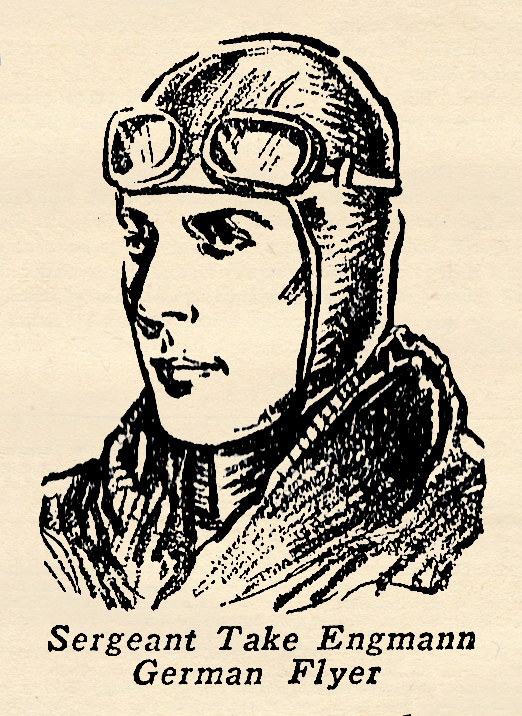 air did not fly single-seater fighting planes, and all of the heroes did not accomplish their missions single handed. Some of the great feats were accomplised by the pilots of the bigger, bulkier, clumsier, two and three-seater observation and bombing planes. Sergeant Engmann was one of the heroes of this latter class. Obscure, reticent, retiring by nature, his own part in the many successful missions accomplished by the greatest of all German observation aces, Captain Heydemarck, whose pilot he was, marks him as one of the outstanding flyers of the war.
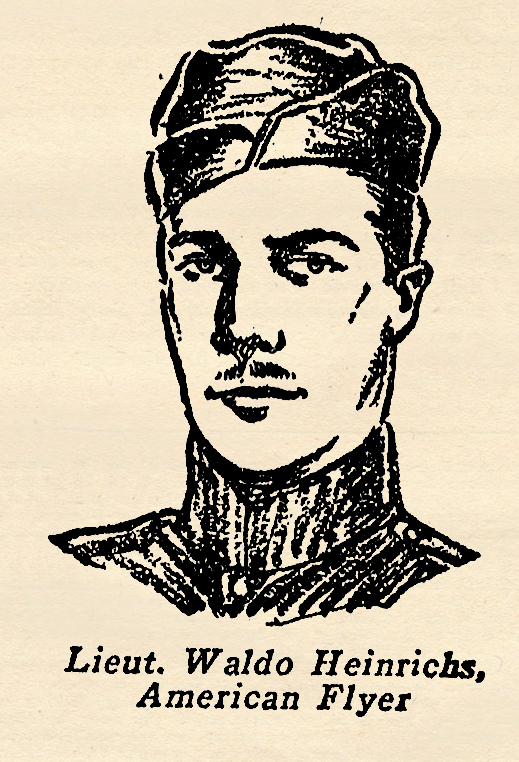 the first contingent of flying cadets to be graduated from the air combat school at Issoudun, France, the great flying field established by the American Air Service on foreign soil after the United States entered the war. He was one of tho original members of the famous 95th Pursuit Squadron, the first American squadron to do actual front line duty with the American Army. Among his squadron mates in the 95th were Lieutenant Quentin Roosevelt and Lieutenant Sumner Sewell.
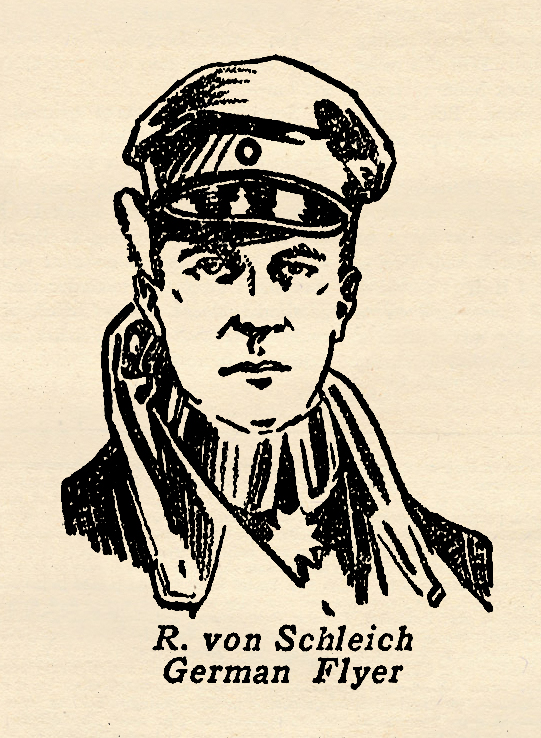 of the least known, but nevertheless, one of the greatest and most successful of the German war birds. A nobleman by birth, he was educated for service in the army beginning with his early childhood. When the war broke out he was an officer in the Uhlans, the most aristocratic branch of the German Army. After transferring to the flying corps, he served some time as an observer, before learning to become a pilot himself; paralleling in that respect the career of Baron Manfred von Richthofen, who preceeded him as an officer of Uhlans.
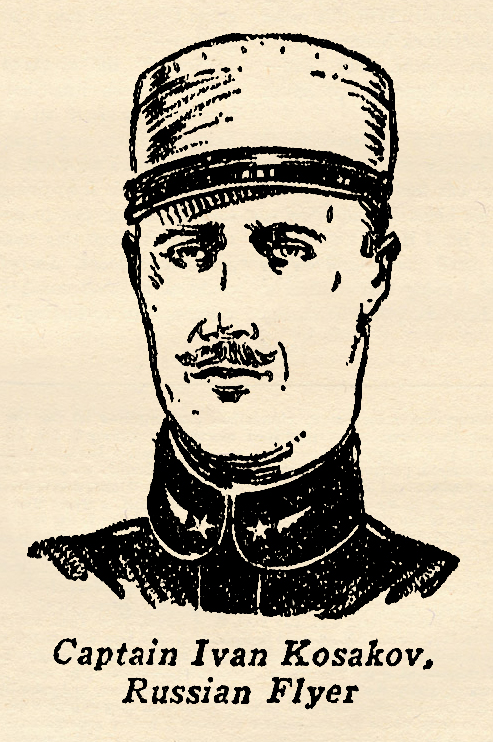 a great war hero when lie transferred from the cavalry to the flying corps. After a short course of just two weeks in flying school, he was sent up to the front again as a bombardment pilot. But flying heavy, unwieldy bombers was too slow and tedious work for him. He was transferred to a single-seater fighting squadron after two months with the bombers. It was then that his remarkable record began to grow.
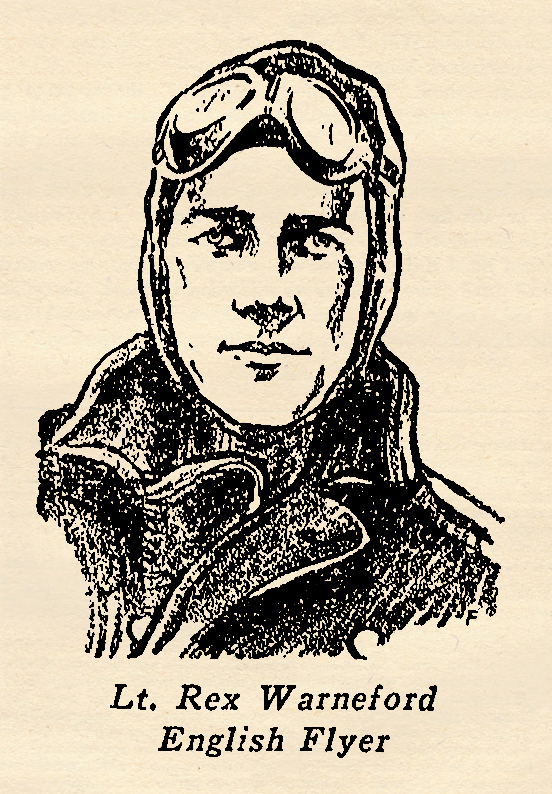 of the British Royal Flying Corps was the first airman to shoot down an enemy Zeppelin, likewise he was the first war pilot to win the coveted Victoria Cross. Previous to his epic fight with the raiding Zeppelin young Warneford was a comparatively obscure pilot. After this amazing and brilliant victory he leaped to the highest pinnacle of fame, he escaped from the German lines with his plane after being forced down fully five miles from his own territory. A troop of German cavalrymen rode up to take him prisoner, but using his machine-gun to the greatest advantage he managed to hold them off until he had completed temporary repairs on his plane. Then, amidst a continual hail of fire, he took off in flight, running the gauntlet of fire successfully, eventually to land within his own lines. Unhappily, two days after the V.C. had been conferred on him, he was killed in an air accident near Paris. In the account below he tells the story of this fight in his own words:
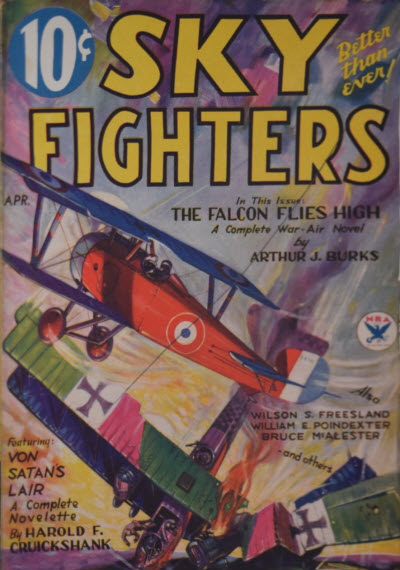 a story by another of our favorite authors—
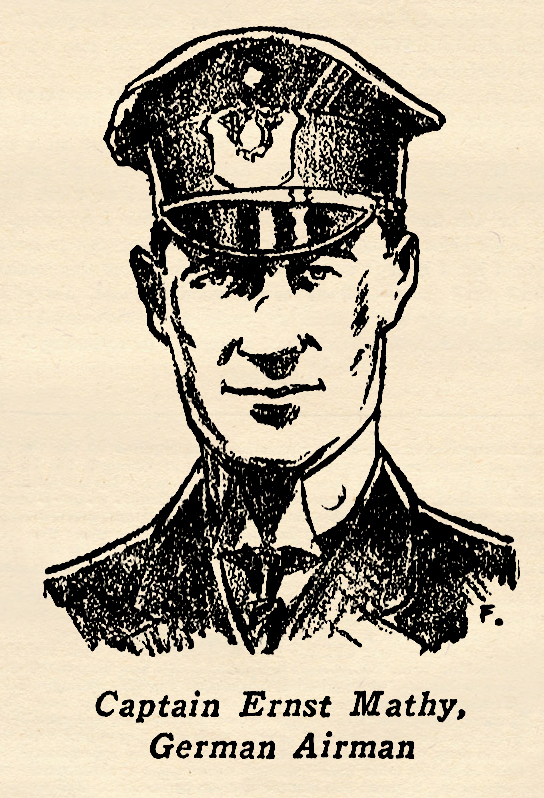 the Zeppelin raiders as told by the raiders themselves have come out of the Great War. Captain Ernst Mathy was one of the most famous of all wartime Zeppelin commanders, having made before he was killed in his final raid over London, six successful night raids over that well protected city, more than any other Zeppelin commander. It was Captain Mathy who developed and perfected most of the strategy of attack for the giant Zeppelins operated by the Imperial
 Flying Corps.
the Zeppelin raiders as told by the raiders themselves have come out of the Great War. Captain Ernst Mathy was one of the most famous of all wartime Zeppelin commanders, having made before he was killed in his final raid over London, six successful night raids over that well protected city, more than any other Zeppelin commander. It was Captain Mathy who developed and perfected most of the strategy of attack for the giant Zeppelins operated by the Imperial
 Flying Corps.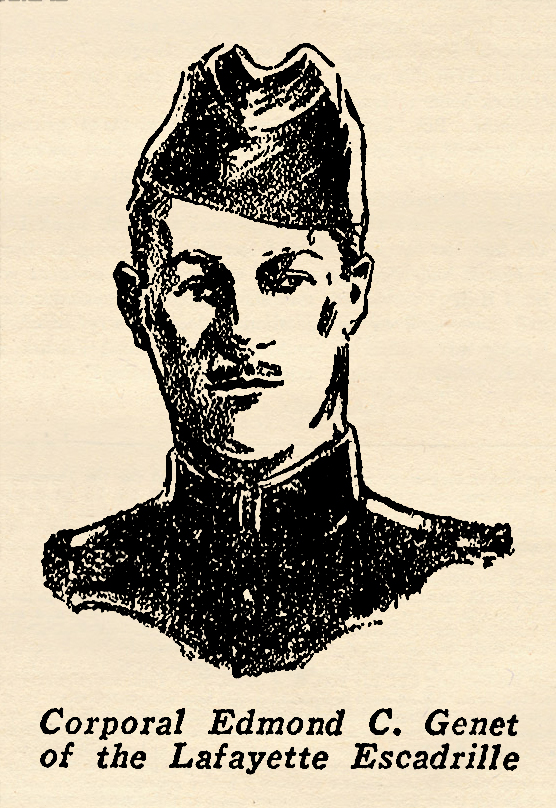 Citizen Genet, who served as the revolutionary ambassador from France during George Washington’s term as president, Edmond C. Genet had a distinguished heritage. Mild-mannered and handsome he was a typical soldier of fortune at heart, possessing an astonishing courage. At 10 he missed an appointment to Annapolis and immediately enlisted in the navy where he participated in the taking of Vera Cruz. A year later he was in battle in Haiti. Later on after the war in Europe broke out, he sailed for France to enlist in the Foreign Legion. He served for some years in the trenches as a simple poilu, then was transferred to aviation and assigned to Escadrille N-124, better known as the Lafayette, where he was the youngest American in a company of famous men. Genet’s flying time on the front was short. He was one of the few airplane pilots to be killed in the air by enemy shrapnel. He was the first American to die in action under the stars and stripes, his death occurring just ten days after America entered the war. The account below is from one of his letters home.
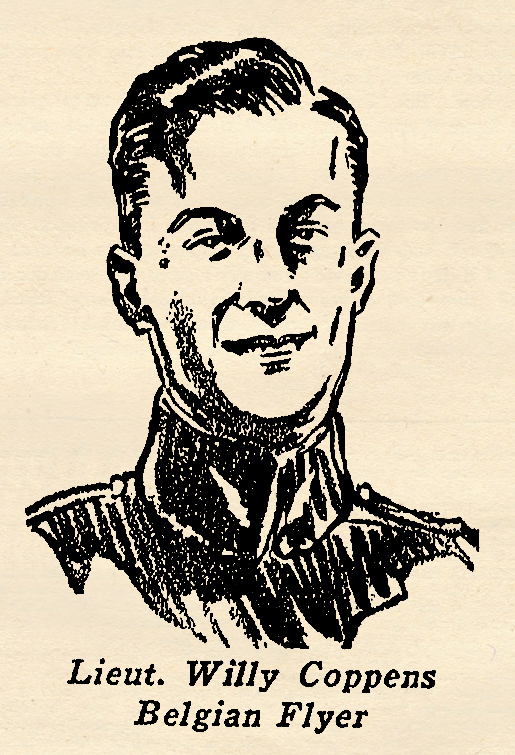 Belgian Ace of Aces. He got his initial training as a soldier and officer in the cavalry division of the army. He transferred later on to the Flying Corps and began immediately to compile the record of victories that gained him top ranking among sky fighters.
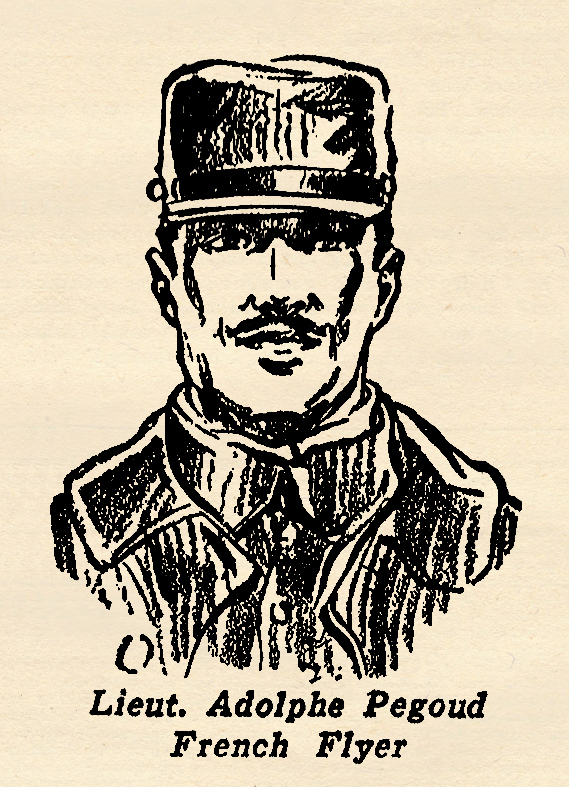 famous flyer before the war began. In 1913, flying a tiny Bleriot monoplane, he astonished the world by doing a series of intricate air maneuvers. Later, he made an upside down landing, the first and to this day the only aviator deliberately to perform such a stunt.