YOUNG Ralph Oppenhiem was a curious and inventive boy who was educated in various public and private schools. The most unique school he attended was, without a doubt, the Old Orchard School in Leonia, New Jersey.
The Old Orchard School was a day and boarding school for little boys and girls between the ages of four and eight. Run from 1912 to 1925, there were never more than twelve children enrolled at any one time. The children were given every opportunity to develop all their capacities to the fullest extent possible. Special attention was paid to health, music, dancing, handicrafts and the care of pets with regular school work systematically pursued as the child was ready for it.
While at play or in the process of daily living, those habits that are always valuable in life were stressed—concentration, construction, self-reliance, helpfulness, thrift, forming right judgments, organizing a democratic society, and the like were engendered in an atmosphere of a well-organized home, where each child could pursue his own interests, or where all could pull together to achieve some communal task.
The school was run by Anna G. Noyes out of her own home. Anna had been raising and educating her own boy Leonard since birth—what had started out with Anna keeping track of young Leonards health and aspect every minute of every day since birth in an effort raise a healthy boy—the results published in a book, “How I Kept My Baby Well” (Warwick & York, Inc. 1913)—had become something more as Leonard got older and was in need of constructive and systematic training.
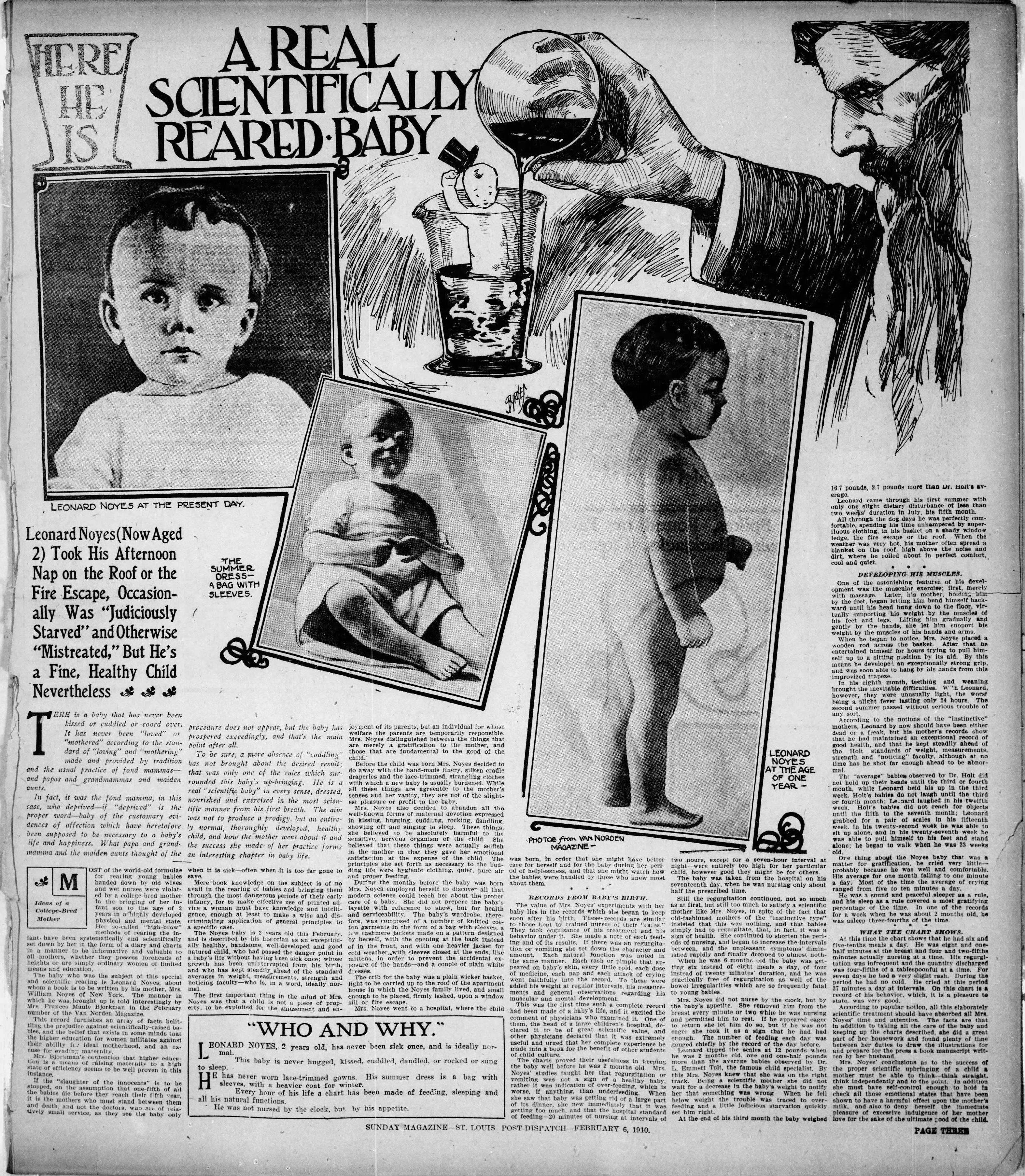
HERE HE IS! An article about Leonard, age 2, The Scientifically Raised Child. From the St. Louis Post Dispatch’s Sunday magazine. February 6th, 1910.
She was determined that her son would not be handicapped by the environment of the city so Anna, the boy, and her husband William Noyes, a professor at Columbia University, took up residence in Leonia on the New Jersey side of the Palisades, and continued educating young Leonard in a scientific way.
Since young Leonard is an only child, Mrs. Noyes formed a little school with a few children from the neighborhood, for she says that no child should be brought up alone, as It makes for selfishness.
“I intend,” she said, “to have three other children come and live with me and then get ten more to attend my school in the garden and in this porch room. That will give Leonard the proper association, for no child should be In the continual company exclusively of adults.”
Mrs. Noyes says that it is an era of Individualism, and that it should start at the very beginning of life.
“Public schools keep a child’s mind back to the level of the dullest scholar in the class, and that’s why we left New York, where my boy would have been in a class of forty-six children and in a school where the windows and doors had to be closed in order that the street traffic would not interfere with the teacher hearing their lessons.
“We are only just beginning to understand the necessity of the individually and specially trained child, and until it becomes generally understood and adopted we may continue with the mediocre minded and have the education problems which have been with us in the past.”
During the summer and at gardening time Mrs. Noyes takes the children out of doors and teaches them the values of color and of size through the practical methods of making them pick the peas, beans and other garden truck.
“Children,” she says, “are too soon put In an abstract world, and the only way to make the child mind fully comprehend and grasp things is in the physical way. A child can much sooner know shades of reds through watching cherries or berries grow ripe than through placing before him blocks of various colors. Every act of childhood can be made pleasant and agreeable and at the same time serve a useful, practical purpose.”
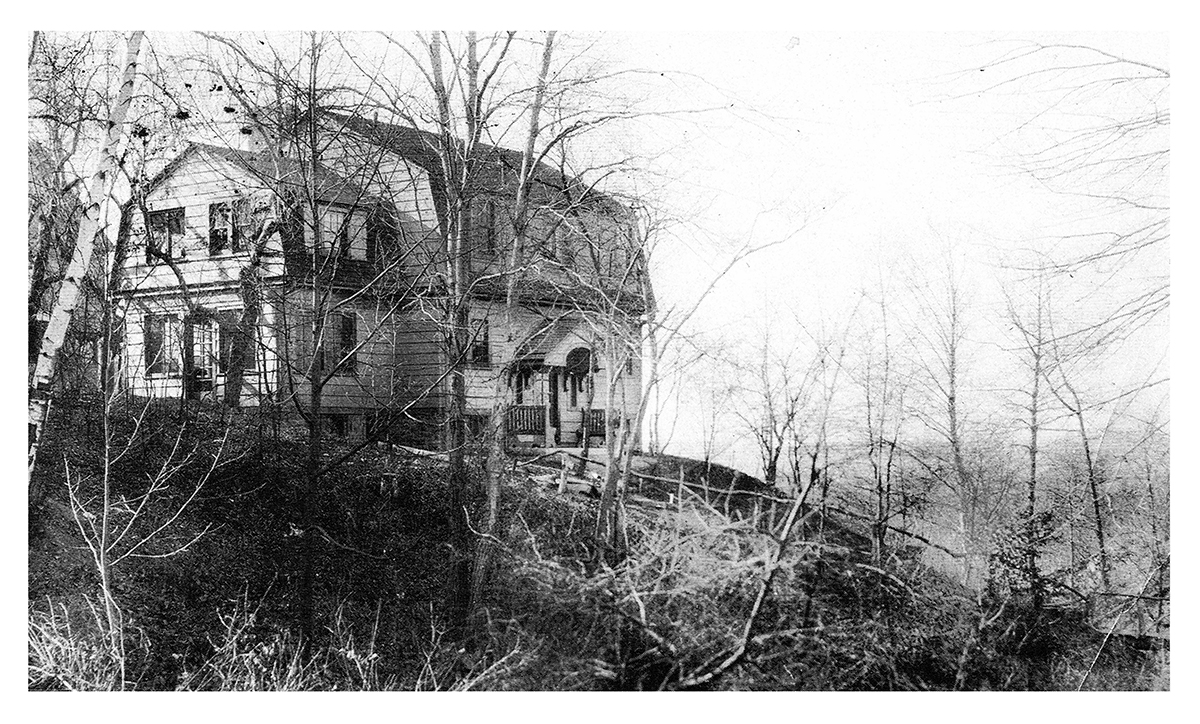
THE OLD ORCHARD SCHOOL, 223 Leonia Avenue. From 1912 to 1925, Anna G. Noyes operated an exclusive day school for city children out of her Leonia home, which overlooked the Hillside Avenue brook.
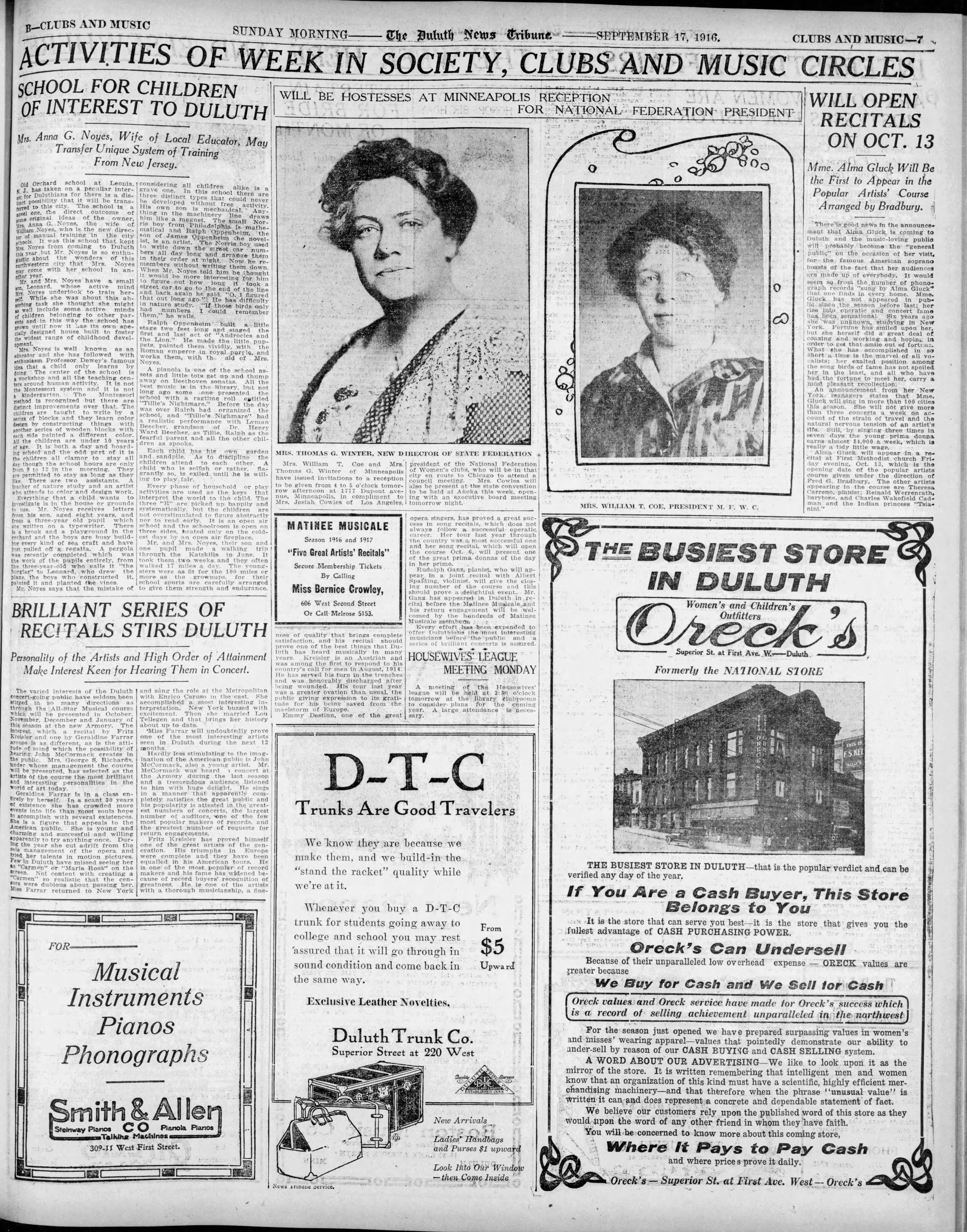
Ralph Oppenheim attended the Old Orchard School as a boy. Living in New York at the time, he boarded at the school from roughly 1914 to 1916 or ‘17. in fact, he’s even mentioned in an article about the school that ran in the Duluth News Tribune in 1916 doing what else—putting on a puppet show!
SCHOOL FOR CHILDREN OF INTEREST TO DULUTH
Mrs. Anna G. Noyes Wife of Local Educator, May Transfer Unique System of Training From New Jersey.
The Duluth News Tribune, Duluth, MN • 17 September 1916 • p.7
Old Orchard school at Leonia N.J. has taken on a peculiar interest for Duluthians for there is a distinct possibility that it will be transferred to this city. The school is a novel one, the direct outcome of some original ideas of the owner. Mrs. Anna G. Noyes, the wife of William Noyes, who is the new director of manual training in the city schools. It was this school that kept Mrs. Noyes from coming to Duluth this year but Mr. Noyes is so enthusiasitic about the wonders of this northwestern city that Mrs. Noyes may come with her school In another year.
Mr. and Mrs. Noyes have a small son, Leonard, whose active mind Mrs. Noyes undertook to train herself. While she was about this absorbing task she thought she might as well Include some active minds of children belonging to other parents and in this way the school has grown until now it has its own specially designed house built to foster the widest range of childhood development.
Mrs. Noyes is well known as 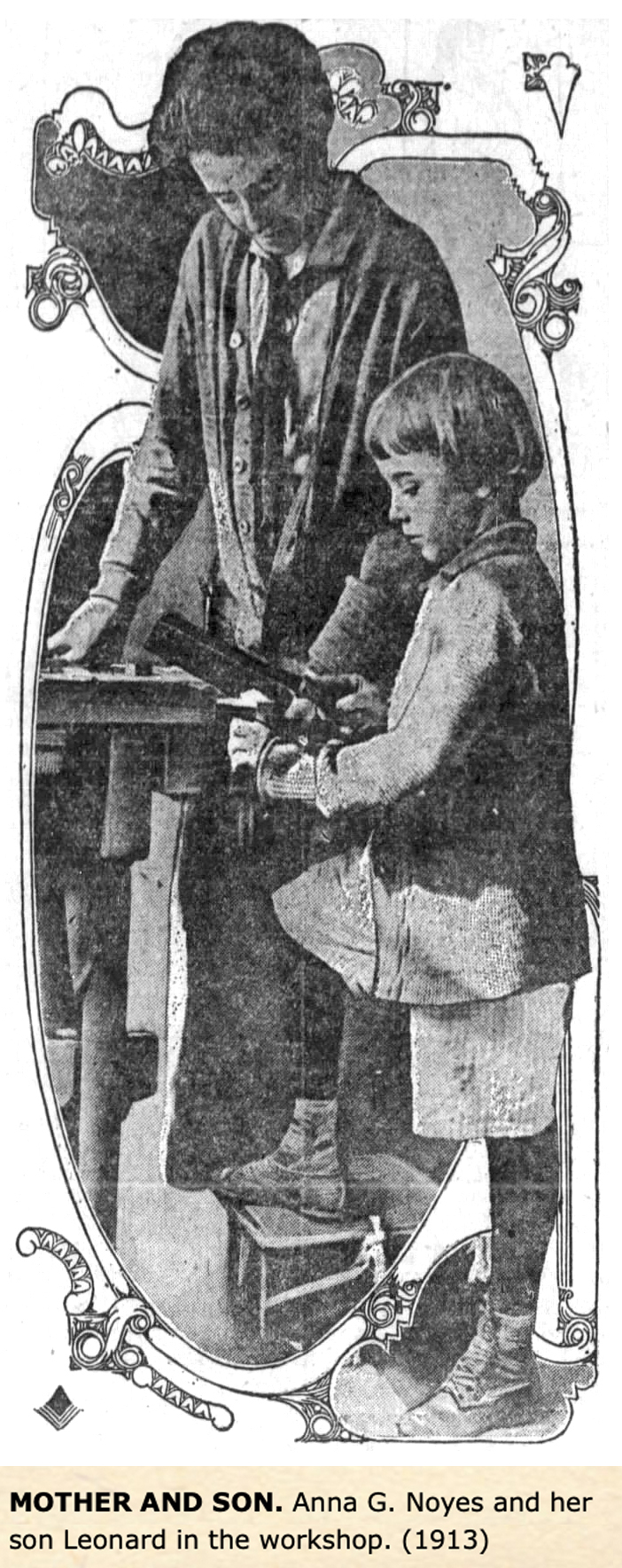 an educator and she has followed with enthusiasm Professor Dewey’s famous Idea that a child only learns by doing. The center of the school is a workshop and all the teaching centers around human activity. It is not the Montessori system and it is not a kindergarten. The Montessori method is recognized but there are distinct improvements over that. The children are taught to write by a series of blocks and they learn color design by constructing things with another series of wooden blocks with each side painted a different color. All the children are under 10 years of age. It is both a day and boarding school and the odd part of it is the children all clamor to stay all day though the school hours are only from 9 to 12 in the morning. They are permitted to stay as long as they like. There are two assistants. A teacher of nature study and an artist who attends to color and design work.
Everything that a child wants to investigate is in the house or grounds to use. Mr. Noyes receives letters from his son. aged eight years, and from a three-year old pupil which are written on a typewriter. There is a brook and a playground in the orchard and the boys are busy building every kind of sea craft and have just pulled off a regatta. A pergola was recently completed which was the work of the pupils entirely, from the three-year-old who calls it “the burglar” to Leonard, who drew the plans, the boys who constructed it, painted it and planted the vines.
Mr. Noyes says that the mistake of considering all children alike is a grave one. In this school there are three distinct types that could never be developed without free activity. His own son is mechanical. Anything in the machinery line draws him like a magnet. The small Noris boy from Philadelphia is mathematical and Ralph Oppenheim, the son of James Oppenheim the novelist, is an artist. The Norris boy used to write down the street car numbers all day long and arrange them inter order at night. Now he remembers without writing them down. When Mr. Noyes told him he thought it would be more interesting for him to figure out how long it took a street car to go to the end of the line and back again he said. “O, I figured that out long ago.” He has difficulty in nature study. “If those birds only had numbers I could remember them,” he wails.
Ralph Oppenheim built a little stage two feet long and staged the first and last act of “Androcles and the Lion.” He made the little puppets, painted them vividly, with the Roman emperor in royal purple, and works them, with the aid of Mrs. Noyes.
A pianola is one of the school assets and little tots get up and thump away on Beethoven sonatas. All the best music is in the library, but not long ago some one presented the school with a ragtime roll entitled “Tillie’s Nightmare.” Before the day was over Ralph had organized the school, and ‘’Tillie’s Nightmare” had a realistic performance with Lyman Beecher, grandson of Dr. Henry Ward Beecher, as Tillie. Ralph as the fearful parent and all the other children as spooks.
Each child has his own garden and sandpile. As to discipline the children attend to each other. A child who is selfish or rather, flagrantly so, is exiled until he is willing to play fair.
Every phase of household or play activities are used as the keys that interpret the world to the child. The three “R” are picked up happily and systematically, but the children are not overstimulated to figure abstractly nor to read early. It is an open air school and the schoolroom is open on three sides, heated only on the coldest days by an open air fireplace.
Mr. and Mrs. Noyes, their son and one pupil made a walking trip through the Katskllls in June. It took them two weeks and they often walked 17 miles a day. The youngsters were as fit for the 100 miles or more as the grownups. for their school sports are carefully arranged to give them strength and endurance.
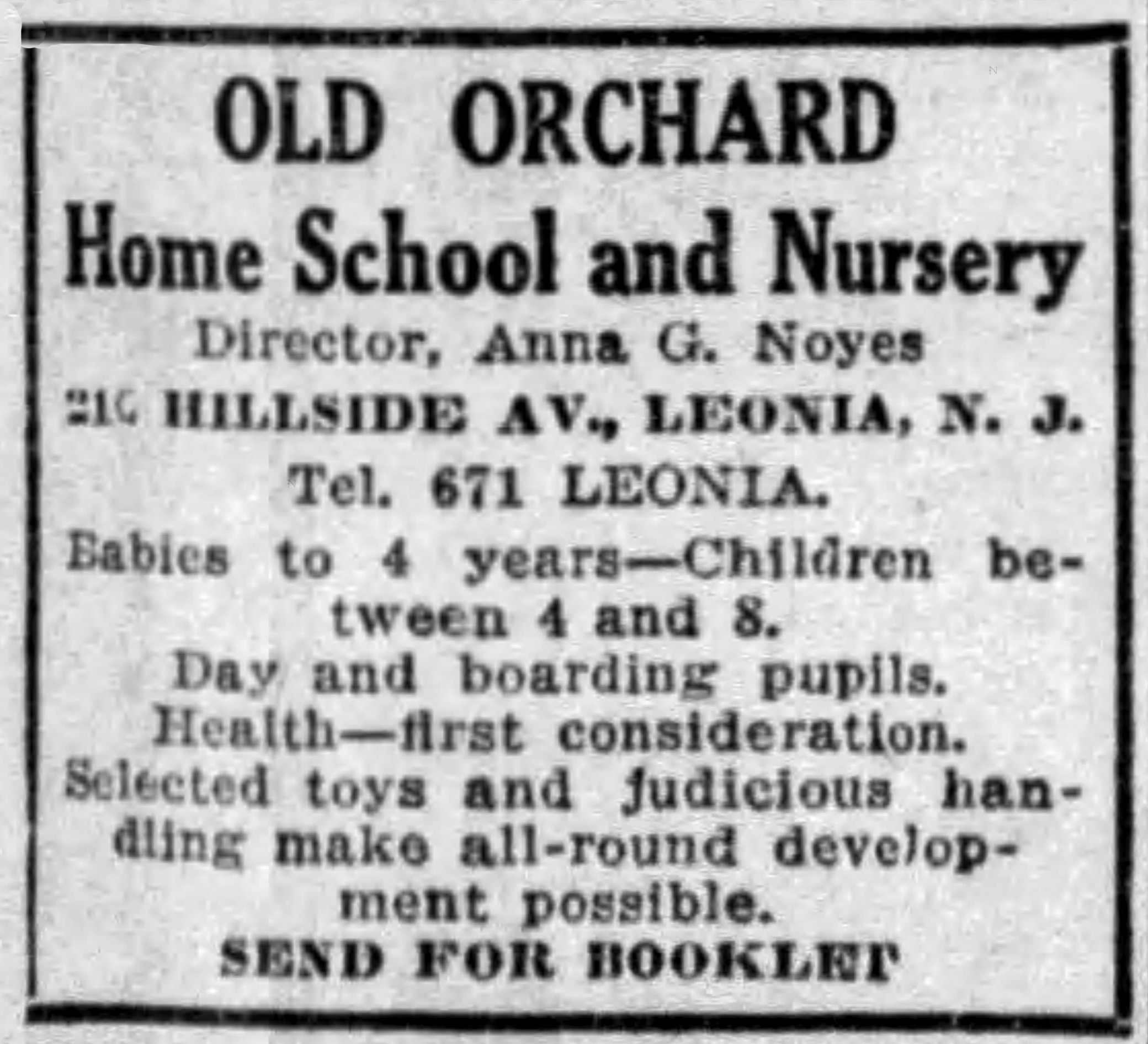
AD FOR THE SCHOOL run in the Hackensack Evening Record November 25th, 1921.





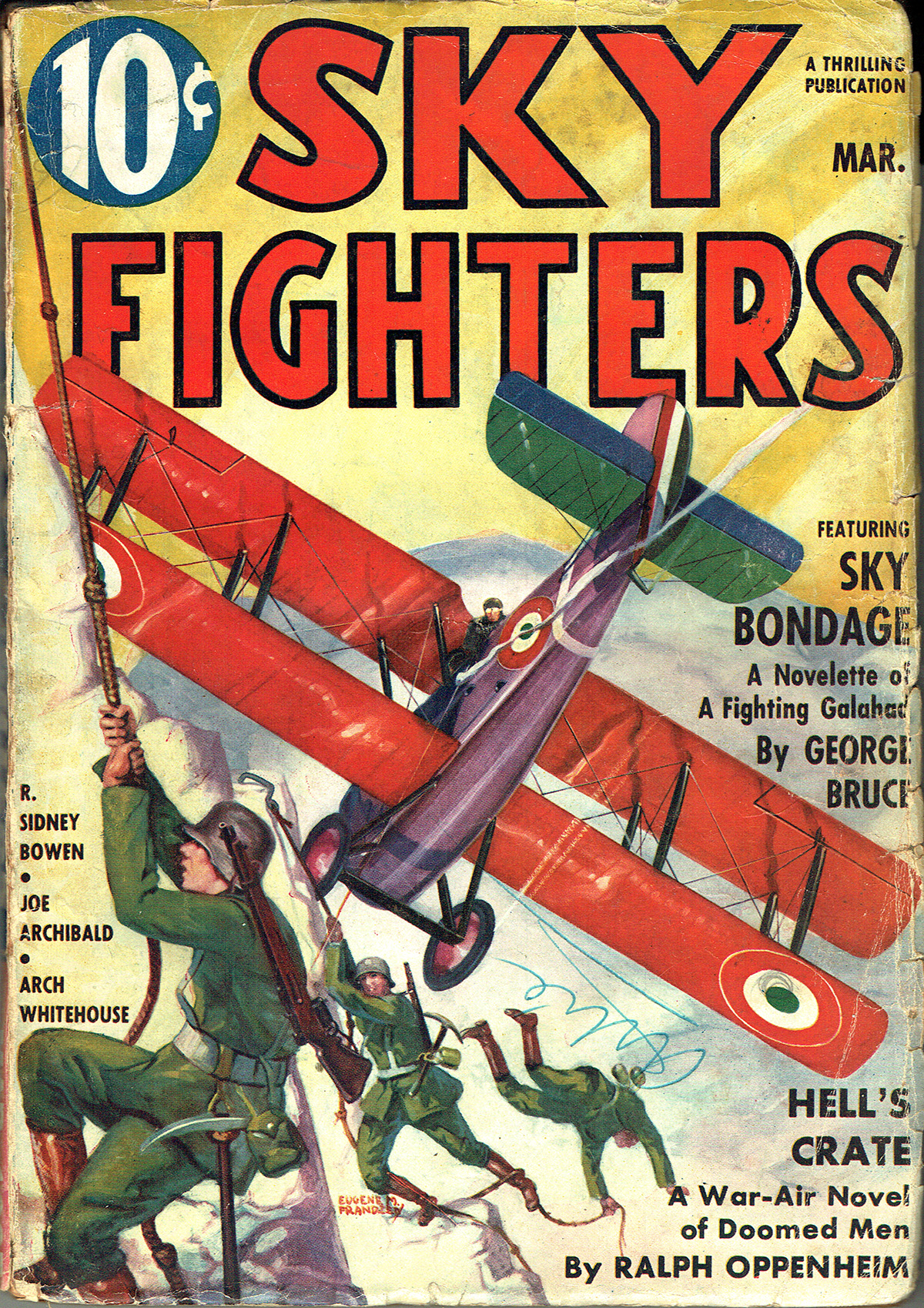 Mosquito Month we have a non-Mosquitoes story from the pen of Ralph Oppenheim. In the mid thirties, Oppenheim wrote a half dozen stories for Sky Fighters featuring Lt. “Streak” Davis. Davis—ace and hellion of the 25th United States Pursuit Squadron—was a fighter, and the speed with which he hurled his plane to the attack, straight and true as an arrow, had won him his soubriquet.
 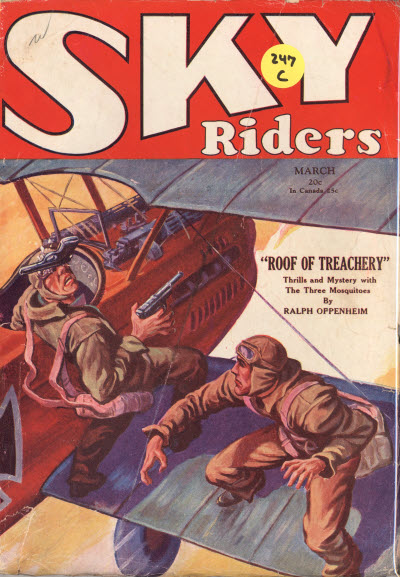 the second of three Three Mosquitoes stories we’re presenting this month. This week it’s “Roof of Treachery” from the March 1930 issue of Sky Riders. The city of Remiens could not be taken. It is continuously ranged and shelled and whole battalions of crops are sent in to take it, but they all die in the undertaking. Pilots are sent over during these skirmishes, but they never return. The Brass turn to The Three Mosquitoes to try to find the secret behind Remiens’ invulnerability just hours before a great push is set to take the town. Can they discover it’s deadly secret in time?
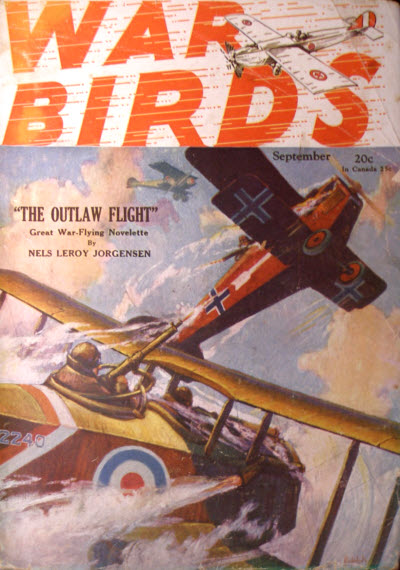 the first of three Three Mosquitoes stories we’re presenting to celebrate Ralph Oppenheim’s inseparable Trio this month. To get the ball rolling, it’s “Crashing Through” from the pages of the September 1928 War Birds in which Kirby is tasked with delivering a much needed load of ammunition to a rag tag group of troops valiantly trying hold a ridge until reinforcements arrive!
 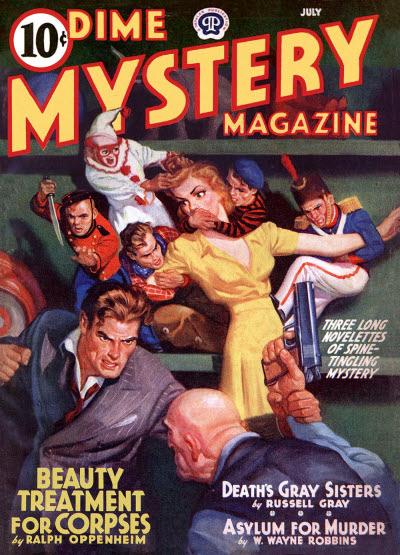 the Bystander’s eye is caught by a girl reminiscent of one from his past that leads him to a rotting corpse that had been very much alive moments before. The girl’s own sister tries to hire Craig to investigate why her own body seems to be rotting away until her husband phones and tells her not to. That’s like waving a bone in front of a dog and Craig can’t help but investigate this bizarre series of deaths! From the July 1940 issue of Dime Mystery Magazine it’s Ralph Oppenheim’s Bystander in “Beauty Treatments for Corpses!”
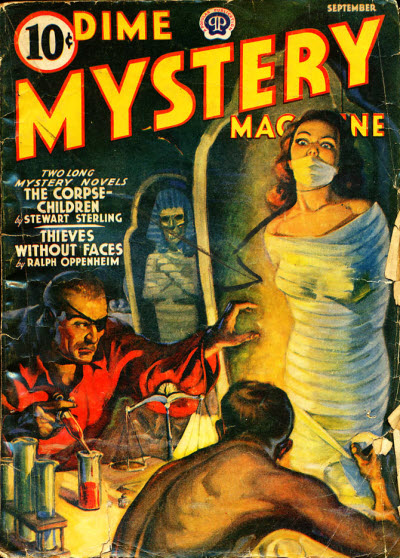 clear lovely Anne Ferris of a shop-lifting charge, he could not guess what was waiting for him. In all his long years of fighting crime, the Bystander had never seen anything like those vastly, distorted corpses—or that he was putting himself into the power of a monstrous murder syndicate whose victims died with the flesh decaying on their bodies! The Bystander found himself trapped and helpless—while they prepared for their last, most fiendish act of all!
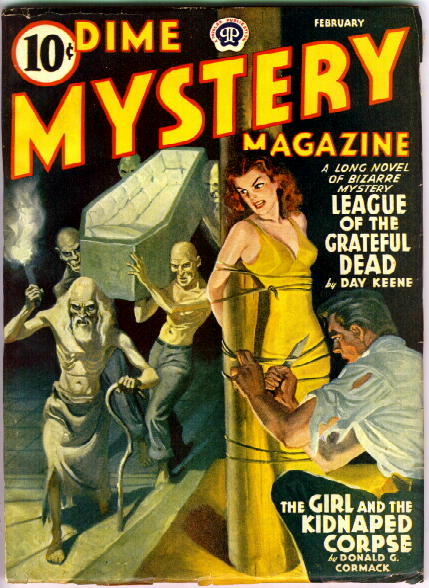 to help the police find the maker of those hideous, purple corpses. But then people began taking pot shots at him from dark corners, and he realized that Ahmed Bey and company had no real interest in his further health. And the Bystander was never the man to turn down a dare—especially from Death! For the death-loaded touch of an invisible finger was turning lovely young girls into rigid corpses—hideously purple!
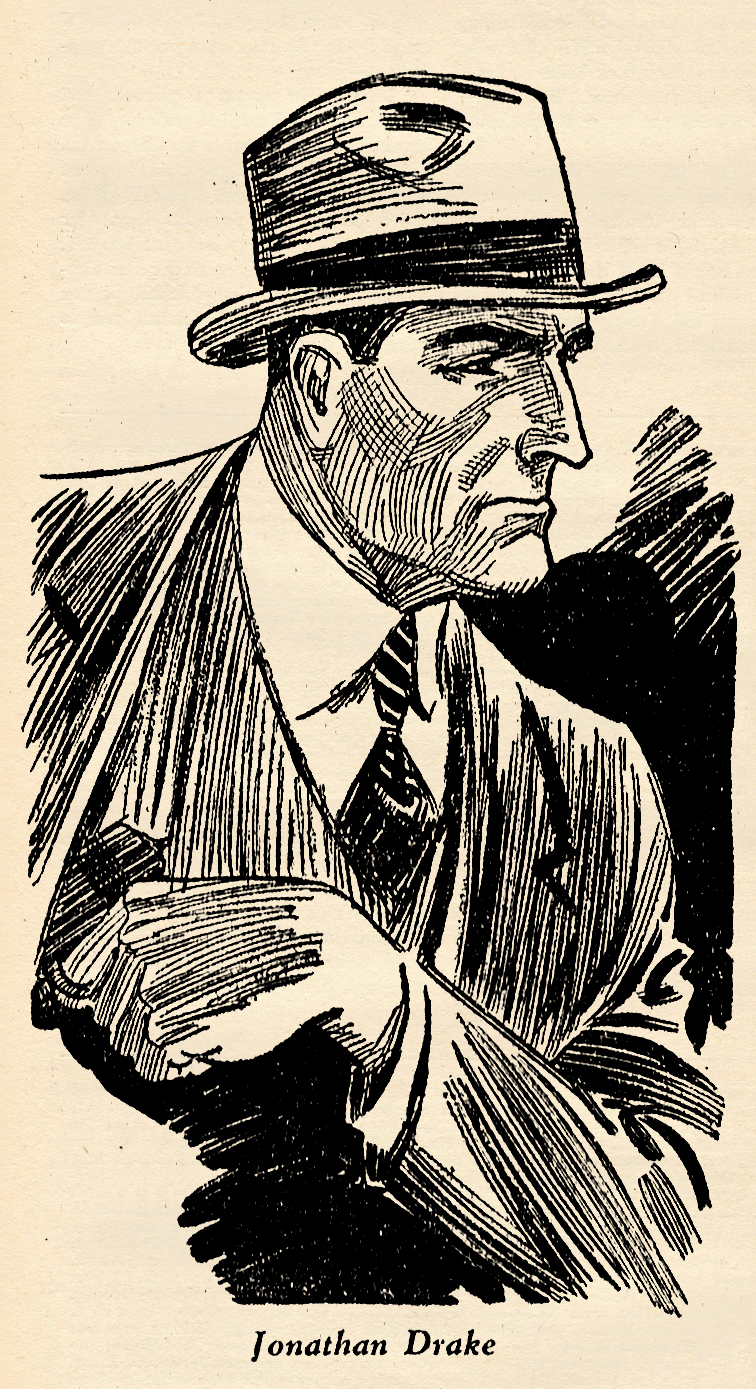 This brings us to Jonathan Drake, Ace Manhunter, from the pages of Black Book Detective! Drake appeared in three consecutive issues of the Black Book, but the three stories were written by three different authors. Oppenheim wrote the first of the three stories which introduced the character. Drake was a world-renown criminologist frequently called in to work with the police on their toughest, most baffling cases! The details of these cases were recorded in huge black loose-leaf volumes—his Black Book of Crime!
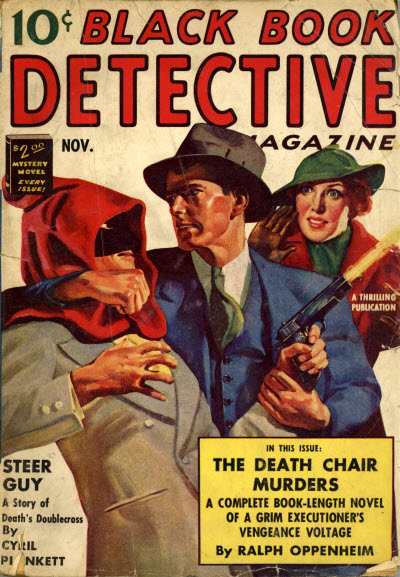 and gets the plot going with a grisley electrocution before introducing our hero (a page long descriptive that is repeated word for word in the second story by Donald Stuart (aka Gerald Verner)). When a second victim is found by a manhole still hooked to the city’s electrical grid and burning, Drake tries to find a connection between the two. This leads to four other men—all six had worked a number of years ago for the Triconi mob and now a shadowy Executioner seem to be exacting revenge for the mob—at least that’s how things appear. Will Drake be able to discern the motive behind the murders, unmask The Executioner, and save the lives of the other four men? Find out in Ralph Oppenheim’s “The Death Chair Murders” from the pages of the November 1938 Black Book Detective!
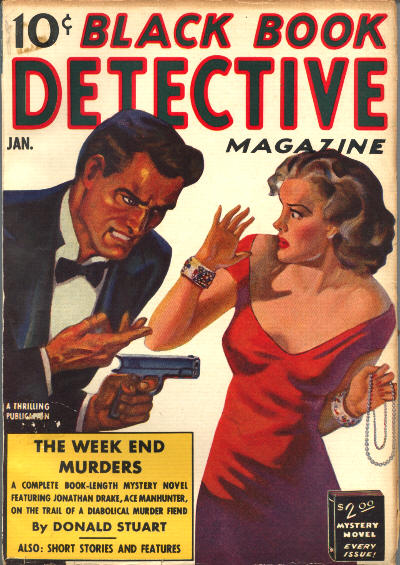 at Backwaters he was not looking forward to his visit with any degree of anticipation. He had no prevision of the tragic events that would take place—but he disliked the average week end house party. This, however, did not turn out to be an average week end house party. From the moment he entered the estate of Montague Hammond, theatrical producer, he was gripped with a strange sense of foreboding. There was death in the warm summer air, bitter hate in the glance of the week end guests when they looked at each other. Then—murder!
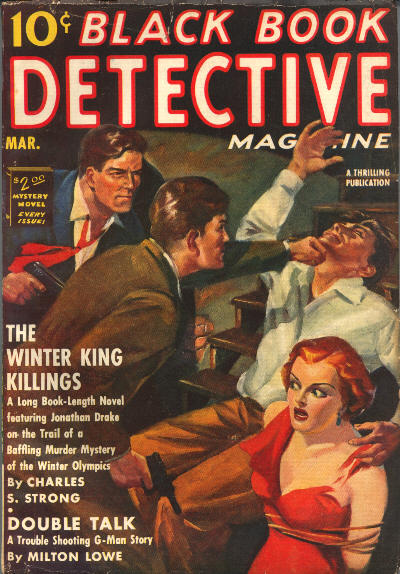 aboard the Griffholm in New York Harbor, he was expecting nothing more than a routine job of investigation into the business of a Winter Olympic Star Sports Group. He had no idea that before he reached the upper deck he would be faced with the fiendish murder of the piquant and attractive Scandinavian skating star, Svana Hanson.
 BLACK BOOK MAGAZINE first hit the newsstands with the June 1933 issue. For the next six years, it tried different approaches to success. Issue one began with a featured novel and several backup short stories. The following year it started promoting “three new complete novels” in each magazine, but abandoned that approach after four issues. It then tried shorter novelets, combined with short stories. By April 1935, the magazine went on an extended hiatus to return in January 1936 with a “weird menace” approach with scantily-clad women in peril or skulls and severed heads on the covers before going on a break again.
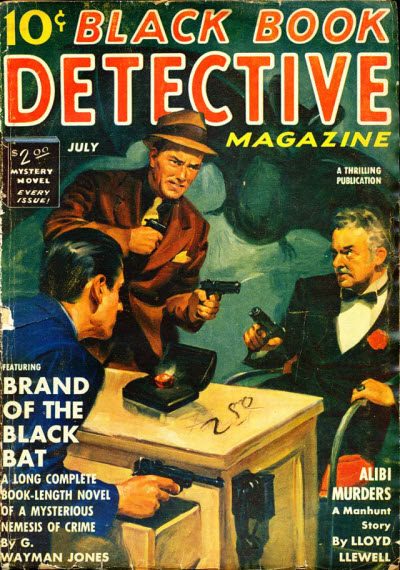 embraced the Ace Manhunter as the editors had hoped and in the “Off The Record” column in the March 1939 issue, the editors were already promoting Rick LeRoy, famous globe-trotting detective by Barry Perowne for the next issue. Perowne’s LeRoy had previously appeared in the pages of The Thriller.
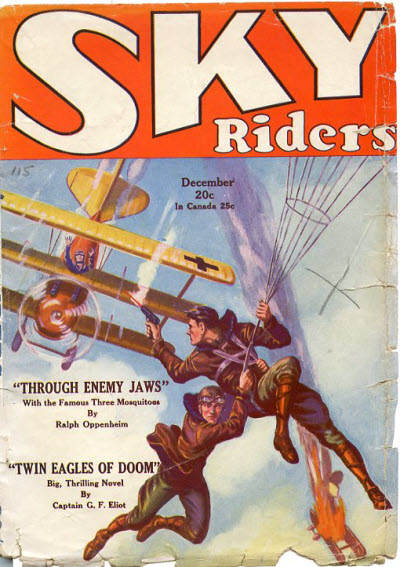 the third and final of three Ralph Oppenheim’s Three Mosquitoes stories we’re featuring this March for Mosquito Month! And this one’s a doozy! Allied intelligence had learned that the Germans had built a great seaplane, destined to turn the whole tide of the naval war. This seaplane was not only a compact fighting and raiding ship, but it could make remarkable speed and cover remarkable distance. It was even rumored that the Germans proposed to send a whole fleet of these new planes across the Atlantic, with the object of raiding the American coast!
 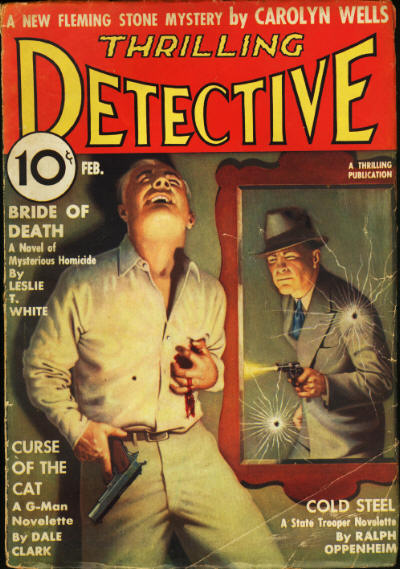 in the pages of Thrilling Detective—the first two in 1936 and 1937 featured Dave Rogers. Dave Rogers was a motorcycle riding state trooper. In this second of the two published tales, a former state trooper, young Bob Hall, has returned to the station as a Federal Agent investigating a counterfeiting ring that is believed to be operating in the area. Rogers says he’s seen one of the three counterfeiters in the area, but is asked to give Hall a wide berth in his investigation. However, when young Bob Hall turns up frozen solid just a short time after Rogers has seen him speeding by on the other side of town, he throws himself into the case!
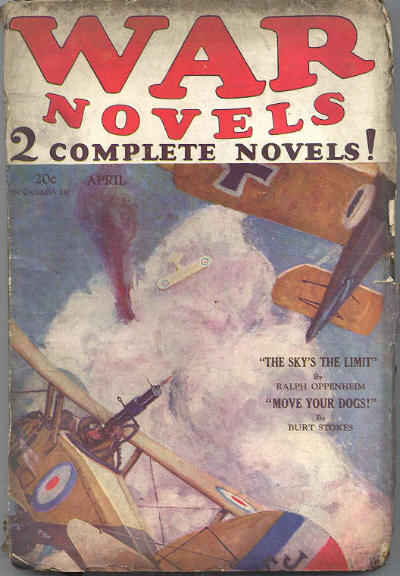 the second of three tales of Ralph Oppenheim’s Three Mosquitoes we’re featuring this March for Mosquito Month! This one is epic! The “Flying Dutchman” and his Circus have been overwhelming the Allied squadrons up and down the Western Front with their sheer numbers. Needless to say Kirby wants to take out the “Flying Dutchman”—Kellar—and put an end to his Circus. They go up again each other several times with alternating fortunes and develop a mutual admiration and respect for one another. Unfortunately, the Western Front is not big enough for both Aces.
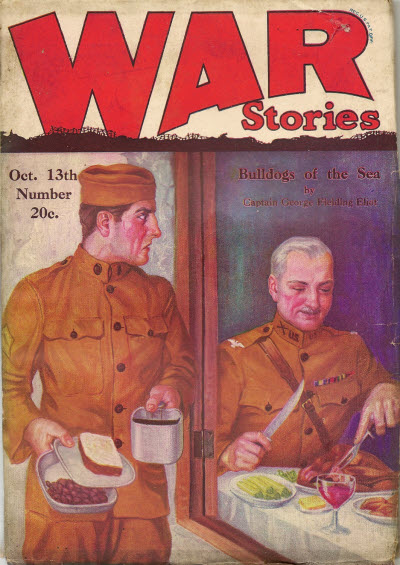 off the ground with an early Mosquitoes tale from the pages of the October 13th, 1927 issue of War Stories. The great German Ace Breikhart has been making his personal mission to down any observation balloon the allies have up. As a result, our intrepid trio has been assigned the task of protecting the observation balloons. An assignment Kirby finds boring and beneath his capabilities, until…
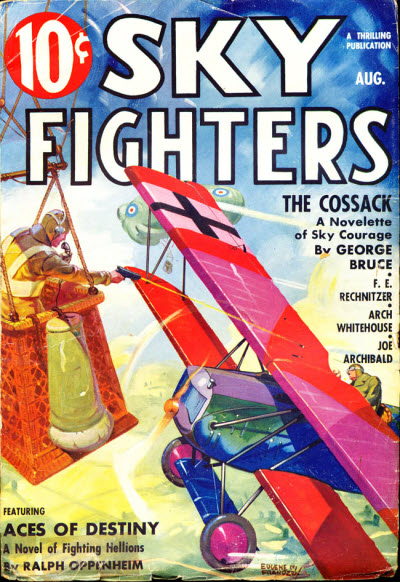 Mosquito Month we have a non-Mosquitoes story from the pen of Ralph Oppenheim. In the mid thirties, Oppenheim wrote a half dozen stories for Sky Fighters featuring Lt. “Streak” Davis. Davis—ace and hellion of the 25th United States Pursuit Squadron—was a fighter, and the speed with which he hurled his plane to the attack, straight and true as an arrow, had won him his soubriquet. Once more it’s a battle against time—B Flight is sent out on a perilous mission to destroy the new Boche anti-tank gun munitions factory by noon in hopes of preventing a massacre when the Allies push forward in their new Whippet tanks. However, after B flight has taken off, Streak learns a spy may have fouled their mission somehow and flies off like a streak to stop them before it’s too late! From the August 1936 issue of Sky Fighters it’s Ralph Oppenheim’s steak Davis in “Aces of Destiny!”
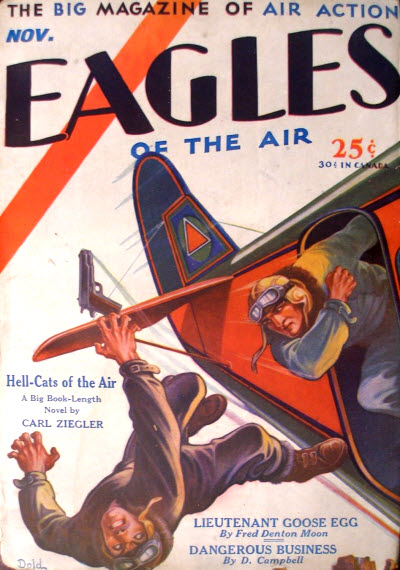 of three stories featuring D. Campbell’s The Three Wasps—stories plagiarized right from The Three Mosquitoes! So instead of the young impetuous leader Kirby of the Mosquitoes, we have the young and impetuous Gary heading up the Wasps. Similarly, Campbell changed “Shorty” Carn to “Shorty” Keen complete with briar pipe and eldest and wisest Travis to Cooper. This time we have their first of five appearances in Harold Hersey’s Eagles of the Air, a short lived pulp that didn’t even run a year. From October 1929 to August 1930, Eagles of the Air had nine issues; The Wasps ran in five of them.
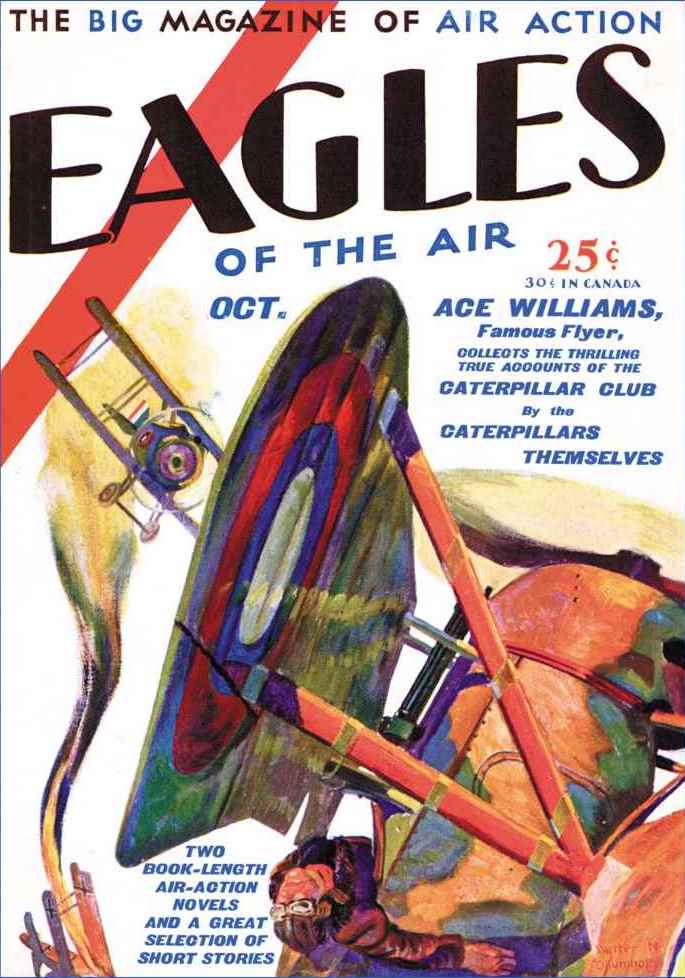 of three stories featuring D. Campbell’s The Three Wasps—stories plagiarized right from The Three Mosquitoes! So instead of the young impetuous leader Kirby of the Mosquitoes, we have the young and impetuous Gary heading up the Wasps. Similarly, Campbell changed “Shorty” Carn to “Shorty” Keen complete with briar pipe and eldest and wisest Travis to Cooper. This time we have their first of five appearances in Harold Hersey’s Eagles of the Air, a short lived pulp that didn’t even run a year. From October 1929 to August 1930, Eagles of the Air had nine issues; The Wasps ran in five of them.

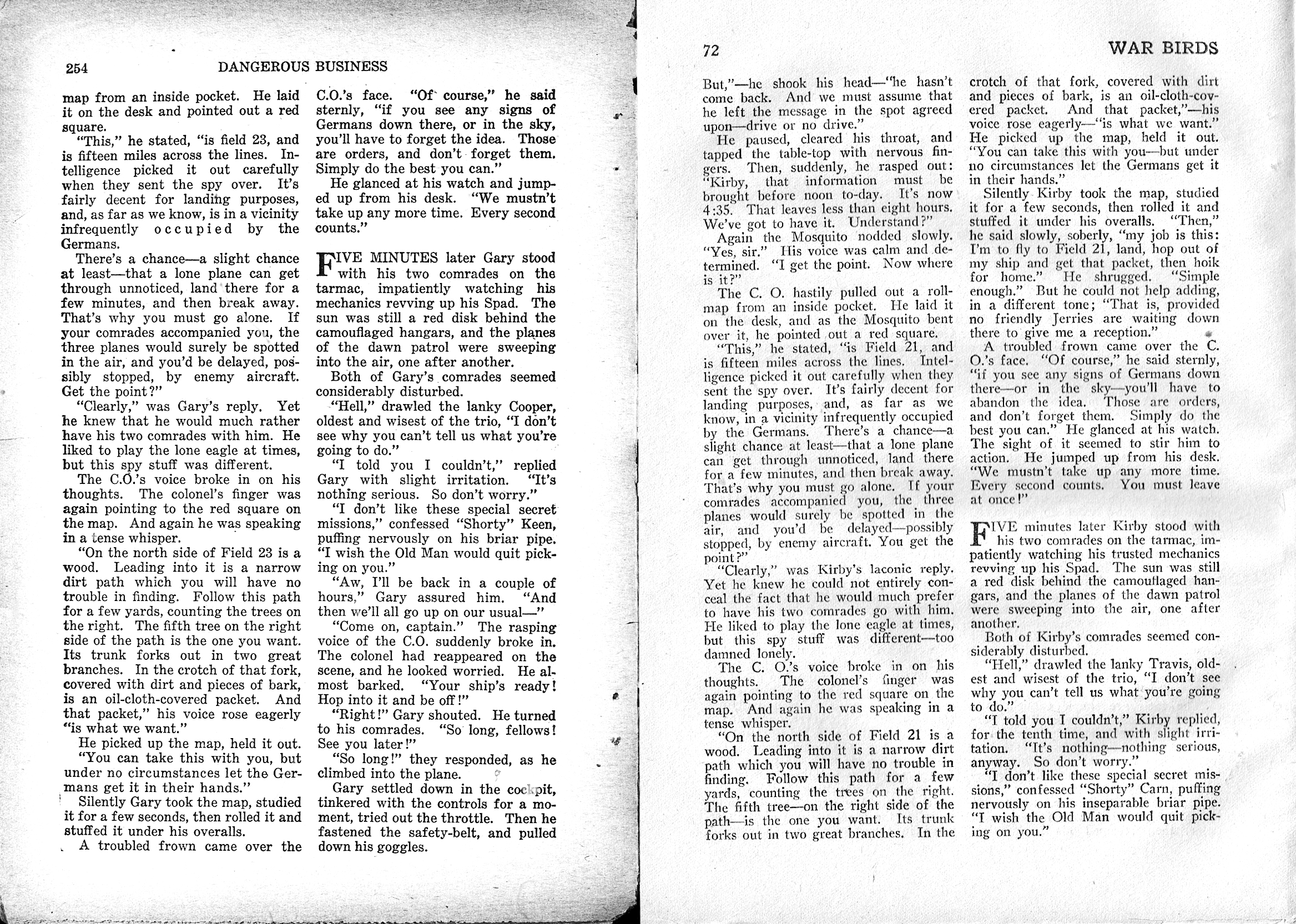


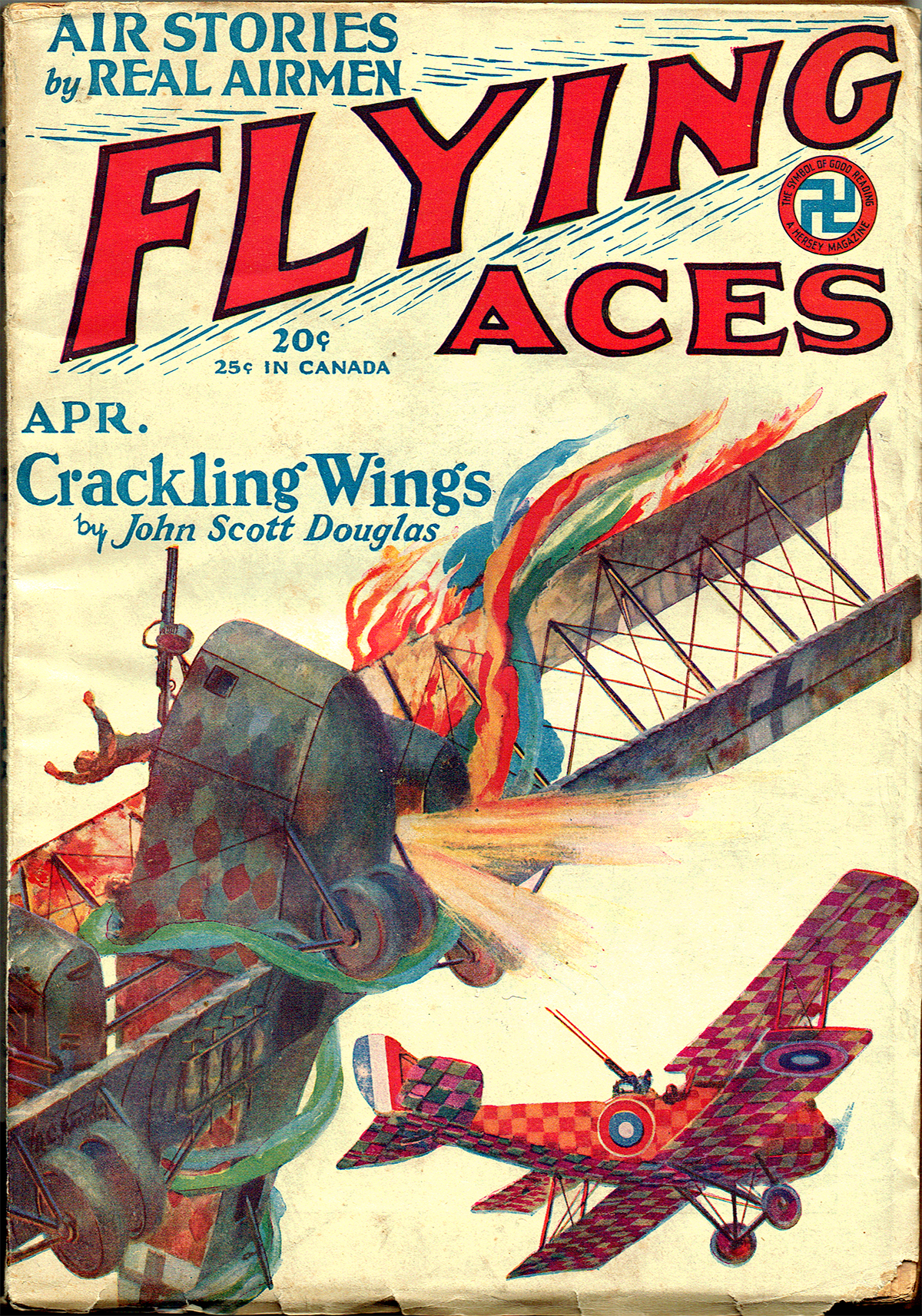 to the squadron and he can’t stand pilots who “grand-stand” which is the Mosquitoes stock-in-trade and boy do they catch hell when they get on the C.O.’s wrong side—that is until the C.O. gets in a jam and it’s trick flying that’ll save him when the Boche attack!