



My Most Thrilling Sky Fight: Lt. Luigi Olivari
AMIDST all the great pulp thrills and features in Sky Fighters, they ran a true story feature collected by Ace Williams wherein famous War Aces would tell actual true accounts of thrilling moments in their fighting lives! This time it’s the inimitable Italian flying ace, Lt. Luigi Olivari’s Most Thrilling Sky Fight!
Luigi Olivari was born in 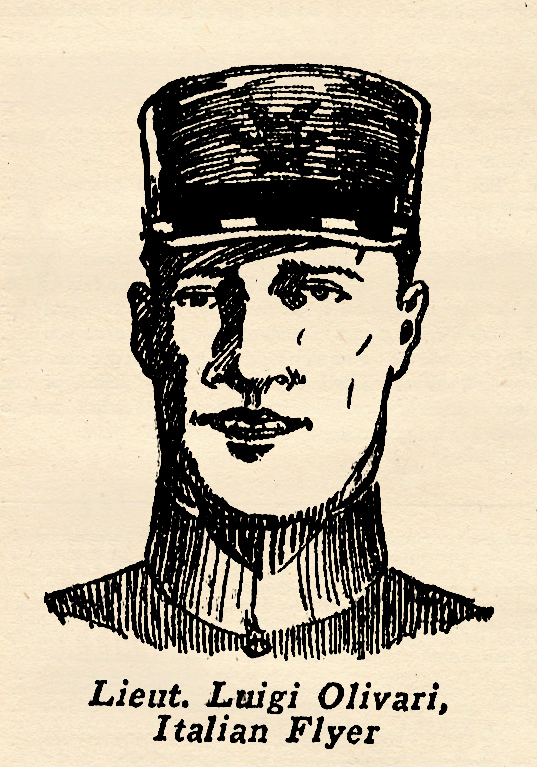 Milan and educated in Switzerland in a military school. Although but a boy in his minority when the war began, he left home and school immediately and enlisted in the ranks of the Italian Army. He rose swiftly in the ranks and was commissioned a Lieutenant in tho Alpine Corps, those rugged mountain troops that did so much to protect the fertile Italian plains from Austrian army raids. After brief service as an officer in that branch he was transferred to the flying corps. Sent to the front he was assigned to a squadron flying little Pomilio monoplanes with Fiat engines. These were the fastest but trickiest of front line lighting machines of their day. Luigi Olivari downed three Austrian planes in his first sky battle. When killed on October 15, 1917, he had run his score to 12 official and was the third ranking Italian ace. The account below is taken from an interview he gave to an American correspondent.
DOWNING A NIGHT RAIDER
by Lieutenant Luigi Olivari • Sky Fighters, October 1936
FIGHTING by day and fighting by night are not at all similar. Of course, one uses his guns in the same manner in both cases; but tactics and strategy are entirely different. In day time one maneuvers to secure the advantage of the sun, so that he may come down in the path of the sun’s rays unseen by his antagonist. To try the same tactics at night, say to maneuver into the path of the moon’s rays, would be fatal. For instead of being hidden you would only succeed in revealing your presence to the enemy. Then another thing, in day fighting one usually tries to gain position behind and above the enemy. In night fighters against bombers such a position is fatal. The glare of your exhausts gives your presence away, and the night bombers are so arranged that many guns can be brought to bear on the rear, in front and to all sides. The only proper way to attack is from directly beneath.
One has to unlearn most of his day fighting tactics when he goes on night patrol. I had had good schooling before I ever went on night patrol. That accounts, I believe, for my success in my first night flight, when I succeeded in bringing down an Austrian Gotha that was attempting to bomb one of our ammunition factories,
A Moonlit Night
Front line patrols had reported that a formation of three Gothas had crossed our lines, proceeding in the general direction of T——. The night was one of bright moonlight, ideal for bombing. And I must also say helpful to us, the flyers of the night patrol, who were supposed to keep them from laying their eggs—and down them if possible.
With Captain M——, Lieutenants S—— and G——, and Sergeant T——, I took off from our airdrome and flew to intercept the night raiders. Even in moonlight one cannot see far at night, hence the Gothas passed us unseen. They came over at a much higher level than they had been reported. It is only when the anti-aircraft battery protecting the factory at T—— began to fire at them, that our formation located them.
We all dashed in then with full power. Our instructions were to split the formation if possible. That we managed to do even before the night raiders had a chance to drop their bombs. Captain M—— and two others went for the Boche leader. Sergeant T—— and I then attacked the Boche on the right. The sergeant went up above and the Boche gunners opened up on him with a heavy fire which he returned. I could see the tracers from both ships racing back and forth like a streaking shuttle in power loom.
Firing at Close Range
Taking advantage of the Boche gunner’s momentary distraction with Sergeant T——, I dived down and came up with full power immediately beneath, my sights fastened on the Boche’s black belly. Knowing that they were armored in places beneath I waited until I was very close before firing. Then when I did, I rooked my stick fore and aft, so that my tracers traversed the whole length of the fuselage.
The Boche gunners saw me now, however, and they switched their fire to me. But their tracers went harmlessly through my outer wings. They couldn’t reach me in a vital spot, for parts of their own plane intervened. I was hovering under their blind spot.
With speed lost, my ship began to wobble. I had fired a whole belt of ammunition into the Boche’s belly and still nothing had happened. I thought my surprise attack from beneath was going to fail and was sick at heart. But no!
A little tongue of fire began to lick along the fuselage. Fanned by the air blast it leaped into a giant flame, the heat of which I felt against my cheeks as I fell off into an uncontrolled spin. Then there was an explosion. My own plane seemed to suddenly thrust sideways. It groaned under the sudden strain and the braces crackled.
But my motor was roaring, so I soon managed to regain control.
There below and to one side of me was a night raider falling in flames. The other two Gothas were streaking homewards with my comrades darting in at them and sniping from all sides like swallows attacking a hawk.
The bombs that were dropped did not do any damage, and I had succeeded in gaining my first victory over a night raider.
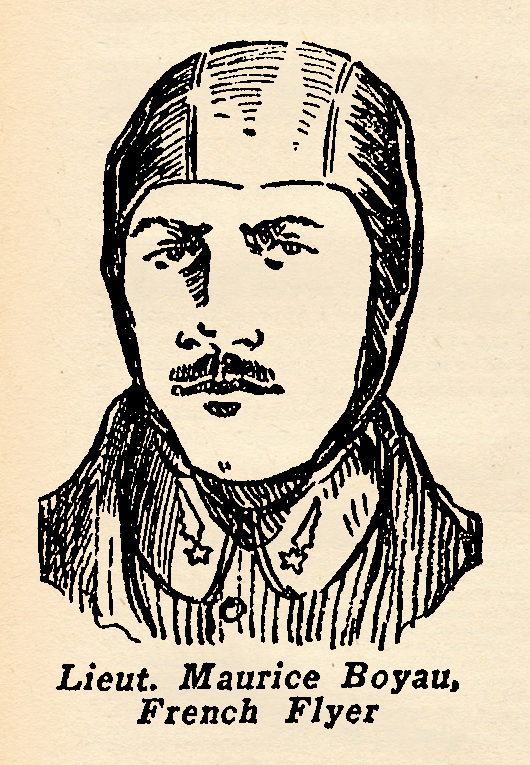 ranking ace. Fonck, Guynemyer, Nungesser and Madon, all ranked above him in actual victories scored. Maurice Boyau combined all the best qualities of these four aces and wan in addition the most ingenious. If death had not cut short his flaming career long before the war ended, it is very possible that he might have attained the honor of being France’s ace of aces, for he had every qualification for that distinction. He was struck down when he had run his 35 victories, but not before he had won every medal within the power of his native country to bestow. These Included the Legion d’Honneur, Medaille Militaire and the Croix da Guerre, with numerous stars and palms. The following story taken from his diary gives a striking and vivid example of his ingenuity. The translator has made no attempt to polish the language of Boyau’s script, feeling that to do so would take away from the charming simplicity of the document.
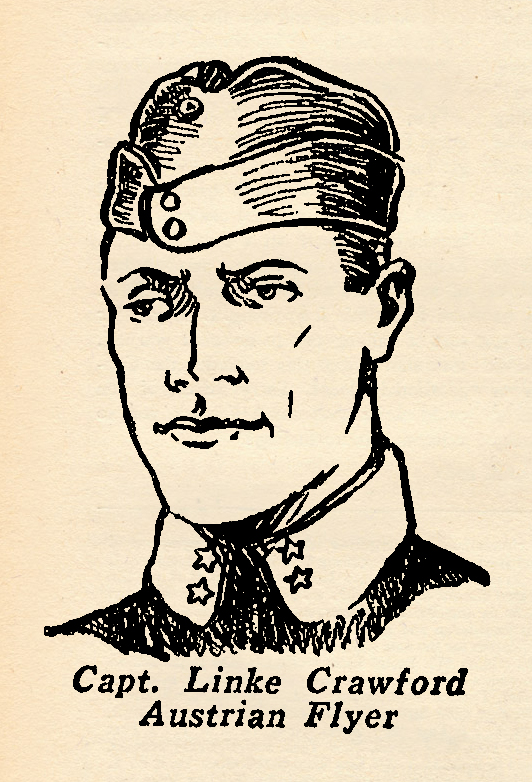 most brilliant and scintillating of all the flying aces. Most everyone knows that Captains Brumoninski and Linke were the ranking Austrian flyers and carried on a duel for top honors all through the war with first one, then the other, on top. But what most informed people do not know, is that Captain Crawford and Captain Linke were one and the same person! Son of an English father and an Austrian mother, Linke Crawford was born and raised in gay Vienna. When he began to win fame as a fighting pilot he had dropped the Crawford part of his name and was known as Captain Linke. although he was listed on the army rolls as Captain Crawford. He fell victim finally under the guns of Colonel Barker, famous Canadian ace. Up to that time, however, he had scored 27 victories and won all the awards possible from his country. The story below is taken from the archives of the Austrian Imperial Air Corps in Vienna.
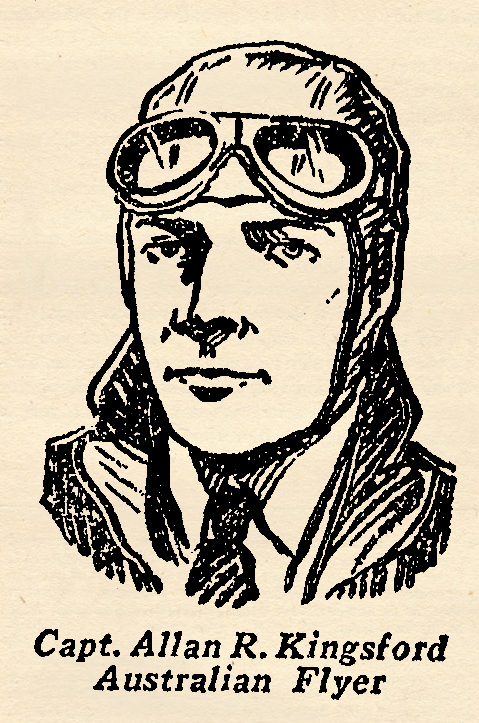 simple private in the Australian Army. The troop ship carrying his contingent was torpedoed by a German submarine and he was cast adrift in a heaving sea at midnight with only a frail spar to buoy him up. He served for over a year as a Lance Corporal of Infantry in Mesopotamia, he determined upon obtaining a transfer to the Hying corps, and after many setbacks he finally was ordered for flight training and sent to England, He became pilot of the Zeppelin night patrol guarding London, later joining that strange organization, the British Independent Air Force, as a bombing pilot attached to 100 Squadron. As a member of that group which served under no army, but roved about from point to point, he took part in 270 night bombing raids and became known as the Ace of night bombers. This account of his most thrilling flight is taken from his private memoirs.
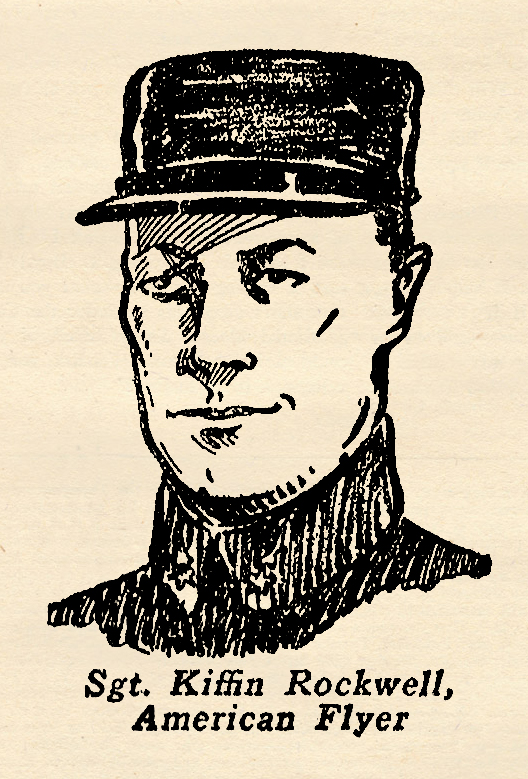 of fortune. Born and raised In Aaheville, N. Carolina, young Rockwell got the wanderlust soon after graduating from the University of Virginia. When the Germans made their surprise move on the forts of Liege, Rockwell was serving in the ranks of the Foreign Legion. For a heroic exploit in hand to hand bayonet fighting, he was awarded the Medaille Militaire. For a whole year he served with the Foreign Legion in the trenches, then transferred to the aviation and went into training at Avord. When Norman Prince formed the first American Flying Squadron in Paris, Rockwell was one of those invited to join. He proved out to be one of the best and most daring pilots of that original band. His career was cut short by his untimely death on September 23rd, 1916.
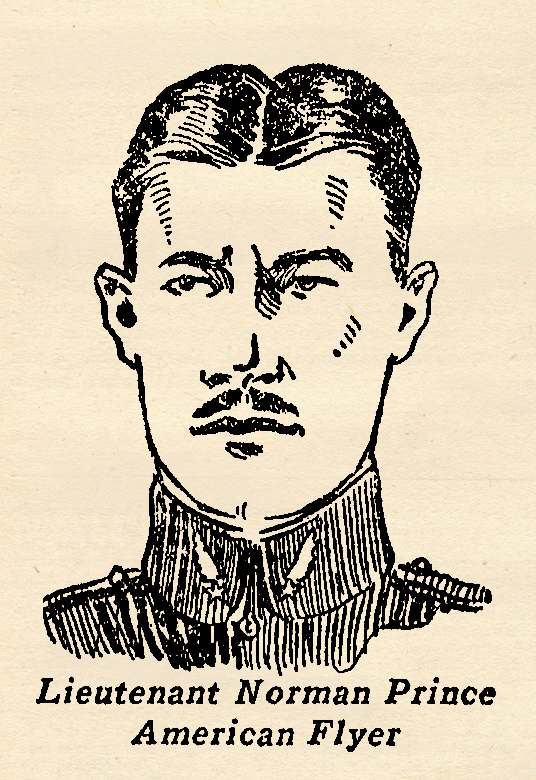 August 31, 1887, scion of one of the blue-blooded families In old Boston, was Norman Pslnce, the founder of the famous LaFayette Escadrille. Educated at Groton and Harvard for a career in business with his wealthy family, he hazarded his promising future and used his wealth and family prestige in overcoming obstacle’s to form a squadron of American aviators for battle at the front. With him in the beginning were Thaw, Chapman, Rockwell, McConnell, Hall and Cowdin. These Americans with Prince made up the roster of the original squadron sent up to the front at Luxeuil in May, 1910.
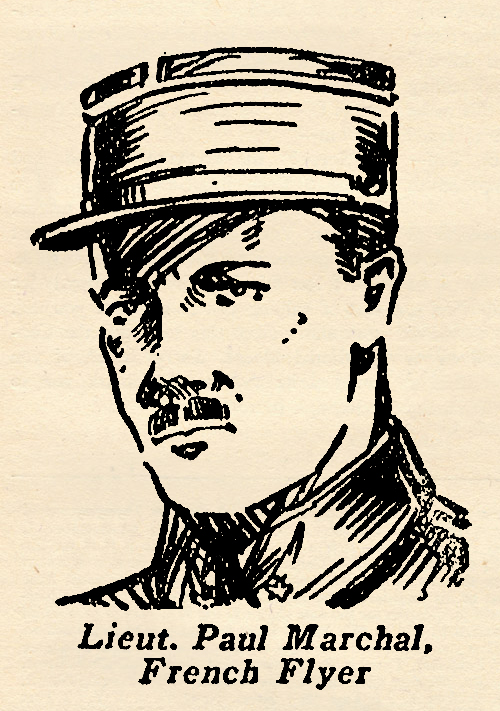 colors on the first day war was declared, and it was he that answered the challenge of that bold German, lieutenant Max Immelmann, when the latter bombed Paris with leaflets calling for surrender. Immelmann had to fly a matter of but a hundred kilometers, or less, to get over the city of Paris. But when Marchal answered his challenge with an identical flight to Berlin, he had to fly 8QO kilometers.
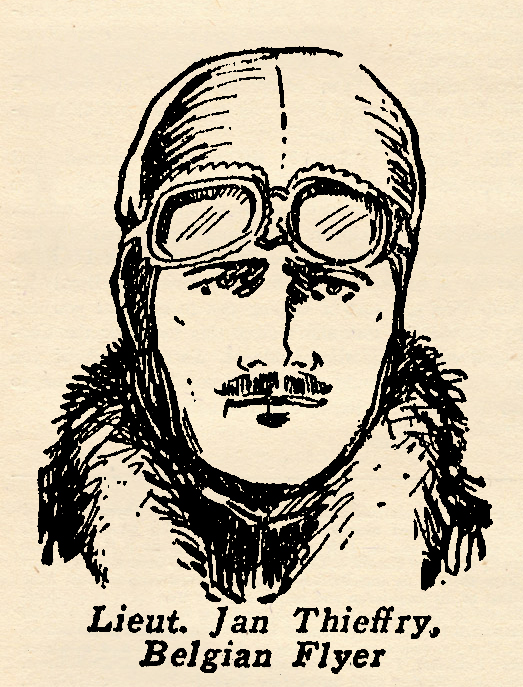 a part in the war of the air as she did in the war on the ground, when her brave soldiers held up the advance of the German hordes at the gates of Liege until the British and French armies could mobilize and get to the front to begin their counter-offensive. Corporal Jan Thieffry was a motorcycle despatch rider at that time. He was taken prisoner by a flying squadron of German Uhlans, but after some months made his escape.
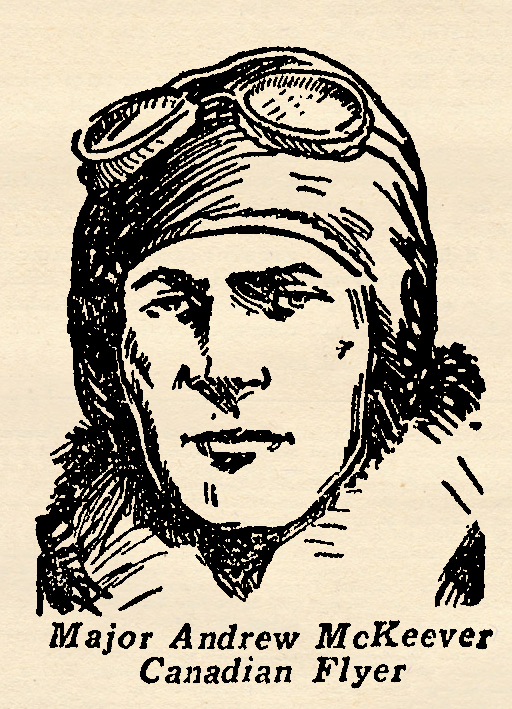 was one of the many daring young sky fighters that came from Canada to add fame and lustre to the deeds and exploits of the Royal Air Force, He put in almost a full year in the infantry before he was transferred for flying training. He joined the R.F.C. in December, 1916, was commissioned a lieutenant and sent over to the 11th Observation Squadron in France on May 16th, 1917.
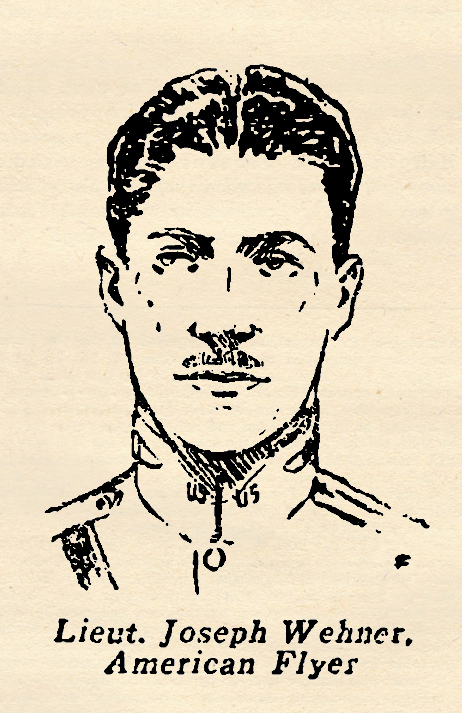 was the most daring sky fighter in the American Air Service. But it is hard to say whether he would have established the record he did without the aid of Joe Wehner, his constant and steadfast companion and buddy in the 27th Squadron. He was Luke’s alter ego.
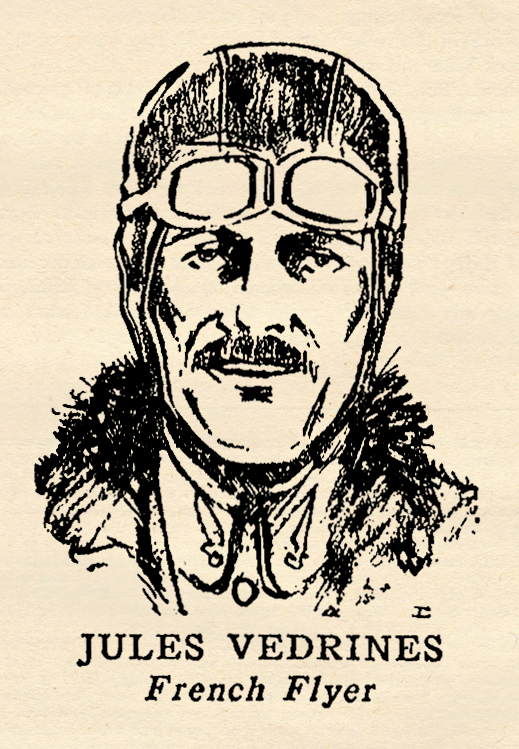 great war broke out Jules Vcdrines was the most famous flyer of France. He had twice won the Gordon Bennett speed trophy, and held both distance and altitude records. It was through his efforts that France wrested supremacy of the air from the United States and Great Britain. Along with Garros, Pegoud, Marechal, Le Blanc, Audemars, and other famous French flyers of his day, he enlisted in the French Flying Corps the day after war was declared.
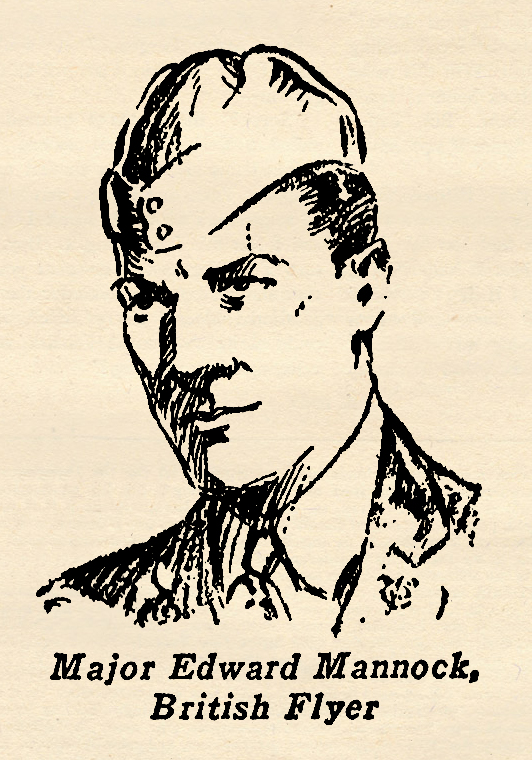 the British postal department, Turkey, when the war broke out. He was immediately made a prisoner by the Turks, and spent almost a year in an enemy camp before he was repatriated to England in 1915. He first served in the Royal Engineers, was commissioned as a lieutenant and transferred to the flying Corps in August, 1916. Major McCudden, the great British Ace, was his first instructor.
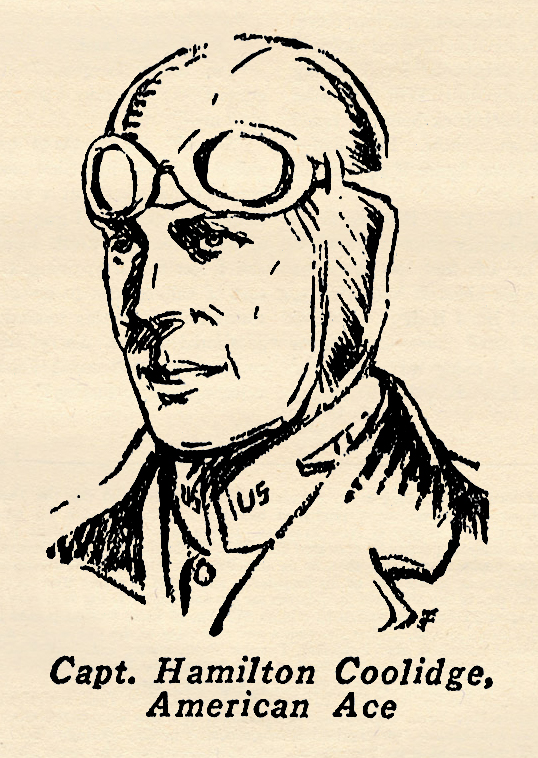 Hamilton Coolidge was well known throughout the land even before the war began. He enlisted in the aviation section of the Signal Corps and got his primary flight training at Mineola along with Quentln Roosevelt, his hoy-hood friend.
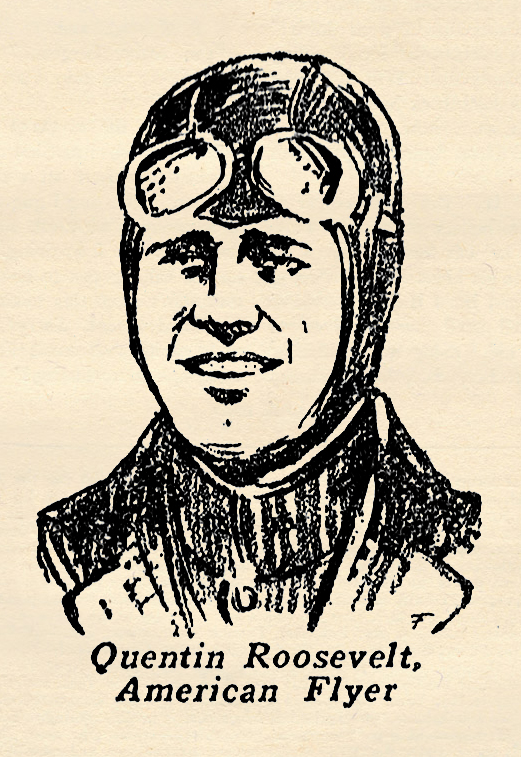 at Oyster Bay, N.Y., the fourth and last son of a famous fighting family, November 19th, 1897, six weeks after his illustrious father, Theodore Roosevelt, had left to fight for the freedom of Cuba. Although handicapped by a permanently injured back, he succeeded by dint of cunning and painful effort in fooling the medical examiners and being accepted for training as an aviator.
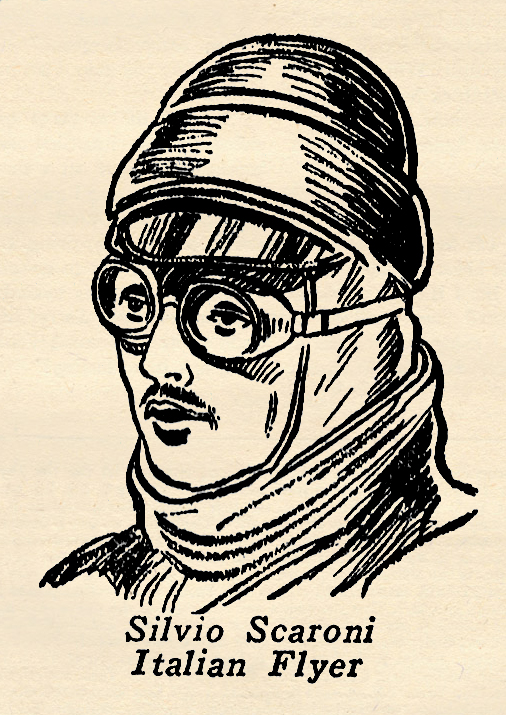 born at Brescia, Italy, and entered the aviation corps at the beginning of the war. As a bomber he was recognized as one of the best in the Italian Flying Corps and he was very adopt in handling big three-engined Capronis. But the big ships were too slow to satisfy Lieutenant Scaroni. He wanted to fly single Heaters and eventually managed to secure his transfer to a combat squadron on the morning of November 14, 1917.