Looking to buy? See our books on amazon.com Get Reading Now! Age of Aces Presents - free pulp PDFs

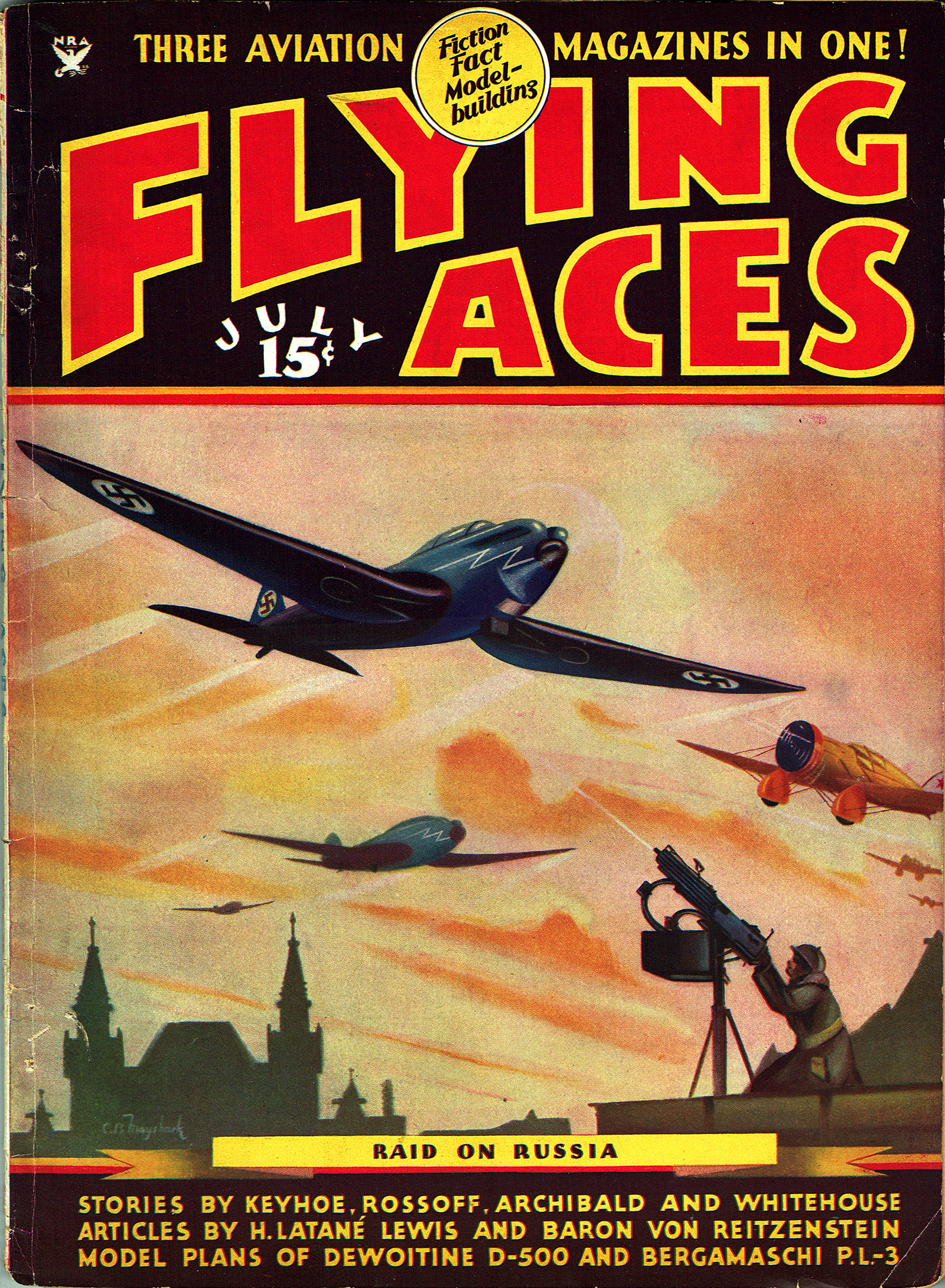
“Flying Aces, July 1935″ by C.B. Mayshark

Link - Posted by David on May 10, 2021 @ 6:00 am in

THIS May we are once again celebrating the genius that is C.B. Mayshark! Mayshark took over the covers duties on Flying Aces from Paul Bissell with the December 1934 issue and would continue to provide covers for the next year and a half until the June 1936 issue. While Bissell’s covers were frequently depictions of great moments in combat aviation from the Great War, Mayshark’s covers were often depictions of future aviation battles and planes—like the July 1935 cover where Mayshark gives us a glimpse into a Nazi raid on Russia!

Raid on Russia

th_FA_3507DEATH, destruction, appalling calamity! Crumbling buildings, writhing humanity! The ominous drone of high-powered aircraft, the rattle of machine-gun fire, the detonation of death-dealing explosives! The Nazi insignia over the city of Moscow!

Russian aircraft sound-detectors had flashed the warning many minutes before, and even now, defense ships are taking off. Motor lorries with anti-aircraft guns mounted upon them are being driven to points of vantage throughout the city. Women and children are being herded into bombproof cellars and, except for the scattered military activity, the city looks deserted.

As the German bombers sweep in from the west, Russian pursuit and attack planes close in upon them. The Germans are flying low so as to be sure of their target, for the effectiveness of a bomb depends on where it hits, and the Germans have a certain objective in mind. The Kremlin comes first, then definite military concentration points, and then, if there is time, certain bridges, railroad terminals and important buildings.

But flying low on a bombing expedition is at best a hazardous business. Anti-aircraft has a better chance; then, too, the repercussion is likely to cause damage to the ship from which the bomb is dropped. But the Nazis are taking their chances. The city of Moscow must be destroyed.

There is an old axiom of war which reads: The attacker is always the heaviest loser. After acknowledging this fact and applying it to the present situation, one wonders just how far Germany would get in an air raid on a power that possesses the military strength that is Russia’s. Indeed, it is likely that a flight of bombers would not even get as far as Moscow, for the capital city is a long way from the border. Defense ships in large numbers would have ample time to mobilize and beat off the attackers, and it is a difficult job for a raiding bomber to engage enemy planes and at the same time continue on toward an objective.

But let’s assume that three or four out of the entire flight of raiding bombers manage to reach Moscow. What then? Would the bombs dropped from these ships be sufficient to wipe out the city completely? Probably not. Even if a few bombs were dropped, it is not likely that they would be as effective as they were intended to be. The fierce firing of the anti-aircraft guns, and the dizzy attack of the defense ships would make jockeying for position an extremely difficult task.

Germany’s threat today lies in the air. This much is accepted by every military expert the world over. Her navy, a small but highly efficient arm, has lost much of the prestige it had before the Battle of Jutland and today is really being upheld by the old German Sons of the Sea. The modern German warrior sees not naval history and glory, but winged glory in the skies. The weapons are not dread-naughts, destroyers and the much-hated U-boats, but highspeed fighting bombers, fighters and well-armed single-seaters.

Her threats are not Zeppelin bombs, flame-throwers and Minnies. Fifteen years of careful preparation in defiance of the Treaty of Versailles have brought such terrible weapons as Brisanze bombs, 500-kilo projectiles, each capable of destroying a complete city block. Then there are the new incendiary bombs containing Celsius, a formula that will throw a burning sheet of flame considered to reach 3,000 degrees of temperature. No liquid or damper is known that will quench such a fire. No peace-time fire-fighting equipment could cope with this.

Also, there are their new gas bombs containing the deadly dichlorethyl sulphide, sometimes known as Yellow Cross, which is invisible to the naked eye and which after several hours, only begins to show its symptoms. By that time it is too late. Men die of necrosis of all living tissues including eyes, nose, lungs and throat. They have other gas bombs, too, including Yperite, Blue Cross or Death Dew, which kills men outright in one minute.

If Germany is to attack Russia—a much larger nation, from the point of view of military might—she would have to use amazing surprise methods, and her war would have to be completed in a comparatively short time. With such weapons as explained above, her leaders would hope to overwhelm any European nation within a few days, by simply preying on the moral fibre of the civilian population.

But one might ask, accepting the fact that Germany has all these weapons, what means does she have to convey them to the point of attack? How can Germany build up an efficient air force in such a short time, and train men to handle it?

German efficiency has been accepted for years. Everyone knows that her great commercial air ventures have been produced with only the future air might in view. Her transport planes are like no others anywhere. Her system of sport-flying clubs and schools were nothing but military training organizations. The ships used in these schools were out-and-out military ships—minus such military equipment as bomb-racks, machine guns and camera fittings.

There’s the set-up that Russia, France and England would have to face. Russia is particularly vulnerable to Germany’s air might because of certain geographical conditions.

In the cover illustration, we show one of Germany’s seven-passenger air transports turned into a high-speed fighting bomber. This could be done in eleven hours. The ship is the new Heinkel, capable of 234 miles per hour. We do not know what the flying range is, but there is no doubt that after the conversion job, the ship would be capable of reaching Moscow.

All bombs would be carried within the fuselage, and dropped through a trap door in the floor. Fixed machine guns would be installed somewhere along the top of the engine, firing forward through the propeller. A movable gun would be carried about midway along the top of the fuselage. The ship is powered with a B.M.W. VI twelve-cylinder vee-geared engine. The motor develops 630 horsepower.

The Russian ship is an Ossaviachim Air 7. Figures on performance are unavailable. All we can say about it is that it is a low-wing wire and strut-braced monoplane, and that it is based on the Travel Air “Mystery” monoplane.

The Story of The Cover
Flying Aces, July 1935 by C.B. Mayshark
Raid on Russia: Thrilling Story Behind This Month’s Cover

“Flying Aces, June 1935″ by C.B. Mayshark

Link - Posted by David on May 3, 2021 @ 6:00 am in

THIS May we are once again celebrating the genius that is C.B. Mayshark! Mayshark took over the covers duties on Flying Aces from Paul Bissell with the December 1934 issue and would continue to provide covers for the next year and a half until the June 1936 issue. While Bissell’s covers were frequently depictions of great moments in combat aviation from the Great War, Mayshark’s covers were often depictions of future aviation battles and planes—like the June 1935 cover where Mayshark gives us a glimpse into a raid on the Panama Canal!

Raid on the Panama Canal

th_FA_3506DEATH and destruction in the Canal Zone! Great masses of concrete and steel scattered to the four winds as if they were paper boxes! Ships and men reduced to fragments with equal abandon! A monument to human progress that took years to construct, a shipping and transportation facility which is absolutely essential to modern needs—all wrecked within the space of a few minutes!

Could it be done? Well, it could be attempted, at any rate. Success would depend upon the precision and the deftness with which the whole maneuver was carried out. Failure would be certain only if the United States air defense arm was of sufficient strength.

The prime reason for such an attack would be, of course, the move to cut off the two main fleets of the United States Navy. If the Atlantic Fleet were in home waters, it would take weeks to concentrate both fleets in the Pacific in case of an emergency. The reverse would be the case, should the national first line of defense be required in the Atlantic.

The Panama Canal is presumed to be international property under certain nautical laws, but it is primarily United States property. After all, it was built by this country, and the problem of defending it lies in the hands of the country that built it.

As is well known, the defensive measures adopted by the United States consists mainly of heavy naval batteries at strategic points. Some of these batteries are hidden, and some mounted on points of material advantage. There are also many troops stationed there—troops well versed in garrison artillery work—who are on duty twenty-four hours a day.

Shipping is carefully watched, and all vessels using the canal are under thorough observation at all times. One of the great dangers is the possibility of an enemy power’s sending through the locks a gigantic floating torpedo in the form of a ship loaded with explosive, which is blown up by means of a time bomb, once the vessel is within the lock walls. Such an explosion would destroy the work of years in a few seconds, and it would take even more time to replace it.

This may sound sensational and melodramatic to conservative readers, but it is not beyond the realm of possibility. Far stranger heroics have been displayed in the heat of war, particularly where national reverence and strange religious fanaticisms are exploited.

But while this method may be the most effective in the long run, there are many reasons why it could not be carried out with any assurance of secrecy. Too many people have to be considered where the crew of a vessel is concerned, and the loading of sufficient explosive necessary to do the job thoroughly presents too many opportunities for leakage of information.

The problem of gathering a crew willing to take this risk is, of course, the most outstanding. Only men fired with deep national pride can be imagined in such an heroic role.

How, then, can the Panama Canal be destroyed, or at least shut off?

The possibility of hostile landing parties who would make a night attack from surface craft is out of the picture when one considers the ground defenses already there. No landing party carrying sufficient demolition equipment could get through the first line, and have enough men left alive to carry out the plan.

Another possibility is the prospect of long-range shelling from naval craft. While the true facts of the Panama defenses are not known to the general public, it is very likely, however, that the guns mounted at Panama can far outrange the 16-inchers of an enemy dreadnaught. They would have a steadier fire platform and, by a system of prearranged charts, could get their ranges set and salvos blanketed over any area long before any enemy battery could score a hit.

The only prospect offering any promise of success is the new air arm involving high-speed bombing planes carrying the proper projectiles. Mere bombs will not do in a case like this. They must be shells with special high tensile nose caps and delayed action fuses. Otherwise, they would simply drop on the surfaces and do nothing but superficial damage. The concrete and steel at Panama calls for special bombs and special explosives.

In all this, we are considering the attack of an enemy power from the Pacific side, but it could be staged from either end of the canal. We must accept the fact that Japan is unusually strong in first-line submarines which have unusual range of action and carry folding-wing planes in their water-tight hatches. There is also the possibility of an air attack being staged from the flight deck of an aircraft carrier or from the discharge catapults of the cruisers. It is for this reason that we show a Japan«se Navy Nakajima shipboard fighter carrying out such a raid.

This machine is one of the finest shipboard fighters in any naval service. It is an all-metal, single-bay biplane, powered with a Japanese-built British Bristol Jupiter radial engine of 450 h.p. It has a top speed of 192 m.p.h., is fitted for day and night work, and can he used for light bombing.

This is an important feature of the bombs. They must he small, light and yet have the penetrating power of larger projectiles. It is known now that Japan has made recent purchases of several new metal formulas which combine unusual lightness with tensile strength. It is no secret, either, that the Japanese have long been experimenting with new explosives designed for special demolition work.

So here we have the sudden attack, by day or night, from the air. The raiders take off and, instead of attacking in formation, they attempt to cross up the defenders and “scramble” their microphone detectors, by appearing over the canal singly, three or four minutes apart. One or two will stand by to take care of defending ships, and the raid is on.

The defense ships, presumably brought into action from one of the near-by air bases, are Curtiss P-6-E Hawks, a standard pursuit fighter of the Air Service. This ship is a good old stand-by—rough, tough and nasty in a scrap. It is armed with the new high-speed Browning gun and can throw a thousand rounds a minute from each muzzle. It has a top speed of 198, with the 675 Curtiss “Conqueror” Prestone-cooled engine.

The point involved now—and one that could be decided only if such an occasion should arise, is whether the 192-m.p.h. Nakajima, with its pilot harried with the orders to drop bombs on particular and important points of the Canal, could withstand the defensive tactics and heavy gun-power of the Curtiss Hawk. It may be the old story of the attacker always suffering the heaviest losses, even though he gains his objective. Who can tell? Perhaps the question will never have to be settled.

The Story of The Cover
Flying Aces, June 1935 by C.B. Mayshark
Raid on the Panama Canal: Thrilling Story Behind This Month’s Cover

“Hoots and Headlights” by Joe Archibald

Link - Posted by David on April 1, 2021 @ 6:00 am in

THERE’S no fool like an April fool, and there’s no bigger April fool than that Bachelor of Artifice, the Knight of Calamity, an alumnus of Doctor Merlin’s Camelot College for Conjurors himself—Lieutenant Phineas Pinkham, the marvel from Boonetown, Iowa!

In the pit of a sinister Kraut Albatros slumped a grim, squat-bodied Kaiser hocher whose greenish eyes boded ill for a certain Yankee flyer who had knocked him for a row of Nisson huts six weeks before. “The Owl” was on the prowl again, and his feathers were ruffled from his high dudgeon. It was said across the Rhine that Herr Hauptmann von Heinz was so closely related to the owl species that the nocturnal birds were in complete harmony with him. Unfortunately for The Owl, Lieutenant Pinkham had a his own peculiar way of shining light on these matters!

More than one person on the Western Front was bent! Having prepared a succulent dish of stuffed owl, Chef Pinkham was bent on giving the bird to one Hauptmann von Heinz. Meanwhile, one Oscar Frump, of Waterloo, Iowa, was bent on giving the bird to Phineas. And before things went much further, one Francois LeBouche was busy sharpening his shiv. He was bent, too—bent on cutting himself a piece of throat.

“Coppens, Belgium’s Greatest Ace” by Paul Bissell

Link - Posted by David on March 15, 2021 @ 6:00 am in

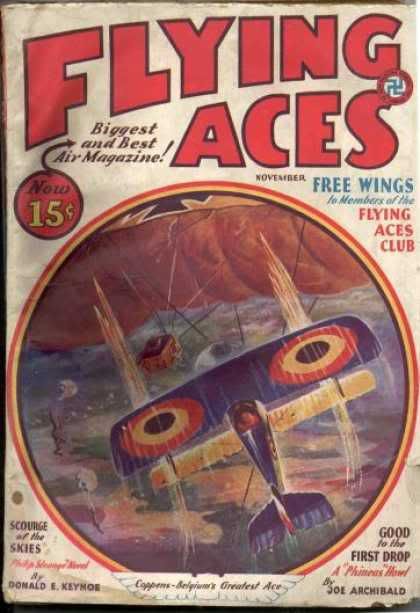
THIS week we present another of Paul Bissell’s covers for Flying Aces! Bissell is mainly known for doing the covers of Flying Aces from 1931 through 1934 when C.B. Mayshark took over duties. For the November 1932 cover Bissell paints one of Belgium’s greatest Aces in action—Lt. Willi Coppens trying to take down a balloon!

Coppens, Belgium’s Greatest Ace

th_FA_3211THE sun had set, and soon night for a few short hours would throw her peaceful blanket of darkness over the gaping wounds of war that now scarred the once beautiful fields of Flanders.

Above, where the sun’s rays still shone from beyond the far horizon, a tiny speck could be seen. Below, on the shell-torn earth, a crew was slowly hauling down a huge yellow sausage with black crosses painted on its sides. Anxiously the officers in charge watched the sky above until sudden recognition of the tiny speck brought hurried orders from their lips. Coppens, the little black devil of the Belgians, was on the wing!

Since the outbreak of the war, Willi Coppens had been in the service of his country. He had enlisted on the 28th of July, serving first as a despatch rider for the 6th Division, and then in other positions of both danger and trust but always with his eyes to the sky, his heart set on the “chasse.”

Three long years of this, then six months of observation, reconnaissance and artillery fire direction, until, in April, 1918, his great ambition was gratified at last. In the past six months he had made himself the terror of the Huns and the idol of his nation. Thirty-three balloons and two planes had fallen to his attack. He was premier ace of the Belgians and premier balloon-buster of the world.

NOW, October 14, 1918, his .small, dark-blue plane with the red, yellow and black circles of Belgium on its wings was once again bringing death and destruction to the invaders of his beloved country.

Down he swooped through the hail of shrapnel and machine-gun fire, his gun spitting incendiary bullets into the great yellow bag below. . . . At the last moment he veered off, banked up on one wing, then as quickly reversed, executing a tight S, his nose down and hugging the balloon as closely as he dared, to gain what little protection might be had through the enemy’s fear of hitting their own observers.

His throttle shot forward as he gave his little Nieuport the gun and dived down under the balloon with terrific speed. Back came the stick—the tiny blue plane shot upward—higher—higher—up into a stall when another instant would have sent it crashing into the swinging balloon.

Now a shift of the release lever, and from the chute on either side six flaming rockets, like meteors against the late afternoon sky, soared through the air with deadly accuracy toward the sausage. In their wake a trail of sparks showered downward, and the plane hung for an instant on the prop. Then its nose flopped down through the drifting sparks. A quick kick of the rudder avoided collision with the big cable by which the Germans were desperately trying to haul the clumsy bag to the ground.

The plane dropped like a plummet. Coppens eased up on his throttle slightly, then leveled off, at last clear of the balloon—and none too soon. The rockets buried themselves in the bulging silk and then, an instant later, there was a terrific burst of flame and smoke. Great fiery tongues leaped hundreds of feet into the air, and the big bag collapsed, falling to the ground and burning fiercely.

Machine guns clattered madly while high explosives and shrapnel once again rent the air in their effort to find the tiny plane. He was almost away, a tiny speck against the darkening sky, when a shrapnel burst squarely in his path. His left leg went numb. The Nieuport shivered as he almost lost control. The little black devil was winged at last!

THE war was over. The invader had been driven out and peace once again reigned. In the warm July afternoon, on one of Belgium’s great air fields, a small army had drawn up in battalion formation. To one side, an area roped off was filled to overflowing by a crowd in holiday attire. Flags were flying and bands playing. On the line a row of planes stood ready, their wings and bodies shining from careful grooming. For on this day a grateful nation was honoring one of its heroes.

A large plane could be seen in the distance. Quickly it approached, circled the field, then landed easily and taxied down near to wrhere a small group was standing in front of the battalions.

The crowd surged restlessly, then broke into tumultuous acclaim as a tall figure stepped from the plane and the bands crashed into the national anthem of the Belgians.

“—And a grateful nation and King salute you, Captain Coppens, Officer of the Order of Leopold.”

The King stepped forward to pin a small ribbon on the breast of the slim aviator in front of him, an aviator whose face was still pale from recent illness and whose left trouser leg flapped loosely against wood instead of bone and flesh. This lad supported himself with two canes, but one of these fell to the ground when he held out his hand to His Majesty.

Several officers started forward to recover the stick, but the King was first. He retrieved the stick quickly and with a gracious, “Permit me, mon Capitaine,” he handed it to Coppens. The crowd roared. A king had stooped to serve a humble subject—and a monarch had proved himself regal.

The Ships on The Cover
“Coppens, Belgium’s Greatest Ace”
Flying Aces, November 1932 by Paul J. Bissell

“Mannock, The Mad Major!” by Paul Bissell

Link - Posted by David on March 1, 2021 @ 6:00 am in

THIS week we present another of Paul Bissell’s covers for Flying Aces! Bissell is mainly known for doing the covers of Flying Aces from 1931 through 1934 when C.B. Mayshark took over duties. For the December 1932 cover Bissell put us right in the action as Major Edward Mannock gives his all

Mannock, the Mad Major!

th_FA_3212FROM the war have come many nicknames which have since been applied rather freely to others besides those who originally earned them. “Crashing Colonels,” “Red Barons,” etc., are now commonplace, and to definitely determine the originals of these titles is almost impossible. However, there is one man, who, if we judge by the consensus of opinion in those places where airmen gather, enjoys his soubriquet without argument or question.

He was a man who started the war as a prisoner of the enemy, was repatriated because of defective eyesight, and lived to prove his eyes the most deadly, searching, and accurate of those of all the airmen who flew for the British, while his irrepressible humor and daredevil recklessness earned for him the name of the “Mad Major.”

On May 7, 1917, the failure of Captain Ball to return from a patrol held the attention of the Allied world. On the same day, unnoticed, the reports show the destruction of an enemy balloon by a Lieutenant Edward Mannock of Squadron 40. No one cried, “The King is dead, long live the King!” Yet well they might have, for this was the first victory of “Micky” Mannock, the “Mad Major,” one of the mysteries of the World War.

Micky, who was to tear through the skies of France like a thunderbolt, leaving a trail of victories surpassing even Captain Ball’s. Micky, who was to become Britain’s ace of aces, with 73 planes to his official credit, and who was to die, known only to his comrades, unfeted and unsung, with only an M.C. as a decoration from his country.

To be sure, the D.S.O. was going through at the time, and posthumously two bars and the V.C. were finally awarded, but even to this day this great ace is little known to the public at large, and it is difficult to learn a great deal about him.

Mannock’s comrades knew that he had been imprisoned by the Turks at the beginning of the war. He had been repatriated, and enlisted at once with the British, serving first with the R.A.M.C., then with the engineers in France, and coming finally to Squadron 40 in April, 1917.

It was soon evident that he was a Hun-hater, one of the few among all the aces. He was not the sportsman type, to whom war was just a game with death as the stake. Nor was he the hunter type, seeking only the joy of the kill. To him the war was “open season” on Germans, and he was out to exterminate them as he would rats or other vermin. He asked no quarter nor gave any, and yet his irrepressible sense of humor and love of a joke was constantly bobbing up.

He it was who, after failing for several days to get the Germans to engage him in battle, dropped a pair of boots on their airdrome with the note attached, “If you won’t come up and fight, maybe you can use these on the ground.”

With his M.C. came his captaincy, and he was made squadron commander. He was older than most aces, being thirty at his death, and he was noted for the care he took of his “new” men. He watched over them carefully, and tried to arrange it so that they would get a victory the first time over. Failing this, he would take them out alone and, finding their victim, he would maneuver the German into a good position for the new pilot’s fire. Then, making sure by a few bursts from his own guns, he would return to the drome, where he would enthusiastically congratulate the fledgling on getting his first German. It is said, in fact, that more than one ace-to-be had his first victory handed him by Micky.

IT IS told, also—and this story is pictured on this month’s cover—that on one of these excursions he gave the mud-covered Tommies in the trenches the thrill of their lives. He and his fledgling had spotted their victim and after some maneuvering Micky had finally forced the German into a position for his youngster to make the kill.

At this instant from the clouds dropped a red Albatross—motors on, and its-tracers already reaching hungrily for the new pilot below. A yank of the stick and Micky had thrown himself square into the line of the Albatross’ fire to save his companion. Bullets crashed through his cockpit and seared holes in his wings, but the German’s dive had been headed off, and a moment later, coming out of a mad vrille, the little S.E.5’s nose was square on the red tail with the black cross.

The Vickers rattled, and the German sped on down to pile up in a trench, while Micky turned back to the battle above. The youngster had failed to get his opponent at the first burst, and the more experienced German by clever flying had gotten himself into a good position for attacking the kid pilots.

However, seeing Micky return to the fray, the German decided to run for it, and turned toward Germany, but little did he know his opponent. The Irishman seemed to go wild. He flung his little S.E.5 after the fleeing Boche and quickly overtook him. Then, to the astonishment of those who watched below, Micky held his fire. Steeply he dived in from the side, forcing the German to turn. But again the Vickers were silent. Apparently the German decided that Micky’s guns were jammed, for he made a desperate attempt to turn to the attack.

Immediately, however, the twin Vickers spoke, spitting hot lead, and forcing him to swing back around. Then to the watching Tommies the game became evident. Like a cat with a mouse the Irishman was playing with the German. Slowly he was forcing the Albatross down.

Lower and lower they came. They were scarcely 100 feet up, and below them was the wrecked remains of the first plane, when suddenly the twin Vickers began chattering. The desperate Jerry swung right and left, only to be met by the deadly hail of bullets from the S.E.’s gun. Then one last burst and those below saw the German jerk from his seat, clawing the air madly in his death agony as his plane crashed, its wings touching the wreckage of the first Albatross.

Two more for Micky! No wonder they called him the Mad Major! And so it went, until, on a similar expedition in July, a machine-gun bullet from the ground found him. At least that’s one version. A second story says that he crashed a German to save one of his fledglings. It was another mystery, but the fact remains that no more would his comrades see him tuck his violin under his chin, and while they sat enthralled, play, “Where My Caravan Has Rested.” For the Mad Major had led his last caravan home.

The Ships on The Cover
“Mannock, The Mad Major!”
Flying Aces, December 1932 by Paul J. Bissell

“Rickenbacker Downs Two” by Paul Bissell

Link - Posted by David on February 28, 2021 @ 6:00 am in

THIS week we present another of Paul Bissell’s covers for Flying Aces! Bissell is mainly known for doing the covers of Flying Aces from 1931 through 1934 when C.B. Mayshark took over duties. For the February 1933 cover Bissell put us right in the action as

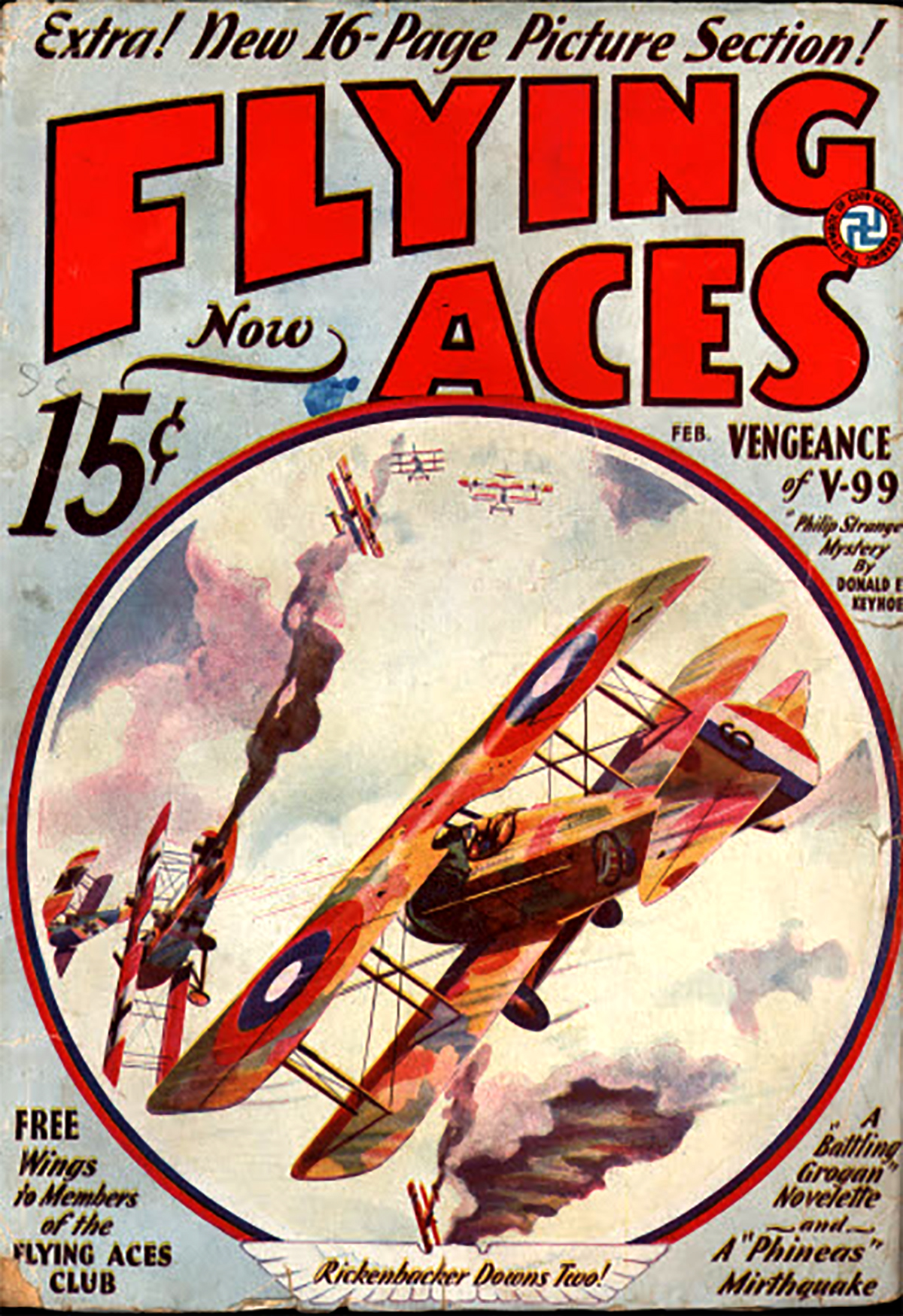
Rickenbacker Downs Two

th_FA_3302“Sure he can fly, I’ll hand him that. But what’s the idea of making us hang around on the ground? We don’t come to this flyin’ school nowadays to watch exhibition flyin’.”

“Oh, well, some guys get all the gravy,” and the speaker petulantly kicked a hole in the turf of the flying field. “Probably he’s somebody’s bright boy whose daddy gave him his own plane. Pretty soft, I call it. What do you say, Sarge?”

The man thus addressed was much older than the students and was evidently in charge of them. He was a hard-bitten mechanician and evidently an ex-army man.

“Soft!” he exclaimed scornfully. “You damned babies make me sick. Say, don’t you know who that guy was?”

“I don’t see that it matters a damn who he was,” spoke up one youngster. “We’re here to learn to fly and—”

“Oh, you don’t, don’t you?” and this time the sergeant’s voice was hard. “Well, get this, youngster. There are certain men who’ve done things for their country that you can’t pay for in dollars and cents, see? You—and I mean everybody in the country—can just try to give them a little courtesy and special treatment whenever you get a chance to, and be damned glad for the chance.

“If we was in the army, you know what I’d ’a’ done, don’t you? I’d ‘a’ marched every damned one of you out on that field and kept you at attention the whole time he was here so that the next time you’d know a good man when you saw him. Say, don’t you guys know who that feller was?” The sergeant’s tone was one of complete exasperation that such ignorance could exist.

“No? Then listen, buzzards. I’m goin’ to tell you a true bedtime story. Once upon a time when you babies were still wearing didies there was a war. Maybe you never heard of it, what with peace societies and all those sort of things these days, but, everything considered, it was quite a little war at that. Now I was sort of young and foolish about then, and seeing a nice poster displayed ’bout how you could join the air service and learn to fly, I goes in and lets them take my fingerprints. I guess that was a mistake. They must’ve read my palm or something at the same time and decided I was an advance model of you birds and never would learn to fly, so they didn’t even try to teach me. But anyway, they sent me over with a squadron to see that the Frogs didn’t get any vin rouge by mistake into the gas tanks ’stead o’ gas.

“The outfit I finally pulls up with was the 94th Squadron. I s’pose you ain’t never heard of the 94th, eh? Guess they just omitted mentionin’ that at your schools. Well, believe me, the Germans knew about the 94th, and when they saw a ship with old Uncle Sam’s hat with a ring around it painted on the sides, they knew that hell was going to be poppin’ loose in just about a minute. That was the first real Yank squadron to cross the Front. Ninety-one Germans they got before the show was over. Americans, every damned one in the 94th. And the guy that just went off in that limousine was the boy that led them through the last lap.

“PRETTY soft, you said, didn’t you, Buck?” And he spat scornfully to one side as he squinted at the embarrassed youngster in front of him. “Well, it wasn’t always soft. Once before I saw him come out on the field, sort of like today, only dif’rent. He was a captain then, and it wasn’t a limousine, but a damned poor motorcycle and side-car, with the corporal sittin’ in the side-car, holding on like he was in a rollercoaster, and the captain tearin’ across the field like he was tryin’ to hang up another speed record.

“It was the day he took charge of the squadron, and he was just hell bent to get up and get himself a Boche. We were just outside of Toul then, and the Germans were damned fresh in that sector, so he didn’t have to look very hard before he located two observation crates quietly gettin’ in their work with five Fokkers playin’ nurse to ’em up in the clouds. Right then the captain started climbin’. The old game—up into the sun.

“Maybe they would see him, and then maybe—well, anyway they didn’t. And he got just where he wanted to, sittin’ up on the last German’s tail with the sun square behind him.

“You ain’t ever seen a Spad dive, buddies, have you? Well, we used to call them the ‘flyin’ bricks’ over there, and when you turn one over on its nose and give her the gun, she moves so fast she damn near catches up with the bullets out of her own guns. And that’s the way the captain went down at that first German. The poor Fritzie didn’t have a chance. Here was the captain lettin’ both guns go, and comin’ down right behind the bullets themselves.

“The bullets must’ve beat the Spad a little, at that, ’cause the Fokker started spoutin’ smoke and slipped off sort of cockeyed, headin’ for the ground, just as the captain and his Spad dived by and right through the whole formation. Then a zoom, and he was back above them again, hangin’ on his prop, lookin’ them over. Fritzie must’ve thought there was another dozen or two comin’ behind him, because they got their wind up and broke.

“Quick as a flash the captain kicked his rudder over, shot his stick to neutral, and down he dropped like God’s judgment on the two L.V.G.s below. They saw him comin’, and the gunners were plenty ready for him, too. Hell’s bells, how they peppered him! I know, ’cause I helped to put the patches on when he got back. But none of those pills landed where it hurt, and before those Fritzies could turn or twist, he was past them, and zooming back for another crack at them.

“The other Jerries had got their nerve back by now and were divin’ in. It had to be a quick job, and the captain knew it. He slipped the bus off on a wing, and, holding her in the slip, slowly eased his nose around until he had both the two-seaters in range at the same instant. Then he cut loose, both guns pumpin’. You could see the tracers zippin’ through the air and buryin’ themselves in the Jerry machines.

“It was a queer spot the captain was in, and a couple of seconds was all he could hold it. But he had the Boche dead on the spot, and these seconds were plenty. The nearest ship tailed up and a couple of German aviators were just German heroes. The other Jerries seemed sort of discouraged, too. They weren’t crowdin’ any more, but had gone into a huddle around the photo-bus, and all were headin’ for the Vaterland.

“Gas and ammo were about out, so the captain came on in. Two minutes—two Germans. Not bad, eh? Well, he got twenty-five before that mess was over, and waded through a hundred bits of hell to get them.

“Soft!” The sergeant spat disgustedly into the dust again. “You birds weren’t close to him, were you? You didn’t see that little blue bar he wears with the silver stars on it? Well, you probably wouldn’t have recognized it, anyway. They ain’t many of them around. Maybe you don’t even know what it means—maybe you don’t know yet who the captain is. Well, remember this, ’cause after all, you’ve got to get over some o’ your dumbness and not be forever shootin’ off your mouth and showin’ your ignorance. That little blue bar is the Congressional Medal of Honor. Only two aviators in the whole war won it. One was Luke, the Balloon Buster. He’s dead, and can’t wear his. But the other man can, and he’s the guy that you birds called soft. He’s Eddie Rickenbacker, ex-captain of the Hat-in-the-Ring Squadron, and America’s ace of aces!”

The Ships on The Cover
“Rickenbacker Downs Two”
Flying Aces, February 1933 by Paul J. Bissell

“First Official Yank Victory” by Paul Bissell

Link - Posted by David on January 31, 2021 @ 6:00 am in

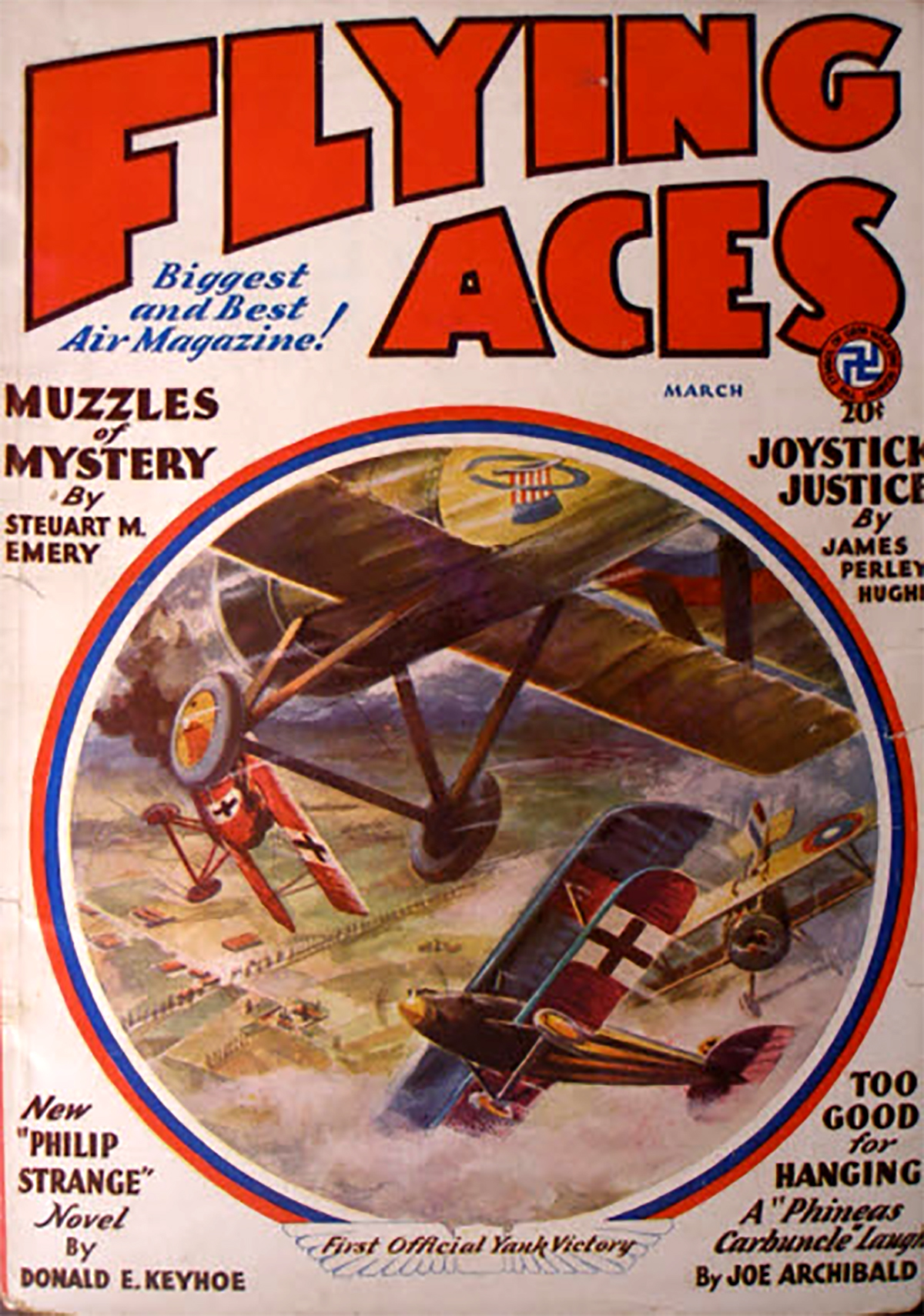
THIS week we present another of Paul Bissell’s covers for Flying Aces! Bissell is mainly known for doing the covers of Flying Aces from 1931 through 1934 when C.B. Mayshark took over duties. For the March 1932 cover Bissell put us right in the action of the

First Official Yank Victory

th_FA_3203LIEUTENANTS Alan Winslow and Douglas Campbell of the 95th Squadron, U.S. Air Service, were on alerte duty, Toul Airdrome, April 14, 1918. American squadrons at the Front were new, and no German had yet been marked up to the credit of the Yanks. These two aces-to-be thought it pretty tough to be kicking their heels on the home airdrome while “Rick” and others were patrolling the lines with a chance of a scrap at any moment, and a chance to bring credit to the 95th for the first Boche.

Suddenly the phone rang. “Yes, Squadron 95 . . . . What? . . . . Deux Boches?
. . . . Oui! Quel direction?
. . . . Pont-a-Mousson! . . . . Bien. Merci.”

In an instant motors already warmed up were roaring, chucks pulled out, and Winslow and Campbell had taken off in a steep climbing spiral, heading back in the direction of two tiny specks now appearing just under the low-hanging clouds. Hugging the ceiling, the two Americans swung to the east, hoping to gain unobserved a position on the tail of their enemy. A cloud, hanging low out of the otherwise fairly level ceiling, helped them in this for a moment. Coming out of this, however, they found themselves flying in the opposite direction, parallel to and about a quarter of a mile to the east of the two Germans, who immediately turned to attack. One was an Albatros D-5, and the other a Pfalz D-3.

The desperate tail chasing game began. Twisting and turning, the battle drifted slowly back until it was actually over the Americans’ own airdrome. Here the clouds drove them down scarcely five hundred feet from the ground. Burst after burst from both sides had as yet done no serious harm to any of the combatants.

Campbell, scrapping it out with the Pfalz, had drifted slightly to the west. Winslow, diving at the Albatros from the side, banked up steeply, kicked his plane over, slipped off on a wing, nosing down until he was under the German plane, then quick back, hard on his stick, and he saw the belly of the red machine come slowly into line with his sights. His chance at last!

Tight he squeezed his trigger, and a wild joy swept over him as he felt the answering throb of his gun. At the last instant he banked over to avoid collision—and just in time, for the red ship, spurting smoke, slipped unevenly off, wing down and tail up. The German pilot strove to gain control, partially righting the wounded ship just before it piled up almost at the door of Winslow’s own hangar.

Just a moment later Campbell brought his man down in a nearby field to the west. It was America’s first air victory. Two to the credit of the Hat-in-the-Ring Squadron, and the Germans knew that the Eagles were in the air!

The Ships on The Cover
“First Official Yank Victory”
Flying Aces, March 1932 by Paul J. Bissell

“Eclipse of the Hun” by Joe Archibald

Link - Posted by David on January 29, 2021 @ 6:00 am in

“HAW-W-W-W-W!” That sound can only mean one thing—that Bachelor of Artifice, Knight of Calamity and an alumnus of Doctor Merlin’s Camelot College for Conjurors is back to vex not only the Germans, but the Americans—the Ninth Pursuit Squadron in particular—as well. Yes it’s the marvel from Boonetown, Iowa himself—Lieutenant Phineas Pinkham!

Hauptmann Adolph August von Heinz—dubbed The Owl of the Ozone—was born on the stroke of twelve in the middle of the Black Forest, and it was rumored across the Rhine that every mouse in the Province scurried to cover when the stork dropped this Kraut squaller down the chimney of the Heinz menage. From that day on, von Heinz got blind staggers when he looked at the sun, and the War found him sleeping in the daytime and attacking at night! But that Boonetown marvel looked to the heavens to find a way to take out the Owl in broad daylight!

On the Western Front, things looked mighty dark for the minions of Democracy—so dark, in fact, that by contrast the pall over Pittsburgh resembled a bridal veil caressing a snowdrift. Once again the fly-by-night in the Entente ointment and cocklebur in the Allied rompers was that sinister Hauptmann von Heinz—The Owl of the Ozone. But what of Phineas? Well, he’d bought himself a book on the Cosmos. To put it poetically, Carbuncle was “lost in the music of the spheres!”

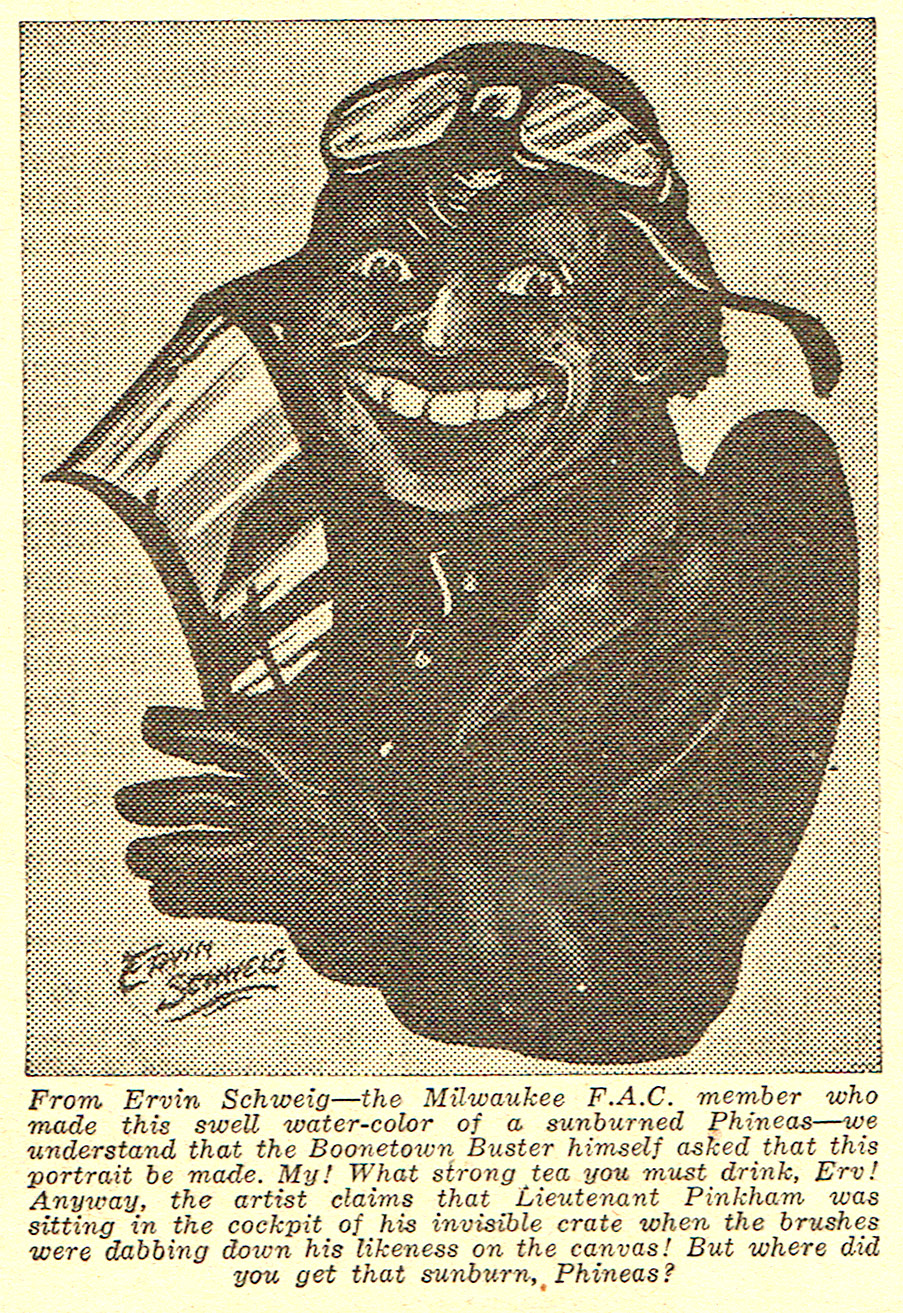
As a bonus…some fan art of the Boonetown Treasure!

“War’s Youngest Ace Downs Voss” by Paul Bissell

Link - Posted by David on January 18, 2021 @ 6:00 am in

THIS week we present another of Paul Bissell’s covers for Flying Aces! Bissell is mainly known for doing the covers of Flying Aces from 1931 through 1934 when C.B. Mayshark took over duties. For the October 1932 cover Bissell put us right in the action as Rhys-Davids downs Werner Voss!

War’s Youngest Ace Downs Voss
th_FA_3210YOUTH, winged youth. Youth, flying to meet death.

In all the strange chapters that came from the war there is nothing more incredible than the youthfulness of its air heroes.

23 years old—a major. Officially credited with seventy-five victories in individual combat.

22 years old—a captain. Internationally known for aggressive bravery, the idol of his nation, and a price on his head, dead or alive.

21 years old—a lieutenant. With more than twoscore victories to his credit. Decorated by nations and feted by kings.

And so it went, on down—20 years—19 years—18 years—and there it stops—officially! But listen:

“And you,” said the recruiting sergeant to a glad-faced youngster who stood, bright-eyed, in front of him. “What do you wish?”

“I’ve come to enlist, sir,” replied the boy.

“Enlist, is it? And do you think it’s a kindergarten in France we be asending the lads to?”

“No, sir. I mean to fight,” was the quiet answer.

For an instant the sergeant studied the serious eyes before him. “And your age, my boy?”

“Fift—I mean eighteen, sir.”

“Eighteen, eh,” growled the sergeant, shaking his head as he reached for an enlistment blank. “Do you know what you’re doing, sonny?”

“Righto, sir.”

“Righto, it is then. And eighteen years ye be, though if you’re eighteen, Mister Methusaleh is my name. What’s your name, youngster?”

“Rhys-Davids, sir,” he replied, and a school lad had started on the road to glory, death and fame.

It was early autumn of seventeen, and the 56th Squadron, R.F.C., was in the thick of it. This famous squadron almost daily battled Richthofen and the best of his “gentlemen.” Fought them through the entire war to a credit of 411 planes downed—but not without themselves adding many famous names to the already long list of those who died for England. Included in this list was the name of their famous commander, McCudden, with fifty-eight victories to his personal credit.

Here, with this outfit, was the lad who had come to France “meaning to fight.” And fight he had. Never was there a pilot more willing or eager for a scrap. He would attack recklessly, even though outnumbered, and in a dogfight he became a madman—a madman dealing death to the enemy. And then he would return to his drome to become all boy again. A happy boy, with pets—birds that sang to him—pups that “Waited each day for his return—and tame rabbits that nipped off the shoots in the little garden behind his shack and nibbled greens, from his hand.

Already more than a score of German. had fallen before his fire. Schaffer, of “Richthofen’s Own,” had fought his last fight against this youngster. But it was on September 23, 1917, that he gained his most famous victory.

THE squadron was on patrol, protecting some bombers, when off to one side were seen two German planes. It did not seem likely that they would attack, as the English squadron numbered more than a dozen of Bristols, Camels and S.E.Ss. That is, it did not seem likely until, by the black-and-white-checkered fuselage it was seen that one of the Germans was Lieutenant Werner Voss.

This was one adversary that the Allies held in the greatest respect. Already both his plane and name were known all up and down the Front. He was always looking for combats, and fought generally over Allied territory, which could not be said of Richthofen. And with forty-eight victories over the Allies, Voss, himself of most humble origin, was a serious rival of the noble-born baron.

Indeed, records seem to show that Voss, feeling himself in every way the equal of his rival as an ace, had refused to be the tail protector to Richthofen and, on at least one occasion, when the victories of Voss had reached a number almost equal to those of the Rittmeister himself, the High Command had seen fit to transfer the mere “Lieutenant” to a less active sector, where opportunities for combat were fewer.

With such an opponent as this, the Britishers knew that attack might be expected, and when, a moment later, a patrol of Albatrosses appeared, no one was surprised to see the checkered triplane dive in headlong. Voss’ companion, flying to one side and slightly behind, was almost immediately shot down. And when the Albatrosses refused to accept battle, Voss was left to his fate.

It was an unequal fight, though after the German had winged his way through the first terrific rain of fire from all the other ships, it was Rhys-Davids who engaged him in a duel. Around and around they tore, with Voss, hemmed in on all sides, hoping only to sell his life as dearly as possible. The Fokker tripe, with its German pilot, had met its equal in the little S.E.5 flown by the English boy!

The British plane turned and twisted, meeting maneuver with maneuver, until at last the looked-for opening came and the checkered fuselage for a moment was full in the sights. Just for an instant—but an instant that was filled with spitting lead, an instant that began that mad, twisting dive that ended near Poelcapelle for the triplane with the black crosses on its wings, and ended in eternity for the brave German ace.

Rhys-Davids followed him down to the ground. It was the game—there must be no slip. Then, with motor full on, himself untouched, he raced back to his pets.

The lad—his comrades thought he must be now almost seventeen years old—had thirty-two unofficial victories to his credit, and those gods that be must have laughed as they wrote his name on a shell. No German airman carried it. But an Archie battery, a month later, shot it from the ground. Ten thousand feet up it found him.

Back in his shack the birds still sang in their cages and the rabbits still nibbled in the garden. But the puppies waited the return of their boy master in vain, for the war’s youngest ace had gone West.

The Ships on The Cover
“War’s Youngest Ace Downs Voss”
Flying Aces, October 1932 by Paul J. Bissell

“Major Vaughn Wins the D.S.C.” by Paul Bissell

Link - Posted by David on January 4, 2021 @ 6:00 am in

THIS week we present another of Paul Bissell’s covers for Flying Aces! Bissell is mainly known for doing the covers of Flying Aces from 1931 through 1934 when C.B. Mayshark took over duties. For the September 1932 cover Bissell put us right in the action that lead to Major George Vaughn winning a D.S.C.!

Vaughn Wins the D.S.C.

th_FA_3209“FOR extraordinary heroism in action near Cambrai, France. On September 22, 1918, Lieutenant Vaughn, while leading an offensive patrol, sighted 18 enemy Fokkers about to attack a group of five Allied planes which were flying at a low level. Although outnumbered nearly five to one, he attacked the enemy group and personally shot down two of the enemy planes, the remaining three pilots of his flight shooting down two more. His daring and courage enabled the group of Allied planes to escape ….”

So reads the American army citation on which the D.S.C. was awarded to Lieutenant George A. Vaughn. But between the lines is even more of a story—the story of a youth who left school to serve his country, first with the British and then under his own colors, with the 17th Aero Squadron—the story of a lad who came victorious through many air battles and who, that morning in September, 1918, seeing some of his comrades trapped by the enemy, went unhesitatingly to their aid. He knew he was outnumbered five to one by the Boche, yet he deliberately accepted the desperate odds. He calmly watched the chill hand of death reach for him; coolly he evaded its annihilating clutch and saw its grim fingers close on two of his enemies.

He fought many times after this, wresting victory after victory from the Boche until the war’s end found him one of America’s leading aces, with the rank of major.

It was 8:45 a.m. on a clear sunny morning. Big cumulus clouds about seven thousand feet up floated slowly across No-Man’s-Land, casting great blue shadows on the shell-pocked surface, and themselves affording excellent hiding places for enemy airplanes.

Vaughn, with three companions, was flying just under the clouds, protecting another flight of five Camels about three thousand feet below and slightly in advance of him. From the east fifteen Fokkers came in at about Vaughn’s level. They turned and flew parallel with him, all the time watching the lower flight. Then suddenly they tipped over on their noses and went down in a body on the planes below.

Suspecting a trap, Vaughn immediately searched the skies overhead. Sure enough, there they were—another batch of Germans ready to swoop down like hawks on him and his companions. Instantly he saw the one chance—to lead his flight down into the fight below, and do what damage they could diving in—at the same time giving the five Allied planes a chance to break away-and then try to get out of it before the enemy from above could surround them.

DOWN the four Camels tore, into the twisting dogfight below them—tracer bullets reaching out ahead, searching their red targets. In an instant it was every man for himself. Vaughn saw one of the Camels go down in flames and cursed the damned Boche as his sights picked up a black cross squarely. His fingers squeezed the trips. A wild answering throb as his guns spit flame, and he saw the red machine fall off out of control.

He swung in a tight turn to the left. The whole world now seemed nothing to him but white streaks of smoke cutting the sky in every direction, while red, yellow, green ships— ships with huge black crosses or ships with the tricolored circles of the Allies—seemed to come suddenly from nowhere.

The upper flight was now on him. He could see their tracers swish by him as they came down.

The red belly of a Fokker stood squarely in front of him. A quick burst, and he saw the red tail kick up as the Boche started on his last dive. Number Two—but a burst of bullets came through the cockpit just over his knees. Too close! They had him hemmed in, so he took his only chance, and threw himself into a spin.

Down he went, his tail whipping around and around. In this way he afforded no easy target. But the Germans followed him down, firing burst after burst into him, diving past, zooming back and diving again, their guns blazing. That spin seemed endless.

Luckily, most of the Germans had given him up as finished, and turned back. One last persistent Boche fired a long burst, and then he, too. turned, leaving Vaughn, as he supposed, to crash. Just in time the little Camel answered the controls.

THEN came the greatest blow of the battle. He was out of gas. There was no answering roar from the motor, and with a sinking heart and a vision of German prison camps, he sought a place to set her down. Lower he came. Now scarcely fifty feet was between him and the torn earth, the idling prop was slowing perceptibly, when suddenly it came to him—-the emergency tank! Quickly he switched it on. There was a sputter; then with a full-throated roar the engine took hold and the little machine climbed rapidly up again.

But the battle was over, and now not a plane was to be seen. So, turning toward his airdrome, some twenty minutes away, Vaughn for the first time had an opportunity to think about himself. It was then he was conscious of a burning sensation across his back. His flying suit was soaking wet just below his right shoulder. Wounded, he thought, and to use his own words, “Fine! Now I’ll get a month in the hospital. Or perhaps they’ll send me to Blighty.”

He could feel no pain, so decided it was slight, and landed with a broad smile, feeling he had rather put it over on the boys. Then came the second blow of the day, as the mechanics pointed to where the corner of his gas tank had been shot away. His clothes were soaked, not with blood, but with gasoline. No wound! No Blighty! Well, what the hell! It had been a good scrap, anyway. Six Fokkers had been accounted for, and only two Camels lost.

All Vaughn got then was a new ship. But later, with bands playing and flags flying and a lot of soldiers standing round to see how it was done, they pinned a bit of ribbon on him. Not much for a man who had played with death daily, but just the Army’s way of saying, “This guy’s damn good!”

The Ships on The Cover
“Major Vaughn Wins the D.S.C”
Flying Aces, September 1932 by Paul J. Bissell

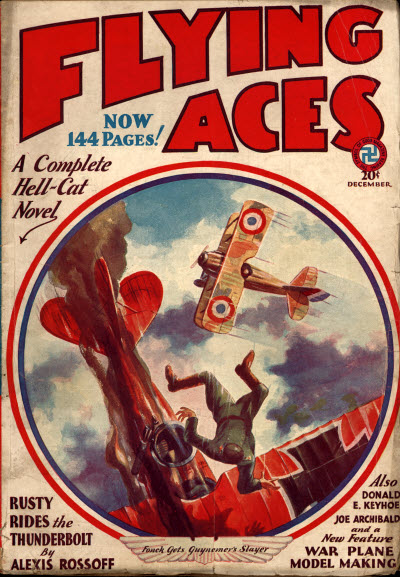
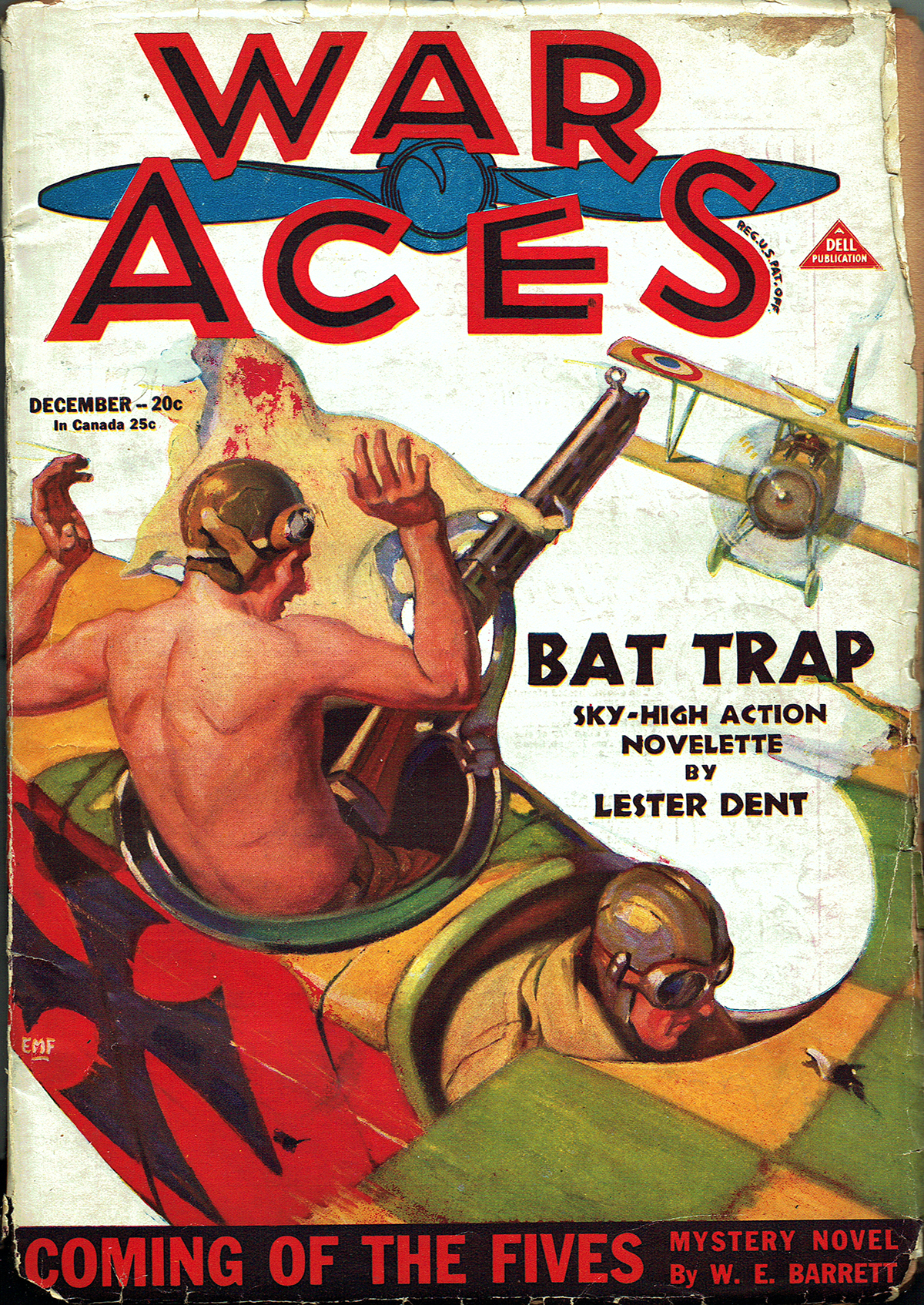
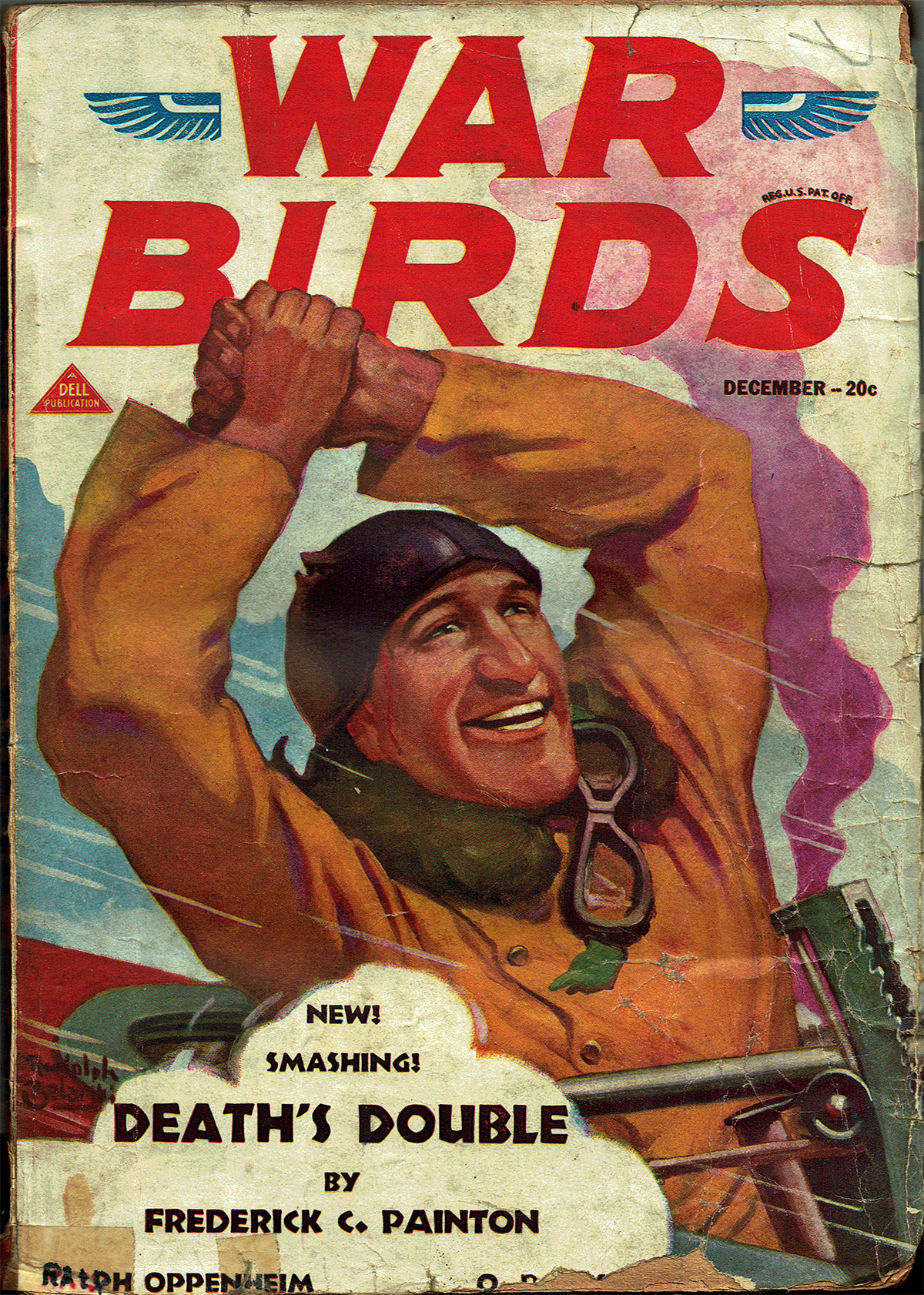
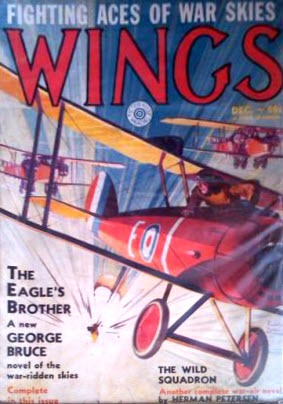
The Aces of Christmas 1931

Link - Posted by David on November 30, 2020 @ 6:00 am in

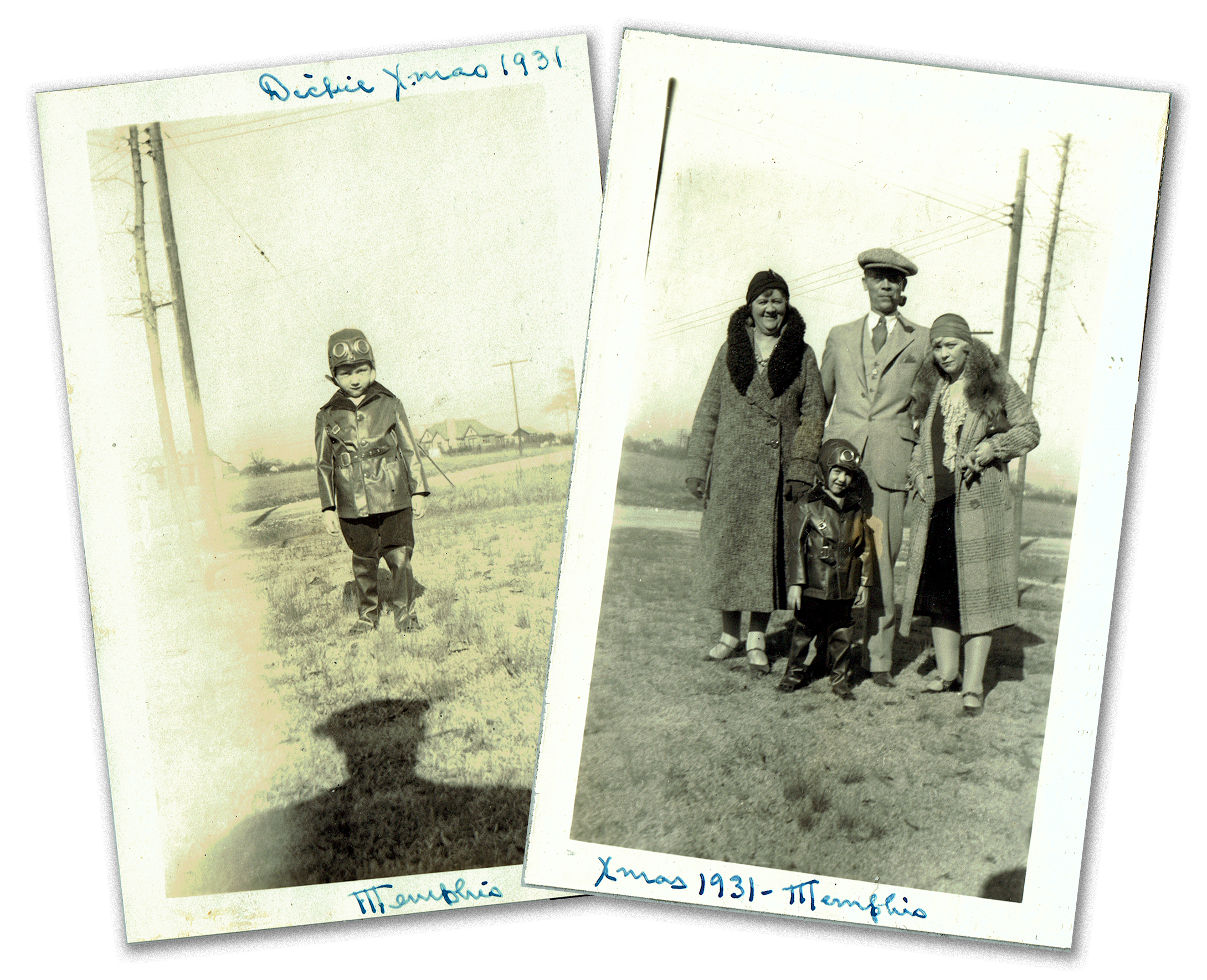
WHILE browsing through eBay a couple months ago, I came upon these two snapshots from a family’s Christmas in Memphis 1931. What caught my eye was the little boy all dressed up as a WWI ace with leather jacket, aviator’s cap with goggles, and some sort of tall leather boots(?)! It got me thinking about what stories that boy could have been reading that rather mild, snowless December in Memphis.

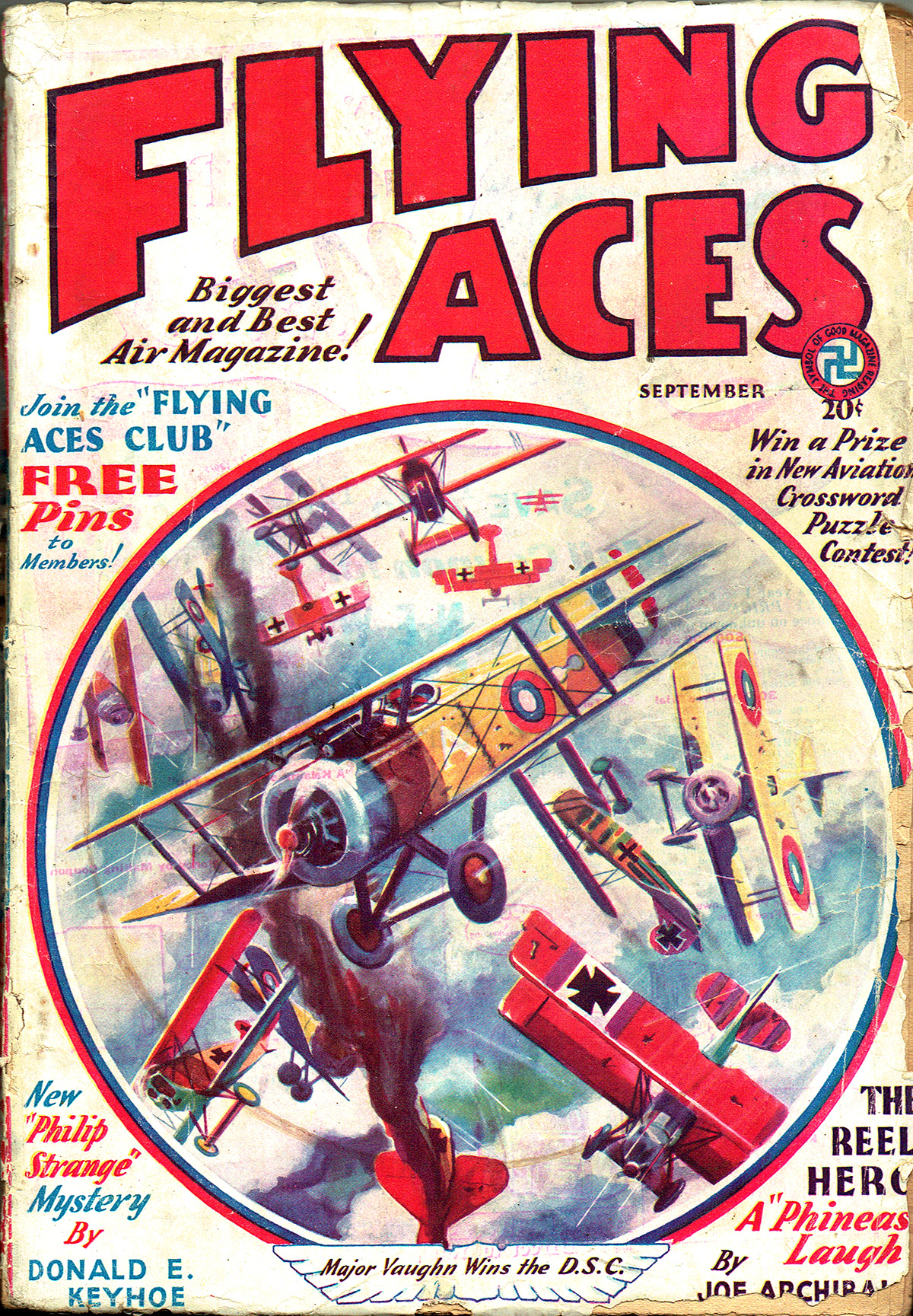
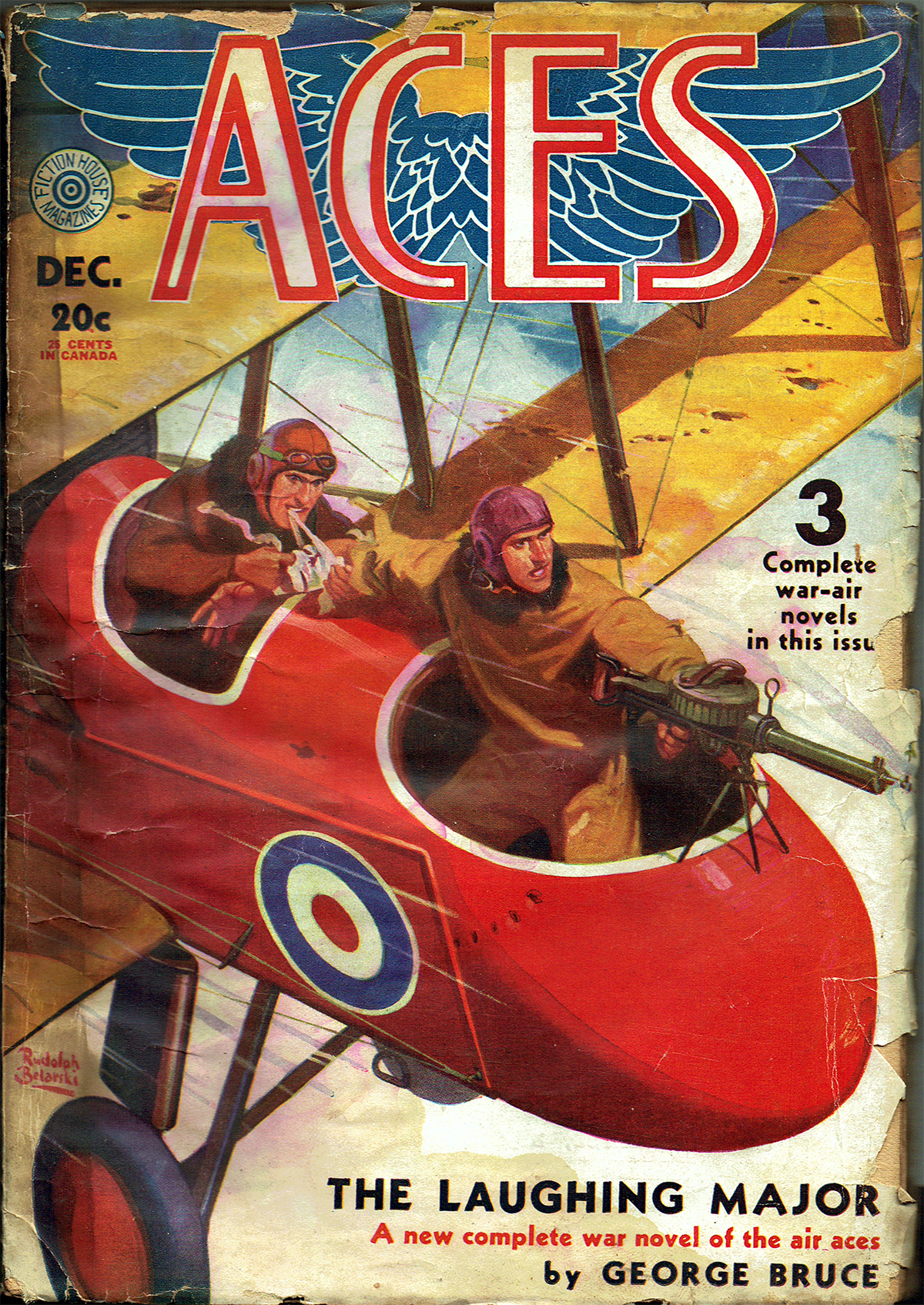
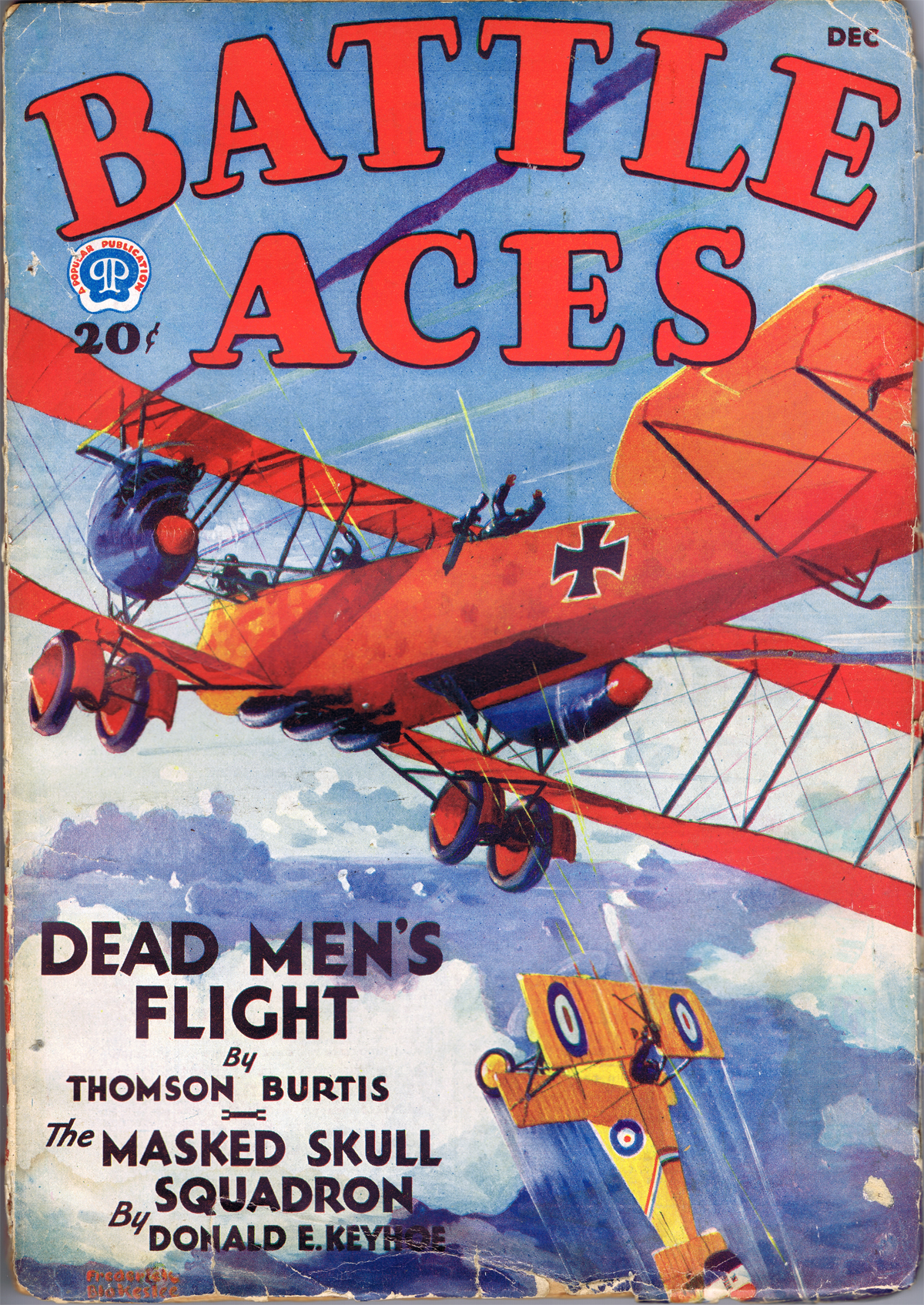
So this month we’ll be featuring stories published in the December 1931 issues of Aces, Sky Birds, War Aces and War Birds, by some of our favorite authors—Arch Whitehouse, O.B. Myers, Frederick C. Painton, Frederick C. Davis, Donald E. Keyhoe, and George Bruce—as well as a couple new or seldom seen authors to our site—Elliot W. Chess, Edgar L. Cooper, and Robert Sidney Bowen.

Looking at that impressive list, you may be wondering where a few of our most often posted authors are. Authors like Ralph Oppenheim, Harold F. Cruickshank, Lester Dent and Joe Archibald. That’s a bit of good news/bad news. The good news, we’ve already posted the stories Ralph Oppenheim (“Lazy Wings”) and Lester Dent (“Bat Trap”) had in the December 1931 War Aces; the bad, I don’t have the December 1931 issues of Wings featuring George Bruce, F.E. Rechnitzer and Edwin C. Parsons or Flying Aces with Keyhoe, Archibald, George Fielding Eliot, Alexis Rossoff, and William E. Poindexter. And as for Cruickshank—he didn’t have a story in any of the air pulps that month.

With that in mind—and since it’s Monday, let’s get the ball rolling with the covers of Christmas 1931!


ACES by Redolph Belarski


BATTLE ACES by Frederick Blakeslee


FLYING ACES by Paul J. Bissell


SKY BIRDS by Colcord Heurlin


WAR ACES by Eugene Frandzen


WAR BIRDS by Redolph Belarski


WINGS by Redolph Belarski

Come back on Wednesdays and Fridays this month for some of the great fiction from these issues!

“Cat’s Spad-Jamas!” by Joe Archibald

Link - Posted by David on November 27, 2020 @ 6:00 am in

“HAW-W-W-W-W!” That sound can only mean one thing—that Bachelor of Artifice, Knight of Calamity and an alumnus of Doctor Merlin’s Camelot College for Conjurors is back to vex not only the Germans, but the Americans—the Ninth Pursuit Squadron in particular—as well. Yes it’s the marvel from Boonetown, Iowa himself—Lieutenant Phineas Pinkham!
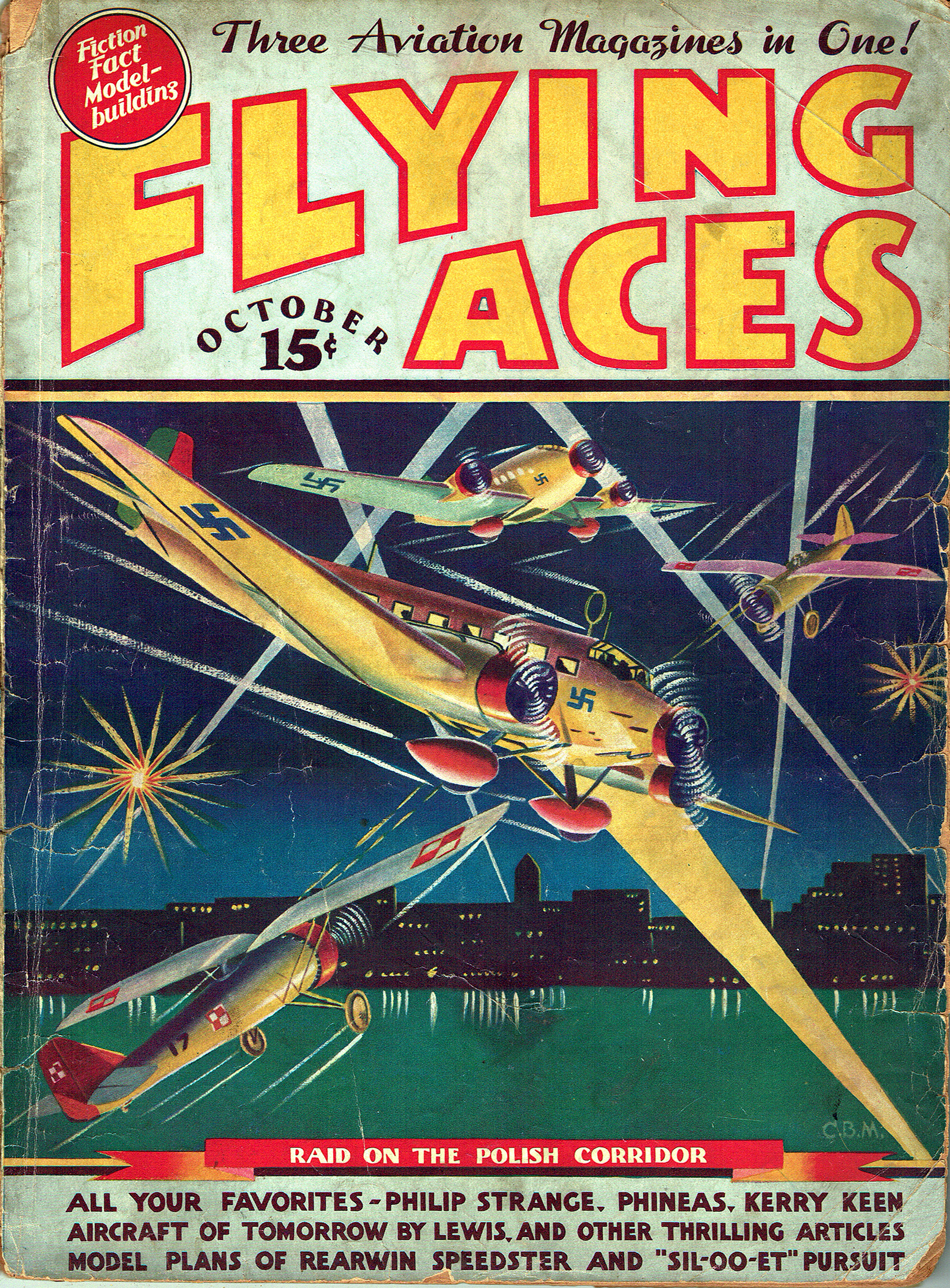
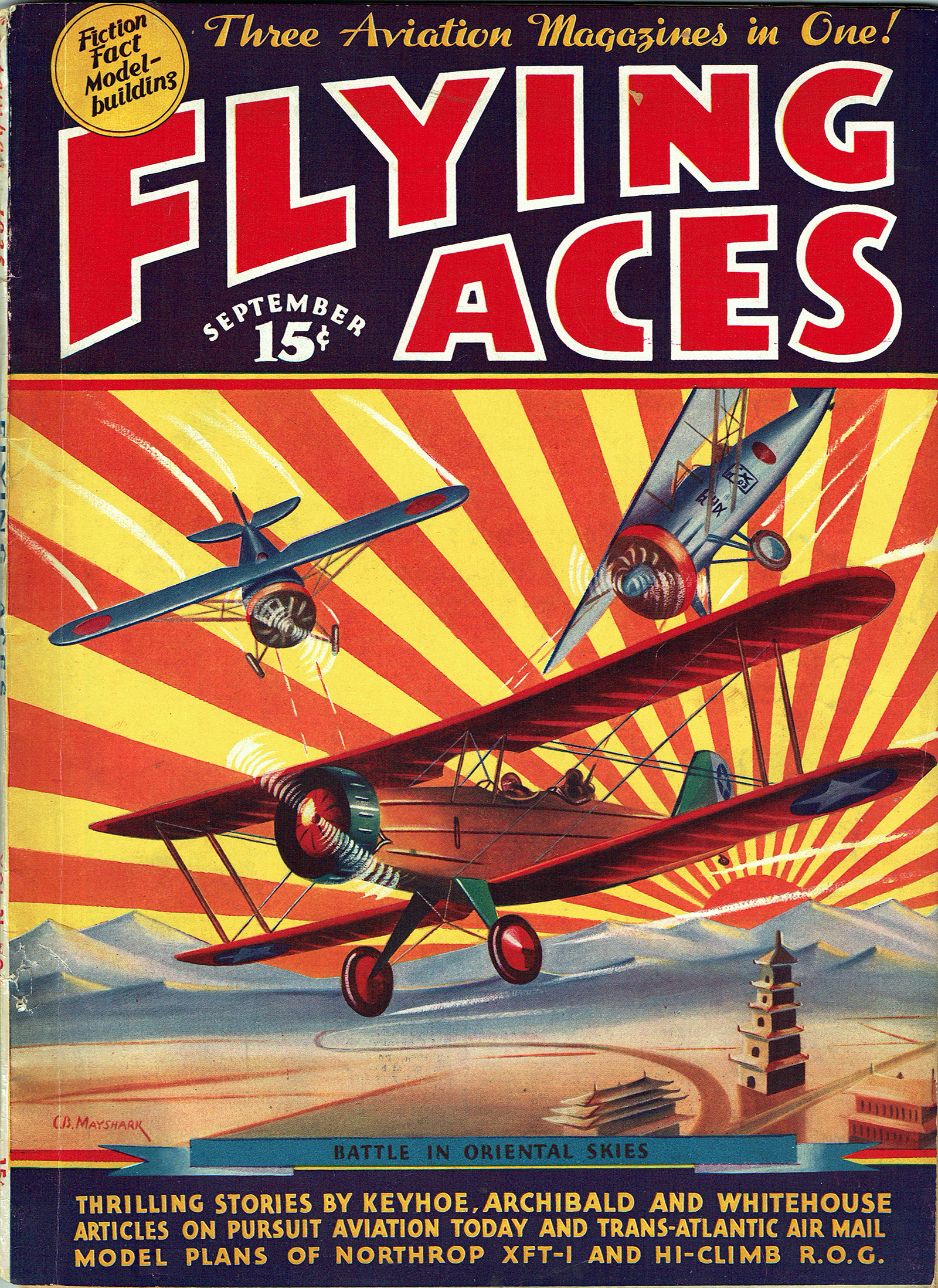
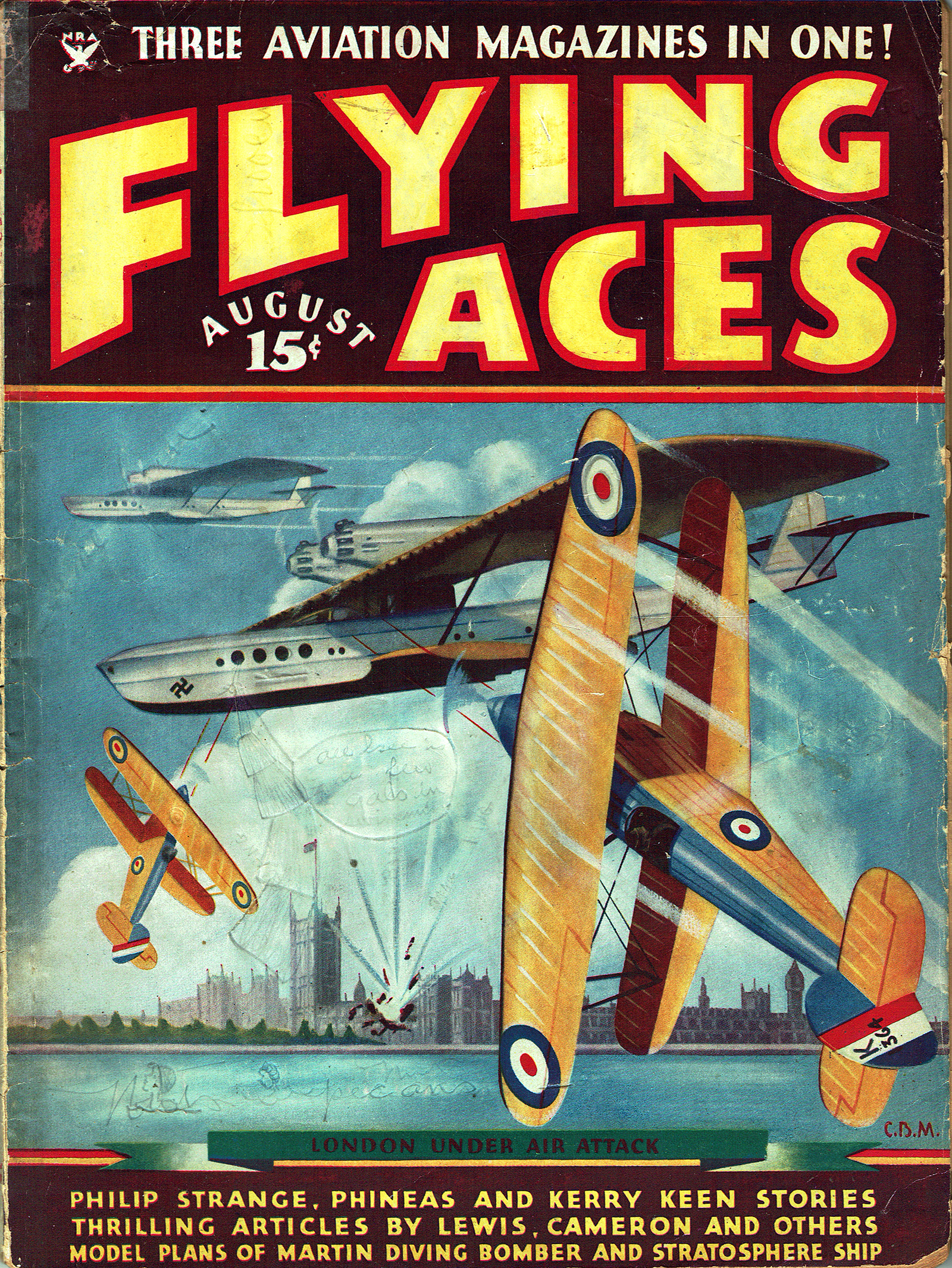
All the Allied Brass Hats were frantic. For Hauptmann von Heinz—the “Owl of the Ozone”—was raising fifty-seven varieties of Cain along the Western Front, and something had to be done before he perpetrated the fifty-eighth. Yes, it was a job for the famed Pinkham. But when the Boonetown Bam tried to snare the Kraut killer into a dog fight, somebody let the cat out of the bag. And from then on it was cats-as-cats-can!


As a bonus, here’s a great article on author/artist Joe Archibald from April 24th 1927 edition of the The Brooklyn Citizen!


Joe Archibald Sees, Comes and Conquers,
Ascending Ladder of Fame as an Artist

by Murray Rosenberg • The Brooklyn Citizen, Brooklyn, NY • 24 April 1927


To show he’s a good sport and a cartoonist Joe Archibald drew this picture of himself—without the use of a mirror. He knows himself too well for that.

Red fire of determination in his eyes, grit in his heart and with very little money in his pockets, young Joe Archibald, cartooning pride of a rural, somewhat obscure town in the New Hampshire hills, fared the whole wide-cold-and seemingly unfeeling world, fully determined to set that chily sphere on fire.

His pen, grit and perseverance were his only weapons but artist Joe was young and he felt that they were match enough for any universe.

It took him four years to get a drawing in print.

Year after year of earnest endeavor in contributing to all types of publications failed utterly. Joe began to suspect that he was the only person who knew he was good.

The art editors, cold bloodily refused him interviews, the papers went to press just as well without his work, the magazines returned his efforts without comment, without the checks he so fondly hoped to find. But Joe gamely contained his persevering struggle for recognition, and then the events of a single day wiped out all the heartaches and bitterness of four long years. One of his cartoons was in print.

It was the “Judge” magazine that suffered. It might be reportod here that Joe, claims the distinction of having more rejection slips than any other cartoonist—sufficient to paper the entire ceiling of the museum of Natural History. But his motto is “keep feeding them pictures until they accept one in self-dense.”

The King of Sports

To-day Joe Archibald, who a decade and some odd years ago was a happy go-lucky country schoolboy, obscured from fame in a hinky-dinky rural village in New England, is recognized as a cartoonist de luxe and a national medium in the sports realm, for, as you probably know, Joe makes it his specialty to draw sport cartoons. Yes, he now sits up on the throne of success to look upon the public with a contented smile, for, like every scout, he does his daily good turn by brightening up sport pages with his peppy drawings and offering the fans intimate glimpses into the lives and records of their favorite athletes.

Following the first purchase of his sketch, the rocky road to success grew a bit smoother and life took on a brighter aspect. Other periodicals accepted his contributions and then he sent a cartoon of a prominent sport event of the day to a daily paper. To his surprise and joy the drawing was accepted and published, and thus Joe embarked on the trail that has finally led him to national fame as a sports cartoonist.

From the position of irregular sports department artist on a junk-town paper Joe emigrated to the big city and began again the routine of presenting his drawings to editors, “big-time” men this time. They were accepted from time to time and soon his work attracted the attention of William J. Granger, sports editor of “The Brooklyn Citizen.” He quickly came to the conclusion that young Joe would be a worthy addition to the cartooning staff of the “Citizen,” following which the machinery began functioning to secure his services. Joe finally consented to pen his “John Hancock” to a contract; and now cartoonist Joe, who through his own relentless efforts and unswerving and set ideals has surmounted the steps to success, provides the many thousands of “Citizen” readers each day with vivid picture descriptions of the latest doings in sports.

Backward, Time in Thy Flight!

Let us look back a bit upon some of the past history of Joe Archibald at the time he began his career—a career fraught with thrills and excitement. He first awakened to the content of his latent talent when be completed a picture with chalk on the blackboard of the little red schoolhouse in New Hampshire. It was a drawing of Lincoln and a startling likeness. It was exhibited in the town and made him famous in the “400.” That was the population of the hamlet.

Then came the ascension of the second rung of the ladder to fame when one of his drawings was selected as the best among many competitors by the famous Homer Davenport. This consequently brought him much fame as a cartoonist in the neighboring counties. When 17 years of age he left the Academy of Arts in Chicago to enlist in the navy. While at Newport, R.I., he joined the staff of the “Newport Recruit,” a famous war time publication and it was here that he labored until the kaiser cried “quits.” Then he landed in New York.

There are few sports cartoonists today better equipped to portray athletic events in cartoons than Joe Archibald, who far back as he can recall has been a keen observer and close follower of every phase of sports. His activities as a sports scribe and artist bring him into close touch with some of the brightest luminaries in athletic competition and it usually is Joe Archibald who much wanted interview. This together with the draftsmanship that seems to make his characters actually “live” on the sport pages, have all served to make his reputation an envied on envied among the brotherhood of cartoonists. joe’s cartoons and articles have been syndicated in close to 100 cities from coast to coast. He was at various times affiliated with the Portland, Me., Press Herald, Boston Advertiser and Telegram.

An Artist Athlete

To cap all that has been said, Joe is himself a finished athlete which accounts partly for his deep and sincere interest in each and every one of his cartoons, in an effort to bring it up to the acme of perfection both in the way of reality and mechanical exactness. And together with aforementioned sufficient humor is injected into his drawings to give the reader a reaL moment of enjoyment.

Cartoonist Joe made a serious study of every star whose name is a byword among sport fans and in the vernacular of the modern slangsters. “He knows his onions.” His lot was success for he saw—he came—he conquered.

“Flight Team Flight!” by Joe Archibald

Link - Posted by David on October 30, 2020 @ 6:00 am in

“HAW-W-W-W-W!” That sound can only mean one thing—that Bachelor of Artifice, Knight of Calamity and an alumnus of Doctor Merlin’s Camelot College for Conjurors is back to vex not only the Germans, but the Americans—the Ninth Pursuit Squadron in particular—as well. Yes it’s the marvel from Boonetown, Iowa himself—Lieutenant Phineas Pinkham!
Life on the drome of the Ninth Pursuit Squadron savored of raccoon coats, chrysanthemums, and ticket scalpers. The pigskin fever had hit the squadron and football was the ruling passion when the Spads were not upstairs. Twelve miles away, a limey squadron, irked by certain remarks from an ex-footballer from Boonetown, Iowa, to the effect that the British rugby was a sissy’s pastime, had challenged the Ninth to a game, American style. For three weeks the Limey pilots had been practicing under the tutelage of a Yankee top-kick who claimed he had once scored a touchdown for Weakfish Normal against Purdue. From the pages of the January 1938 issue of Flying Aces, Phineas lets go with a pass, a punt and a prank as the Ninth must “Flight Team Flight!” by Joe Archibald.

“Crashity—spiff! Crashity—spiff! Kill the bums who eat roas’ biff!” So sang Sergeant Casey’s grease monkey cheering section on that sunny day when Major Garrity led his hardy Ninth Pursuit eleven against Captain Hardleigh-Bryte and his lambasting Limeys. But meanwhile the Vons had put over a spinner that reversed the field so you could see into the basements of laundries in China. And if it hadn’t been for Pinkham’s timely lateral, the Allies might have ended up horizontal.

“Baracca Leads Raid on Austrians” by Paul Bissell

Link - Posted by David on October 26, 2020 @ 6:00 am in

THIS week we present another of Paul Bissell’s covers for Flying Aces! Bissell is mainly known for doing the covers of Flying Aces from 1931 through 1934 when C.B. Mayshark took over duties. For the August 1932 cover Bissell put us right in the cockpit with Baracca as his squadron bombs the Austrian Naval at Pola!

Baracca Leads Raid on Austrians

th_FA_3208“ALL ships are on the line, sir. Bombs are in racks, and they are ready to take off.” The general’s aide saluted smartly, and the general turned ^o a major at his side, who wore his boots like a cavalryman, but whose silver wings showed him to be an aviator.

“You know your orders, major. You will lead the squadron and be guided across by the boats. The planes will follow you at four-minute intervals. When you have found your objective, you will drop your bombs. Captain Barrechi will release his parachute light on the target you designate. After dropping their explosives, all ships will return directly to this airdrome. That is all.”

And instead of the usual salute he held out his hand, which was eagerly grasped by the major.

The field was an Italian airdrome on the west coast of the Adriatic. The major, unlike most aviators of the war, was not a young man. He had entered the Italian army almost fifteen years before, serving in the cavalry, and rising to the rank of captain. In the first days after Italy had cast her fate with that of the Allies and it became necessary to build up an Italian air force, he had, in spite of his “advanced age,” obtained a transfer to this branch of the service, and had quickly become an ace.

Now he was Major Baracca, the Italian ace of aces. All up and down. the entire front he was known not only as a great pilot, but as one of the great air fighters of the world. With a more matured mind than the younger men, he, though ever searching and participating in personal battles with the enemy, was constantly planning and scheming larger offensive movements—movements using whole groups and squadrons, and inflicting severe damage along the Austrian front. More than seventy successful bombing raids were under his personal leadership. More than a thousand times he crossed the enemy line, seeking battle. In thirty-six of these individual combats he had come away victorious, before finally, on June 21, 1918, fighting against tremendous odds, the bullet bearing his name found its mark, and he fell from the skies, a flaming sacrifice to war.

Tonight, in the late summer of 1917, he was leading one of the largest and most daring of his raids. Over to the east the Austrians, in their naval base at Pola, felt themselves safe from attack in the knowledge that the broad Adriatic lay between them and their Italian foes.

At nine-thirty sharp, the first huge ship took the air. One thousand pounds of high explosives were fastened beneath its wings. Below, stretched out across the Adriatic, was a fleet of power boats, speeding across the dark waters, a hooded light shining from each stern to guide the big planes to their destination. Four minutes later, with huge engines roaring, the second plane took off, and so on at four-minute intervals until the entire force was in the air. Twenty planes were in the first squadron, and twenty-six in the second. Long before the last ship had left the field, the first ship had already dropped its missiles and was on its way back home.

The night was deathly still. Not even a light breeze fanned the smooth surface of the sea below. From three thousand feet up Major Baracca could see the tiny light guiding him—a light which he soon overtook, only to pick up another immediately a few miles farther along and speeding in the same direction. And so he passed from one to another of these moving beacons, until he made out the lights of a city on the dim horizon.

Now the tiny light he had been following flashed brightly twice, then swung out in a wide circle and vanished. It was the signal. In front and below him lay the naval base and arsenal of Pola. The moment had arrived. Carefully he made his calculations and peered searchingly into the darkness below. His must be a direct hit. The naval base itself must be spotted, so that Captain Barrechi might drop his parachute flare directly over their objective.

He signaled to his pilot, who nosed the big plane over into an easy glide, motors throttled down and wires singing. He had made almost a complete circle over the town when his eyes picked up the marks he was looking for. A quick order to the pilot, and the plane flattened out, gliding squarely over the target. The bomber leaned tensely over the side, his arm raised, his eyes carefully lining through the sights on the lights below. A quick signal, a click of levers, a slight waver, and two dark masses detached themselves from below the wings and hurtled downward.

One tense instant, and then, far below, two blinding flashes followed by the sharp, terrific intonation of high explosives. Immediately the night was stabbed by beams of light. Major Baracca gazed, eagerly over the sides to mark his hit. The blinding light of one of the beams caught his ship full in its glare, and shells began to burst around him. But below a sudden burst of flame, as a small store of munitions went off, showed that his bombs had landed in the arsenal area.

THE archies were now bombing him heavily. Machine guns spattered, and flaming onions swept through the night. His motors roared as the pilot gave her the gun, and with a wild feeling of exultation Baracca signaled to swing in a wide circle so as to give Barrechi a chance to drop his light, and give himself the benefit of this light, in dropping his other bombs.

As Barrechi glided down and dropped his flare, there was a sharp explosion, followed by a bright downward rush as of a falling meteor. Then a sharp snap as the parachute opened, and the light floated easily in space, swaying gently and lighting up the scene below. With no breeze, the light hung in the air as if anchored.

This came as a complete surprise to the Austrians, and for some minutes there was panic. Men could be seen dashing madly around; the guns actually ceased firing, and even the searchlights snapped off as if trying to hide from the merciless glare above.

Quickly Baracca saw his advantage, and undisturbed by fire from below, he calmly glided his plane lower and directly over a spot marked with a red X on the map held on his knees. Leisurely and with deadly certainty the bomber sighted; his arm flashed downward, and the levers clicked. Tensely they waited, leaning over the side to watch the two bombs drop straight down, their white fins clearly seen in the brilliant light.

For a split second they seemed to disappear as they landed. Then there was a terrific upheaval. A whole section of the surface below seemed to lift itself up in an attempt to reach the plane above—then, giving up its vain effort, to split into a thousand weird shapes and tongues of flame. Explosion after explosion followed, as one building set off another. Again Baracca’s lever worked, and the giant plane dealt another hand of death from the sky.

Now Barrechi was also releasing his bombs. And plane number three was just entering the circle of light. The archies had commenced their fire again, but their aim was wild, for terror had struck the hearts of the Austrians.

For five hours this bombardment continued. One after another the big Capronis, heedless of the shell-fire from below, coolly dropped their eggs. Forty-six ships came over, carrying death and destruction to the Austrians, and forty-six ships returned safely to Italy, with their bomb-racks empty.

The Ships on The Cover
“Baracca Leads Raid on Austrians”
Flying Aces, August 1932 by Paul J. Bissell

“Nungesser to the Rescue!” by Paul Bissell

Link - Posted by David on October 12, 2020 @ 6:00 am in

THIS week we present another of Paul Bissell’s covers for Flying Aces! Bissell is mainly known for doing the covers of Flying Aces from 1931 through 1934 when C.B. Mayshark took over duties. For the July 1932 cover Bissell put us right in the action as Lieutenant Charles Nungesser surprises a flight of German Hell hawks!

Nungesser to the Rescue!

th_FA_3207IT WAS a hazy morning in December of ’16. The sun struggled to break through the heavy fog which had for days now hung close to the sodden landscape. Here and there were patches of snow, but in general the land was all half-frozen mud. The armies of the Allies and the Germans had dug themselves in for the winter, satisfied, except for an occasional almost individual effort, merely to hold what they had, fortify themselves against attack, and await spring for offensive movements.

On a French airdrome just a few kilometers back of the lines several ships were being groomed to take off. Motors were warmed up and impatient pilots looked constantly up at the sky, waiting for the fog to clear away. Finally a small Nieuport took off, circling the field and climbing away rapidly, soon to be lost in the mist. On the wings was the tri-color cocarde of the French. On the fuselage was painted a curious insignia. On a black heart was imposed a white skull and crossbones, above which was a coffin with a lighted candle at either end, and to one side was featured in large figures the number 13.

This was the plane of Lieutenant Charles Nungesser, a pilot who, even at this early date in the war, was already an ace, and whose daring and aggressiveness were to lead him into numberless air battles, gain for him the credit of forty-five victories against his adversaries, and leave him, at the end of the war, with more wounds than any living aviator. He fought always for the glory of France, with a recklessness and abandon that did not take into consideration any thought of personal safety. To him days that he could not fly were days wasted. He chafed with impatience when bad weather or wounds kept him from the skies and his eager search for the enemy.

For days now Nungesser had been held down to earth by the bad weather and restlessly he had waited for the sun to break through, until, when telephonic advices from up and down the line told him that the weather was clearing, he took off into the mist rather than wait longer for it to lift.

He was not a thousand feet up when he went into a cloud bank, and, nosing the little machine up slightly, he headed in the general direction of Metz, flying solely by his compass and instinct. All around was gray mist. There was no top, no bottom, just one moist, gray evenness all around. Only the “feel” of his seat told him whether he was climbing, level, or banked over.

Steadily he gained altitude, his windshield running little streams of water, his whole plane glistening wet from the gray mist. Ten, fifteen minutes he climbed; his altimeter now showed twelve thousand feet when suddenly he burst from the grayness into the blazing sunlight. Above him, now, was only the limitless blue, below the great billowy clouds formed an irregular floor, dazzling white in the sunshine, with brilliant blup shadows.

IT WAS some seconds before he could adjust his eyes to the sudden brilliance. Then, off to the left, he made out four planes, mere specks against the horizon. Placing the sun behind him, and still climbing, slowly he gained on them, and before long made them out to be four German Halberstadt scouts. He was now fifty miles north of his airdrome, and the cloud formations were beginning to break up. Great holes in them showed, far below, the woods of Valluber, splotched with sunlight and shadow.

Just east of Lechelle he saw the four scouts suddenly turn over on their noses and go diving through one of these openings. His first thought was that they were simply diving to get below the clouds, but a second glance showed him the reason of their plunge. A British Caudron artillery observation plane was flying calmly below, unaware of the death and destruction hurtling toward it.

A push forward on the wheel and the little Nieuport nosed over, motor full on, roaring in pursuit of the diving Germans. The British pilot, now aware of his danger, banked around sharply, avoiding the first German plane, which flashed by and turned in a wide spiral to renew the attack. The second German, diving with guns blazing, was forced to change his course to avoid the deadly fire that the British observer poured out on him.

Nungesser, as yet unobserved, banked over to keep “in the sun” and be ready for the first German as he turned back to dive at the Caudron. Easing back on his wheel to hold his elevation, he got himself directly in position, counting on the fact that because of the sun at his back he would be unseen by the German, now up on his wingtip, twisting as he turned for his second attack. Over again went the Nieuport’s nose, on went the motor full, and carefully Nungesser guided his headlong flight until at last he saw the German’s tail creep between his sights. A little more and the Boche pilot himself was full in line with the Frenchman’s guns. A squeeze of the trigger and a tracer bullet proved the aim was true. Then a full burst. The German, caught unawares, half-turned in his seat as the bullets spat around him. His arm jerked up sharply as he was hit. Helplessly he attempted to evade the diving Frenchman. He veered off to the left, but his move was anticipated by Nungesser, and another burst, this time into his gas tank, finished the show.

A puff of smoke, then a burst of flame, and the doomed Halberstadt plunged downward, twisting and turning, leaving a trail of smoke behind.

A sharp renversement and Nungesser was back to the defense of the slow-moving Caudron. The Germans, however, seeing their leader go down in flames, had had enough, and were already streaking it for home.

The Ships on The Cover
“Nungesser to the Rescue!”
Flying Aces, July 1932 by Paul J. Bissell

IT WAS ten years later, and again the day was gray. Again a ship stood impatiently at a French airdrome. It was a larger ship this time, a ship carrying untold gallons of gasoline to enable it in one flight to span an ocean. A ship all white, but on its fuselage was again painted that strange insignia, a white skull and crossbones on a black heart. It was scarcely daybreak, but a crowd had collected. Word had gone around that Nungesser and Coli were about to start.

For days and weeks they had waited impatiently on the ground for conditions which would give them at least a chance of success. On the other side of the Atlantic, groomed and ready, other planes were waiting to make this same attempt from the west. No time could be lost if Nungesser was to.gain for his beloved country the honor of the first successful flight between France and America. The telegraph clicked, word was flashed that the weather over the Atlantic seemed favorable, or at least as favorable as they might hope for. The chance must be taken.

Quick orders were given. The motor, already warmed, was again tested. Last-minute directions and dispatches were given, and farewells spoken. Two men climbed into the cockpit. All was ready. A face leaned out of the cabin, a hand went up in a waved farewell to the crowd. The chocks were pulled, and the plane started down the runway. A moment later, and the great White Bird, staggering under its weight of gasoline, rose into the air, and Nungesser, one of France’s great air heroes, had started on his last flight.

Twenty hours had passed. Once again a plane struggled in the dense nothingness of the fog. A pilot who had come victorious through many air battles against the Germans was now at death grips with the elements themselves. A missing motor, wings heavily laden with ice, fuel low, and a storm-whipped sea beneath. The last grim secrets of that brave flight have been hidden forever.

On the night of Nungesser’s fateful flight there was on the west shore of the Atlantic a British ex-war pilot who owed his life to the French ace, a pilot who waited anxiously for word of the White Bird’s safe arrival, waited anxiously and waited in vain. And there is a legend that on a high cliff of the bleak Newfoundland coast there is a small stone that looks ever out toward sea. It has no name, and bears but two words, “In Memory.” And carved deep in the solid granite slab is once again that strange insignia—a skull and crossbones on a heart.

« Previous PageNext Page »