



My Most Thrilling Sky Fight: Lieutenant Roland Garros
Amidst all the great pulp thrills and features in Sky Fighters, they ran a true story feature collected by Ace Williams wherein famous War Aces would tell actual true accounts of thrilling moments in their fighting lives! This time it’s France’s Lieutenant Roland Garros’ Most Thrilling Sky Fight!
Roland Garros was 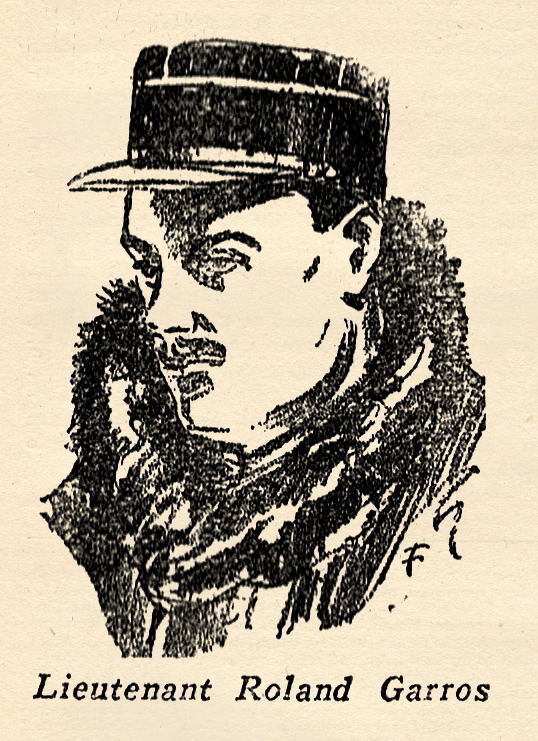 one of the world’s foremost airmen before the World War began. When the French army was mobilized, Garros joined his squadron, the Morane-Saulnier 23, just as it was leaving for the front. He built up a wonderful record for himself in respect to scouting.
Garros was an inventor as well as an aviator, and from the beginning of the war he set about improving the airplane as a fighting machine. On February 5th, 1915, he mounted a machine-gun on his airplane in such a manner that it fired through the whirring blades of the propeller, and thus changed the whole course of aerial warfare. His gun was not arranged to fire in synchronism with the propeller, so to save it from being shot through with holes, he armored it with steel tips. The bullets hitting it would thus be deflected harmlessly.
Improvements came later, but Garros, with his crude invention, shot down the first enemy airplane to be winged from the air. And from February 5th to April 19th, 1915, he succeeded in shooting down four others, becoming the first flying Ace.
The Germans learned his secret and equipped their planes in the same manner as his.
The account below is taken from an interview he gave the day after he shot down his first victim.
WINGS OF DEATH
by Lieutenant Roland Garros • Sky Fighters, March 1934
NATURALLY, the question in my mind was whether it would work in the air or not. I had tried it on the ground, and the gun functioned perfectly. I was able to hit a small target at a range of 100 meters. That success made me anxious to take off immediately. But mon commandant, Capitaine de Beauchamp, restrained me until the next morning.
Then he patted me on the shoulder and smiled: “Come back, mon enfant and tell the rest of us how it worked.” I waved and shot down the field, taking off lightly as a feather, despite the added weight of machine-gun and ammunition.
I flew towards Germany, until I came to a German drome. Three ships were on the ground getting ready to take off. I slanted off when I saw them, knowing that they saw me. too. But I wanted them to come up and fly after me.
I would let them chase me until they got close, then I would turn suddenly and fire on the leader.
I knew I could duck their bombs and rifle fire, then would come the surprise. All three Taubes came up and started in my direction. I slowed down. They circled trying to herd me back towards my own trenches. I let them get closer. The leading Taube was less than a hundred meters behind. “Now is the time!” I said, and threw my little ship around swiftly. The German darted past. I had banked so swiftly he couldn’t follow. I banked again, lowered my nose, until it sighted right on the German pilot’s back. I pressed the gun trigger.
Clackety-clack—clack-clack!
The gun stuttered, shook. The bullets spewed out. Linen stripped from the Taube, blasting back in the wind stream. I moved my controls slightly, pulled the trigger again. The pilot wilted. The Taube went up on one wing, began slipping sideways. Then it nose-dived and plunged into the ground.
I wheeled then to attack the others. But one had been forced down with motor trouble. The other was running away towards his own drome. I chased him clear to the ground, and fired my last rounds as it landed. I had no more bullets, so rushed home to make my report to Captain de Beauchamp. I was breathless! My invention had worked in the air!
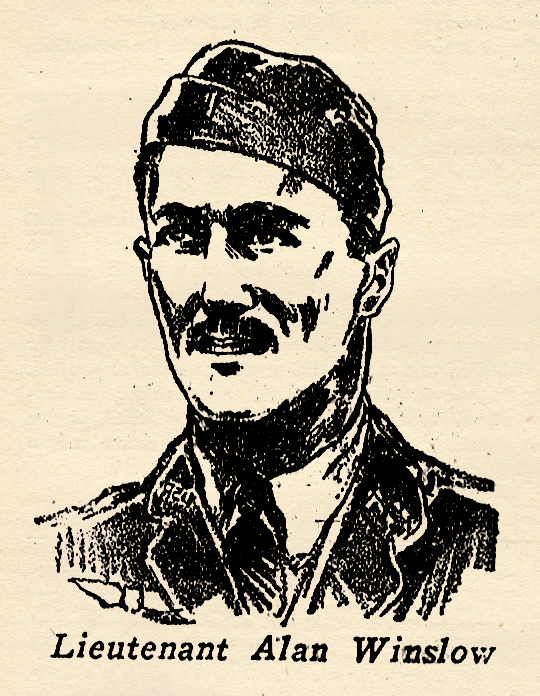 went oyer to France as a member of tho American Ambulance Section serving with the French Army. After America entered the war he was transferred to the American Army. When the American Air Service under command of Colonel Mitchell began definite duties on the Western Front, Alan Winslow had won his commission as a First Lieutenant and was assigned as a pilot in the 94th Aero Squadron, the famous “Hat in the Ring” outfit later made famous by Captain Eddie Rickenbacker.
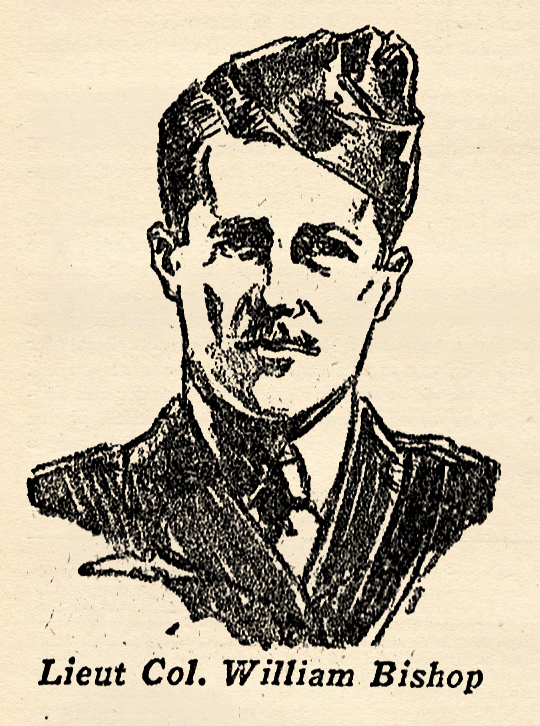 is one of the few great war Aces still living. And he probably owes his life to the fact that the British General Staff ordered him to Instruction duty in London while the war was still on. Bishop first served in the Second Canadian Army as an officer of cavalry, but tiring of the continuous Flanders mud, he made application for transfer to the Royal Flying Corps. He was first sent up front as an observer. When he went up later as a pilot he immediately began to compile the record which established him as the British Ace of Aces. He won every honor and medal possible. He was an excellent flyer, but attributed most of his success to his wizardry with the machine-gun. When the war ended he was officially credited with downing 72 enemy planes and balloons. The account below is from material he gathered for a book.
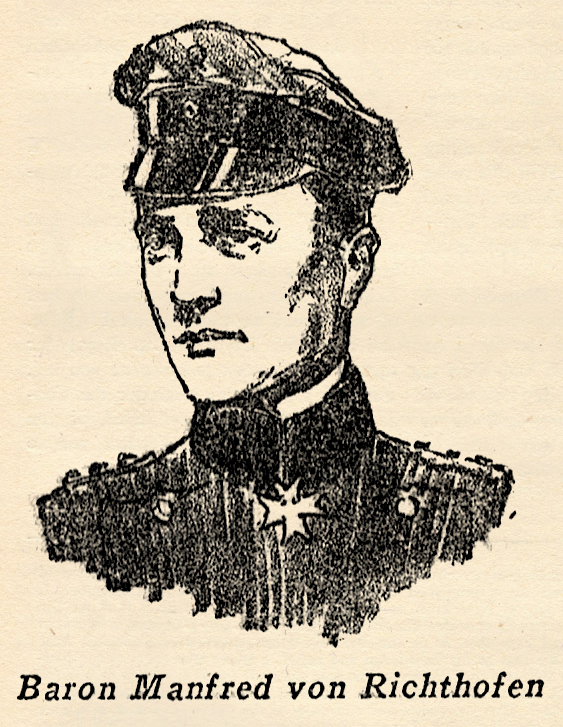 was the greatest of all the German flyers. He had more victories to his credit than any other battle flyer. He began in the Imperial Flying Corps, on the Russian Front. Soon afterwards he was transferred to the German North Seas station at Ostend, where he served as a bomber. Backseat flying never appealed to him, so he took training, soon won his wings, and was sent to join the jagdstaffel commanded by Oswald Boelke. After his sixteenth victory, he was promoted to Lieutenant and assigned to command a squadron. This became the Flying Circus, the most famous of all the German squadrons, the scourge of the western skies.