Looking to buy? See our books on amazon.com Get Reading Now! Age of Aces Presents - free pulp PDFs

“The Death Disc” by Frederick Blakeslee

Link - Posted by David on August 17, 2015 @ 6:00 am in

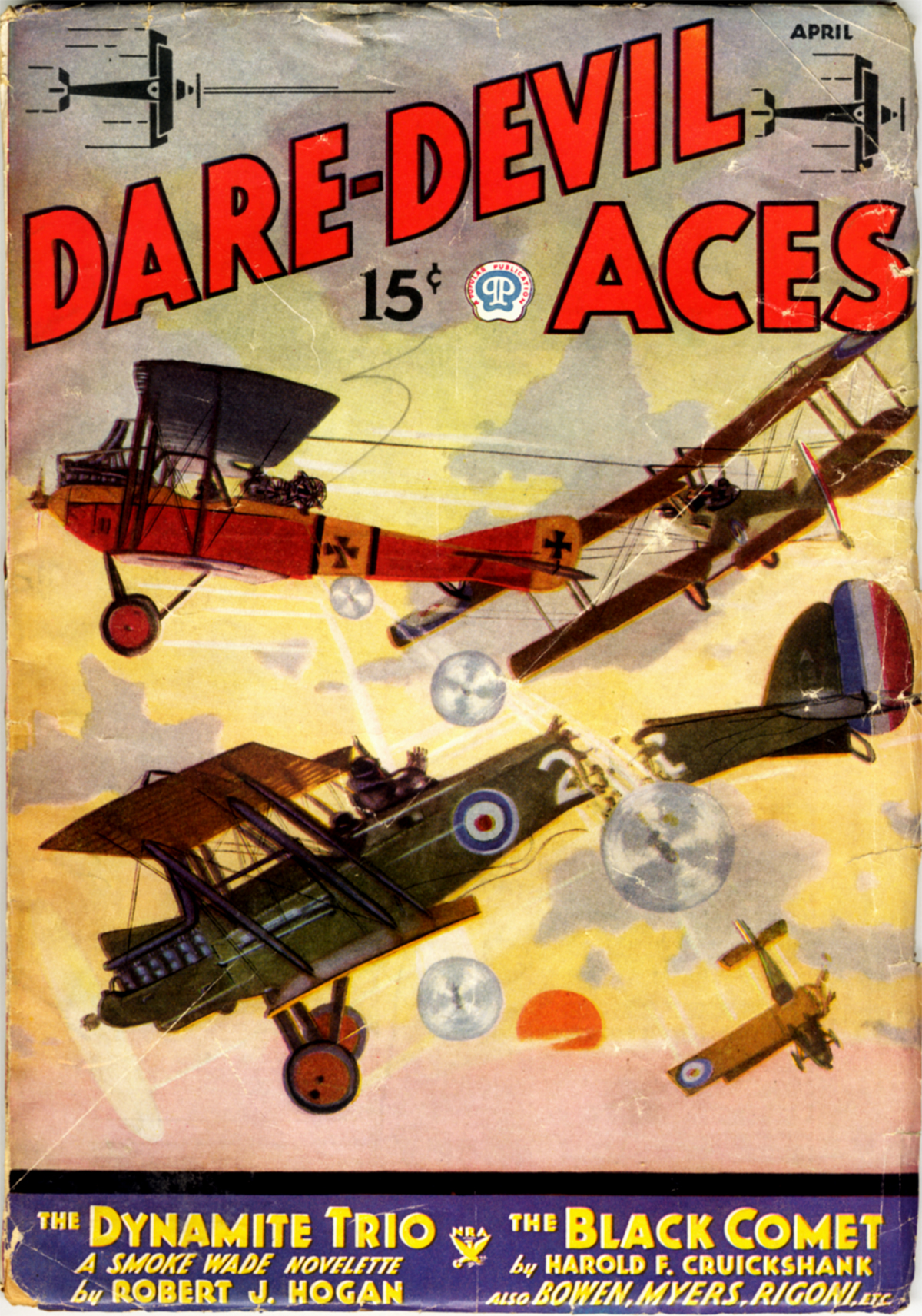
Frederick Blakeslee painted all the covers for the entire run of Dare-Devil Aces. And each of those covers had a story behind it. This time Mr. Blakeslee brings us a story of a weapon that was made, but never used during the war. From the April 1935 issue of Dare-Devil Aces, we present “The Death Disc!”

th_DDA_3504SOME time ago we mentioned the fact that during the war people in all walks of life set their creative minds at work on inventions to “win the war.” Each inventor seemed to think that he had hit upon an original principle, or a new application of an old principle. The majority of these inventions were utterly useless. This month’s cover is based on the invention of a German who lived in a small village in East Prussia.

He had been a brilliant instructor of mathematics in a famous German university. Later on in life he retired and when war broke out he was too old to fight

There was no lack of courage in the old man for he tried in vain to find a place in the fighting forces of his country. But German officialdom at that time would have none of him.

Finding no place for himself he had retired to his village again and there devoted his time and his modest fortune to experimentation on explosives. None of his formula proved successful and after an accident that wrecked his laboratory, the towns people persuaded him to give up this dangerous occupation. Discouraged by his failures, he did stop dabbling in explosives and turned to commodities.

He figured, and rightly, that the war would last longer than people thought, and foresaw a shortage in some of the staple commodities. He received no backing whatever, although some of his ideas, conceived during this period, were later adopted.

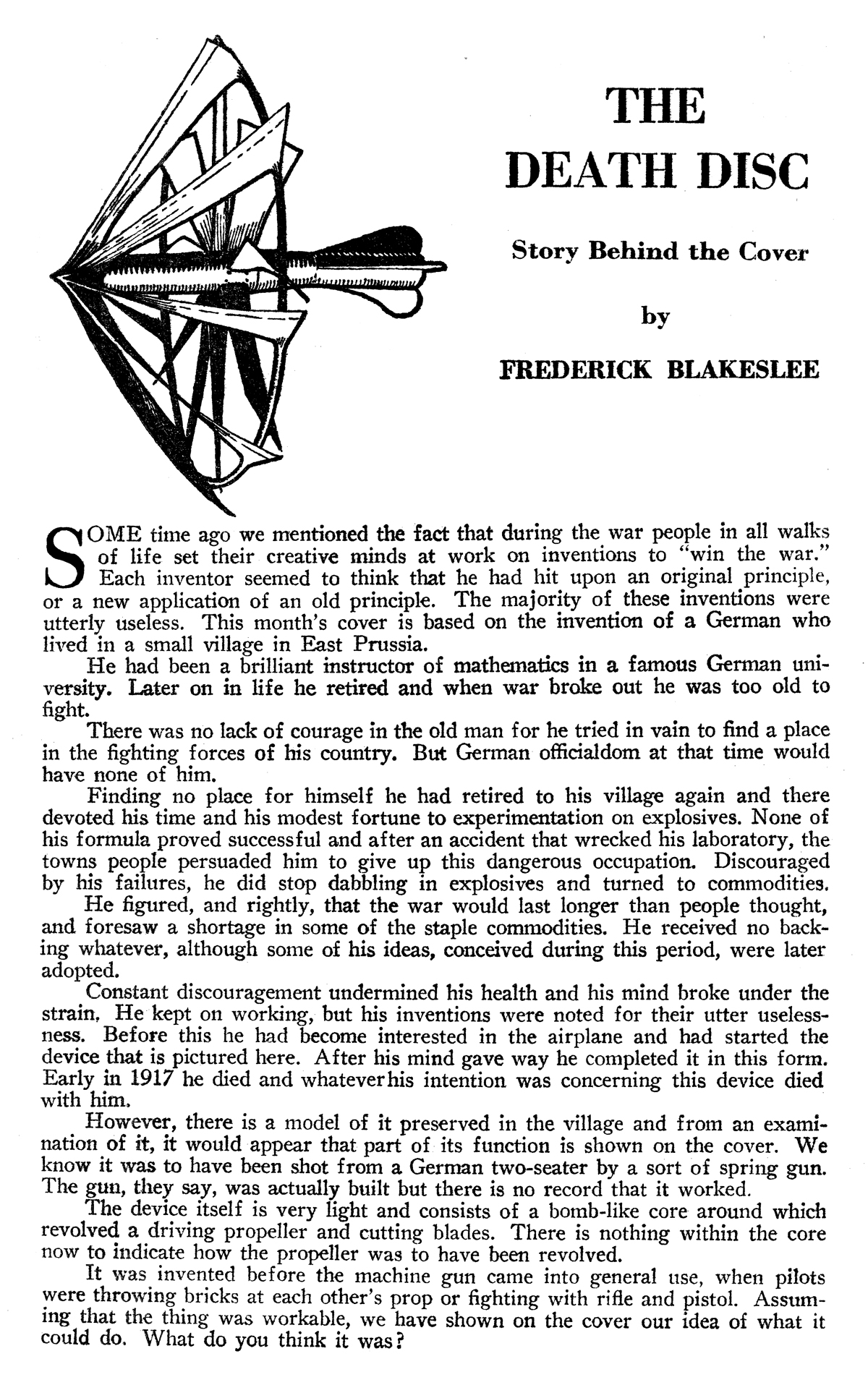
Constant discouragement undermined his health and his mind broke under the strain, He kept on working, but his inventions were noted for their utter uselessness. Before this he had become interested in the airplane and had started the device that is pictured here. After his mind gave way he completed it in this form. Early in 1917 he died and whatever his intention was concerning this device died with him.

However, there is a model of it preserved in the village and from an examination of it, it would appear that part of its function is shown on the cover. We know it was to have been shot from a German two-seater by a sort of spring gun. The gun, they say, was actually built but there is no record that it worked.

The device itself is very light and consists of a bomb-like core around which revolved a driving propeller and cutting blades. There is nothing within the core now to indicate how the propeller was to have been revolved.

It was invented before the machine gun came into general use, when pilots were throwing bricks at each other’s prop or fighting with rifle and pistol. Assuming that the thing was workable, we have shown on the cover our idea of what it could do, What do you think it was?

The Story Behind The Cover
“The Death Disc: The Story Behind The Cover” by Frederick Blakeslee
(April 1935, Dare-Devil Aces)

“The Dynamite Monster” by Frederick Blakeslee

Link - Posted by David on August 3, 2015 @ 6:00 am in

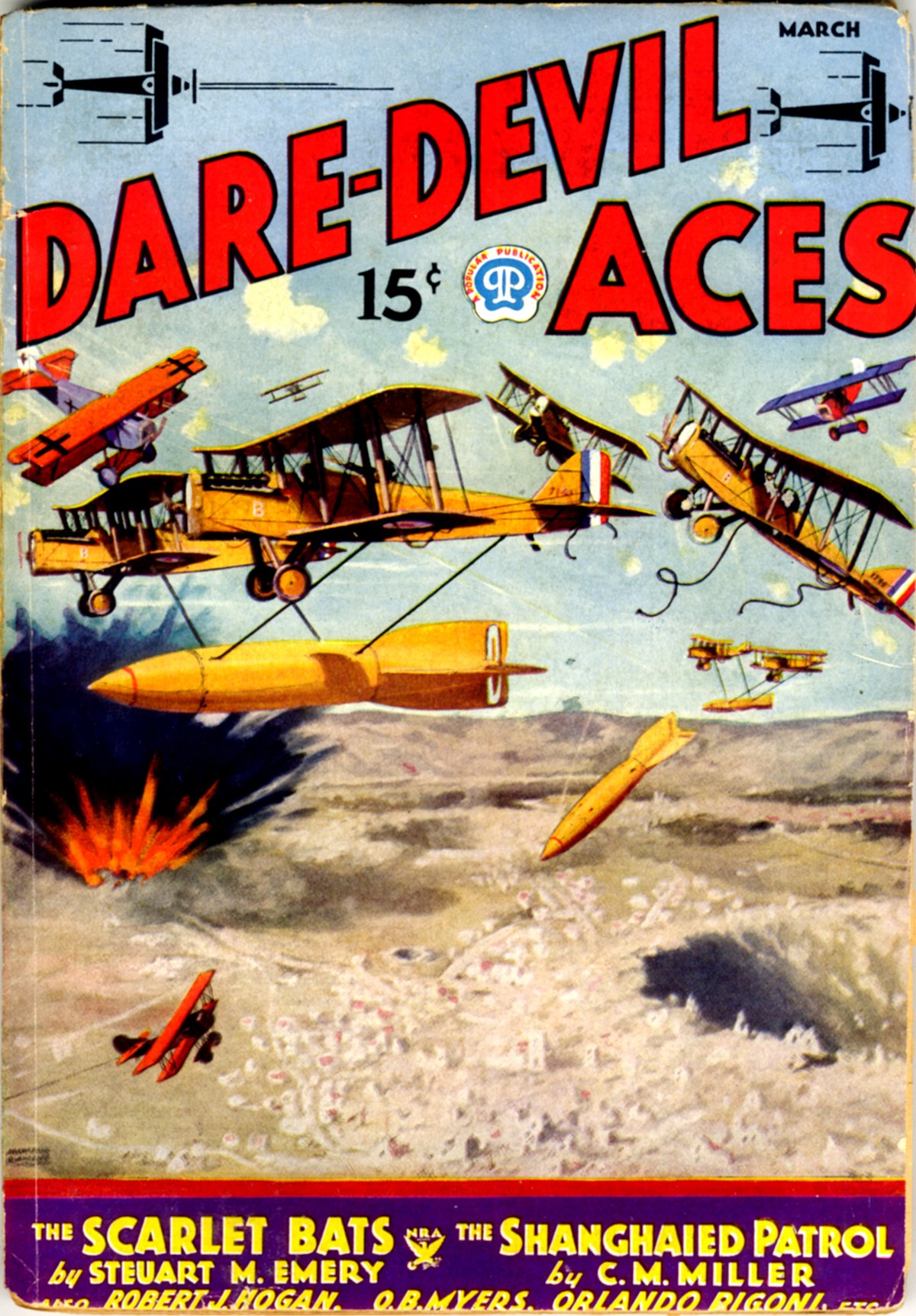
Frederick Blakeslee painted the covers for Dare-Devil Aces‘ entire fourteen year run. This time Mr. Blakeslee looks into the possiblity of a giant bomb that needed to be carried aloft by two planes! From the March 1935 Dare-Devil Aces, it’s “The Dynamite Monster!”

th_DDA_3503I MET Ed in the Savoy Grill in London. We had not seen each other since I had been in England three years before, so naturally we sat down, ordered drinks and spent the rainy afternoon talking over old times.

Finally. “I suppose you’re over digging up ideas, what?” he asked.

“Among other things,” I answered. “Have you any ideas around loose?” and I explained what I was after.

“Inventions is it?” he said. “Well, I don’t know of any unless—”

“Unless what?” I urged.

“Oh nothing, I was just thinking of something I heard some time ago, but you’re after authentic material, aren’t you?”

I told him I was.

“There you are,” he returned. “I can’t prove it because Bill Totling told it and someone told Bill, or so he says, and you’d have to trace the story to the original source.”

“As long as the story had a source, that’s all the proof I require, so tell it.”

“All right,” he began, “but keep this in mind, personally I think Bill was pulling our legs. It was at the annual binge of the W.B.C. (I have called it the W B C (War Birds Club) which is not its real name.—Author.) Bill said that late in 1918 we were experimenting with a bomb to drop on Berlin that was to be carried by two airplanes. The bomb was to be slung between the ships by cables. At the proper place it was to be released by electricity from one of the ships.”

“I’d like to hear more of the details,” I said,

“Why don’t you look up Bill and ask him?”

I thanked Ed and we parted. I found that Bill lived on Taviton Street which was near my hotel so that very night I called on him. He remembered the story.

“Sid Stanley told it to me,” he said to my question, “Who told it to Sid I don’t know, it’s one of those yarns that has been told to so many people that without a doubt it has been changed in the telling, but I have reason to think that it has some foundation in fact.”

“That’s all the proof I need,” I said, “perhaps you can answer some questions. What kind of ships were to be used?”

“That I don’t know. They experimented with deHavilands.”

“Why deHavilands?”

“I suppose because they were easier to handle in the take-off. The idea was to train the pilots on the lighter ship before handling the heavier planes.”

“I see. Well, how did they take off?”

“The bomb was on a carriage. The ships took up position on either side of the bomb, dragged it between them, rose in the air and gradually took up the load of the bomb lifting it off the carriage and there you are. Sid said they actually got in the air with one too,”

The Story Behind The Cover
“The Dynamite Monster: The Story Behind The Cover” by Frederick Blakeslee
(March 1935, Dare-Devil Aces)

“The Fokker D-VII” by Robert H. Rankin

Link - Posted by David on July 27, 2015 @ 6:00 am in

Frederick Blakeslee painted all the covers for the entire run of Dare-Devil Aces. And each of those covers had a story behind it. This time, we have more of the approach he used for the covers he painted for Battle Aces—telling us about the ship on cover. But, instead of Mr Blakeslee telling us about the ship on the cover, we have Mr. Robert H. Rankin, formerly a draughtsman for the Fokker Aircraft Corp telling the story of the Fokker D-VII on the cover of the February 1935 cover of Dare-Devil Aces. . . .
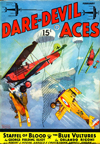
th_DDA_3502The contraption shown on the cover was supposed to have been invented just after our entry into the war. The idea was for a bomber to drop the net and then the combat ships were to lure the enemy into it, or else the combat ship was to carry the net itself. The story goes that the inventor offered it to the U.S. government, then to France and England and finally into German hands. (A similar device was employed in the Sky Devil story “The Haunted Fokker” (Dare-Devil Ace, April 1933))

Now let’s review the history of the Fokker D-VII, written by an authority on the subject.

THE FOKKER D-VII
by ROBERT H. RANKIN
Formerly Draughtsman, Fokker Aircraft Corp.

TO ANY one familiar with the fighting planes developed during the World War the Fokker D-VII is outstanding. It was superior to any other plane used by Germany and it was certainly the equal of any machine used by the Allies. Using the D-VII the German pilots were able to hold their own against a much larger force of Allied aircraft, and so great did the fear of these planes become that it was definitely stated in terms of the Armistice that all Fokker planes should be destroyed.

The D-VII was the result of the gradual development of the earlier Fokker Fighters. When it was found that the 110 H.P. Le Rhone powered Nieuport easily outmoded the 80 H.P. Gnome powered Fokker the design of the Fokker tri-plane was completed.

The triplane enabled the German pilots to gain a series of impressive victories and it was used by the great von Richthofen in many of his aerial duels. Although the speed of this plane was comparatively slow, its decided ease of maneuverability more than made up for the disadvantage.

But its flight range was limited by a small gasoline capacity and Allied pilots found that the best way to escape it was to out-distance it.

As it became apparent that the fighting planes of the Allies, and in particular the Sopwith Camels and Spads, were giving them the advantages of speed and flight range the design of the D Series Fokkers was started. The first of these was the D-I, a bi-plane powered with a 120 H.P. Mercedes, and like the rest of the series it was fast and efficient.

About this time the Albatros works (Albatros Werke) began production of the D Series Albatros machines. The Albatros D-II proved itself superior to the Fokker D-I and by 1917 the later developed D-III had surplanted the Fokkers at the Front. This Albatros was powered with a 175 H.P. Mercedes, weighed 1,470 lbs. and carried a useful load of 297 lbs.

These D Series Albatros planes were a bi-plane design, having a small lower wing (made of a single spar) connected to a larger upper wing with a V strut. Any combat advantages which the Albatros offered were offset by the fact that the plane was structurally weak and the wings could not stand torsions. Consequently, when fighting the Albatros, Allied pilots had but to put their planes into a steep dive to be safe.

Many German airmen were killed when their planes went to pieces in mid-air; the celebrated Captain Boelke met death when the wings of his Albatros pulled off while he was flying over his own lines. Several pilots deliberately wrecked their machines rather than take them into the air.

The father of the D-VII was a bi-plane of somewhat radical appearance. Its fabric-covered fuselage was made of wood covered welded tubing, making a clean and decidedly streamlined job. The wings were built up of wood in much the same manner as were the wings of the later Fokker commercial types.

Although this plane offered every advantage and was years ahead of its time in many ways it was refused by the German High Command. Realizing that little satisfaction could be had from the German government (politics meaning more to them than efficient fighting equipment) Mr. Fokker managed to contact the important pilots. He found that they were not satisfied with the planes and materials furnished them and they desired to select their own equipment.

After some difficulty and much red tape an open competition of the leading makes of military planes was held. For this competition Fokker redesigned his bi-plane and the D-VII was born.

The D-VII was characterized by its cantilever wings (made up of box spars). No wires or external braces were used and the wings were joined together at the tips with a single strut. The fuselage was of a rectangular cross section which feature made for simplified manufacturing and quantity production. By streamlining the landing gear axle with a tiny wing, speed was added to the plane.

The D-VII fast became a favorite of the pilots. Although the Rumpler climbed faster, it handled very badly, especially on the turns. So great was the demand for the new Fokker that the factories making other planes were required to stop production of their own types and concentrate on the building of the D-VIIs.

The following figures give an insight into the construction and performance of the plane.

Wing curve Fokker varying
Sweepback None
Dihedral, upper wing 2°
Dihedral, lower wing 1° 20′
Stagger 2′ 1″
Total wing area, including ailerons 236 sq. ft.
 
Upper plane—
  Span 27′ 5½”
  Chord 5′ 3″
  Area, with ailerons 145 sq. ft
 
Lower plane—
  Span 22′ 11¼”
  Chord 3′ 11¼”
  Area 91 sq. ft.
  Incidence 1 to 1.5 degrees
  Gap 4′ 6¼”
 
Fuselage—
  Max. cross section shape Rectangular
  Max. cross section area 9.35 sq. ft.
  Max. cross section dimension 3′ 9½” by 2′ 5½”
 
General Dimensions—
  Overall span 27′ by 5½”
  Length 23′
  Height 9′ 3″
 
The weight of plane (empty, including water) 1,867 pounds
The weight of plane loaded 2,462 pounds

The endurance of the Fokker D-VII is, full throttle at 10,000 feet (including climb) 2 hrs. 13 minutes.

Minimum speed of the D-VII at sea level (lowest throttle) is 62 miles per hour.

The Story Behind The Cover
“The Fokker D-VII” by Frederick Blakeslee (February 1935, Dare-Devil Aces)


Mr. Blakeslee covered the Fokker D-VII himself with the story of Billy Bishop for the cover of the February 1932 number of Battle Aces.


“Death Lightning” by Frederick Blakeslee

Link - Posted by David on July 20, 2015 @ 6:00 am in

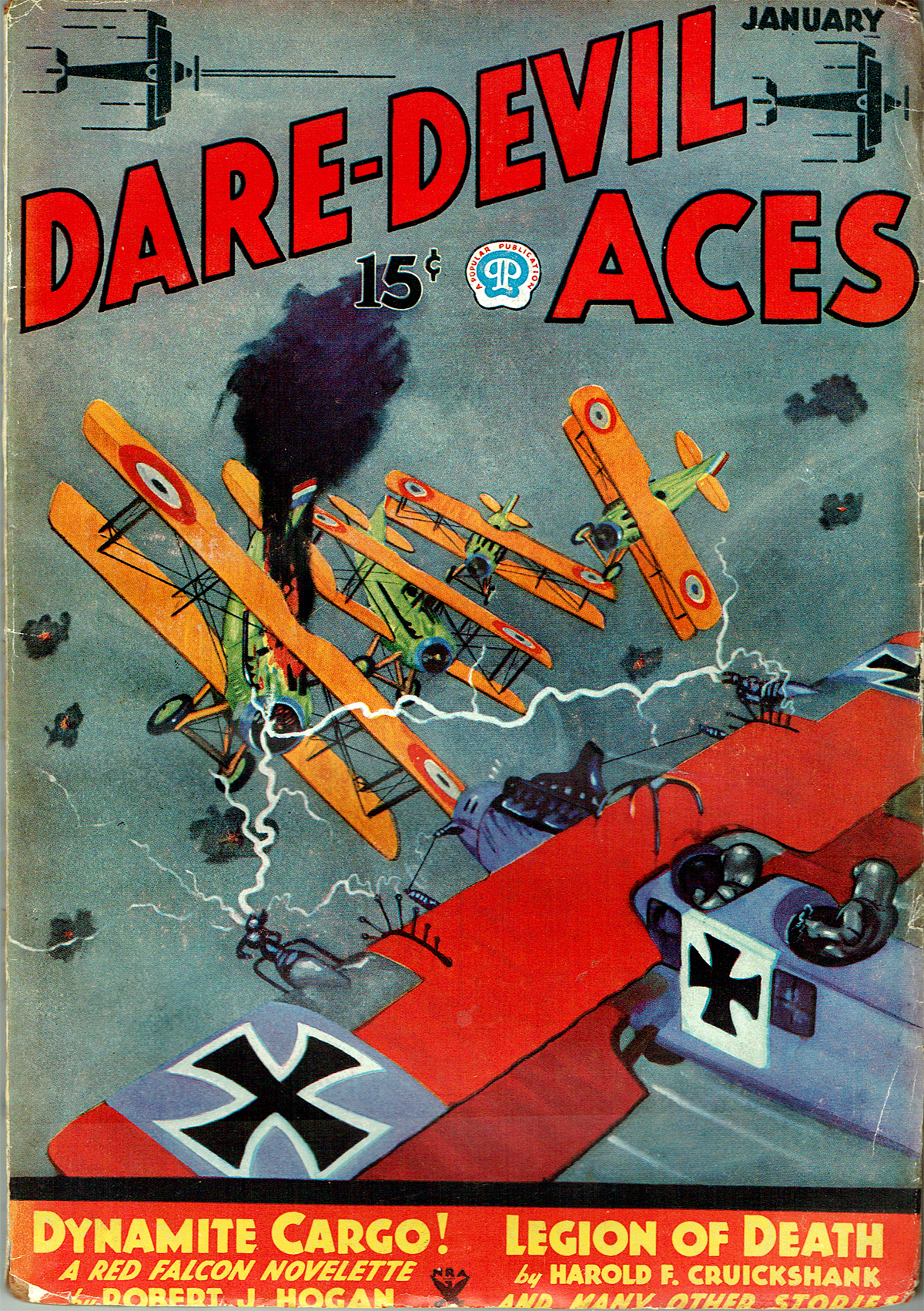
Frederick Blakeslee painted all the covers for the entire run of Dare-Devil Aces. And each of those covers had a story behind it. It’s another of Mr. Blakeslee’s future tech story covers—and it’s a cover you don’t see often because it’s a hard to find issue due to G-8 guest staring in Robert J. Hogan’s Red Falcon story that month—Dynamite Cargo! (available in our first volume of Red Falcon: The Dare-Devil Aces Years.) Another side note: Although Blakeslee did the cover, he did not do the interior illustrations aside from the interstitials Would You Believe it? and The Story Behind The Cover—Josef Katula handled the art honors this month. So feast your eyes on the January 1935 number of Dare-Devil Aces!

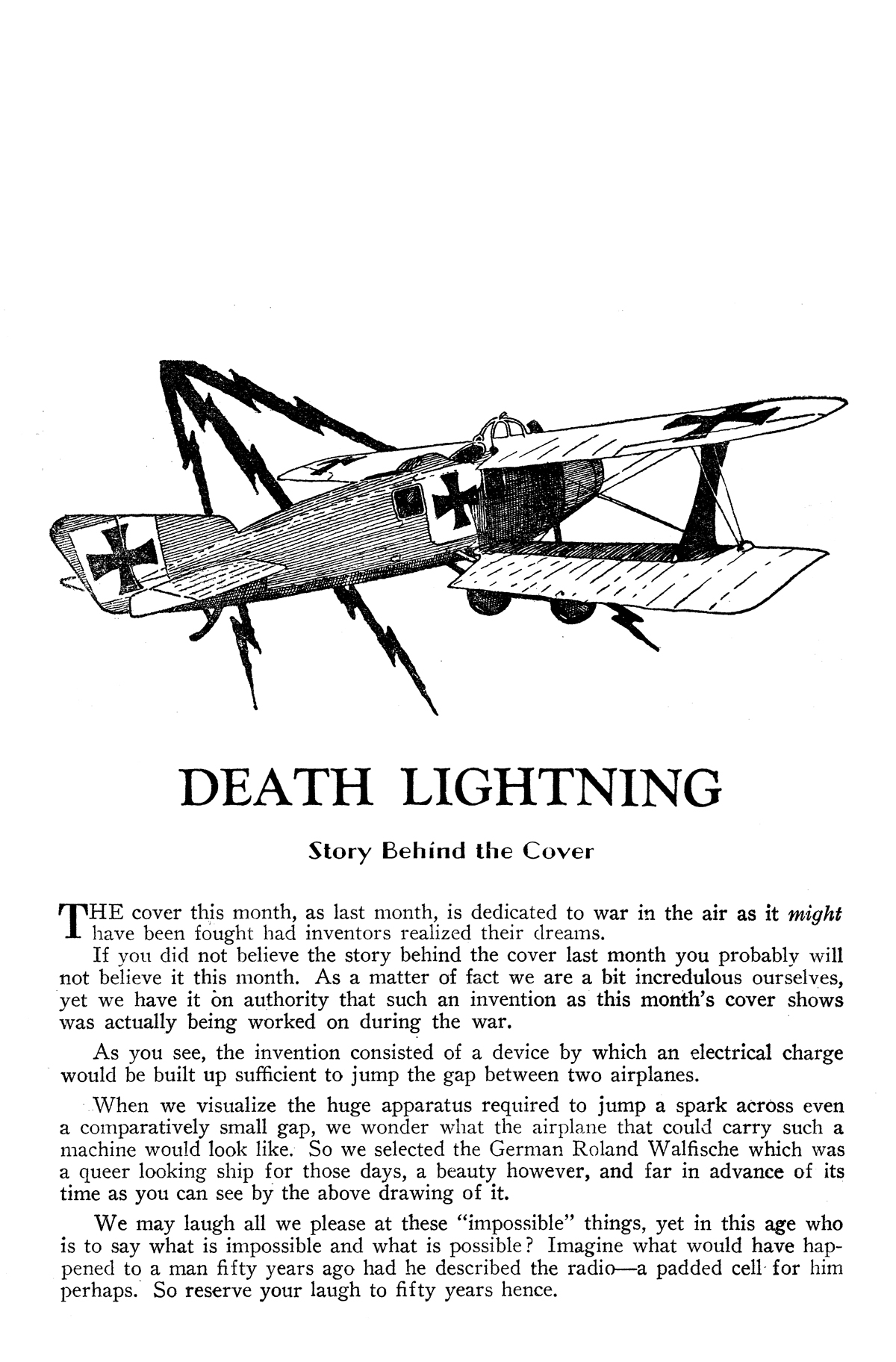
th_DDA_3501THE cover this month, as last month, is dedicated to war in the air as it might have been fought had inventors realized their dreams.

If you did not believe the story behind the cover last month you probably will not believe it this month. As a matter of fact we are a bit incredulous ourselves, yet we have it on authority that such an invention as this month’s cover shows was actually being worked on during the war.

As you see, the invention consisted of a device by which an electrical charge would be built up sufficient to jump the gap between two airplanes.

When we visualize the huge apparatus required to jump a spark across even a comparatively small gap, we wonder what the airplane that could carry such a machine would look like. So we selected the German Roland Walfische which was a queer looking ship for those days, a beauty however, and far in advance of its time as you can see by the above drawing of it.

We may laugh all we please at these “impossible” things, yet in this age who is to say what is impossible and what is possible? Imagine what would have happened to a man fifty years ago had he described the radio—a padded cell for him perhaps. So reserve your laugh to fifty years hence.

The Story Behind The Cover
“Death Lightning: The Story Behind The Cover” by Frederick Blakeslee
(January 1935, Dare-Devil Aces)

Next time, Mr. Blakeslee brings us another fanciful invention—”Death Lightning” for the January 1935 cover. Be sure not to miss it.

“Lives of the Aces in Pictures – Part 40: Major Francesco Baracca” by Eugene Frandzen

Link - Posted by David on July 15, 2015 @ 6:00 am in

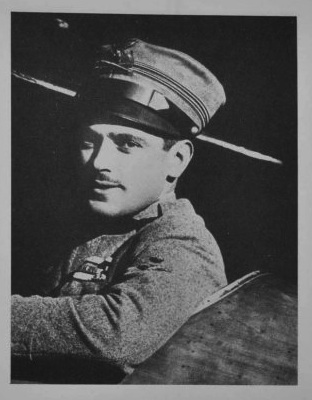
Back with another of Eugene Frandzen’s “Lives of the Aces in Pictures” from the pages of Flying Aces Magazine. The series ran for almost four years with a different Ace featured each month. This time around we have the October 1935 installment featuring the illustrated biography of Italy’s Ace of Aces—Major Francesco Baracca!

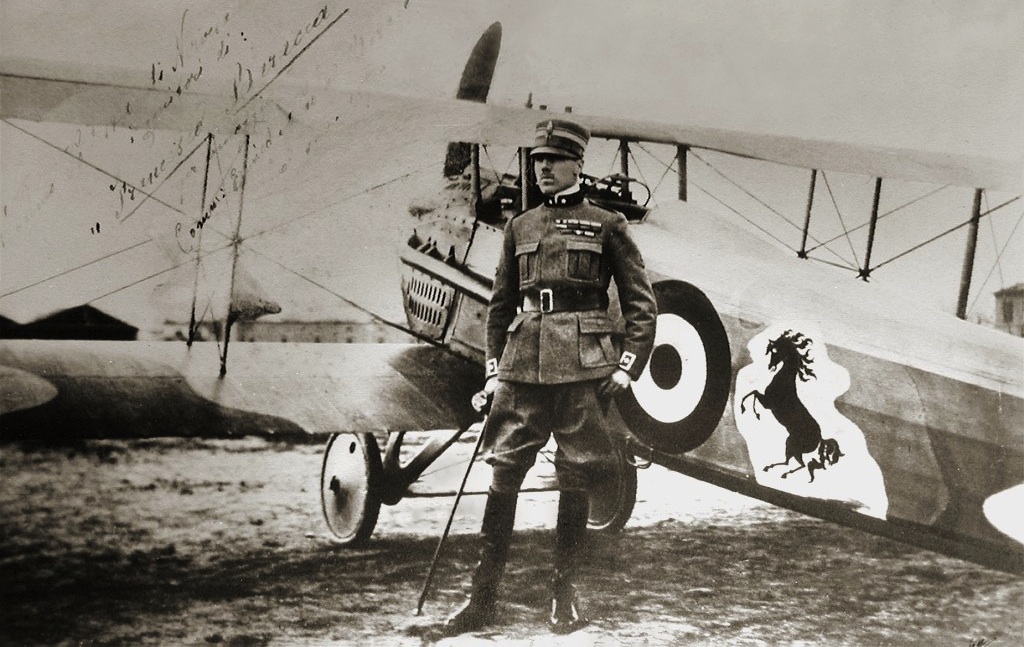
Major Francesco Baracca is Italy’s greatest Ace of WWI but started his millitary carrer in the cavalry before the war with the prestigious Piemonte Reale Cavalleria Regiment upon his commisioning in 1910. Baracca’s interests turned to Aviation a few years later when he was transfered from Rome to a small town in central Italy and learned to fly at Reims, France.

Son of a nobleman, Barraca is credited with 34 victories and emblazzened the fuselage of his plane with his personal emblem, a black prancing horse—the Cavallino Rampante—in tribute to his calvalry days. It is this emblem that his mother gave to Enzo Ferrari in later years to be the official symbol of the Scuderia Ferrari Racing team since 1929 and later Ferrari Automobiles.

He was killed while out on a straffing run in June 1918.

“Lives of the Aces in Pictures – Part 39: Gabriel Guerin” by Eugene Frandzen

Link - Posted by David on July 1, 2015 @ 6:00 am in

Back with another of Eugene Frandzen’s “Lives of the Aces in Pictures” from the pages of Flying Aces Magazine. The series ran for almost four years with a different Ace featured each month. This time around we have the September 1935 installment featuring the illustrated biography of the ninth ranking French Ace—Gabriel Guerin!

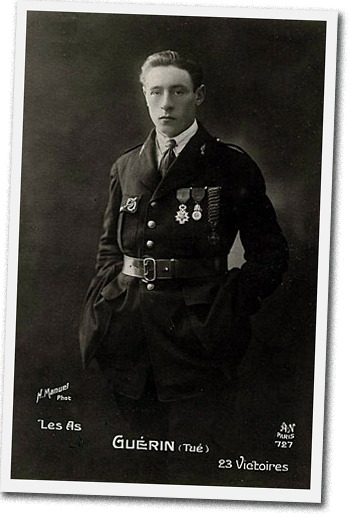
Sous Lieutenant Gabriel Fernand Charles Guerin was credited with 23 confirmed victories—including five of which he shared—and a reported 10 more unconfirmed. Most of these victories were while a pilot in SPA 15. As we said he was France’s ninth ranking Ace in the First World War and was awarded the Legion d’honneur, Médaille Millitaire and the Croix de Guerre with 15 palms and two bronze stars!

Sadly, Guerin died when the aircraft he was piloting, a SPAD VII, spun out of control and plunged to the ground soon after take-off near Mont l’Eveque on the 1st of August 1918. He was 26.

“Crêpe Hangars” by Joe Archibald

Link - Posted by David on June 26, 2015 @ 6:00 am in

“Haw-w-w-w-w!” That sound can only mean one thing—that Bachelor of Artifice, Knight of Calamity and an alumnus of Doctor Merlin’s Camelot College for Conjurors is back and this time the marvel from Boonetown faces a dilema—face a court martial or transfer to the Pallbearer Squadron—the most morose lot on the Western Front—to boost their morale as only a Pinkham can.
They thought Phineas could make anybody laugh—until they sent him to the Pallbearers’ drome, where even the birds sang death marches. Yes, it looked for once as if Phineas had met his match in that bunch of Crêpe Hangars!

“Lives of the Aces in Pictures – Part 38: Carl Bolle” by Eugene Frandzen

Link - Posted by David on June 17, 2015 @ 6:00 am in

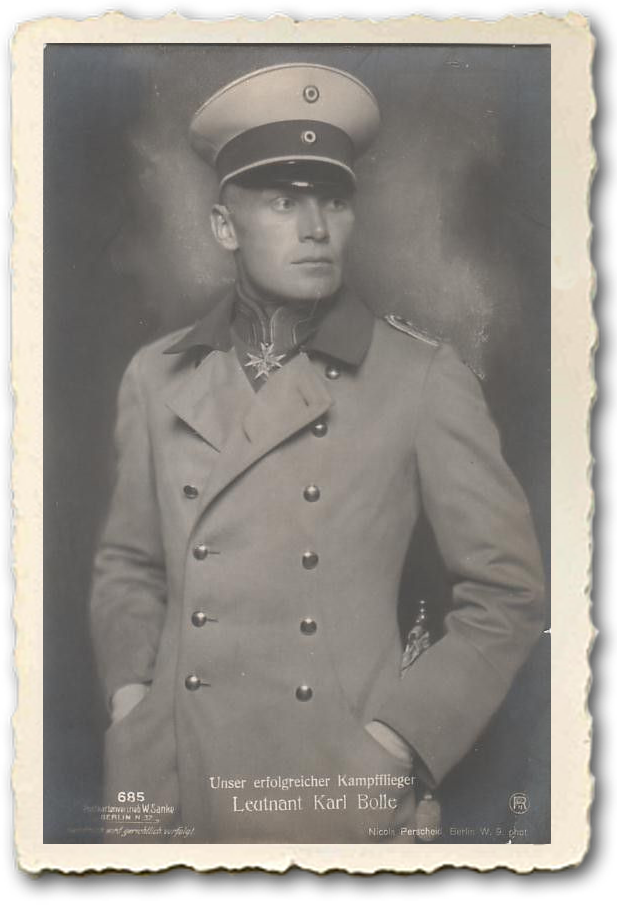
Back with another of Eugene Frandzen’s “Lives of the Aces in Pictures” from the pages of Flying Aces Magazine. The series ran for almost four years with a different Ace featured each month. This time around we have the August 1935 installment featuring the illustrated biography of the last leader of the Jagdstaffel Boelcke—Carl Bolle!

Carl Bolle started his military career in the cavalry, later transfering to the air service. During his time in the air service he is credited with 36 victories rising to the rank of Oberleutnant and transfered to command Jasta 2—the very squadron Oswald Boelcke had commanded.

After the war, Bolle became a flying instructor and in the 1920’s director of German Air Transport School—the Deutsche Verkehrsfliegerschule. Subssequently helping in the covert training of pilots for the Luftwaffe with which he served as an advisor during the second World War, reporting to Hermann Goring himself!

Carl Bolle passed away on the 9th of October 1955 in his native city of Berlin.

“Raid of the Unseen” by Kenneth Brown Collings

Link - Posted by David on June 12, 2015 @ 6:00 am in

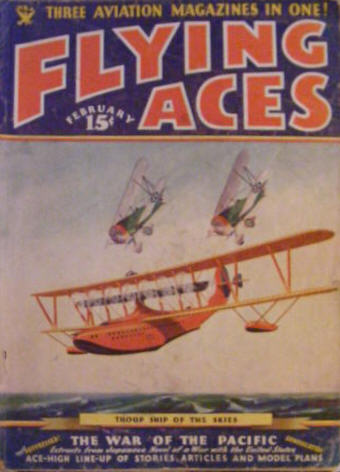
This week we have a tale from the pen of a dare-devil adventurer, aviator, soldier and war correspondent—Kenneth Brown Collings, whose interest in aviation began in childhood when he saw the Wrights brothers and their flying machine perform at Fort Myer, Va., in 1908. From the pages of the February 1935 number of Flying Aces, it’s a smashing yarn of night bombers—”Raid of the Unseen!”

The C.O. of the 7th Marines Squadron was not new at the fighting game. He’d taken lessons from blood-crazed Moros in the Philippines, from slant-eyed Boxers in China. And he’d learned one thing—you’ve got to hit what you shoot at, whether you’re on the ground or in the air. And because he’d learned that lesson so well—he was faced with a court-martial!

“Lives of the Aces in Pictures – Part 37: Lt. Col. Barker” by Eugene Frandzen

Link - Posted by David on June 3, 2015 @ 6:00 am in

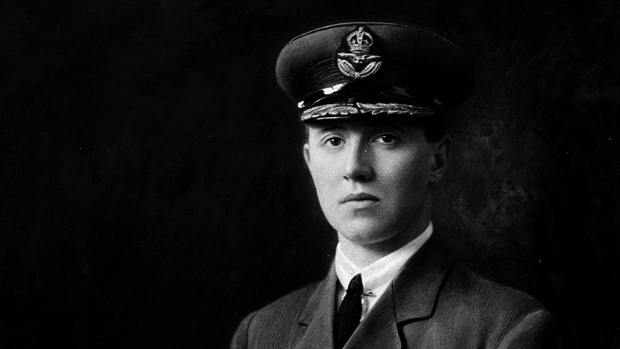
Back with another of Eugene Frandzen’s “Lives of the Aces in Pictures” from the pages of Flying Aces Magazine. The series ran for almost four years with a different Ace featured each month. This time around we have the July 1935 installment featuring the illustrated biography of the most decorated Canadian Ace—Lt. Col. William Barker, V.C., D.S.O. M.C.!

William George “Billy” Barker was a fighter pilot credited with 53 aerial victories during WWI, but is mostly remembered for the epic, single-handed combat on October 27th 1918 against some 60 German aircraft that won him the Victoria Cross.

After the war he joined Canada’s other Ace named Billy—William Bishop in an ill-conceived commercial aviation venture in Toronto, but in June 1922 he accepted a commission in the Canadian Air Force and was briefly the acting director of the RCAF.

Barker was fatally injured when his new two-seater Fairchild aircraft he was demonstrating crashed at Rockcliffe air station, Ottawa. He was 35.

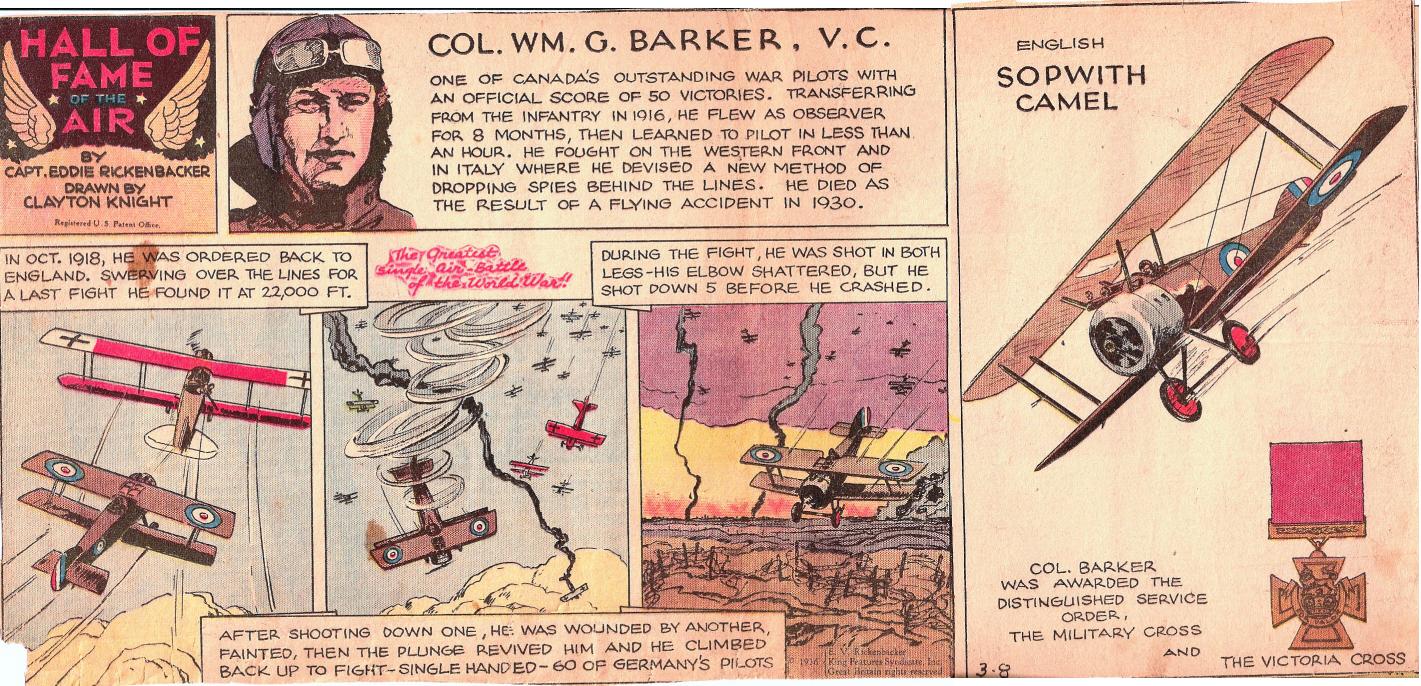
As a bonus—here is the feature on Lt. Col. William Barker from Clayton Knight’s newspaper feature Hall of Fame of the Air which ran Sundays from 1935 to 1940. This strip is courtesy of Stephen Sherman’s acepilots.com which has a large collection of HFA strips that his father had clipped and saved at the time.

Great stuff!

“Spy Larking” by Joe Archibald

Link - Posted by David on May 29, 2015 @ 6:00 am in

“Haw-w-w-w-w!” You heard right! That marvel from Boonetown, Iowa is back and there is a spy in their midst—surely it’s not the latest recruit to the 9th Pursuit Squadron—Lt. Harold Bartholomew Cheeves, the one man on the base that truely gets Pinkham!
Haul out the solid ivory and strike off the International Crack-Brain Medal for Lieut. Harold Bartholomew Cheeves, newcomer with the Fighting 9th. For here’s a man who APPRECIATES Phineas! In fact, the more cockleburs he finds in his hash, the more he admires the Boonetown Barbarian.

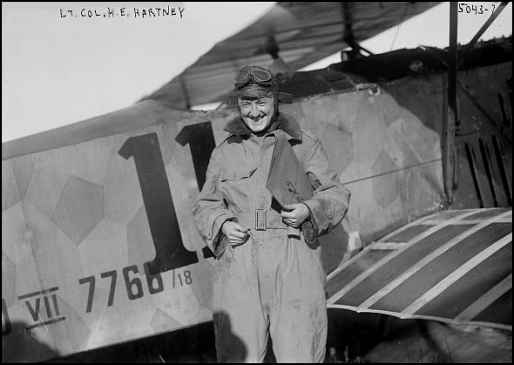
“Lives of the Aces in Pictures – Part 36: Lt. Col. Harold E Hartney” by Eugene Frandzen

Link - Posted by David on May 6, 2015 @ 6:00 am in

Back with another of Eugene Frandzen’s “Lives of the Aces in Pictures” from the pages of Flying Aces Magazine. The series ran for almost four years with a different Ace featured each month. This time around we have the June 1935 installment featuring the illustrated biography of Rickenbacker’s Commander—Lt. Col. Harold E. Hartney!

Harold Evans Hartney was born in Ontario, Canada and enlisted in the Canadian Militia serving with the Saskatoon 105th Fusiliers before requesting a transfer to the Royal Flying Corp after a chance meeting with William Bishop. He flew with No. 20 Squadron RFC and scored six confirmed victories before being shot down in February of 1917—he claims by Manfred von Richtofen. After he recovered he ws promoted to the rank of Major and assumed the command of the American 27th Aero Squadron.

Hartney became an American citizen in 1923 and penned a number of books, foremost of which was the autobiographical Up and At ‘Em.

He passed away from heart disease October 5th, 1947 in Washington, DC. at the age of 57. Lt. Col. Harold E. Hartney is buried in Arlington National Cemetary.

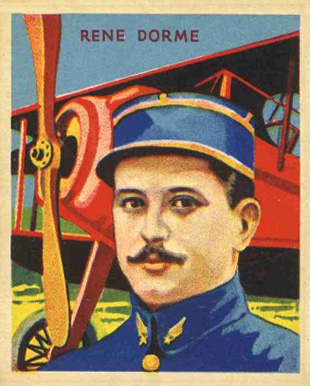
“Lives of the Aces in Pictures – Part 35: René Dorme” by Eugene Frandzen

Link - Posted by David on April 15, 2015 @ 6:00 am in

Back with another of Eugene Frandzen’s “Lives of the Aces in Pictures” from the pages of Flying Aces Magazine. The series ran for almost four years with a different Ace featured each month. This time around we have the May 1935 installment featuring the illustrated biography of France’s unpuncturable Ace—René Dorme!

Sous Lieutenant René Pierre Marie Dorme has been credited with 23 victories although officially noted with a probable 43. He had started his service as an artilary man in North Africa before becoming a pilot and managing to get injured in a crash before even seeing action. But that didn’t stop him—He got into combat in March of 1916 and achieved his first credited victory in July shooting down an L.V.G.

The French called him “the beloved” and even the great Guynemer called him France’s greatest air fighter. His plane was only hit twice in all his fights earning him the name “unpuncturable.” Dorme was awarded the Chevalier de la Légion d’Honneur, the Médaille Militaire and the Croix de Guerre (with 11 palms!).

While flying on May 25th 1917, Dorme dissapeared over German territory after downing a plane. Two weeks later the enemy reported he was killed in combat, but nothing more than that was ever heard of him—no trace ever found!

“Lives of the Aces in Pictures – Part 34: Lt. Rudolph von Eschwege” by Eugene Frandzen

Link - Posted by David on April 1, 2015 @ 6:00 am in

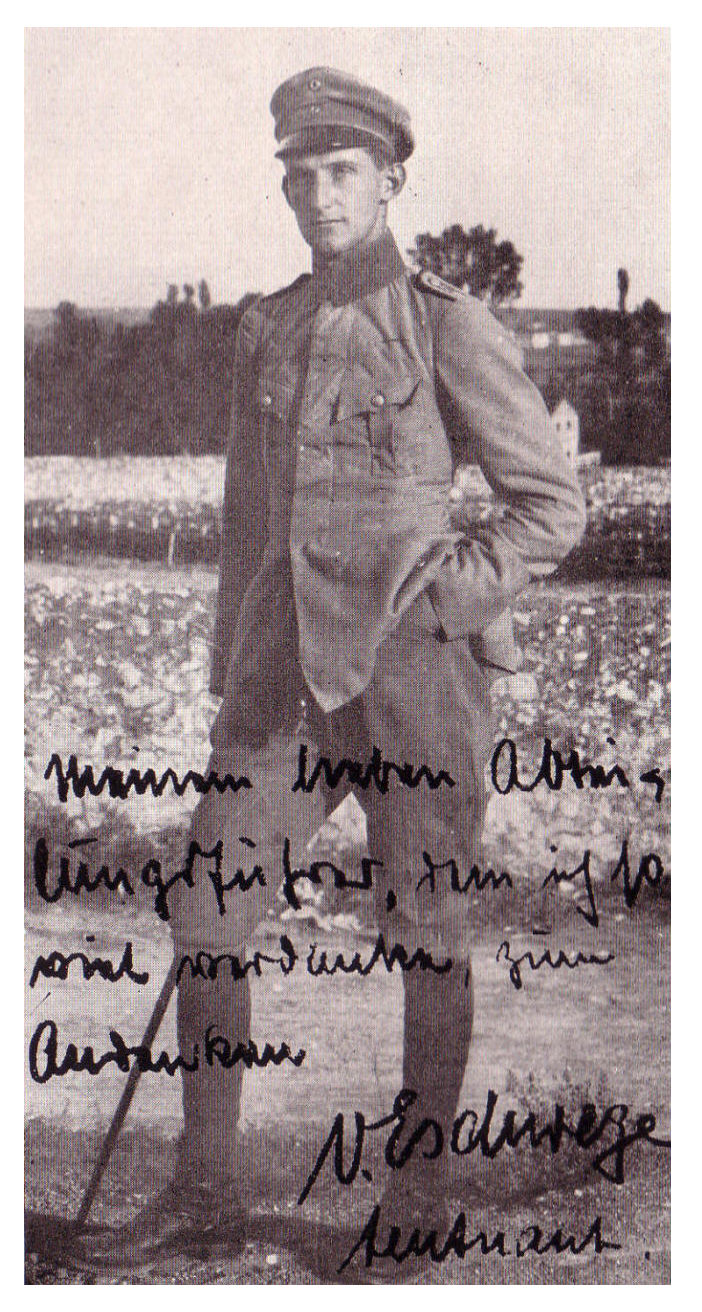
Back with another of Eugene Frandzen’s “Lives of the Aces in Pictures” from the pages of Flying Aces Magazine. The series ran for almost four years with a different Ace featured each month. This time around we have the April 1935 installment featuring the illustrated biography of the “German Eagle” himself—Lieutenant Rudolph von Eschwege!

Rudolph von Eschwege, known as the Eagle of the Aegean, was a German Ace who fought on the lesser known Balkan front and based at Drama, Greece. However, von Eschwege had been enlisted in the army before the war, and first saw combat with the 3rd Mounted Jaeger Regiment on the Western Front. It was several months later that he would take pilot training and transfer to aviation. First with a reconnaissance unit until he was commissioned in the Autumn of 1916 and tranfered to the Macedonian Front.

Unlike on the Western Front, German aircraft in Macedonia were greatly outnumbered. And young von Eschwege was given a tall order. He was responsible for protecting all German aircraft as well as intercepting any identified Allied aircraft along 37 miles of the Struma River and 62 miles of the Aegean coast—and he was also supposed to protect the Bulgarian 10th Division from aerial attacks. All this essentially on his own. With the odds against him—where Allied craft outnumbered Central Powers 10 to 1—Eschwege managed to carve out a fierce reputaion in the air. He is credited with 20 confirmed and 6 unconfirmed victories.

He was killed in action on the 21st of November 1917 when he attacked a British observation balloon that had been fitted with a dummy observer and 500 pounds of high explosives.

“Lives of the Aces in Pictures – Part 33: Lieut. Scaroni” by Eugene Frandzen

Link - Posted by David on March 18, 2015 @ 6:00 am in

Back with another of Eugene Frandzen’s “Lives of the Aces in Pictures” from the pages of Flying Aces Magazine. The series ran for almost four years with a different Ace featured each month. This time around we have the March 1935 installment featuring the illustrated biography of Italy’s First-Ranking Living Ace (at the time of publication (second over-all for Italy during WWI)—Lieutenant Silvio Scaroni!

Scaroni is credited with 26 victories and an additional six unconfirmed! He is beat by the great Francesco Baracca who is credited with 34 victories, but Baracca did not survive the war. Scaroni did and went on to help establish a flying school for the Chinese Air Force at Loyang and set up an aircraft plant to produce Fiat fighters and Savoia-Marchetti bombers under license.

When WWII came along, it was General Scaroni who commanded the Italian air forces against France at the outset of Italy’s involvement and later transfered to Sicily in charge of units fighting against Malta. On September 8th, 1943 Scaroni decided to stop his war and hid in a small town near Garda lake until the end of the war. He entered the reserve after the war ending his career in 1958 with the rank of “Generale di Squadra Aerea.”

He passed away on 16 February 1977. He was 83 years old.

« Previous PageNext Page »