Looking to buy? See our books on amazon.com Get Reading Now! Age of Aces Presents - free pulp PDFs

“Prop Eyes” by Joe Archibald

Link - Posted by David on September 30, 2016 @ 6:00 am in

“Haw-w-w-w-w!” You heard right! That marvel from Boonetown, Iowa is back and this time Phineas goes in for hypnotism!

Bump Gillis was crazy to let the Jerries force him down behind their lines. But the Jerries were crazy, too. For Bump was the hutmate of the incurable Boonetown jokester—and taking him away from Phineas was like wounding a sabre-toothed tiger’s wife

“Cinema Bums” by Joe Archibald

Link - Posted by David on February 26, 2016 @ 6:00 am in

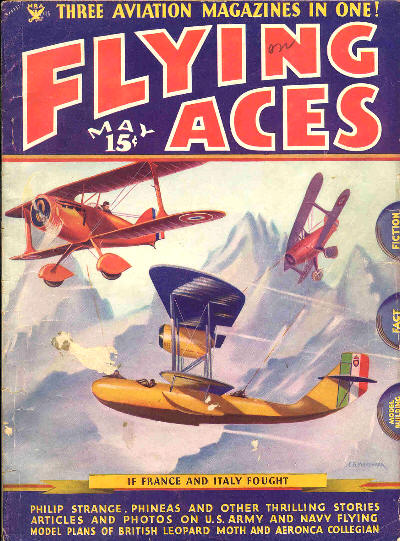
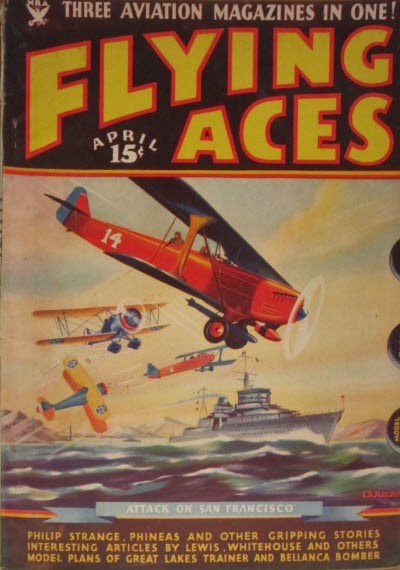
“Haw-w-w-w-w!” You heard right! That marvel from Boonetown, Iowa is back with a tale of starry-eyed colonels with visions of Hollywood and hidden german gun placements. Can that Knight of Calamity manage to find the Boche’s long-range guns while placating a colonel who thinks he’s the next Cecil B. DeMille all while avoiding landing in a dank cell in Blois? Find out in “Cinema Bums” from the pages of the May 1935 Flying Aces.

Can a Pinkham reform? A certain high and mighty Wing colonel thought so. But the Ninth shook in its shoes. For the Boonetown wonder’s eyes were entirely too friendly when they rested on the colonel—friendly like the eyes of a surgeon when he hovers over a guinea pig with a meat axe in his hand.

“The Hawker Demon” by Frederick Blakeslee

Link - Posted by David on December 28, 2015 @ 6:00 am in

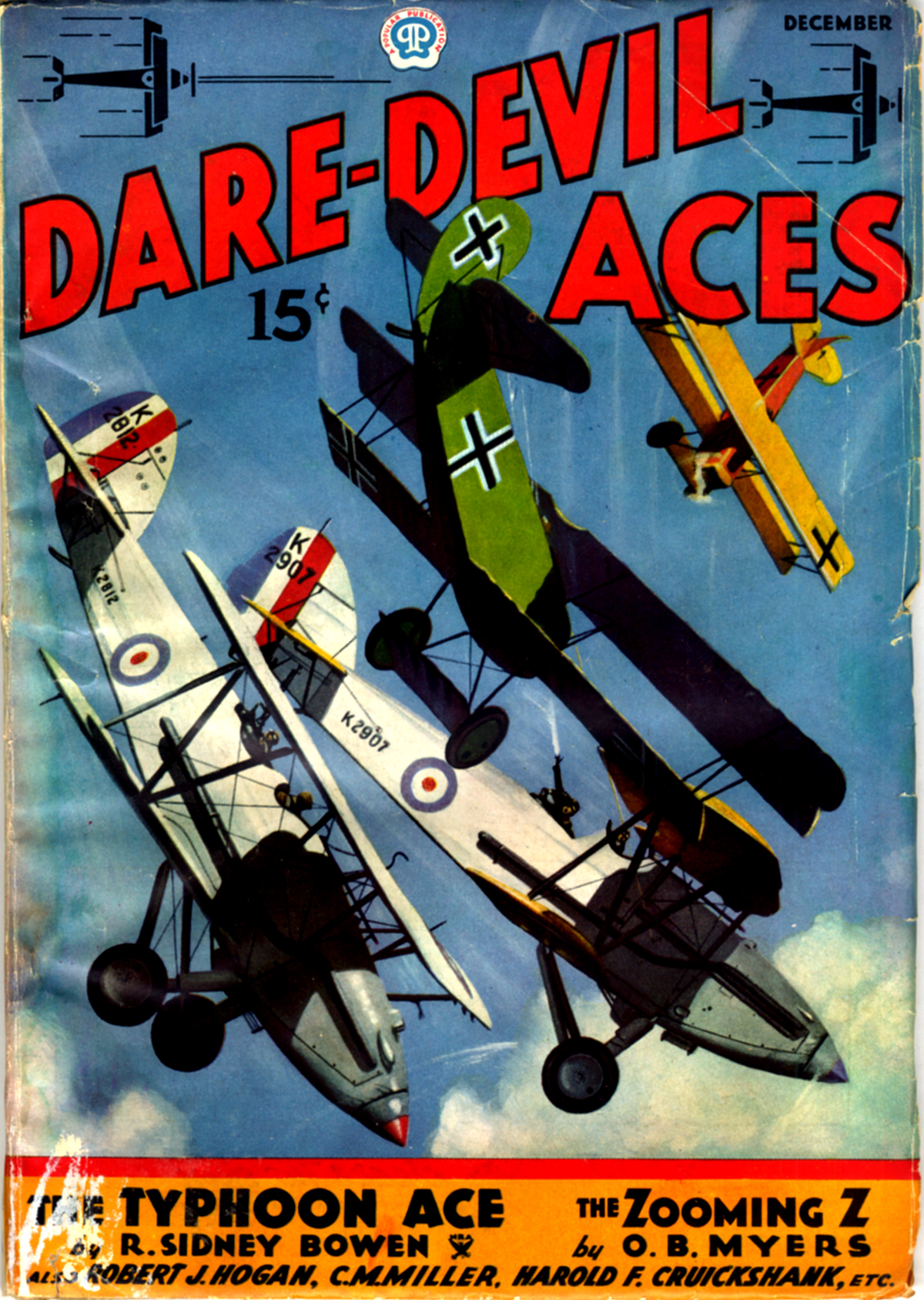
Frederick Blakeslee painted all the covers for the entire run of Dare-Devil Aces. And each of those covers had a story behind it. Last time Mr. Blakeslee gave us the first in a new series of mismatched time images with planes from the Great War along side present day planes from 1935! This time he returns with another in the series, from the cover of the December 1935 number of Dare-Devil Aces—where a Fokker DVII finds itself pitted against “The Hawker Demon!”

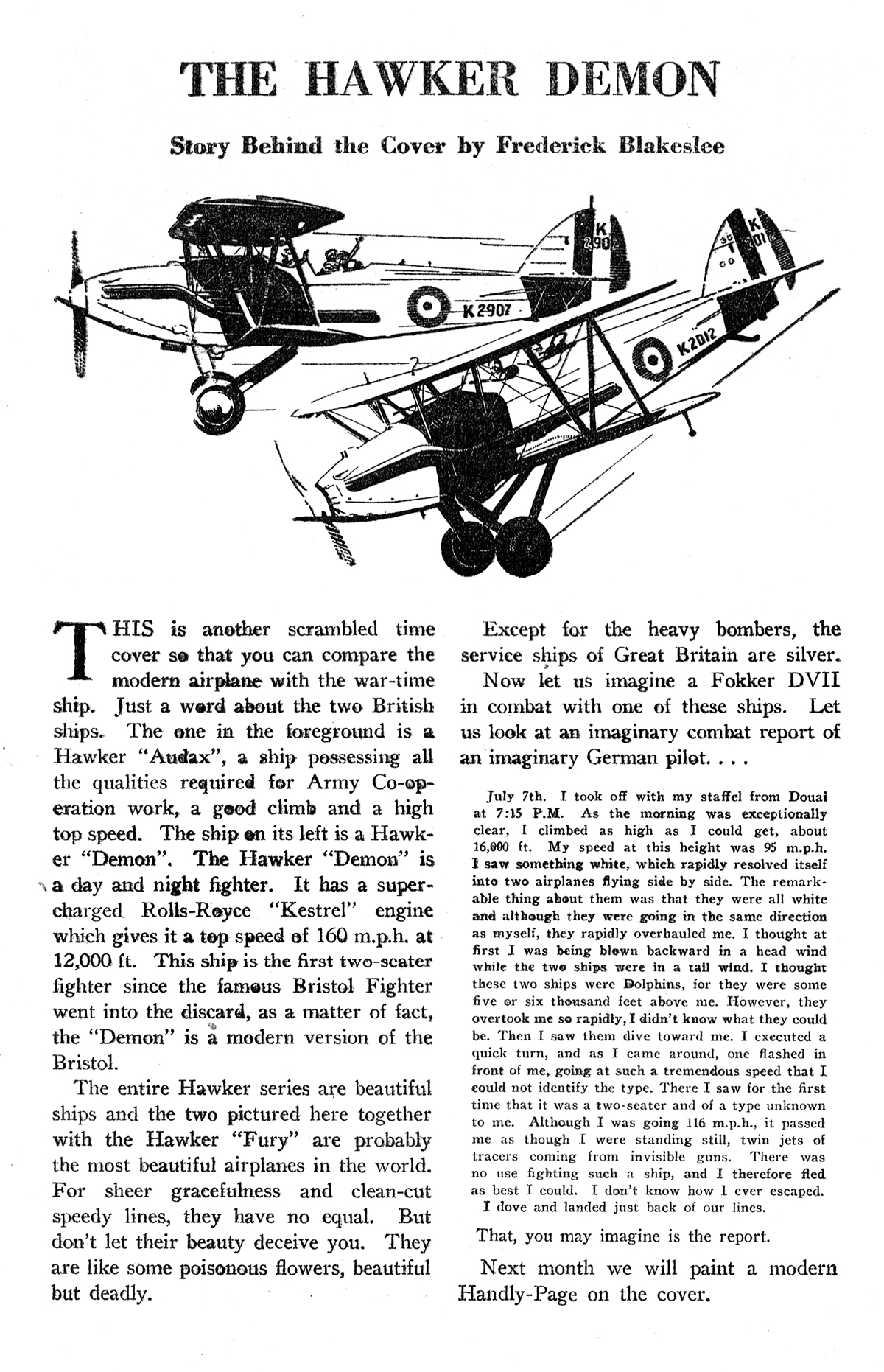
th_DDA_3512THIS is another scrambled time cover so that you can compare the modern airplane with the war-time ship. Just a werd about the two British ships. The one in the foreground is a Hawker “Audax”, a ship possessing all the qualities required for Army Co-operation work, a good climb and a high top speed. The ship an its left is a Hawker “Demon”. The Hawker “Demon” is a day and night fighter. It has a supercharged Rolls-Royce “Kestrel” engine which gives it a top speed of 160 m.p.h. at 12,000 ft. This ship is the first two-scatcr fighter since the famous Bristol Fighter went into the discard, as a matter of fact, the “Demon” is a modern version of the Bristol.

The entire Hawker series are beautiful ships and the two pictured here together with the Hawker “Fury” are probably the most beautiful airplanes in the world. For sheer gracefulness and clean-cut speedy lines, they have no equal. But don’t let their beauty deceive you. They are like some poisonous flowers, beautiful but deadly.

Except for the heavy bombers, the service ships of Great Britain are silver.

Now let us imagine a Fokker DVII in combat with one of these ships. Let us look at an imaginary combat report of an imaginary German pilot. . . .

  July 7th. I took off with my staffel from Douai at 7:15 P.M. As the morning was exceptionally clear, I climbed as high as I could get, about 16,000 ft. My speed at this height was 95 m.p.h. I saw something white, which rapidly resolved itself into two airplanes flying side by side. The remarkable thing about them was that they were all white and although they were going in the same direction as myself, they rapidly overhauled me. I thought at first I was being blown backward in a head wind while the two ships were in a tail wind. I thought these two ships were Dolphins, for they were some five or six thousand feet above me. However, they overtook me so rapidly, I didn’t know what they could be. Then I saw them dive toward me. I executed a quick turn, and as I came around, one flashed in front of me, going at such a tremendous speed that I could not identify the type. There I saw for the first time that it was a two-seater and of a type unknown to me. Although I was going 116 m.p.h., it passed me as though I were standing still, twin jets of tracers coming from invisible guns. There was no use fighting such a ship, and I therefore fled as best I could. I don’t know how I ever escaped.
  I dove and landed just back of our lines.

That, you may imagine is the report.

The Story Behind The Cover
“The Hawker Demon: The Story Behind The Cover” by Frederick Blakeslee
(December 1935, Dare-Devil Aces)

Next month we will paint a modern Handly-Page on the cover.

“The Sopwith Salamander” by Robert H. Rankin

Link - Posted by David on December 14, 2015 @ 6:00 am in

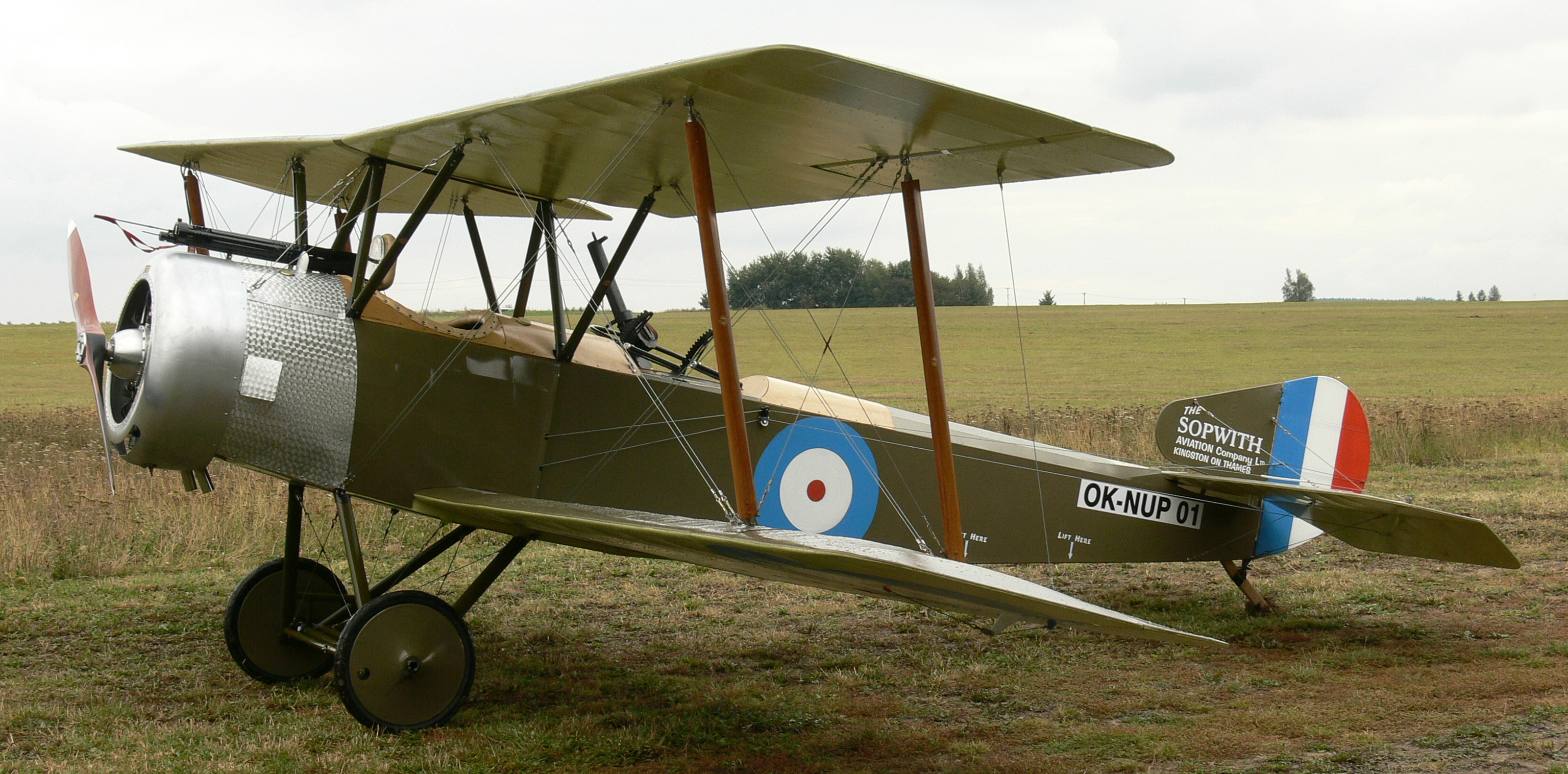
Frederick Blakeslee painted all the covers for the entire run of Dare-Devil Aces. And each of those covers had a story behind it. Although this looks like it should be in his new series of scrambled time covers, instead we get Robert H. Rankin, formerly a draughtsman for Fokker Aircraft Corp, telling the story of the last of the Sopwith war-time machines—The Sopwith Salamander—from the cover of the November 1935 number of Dare-Devil Aces!
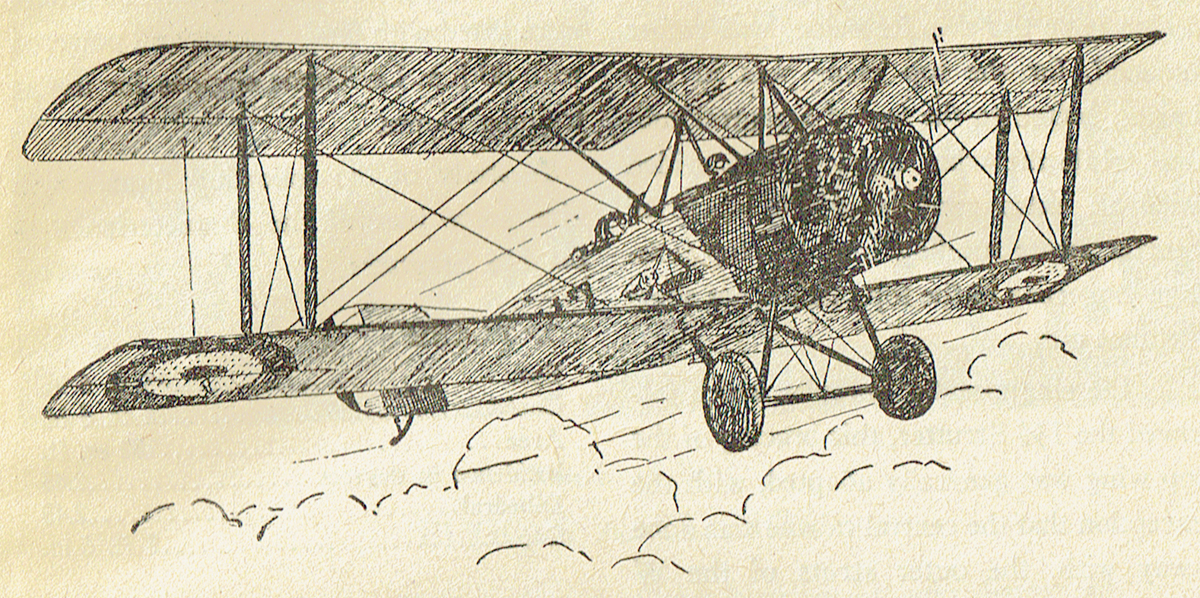
th_DDA_3511THE SALAMANDER, the last of the Sopwith war-time machines, was one of the most interesting and efficient types used in the World War. Although the design of the Salamander followed that of the earlier developed Sopwith Snipe, the plane was not intended for use as a scout or fighter—as were the Camel, Pup, Dolphin, and Snipe. It was designed primarily as a trench fighter, and in official circles it was known as the T.F.2.

The rudder of the Salamander was larger than those on the majority of the Sopwith designs. The pilot’s head, owing to the extremely deep fuselage and comparatively small wing gap, was on a level with the top plane, the center of which was partly slotted and partly cut away, to insure a better vision.

Due to the rather large diameter of the engine used, a B.R.2., the rectangularity of the fuselage was apparent toward the tail only, with the result that the fuselage was of a more circular cross-section than was the case in the other Sopwith ships.

Perhaps the mast interesting feature of the Salamander was the manner in which it was armored. Light steel plating formed the front of the fuselage from a point immediately in the rear of the engine, and extended to a point slightly to the rear of the cockpit. This armor, instead of being added to an existing fuselage frame, was a definite structual part of the frame work, and in itself formed the front portion of the fuselage. Thus, the armor plating served a structual, as well as a protective function.

Another variation from the usual Sopwith designs was incorporated in a tapering spine which served to taper off the pilot’s head and at the same time act as a head rest. This spine, being bulletproof, gave the pilot considerable protection against a rear attack.

The total weight of the armor in the Salamander totaled to some 650 pounds, and in addition to this weight, more than 2,000 rounds of ammunition was carried. In all, the ship weighed 2,945 pounds, as compared to the 1,959 pounds of the Dolphin, which was considered a rather heavy plane.

The following figures will give some idea of the performance and construction of the Salamander:


GENERAL SPECIFICATIONS
    Type Tractor Bi-plane
    Purpose Trench fighter
    Engine B.R.2, 230 h.p.
    Weights
        Loaded 2,945 lbs.
        Empty 1,844 lbs.
 
PERFORMANCE
    Speed (High—at 6,500 ft.) 123 m.p.h.
              (High—at 10,000 ft.) 117 m.p.h.
    Climb 10,000 ft. in 17 min.
    Landing speed 60 m.p.h.
    Ceiling 14,000 ft.
 
DIMENSIONS
    Length, over all 19 ft. 6 in.
    Stagger 1 ft. 5 in.
    Sweepback None
    Top Wing
        Span 31 ft 2⅝ in.
        Chord 5 ft.
        Area, not including ailerons 139 sq.ft.
        Incidence 1.8 deg.
        Dihedral 4.0 deg.
    Bottom Wing
        Span 30 ft. 2½ in.
        Chord 5 ft.
        Area, not including ailerons 123 sq.ft.
        Incidence 1.8 deg.
        Dihedral 4.0 deg.
 
AREAS
    Total wing area, not including ailerons
    Total wing, not inch ailerons 272 sq. ft.
    Tailplane 15 sq. ft.
    Elevators 11 sq. ft.
    Fin 2.75 sq. ft.
    Rudder 9 sq. ft.
    Total aileron area 51 sq. ft.


With the weights carried, the machine had a loading of 11 pounds per horse power, or 9.4 pounds per square foot.

As originally designed, the Salamander was armed with two fixed machine guns, but with its development into a general ground strafer, and later into a contact-patrol ship, the armament was increased, first to four guns, and later to six guns. In this later type there were two Lewis guns mounted on the top wing in such a manner that they could be easily drawn back and reloaded by the pilot from the cockpit.

Then, two Vickers were fixed on the top of the cowling, synchronized to fire through the propeller arc, while two Lewis guns, intended for trench strafing work were mounted on the bottom of the cockpit in such a way as to fire through the floor of the fuselage at an angle of about forty-five degrees.

The Salamander was passed by the experimental board of the Sopwith concern in April, 1918, but it was not until considerably later on in the year that the plane reached a production stage. Consequently few of them were in service over the lines.

In the short time that they were in action they showed such a performance record that it is quite probable, had the conflict lasted longer, the Salamander would have been one of the outstanding planes.

It is interesting to note, in connection with the Salamander, that the armored airplane has always been generally accepted as a logical step in the evolution of military planes by aeronautical engineers and designers. In actuality, however, there have been very few armored ships produced, and in fact, it was not until late in the war that any machines of the armored classification appeared.

For the most part, the greater number of the so-called armored planes produced were most inefficient, and in most instances the protective plating was added to the fuselage frame work of a regular pursuit or observation ship, with the result that the total weight of the machine was increased to a point where, powered with the engines then in use, they were sadly underpowered.

The Salamander, however, was designed from the first as an armored fighter, and inasmuch as the armor plating was made an integral part of the structural framework, the weight problem was done away with. This particular Sopwith offered a definite advance over the designs then in use, and it will be interesting to note in just what ways the modern armored pursuits will follow this pioneer model.

The Story Behind The Cover
“The Sopwith Salamander: The Story Behind The Cover” by Frederick Blakeslee
(November 1935, Dare-Devil Aces)


Introducing Your Friend—Joe Archibald

Link - Posted by David on December 7, 2015 @ 6:00 am in

Since we’re celebrating the man behind the mirthquakes this month, a little introduction is in order. Here is a brief bio that ran in the back of the September 1935 issue of Sky Birds as part of Magazine Publisher’s The M-P News Flash—a one page newsletter of sorts getting readers interested in and informed about what’s in the other titles they publish. The prolific Archibald ran stories in all their titles.

JOE ARCHIBALD is one of the veterans of the Magazine-Publishers group. Since its conception, the words he has pounded out are beyond computation. The short chunky little writer who is never seen without a cigar has had a diversified career to put it mildly. In 1917 be was selected as one of a small group from the Chicago Academy of Arts to draw pictures of mother earth from the air. Joe arrived at Kelly Field and was about to climb in a plane when a telegram arrived from his fond parents. He was under age and they clipped his wings! A year later he joined the Navy and chased up and down the New England coast looking for German subs. After the fuss was over he became a police reporter on the “Boston Telegram” and “Post.” Joe can also swing a pencil. He stopped haunting Beantown’s underworld and signed up to draw two or three features for the McClure Newspaper Syndicate. From there he went to the United Press to draw sport cartoons and write a column.

“The New York Graphic” drew Joe next. He claims to have been the pioneer in detective strips. But the yen to write fiction was strong and he quit newspaper work to devote his entire time to turning out flying, detective. western and adventure stories for WESTERN ACES—WESTERN TRAILS—TEN DETECTIVE ACES—FLYING ACES and SKY BIRDS.

The majority of his readers do not have to be told that Joe prefers to dish out humor more than anything else. He assures us that a man has to possess an abnormal funny bone to have been a hotel man, a wrestler, a bookkeeper, an artist, a writer and a newspaper reporter during a period of seventeen years. Life has not begun for Joe as yet. He’s nowhere near forty. There’s no telling what he’ll try his hand at next.

“The Yellow Monsters” by Frederick Blakeslee

Link - Posted by David on November 30, 2015 @ 6:00 am in

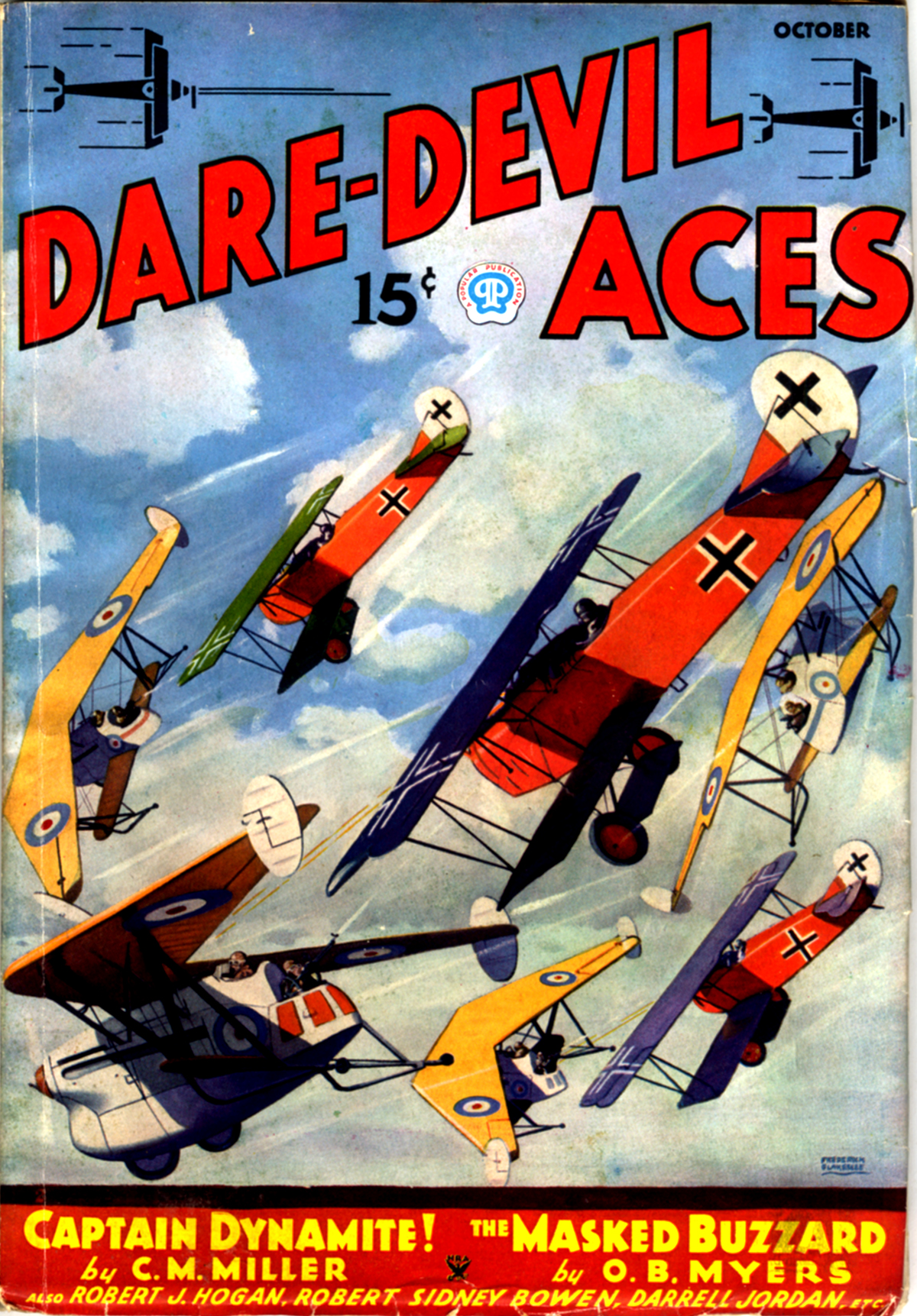
Frederick Blakeslee painted all the covers for the entire run of Dare-Devil Aces. And each of those covers had a story behind it. Last time Mr. Blakeslee gave us the first in a new series of mismatched time images with planes from the Great War along side present day planes from 1935! This time he returns with he second in the series, from the cover of the October 1935 number of Dare-Devil Aces—”The Yellow Monsters!”

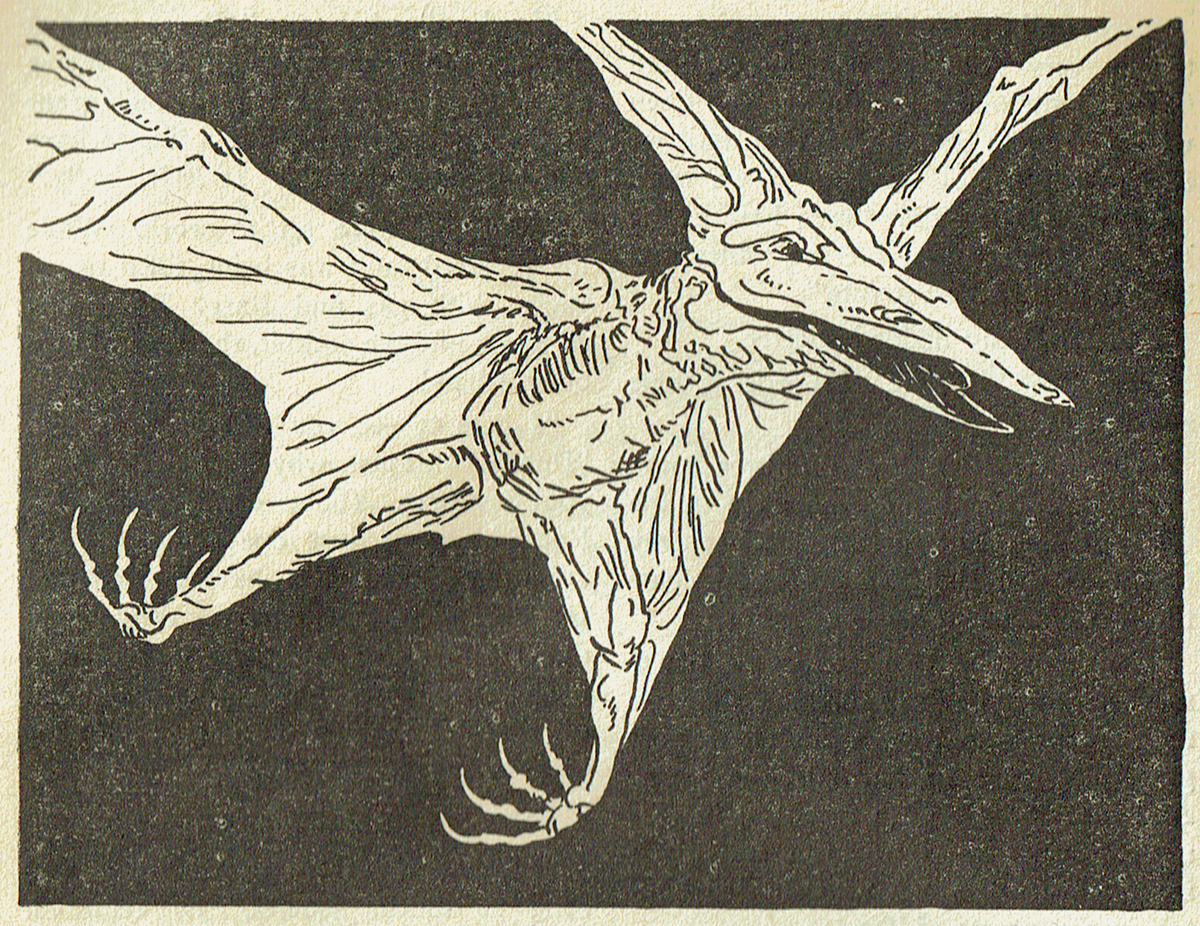
th_DDA_3510ABOVE is the drawing of a Pterodactyl, a pre-historic flying reptile that lived thousands of years ago. Today the Pterodactyl flies again, but this time it is man-made—in short, a modern fighting airplane. Before we go ahead with our story, let us explain why you find a modern ship in combat with a wartime airplane.

The World War is long past, yet many are still interested in the war-time ship; but an equal number are interested in the modern craft too. In thinking it over we wondered what a war-time pilot would do, had he in war days, met a ship of today. The problem was solved. Why not mix time? Take 1918 and 1935 and just scramble them?

The result certainly isn’t the World War, in fact it isn’t any war; it isn’t even real and not being real we can let our imagination roam. By scrambling time this way we can not only show you a war-time ship, but a modern one as well both on the same cover thus giving you an easy way of comparing the fighting ship of today with the fighting ship of yesterday.

So now, let us enter the realms of imagination. Let us see what Otto, a German pilot of 1918 would do had he met the Pterodactyl.

Otto was a crack pilot; he was leader of his staffel and was in the habit of going off on bis own occasionally to look for trouble. He was on one of these trips when he saw a speck way off on his right. Being over the French lines he guessed it was an Allied plane. His big Mercedes engine soon had him high above the other ship. As he crossed its path he looked down and saw the British insignia on the wing-tips. Something about the plane seemed queer, but not giving it a second thought he dove.

He suddenly pulled out of his dive and rubbed his eyes. He looked again. His first impression had been right after all. Something was definately queer about the British ship. Mein Gott, what was it? Was it an airplane? If so it was like nothing he had ever seen.

But he could see the flash of propellers and the crew—that was real anyway, so it must be an airplane. Dunner und blit-sen, what a crazy thing it was! Why it looked as though it would fall apart if a wind hit it. Where was the tail? Well, thought Otto, this will be cold turkey.

He was about to dive again when the strange ship put on a burst of speed. To Otto’s surprise he discovered that he had had his throttle wide open to keep up with the yellow monster.

Well it certainly could fly, he decided, as the Britisher pulled rapidly away from him. Then he saw several others of the strange ships join the first and turn toward him. Otto thought he better return to his drome and get help.

Otto assembled his pilots and recounted what he had seen. The assembled pilots looked at each other but said nothing. Otto was their superior officer so what could they say? A tailless ship indeed, bosh!

Otto led his staffel back and soon spotted the strange ships.

He made a wide circle and gave the signal to dive. The scene on the cover shows the beginning of the fight.

Here we might consider what chance Otto and his men flying Fokker DVII’s would have against the Pterodactyl. We do not hesitate to say that they don’t stand a ghost of a chance.

At the time of writing this, no data on the performance of the Pterodactyl is available. The speed is very high; the exact figure we do not know. Note the wonderful unobstructed field of fire of the rear gunner. It would be impossible for an attacker to hide under the tail. It can deliver a steady stream of lead from its fixed guns and as it dives on an enemy another dose from the free gun as it zooms away. The rear gunner by the way is fully protected from the wind. The pilot can look either under or over the center section too.

Some think that the Pterodactyl may prove to be the most formidable fighter yet produced. Others wonder if it will not become extinct as the bird-lizard from which the new ship gets its name.

The Story Behind The Cover
“The Yellow Monsters: The Story Behind The Cover” by Frederick Blakeslee
(October 1935, Dare-Devil Aces)

The Pterodactyl is manufactured by Westland Aircraft Co., England, and was first produced last year.

 BBAA_3501
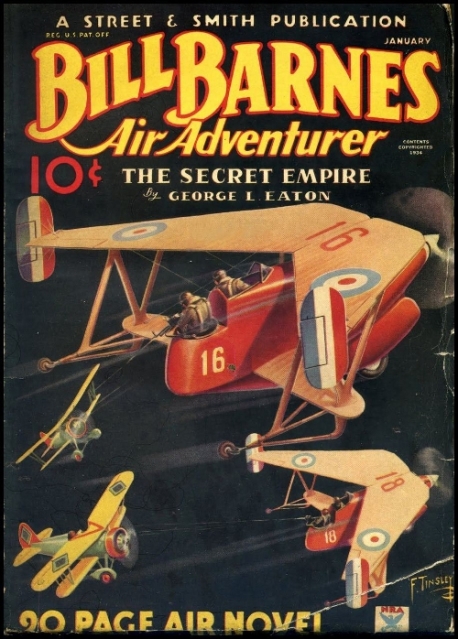
Editor’s Note: The Westland Pterodactyl was featured much more prominently earlier in 1935 on the January cover of Street & Smith’s Bill Barnes Air Adventurer. Here Frank Tinsley has place the Pterodactyl front and center with the tailless tailgunner blasting away at the pursuing biplanes!

“Geese Monkeys” by Joe Archibald

Link - Posted by David on November 27, 2015 @ 6:00 am in

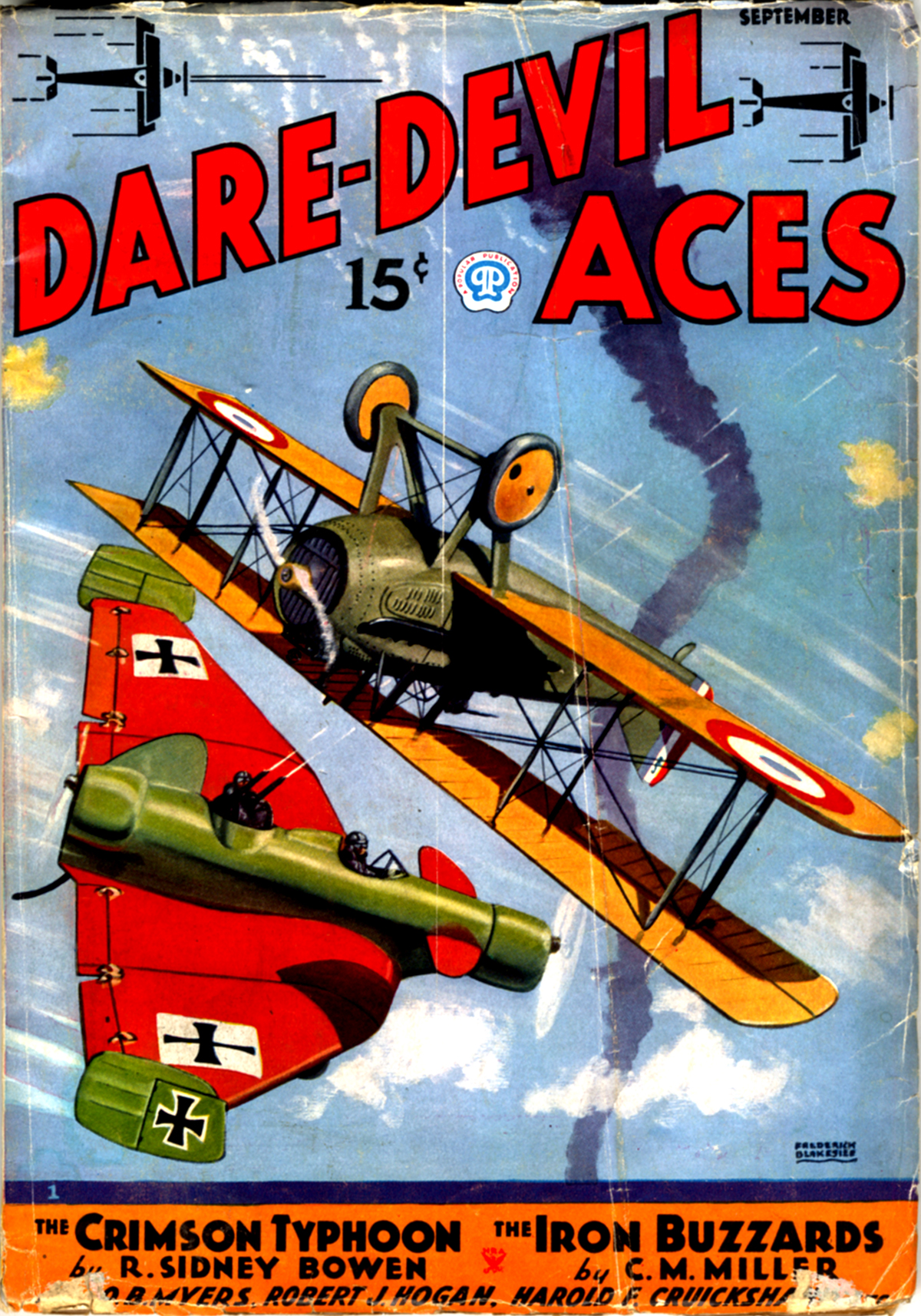
“Haw-w-w-w-w!” You heard right! That marvel from Boonetown, Iowa is back and in hotter water than usual, but as is the case—what’s sauce for the goose is gravy for Phineas!
Trouble had been coming to Phineas in bunches, like bananas. At last, the Ninth Pursuit thought they had got him down. But don’t let that fool you. A Pinkham at bay is worse than an army of leopards with brass knuckles.

“The Solo Skipper” by Harold F. Cruickshank

Link - Posted by David on November 20, 2015 @ 6:00 am in

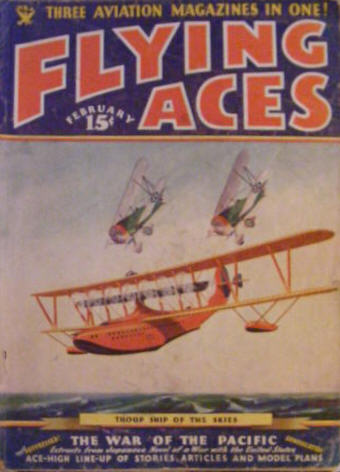
This week we have a story by another of our favorite authors—Harold F. Cruickshank! Cruickshank is popular in these parts for the thrilling exploits of The Sky Devil from the pages of Dare-Devil Aces, as well as those of The Sky Wolf in Battle Aces and The Red Eagle in Battle Birds. He wrote innumerable stories of war both on the ground and in the air. Here we have a tale of “Mud” Collier, a flyer who likes to go it alone and is as comfortable in the trenches where he started out as he is in the air. From the February 1935 Flying Aces we bring you “The Solo Skipper”—
His own squadron called him “Mud” because he spent his leave up front with the infantry and his air hours patrolling their death-infested forward zone to protect them. But to those doughboys who every day defied the fury of the enemy barrage—his name was not mud.

“The Tailless Ship” By Frederick Blakeslee

Link - Posted by David on November 16, 2015 @ 6:00 am in

Frederick Blakeslee painted all the covers for the entire run of Dare-Devil Aces. And each of those covers had a story behind it. This time Mr. Blakeslee gives the first in a new series of mismatched time images with planes from the Great War along side present day planes from 1935! Without further Ado, Mr. Blakeslee gives us the story of “The Tailless Ship!”

th_DDA_3509AFTER looking at the cover this month you have probably turned to this story quickly to find out what it is all about. You probably think you have missed something in German war-time ships. But you haven’t. Its this way.

Recently we were wondering what a war-time pilot would think and do, had he, in 1918, met a ship of today. So we took 1918 and 1935, mixed them thoroughly and what have we? Well, the result certainly isn’t the World War. As a matter of fact it isn’t any war. It isn’t even real, and that is just the result we were after. Not being real we can let our imaginations roam. Therefore, this cover is No. 1 of a brand-new series. To
keep them in order we will number them. You will find the number in the lower left-hand corner on the blue band.

Now let us suppose that a French pilot, in 1918 meets a ship of 1935. This opens a fascinating field. We can keep abreast with the very latest in modern fighting aircraft design on these covers as well as present the war-time ship. And more, you will then have an easy way of comparing the fighting ship of today with the fighting ship of yesterday.

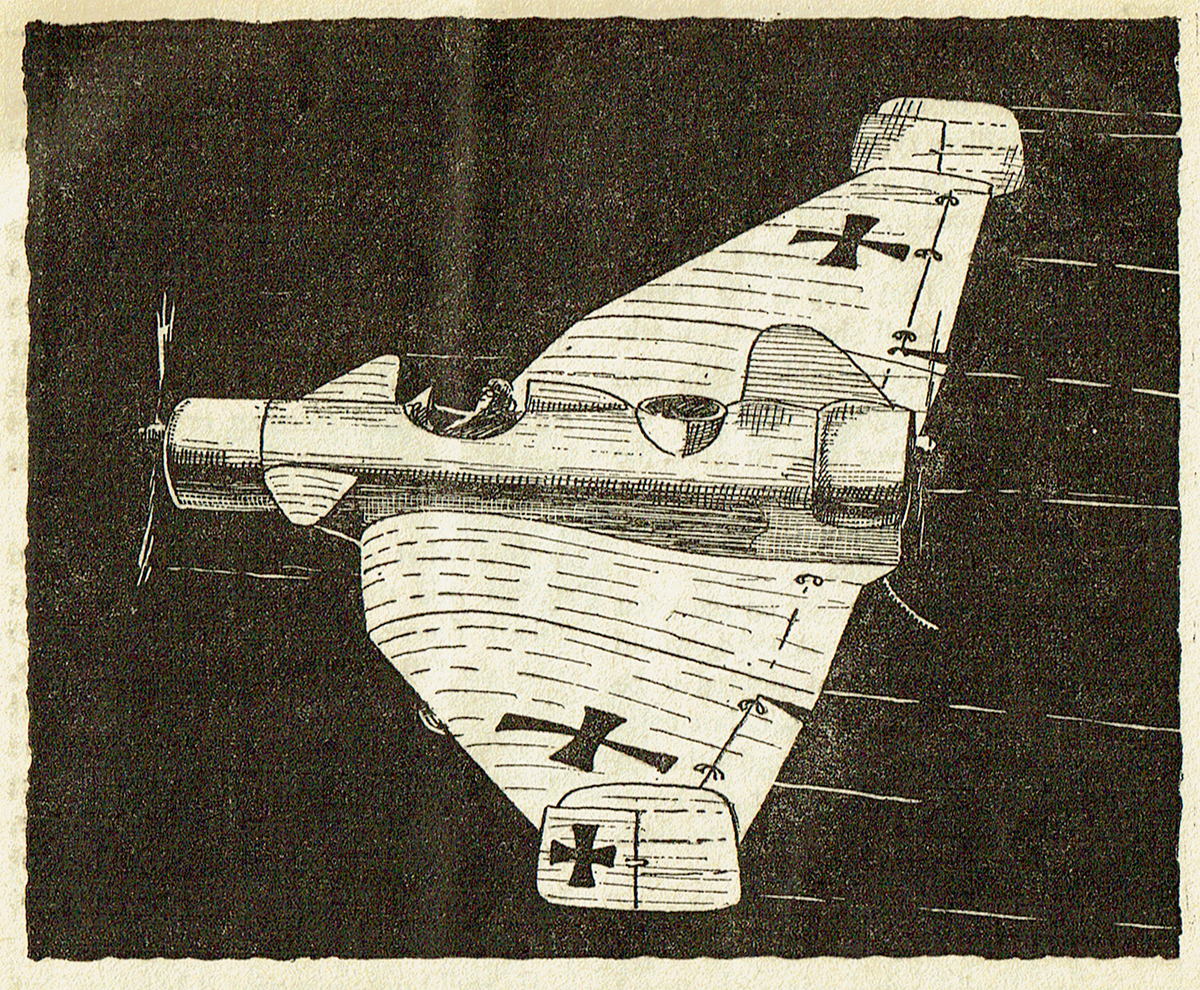
To start off, we have selected a tailless ship. It is not strictly speaking, a fighter. It was designed by a young German inventor in 1933 and he startled the aeronautical world by actually flying it.

It was, therefore, the forerunner of the modern tailless type. Designers seized on the tailless idea and a recent ship of this type, produced by Great Britain, may prove to be the most formidable fighting craft yet made. That ship is the Pterodactyl, which we shall show next month.

As we said above, the tailless ship was not designed as a fighter. But for the purposes of this cover and to give the Spad a break, we have made it into a fighter by merely making the passenger cockpit into a gun nacelle.

Granted it is a fighter, let us see what Pierre, our French pilot of 1918, would think of it. When he first sighted it he probably thought it was a bat, but as it approached and grew in size, and although it still looked to him like a bat, he knew it for what it was, for he caught the flash of propellers.

And then he sat fascinated as the strange ship circled him. His eyes told him it zvas an airplane, but his mind refused to accept it as such. He probably said to himself, in French of course, “There ain’t no such animal, there couldn’t be! Why, it hasn’t even got a tail and where the tail should be is a propeller! There’s a propeller at the bow too. Good grief, it’s a pusher and a tractor at the same time, impossible! And what are those green things at the end of the wings, if they are wings?”

Just then the bat-like ship banked. “Are they rudders? How could rudders be there? No, I’m seeing things, no more cognac for me!”

Of course we must assume all this went through Pierre’s head in a flash. As the ship banked, Pierre was startled to see smoking white tracers flash past. He then saw what had escaped him at first, the bat ship carried German crosses. Pierre looped and although he didn’t think the thing was really there, went to work.

Now what chance would Pierre have against this ship? A very good chance indeed. Pierre, with his 300 h.p. Hispano could do 130 m.p.h. on the straight-away. The tailless ship with only 150 h.p. could do 160, no use trying to run for it. Maybe he could out-climb it? No, the German could climb a thousand feet a minute. Well maybe he could out-dive it? Not that either, the German ship could dive like a bat out of hell.

He could out-maneuver it however, but what good would that do? The gunner had an unrestricted field of fire, back, ahead, up and to the sides. Well, maybe the thing has a blind spot. Ah! There we have him; underneath Pierre was as safe as a church. Now just tip up and let him have it.

Yes, we’re sure Pierre would win this fight, but next month the tailless ship tells a different story.

The Story Behind The Cover
“The Tailless Ship: The Story Behind The Cover” by Frederick Blakeslee
(September 1935, Dare-Devil Aces)

“Aces and Boses” by C.M. Miller

Link - Posted by David on November 6, 2015 @ 6:00 am in

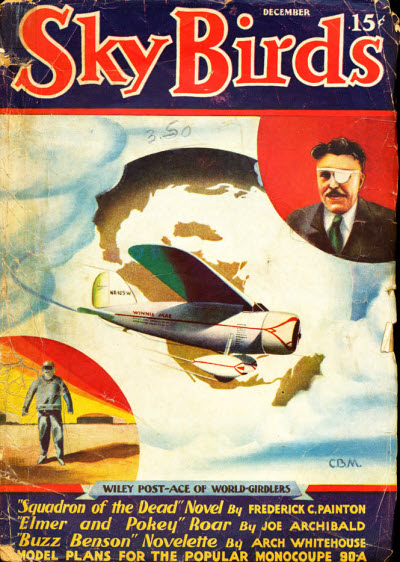
This week we have a story by C.M. Miller, author of Chinese Brady: The Complete Adventures! A short story of a green recruit who challenges his commanding officer’s orders in a way that yields surprising results! From the December 1935 number of Sky Birds, it’s C.M. Miller’s “Aces and Bosses”—

No Vandyke-bearded, college-prof cadet was going to tell Bull McGrady which way his propeller was turning—for Bull was head man of the Peppermints, and no mistake! “Those whiskers,” he told the tall newcomer, “will have to come off!” And they finally did—but not the way Bull expected . . . .

“The Green Death” by Frederick Blakeslee

Link - Posted by David on October 5, 2015 @ 6:00 am in

Frederick Blakeslee painted all the covers for the entire run of Dare-Devil Aces. And each of those covers had a story behind it. This time, we have Mr. Blakeslee’s cover for the August 1935 number on which he depicts the story of The Green Death!

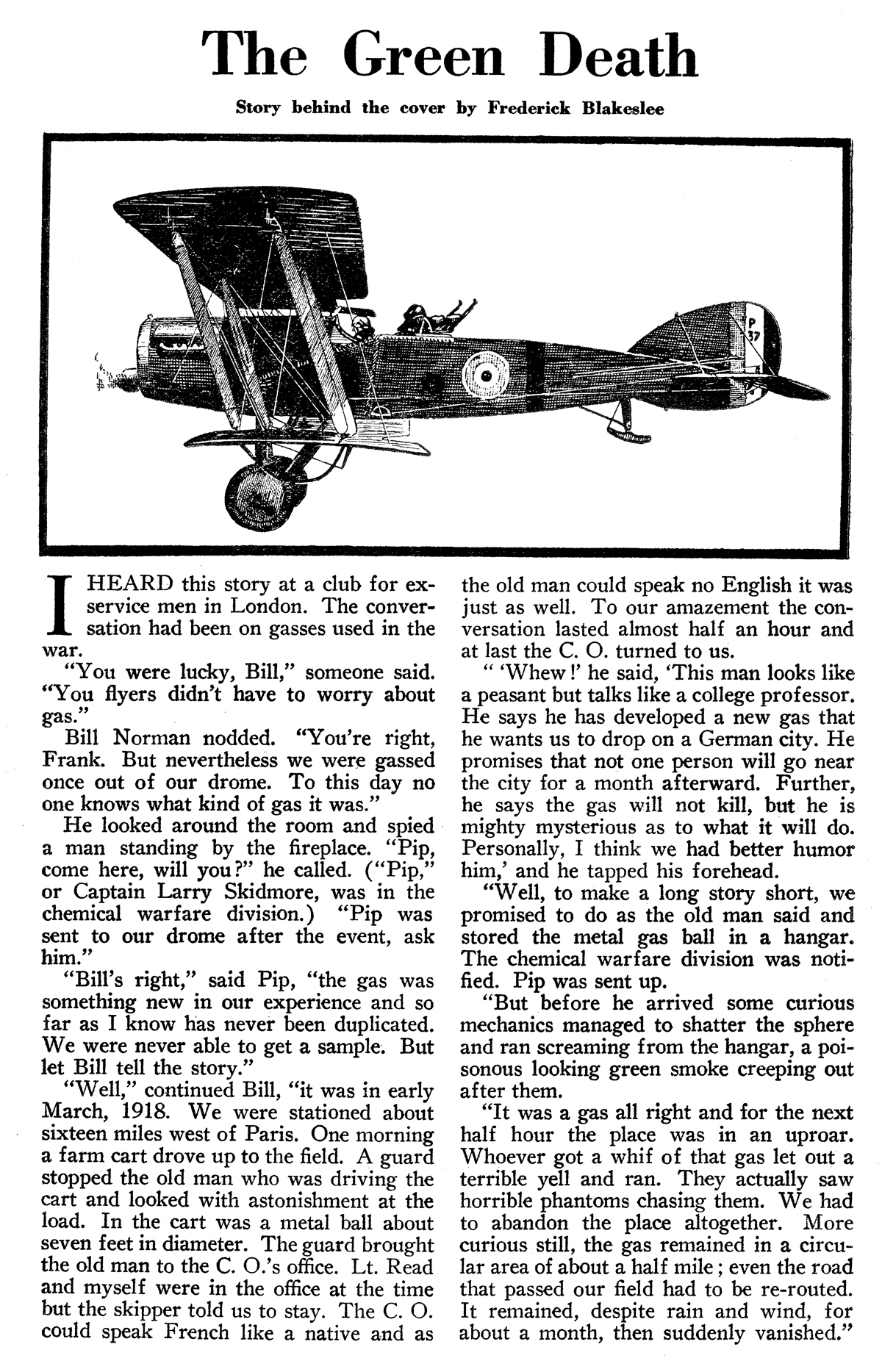
th_DDA_3508I HEARD this story at a club for ex-service men in London. The conversation had been on gasses used in the war.

“You were lucky, Bill,” someone said. “You flyers didn’t have to worry about gas.”

Bill Norman nodded. “You’re right, Frank. But nevertheless we were gassed once out of our drome. To this day no one knows what kind of gas it was.”

He looked around the room and spied a man standing by the fireplace. “Pip, come here, will you?” he called. (”Pip,” or Captain Larry Skidmore, was in the chemical warfare division.) “Pip was sent to our drome after the event, ask him.”

“Bill’s right,” said Pip, “the gas was something new in our experience and so far as I know has never been duplicated. We were never able to get a sample. But let Bill tell the story.”

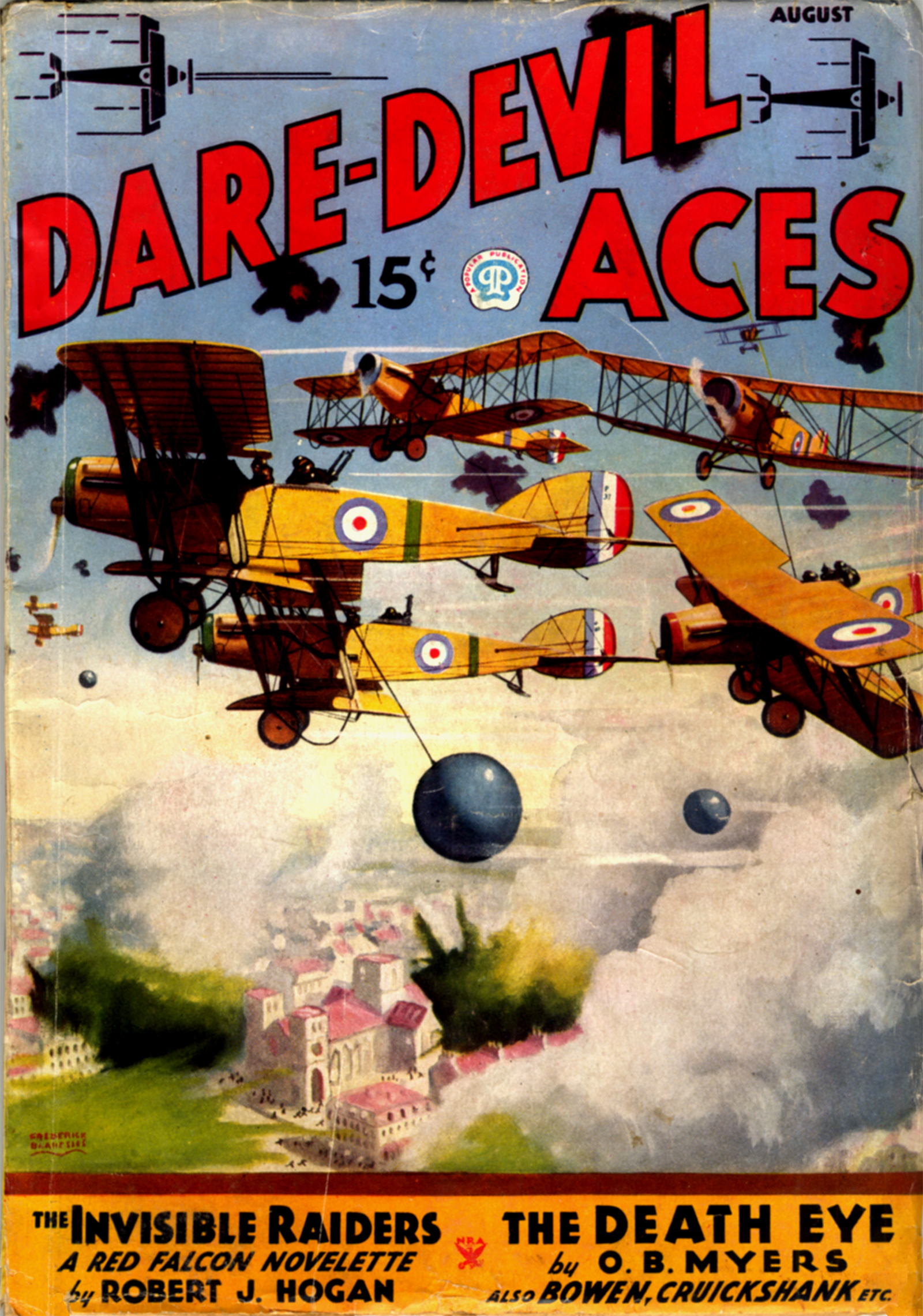
“Well,” continued Bill, “it was in early March, 1918. We were stationed about sixteen miles west of Paris. One morning a farm cart drove up to the field. A guard stopped the old man who was driving the cart and looked with astonishment at the load. In the cart was a metal ball about seven feet in diameter. The guard brought the old man to the C.O.’s office. Lt. Read and myself were in the office at the time but the skipper told us to stay. The C.O. could speak French like a native and as the old man could speak no English it was just as well. To our amazement the conversation lasted almost half an hour and at last the C.O. turned to us.

” ‘Whew!’ he said, ‘This man looks like a peasant but talks like a college professor. He says he has developed a new gas that he wants us to drop on a German city. He promises that not one person will go near the city for a month afterward. Further, he says the gas will not kill, but he is mighty mysterious as to what it will do. Personally, I think we had better humor him,’ and he tapped his forehead.

“Well, to make a long story short, we promised to do as the old man said and stored the metal gas ball in a hangar. The chemical warfare division was notified. Pip was sent up.

“But before he arrived some curious mechanics managed to shatter the sphere and ran screaming from the hangar, a poisonous looking green smoke creeping out after them.

“It was a gas all right and for the next half hour the place was in an uproar. Whoever got a whif of that gas let out a terrible yell and ran. They actually saw horrible phantoms chasing them. We had to abandon the place altogether. More curious still, the gas remained in a circular area of about a half mile; even the road that passed our field had to be re-routed. It remained, despite rain and wind, for about a month, then suddenly vanished.”

The Story Behind The Cover
“The Green Death” by Frederick Blakeslee (August 1935, Dare-Devil Aces)

“The Sopwith Triplane” by Robert H. Rankin

Link - Posted by David on September 28, 2015 @ 6:00 am in

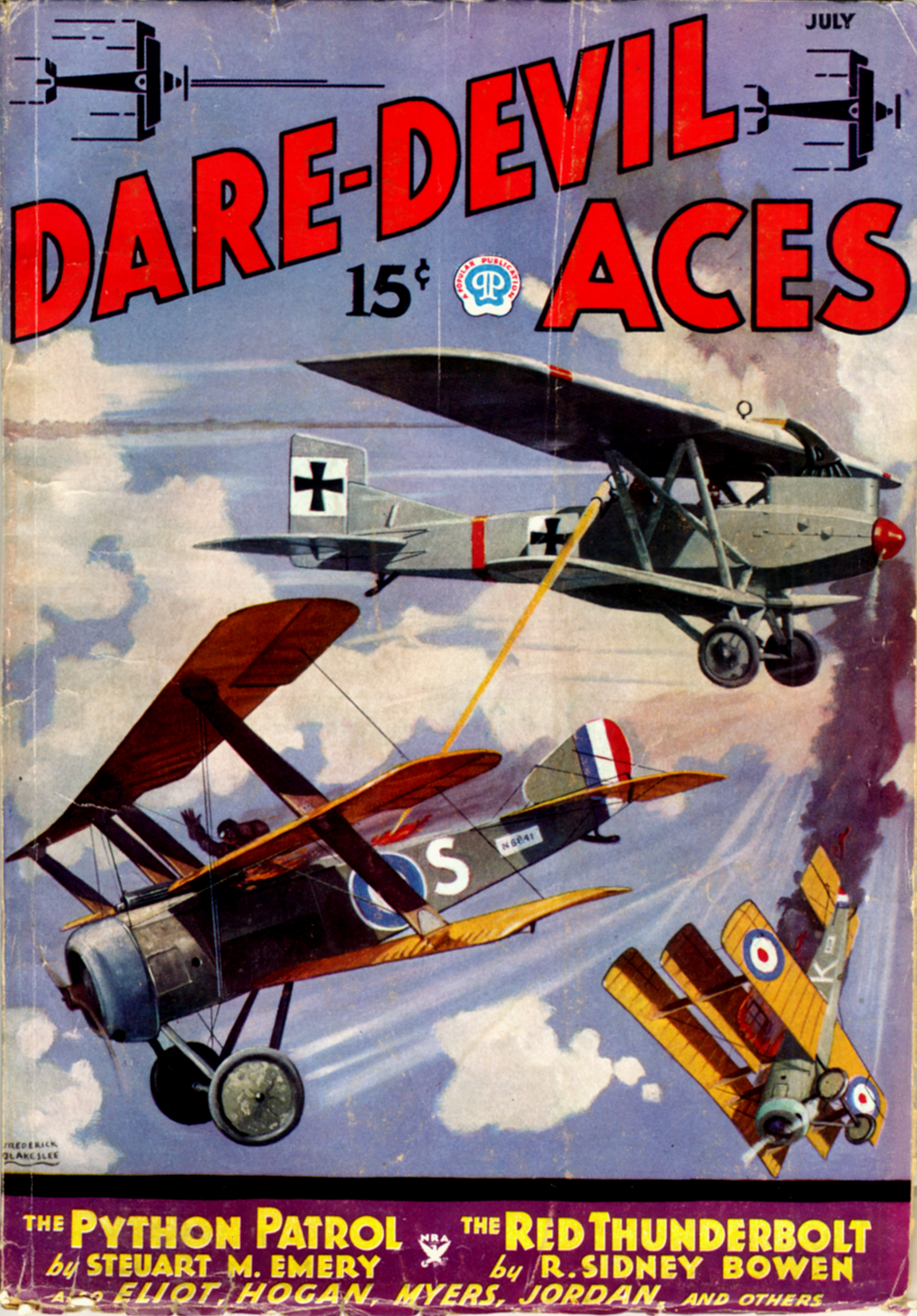
Frederick Blakeslee painted all the covers for the entire run of Dare-Devil Aces. And each of those covers had a story behind it. This time, we have more of the approach he used for the covers he painted for Battle Aces—telling us about the ship on cover. But, instead of Mr Blakeslee telling us about the ship on the cover, we have Mr. Robert H. Rankin, formerly a draughtsman for the Fokker Aircraft Corp telling the story of the Sopwith Triplane—featured on the cover of the July 1935 cover of Dare-Devil Aces. . . .

th_DDA_3507Editor’s Note: This month’s cover shows what would happen if a certain invention, had been perfected during the War. The rear-pit man in the all metal Junkers is operating a huge, highly magnified tense, so constructed as to concentrate a powerful percentage of the sun’s rays. When focused on the fabric covering of an airplane, this sunlight beam would cause a tiny burn. It is based on the same principle as that of lighting a fire by focusing sunlight on a small glass dial. The Allied ships on the cover are Sopwith triplanes.

The Sopwith Triplane
By ROBERT H. RANKIN
Formerly draughtsman, Fokker Aircraft Corporation

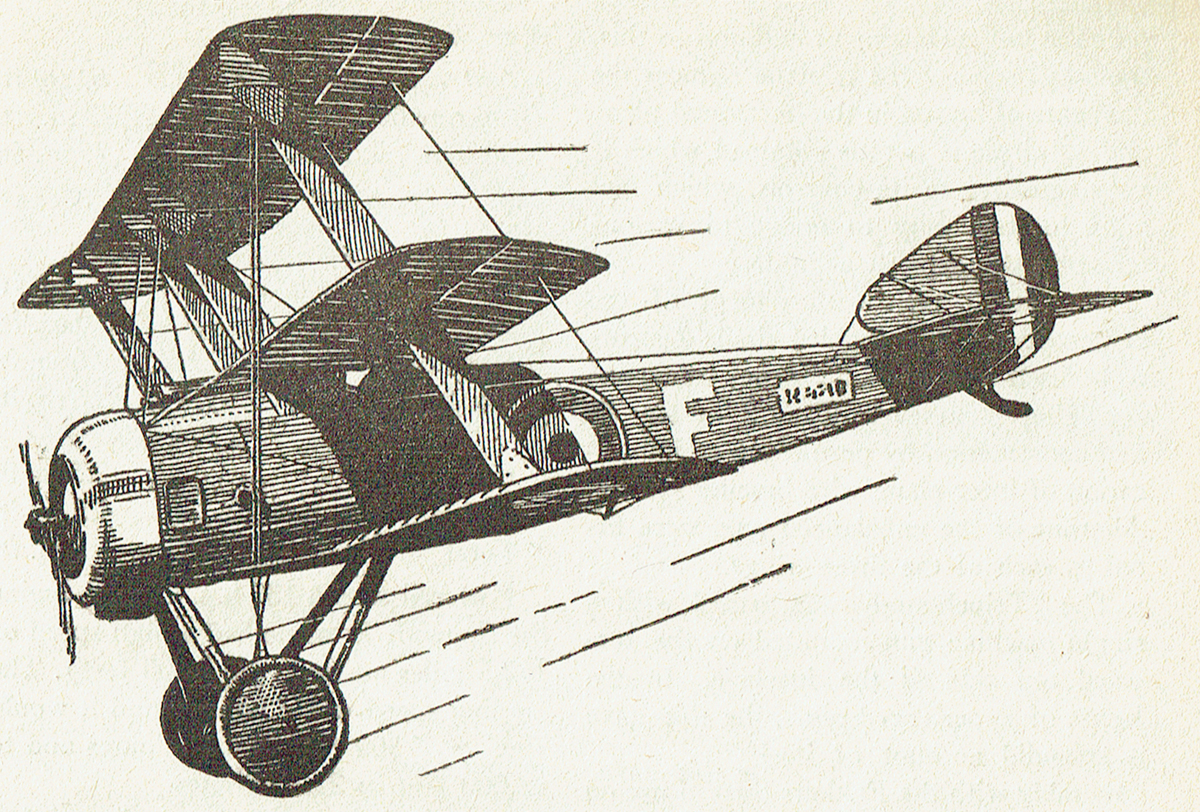
OF THE various Sopwith planes, all of which attained great fame, none is more interesting and characteristic than the Triplane—or as it was better known by the German and British pursuit pilots, the “Tripe” or “Tripe-hound.”

The Triplane was the ninth type produced by the Sopwith works, being accepted by the Experimental Board about four months after the Sopwith Pup. The principal object aimed at in the design of the Triplane was the attainment of an extra high degree of visibility, or in other words, the reduction to minimum of the pilot’s blind angle.

With his eyes on a level with the intermediate plane the pilot had practically an junrestricted arc of vision through some 120 degrees, while a section cut out of the intermediate wing enabled him to have a rather good view of the ground while landing the ship, the position of the cockpit being such that the bottom wing had no restricting effect on the vision.

The narrowness of the chord made possible by the use of three main planes also enabled the pilot to have an exceptional view upward and to either side—a most important consideration in any pursuit ship. Another object aimed at in the “Tripehound” was an increase in maneuverbility.

It will be seen that due to the narrow; chord the shifts in the center of pressure with varying angles of incidence is smaller than in a biplane, and consequently a much shorter fuselage can be used to suport the tail surfaces. In addition to this, the small span of the triplane reduces the moments of inertia in the horizontal plane and an airplane is thus obtained which is very sensitive to its controls, which fact adds to its ability to dodge to various strategic positions in a fight.

The factor of the movement of the center of pressure enabled single I-struts to be used instead of the usual pairs, one springing from each spar. This simplified construction by permitting a simplification of inter-plane wire bracing system. Ailerons of the unbalanced type were fitted to each of the three wings.

The “Tripehound” was armed with a single machine gun mounted on the forward top side of the fuselage. In the hands of experienced pilots the ship gave a splendid account of itself and coped favorably with the Fokkers then in use on the Western Front.

The dimensions of the Triplane follow:

Sweepback None
Stagger 1 ft. 6 in.
Dihedral (same for each wing) 2.5 degrees
Total wing area 231 sq.ft.
Length over all 18 ft. 10 in.
Overall span 26 ft. 6 in.
Wing span (same for each wing) 26 ft. 6 in.
Chord (same for each wing) 3 ft. 3in.
Wing areas—
    Top 84 sq. ft.
    Intermediate 72 sq. ft.
    Bottom 75 sq. ft.
    Gap 3 ft.
Areas—
    Aileron 34 sq. ft.
    Tail plane 14.0 sq. ft.
    Elevators 9.6 sq. ft.
    Total 23.6 sq.ft.
    Fin 2.5 sq. ft.
    Rudder 4.5 sq. ft.
    Total 6.5 sq. ft.


Powered with a 130 h.p. Clerget engine the Sopwith Triplane had a high speed of 112.5 miles an hour (at 6,500 feet). The landing speed was 35 m.p.h. and it would climb to 6,500 feet in 6.5 minutes and to 15,000 feet in 22.3 minutes.

The plane had a fuel capacity of 180 pounds and a flight range of 310 miles. The ceiling was 20,500 feet. The “Tripehound” weighed 1,103 pounds empty and 1,543 pounds loaded which made a loading of 6 pounds per square foot or 12.4 pounds per horse power.

Although judged by present standards the Triplane was low-powered and rather slow, its speed, ease of handling and general performance were outstanding at the time of its introduction into the Royal Flying Corps.

The Story Behind The Cover
“The Sopwith Triplane” by Frederick Blakeslee (July 1935, Dare-Devil Aces)

“Horse Flyers” by Joe Archibald

Link - Posted by David on September 25, 2015 @ 6:00 am in

“Haw-w-w-w-w!” That sound can only mean one thing—that Bachelor of Artifice, Knight of Calamity and an alumnus of Doctor Merlin’s Camelot College for Conjurors is back—Yes it’s the marvel from Boonetown, Iowa himself—Lieutenant Phineas Pinkham! It was a strange chain of circumstances that pulled Phineas Pinkham right out of France, towed him across the Channel, and finally deposited him in a very bucolic spot in Merrie England.
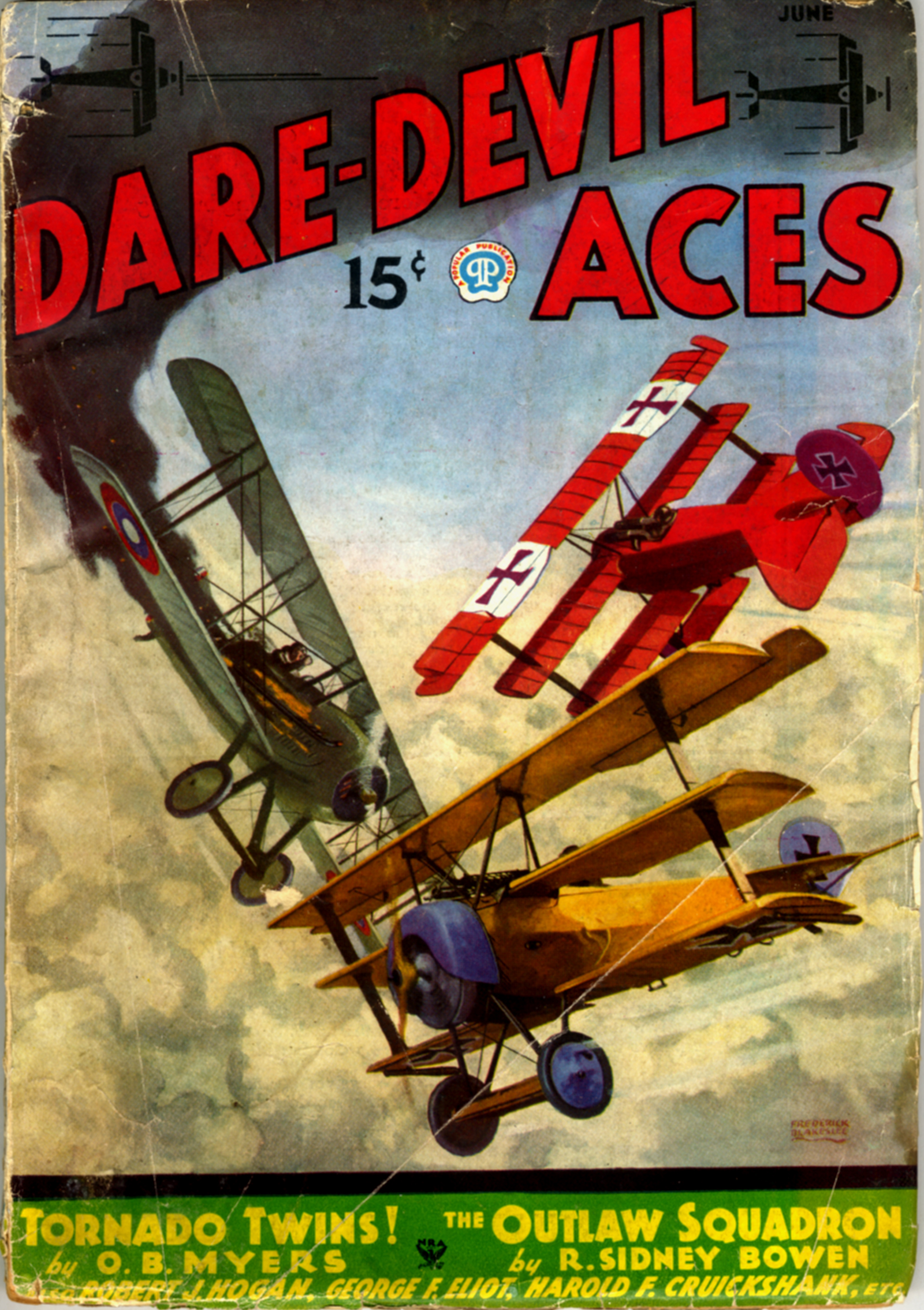
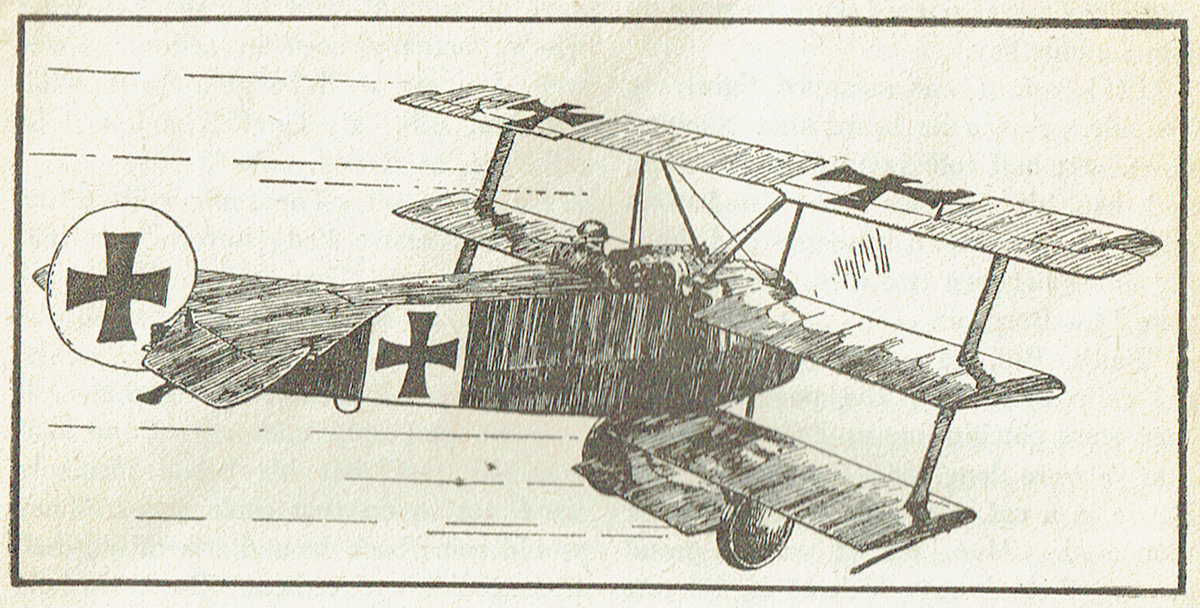
Yoicks! Tallyho and tantivy! Here is Phineas Carbuncle Pinkham riding to ‘ounds—believe it or not—in plane! But, as Phineas says, “It’s more fun to be the fox!”

“The Fokker Triplane” By Robert H. Rankin

Link - Posted by David on September 21, 2015 @ 6:00 am in

Frederick Blakeslee painted all the covers for the entire run of Dare-Devil Aces. And each of those covers had a story behind it. This time, we have more of the approach he used for the covers he painted for Battle Aces—telling us about the ship on cover. But, instead of Mr Blakeslee telling us about the ship on the cover, we have Mr. Robert H. Rankin, formerly a draughtsman for the Fokker Aircraft Corp telling the story of the most recognized plane of the era—the Fokker Triplane—featured on the cover of the June 1935 cover of Dare-Devil Aces. . . .

th_DDA_3506AFTER one look at the cover this month you would probably think that the American and German pilot were doomed. However, both escaped, the American with minor burns and the German with a bad fright.
  As a matter of fact, the fire on the Spad was not quite as bad as we have shown; just bad enough to make the pilot think that he was due for an awful death. He decided to crash one of the Fokker tripes, bringing it down with him. But the pilot of the Fokker got ont of the way just in the nick of time.
  The American discovered in that dive that if he side-slipped the blast of wind would keep the fire away from the cockpit. He managed to reach the ground by side-slipping. As he later said—”Given my choice of crashing or being burned to a cinder, I’ll crash every time.” And crash he did.

Now let’s hear from an expert the inside dope on the Fokker triplane.

The Fokker Triplane
By ROBERT H. RANKIN
Formerly Draftsman, Fokker Aircraft Corporation

DURING the early part of the year 1916 the German High Command realized that the war had developed into a bitter struggle which would be prolonged much longer than had at first been expected.

With this fact in mind, Germany at once redoubled her efforts to gain undisputed supremacy of the skies and Anthony Fokker was asked to design and produce a new combat ship which would enable her to gain the upper hand. Fokker set to work at once and in the early fall of 1916 this plane was placed in the hands of the fighting pilots. It was the Fokker D.R.-I, or as it was perhaps better known, the Fokker triplane.

At first the performance of the triplane was not viewed seriously by the Allies. But within a short time they learned to have a high regard for the new Fokker pursuit. Although this unique ship was slower than the Nieuports, Sopwiths and Spads, its ability to climb and maneuver gave it a decided advantage over any ship then in use and the series of impressive victories for which it was responsible gave the entire world notice that it was a most important factor in aerial warfare.

In general outline the Fokker D.R.-I was of the orthodox triplane type. However, unlike the Sopwith triplane the span of the wings were unequal.

The span for the top wing was 23 feet, 7 inches, the span for the middle wing was 20 feet, 6 inches, while the span of the bottom wing was 18 feet, 9 inches. The chord was the same for all three wings. The top wing alone was provided with ailerons, and these were of the balanced type.

One of the outstanding features of the Fokker was the wing spar construction. The main point of interest is that the twin spars were built up of two box section tapering spars, these being joined by transverse plywood. The front and rear shear strength of this built-up member was supplied by one right and one left plywood bulkhead in each wing.

Structurally the main wing frame could be regarded as consisting of three pairs of cantilevers tied by pseudo-struts near the wing-tips. The function of this structure was to distribute the load evenly from wing to wing.

The use of the triplane design gave the advantage of a larger ratio of lifting power. Of course, there was some increase in head resistance caused by the use of the extra set of inter-plane struts. But by bracing the wings internally, Fokker eliminated all brace wires, thus reducing the total head resistance to some extent.

It is interesting to note in connection with this that Fokker was the first designer to completely do away with inter-plane bracing.

The Story Behind The Cover
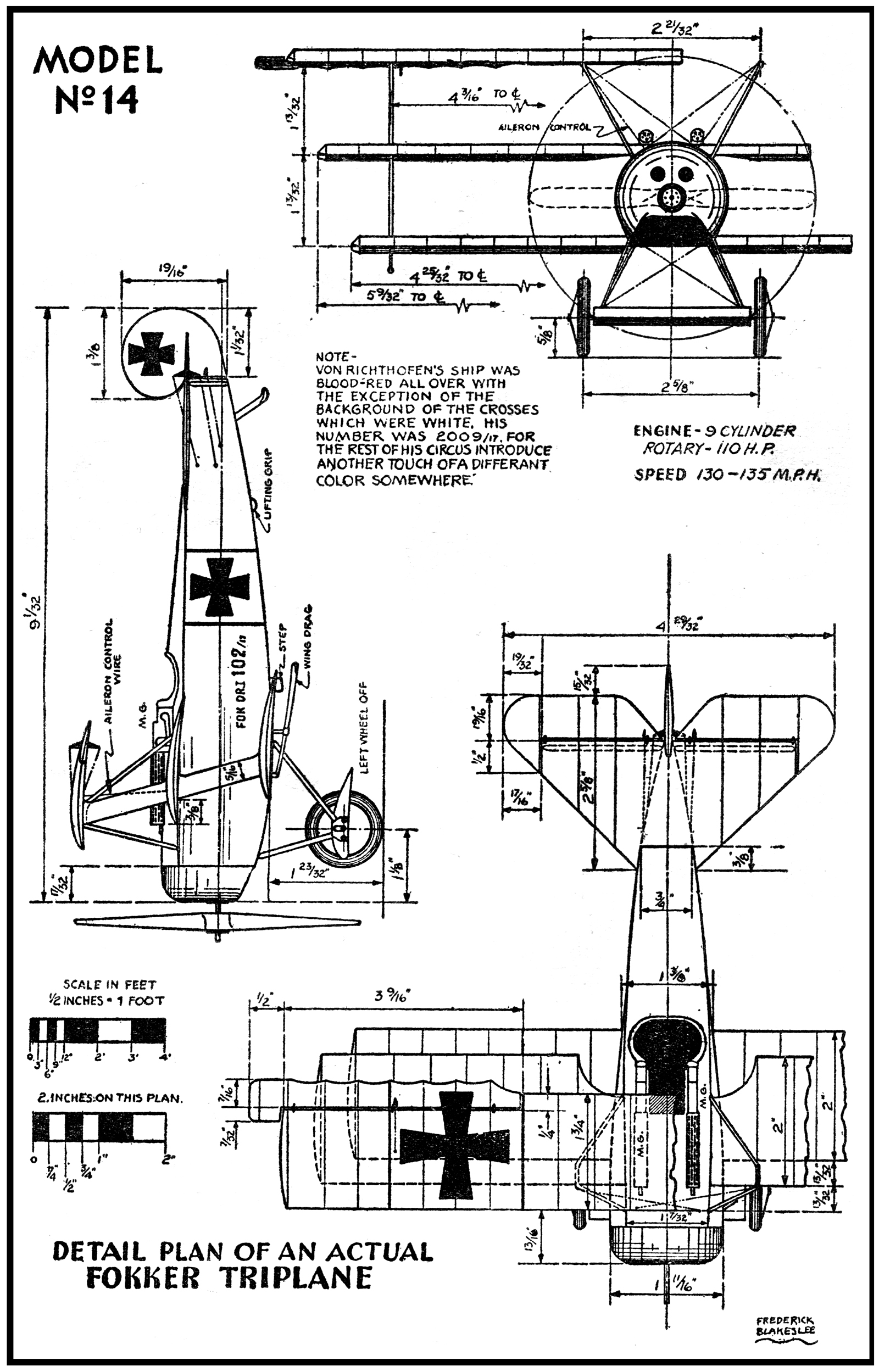
“Model No.14 – Fokker Triplane” by Frederick Blakeslee (January 1934, Battle Birds)

The fuselage of the triplane was built up of welded tubular steel and was covered with linen fabric. It was rather well streamlined, and like most of the Fokker war-time designs it compared closely to modern aeronautical practice.

The empennage or tail of the ship was a fabric covered steel tubing framework. There was no vertical fin, there being only the characteristic Fokker rudder. The tail plane or stabilizer was comparatively large and was fitted with the usual type elevators.

The landing gear axle was inclosed by a wing, a feature which was incorporated on all of the later Fokker fighting models. This wing was two pieces and these were attached to a central casting which housed the shock absorbing agents and the axle. The covering for this wing was plywood.

The triplane or D.R.-I was equipped with a 110 h.p. 9 cylinder Oberursel rotary motor. This motor was mounted on a plate which was stamped from sheet steel. The plate was attached, of course, to the front ends of the fuselage longerons.

For armament the plane was fitted with twin Spandau machine guns, these being mounted on the top side of the fuselage directly in front of the cockpit. Directly behind the engine was the synchronizing gear for the guns, and behind this gear was located the fuel tank. This tank was of a rather small capacity and as a result the flight range of the machine was greatly limited.

The triplane answered very well to the controls and as far as climb and general maneuverability are concerned it was equaled by but very few of the later war time designs.

German pilots have told the writer that they were greatly impressed with the ship and if the speed of the plane could have been increased they would have preferred it to any other plane, with the possible exception of the D-VTI. Certainly it was the choice of many of the German pilots.

The great von Richthofen, who could select any ship he desired, favored it above them all; and his series of victories indicate the famous flyer made no mistake in his choice of a pursuit.

The Story Behind The Cover
“The Fokker Triplane” by Frederick Blakeslee (June 1935, Dare-Devil Aces)


Mr. Blakeslee covered the Fokker Triplane himself with the story of the great von Richthofen last flight for the cover of the March 1932 number of Battle Aces.

“Sopwith 1½ Strutter” by Robert H. Rankin

Link - Posted by David on September 14, 2015 @ 6:00 am in

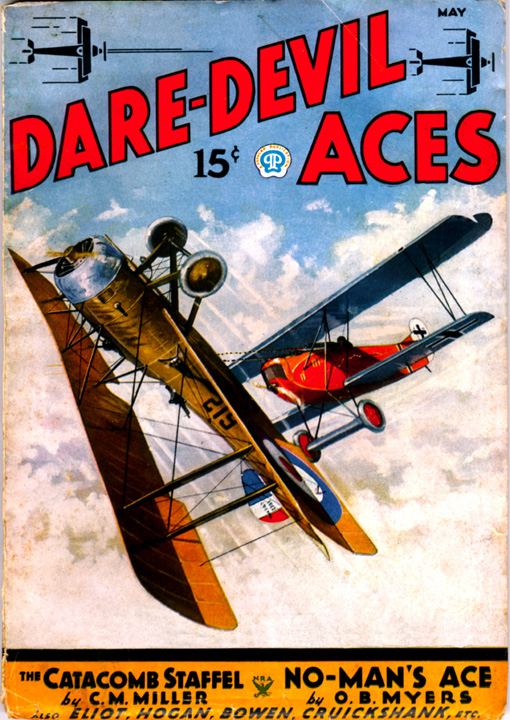
Frederick Blakeslee painted all the covers for the entire run of Dare-Devil Aces. And each of those covers had a story behind it. This time, we have more of the approach he used for the covers he painted for Battle Aces—telling us about the ship on cover. But, instead of Mr Blakeslee telling us about the ship on the cover, we have Mr. Robert H. Rankin, formerly a draughtsman for the Fokker Aircraft Corp telling the story of the Sopwith 1½ Strutter on the cover of the May 1935 cover of Dare-Devil Aces. . . .

th_DDA_3505
Editor’s Note: This is a surprise cover. In painting it, Frederick Blakeslee attempted to tell no story, but simply painted a ship for your collection. The color and every detail on the ship is exactly as it is on the original. We are very anxious to know how you like this cover. Write to Frederick Blakeslee in care of this magazine and tell him what type of cover you like best.

Sopwith 1½ Strutter
by ROBERT H. RANKIN
Formerly Draughtsman, Fokker Aircraft Corporation

WITH the exception of Fokkers, the Sopwiths were in all probability the best-known fighting ships used during the World War. The Sopwith Camels did more to repulse the German attempts at aerial supremacy than any other type or make of plane, while the Sopwith Pups and Triplanes made themselves almost equally as famous.

Although not as well-known as the other Sopwith models, the 1½ Strutter has a definite claim to historical distinction, not only because it was a great fighter, but because it was the first British plane to be fitted with a gun synchronized to shoot through the propeller.

The Sopwith-Kauper synchronization gear which made this possible was developed at the Sopwith factory and was as much a product of that firm as was the ship to which it was fitted.

The 1½ Strutter was originally designed as a high-performance two-seater fighter powered with the 100 h.p. Clerget engine. As such it gave a very good account of its self, showing an excellent performance and a decided ease of maneuverability.

In view of its worth as a fighter, many 1½ Strutters were built to the order of the governments of Roumania, Russia, Belgium, and the United States. In addition to this, the French government, under license, built more than 4,500 of these machines.

Structurally the 1½ Strutter was interesting in several ways. The wing bracing, which gave the ship its name, was rather unusual, for the top plane was in two halves, bolted to the top of a central cabane, while the wing spars were provided with an extra support in the shape of shorter struts running from the top fuselage longerons to the top plane spars some distance out.

In the single-seater pursuits which followed the 1½ Strutter, this bracing of the top wing was generally adopted, with the exception that the central cabane was done away with, the outer struts of the W formation having a slightly less pronounced slope, and supporting a separate top wing centersection.

Aerodynamically the machine is of interest because of the air-brakes with which it was fitted. These were in the form of adjustable flaps in the trailing edge of the lower wings. These flaps could be rotated by the pilot until they were normal to the wind, thus helping to pull the plane up as it was about to land.

Another innovation incorporated in the 1½ Strutter was the trimming gear by means of which the angle of incidence of the tail plane could be altered in flight. This allowed the tail to be adjusted for speed, climbing, etc.

Although designed originally to be used as a two-seater fighter only, the 1½ Strutter was later successfully adopted as a single-seater bomber, and as such it was used in bombing such German towns as Essen, Munich, and Frankfort. For bombing service the machine was equipped with the 130 h.p. Clerget.

Later this higher-powered engine was used in the standard two-seater fighters. After the war a number of these fighters were fitted with dual controls and powered with 80 h.p. Le Rhone engines for use as training planes.

A study of the following figures will give some idea of the characteristics of the 1½ Strutter:

TOP PLANE
   
Span 33 ft. 6 in.
Chord S ft. 6 in.
Area 183 sq. ft.
Incidence in degrees 2.45
Dihedral 2.45
Gap 5 ft. 5 in.
   
BOTTOM PLANE
   
All dimensions the same as for the top plane.
   
GENERAL DIMENSIONS
   
Total wing area 373 sq. ft.
Length over all 25 ft. 4 in.
Stagger 2 ft. 0 in.
Sweepback 0 ft. 0 in.
Aileron area 52 sq. ft.
Tail plane area 35.5 sq. ft.
Elevator area 21.5 sq. ft.
Fin area 3.5 sq. ft.
Rudder area 7.25 sq. ft.


Powered with the 110 h.p. Clerget engine, the two-seater fighter weighed 1,281 pounds empty, had a high speed of 130 m.p.h. and climbed 6,500 feet in 10½ minutes. The ceiling was 16,000 feet, the military load 160 pounds, and the landing speed 35 m.p.h. In addition to the fixed gun, the fighter carried a Scarfe ring and gun for the use of the man in the rear pit.

As a bomber, powered with the 130 h.p. Clerget, the ship weighed 1,316 pounds empty, showed a high speed of 102 m.p.h., and climbed to 6,500 feet in 12.7 minutes. The ceiling was 13,000 feet, the military load was 344 pounds, and the landing speed 35 m.p.h.

The Story Behind The Cover
“Sopwith 1½ Strutter” by Frederick Blakeslee (May 1935, Dare-Devil Aces)

« Previous PageNext Page »