



“Sky Fighters, August 1935″ by Eugene M. Frandzen
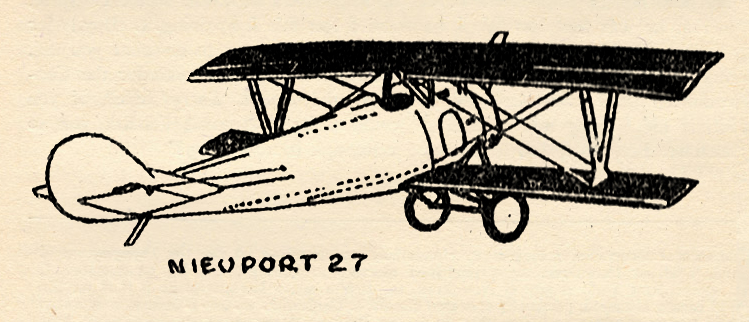
Eugene M. Frandzen painted the covers of Sky Fighters from its first issue in 1932 until he moved on from the pulps in 1939. At this point in the run, the covers were about the planes featured on the cover more than the story depicted. For the August 1935 cover, Mr. Frandzen features the a couple of Junkers C.L.1 Seaplanes taking on a Neieuport 27!
The Ships on the Cover
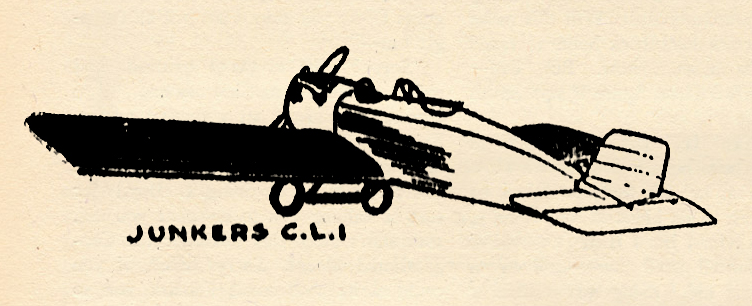
ALL metal low-wing monoplanes 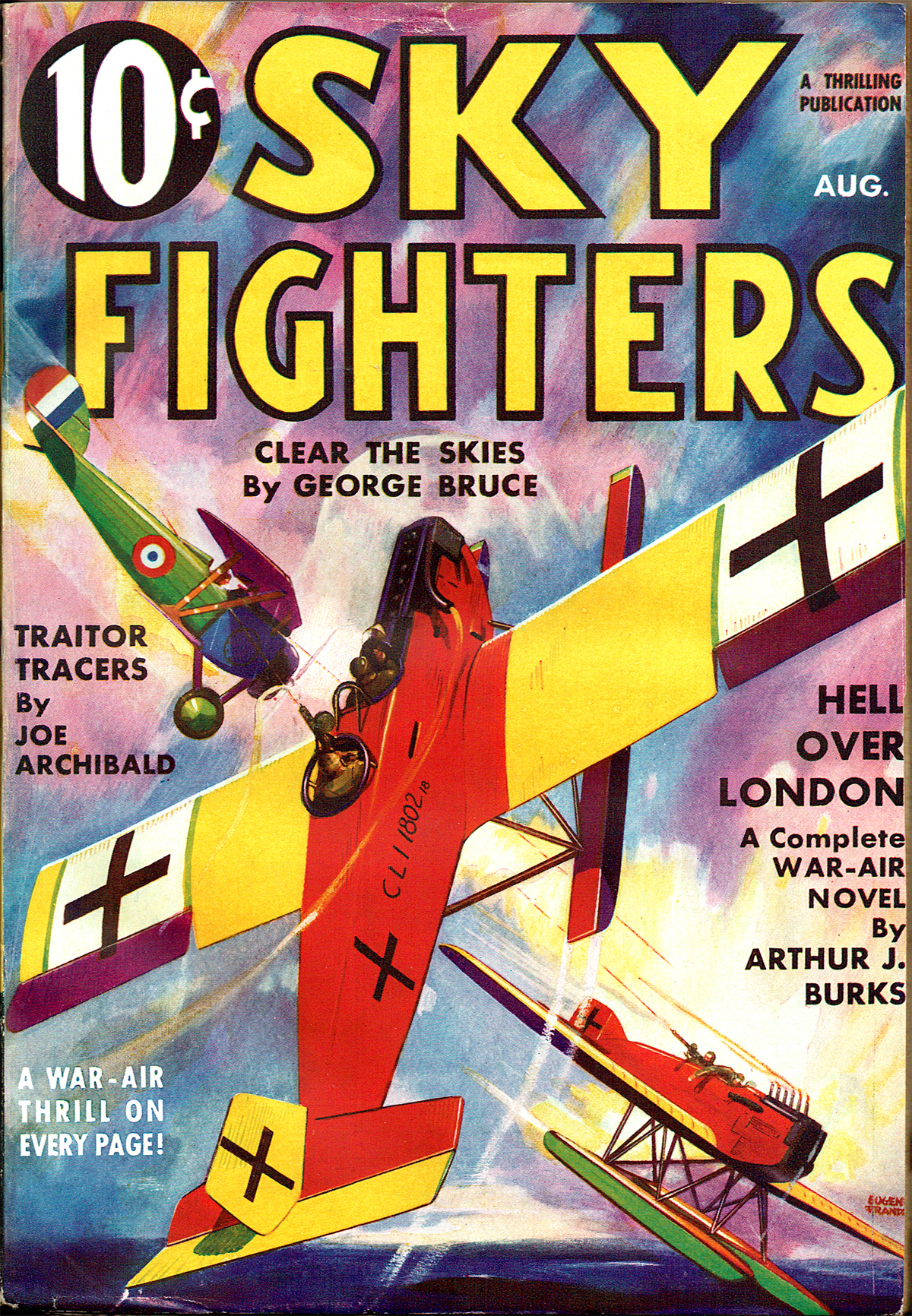 are not a new wrinkle in sky ships. Back in the World War days, Professor Hugo Junkers sat before a drafting table littered with plains, blueprints and bits of corrugated metal. His simple stream-lined designs were far ahead of his day, therefore they were scoffed at by the heads of the German Flying Corps.
Anthony Fokker had a welded steel frame in the fuselage of his planes at the time. But this welding job was an exception. Fokker liked the looks of the Junkers design and saw to it that certain strings were pulled along the political line and it came to pass that those who had turned down the Junkers all metal planes swung into a snappy about-face in their beliefs. Fokker linked his name definitely with Hugo Junker’s. If those shiny metal jobs load been adequately powered with engines which were not too heavy, they would have revolutionized airplane design.
Finest of ‘em All
The C.L.1 All Metal monoplane in the foreground on the cover, powered by a Mercedes engine, was probably the finest ship turned out by Junkers in 1918. The wings had considerable dihedral and were very thick at the leading edge. Junkers who was an authority on Diesel engines which his firm manufactured, insisted that the Mercedes engine be used in his planes. Car type radiators were used in the nose. Ailerons on most of the Junkers craft were balanced, similar to the Fokker D7. But on this particular version of the C.L.1 they were unbalanced as was the elevator. The rudder was anchored by a single post which in rotating swung it to left or right. Corrugated aluminum was used throughout, which did not by any means make the ship bullet proof but it did minimize the fire hazard and give added strength to the ship that allowed inner structural bracing to be lightened.
Professor Junkers, who died only a few months ago at the age of seventy-six, predicted when he made his first all metal airplane that some day planes would be armor-plated. But with heavy motors developing less than 300 h.p., he was limited to aluminum which is about one-third the weight of steel. Had he been able to armor plate the Junkers planes, a different story could be told of the cover picture.
Zeebrugge, the submarine lair of the German navy, was bottled up by the British navy on April 23, 1918, by sinking ships filled with concrete across the mouth of the harbor.
Blazing Red Skies
A lone French Nieuport roared along the coast toward the heavily fortified submarine basin. A final observation from the air was necessary to the British. Two shining German Junkers seaplanes skidded off the water and flashed into the skies. The Nieuport looked like a butterfly attacked by two bats. But the thundering Vickers guns in the French plane’s nose blasted a rain of slugs through the thin-gauge aluminum of the Junkers into a vital spot. One down! The back gunner on the foremost Junkers blazed at the Nieuport. The tiny French ship flipped under the German plane. One volley sent it reeling towards the sea. The Nieuport circled twice over Zeebrugge, streaked for home.
A telegraph key clattered in a British seaport. An admiral smiled grimly as he read the dispatch from the French pilot.
That night the skies blazed red above Zeebrugge in the most spectacular naval-land battle of the whole war. The engagement mounted to an unbelievable pitch, then slowly died out as the British ships, battered, decks blasted away and superstructure listing, limped into the darkness toward home.
A terse message flashed through the ether from the Admiral’s flagship to British headquarters: “Mission accomplished satisfactorily.”
Sky Fighters, August 1935 by Eugene M. Frandzen
(The Ships on The Cover Page)
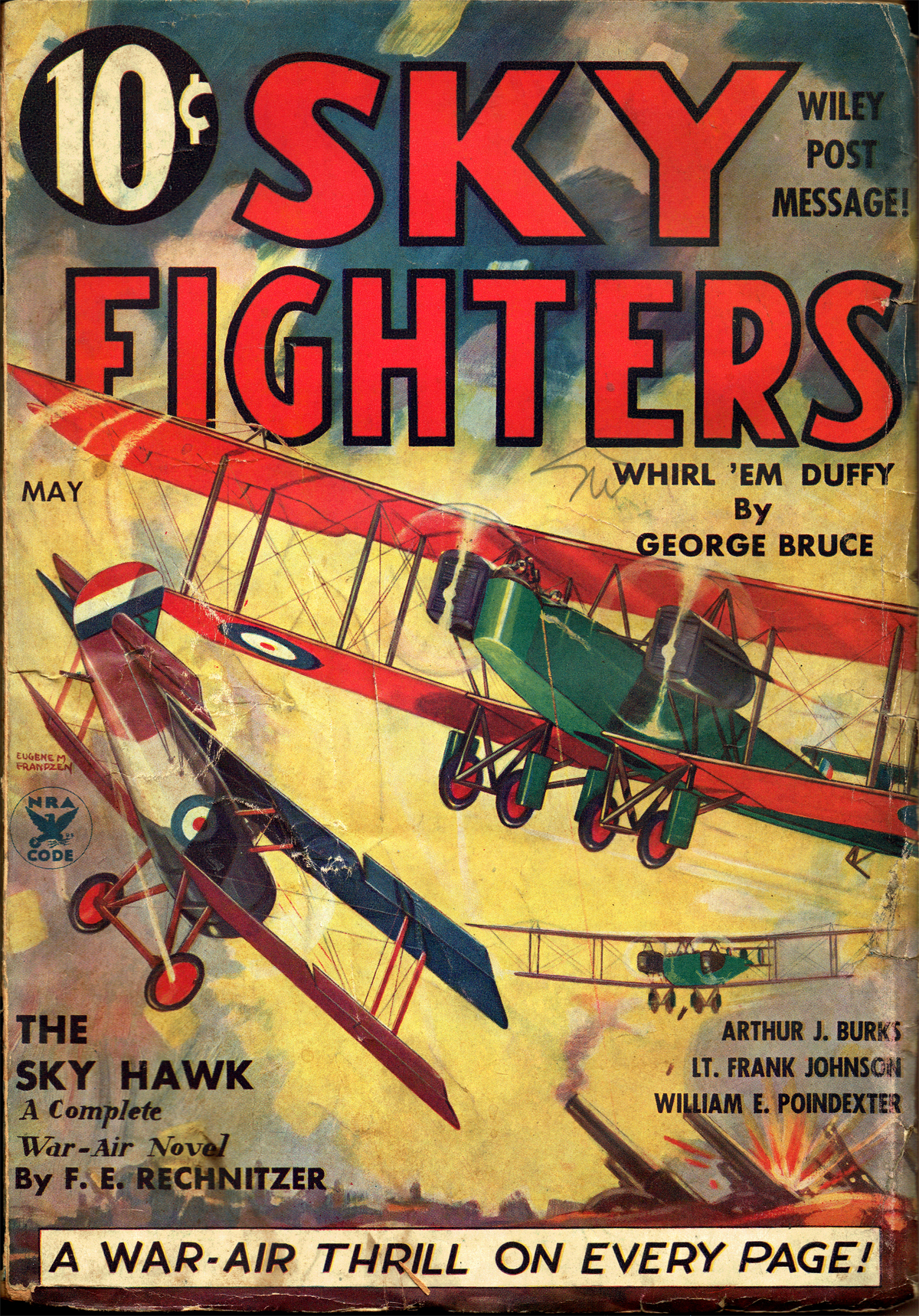
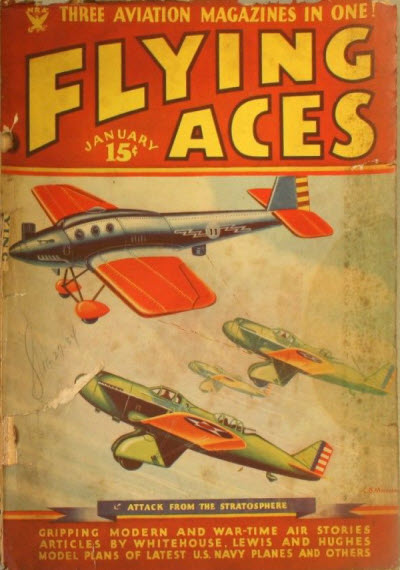 You heard right! That marvel from Boonetown, Iowa is back causing more trouble than he’s worth! That Knight of Calamity manages to find not only the Boche’s ammo train, but a former victim of the ol’ Pinkham charm from his hometown now glad to seek revenge! How can he stop the Boche ammo train, escape the butcher of Boonetown, and capture the Rittmeister von Schnoutz? He does it all with mirrors—Find out in “An Itch In Time” from the pages of the January 1935 Flying Aces.
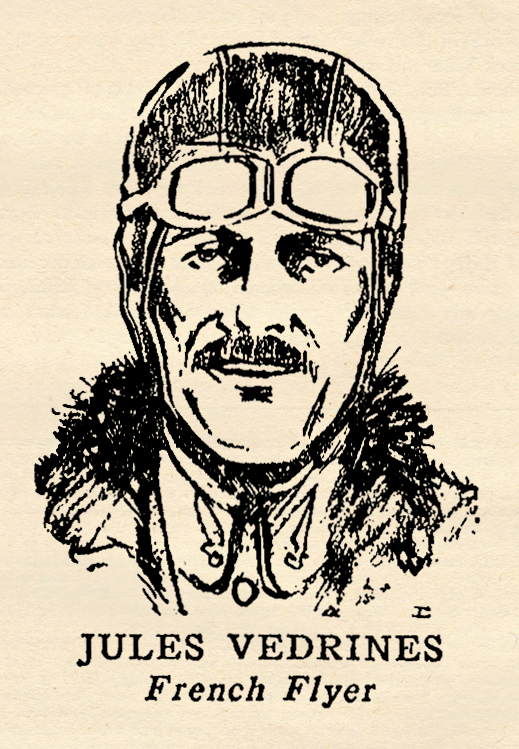 great war broke out Jules Vcdrines was the most famous flyer of France. He had twice won the Gordon Bennett speed trophy, and held both distance and altitude records. It was through his efforts that France wrested supremacy of the air from the United States and Great Britain. Along with Garros, Pegoud, Marechal, Le Blanc, Audemars, and other famous French flyers of his day, he enlisted in the French Flying Corps the day after war was declared.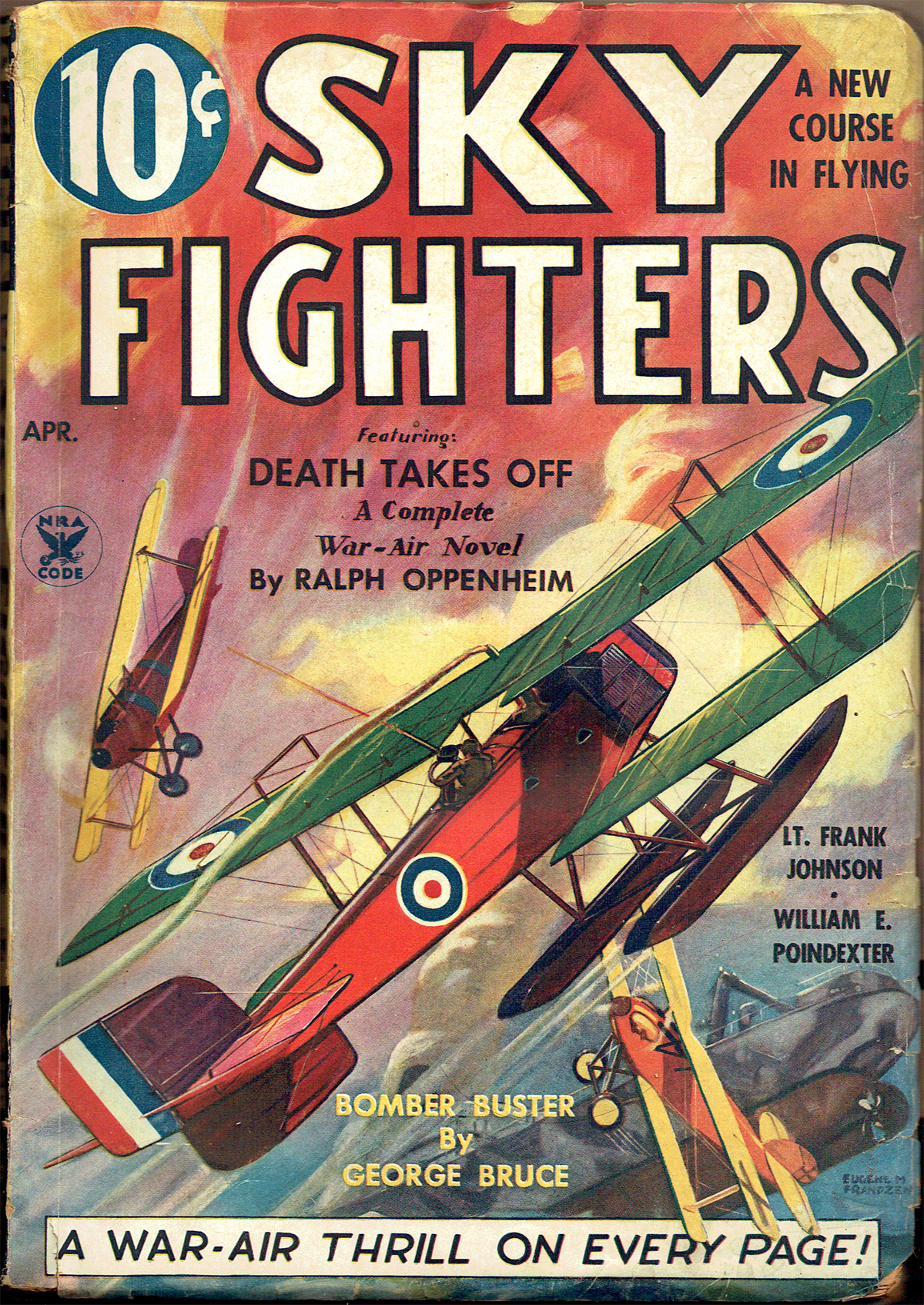
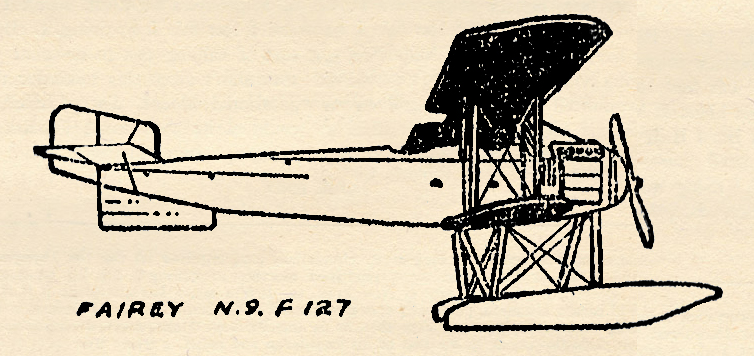
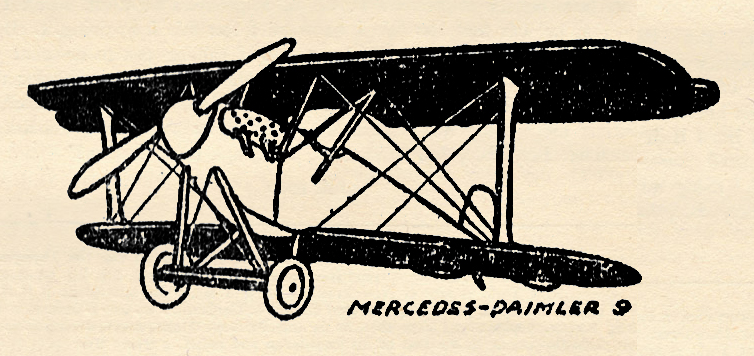
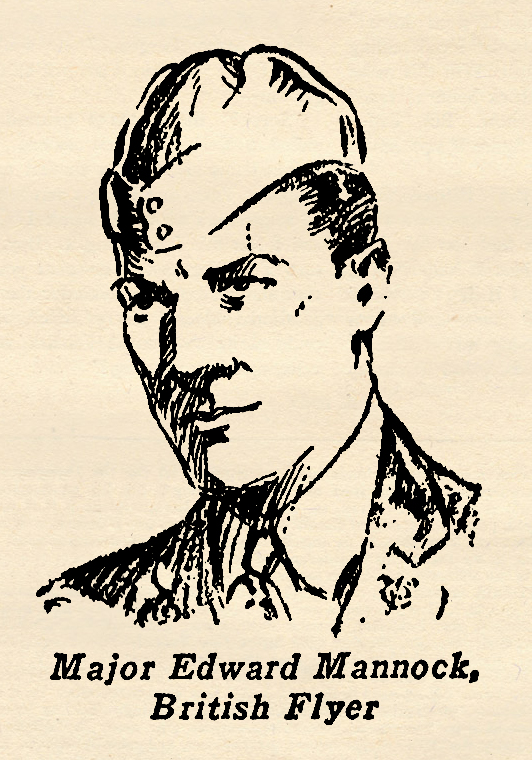 the British postal department, Turkey, when the war broke out. He was immediately made a prisoner by the Turks, and spent almost a year in an enemy camp before he was repatriated to England in 1915. He first served in the Royal Engineers, was commissioned as a lieutenant and transferred to the flying Corps in August, 1916. Major McCudden, the great British Ace, was his first instructor.
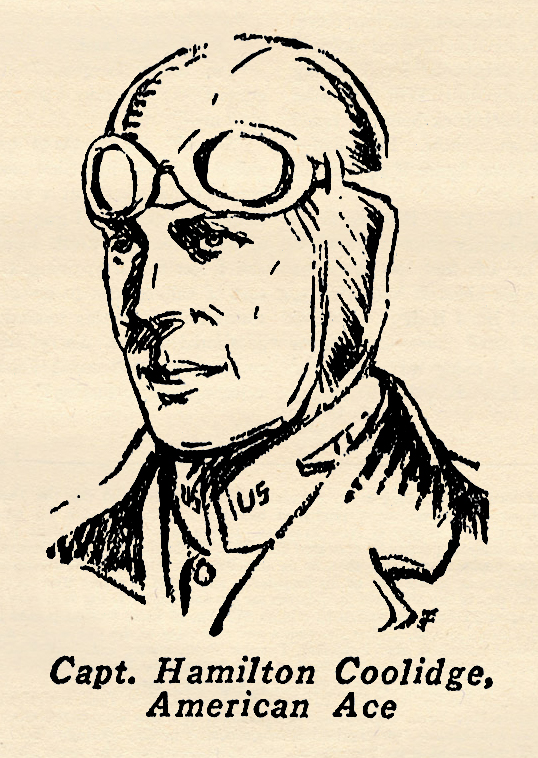 Hamilton Coolidge was well known throughout the land even before the war began. He enlisted in the aviation section of the Signal Corps and got his primary flight training at Mineola along with Quentln Roosevelt, his hoy-hood friend.
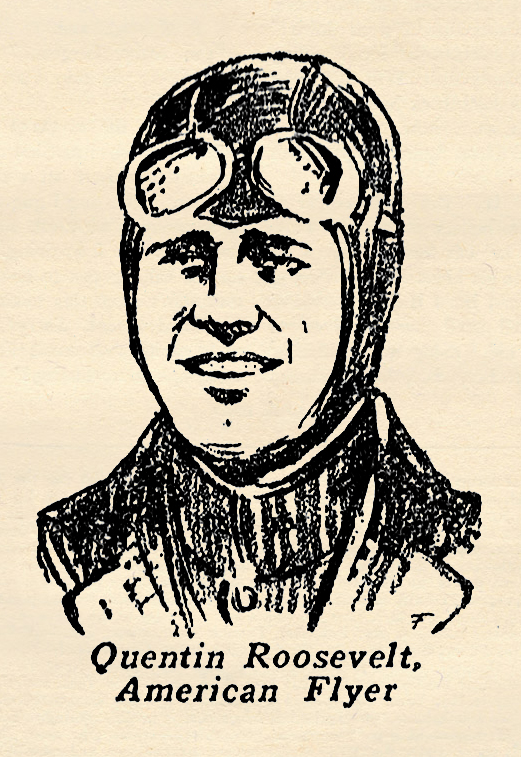 at Oyster Bay, N.Y., the fourth and last son of a famous fighting family, November 19th, 1897, six weeks after his illustrious father, Theodore Roosevelt, had left to fight for the freedom of Cuba. Although handicapped by a permanently injured back, he succeeded by dint of cunning and painful effort in fooling the medical examiners and being accepted for training as an aviator.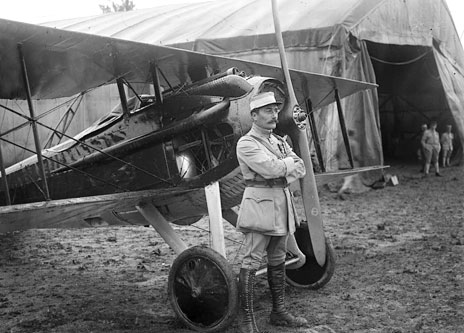
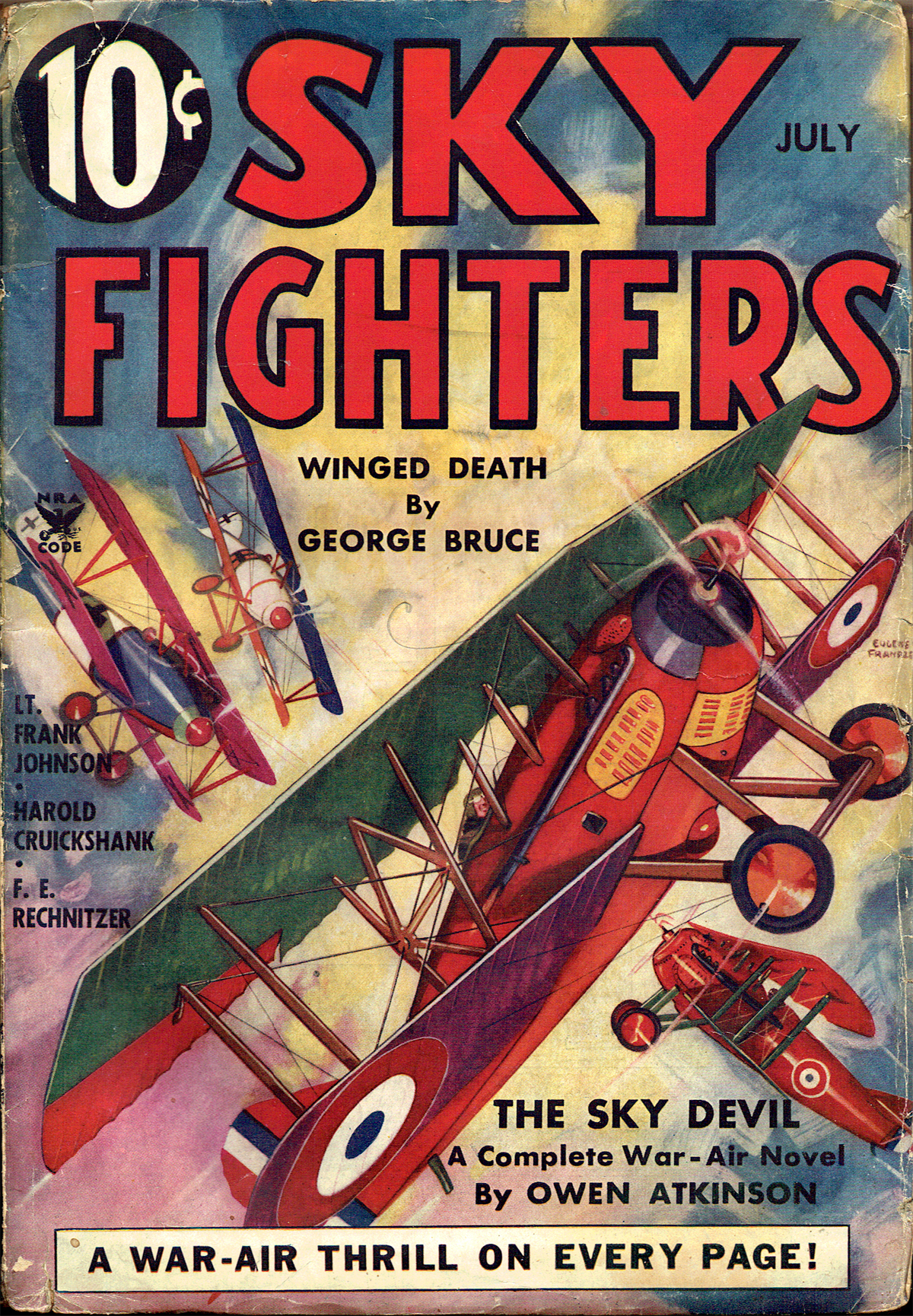
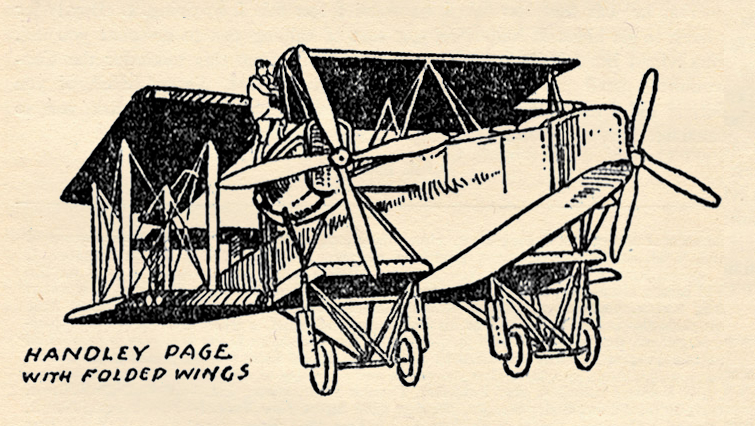
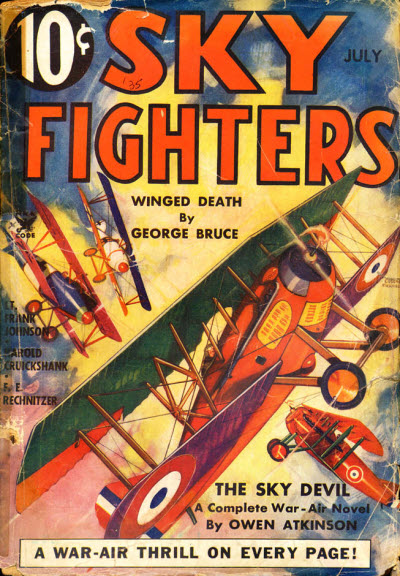 a story from the pen of a prolific pulp author—F.E. Rechnitzer. In “Errant Flight” from July 1935 Sky Fighters, Rechnitzer presents a tale of a pilot who feels he’s washed up and going to be sent stateside any day until fate intervenes and a mistaken order sends him to a British bombing squadron—only problem is Lt. P.T. Garner who can barely land a Spad without cracking up, must now pilot a large Handley-Page Bomber!
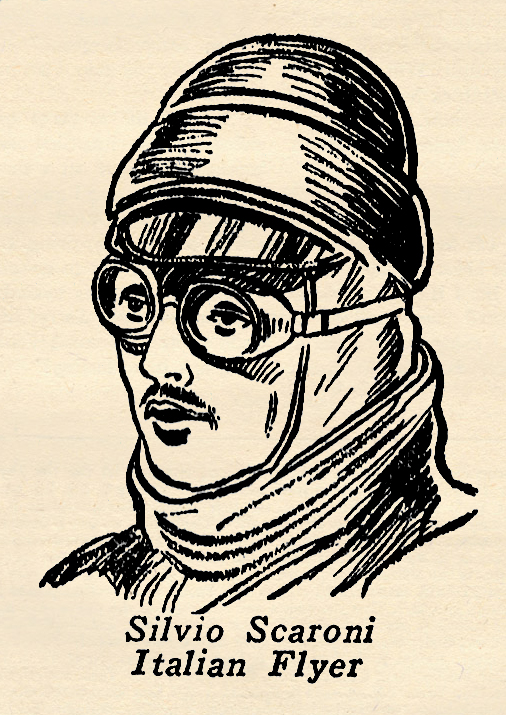 born at Brescia, Italy, and entered the aviation corps at the beginning of the war. As a bomber he was recognized as one of the best in the Italian Flying Corps and he was very adopt in handling big three-engined Capronis. But the big ships were too slow to satisfy Lieutenant Scaroni. He wanted to fly single Heaters and eventually managed to secure his transfer to a combat squadron on the morning of November 14, 1917.
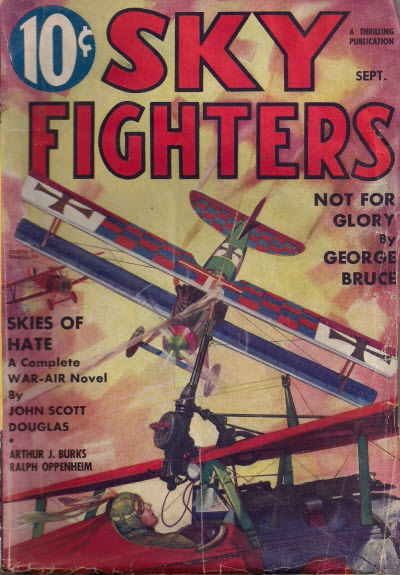 a story from the one and only creator of The Three Mosquitoes—Ralph Oppenheim! Mickey Rand trained pilots to be Aces using his infallible techniques of air combat. That is until it seemed the German Ace Kemmerer had found a way to beat these tricks, downing three of Mickey’s star pupils and he wasn’t about to let his latest protege, Jim Conway be next!


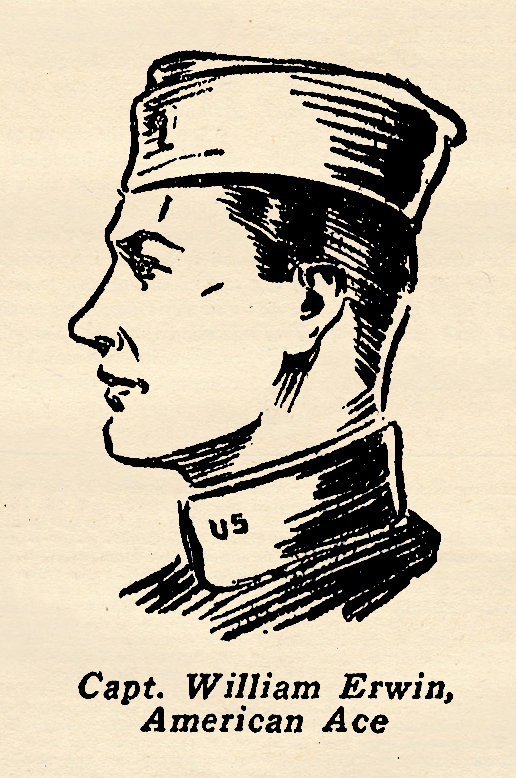 a unique record. He was the only accredited American observation ace, and piled up a string of 9 official victories while flying slow ungainly two-seaters. A Texan, William Erwin enlisted for training the day after war was declared. He received his commission as a Lieutenant after a bare forty hours of flight and was immediately sent overseas and assigned to the First Aero Squadron which he joined on its first day at the front. Before his first week he had downed an enemy plane and the French awarded him the Croix de Guerre. He was awarded additional recognition by the French and also received the American Distinguished Service Cross with Oak Leaves. Through the war safely, without ever having been wounded despite his rare courage and daring, he came to an untimely end while flying the Pacific in a futile search for the missing Dole flyers in 1923. Erwin, himself, recounted the following experience to the compiler of these records on a grey day in the Argonne many years ago.