




Looking to buy? See our books on amazon.com Get Reading Now! Age of Aces Presents - free pulp PDFs

“The Green Devil” by Frederick Blakeslee

Link - Posted by David on December 11, 2014 @ 12:00 pm in

Frederick Blakeslee painted all the covers for the entire run of Dare-Devil Aces. And each of those covers had a story behind it. For the January 1934 issue Blakeslee paints a confrontation between Richthofen’s Circus and a couple of English Camels in “The Green Devil”…
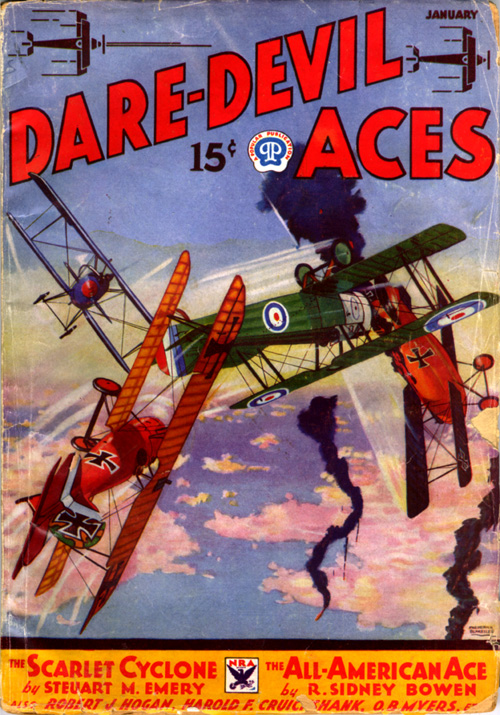
th_DDA_3401TO MEET the Richthofen Circus in combat was not a matter to be taken lightly, even when the number of ships on both sides were equal. But to meet them on a basis of two to six was no less than suicidal—yet this month’s cover shows a thrilling incident that actually occurred in a dogfight of similar proportion.

On a day early in 1918, an English pilot, Lt. Alderson, was ordered to report at his squadron office. There the C.O. told him that the Richthofen Circus was out looking for trouble and that his squadron (No. 3 R.F.C.) had been selected to provide it. Most of the squadron was out on patrol and only four pilots were available—but orders were orders. So Lt. Alderson and three others took off without delay.

They knew that the Circus numbered six. Four Camels against six Fokkers was not too bad. However, when one of the Camels dropped out of formation with engine trouble, that was something-else again. Three against six! Not so good, damn bad in fact. However, the three Camels kept on.

They sighted the six brilliantly painted Albatrosses almost as soon as they had crossed the lines. Realizing that surprise was their best bet, they charged immediately.

But the Germans had also seen the Englishmen—and they too charged. With the very lirst shots fired, one of the Camels dove out of the fight with a badly damaged tail plane.

The battle that then took place was one ol the fiercest of the whole war. Such a one-sided combat could only end in one way, and the two Englishmen knew it. But before they went West they were determined to do as much damage as possible.

The fight had been on less than a minute when an Albatros went plunging earthward, a mass of flames. Score one for the Camels! A second later another Albatros hurled out of the scrap and, trailing fire and black smoke, went plunging in its turn to destruction. Score two Eor the Camels!

But now the tide began to turn. Observers on the ground saw a Camel fall, completely out of control; it disappeared far over into German territory. A moment later the remaining Camel dove down—a roaring inferno. The fight was over. But only three Germans returned.

The Camel going down out of control was Alderson’s ship. An explosive bullet had shattered his right leg, and he lost consciousness.

From 13,000 feet—a two and a half mile fall—he plunged to earth.

How the ship landed upright has never been told; at any event Alderson survived the crash. When he opened his eyes, a week later, it was to find himself a prisoner of war.
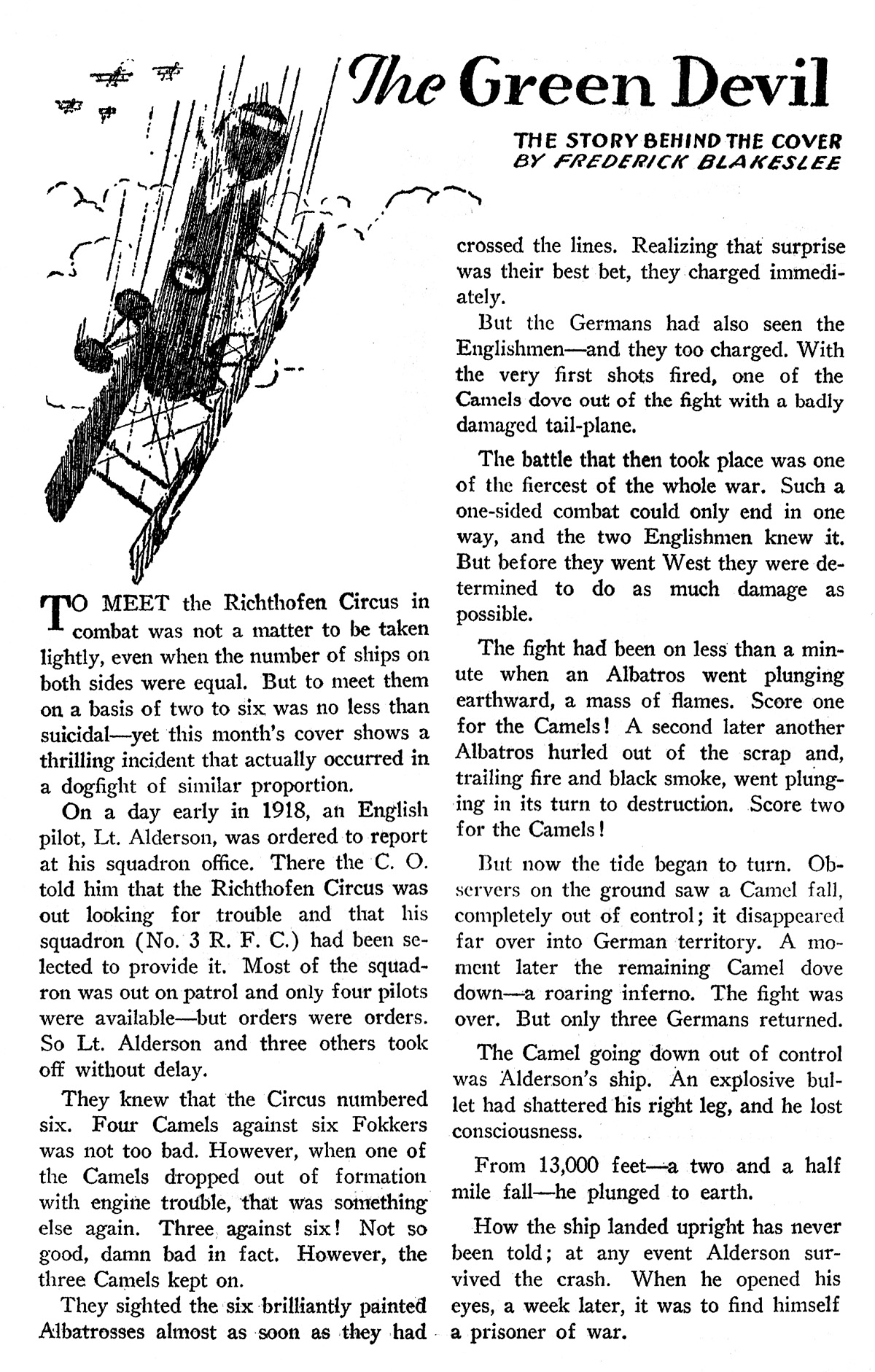
The Story Behind The Cover
“The Green Devil: The Story Behind The Cover” by Frederick M. Blakeslee (January 1934)

Check back again. We will be presenting more of Blakeslee’s Stories behind his cover illustrations.
“Lives of the Aces in Pictures – Part 28: Major Andrew McKeever” by Eugene Frandzen

Link - Posted by David on November 11, 2014 @ 12:00 pm in

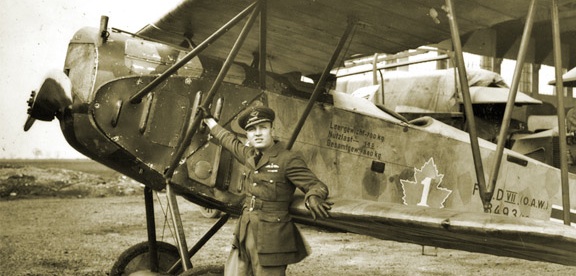
Here’s another of Eugene Frandzen’s “Lives of the Aces in Pictures” from the pages of Flying Aces Magazine. The series ran for almost four years with a different Ace featured each month. This week we have the his illustrated biography from the October 1934 issue, that famous Canadian Ace—Major Andrew McKeever!
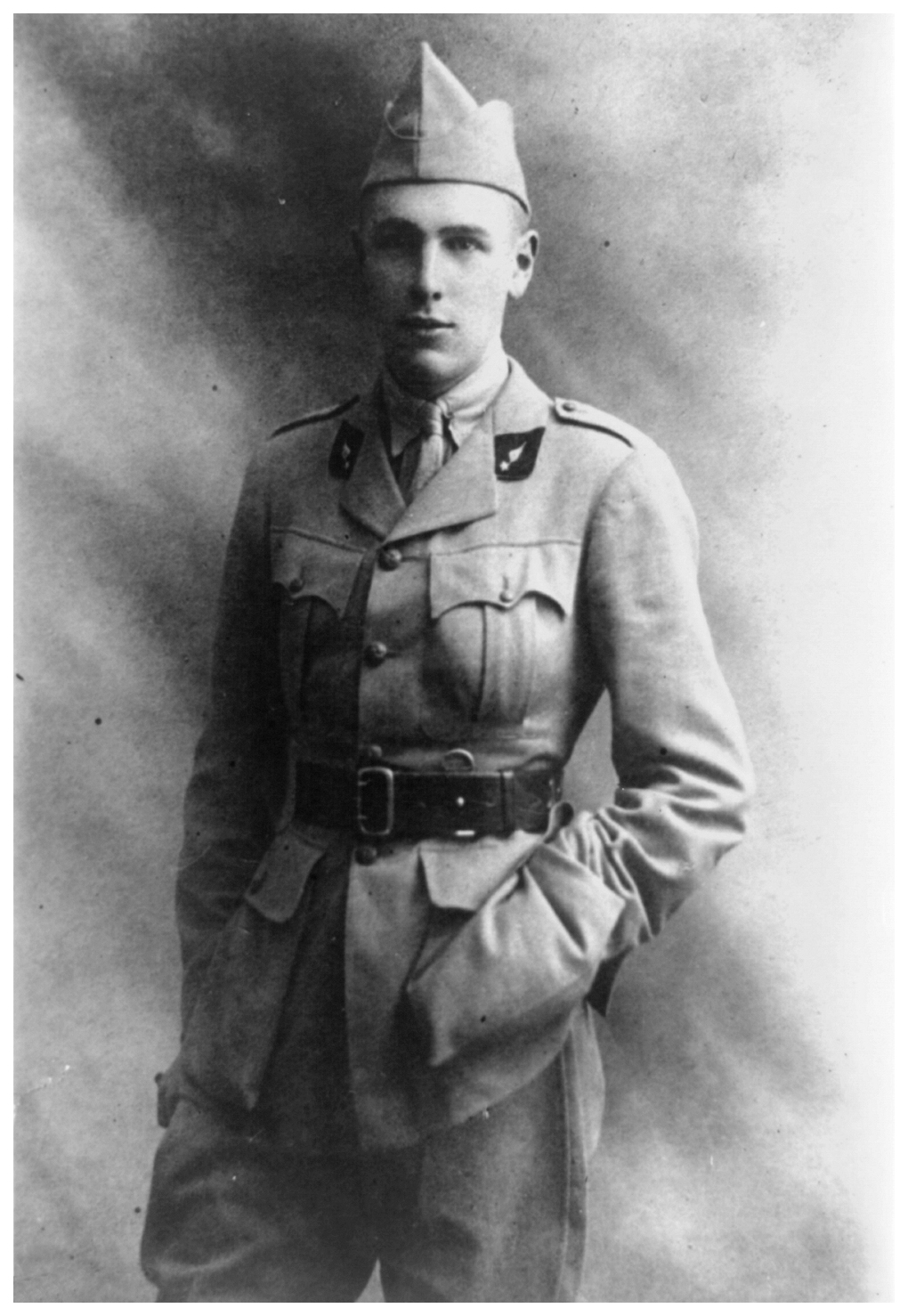
Major Andrew Edward McKeever is the RFC/RAF’s leading two-seater fighter pilot ace scoring 31 victories with seven different gunners/observers. He was awarded a chest-full of awards—The Distinguished Service Order, Military Cross & Bar, Distinguished Flying Cross, and from France, the Croix de Guerre.

With the end of the war, McKeever accepted a job managing an airfield at Mineola, New York. Before he could start work, he was involved in an auto accident in his home town of Listowel on September 3rd, breaking his leg. Over the following weeks, complications set in—he died of cerebral thrombosis on Christmas Day, 1919.

“Lives of the Aces in Pictures – Part 26: Lt. Thomas Hitchcock, Jr.” by Eugene Frandzen

Link - Posted by David on November 4, 2014 @ 12:00 pm in

Here’s another of Eugene Frandzen’s “Lives of the Aces in Pictures” from the pages of Flying Aces Magazine. The series ran for almost four years with a different Ace featured each month. This week we have the August 1934 installment which pictorialized the life of Lt. Thomas Hitchcock, Jr., Yank flyer!!
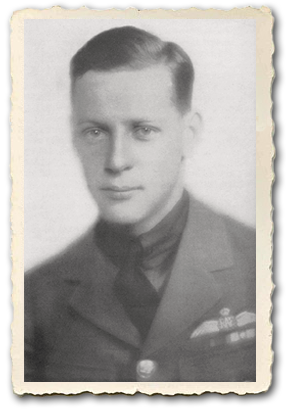
Hitchcock, rejected by the American forces due to his age, enlisted with the Lafayette Esquadrille where he was decorated for bringing down two German flyers. Captured in March of 1918 when he fell behind enemy lines while in a tangle with three Boche planes, he managed to escape by jumping from a train near Ulm and walked 80 miles through hostil territory to reach the Swiss border.

Hitchcock was a whiz on the polo field as well as in the air—leading the U.S. team to victory in the 1921 International Polo Cup. He carried a 10-goal handicap from 1922 to 1940 and led four teams to U.S. National Open Championships. In 1990 he was inducted posthumously into the Museum of Polo and Hall of Fame.

It is said that F. Scott Fitzgerald even based two characters on Thomas in two of his novels. He turned all his virtues to vices in The Great Gatsby for the character of Tom Buchanan in 1925 and later used him as inspiration for Tommy Barban in Tender is the Night (1934).

Hitchcock served as a Lieutenant Colonel in the U.S. Army Air Forces in World War II and was assignedas an assistant air attache to the US Embassy in London. In this capacity he was instrumental in the development of the P-51 Mustang fighter plane. Sadly he lost his life while test piloting the plane near Salisbury, Wiltshire, England in 1944. He was 44.

“Hans Up!” by Joe Archibald

Link - Posted by David on October 28, 2014 @ 12:00 pm in

Haw-w-w-w! It’s another Phineas Pinkham howl. We present another humerous tale of Phileas Pinkham from the prolific pen of Joe Archibald. Pinkham appeared in almost every issue of Flying Aces from November 1930 through November 1943! As if Archibald didn’t have enough to do, he also supplied the artwork for the story.

It was a nice trip. It began with Phineas knocked out cold after a crack-up. It continued with a couple of doughboys loading him onto an ambulance bound for the hospital. And it ended with a couple of doughboys knocked out cold in an ambulance. What do you expect?

“Lives of the Aces in Pictures – Part 24: Captain Quigley” by Eugene Frandzen

Link - Posted by David on October 21, 2014 @ 12:00 pm in

Back with another of Eugene Frandzen’s “Lives of the Aces in Pictures” from Flying Aces Magazine. The series ran for almost four years with a different Ace featured each month. This time we have the June 1934 installment which pictorialized the life of that great Canadian Ace—Captain Francis Granger Quigley!

Private Quigley enlisted in December 1914 and served with the 5th Field Company of the Canadian Army Engineers on the Western Front. He transfered to the RFC in September of 1917 where he was assigned to the 70th Squadron RFC. By this time he had made the rank of Captain and flying a Sopwith Camel, he is credited with 33 victories! He earned the Distinguished Service Order, the Military Cross and the Military Cross with Bar!
Wounded in March of 1918 when a bullet shattered his ankle, he was sent to Le Touquet Hospital to recover. He finished his convalescence in Canada where he served as an instructor at Amour Heights. Requesting a return to action in France when his ankle had heeled, Guigley came down with the influenza on the way back to England. He died in a hospital two days after his ship docked in Liverpool.

“Lives of the Aces in Pictures – Part 23: William P. Erwin” by Eugene Frandzen

Link - Posted by David on October 7, 2014 @ 12:00 pm in

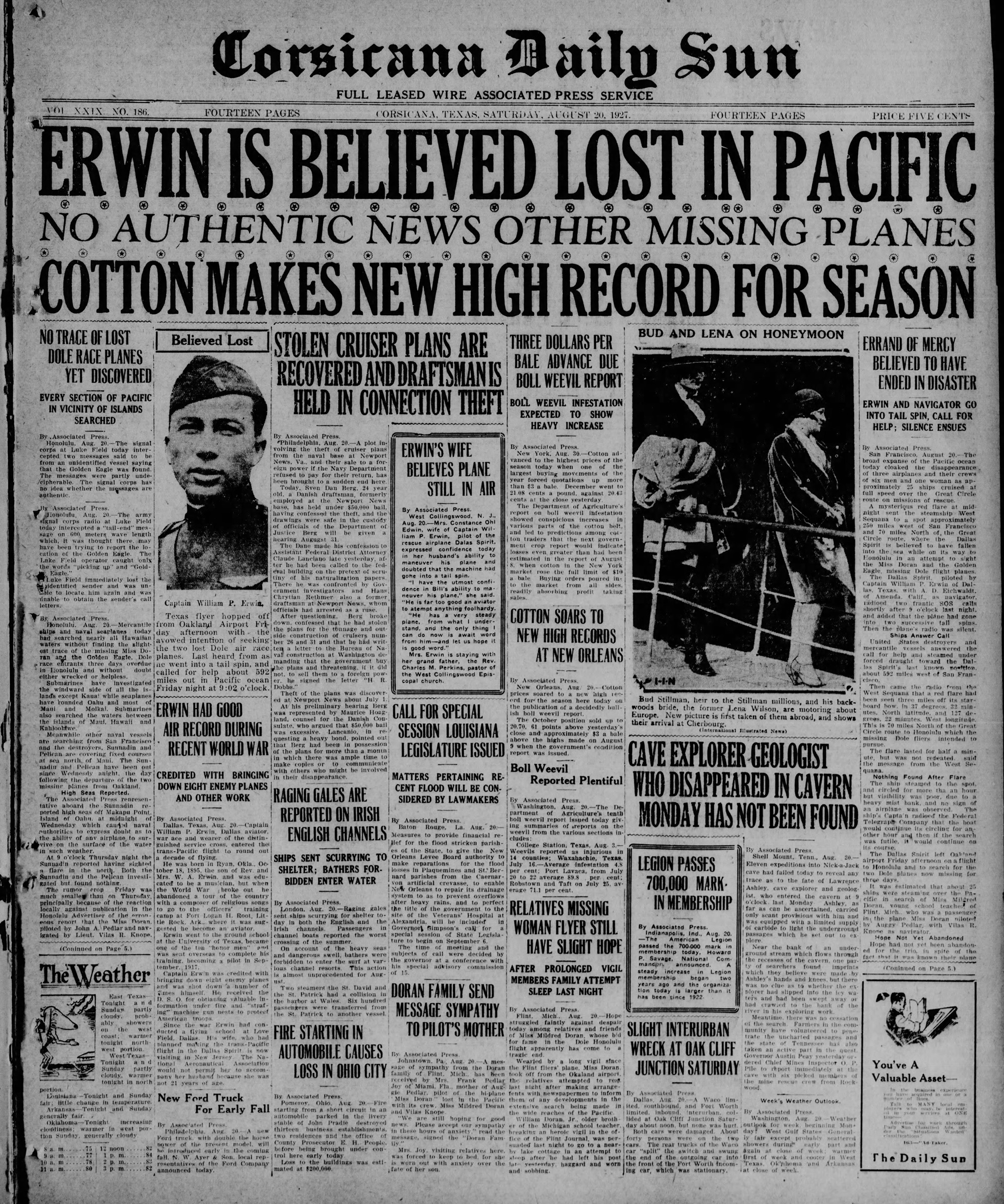
Back with another of Eugene Frandzen’s Lives of the Aces in Pictures from Flying Aces Magazine. The series ran for almost four years with a different Ace featured each month. This week it’s Lt. William Portwood Erwin, featured in the May 1934 issue.

Erwin was assigned to the 1st Observation Squadron in July of 1918. Flying Salmson 2A2s, he and his observers are credited with eight victories! He was awarded the Distinguished Service Crossfor extrodinary heroism in action in the Chateau-Thierry and St Mihiel Salients theaters. And for a dangerous infantry liaison mission at night that he had volunteered for—on his third day with the 1st Observation, he recieved the French Croix de Guerre!

He continued in aviation after the war, conducting a flying school at Love Field, Dallas.

The Dole Air Race of 1927—a race from California to Hawaii. While searching for two lost air race planes and their passengers, he was last heard radio that his plane went into a tail spin and he called for help about 592 miles out in the Pacific Ocean. His plane, “Dallas Spirit” and its occupants were never found.

“Lives of the Aces in Pictures – Part 22: Major Reed G. Landis” by Eugene Frandzen

Link - Posted by David on September 30, 2014 @ 12:00 pm in

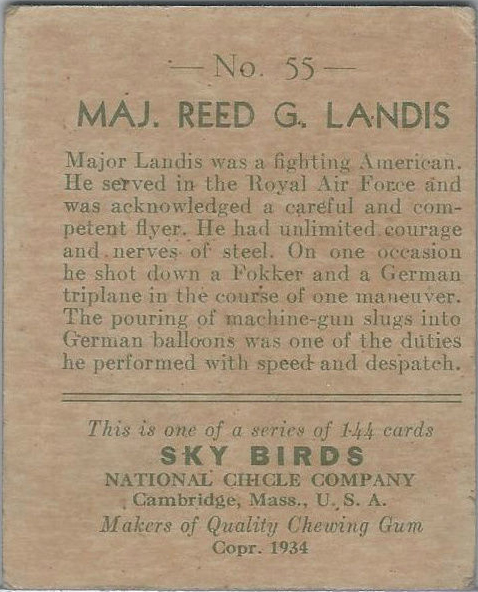
From May 1932 through March 1936, Flying Aces ran a pictorial feature illustrated by Eugene Frandzen on the ” Each month they featured a different ace from The Great War—telling his story. Very similar to Alden McWilliams’ “They Had What It Takes” which would run in the magazine after LOTAIP had run it’s course. When Flying Aces was a traditional pulp magazine size of 7×10″, it was a two page feature, but when they changed formats and went with a bedsheet size, the feature became one page.

This week we have the twenty-second installment featuring the American aviation Ace, Major Reed Gresham Landis! Landis was flying with the RFC when he scored his dozen victories, all from an S.E.5. Landis was awarded the British Distinguished Flying Cross and the American Distinguished Service Cross. He would survive the war and go on to become chairman of the American Legion during the 1920’s, but returned to service in 1942 where he rose to the rank of colonel—stationed in Washington, D.C.

He passed away May 30th, 1975, aged 78 near Hot Springs, Arkansas.

“String ‘Em Back Alive” by Joe Archibald

Link - Posted by Bill on June 11, 2010 @ 8:58 am in

Major Garrity had an idea. It involved sending Phineas Pinkham back to training school in his stolen Fokker to teach rookies to fight. Phineas had an idea, too. It involved taking that stolen Fokker across the lines to teach the Mad Butcher not to fight. Lay your bets, gentlemen!

“Smell-Shocked” by Joe Archibald

Link - Posted by Bill on April 20, 2010 @ 10:59 am in

That great German ace, the Mad Butcher from Hamburg, wants some Limburger and can’t find it. Phineas, the mad Pinkham from Boonetown, Iowa, has some Limburger and doesn’t know it. Oh, yes. Fate brings them together. The big cheese!

“The Varnishing Americans” by Joe Archibald

Link - Posted by Bill on October 22, 2009 @ 12:33 pm in

If you thought Elmer Hubbard and Pokey Cook were a couple of wild Indians before, just wait until you see them with their war paint and feathers on! Even C.O. Mulligan had to listen to their war whoops with a smile.

“Devildog Breed” by Donald E. Keyhoe

Link - Posted by Bill on August 19, 2009 @ 4:37 pm in

Here they are again—that bunch of flying, fighting Devildogs—Lucky Lane and the Three Lunatics, Cyclone Bill Garrity, and the rest of the mad Marines. And fighting against them is a silent, unseen menace—a strange, black shadow that shrouds whole formations in its sable cloak of death, and sends them reeling down—to doom.

“The Nippon Nightmare” by Arch Whitehouse

Link - Posted by Bill on November 14, 2008 @ 4:01 pm in

The moment Buzz Benson flew over that landing field near the Mississippi River, he knew that something strange, something ghastly, had happened. A weird glow filled the air, and a white dust coated the field like snow. And on that tarmac, where men lay huddled and telephone bells remained unanswered, nothing moved— nothing stirred. Yet it was not death that had claimed them.

“Channel Skimmers” by Joe Archibald

Link - Posted by Bill on September 5, 2008 @ 3:38 pm in

This story features the wacky duo of Elmer Hubbard and Pokey Cook. See how they manage to get themselves into and out of hot water once again.

“Brigand Beacons” by Arch Whitehouse

Link - Posted by Bill on July 4, 2008 @ 2:27 pm in

By day he is a flying reporter for the Los Angeles Mercury newspaper, but Billy “Buzz” Benson’s real job is much more dangerous. He is a secret agent and pilot extraordinaire for the U.S. military. And his chief mission is keeping the emerging Japanese threat in the Pacific at bay. In this tale he is on hunt for “The Fiends of Fujiyama” and some stolen experimental weapons.

“Hell’s Hack” by Arch Whitehouse

Link - Posted by Bill on May 23, 2008 @ 11:57 pm in

Handley-Page No. 13 was just an old hack, battered by months of night flying for the Independent Air Force. Her sides were patched, her wings weary from too many foldings. The crew of Handley-Page No. 13 was just an ordinary bomber gang, as battered and bruised as their plane. But see what happens when these scrappers are accused of bombing their own troops.

« Previous PageNext Page »