Looking to buy? See our books on amazon.com Get Reading Now! Age of Aces Presents - free pulp PDFs

Just in time for PulpFest . . .

Link - Posted by David on August 4, 2012 @ 8:40 pm in

seteaser

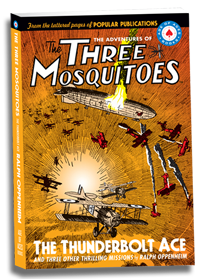
We’ll be debuting the second volume of our Captain Philip Strange series at PulpFest on Friday. So if you’re in attendance stop by our table and meet the Age of Aces crew and pick up a copy of Captain Philip Strange: Strange Enemies (and The Three Mosquitoes: The Thunderbolt Ace if you haven’t yet).

He hope to see you there!

“The Sky Cop” by Donald E. Keyhoe

Link - Posted by David on August 1, 2012 @ 8:48 pm in

To get you excited about the new Captain Philip Strange book set to come out soon, we have a story from the fertile mind of Donald E. Keyhoe. This story has everything: An amazing new invention—smashing battles and cold-blooded murder high above New York skyscrapers—take-offs from catapults atop huge city buildings—parachutes coming to earth along the Great White Way. The first story of its kind and you’re sure to enjoy it!

We’ve posted several stories by Donald E. Keyhoe on the site and collected his Vanished Legion stories from Dare-Devil Aces into a volume as well as our new series of his Captain Philip Strange stories that ran for nine years in Flying Aces. The first of which appeared just a year after this story in August 1931.

Rest in Peace Sid

Link - Posted by Bill on July 18, 2012 @ 10:47 pm in

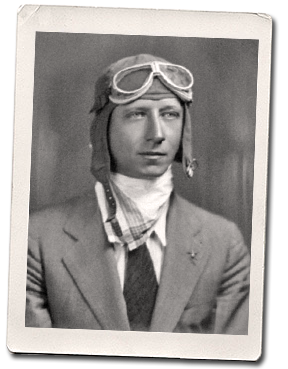
If you are a fan of the air war pulps, or have read some of Age of Aces’ pulp reprints, you have heard the name Sid Bradd. He has been writing articles about the air pulps for over 40 years. Many people know him from his essay in Nick Carr’s The Flying Spy, which detailed the life and adventures of G-8 and His Battle Aces. He was a supporter and contributor to our work here at Age of Aces. But more importantly, he was our friend.
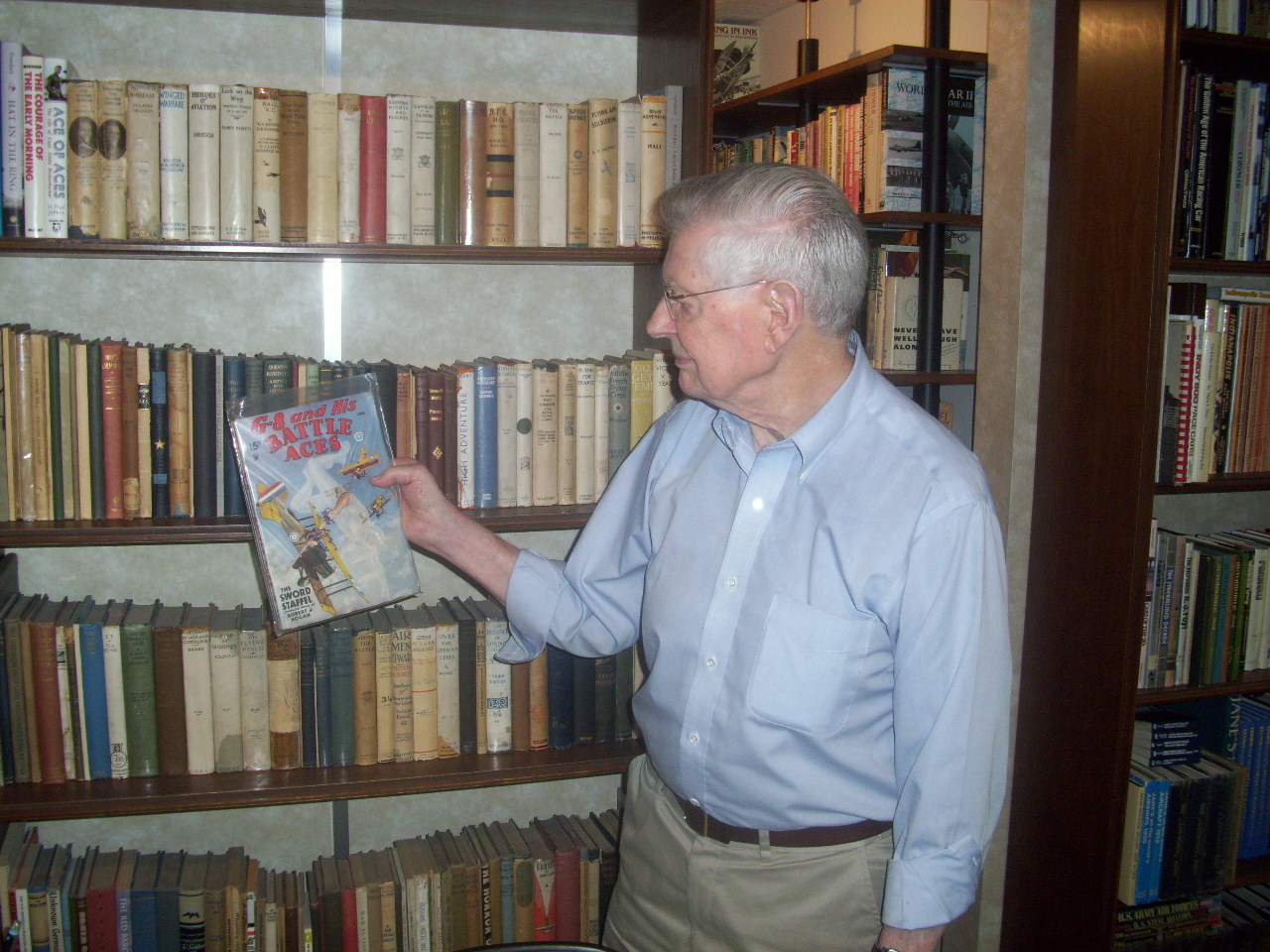
Sid_G8

Sid died on June 19, 2012. He left behind his wife of 50 years, Johanne, and three daughters. He also left behind a countless number of fans and people who have been touched by his friendship and generosity.

While I have been reading Sid’s writings for many years, I didn’t meet him until 2007. I had contacted him to get permission to use some of his research on Robert Hogan for our first “Red Falcon” book. He not only agreed to that request, he would go on to help us on many of our other projects.

Sid had been to many Pulpcons in the past, but it had been several years since he had attended one. When it was announced in 2008 that the very first Pulpfest would be held in Columbus I thought it would be great if Sid could get there from nearby Cleveland. I talked to him about it, and I offered to drive him there and back. He took me up on it, and in July 2009 I finally got to meet Sid in person.

Of course when I got to his home, the first thing I wanted to do was see his legendary aviation and pulp library. But Johanne insisted that we have lunch first. She is an awesome person, and was incredibly kind to me on my visit. After eating, Sid led me up to his library.

He had converted the entire second floor of his house into a place to hold his extensive collection of aviation books and magazines. Every wall was bookshelves from floor to ceiling. His pulp collection had its own separate room. They were all carefully bagged and boxed alphabetically. I couldn’t wait to start digging through them.

The first ones Sid wanted to show me were his pride and joy, his complete run of pristine copies of “G-8 and His Battle Aces”. Sid explained that he had become acquainted with Henry Steeger of Popular Publications. When Sid mentioned to him that he wanted to upgrade his G-8 collection, Steeger gave him a complete run of unread G-8 magazines from his files.

Steeger wasn’t the only pulp magazine legend Sid had known personally. He had also spent some time with Robert Hogan and Donald Keyhoe. In fact it was Sid’s urging that convinced us to publish Keyhoe’s “Vanished Legion” stories in 2011.

Eventually I had to drag myself away from his library so we could drive to Columbus. That drive is something that I will cherish forever. For a couple hours, Sid entertained me with tales of his experiences around the pulp and aviation worlds. The time just flew by.

We spent a lot of time together that weekend, and by the time I dropped him off at home Sunday evening, I knew I had made a friend for life. Sid seemed to really enjoy that trip, especially meeting all the Age of Aces crew. I know we enjoyed spending that time with him.

Sid had another commitment and was unable to attend Pulpfest 2010. He and Johanne drove up to Columbus and he spent a couple hours one day at Pulpfest 2011. And they were both planning to attend this year’s Pulpfest, but sadly Sid left us before that could happen.

After my first visit, Sid gave me an open invitation to come back any time. And the whole Age of Aces crew was planning a visit this year on our way to Pulpfest 2012. I did talk to him on the phone many times, but I regret not seeing him again. He was a wonderful person and a good friend.

Artist and pulp historian David Saunders recently wrote about Sid’s passing. He summed up perfectly what I was feeling but struggling to put into words:

“Sid Bradd’s authority on aviation history, his inventive mind and inspiring life experience can never be replaced. He generously contributed his skills and expertise to our projects, and in so doing raised our standards higher than we had at first thought possible. Although we always thanked him in our “acknowledgements” we could never adequately express our gratitude for his reliable expertise, his inspiring encouragement and his warm-hearted friendship.

If any of our future projects should happen to sustain a veneer of authority it will be primarily due to the lasting impact of Sid Bradd.

It’s fun to imagine a ten-year-old Sid Bradd in 1935 reading G-8 and his Battle Aces and discovering his own lifelong inspiration.”

Rest in peace Sid. We will miss you.

Sids library

The Thunderbolt Ace!

Link - Posted by David on July 17, 2012 @ 7:52 pm in

thunderbolt_3dStreaking swiftly through Hell skies, their three Hisso engines thundering, we find The Greatest Trio of Aces! The famous and inseparable “Three Mosquitoes,” the mightiest flying combination that had ever blazed its way through overwhelming odds and laughed to tell of it, take off in four more exciting adventures from the pages of Popular Publications! Yes, Kirby, impetuous young leader of the great trio, lanky Travis, eldest and wisest of the Mosquitoes, and the mild-eyed, corpulent little Mosquito—“Shorty” Carn are all back and ready for action. This time up we have two tales from 1932 issues of Dare-Devil Aces and two from 1933 that were published in Battle Birds. If you enjoyed the pride and glory of the 44th’s last two books then you’ll surely want to pick up this volume. And if you are new to The Adventures of The Three Mosquitoes, what better place to start than with The Thunderbolt Ace!

thunderbolt_ad

“They Had What It Takes – Part 39: Tony Fokker” by Alden McWilliams

Link - Posted by David on July 16, 2012 @ 6:07 pm in

With the 39th installment of Alden McWilliams’ “They Had What It Takes” in Flying Aces, he chronicles the man who is maybe the greatest aircraft designer of all time—The Flying Dutchman himself, Anthony Fokker!

Fokker was training as an automotive mechanic in Germany when he built his first plane—”The Spider”—in 1910. That plane was subsequently destroyed when his partner flew it into a tree. Fokker built another and managed to gained his piolt’s licence flying it. By 1912 he had started his own Airplane Company and quickly established a reputation for building some of the fastest and most stable planes flying at the time. One of the keys to his success is that he personally tested all the planes he designed and kept the pilot in mind asking their opinions on the planes. He sought out the advice of the men on the flight line and brought in the best engineers he could find.

With the outbreak of WWI, Fokker’s designs were very much in demand and soon the greatest names in German aviation—Voss, Immelmann, Boelke and Richtoffen—were being cursed at while flying his planes.

After the war he returned to his native Holland establishing a company there and later emigrating to America where his tri-motor planes helped establish the fledgling airlines and some of the great airplane records of the 30’s. Fokker unfortunately died at 49 in 1939 from pneumococcal meningitis after having been ill for three weeks.

“They Had What It Takes – Part 38: Grover Loening” by Alden McWilliams

Link - Posted by David on July 9, 2012 @ 4:57 pm in

Alden McWilliams continues his look at the great airplane designers in his “They Had What It Takes” feature from Flying Aces. It’s March 1940, and this time we have Grover Loening.
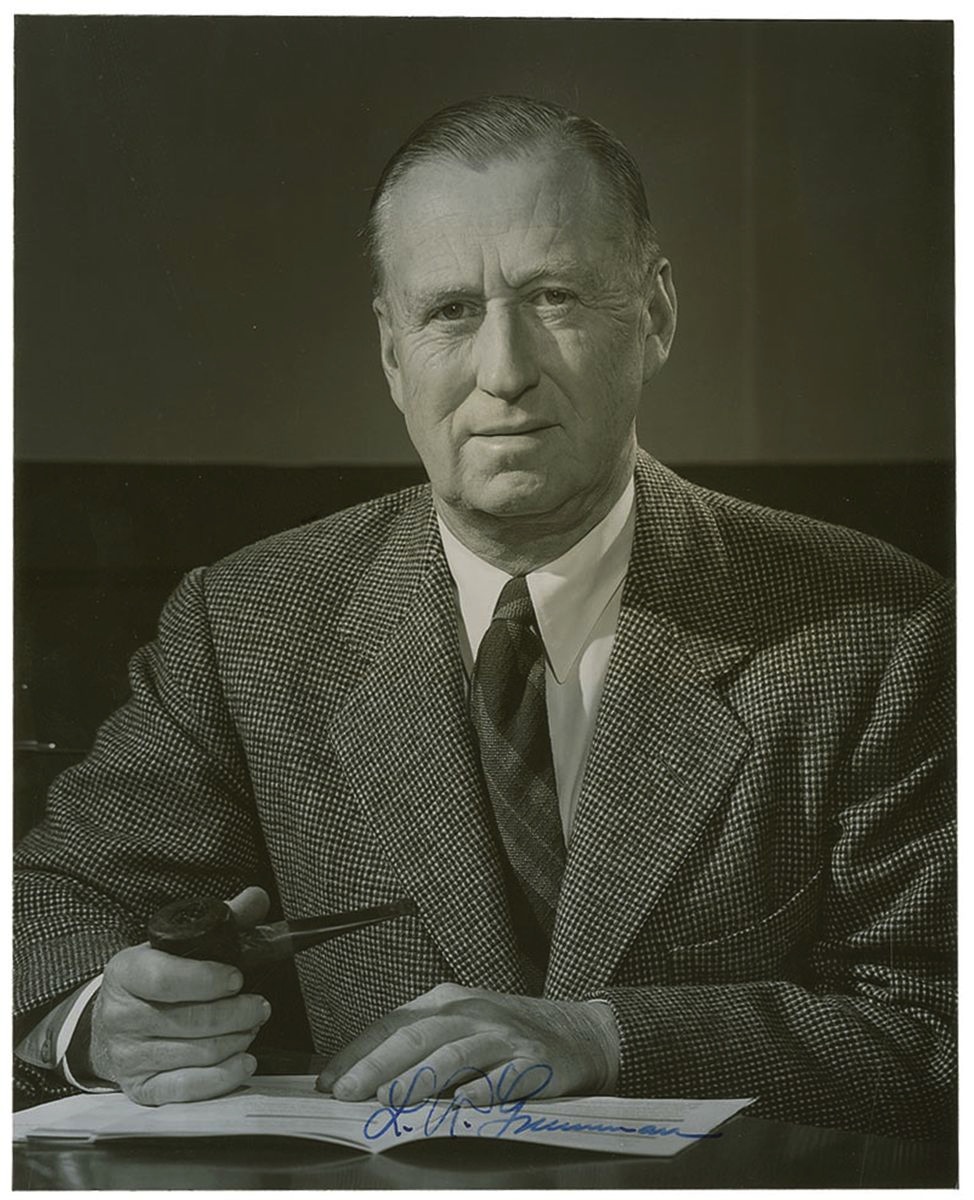
Grover Loening was a noted American aircraft manufacturer, who got his start as an assistant engineer to Orville Wright before starting his own company. He was known for test flying his own planes and at one time employed Leroy Grumman, William T. Schwendler, and Jake Swirbul who left to form Grumman. Of his many accomplishments, Loening was appointed chief aero-engineer for the Army Signal Corps in World War I and was chief consultant to the War Production Board, NACA and Grummand during the Second World War.

Grover Loening lived to the ripe old age of 87, passing away in 1976.

“They Had What It Takes – Part 37: Leroy E. Grumman” by Alden McWilliams

Link - Posted by David on July 3, 2012 @ 2:59 pm in

In this and the next few installments of Alden McWilliam’s “They Had What It Takes,” McWilliams turns his pen to those who designed the planes. First up, from the February 1940 issue of Flying Aces we have Leroy E Grumman (or Leroy R. Grumman as history records him).
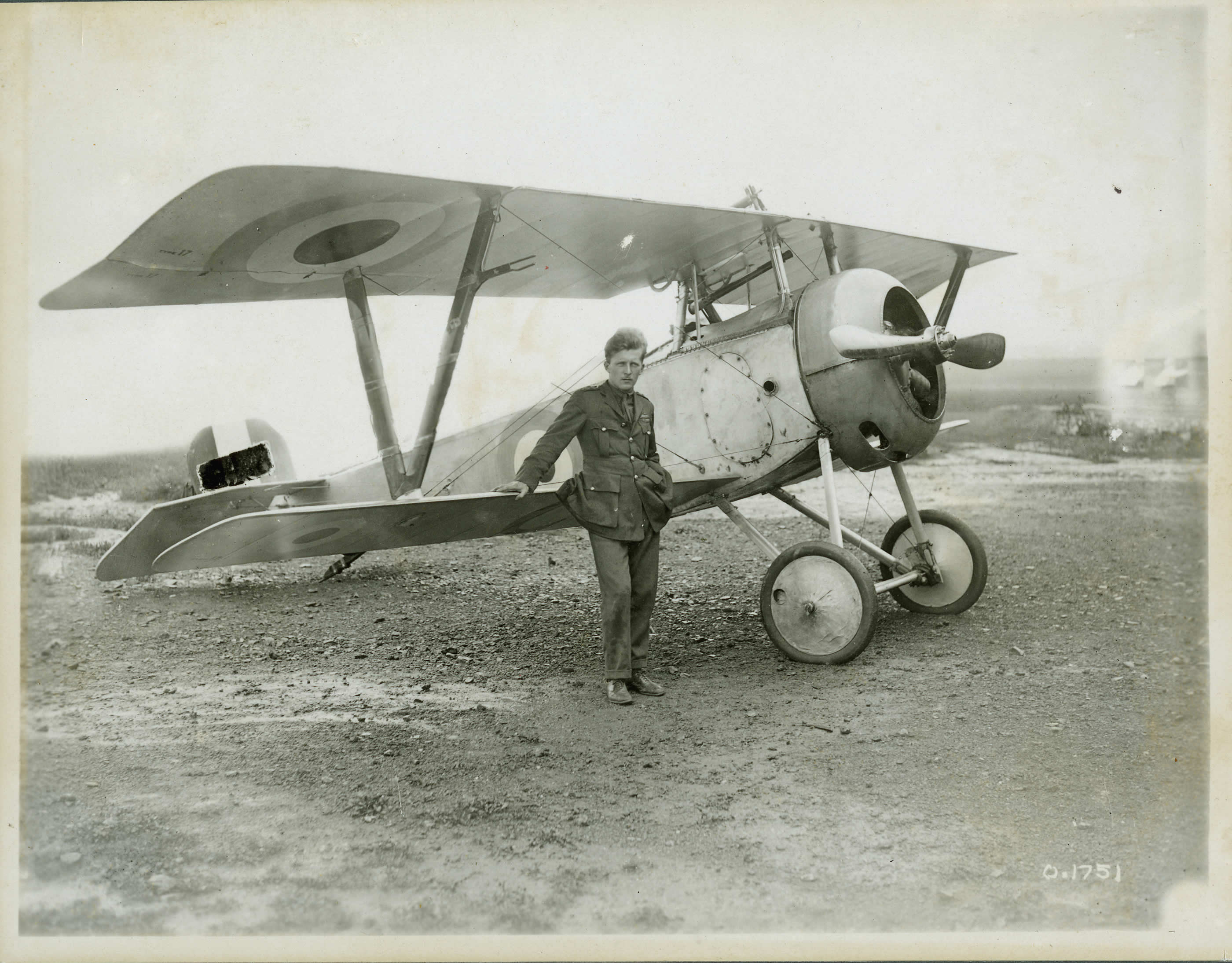
Grumman may have started out as a Navy flier, but he went on to become one of the leaders in Aircraft design and beyond. The company he founded in 1930 by mortgaging his house and pooling that money with several other investors would go on to build some of the key planes of WWII—The F4F Wildcat, F6F Hellcat and the TBF Avenger torpedo bomber. After the war the company continued to supply the Navy with excellent fighter aircraft like the A-6 Intruder in the 1960’s and the F-14 Tomcat of the 1970’s, but sought out new markets as well. They developed the Gulfstream series of corporate Jets and the Apollo program’s Luner Excursion Module (LEM) that landed astronauts on the moon!

Grumman passed away in 1982 at the age of 87, but his company, which had been aquired by Northrop lives on as Northrop Grumman, one of the largest defence contractors in the world.

“They Had What It Takes – Part 36: Billy Bishop” by Alden McWilliams

Link - Posted by David on June 16, 2012 @ 2:05 pm in

This week we bring you the thirty-sixth installment of Alden McWilliams’ illustrated tribute to the pioneer fliers of the early days of aviation which he called “They Had What it Takes”. We’re up to the January 1940 issue of Flying Aces where McWilliams featured Canada’s Greatest WWI Ace—Billy Bishop!

William Avery “Billy” Bishop, V.C. has been credited with 72 victories making him the fourth greatest Ace of the First World War. He was made an honorary Air Marshall of the Royal Canadian Air Force and placed in charge of recruitment in 1938 and developed a training program for pilots across Canada during the Second World War. Stress would eventually see him resign his post in the RCAF in 1944, but remained active in aviation, even offering to return to his recruitment role with the RCAF with the outbreak of the Korean War (he was politely refused by the RCAF due to poor health).

Billy passed in his sleep in 1956 while wintering in Palm Beach, Florida and was buried in Greenwood Cemetery in Owen Sound, Ontario where he was born 62 years earlier.

“They Had What It Takes – Part 35: Major Fred Lord” by Alden McWilliams

Link - Posted by David on November 29, 2011 @ 12:21 pm in

Alden McWilliams’ illustrated tributes to the pioneer fliers of the early days of aviation ran in Flying Aces from 1937 through 1940. McWilliam’s bio-graphical sketch for the December 1939 issue was Major Frederic Ives Lord—a real life version of Chinese Brady! A self-described soldier for hire, Major Lord flew in five different wars: The First World War, The Russian Cival War, The Mexican Revolution, The Spanish Cival War, and The Second World War.
According to his wikipedia entry, Major Lord was a keen writer, often chronicalling his exploits. A number of these appeared in Flying Aces while his unpublished papers are held in the archives of the Rabb Collection along with hundreds of photographes of Lord frequently with his plane. Lord even “approached movie production companies in the hopes that his story would be turned into a feature film.”

He lived to the age of 70 when he was killed by a vagrant in Apple Valley, California in 1967.

The G-8 Premiums Declassified

Link - Posted by Chris on October 10, 2011 @ 8:51 am in

When the publishers of G-8 and His Battle Aces announced the formation of a G‑8 Club in the seventh issue (April 1934), G-8 promised that “this club is going to be different from any other magazine club in the country. It will be a secret organization.” So successful was the club that it persisted throughout the ten-year run of the magazine; So successful was the pledge of secrecy that NO evidence of its membership has turned up in the last 75 years. Until now.

Admittedly, proof of the club outside of the monthly editor’s column, “G-8 Speaks,” is rare. As G-8 explained: “There will be no cards — no buttons — no emblem of any kind. The only ones who know they are members will be the members themselves. Just as the Secret Service is run. Get it?”

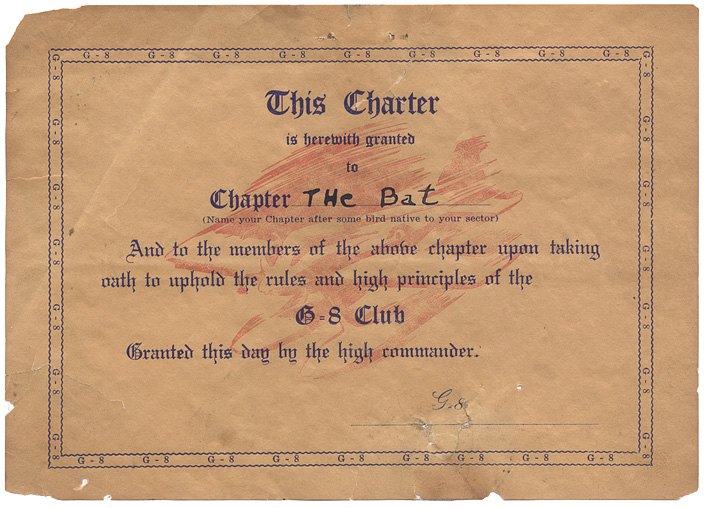
But even though individual members did not receive identifying papers from the magazine, local chapters of five or more kids did, in the form of a G-8 Club Charter. In order to form a chapter of the G-8 Club in your community all you needed to do was find four friends who also bought G-8 every month, and mail in five club coupons from the same issue. (Some chapters were formed by individuals in different communities connecting through the G-8 letters column.) The June issue reported that the very first chapter of the G-8 Club mailed their coupons on February 28th — actually a day before the street date of the April issue that announced it.

G8Club-charter

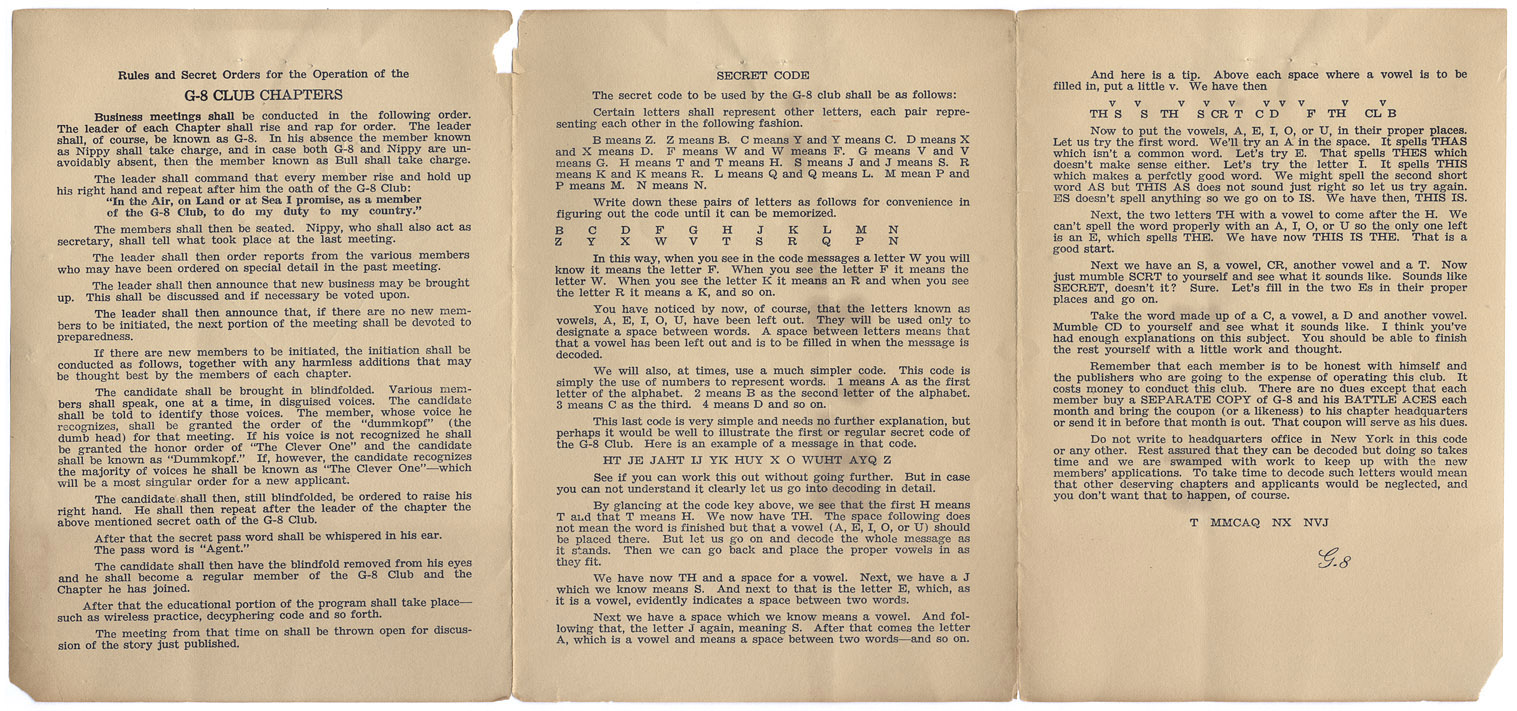
Qualifying clubs received a charter, a small (7″x5″) but distinguished-looking two-color certificate with a blank for the name of the chapter (ideally to be named after a local bird) and “signed” by G-8. In addition they received the Rules and Secret Orders for the Operation of the G-8 Club Chapters a tri-fold brochure (5″x7″ folded) that consisted of one page detailing the meeting rules (including an oath) and two pages describing the club’s SECRET CODE, none of which was ever reprinted in the magazine.

G8Club-rules

Members of the G-8 Club apparently took their secrets all the way to the grave or the nursing home, because neither of these giveaways had ever been documented by collectors or pulp historians until two weeks ago, when one example of each turned up at auction. The only other known G-8 premium is equally rare …

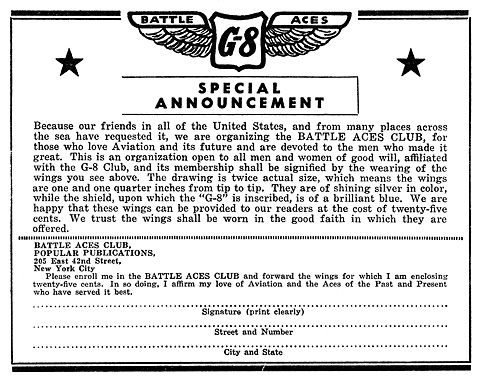
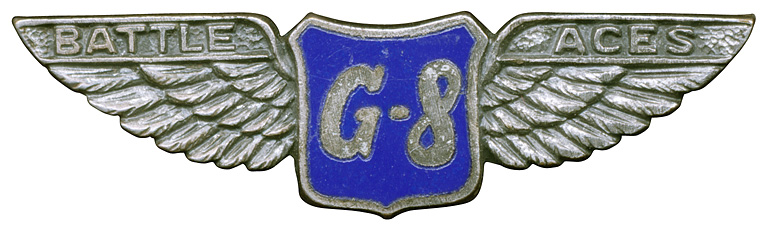
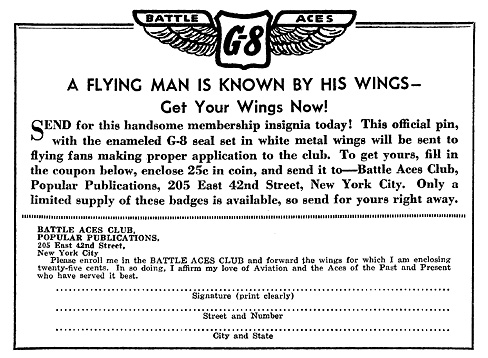
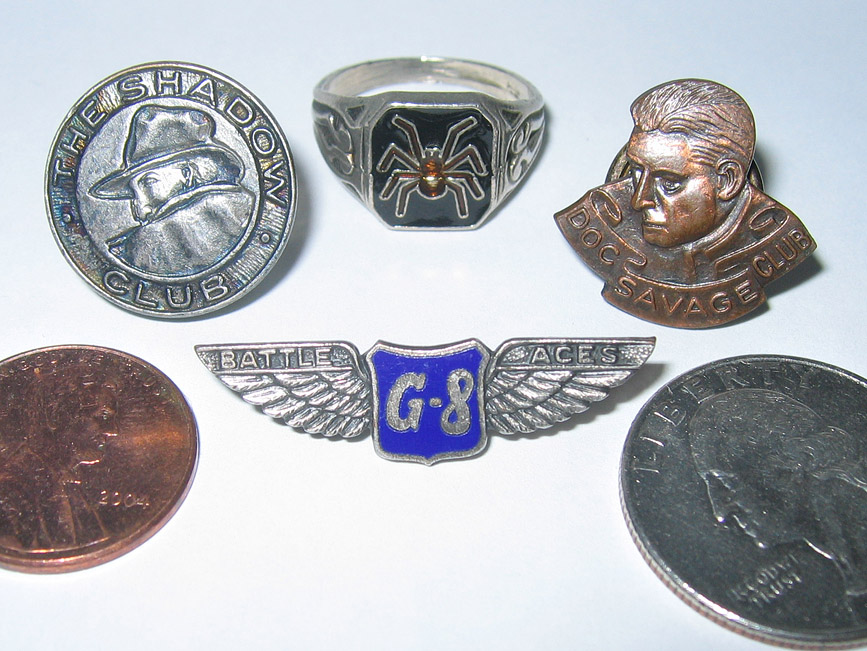
G-8 and His Battle Aces didn’t offer any other premiums for many years following the launch of the club. Then, in the November 1939 issue, came the “Special Announcement” of the G-8 Battle Aces Club Wings — silver metal wings with a blue enamelled shield in the center, measuring 1.25″ wide. As the announcement makes clear, this is not for the secretive G-8 Club (remember, that would blow your cover) but a separate, “affiliated” Battle Aces Club.

G83911_announcement

BattleAces-wings

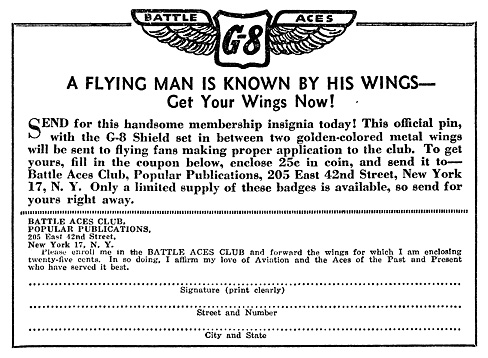
Strangely, after this “Special Announcement” there was no mention of the badge again until the April 1941 issue, when the wings coupon became a staple of the club section of the magazine through October 1942. The wings offer reappeared for two months in the final year of G-8, with a interesting variation: golden wings. Only one example of the G-8 Wings has ever turned up and yet it sold at auction in 2007 for only $800. Like the Spider Ring, the G-8 wings were produced by Uncas Manufacturing Co. of Providence, Rhode Island, and bear the company stamp of a “U” with an arrow through it.

Silver Wings Coupon

Silver Wings Coupon

Gold Wings Coupon

Gold Wings Coupon

Comparison of G-8 wings with Shadow & Doc pins and (repro) Spider Ring

Comparison of G-8 wings with Shadow & Doc badges and (repro) Spider Ring

“They Had What It Takes – Part 34: Clarence Chamberlin” by Alden McWilliams

Link - Posted by David on September 8, 2011 @ 6:20 pm in

Alden McWilliams’ illustrated tribute to the pioneer fliers of the early days of aviation was called “They Had What it Takes”, and this week we bring you the 34th installment, which appeared in the November 1939 Flying Aces. . In this week’s installment McWilliams brings his talents to rendering the life of that Trans-Atlantic vet, Clarence Chamberlin.
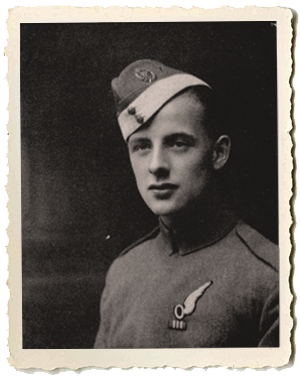
Clarence Chamberlin just missed out on being the household name that Lindbergh became. When Lindbergh took off, the plane’s owner Levine was still tinkering with the plane and arguing with who would pilot it—thus preventing Chamberlin from becoming the first to fly solo across the Atlantic. However, several weeks later, Chamberlin took off with Levine as a passenger and became the second man to pilot a fixed wing aircraft across the Atlantic to the European mainland, but the first to take a passenger! And he flew further setting a distance record, landing in Eisleben, Germany when he ran out of gas—just 110 miles short of his goal of Berlin.

“They Had What It Takes – Part 33: Arch Whitehouse” by Alden McWilliams

Link - Posted by David on August 24, 2011 @ 9:12 pm in

This week we bring you Part 33 of Alden McWilliams’ illustrated tribute to the pioneer fliers of the early days of aviation. He called it “They Had What it Takes” and this installment appeared in the October 1939 Flying Aces. It features our old pal here at Age of Aces—Arch Whitehouse. Whitehouse was a prolific writer, both for the pulps and aviation-themed books after the pulps ended. We’ve posted a number of Whitehouse’s stories from Flying Aces and Sky Birds with some of his long running characters like Buzz Benson, Crash Carringer, Coffin Kirk, The Casket Crew, Tug Hardwick and The Griffon!

Arch Whitehouse was blessed with a fertile imagination which seemed to spill over into the acounts of his own war record. McWilliams piece and Whitehouse’s own biography, Hell in Helmets, credit Whitehouse with shooting down 16 German aeroplanes—at most he may have had 4 kills—it seems that he was something of a serial exaggerator.

We’ve posted this installment long before we started posting the entire series of Alden McWilliam’s “They Had What It Takes”, but here it is in sequence in case you missed it.

Next time: Clarence Chamberlin—Trans-Atlantic Vet.

New Strange Desktops

Link - Posted by David on August 21, 2011 @ 2:38 pm in

We can’t stop harping on about the excellent art work that doesn’t get enough credit in our books. Frederick Blakeslee and John Flemming Gould were masters at rendering airplanes in flight while our own Chris Kalb’s inventive designs are simply the coolest out there.

In our books the spine breaks up the tableaus—and in the interior art galleries we present the art as it was originally published. We spend some time mending the images back together to create a complete image—with a majority of our work ending up in the gutter of the book anyway. Some of these images are just so good we felt the needed to turn them into desktops for you to enjoy on your computer everyday. And we’re getting the ball rolling with three of Chris’ splash page treatments from our latest book, Captain Philip Strange: Strange War. You can choose from the plane vs. pterodactyl of Scourge of the Skies; the bullseye cocarde of Cocardes of Courage; or the green flaming bombs, in black and white here, of The Unholy Horror!

strange_wp_spot

They are available in our Age of Aces Desktops Gallery in a variety of aspect ratios—pick the one that best suits your computer.

We plan to add to the gallery with images from previous books as well as those to come!

“They Had What It Takes – Part 32: “Casey” Jones” by Alden McWilliams

Link - Posted by David on August 16, 2011 @ 10:45 pm in

Age of Aces presents the thirty-second installment of Alden McWilliams’ illustrated tribute to the pioneer fliers of the early days of aviation. This week McWilliams chronicles the life and contributions to aviation of aero booster No.1—Charles S. “Casey” Jones. Jones, a veteran of the hell skies of WWI, would rise to prominance as one of the great air racers of his time. He used his popularity to sell the American public on aviation, contributing to radio shows and having columns in two leading aviation magazines—”Flying Colors” in Air Adventures (1928-29) and “Casey Jones’ Flying Course” in Sky Birds (1933-34).

In 1932 he founded the Casey Jones School of Aeronautics along with Lee D. Warrender and George A. Vaughn Jr. The school went through a number on name changes, the most recent was in 2004 when it was remamed after Vaughn.

Casey passed away in February 1976.

Get Strange!

Link - Posted by David on July 29, 2011 @ 10:29 pm in

Yes, the first book in our new series, Captain Philip Strange: Strange War is here and just in time for the 80th Anniversary of the publication of his first appearance in Flying Aces Magazine in August of 1931!

We were at the PulpFest in Columbus, Ohio this weekend premiering our new book. Strange War has six exciting stories of “the Phantom Ace of G-2″ with an introduction by Sid Bradd and all beautifully wrapped up in an exciting new design by Chria Kalb. Keyhoe’s Brain-Devil takes on all manner of pterodactyls, flaming fire balls raining down from the sky and demon aces with the help of Tom and Noisy Jay—the twin aces of G-2 affectionately known as the Jay Birds.

The Captain Philip Strange stories ran for nine years—from 1931 through 1939—in the pages of Flying Aces magazine. And we’re already preparing the second volume which will collect the Fraulein Doktor stories—Strange’s former love, now nemesis due to circumstances brought about by the war. (This book will be out later this year.)

Strange War should be available at Amazon very soon—it sometimes takes a day or two for them to add the book to their system. And speaking of PulpFest, for those who couldn’t attend, here are some links to download the various flyers he had out for people to pick up:

« Previous PageNext Page »