



My Most Thrilling Sky Fight: Lieutenant Norman Prince
AMIDST all the great pulp thrills and features in Sky Fighters, they ran a true story feature collected by Ace Williams wherein famous War Aces would tell actual true accounts of thrilling moments in their fighting lives! This time we have the founder of the LaFayette Escadrille—Lieutenant Norman Prince!
Born to the purple on 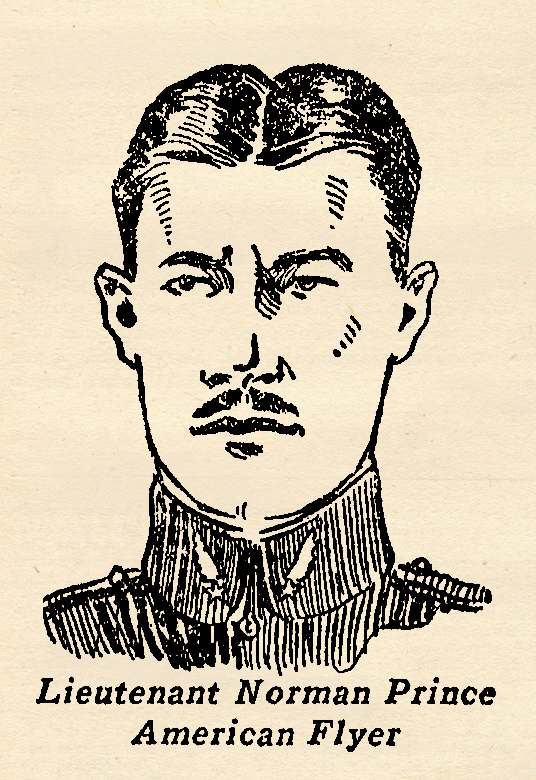 August 31, 1887, scion of one of the blue-blooded families In old Boston, was Norman Pslnce, the founder of the famous LaFayette Escadrille. Educated at Groton and Harvard for a career in business with his wealthy family, he hazarded his promising future and used his wealth and family prestige in overcoming obstacle’s to form a squadron of American aviators for battle at the front. With him in the beginning were Thaw, Chapman, Rockwell, McConnell, Hall and Cowdin. These Americans with Prince made up the roster of the original squadron sent up to the front at Luxeuil in May, 1910.
Later on it became known as the Escadrille de Lafayette and 325 fighting pilots flew under its proud banner before the war came to an end. Prince’s career on the front was short but meteoric. Before he was killed, however, on October 15, of the same year, he had engaged in 122 aerial combats and won every award possible for his many acts of bravery and heroism. The story below is taken from the records of a French war correspondent.
SOLO TO DOUAI
by Sous-Lieutenant Norman Prince • Sky Fighters, May 1936
A HIDDEN Boche artillery emplacement was holding up the French advance on the captured fortress of Douai. The General des Armees became frantic. His cavalry scouts had failed. Infantry patrols had learned nothing. The Boches had command of the air. But locating the hidden emplacement was imperative. Though the weather was far from auspicious, the General demanded that the avions de chasse break through the Boche net and discover the hidden guns so that our 75s could destroy them.
It was a grim, desperate order. The sky was on the ground in spots. It was rain and sunshine alternately, and the wind blew in whirling tempests across our front . . . very bad weather for flying. And much, more worse for reconnaissance. Twenty-four avions took off on that desperate mission, 4 from our squadron; the rest from other squadrons nearby, including the famous Storks.
Little Hope of Returning
I had few hopes of returning when I lifted wings into the air on that bleak day. But one thing I vowed: no Boche in the sky or on the earth was going to force me to turn back until I had won through to Douai. I did not fear death. I feared only that I would not be able to accomplish the mission; that no one of us would.
The first half hour it was a battle against wind and weather. My frail avion tossed up and down like a cork. For a few minutes I saw my comrades on either side of me, then they gradually faded into the dismal sky and I found myself alone in a dripping, grey-black void. My thoughts were somber and the whirling rotary engine seemed to sob out a sinister cadence: “Solo to Douai! Solo to Douai!â€
I caught myself mouthing it aloud in rhythm with the moaning exhausts where I was rudely awakened from my lethargy by the stitching, ripping sound of Boche bullets tearing into the fuselage at my back. Instinctively I whirled off in an abrupt virage and saw black spots that were enemy planes dotting the grey sky all around me . . . and the fortress of Douai was immediately beneath!
Enemy Avions
I took in everything with a single, darting glance. My Lewis coughed sharply as I spiraled down through the converging black specks. Some of those black specks puffed and mushroomed . . . shrapnel bursts! Others grew wings and blue smoke spouted over engine nacelles . . . enemy avions!
How many I did not know. There was not time to count. I circled, dived, zoomed; firing my piece when Boche shapes slid by in my sights. I got one I know, for I saw the avion sway and fall away in a lazy zig-zag glide with black smoke pluming from the cockpit.
But that was not important. More important was the blinding flash of firing guns just below me . . . the hidden gun emplacement! There it was in a wooded copse beyond and to one side of the fortress of Douai.
There was no need of me tarrying longer over Douai! Back I whirled with my avion not more than 500 meters off the ground. Bullets from sky and earth rained around me like hail.
Ages passed, it seemed, before our trench lines loomed beneath me. But finally they showed, then my own airdrome, the green turf glistening like an emerald in the sudden sunshine.
I set down safely to find that of the 24 who tried to reach Douai, I was the only one to succeed. And I had returned with what the General ordered. Fate had favored me, but I know that she shan’t always do so. Some day I shall not return.
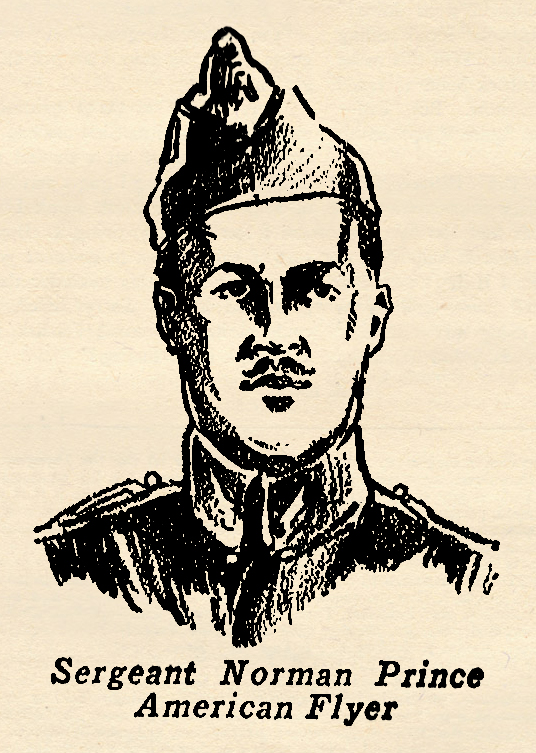 France when the World War began. Being immensely wealthy in his own right, he offered to furnish and equip an entire squadron of planes and pilots. The French Army would not accept this generous offer, but Prince, acting in co-operation with William Thaw of Pittsburgh, convinced the officials that they could muster enough Americans to man an entire squadron. Their offer was accepted, and the LaFayette Escadrille was born. A French officer was put in command. All the rest of the pilots were American. Prince’s death was tragic. Though wounded in an air battle, he managed to fly his crippled plane homeward, and was about to land on his own airdrome in the gathering darkness when his plane ran into a telephone pole and crashed. In his weakened condition he did not have strength enough to guide his plane over or around the obstacle. So perished one of the bravest and most courageous of the early American pilots who gave their lives for France. The story below was told to a French reporter.