



The Man Behind The Mosquitoes
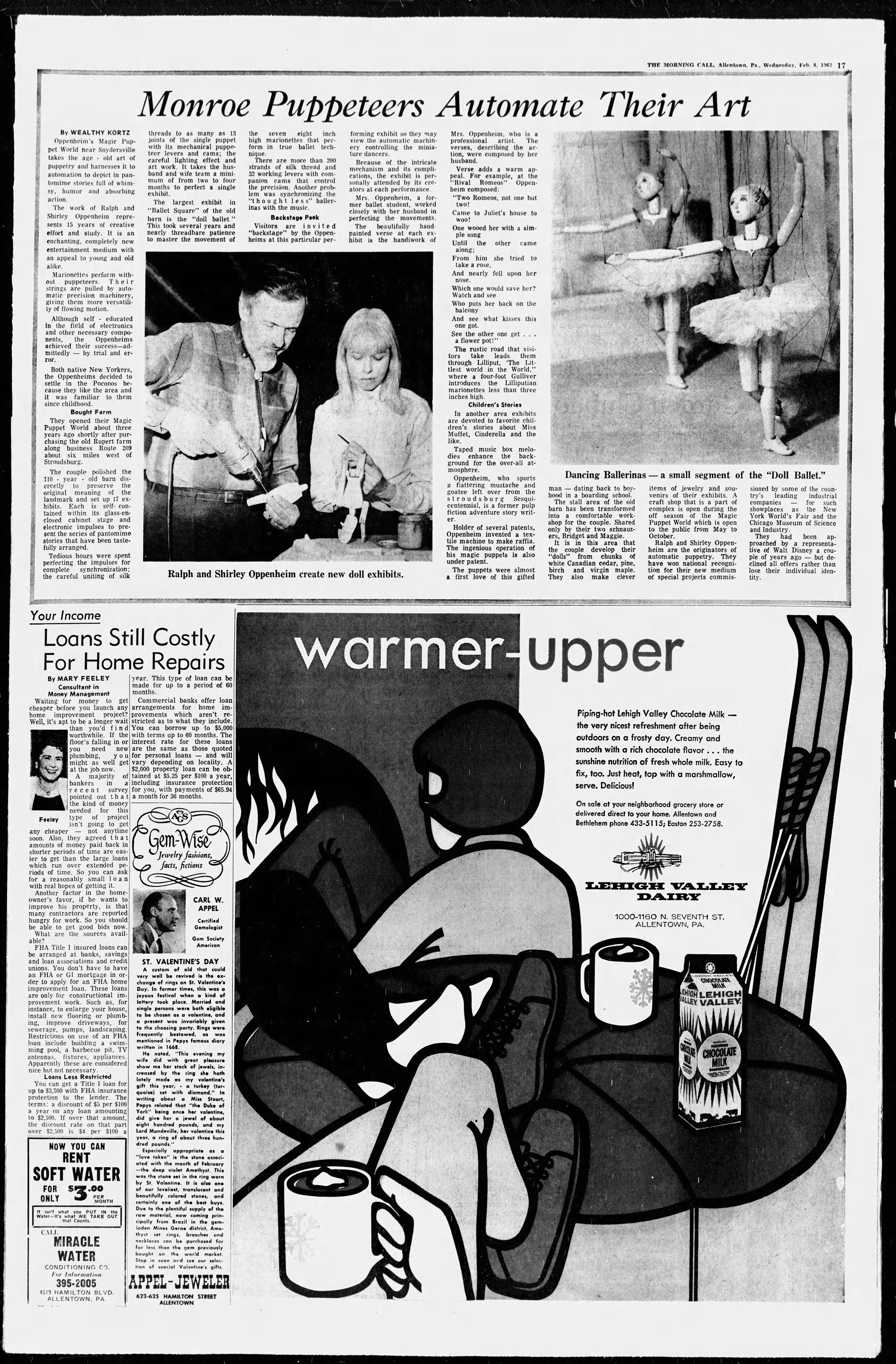
BACK in 2015 during our first Mosquito Month, we ran a series of articles from The Pocono Record that covered Oppenheim’s Magic Puppet World. Recently, I came upon another article about Ralph and Shirley Oppenheim and their Magic Puppet World—this time from nearby Allentown, PA’s The Morning Call from 1967—complete with a picture!
Monroe Puppeteers Automate Their Art
by WEALTHY KORTZ | The Morning Call, Allentown, PA • 8 February 1967
Oppenheim’s Music Puppet World near Snydersville takes the age-old art of puppetry and harnesses it to automation to depict in pantomime stories full of whimsy, humor and absorbing action.
|
|
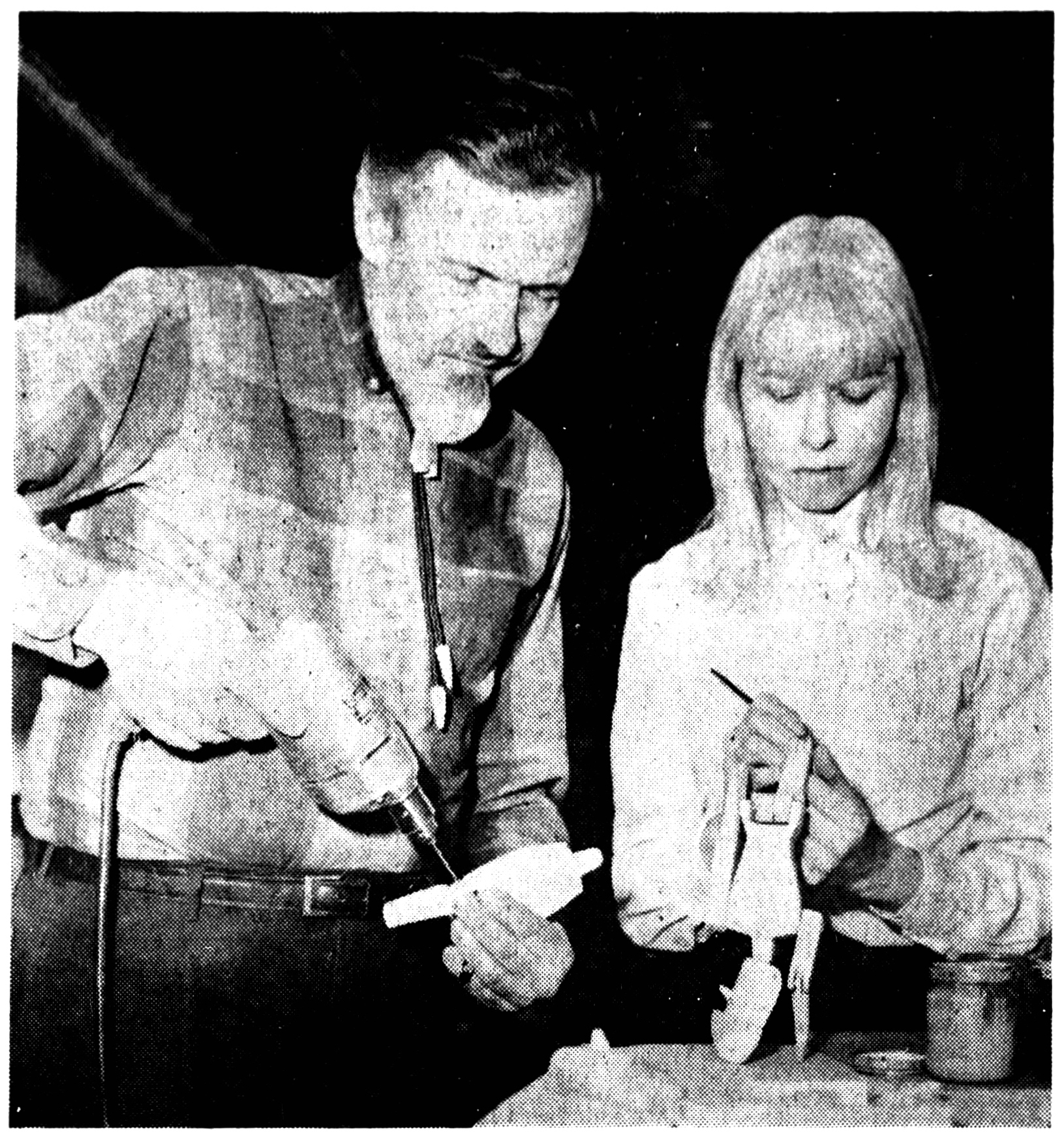
The work of Ralph and Shirley Oppenheim represents 15 years of creative effort and study. It is an enchanting, completely new entertainment medium with an appeal to young and old alike.
Marionettes perform without puppeteers. Their strings are pulled by automatic precision machinery, giving them more versatility of flowing motion.
Although self-educated in the field of electronics and other necessary components, the Oppenheims achieved their success—admittedly—by trial and error.
Both native New Yorkers, the Oppenheims decided to settle in the Poconos because they like the area and it was familiar to them since childhood.
Bought Farm
They opened their Magic Puppet World about three years ago shortly after purchasing the old Rupert farm along business Route 209 about six miles west of Stroudsburg.
The couple polished the 110-year-old barn discreetly to preserve the original meaning of the landmark and set up 17 exhibits. Each is self-contained within its glass-enclosed cabinet stage and electronic impulses to present the series of pantomime stories that have been tastefully arranged.
Tedious hours were spent perfecting the impulses for complete synchronization; the careful uniting of silk threads to as many as 13 joints of the single puppet with its mechanical puppeteer levers and cams; the careful lighting effect and art work. It takes the husband and wife team a minimum of from two to four months to perfect a single exhibit.
|
|

The largest exhibit in “Ballet Square” of the old barn is the “doll ballet.” This took several years and nearly threadbare patience to master the movement of the seven eight inch high marionettes that perform in true ballet technique.
There are more than 200 strands of silk thread and 32 working levers with companion cams that control the precision. Another problem was synchronizing the “thought1ess” ballerinas with the music.
Backstage Peek
Visitors are invited “backstage” by the Oppenheims at this particular performing exhibit so they may view the automatic machinery controlling the miniature dancers.
Because of the intricate mechanism and its complications, the exhibit is personally attended by its creators at each performance.
Mrs. Oppenheim, a former ballet student, worked closely with her husband in perfecting the movements.
The beautifully hand-painted verse at each exhibit is the handiwork of Mrs. Oppenheim, who is a professional artist. The verses, describing the action, were composed by her husband.
Verse adds a warm appeal. For example, at the “Rival Romeos” Oppenheim composed:
“Two Romeos, not one but two!
Came to Juliet’s house to woo!
One wooed her with a simple song
Until the other came along;
From him she tried to take a rose,
And nearly fell upon her nose.
Which one would save her?
Watch and see
Who puts her back on the balcony
And see what kisses this one got.
See the other one get . . . a flower pot!”
The rustic road that visitors take leads them through Lilliput, “The Littlest world in the World,” where a four-foot Gulliver introduces the Lilliputian marionettes less than three inches high.
Children’s Stories
In another area exhibits are devoted to favorite children’s stories about Miss Muffet, Cinderella and the like.
Taped music box melodies enhance the background for the over-all atmosphere.
Oppenheim, who sports a flattering mustache and goatee left over from the Stroudsburg Sesquicentennial, is a former pulp fiction adventure story writer.
Holder of several patents, Oppenheim invented a textile machine to make raffia. The ingenious operation of his magic puppets is also under patent.
The puppets were almost a first love of this gifted man — dating back to boyhood in a boarding school.
The stall area of the old barn has been transformed into a comfortable workshop for the couple. Shared only by their two schnauzers, Bridget and Maggie.
It is in this area that the couple develop their “dolls” from chunks of white Canadian cedar, pine, birch and virgin maple. They also make clever items of jewelry and souvenirs of their exhibits. A craft shop that is a part of complex is open during the off season of the Magic Puppet World which is open to the public from May to October.
Ralph and Shirley Oppenheim are the originators of automatic puppetry. They have won national recognition for their new medium of special projects commissioned by some of the country’s leading industrial companies — for such showplaces as the New York World’s Fair and the Chicago Museum of Science and Industry.
They had been approached by a representative of Walt Disney a couple of years ago — but declined all offers rather than lose their individual identity.
- Download “Monroe Puppeteers Automate Their Art”
(8 February 1967, The Morning Call)
With Ralph’s death in August 1978, Shirley closed up the Oppenheim Gallery and Puppet World and moved back to New York City to be near family. She passed away in 2006.
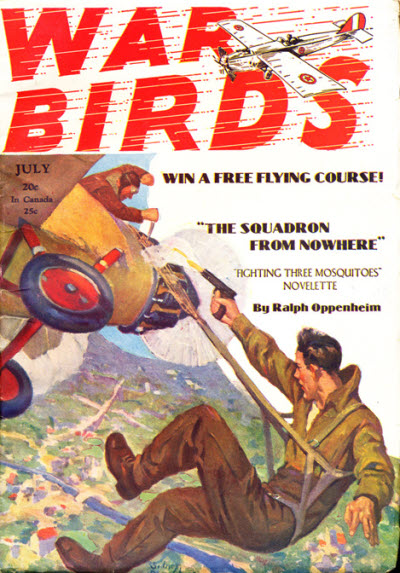 the second of three Three Mosquitoes stories we’re presenting this month. The Three Mosquitoes have been dispatched to the Scottish Highlands to investigate sightings of German Gothas! Equipped with brand new Sopwiths, the Three Mosquitoes take on The Black Raiders and try to fathom how these planes could even be this far from their Fatherland and so perilously close to the shipbuilding yards of Deemsgate! It’s a mystery whose answer lies in the craggy mountains of Scotland!
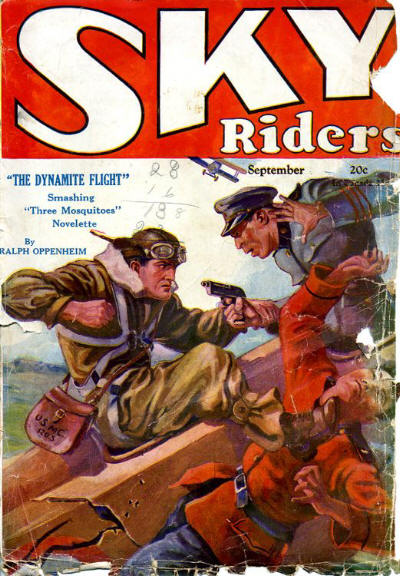 Mosquitoes—the approach of spring has brought the Mosquitoes out of hibernation to help hurry on the warm summer months ahead. At Age of Aces dot net it’s our fifth annual Mosquito Month! We’ll be featuring that wiley trio in three early tales in the hell skies over the Western Front. And we’re starting things off with a bang! The Germans have developed a new super explosive they’ve called XXX—five time as powerful as the Allies’ most destructive explosives! A boast they demonstrate by wiping the 44th Squadron’s drome off the face of the map! The Three Mosquitoes concoct a perilous plan to sneak into the largest and most well-guarded German munitions plants where the XXX is being manufactured and blow it all to kingdom-come!
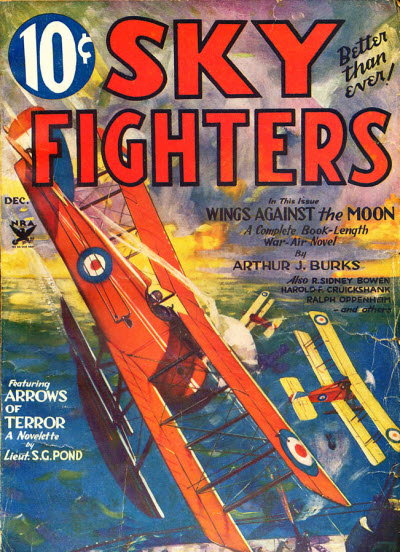 great story from the pen of Ralph Oppenheim. Best known in these parts for
 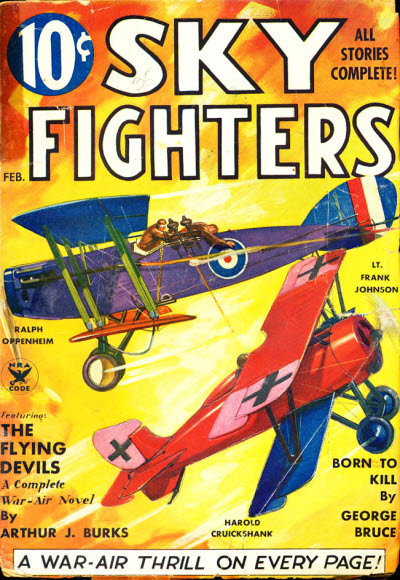 Mosquito Month we have a non-Mosquitoes story from the pen of Ralph Oppenheim. “Streak” Davis must stop Erich von Hartwig, Germany’s master flying spy—the craftiest and most underhanded Boche in the war! Von Hartwig just murdered three Allied officers at Chaumont in cold blood—then made off with a dispatch cylinder containing most vital information of our troop movement. His orders: “Head him off and burn von Hartwig and his black Albatross in the sky so there’s no chance of those papers falling into German hands!”
 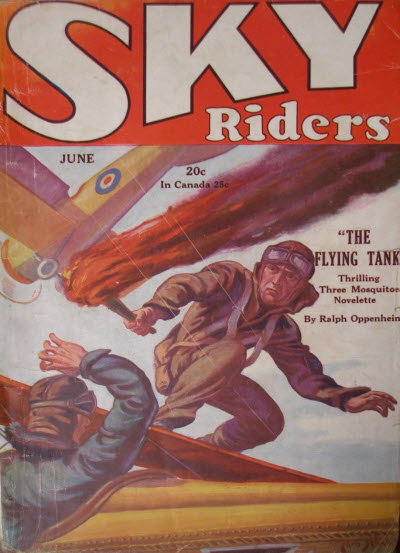 the third of three Three Mosquitoes stories we’re presenting this month. This week the inseparable trio and sent to destroy an indestructible allied tank that has been stolen by a german spy. Kirby, Shorty and Travis must stop the germans from stealing all the secrets of the X Tank by any means possible and at all costs! From the June 1930 issue of Sky Riders, it’s “The Flying Tank!”
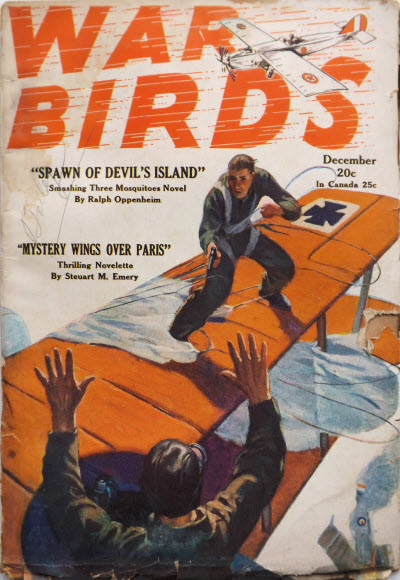 the second of three Three Mosquitoes stories we’re presenting this month. The Mosquitoes fame had spread to such an extent on the Western Front that the German high command had issued a general order to get them, alive or dead. To cool things down, our impetuous trio has been temporarily reassigned to the British East African front. While on patrol the trio is hit by a violent tropical storm and separated. Kirby finds himself swept out over the Indian Ocean. After a confrontation with a Zeppelin he tried to take with him, Kirby is forced to land on a scraggy rock in the middle of the ocean. Marooned. His only company the skeletons of the island’s previous visitors, until—it turns out he did bring down the zeppelin, unfortunately the german crew of said zeppelin find themselves marooned on the same rock! From the December 1st, 1929 number of War Birds, it’s The Three Mosquitoes vs the “Spawn of Devil’s Island!”
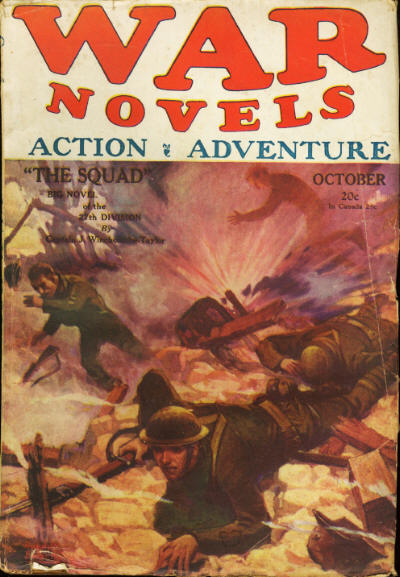 Mosquitoes—the unseasonably warm weather has brought the Mosquitoes out of hibernation to help get through the cold winter months, at Age of Aces dot net it’s our fourth annualMosquito Month! We’ll be featuring that wiley trio in three early tales from the Western Front. To start things off we have a tale featuring Travis from 1928. There are no secrets between The Three Mosquitoes—if that’s the case, then what’s Travis been doing on his early morning test runs? That’s what the impetuous Kirby and his pal Shorty want to find out. And they get more than a proverbial worm when they’re up with the “Early Birds.” From War Novels, October 1928—
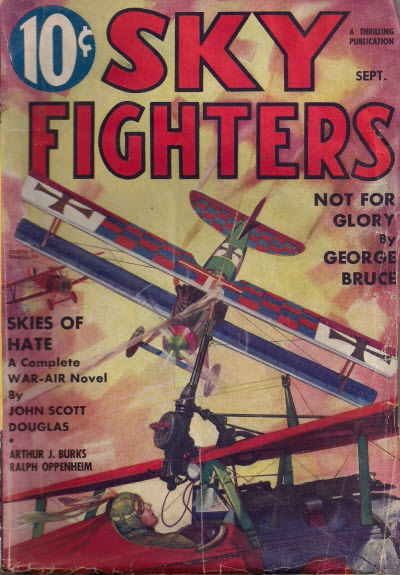 a story from the one and only creator of The Three Mosquitoes—Ralph Oppenheim! Mickey Rand trained pilots to be Aces using his infallible techniques of air combat. That is until it seemed the German Ace Kemmerer had found a way to beat these tricks, downing three of Mickey’s star pupils and he wasn’t about to let his latest protege, Jim Conway be next!
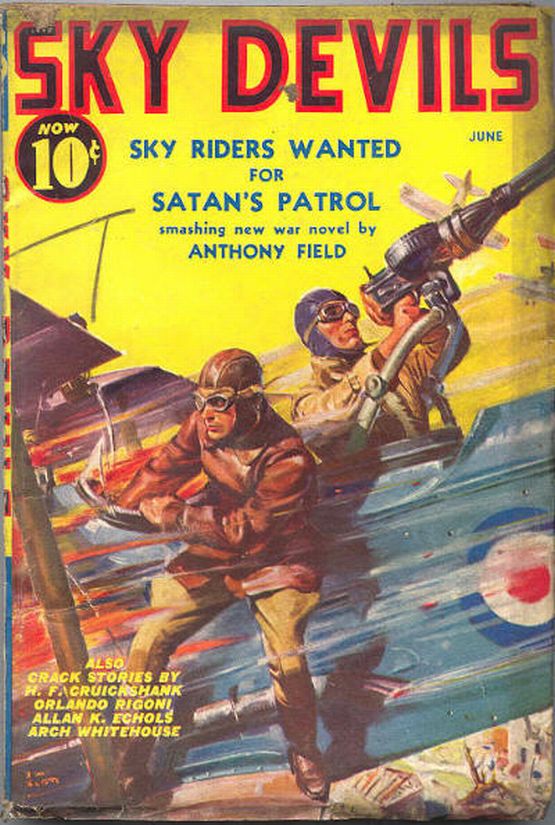 flew through the Hell Skies of 29 adventures in the pages of Dare-Devil Aces from 1932-1935. Cruickshank returned to the savior of the Western Front in six subsequent stories several years later. The first two were in the pages of Sky Devils (June 1939) and Fighting Aces (March 1940). The other four ran in Sky Fighters (1943-1946); and like Oppenheim had done with his Three Mosquitoes, so Cruickshank did with Sky Devil—he moved him to the Second World War where Bill Dawe changes his name to get into the air service and flys along side his son!
 of Sky Devil and his Brood by Harold F. Cruickshank, check out our new volume of his collected adventures in
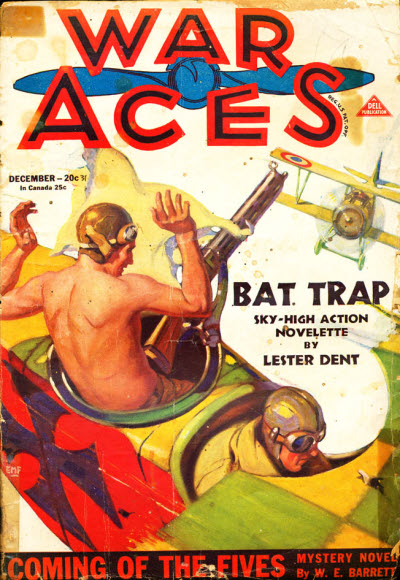 Mosquito Month we have a non-Mosquitoes story from the pen of Ralph Oppenheim. It’s a humerous tale of Lieutenant Sleepy Miller—so named because he could fall asleep anywhere at anytime—even in the middle of a war with bombs going off all around him. From the December 1931 issue of War Aces it’s “Lazy Wings.”


 it’s already been ten years since we introduced you to Jed Garrett, aka Captian Babyface, and his faithful dog Click, the hell-hound, but it has. It was ten years ago today Age of Aces Books published it’s first—
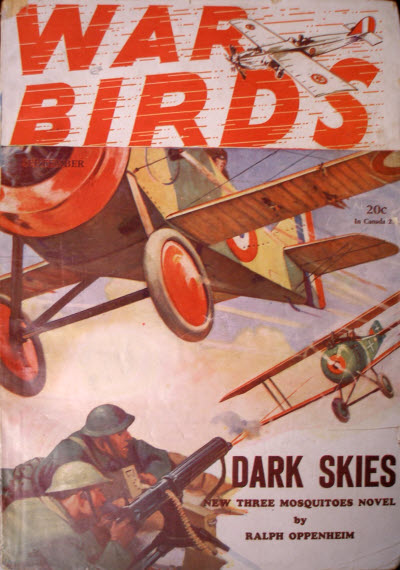 the third of three Three Mosquitoes stories we’re presenting this month. Every night at 11pm the Boche have been raining down bombs from seemingly nowhere with ever increasing accuracy—slowly getting closer to the Allies big supply dump in Remiens! Kirby, Shorty and Trav race to find out where the bombs are coming from and stopping them before the Boche finally hit their target! From the December 1930 number of War Birds, the Three Mosquitoes fly into Dark Skies!