




“Flying Aces, March 1936″ by C.B. Mayshark
THIS May we are once again celebrating the genius that is C.B. Mayshark! Mayshark took over the covers duties on Flying Aces from Paul Bissell with the December 1934 issue and would continue to provide covers for the next year and a half until the June 1936 issue. While Bissell’s covers were frequently depictions of great moments in combat aviation from the Great War, Mayshark’s covers were often depictions of future aviation battles and planes, like March 1936’s thrilling story behind its cover which imagines what a clash between Russia and Japan might look like!
Russia Clashes with Japan
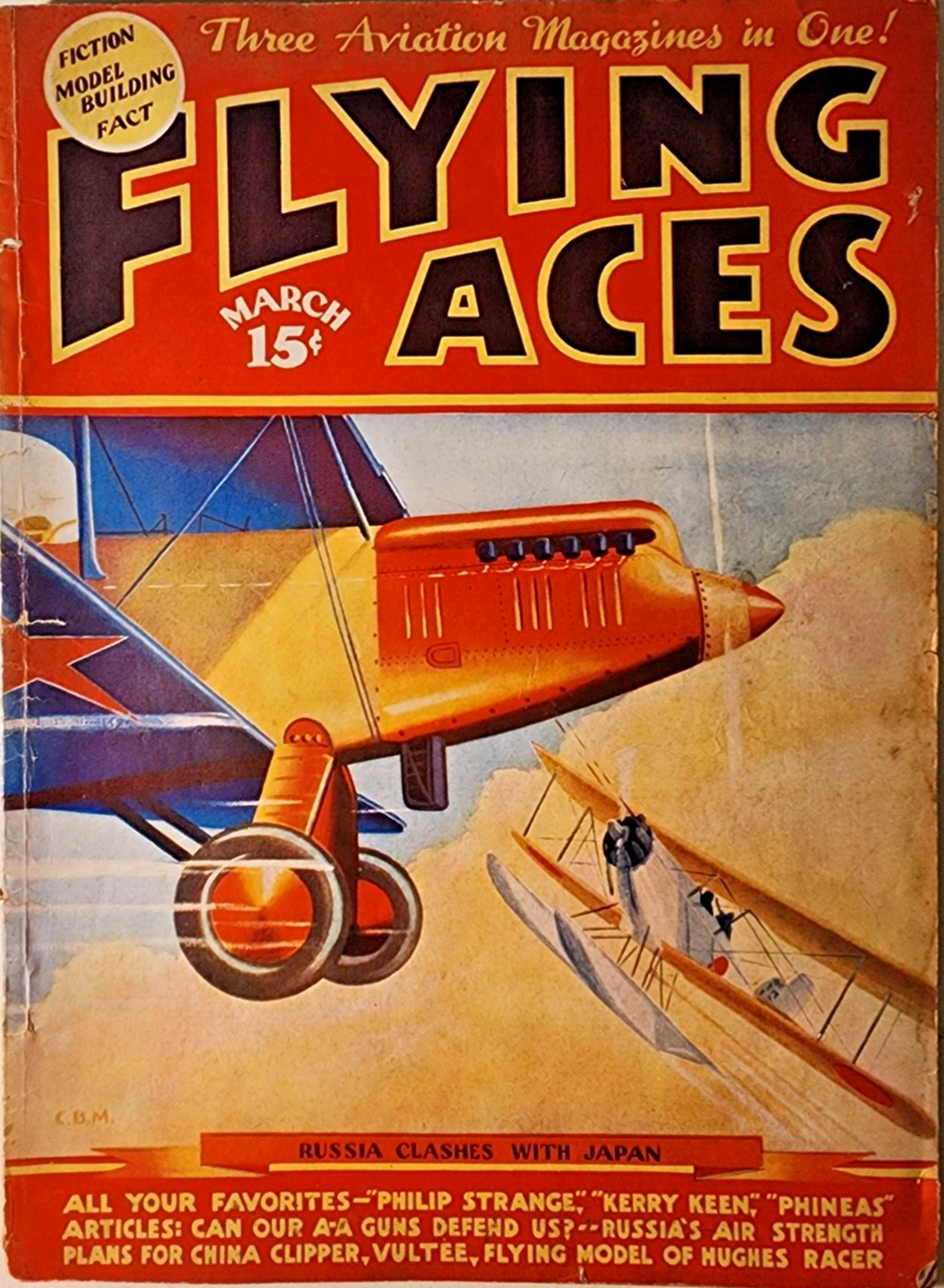 A NEWLY-ESTABLISHED Japanese air base in the Nippon-controlled area of Manchuria is suddenly startled into great activity. A distant purr of motors has been heard, and in a moment the purr becomes a roar—not the staccato roar of a single, hurtling ship, but the slurred thundering of a dozen or more. The unscheduled racket means but one thing: Attack from the air!
In a moment the foremost ship of the raiding flight plunges into view. A Japanese observer on a tower excitedly jots some characters and figures on a slip of paper. Then he grabs his phone.
“Commanding officer? Tower observer speaking. Russian reconnaissance planes leading bombing attack. Objective—either flying field or naval vessels in outer harbor. Planes at about four thousand feet. That’s all, sir.”
Suddenly the telegraph instruments in the communications room crackle to life, while three or four radio operators get busy at the dials. In two or three minutes every Japanese commanding officer in the area is advised of the Russian air offensive.
IN JUST such a manner as we have portrayed above, the Far East may at any time be plunged into war. But we hasten to say that our imaginative clash is the second act and not the first act of the drama. Initially, there would probably be some detonating altercation at the border in which each party would be as much to blame as the other. Diplomatic relations between Japan and Russia has, in recent months, been considerably strained. With these two powers rubbing each other the wrong way, some slight misunderstanding at the frontier might set off the powder keg. The territorial controversy is so entangled that either might be the aggressor. In short, our scene above might just as likely find Japanese planes raiding a Russian base as vice versa; for by that time, the trouble will have already begun.
In the meantime, we can only hope that relations between the two countries may improve to a point where such a war may be sidestepped.
The last “official disagreement” between Japan and Russia occurred in 1904-05. Before the entanglement, numerous diplomatic conversations took place, the main discussion revolving about the vast stretches of land to the North of China. Eventually, however, relations were severed and war declared.
And now history may repeat itself. Whereas there has as yet been no severance of relations, it is the belief in many quarters that the patience of officials of both governments has already been taxed to the breaking point.
But a new Russo-Japanese war would be different from the last one. With the turn of the century, mechanized warfare had just come into its own and the 1904-05 Far Eastern conflict was a prime example of the new mode. But that war will seem like a practice maneuver alongside of a Far East war 1936 style. To be sure, there were several large scale battles in the last entanglement and many thousands of lives were lost. But what is the annihilation of a body of troops trained in the business of war against the possible butchering of a huge civil population?
The 1904-1905 war was, in the main, a series of naval engagements. Actually, the decisive battles took place on land; but it was the Japanese navy, adroitly handled, which assured success for the Land of the Rising Sun. Russia, too, had plenty of strength on the sea, but she couldn’t cope with the masterful tactics of the Japanese commanders who were navigating in waters close to home. The Russian fleet as well as her troops were too far away from Moscow to move intelligently and cooperatively. And so Japan won the war.
Peace ensued for a number of years, but now once more the old story springs into the headlines. Japan needs to expand. And she may encroach upon Russian sovereignty in doing it. And Russia, quite naturally, balks. What will be the outcome? Will there be war? Very likely Japan has become nervous over the manner in which the League of Nations has launched sanctions upon Italy. Maybe both she and Russia will think twice before going to war in earnest. Effective sanctions would certainly cripple Japan in short order. True, Japan is no longer a member of the League, but sanctions could still be imposed.
Now let us consider such a 1936 Far East conflict. Russia is not so far away as she was in 1904. The mileage is the same, of course, but the transportation time is vastly less. Russia’s main difficulty in 1904 was in transporting troops and material with only one railroad line. Today facilities are better, but that is only part of the story. The air aspect will be the most important feature in a new war.
With the fast, mammoth ships of the air recently built by Russia, men and materials could be transported across the wastes of Siberia with a speed that would make the rail trip of 1904 look silly. But the transportation problem is only one angle which would be solved by airplanes. The important offensive and defensive gestures would be carried out by means of aircraft—not only on the part of Russia, but Japan, as well.
AND now let us return to our raid. As the Russians attack, a flight of seaplanes quickly takes off from a nearby base and rushes into the fray. On our cover, we show one of these craft intercepting a Russian plane. What will be the outcome? We can’t tell. It is hard to say which of two military planes will be victorious in an air battle which has never been fought and which may never come to pass.
But this much we do know: A new war in the Far East will be a veritable hell on earth. And that hell, ironically enough, will come from the direction of heaven—via the air lanes.
The Russian plane is an R-5 biplane powered with a 650 h.p. M-17 (Russian built B.M.W.) motor. The ship is equipped with two Lewis and two Vickers guns. The Japanese ship is a Kawanishi 90 reconnaissance seaplane powered with a 450 h.p. Japanese-made “Jupiter.”
Russia Clashes with Japan: Thrilling Story Behind This Month’s Cover
Flying Aces, March 1936 by C.B. Mayshark
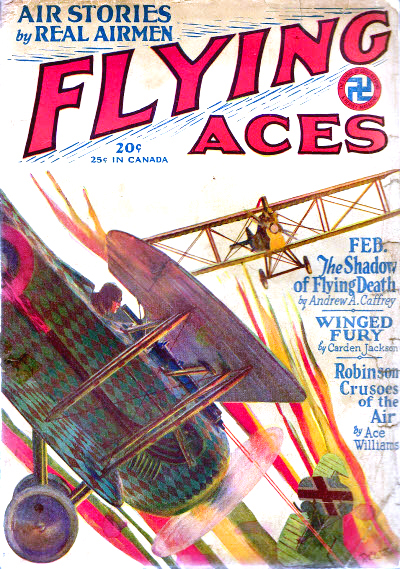 another story by Franklin M. Ritchie. Ritchie only wrote aviation yarns and his entire output—roughly three dozen stories—was between 1927 and 1930. Today we have another one from the lawyer who wrote pulp stories on the side to satisfy his yen for flying. From an early issue of Flying Aces, Ritchie gives us a tale of bomber Jim Barker who longed to show everyone that even a bombing pilot can get Germany’s most ruthless Ace, by any means necessary! From the February 1929 issue of Flying Aces, it’s Franklin M. Ritchie’s “Say It With Bombs!”
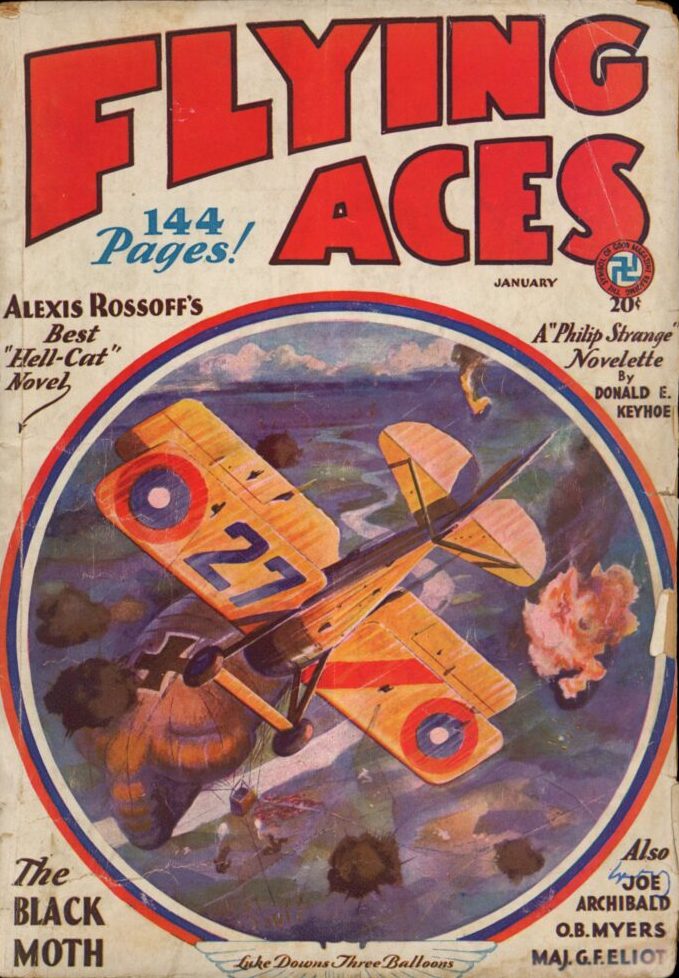 That sound can only mean one thing—that Bachelor of Artifice, Knight of Calamity and an alumnus of Doctor Merlin’s Camelot College for Conjurors is back to vex not only the Germans, but the Americans—the Ninth Pursuit Squadron in particular—as well. Yes it’s the marvel from Boonetown, Iowa himself—Lieutenant Phineas Pinkham!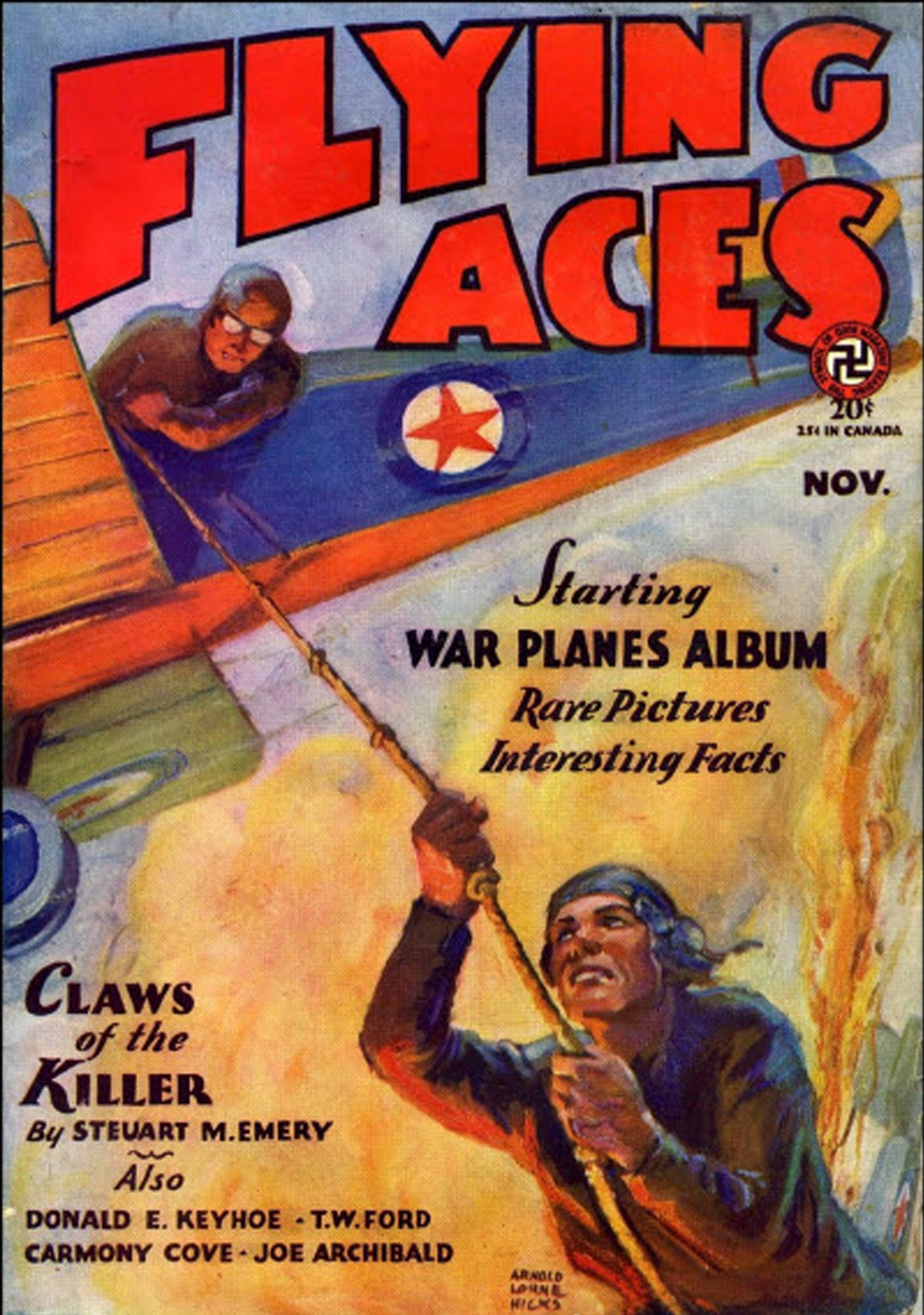
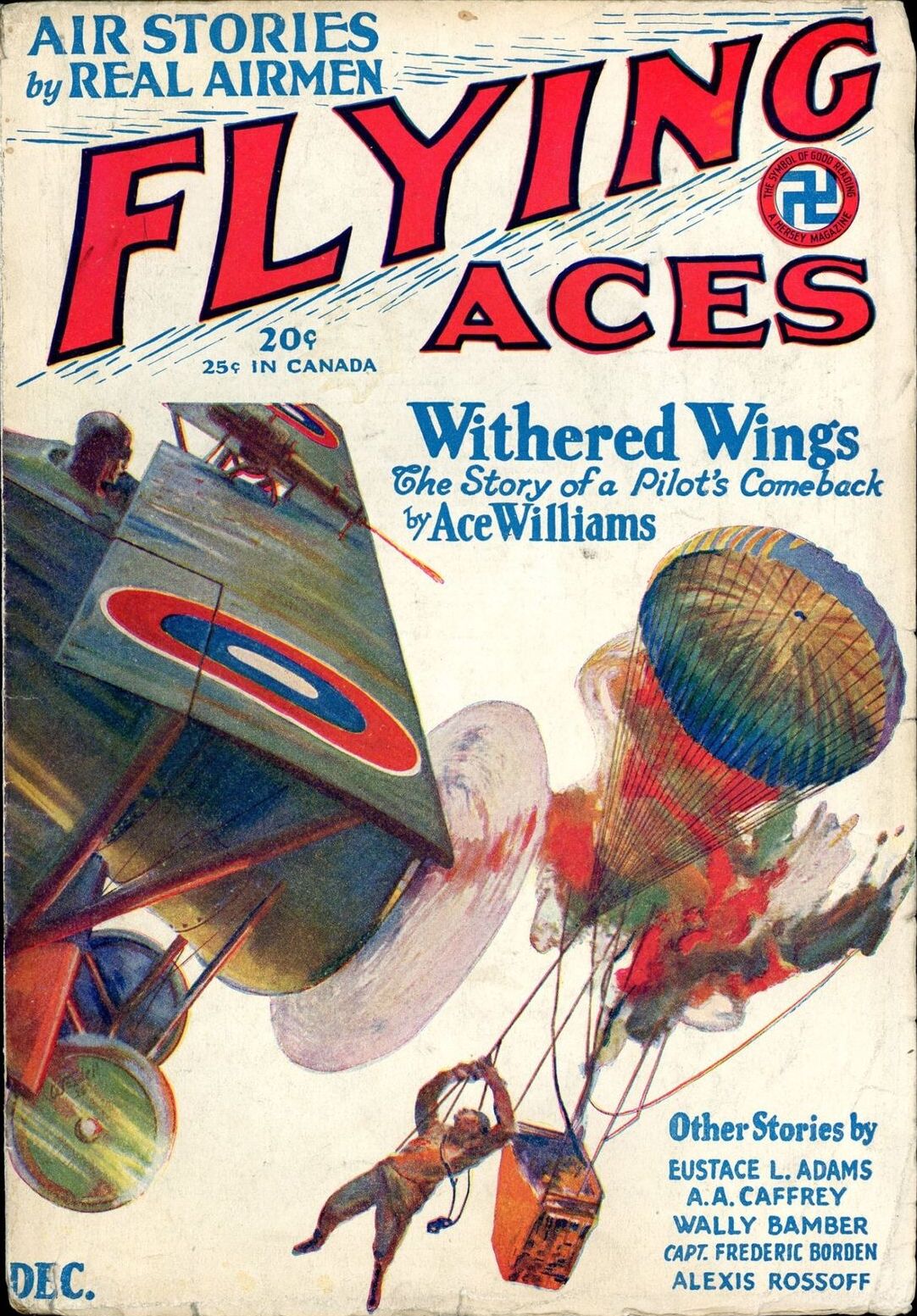 another story from one of the new flight of authors on the site this year—Andrew A. Caffrey. Caffrey, who was in the American Air Service in France during The Great War and worked for the air mail service upon his return, was a prolific author of aviation and adventure stories for both the pulps and slicks from the 1920’s through 1950. Here Caffrey tells the tale of Lieutenant Harry Pond.
 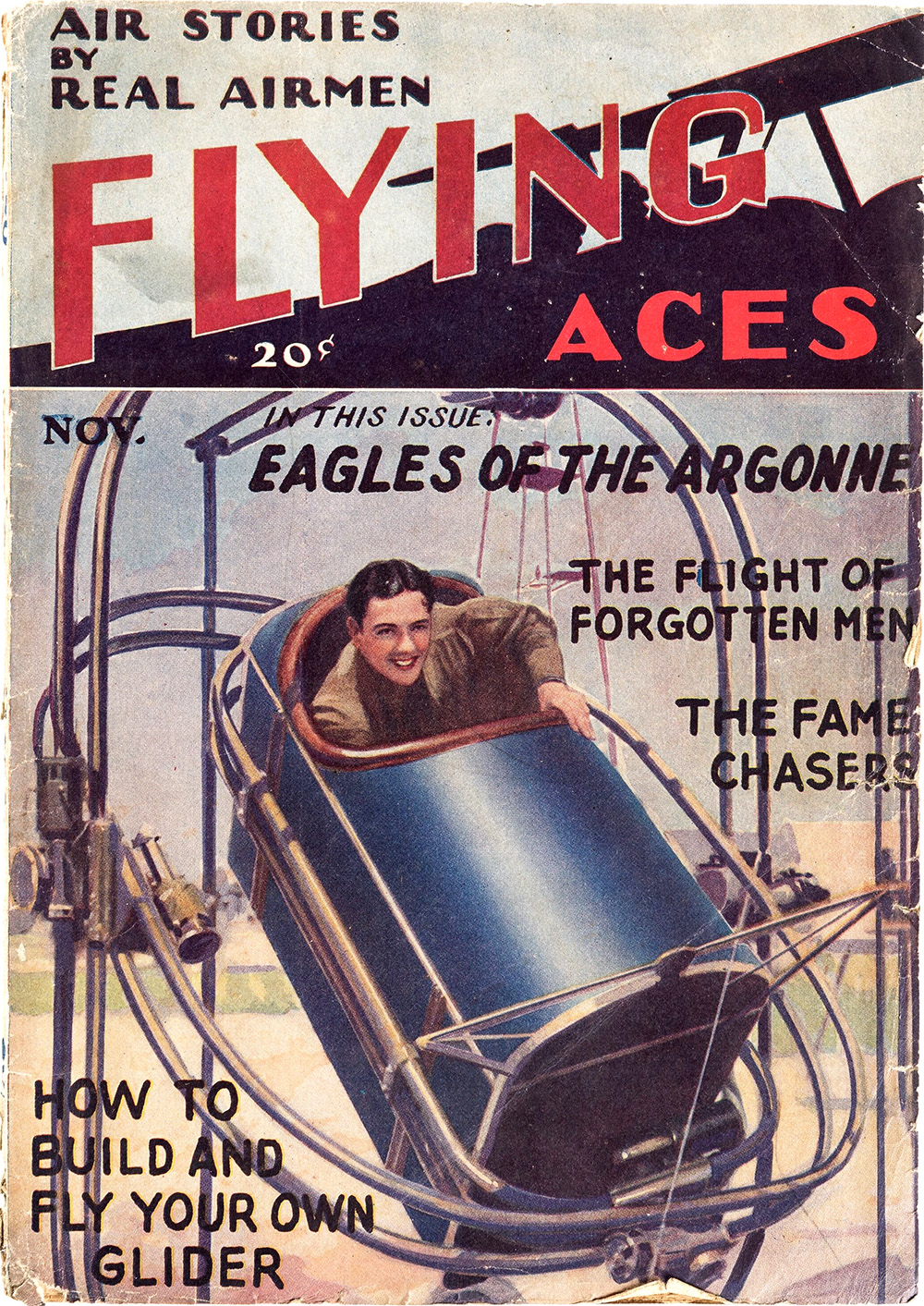 exciting air adventure from the pen of F.H. Griggs, Jr. Griggs is a rather enigmatic figure with just two stories to his name from those issues indexed by Fiction Mags.

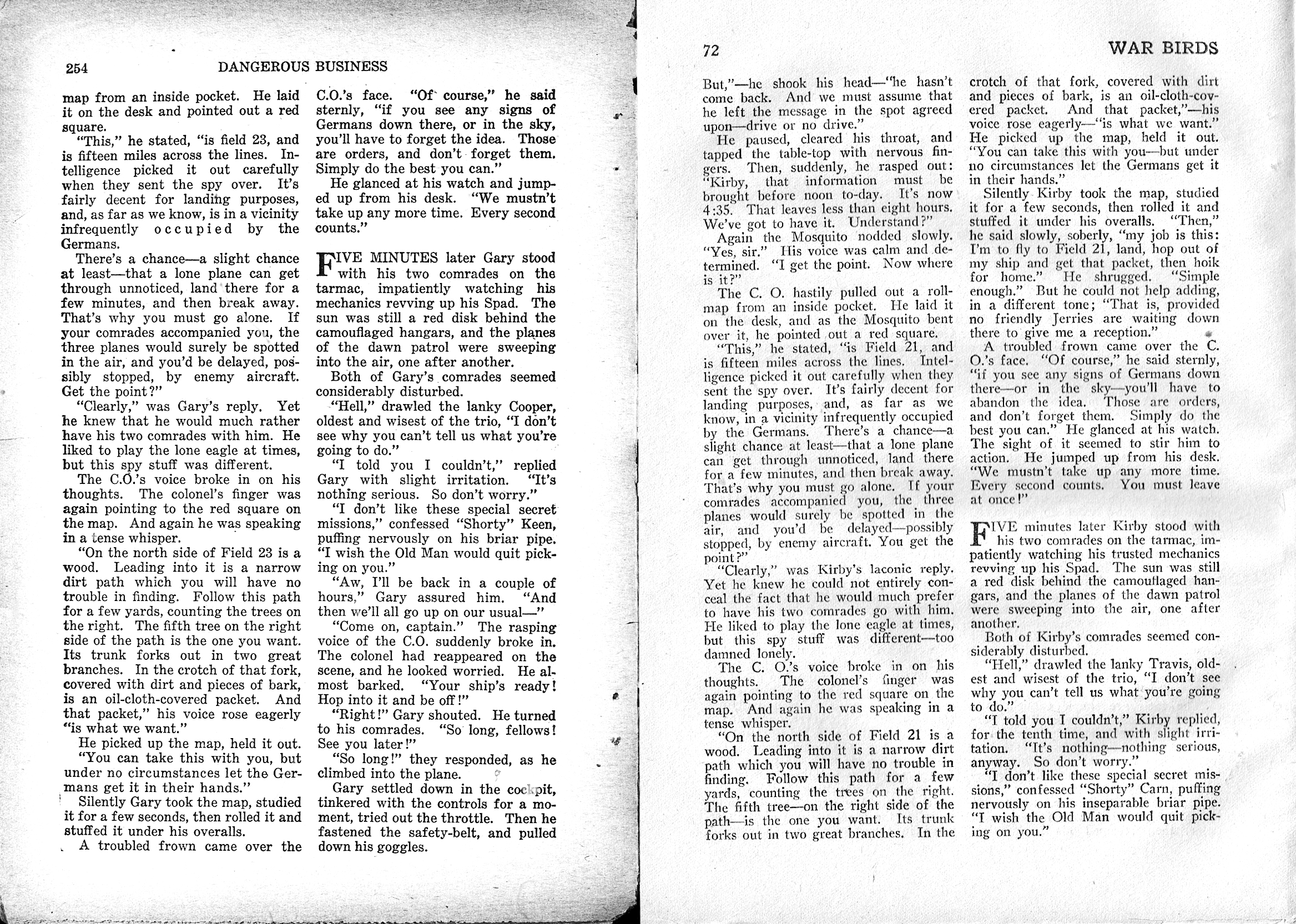


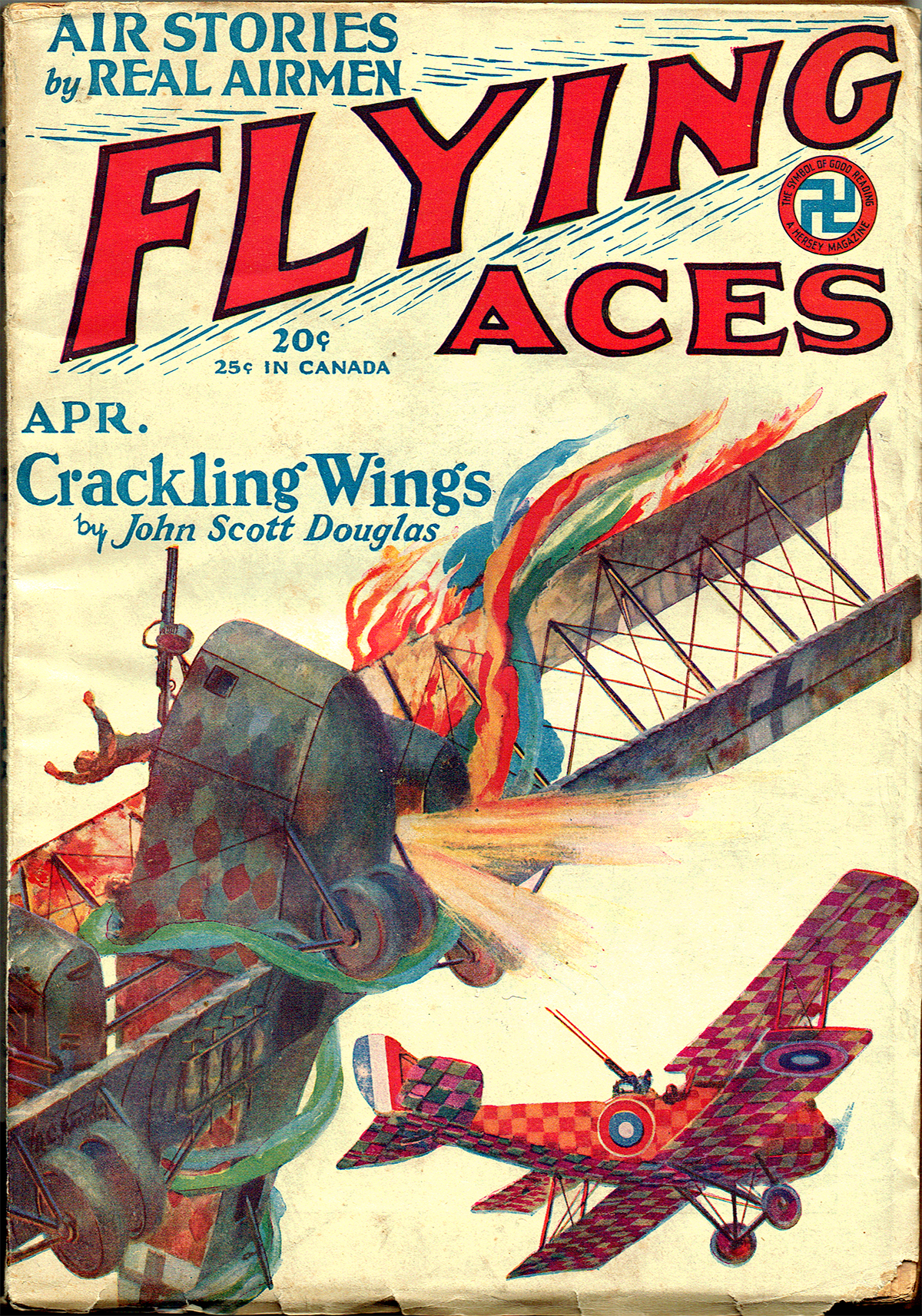 to the squadron and he can’t stand pilots who “grand-stand” which is the Mosquitoes stock-in-trade and boy do they catch hell when they get on the C.O.’s wrong side—that is until the C.O. gets in a jam and it’s trick flying that’ll save him when the Boche attack!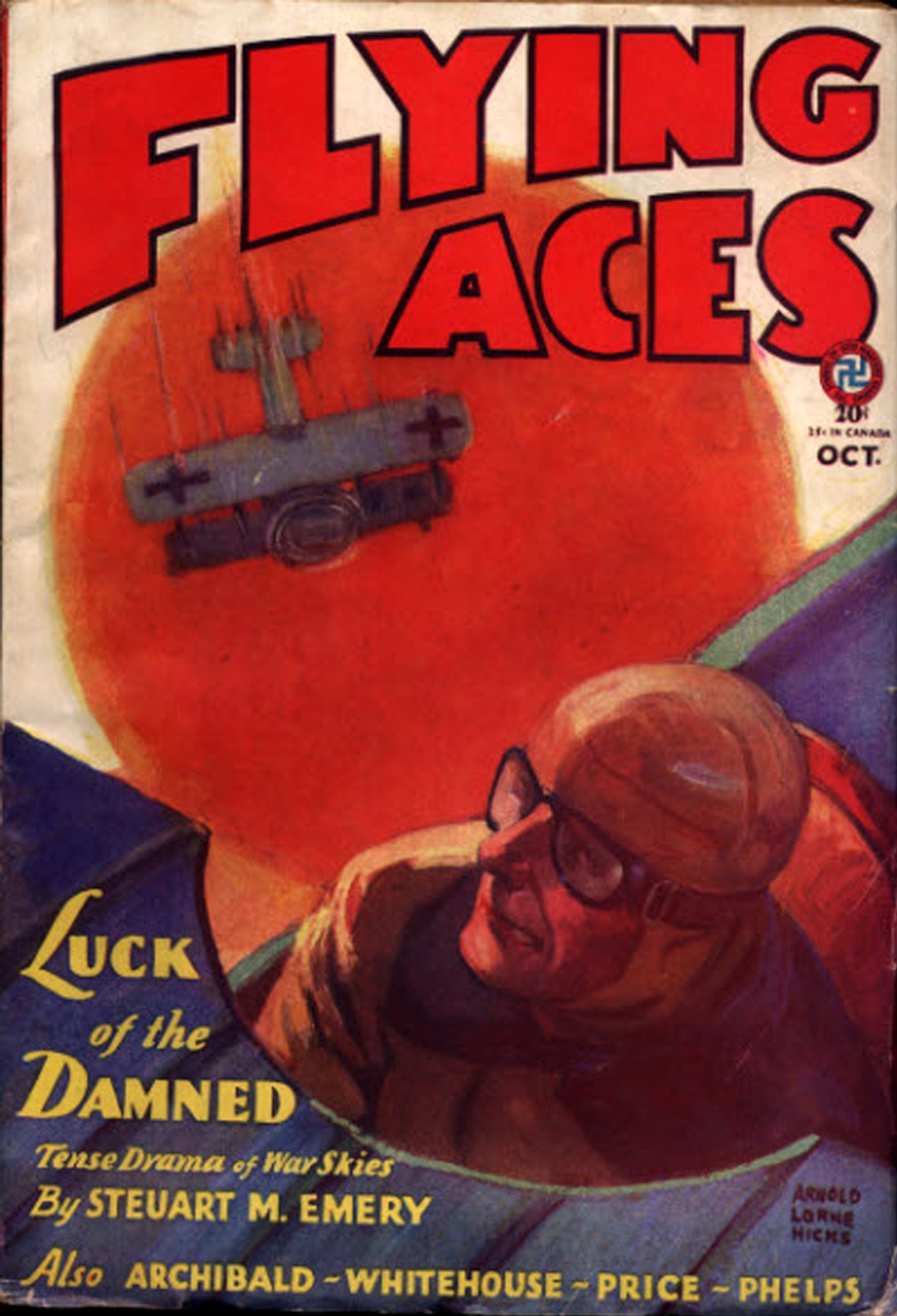
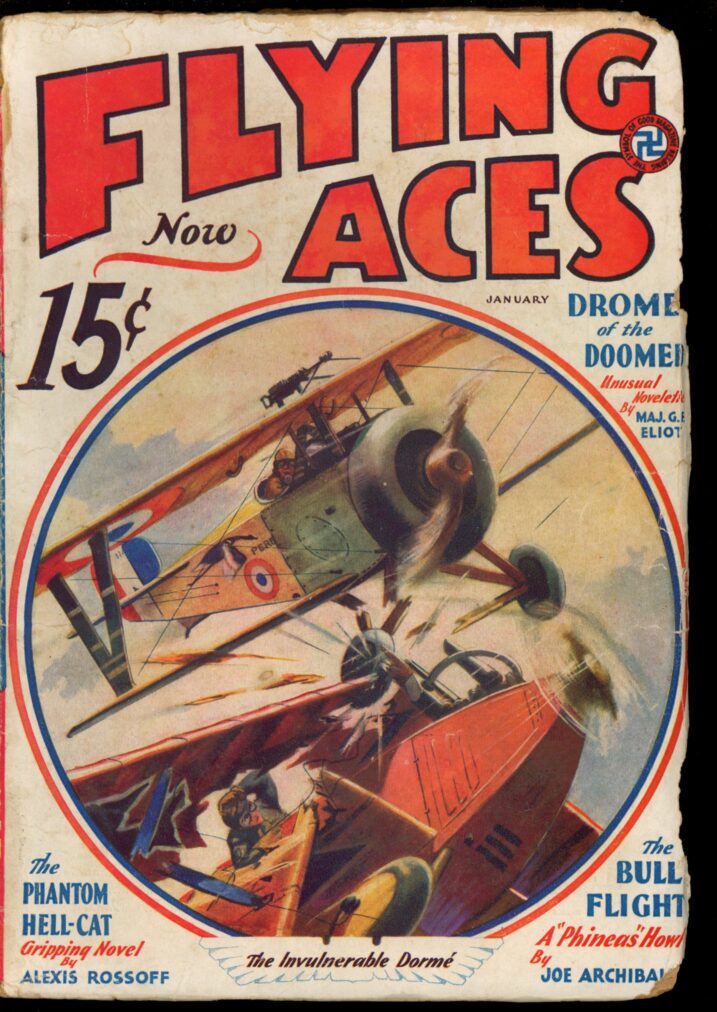 a story from the pen of a prolific pulp author O.B. Myers! Myers was a pilot himself, flying with the 147th Aero Squadron and carrying two credited victories and awarded the
 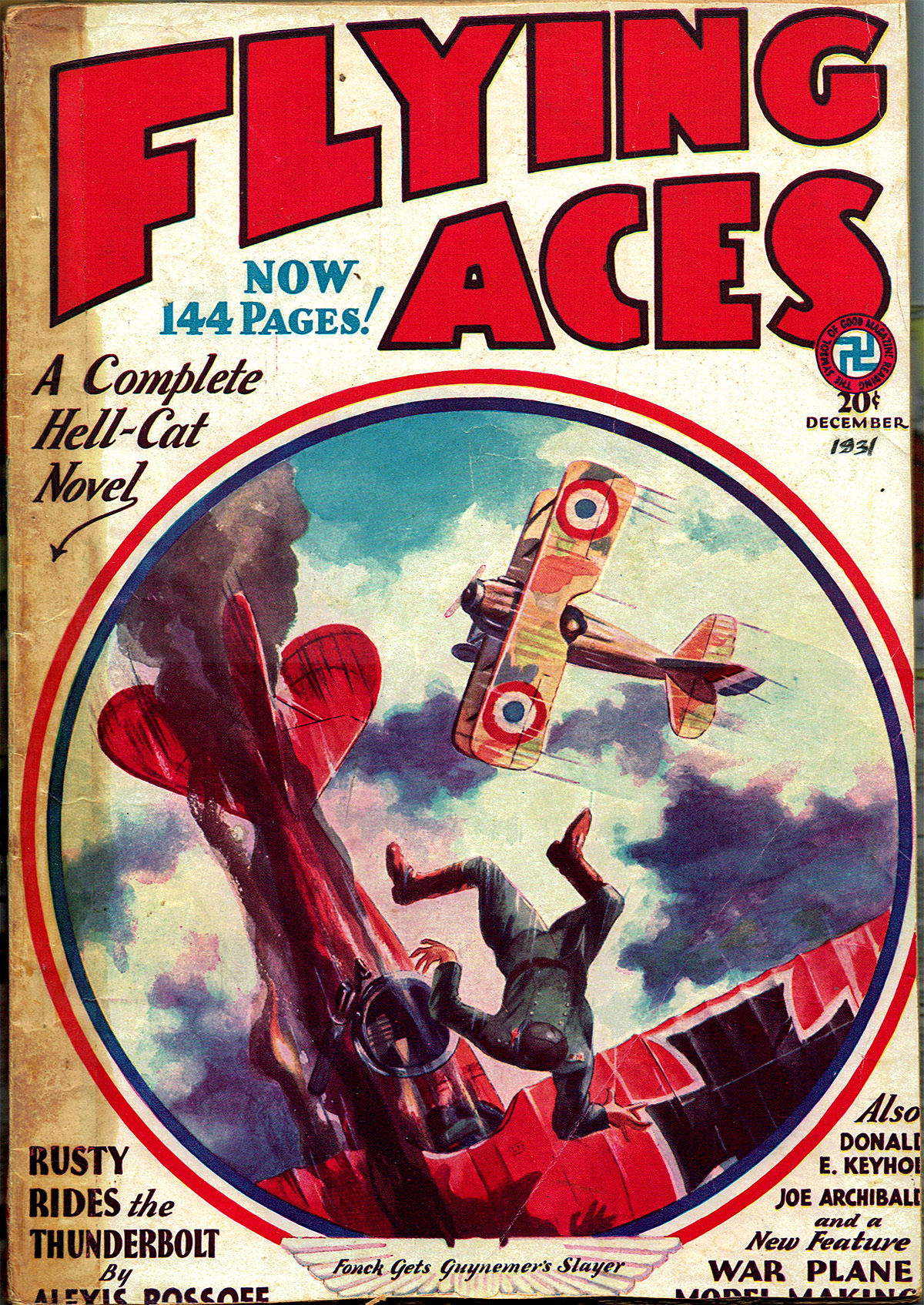 That sound can only mean one thing—that Bachelor of Artifice, Knight of Calamity and an alumnus of Doctor Merlin’s Camelot College for Conjurors is back to vex not only the Germans, but the Americans—the Ninth Pursuit Squadron in particular—as well. Yes it’s the marvel from Boonetown, Iowa himself—Lieutenant Phineas Pinkham!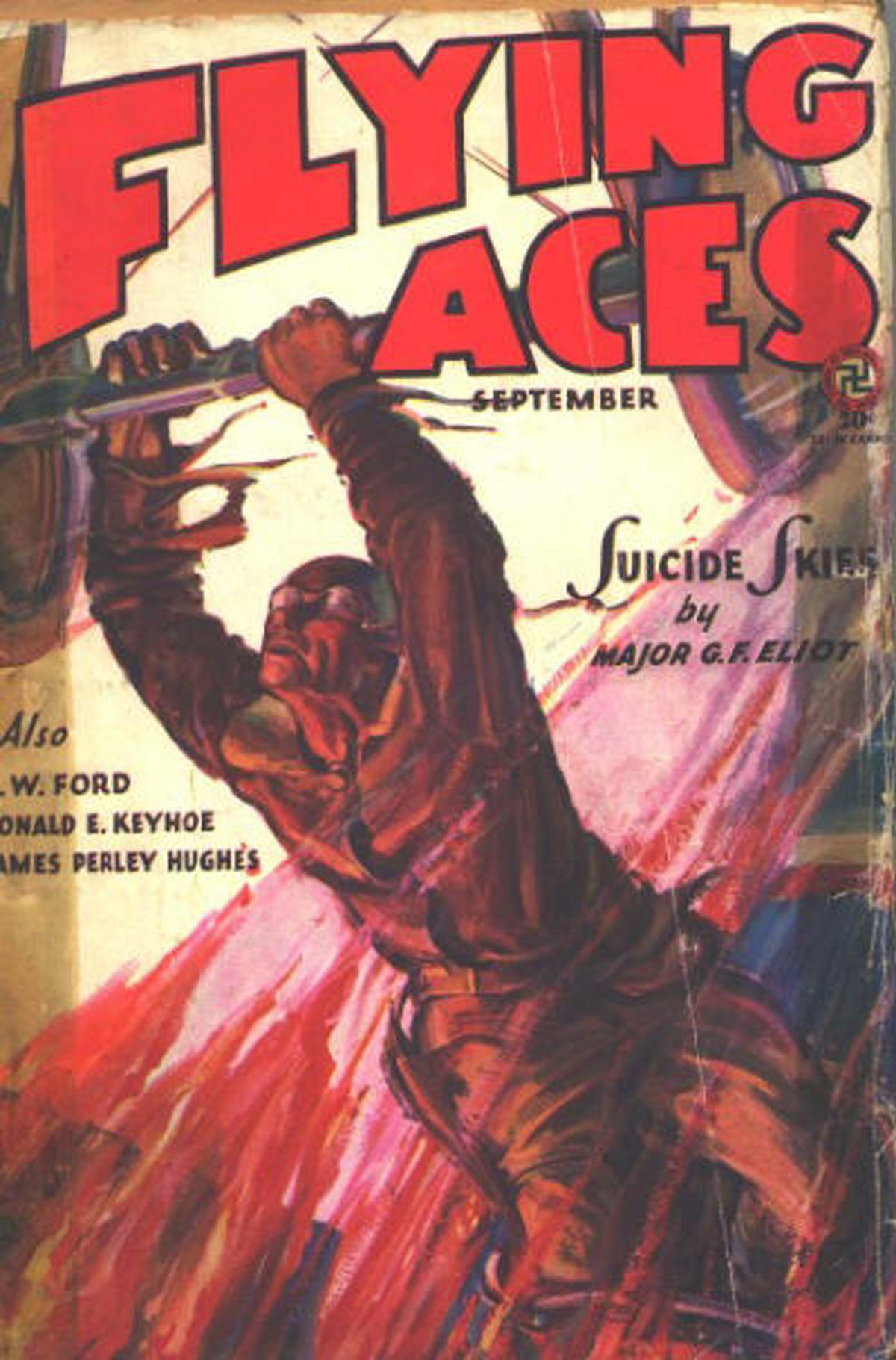
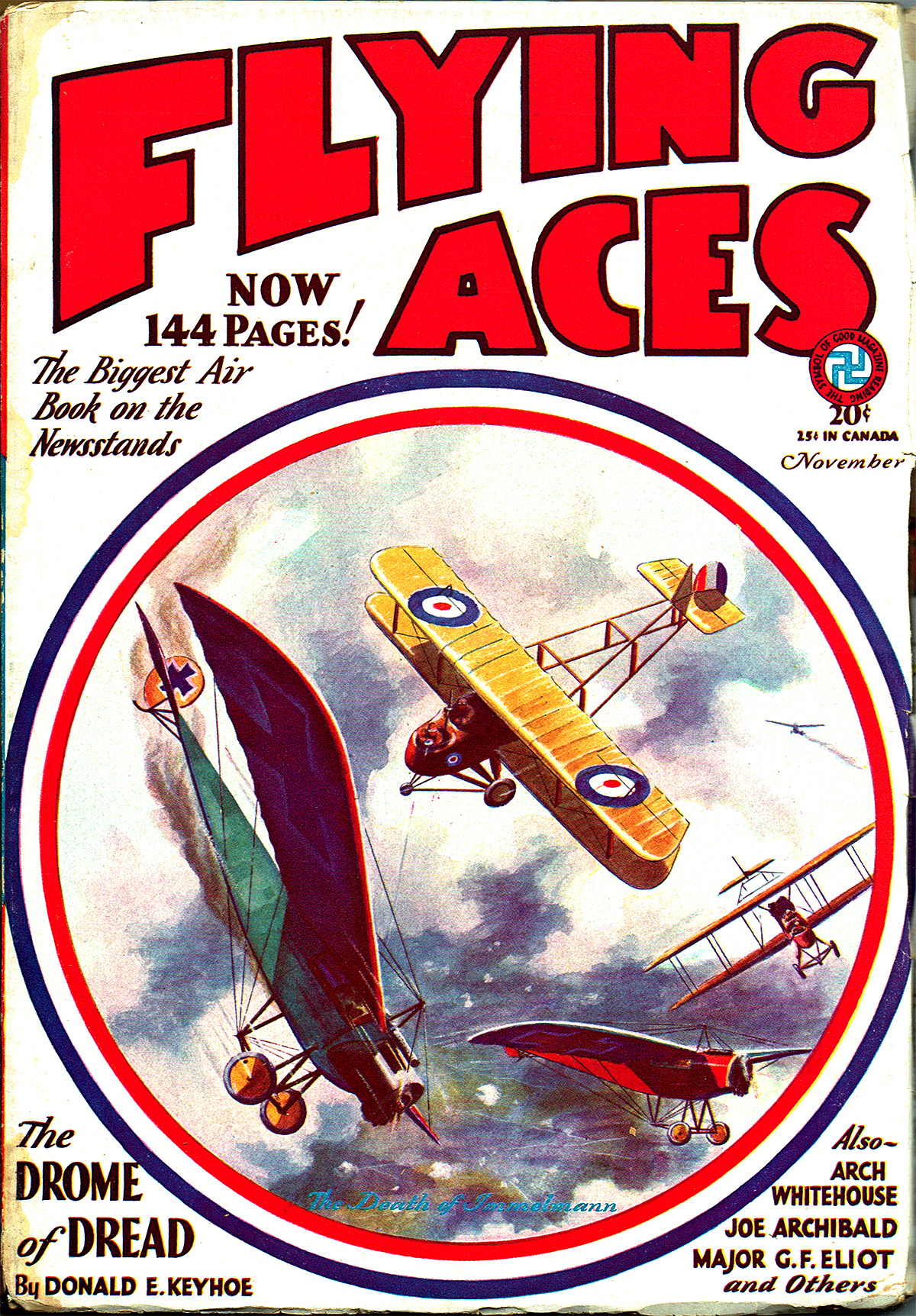 That sound can only mean one thing—that Bachelor of Artifice, Knight of Calamity and an alumnus of Doctor Merlin’s Camelot College for Conjurors is back to vex not only the Germans, but the Americans—the Ninth Pursuit Squadron in particular—as well. Yes it’s the marvel from Boonetown, Iowa himself—Lieutenant Phineas Pinkham!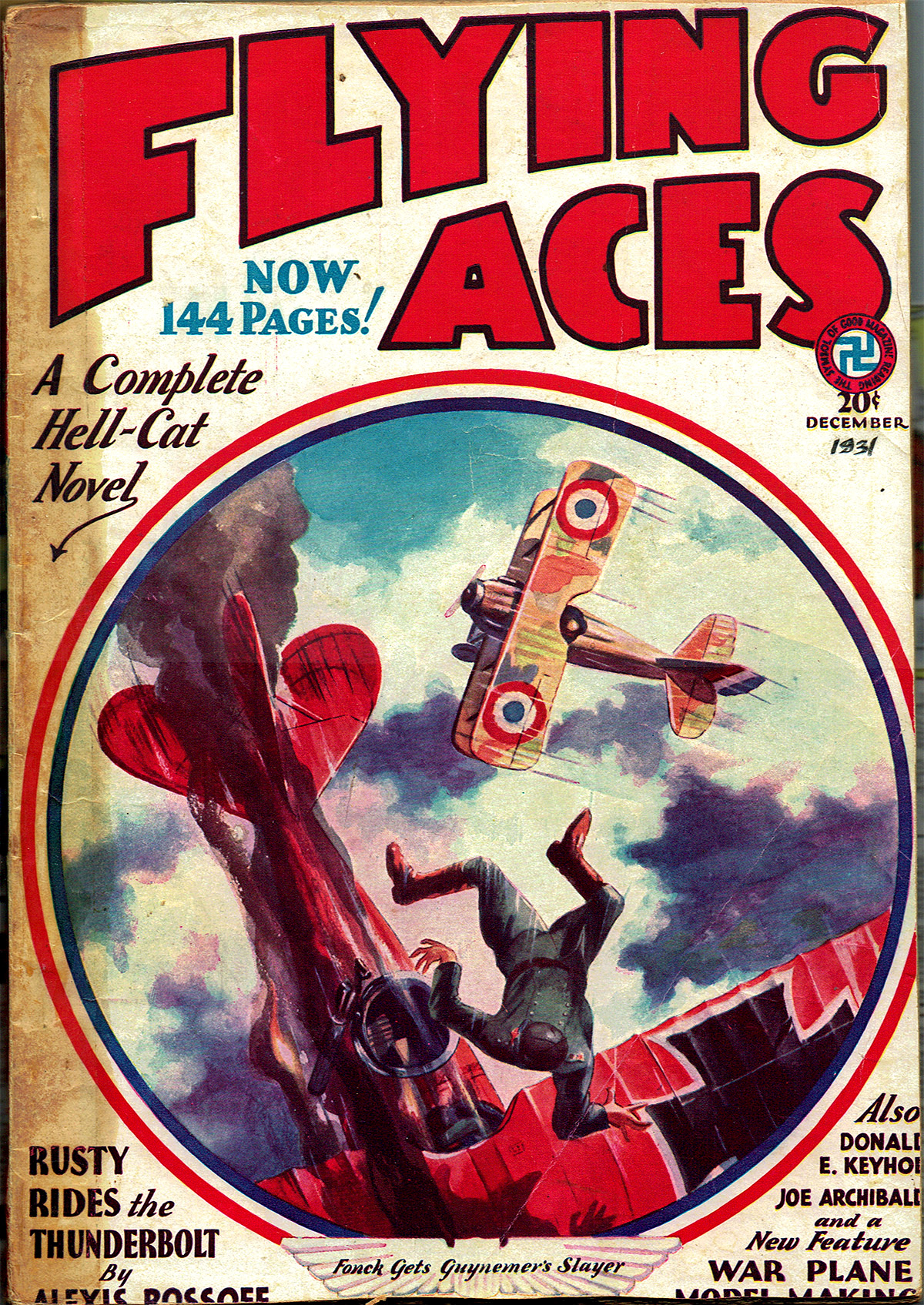
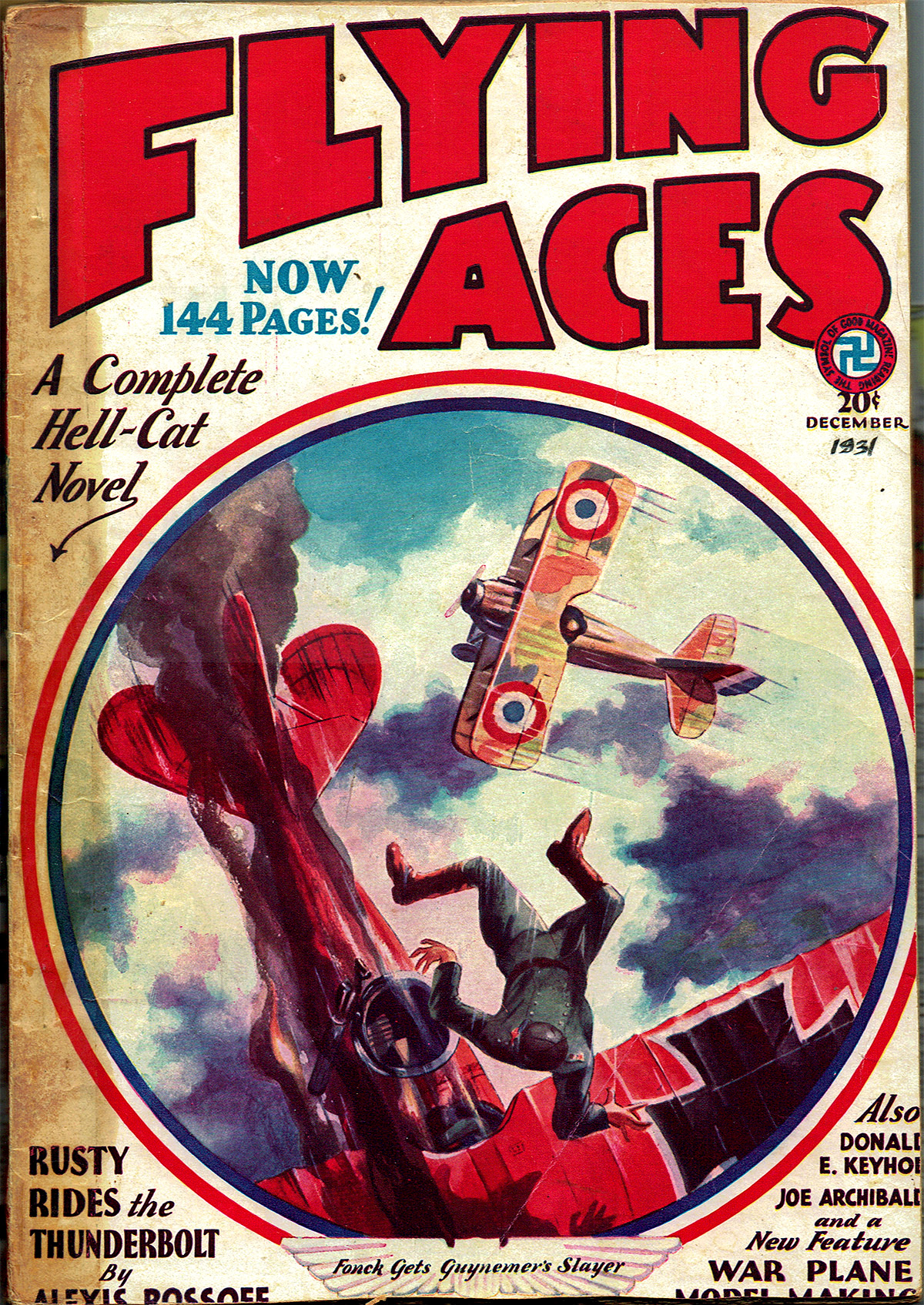 a story from the pen of Donald E. Keyhoe—his first in the pages of Flying Aces magazine, which ran a story by Keyhoe in most of their issue from January 1930 through September 1942, featuring characters like Richard Knight, Eric Trent or Captain Philip Strange! Before Keyhoe started up the series characters, he wrote other stories of then present day aviation situations—especially situations in the Far East.
 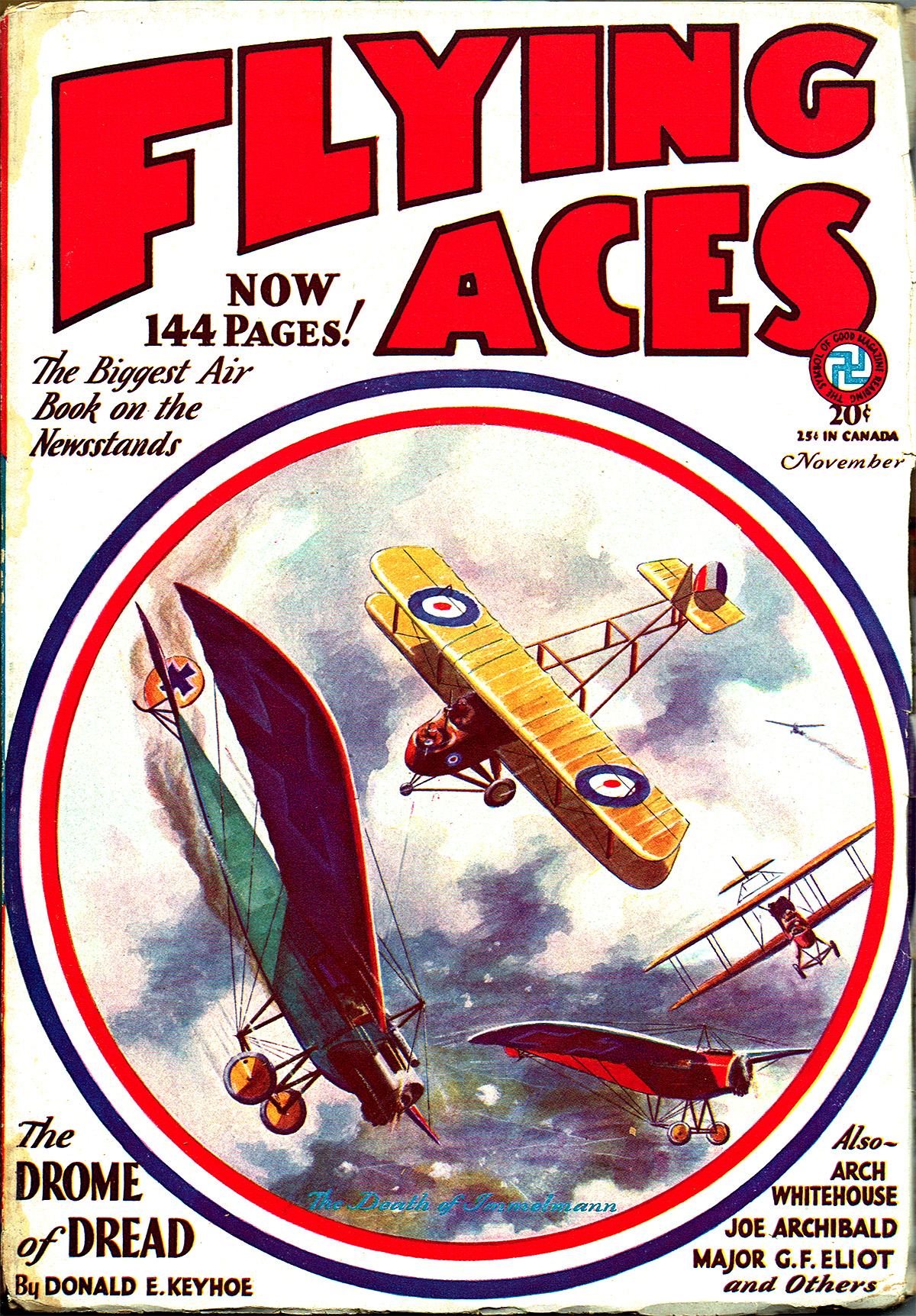 a story from Curtis Mitchell. Mitchell was born in Mexico, MO in 1902. He started his career as a newspaper man working for both the hometown papers—The Daily Ledger and The Intelligencer—even becoming the city editor for the former before heading east to New York in 1922 to become the publicity director for the Charity Organization Society of New York City. From there he worked his way back in to publishing becoming the youngest editor and vice president of a publishing house, Dell. He edited a variety of magazines, most dealing with entertainment like Film Fun and Film Humor and latter Modern Screen Magazine and Radio Stars. From 1928 to 1934, Mitchell was a frequent contributor to the aviation pulps like Wings, Sky Riders, Flying Aces, Air Trails, Air Stories, Sky Birds and War Birds.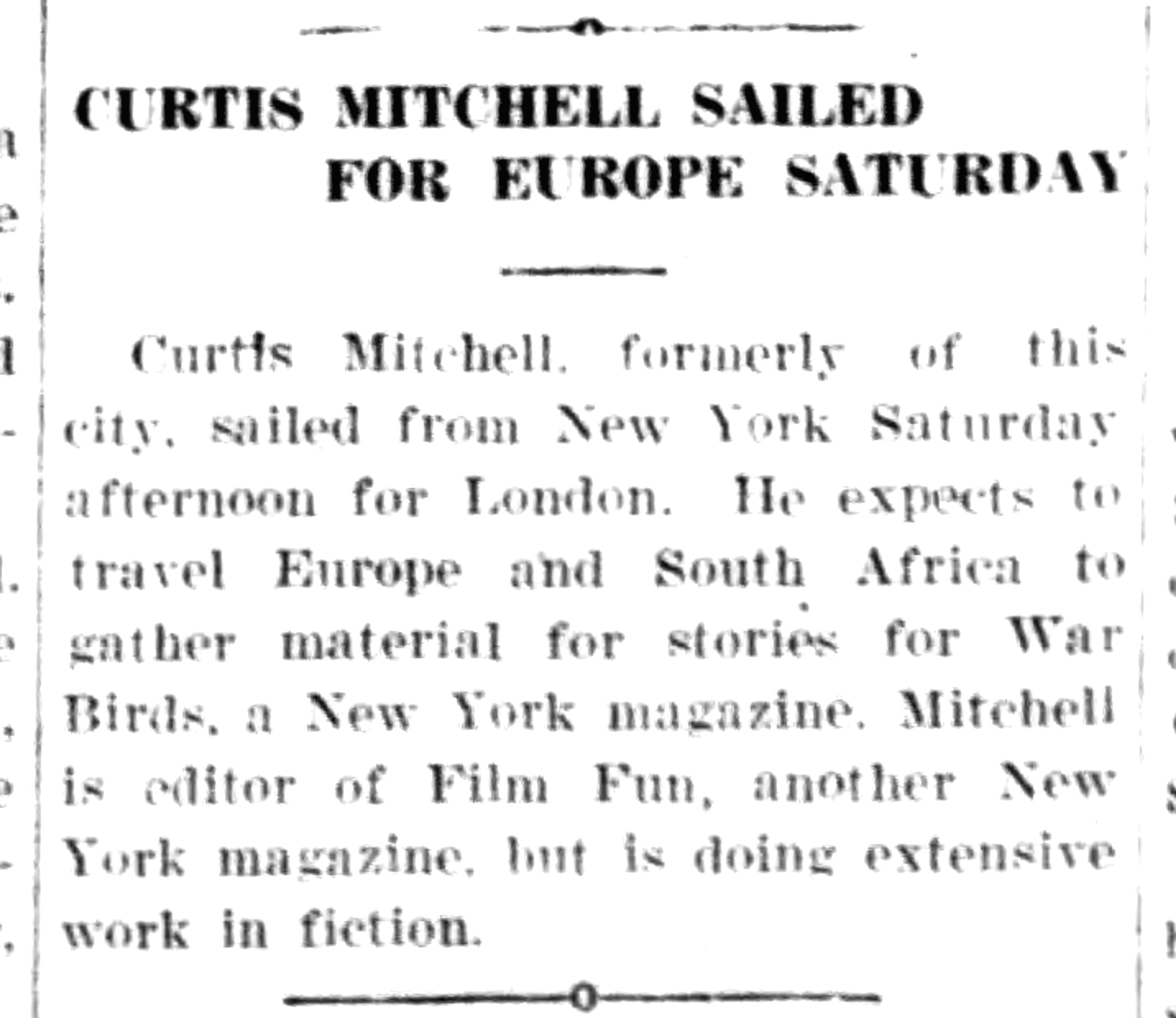
 Colonel Curtis Mitchell, recently pictorial chief for the War Department Bureau of Public Relations and now on terminal leave after four and one-half years of active service, assumed the duties of director of advertising and publicity for Paramount Pictures on November 1, it was announced Wednesday by Charles M. Reagan, Paramount vice-president in charge of distribution. He succeeds to the post vacated by R.H. Gillham, who resigned.